Bridging the Agent-World Gap: Text World Models for LLM-based Agents
Pith reviewed 2026-06-27 17:04 UTC · model grok-4.3
The pith
Text world models predict the next textual state from a current state and action, letting LLM agents plan and learn without direct environment interaction.
A machine-rendered reading of the paper's core claim, the machinery that carries it, and where it could break.
Core claim
Text world models are transition models over textual states that, given a state and a candidate action, predict the resulting webpage, terminal output, API response, or user reply, thereby supporting planning, efficient learning, and principled evaluation.
What carries the argument
Text world models, defined as functions that map a textual state plus action to a predicted next textual state.
If this is right
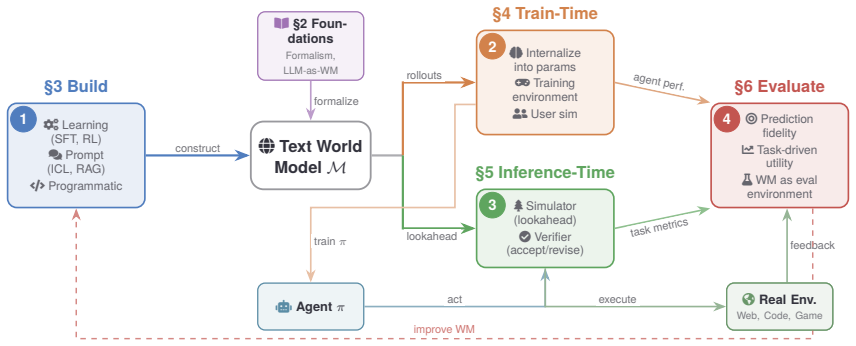
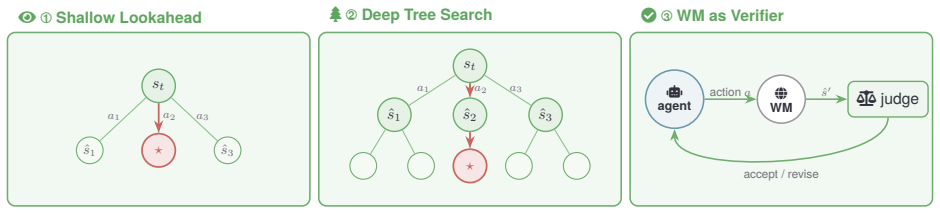
- Agents can simulate candidate action sequences inside the world model before committing to real steps.
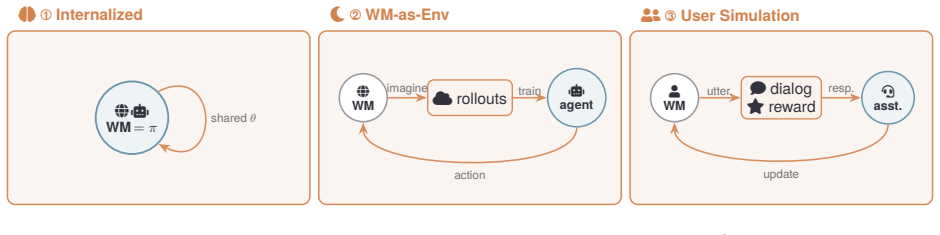
- Training data can be generated synthetically by rolling out the world model instead of interacting with live environments.
- Verification and adaptation modules can check predicted outcomes against observed ones at inference time.
- Evaluation of agent policies can occur inside the world model without risking the actual environment.
Where Pith is reading between the lines
- Accurate text world models could allow agents to rehearse rare or costly failure modes offline before deployment.
- If world models generalize across domains, a single model might support agents in both web navigation and code editing without retraining.
- Combining world models with verification loops might reduce hallucinated actions that current reactive agents produce.
Load-bearing premise
Many current LLM-based agents remain largely reactive, mapping observations to actions without an explicit model of how environments are structured and evolve.
What would settle it
A controlled comparison in which agents equipped with accurate text world models show no improvement in task success rate or sample efficiency over purely reactive baselines on the same long-horizon textual tasks.
Figures
read the original abstract
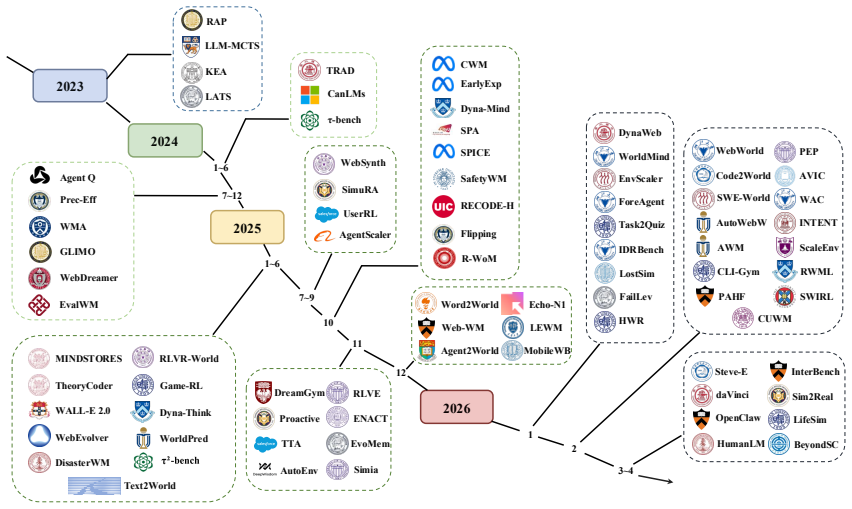
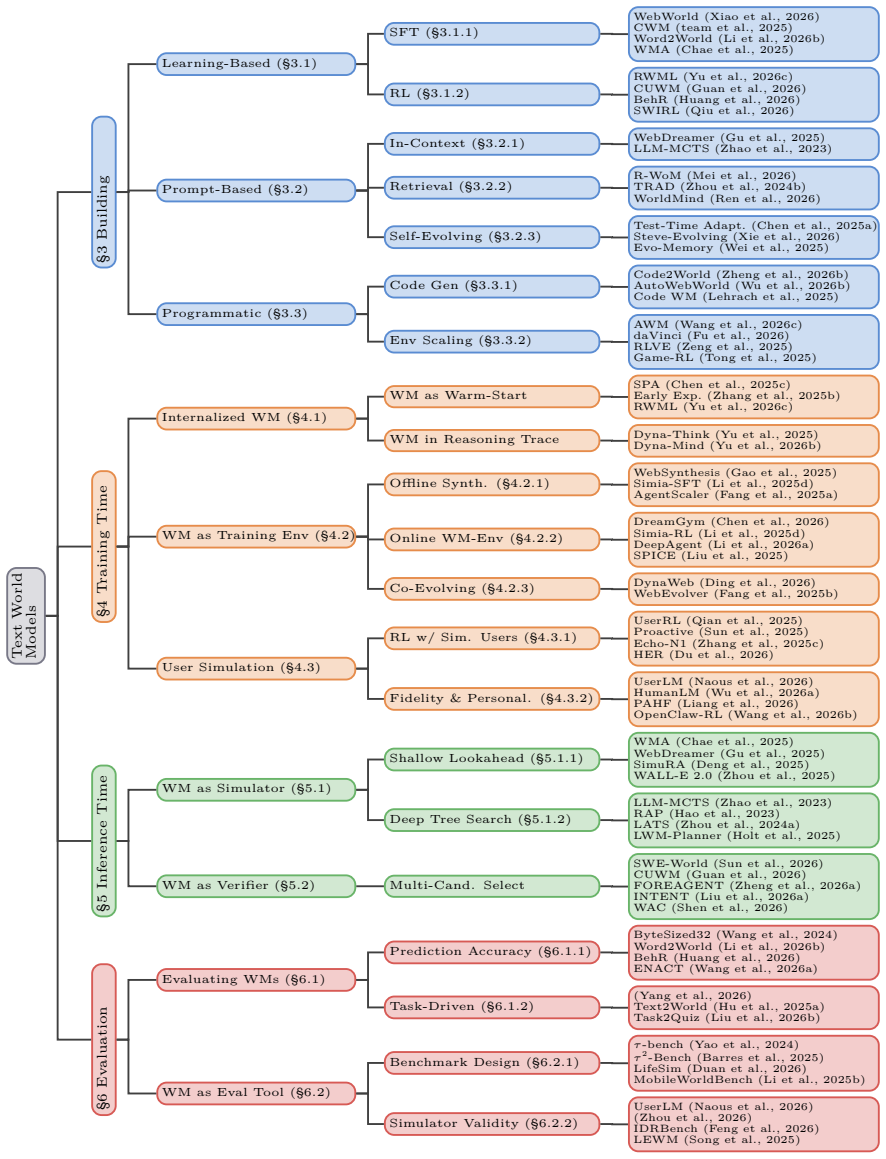
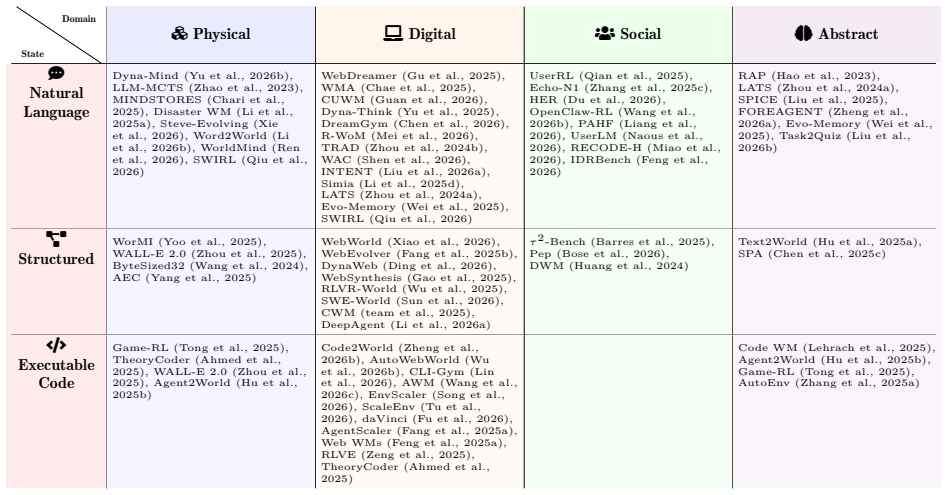
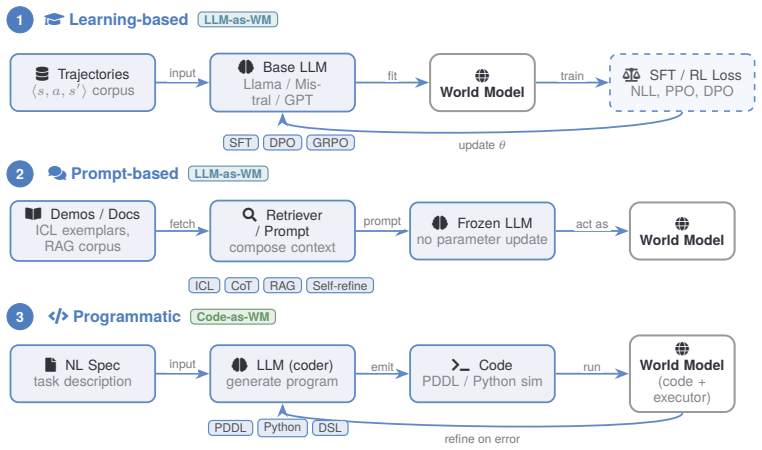
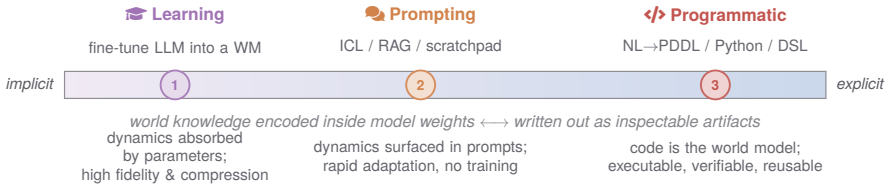
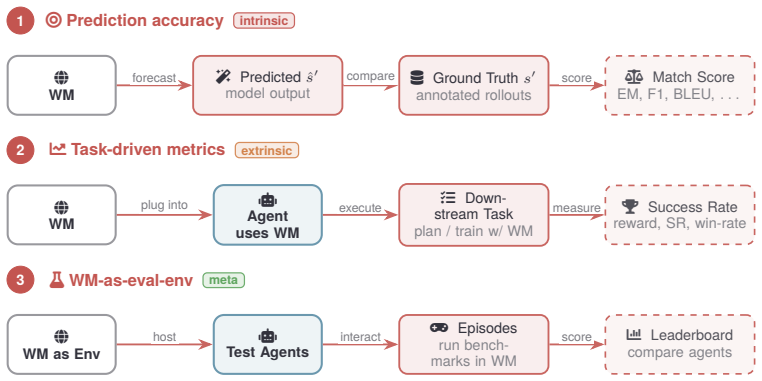
Large language model (LLM)-based agents are increasingly used in interactive textual environments, from web navigation and code editing to tool use and long-horizon dialogue. Yet many remain largely reactive, mapping observations to actions without an explicit model of how these environments are structured and evolve. This motivates text world models (TWMs): transition models over textual states that, given a state and a candidate action, predict the resulting webpage, terminal output, API response, or user reply, thereby supporting planning, efficient learning, and principled evaluation. We systematically review text world models for LLM-based agents, organized around a formal framework and the agent lifecycle: (1) Foundations, defining text world models and characterizing them by state representation and grounding domain; (2) Construction, taxonomizing LLM-as-WM and code-as-WM paradigms and reviewing methods for building them; (3) Application, examining how world models support agents at training time through experience synthesis and at inference time through planning, verification, and adaptation; and (4) Evaluation, covering both evaluation of the world model itself and its use as an evaluation environment for agents. We aim to consolidate this rapidly developing area, clarify its design space, and highlight open challenges for future research.
Editorial analysis
A structured set of objections, weighed in public.
Referee Report
Summary. The manuscript is a literature survey defining text world models (TWMs) as transition models over textual states that, given a state and action, predict resulting outputs (e.g., webpages, terminal responses) to support planning and evaluation in LLM-based agents. It organizes the reviewed literature around a four-part lifecycle framework: (1) Foundations (state representation and grounding), (2) Construction (LLM-as-WM and code-as-WM paradigms), (3) Application (training-time synthesis and inference-time planning/verification), and (4) Evaluation (of the model and as an agent testbed), with the goal of consolidating the area and identifying open challenges.
Significance. If the proposed organizational framework holds, the survey would provide a clear design space for TWMs that could help structure research on non-reactive LLM agents. The work earns credit for its systematic, non-predictive synthesis of an emerging area without introducing new empirical results, parameter fits, or derivations that could introduce circularity.
minor comments (2)
- [Abstract] Abstract: the claim that 'many' current agents 'remain largely reactive' is presented without supporting citations or quantification; adding 2-3 representative references would strengthen the motivation.
- The four-part lifecycle framework is introduced in the abstract but the manuscript should include an explicit diagram or table summarizing how the reviewed papers map onto the four stages to improve navigability.
Simulated Author's Rebuttal
We thank the referee for their positive summary of the manuscript and for recommending minor revision. The review accurately captures the scope and organization of the survey. No major comments were provided in the report, so we have no specific points to address point-by-point. We will incorporate any minor suggestions from the editor or additional feedback during the revision process.
Circularity Check
No significant circularity: survey with no derivations
full rationale
The paper is a literature review that defines text world models conceptually and organizes existing work into a four-part lifecycle framework. It contains no equations, no fitted parameters, no new predictions, and no load-bearing derivations. All claims are descriptive summaries of prior literature rather than reductions of outputs to inputs by construction. No self-citation chains or ansatzes are invoked to justify novel results.
Axiom & Free-Parameter Ledger
Reference graph
Works this paper leans on
-
[1]
2025 , eprint=
Large Emotional World Model , author=. 2025 , eprint=
2025
-
[2]
2026 , eprint=
LifeSim: Long-Horizon User Life Simulator for Personalized Assistant Evaluation , author=. 2026 , eprint=
2026
-
[3]
Transactions on Machine Learning Research , issn=
Emergent Abilities of Large Language Models , author=. Transactions on Machine Learning Research , issn=. 2022 , url=
2022
-
[4]
Faithful Simulation of User
Aleksei Kudrinskii and Saibo Geng and Luca Beurer-Kellner and Marc Fischer , year=. Faithful Simulation of User
-
[5]
Sutton, Richard S. , title =. SIGART Bull. , month = jul, pages =. 1991 , issue_date =. doi:10.1145/122344.122377 , abstract =
-
[6]
Ding, Jingtao and Zhang, Yunke and Shang, Yu and Zhang, Yuheng and Zong, Zefang and Feng, Jie and Yuan, Yuan and Su, Hongyuan and Li, Nian and Sukiennik, Nicholas and Xu, Fengli and Li, Yong , title =. ACM Comput. Surv. , month = sep, articleno =. 2025 , issue_date =. doi:10.1145/3746449 , abstract =
-
[7]
2022 , url=
A Path Towards Autonomous Machine Intelligence , author=. 2022 , url=
2022
-
[8]
Ha, David and Schmidhuber, Jürgen , title =. 2018 , copyright =. doi:10.5281/ZENODO.1207631 , url =
-
[9]
Lillicrap and David Silver , title =
Schrittwieser, Julian and Antonoglou, Ioannis and Hubert, Thomas and Simonyan, Karen and Sifre, Laurent and Schmitt, Simon and Guez, Arthur and Lockhart, Edward and Hassabis, Demis and Graepel, Thore and Lillicrap, Timothy and Silver, David , year=. Mastering Atari, Go, chess and shogi by planning with a learned model , volume=. Nature , publisher=. doi:1...
work page internal anchor Pith review doi:10.1038/s41586-020-03051-4
-
[10]
2024 , eprint=
Mastering Diverse Domains through World Models , author=. 2024 , eprint=
2024
-
[11]
2026 , eprint=
From Word to World: Can Large Language Models be Implicit Text-based World Models? , author=. 2026 , eprint=
2026
-
[12]
Transactions on Machine Learning Research , year=
Is Your LLM Secretly a World Model of the Internet? Model-Based Planning for Web Agents , author=. Transactions on Machine Learning Research , year=
-
[13]
Proceedings of the 62nd Annual Meeting of the Association for Computational Linguistics (Volume 2: Short Papers) , pages=
Can language models serve as text-based world simulators? , author=. Proceedings of the 62nd Annual Meeting of the Association for Computational Linguistics (Volume 2: Short Papers) , pages=
-
[14]
Proceedings of the 41st International Conference on Machine Learning , articleno =
He, Jianliang and Chen, Siyu and Zhang, Fengzhuo and Yang, Zhuoran , title =. Proceedings of the 41st International Conference on Machine Learning , articleno =. 2024 , publisher =
2024
-
[15]
2025 , eprint=
Text2World: Benchmarking Large Language Models for Symbolic World Model Generation , author=. 2025 , eprint=
2025
-
[16]
2025 , eprint=
Agent2World: Learning to Generate Symbolic World Models via Adaptive Multi-Agent Feedback , author=. 2025 , eprint=
2025
-
[17]
2025 , eprint=
Web World Models , author=. 2025 , eprint=
2025
-
[18]
The Thirty-ninth Annual Conference on Neural Information Processing Systems , year=
WALL-E: World Alignment by NeuroSymbolic Learning improves World Model-based LLM Agents , author=. The Thirty-ninth Annual Conference on Neural Information Processing Systems , year=
-
[19]
2025 , eprint=
World Models in Artificial Intelligence: Sensing, Learning, and Reasoning Like a Child , author=. 2025 , eprint=
2025
-
[20]
2026 , eprint=
Measuring Intent Comprehension in LLMs , author=. 2026 , eprint=
2026
-
[21]
2025 , eprint=
On Memory: A comparison of memory mechanisms in world models , author=. 2025 , eprint=
2025
-
[22]
Angelo and La Malfa, Emanuele and Marro, Samuele and Asperti, Andrea and Cohn, Anthony G
Huang, X. Angelo and La Malfa, Emanuele and Marro, Samuele and Asperti, Andrea and Cohn, Anthony G. and Wooldridge, Michael J. A Notion of Complexity for Theory of Mind via Discrete World Models. Findings of the Association for Computational Linguistics: EMNLP 2024. 2024. doi:10.18653/v1/2024.findings-emnlp.167
-
[23]
Making Large Language Models into World Models with Precondition and Effect Knowledge
Xie, Kaige and Yang, Ian and Gunerli, John and Riedl, Mark. Making Large Language Models into World Models with Precondition and Effect Knowledge. Proceedings of the 31st International Conference on Computational Linguistics. 2025
2025
-
[24]
2025 , eprint=
CWM: An Open-Weights LLM for Research on Code Generation with World Models , author=. 2025 , eprint=
2025
-
[25]
2026 , eprint=
WebWorld: A Large-Scale World Model for Web Agent Training , author=. 2026 , eprint=
2026
-
[26]
2025 , eprint=
Agent Learning via Early Experience , author=. 2025 , eprint=
2025
-
[27]
2025 , eprint=
RLVR-World: Training World Models with Reinforcement Learning , author=. 2025 , eprint=
2025
-
[28]
2026 , eprint=
Reinforcement World Model Learning for LLM-based Agents , author=. 2026 , eprint=
2026
-
[29]
2026 , eprint=
Self-Improving World Modelling with Latent Actions , author=. 2026 , eprint=
2026
-
[30]
Advances in neural information processing systems , volume=
Large language models as commonsense knowledge for large-scale task planning , author=. Advances in neural information processing systems , volume=
-
[31]
The Fourteenth International Conference on Learning Representations , year=
Test-Time Adaptation for LLM Agents via Environment Interaction , author=. The Fourteenth International Conference on Learning Representations , year=
-
[32]
2026 , eprint=
Current Agents Fail to Leverage World Model as Tool for Foresight , author=. 2026 , eprint=
2026
-
[33]
2026 , eprint=
R-WoM: Retrieval-augmented World Model For Computer-use Agents , author=. 2026 , eprint=
2026
-
[34]
Proceedings of the 47th International ACM SIGIR Conference on Research and Development in Information Retrieval , pages=
Trad: Enhancing llm agents with step-wise thought retrieval and aligned decision , author=. Proceedings of the 47th International ACM SIGIR Conference on Research and Development in Information Retrieval , pages=
-
[35]
2026 , eprint=
Aligning Agentic World Models via Knowledgeable Experience Learning , author=. 2026 , eprint=
2026
-
[36]
2026 , eprint=
Steve-Evolving: Open-World Embodied Self-Evolution via Fine-Grained Diagnosis and Dual-Track Knowledge Distillation , author=. 2026 , eprint=
2026
-
[37]
2025 , eprint=
Evo-Memory: Benchmarking LLM Agent Test-time Learning with Self-Evolving Memory , author=. 2025 , eprint=
2025
-
[38]
2025 , eprint=
Agentic Episodic Control , author=. 2025 , eprint=
2025
-
[39]
Proceedings of the 12th Knowledge Capture Conference 2023 , pages=
Knowledge-enhanced agents for interactive text games , author=. Proceedings of the 12th Knowledge Capture Conference 2023 , pages=
2023
-
[40]
2025 , eprint=
MINDSTORES: Memory-Informed Neural Decision Synthesis for Task-Oriented Reinforcement in Embodied Systems , author=. 2025 , eprint=
2025
-
[41]
International Conference on Machine Learning , pages=
World Model Implanting for Test-time Adaptation of Embodied Agents , author=. International Conference on Machine Learning , pages=. 2025 , organization=
2025
-
[42]
2024 , eprint=
Grounding Large Language Models In Embodied Environment With Imperfect World Models , author=. 2024 , eprint=
2024
-
[43]
2026 , eprint=
Code2World: A GUI World Model via Renderable Code Generation , author=. 2026 , eprint=
2026
-
[44]
2026 , eprint=
SWE-World: Building Software Engineering Agents in Docker-Free Environments , author=. 2026 , eprint=
2026
-
[45]
2026 , eprint=
AutoWebWorld: Synthesizing Infinite Verifiable Web Environments via Finite State Machines , author=. 2026 , eprint=
2026
-
[46]
2026 , eprint=
CLI-Gym: Scalable CLI Task Generation via Agentic Environment Inversion , author=. 2026 , eprint=
2026
-
[47]
2025 , eprint=
Code World Models for General Game Playing , author=. 2025 , eprint=
2025
-
[48]
Transactions on Machine Learning Research , year=
Synthesizing world models for bilevel planning , author=. Transactions on Machine Learning Research , year=
-
[49]
2026 , eprint=
Agent World Model: Infinity Synthetic Environments for Agentic Reinforcement Learning , author=. 2026 , eprint=
2026
-
[50]
2026 , eprint=
EnvScaler: Scaling Tool-Interactive Environments for LLM Agent via Programmatic Synthesis , author=. 2026 , eprint=
2026
-
[51]
2026 , eprint=
ScaleEnv: Scaling Environment Synthesis from Scratch for Generalist Interactive Tool-Use Agent Training , author=. 2026 , eprint=
2026
-
[52]
2026 , eprint=
daVinci-Env: Open SWE Environment Synthesis at Scale , author=. 2026 , eprint=
2026
-
[53]
2025 , eprint=
Towards General Agentic Intelligence via Environment Scaling , author=. 2025 , eprint=
2025
-
[54]
2025 , eprint=
RLVE: Scaling Up Reinforcement Learning for Language Models with Adaptive Verifiable Environments , author=. 2025 , eprint=
2025
-
[55]
2025 , eprint=
AutoEnv: Automated Environments for Measuring Cross-Environment Agent Learning , author=. 2025 , eprint=
2025
-
[56]
2025 , eprint=
Game-RL: Synthesizing Multimodal Verifiable Game Data to Boost VLMs' General Reasoning , author=. 2025 , eprint=
2025
-
[57]
Dyna-Mind: Learning to Simulate from Experience for Better
Xiao Yu and Baolin Peng and Michel Galley and Hao Cheng and Qianhui Wu and Janardhan Kulkarni and Suman Nath and Zhou Yu and Jianfeng Gao , booktitle=. Dyna-Mind: Learning to Simulate from Experience for Better. 2026 , url=
2026
-
[58]
Proceedings of the 2025 Conference on Empirical Methods in Natural Language Processing , pages=
WebEvolver: Enhancing Web Agent Self-Improvement with Co-evolving World Model , author=. Proceedings of the 2025 Conference on Empirical Methods in Natural Language Processing , pages=
2025
-
[59]
2026 , eprint=
DynaWeb: Model-Based Reinforcement Learning of Web Agents , author=. 2026 , eprint=
2026
-
[60]
The Fourteenth International Conference on Learning Representations , year=
Scaling Agent Learning via Experience Synthesis , author=. The Fourteenth International Conference on Learning Representations , year=
-
[61]
2025 , eprint=
SPICE: Self-Play In Corpus Environments Improves Reasoning , author=. 2025 , eprint=
2025
-
[62]
2025 , eprint=
WebSynthesis: World-Model-Guided MCTS for Efficient WebUI-Trajectory Synthesis , author=. 2025 , eprint=
2025
-
[63]
2025 , eprint=
Simulating Environments with Reasoning Models for Agent Training , author=. 2025 , eprint=
2025
-
[64]
2025 , eprint=
Internalizing World Models via Self-Play Finetuning for Agentic RL , author=. 2025 , eprint=
2025
-
[65]
Proceedings of the ACM Web Conference 2026 , pages =
Li, Xiaoxi and Jiao, Wenxiang and Jin, Jiarui and Dong, Guanting and Jin, Jiajie and Wang, Yinuo and Wang, Hao and Zhu, Yutao and Wen, Ji-Rong and Lu, Yuan and Dou, Zhicheng , title =. Proceedings of the ACM Web Conference 2026 , pages =. 2026 , isbn =. doi:10.1145/3774904.3792460 , abstract =
-
[66]
2025 , eprint=
UserRL: Training Interactive User-Centric Agent via Reinforcement Learning , author=. 2025 , eprint=
2025
-
[67]
2025 , eprint=
Echo-N1: Affective RL Frontier , author=. 2025 , eprint=
2025
-
[68]
2026 , eprint=
OpenClaw-RL: Train Any Agent Simply by Talking , author=. 2026 , eprint=
2026
-
[69]
2025 , eprint=
Training Proactive and Personalized LLM Agents , author=. 2025 , eprint=
2025
-
[70]
2026 , eprint=
HER: Human-like Reasoning and Reinforcement Learning for LLM Role-playing , author=. 2026 , eprint=
2026
-
[71]
2026 , eprint=
Learning Personalized Agents from Human Feedback , author=. 2026 , eprint=
2026
-
[72]
The Fourteenth International Conference on Learning Representations , year=
Flipping the Dialogue: Training and Evaluating User Language Models , author=. The Fourteenth International Conference on Learning Representations , year=
-
[73]
2026 , eprint=
Cold-Start Personalization via Training-Free Priors from Structured World Models , author=. 2026 , eprint=
2026
-
[74]
Reasoning with Language Model is Planning with World Model , booktitle =
Hao, Shibo and Gu, Yi and Ma, Haodi and Hong, Joshua and Wang, Zhen and Wang, Daisy and Hu, Zhiting. Reasoning with Language Model is Planning with World Model. Proceedings of the 2023 Conference on Empirical Methods in Natural Language Processing. 2023. doi:10.18653/v1/2023.emnlp-main.507
-
[75]
Proceedings of the 41st International Conference on Machine Learning , pages=
Language agent tree search unifies reasoning, acting, and planning in language models , author=. Proceedings of the 41st International Conference on Machine Learning , pages=
-
[76]
The 2025 International Conference on Learning Representations (ICLR 2025) , year=
Web Agents with World Models: Learning and Leveraging Environment Dynamics in Web Navigation , author=. The 2025 International Conference on Learning Representations (ICLR 2025) , year=
2025
-
[77]
2026 , eprint=
When and How Much to Imagine: Adaptive Test-Time Scaling with World Models for Visual Spatial Reasoning , author=. 2026 , eprint=
2026
-
[78]
2024 , eprint=
Agent Q: Advanced Reasoning and Learning for Autonomous AI Agents , author=. 2024 , eprint=
2024
-
[79]
2025 , eprint=
Dyna-Think: Synergizing Reasoning, Acting, and World Model Simulation in AI Agents , author=. 2025 , eprint=
2025
-
[80]
2026 , eprint=
Can We Predict Before Executing Machine Learning Agents? , author=. 2026 , eprint=
2026
discussion (0)
Sign in with ORCID, Apple, or X to comment. Anyone can read and Pith papers without signing in.