REVIEW 4 major objections 4 minor 26 references
This paper shows that an uncertainty-aware FEA–AI hybrid search outperforms both FEA-only and AI-only motor optimization under an equal simulation budget.
Reviewed by Pith at T0; open to challenge. T0 means a machine referee read the full paper against a public rubric. the ladder, T0–T4 →
T0 review · deepseek-v4-flash
2026-08-03 02:08 UTC pith:Z7I5XCJE
load-bearing objection A serious workflow-integration paper with a genuinely useful resampling loop, but the headline hybrid-vs-FEA-only advantage is a 0.7% gap without per-seed statistics, and the abstract oversells results the body doesn't contain. the 4 major comments →
A Multi-Agent System for Motor Design Optimization via an FEA-AI Hybrid Approach
The pith
A machine-rendered reading of the paper's core claim, the machinery that carries it, and where it could break.
Core claim
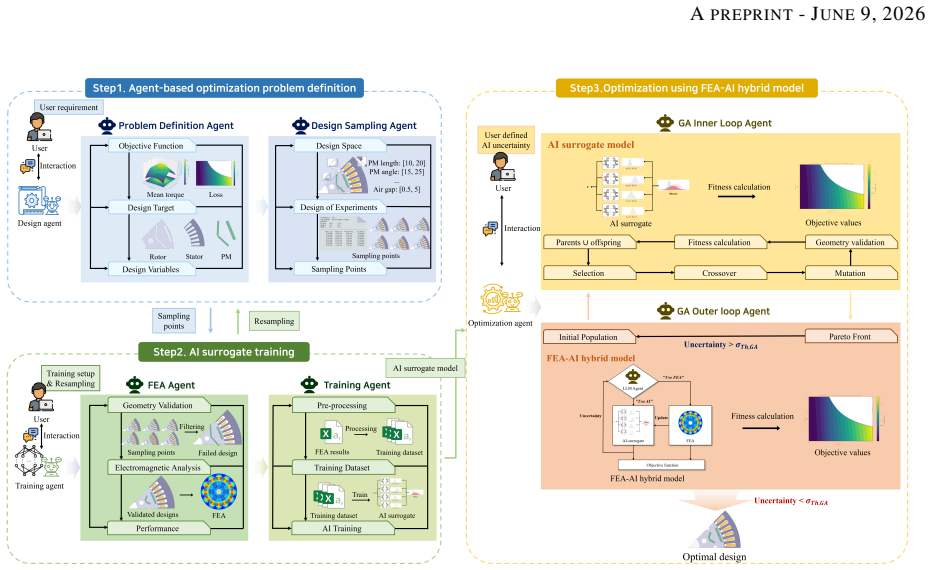
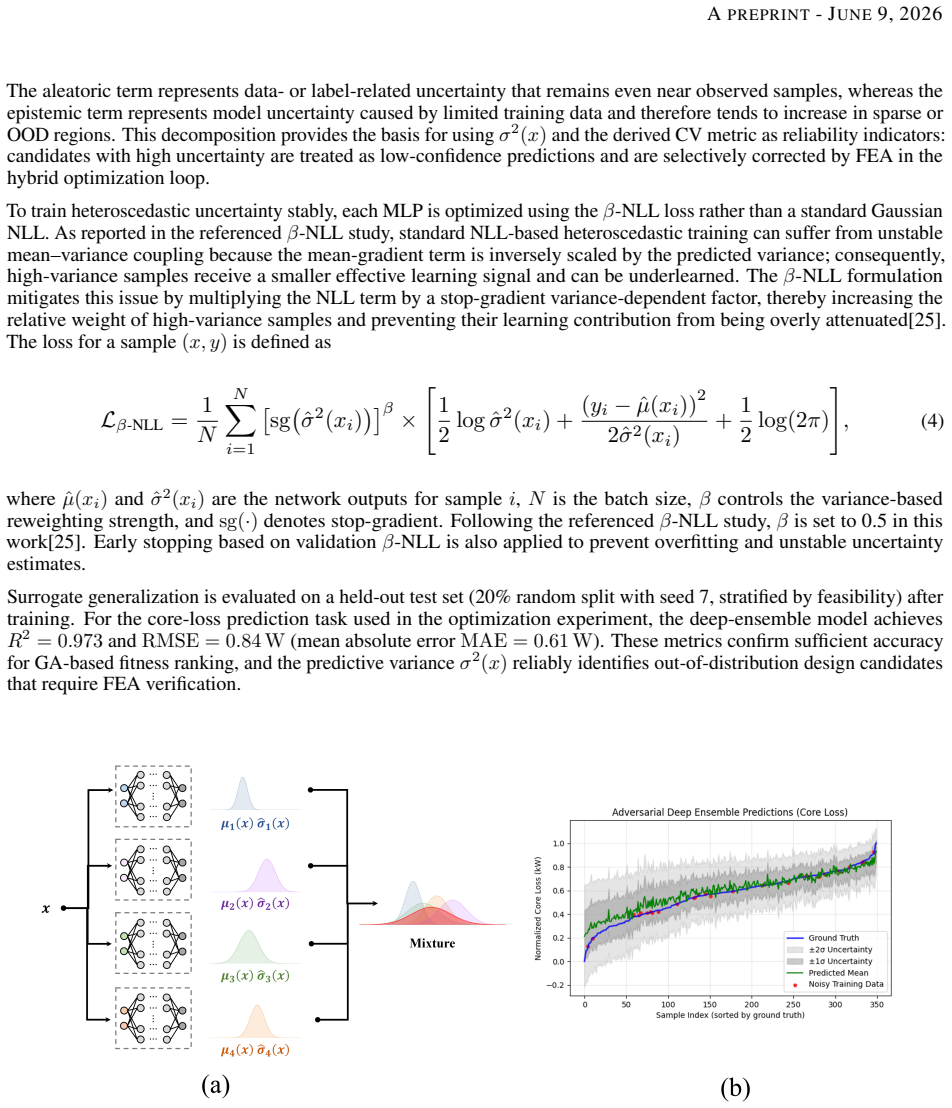
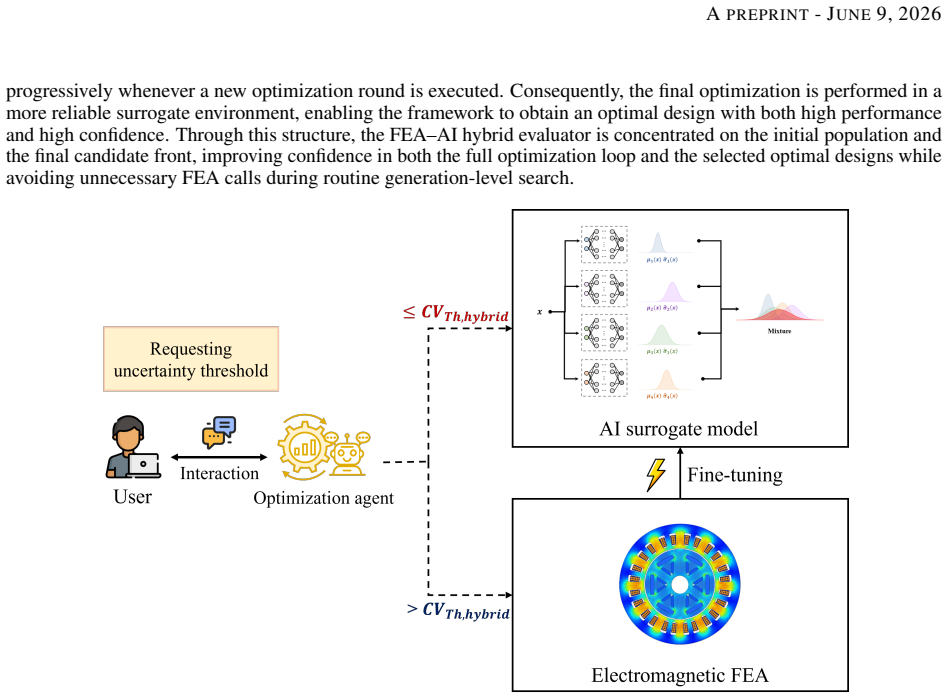
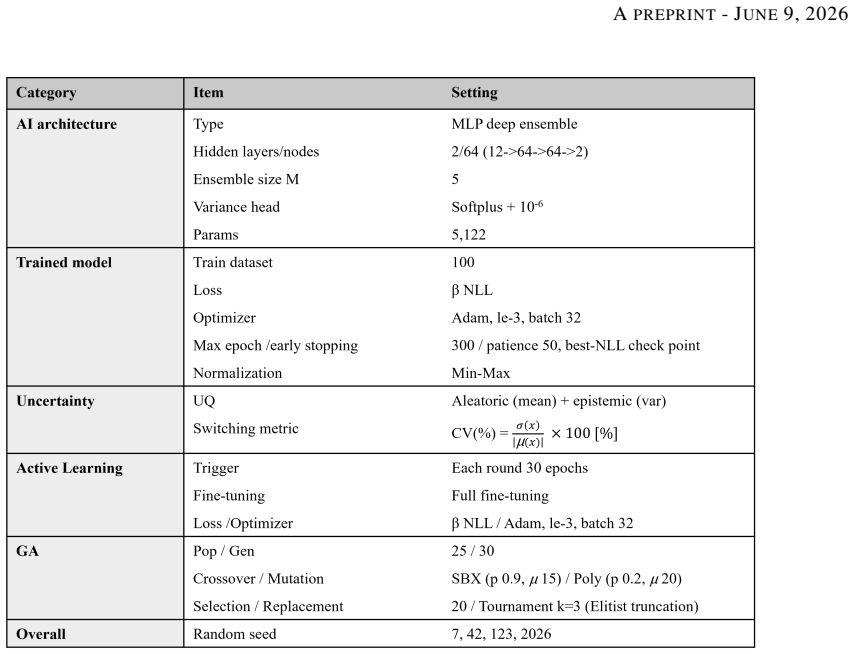
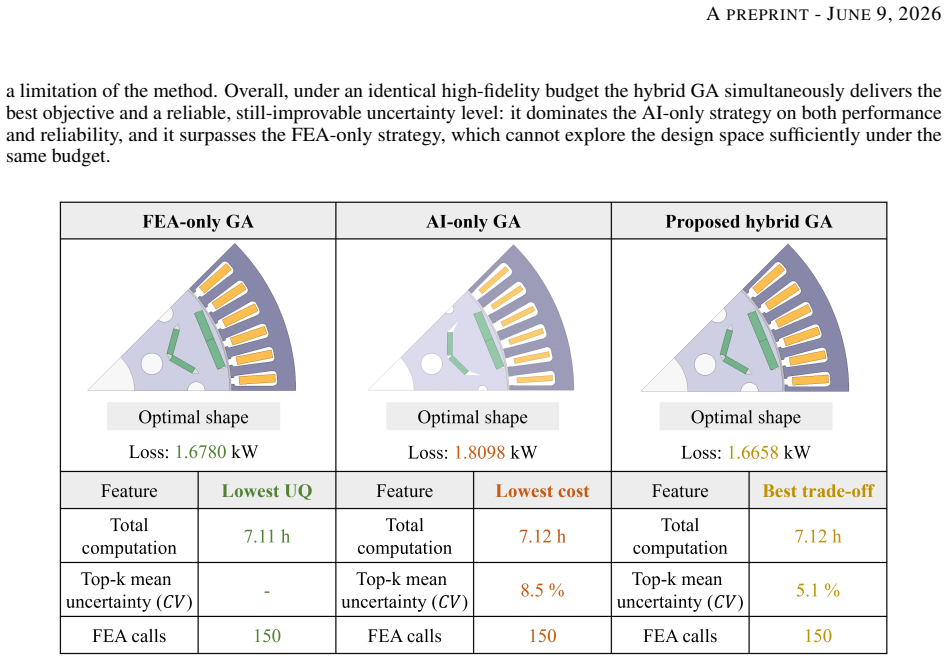
The central claim is that uncertainty-threshold switching between a deep-ensemble surrogate and high-fidelity FEA—rather than more FEA calls or a larger surrogate—is what determines whether simulation-driven motor optimization succeeds. When a candidate's coefficient-of-variation uncertainty exceeds a 3% threshold, FEA is invoked, the result replaces the surrogate guess, and the labeled sample is fed back into surrogate retraining; otherwise the surrogate evaluates the candidate cheaply. Under a matched budget of 150 FEA runs, this hybrid loop evaluated roughly 1,200 candidate geometries and found a 1.6658 kW iron-loss design, better than both baselines, while keeping selected-design uncerta
What carries the argument
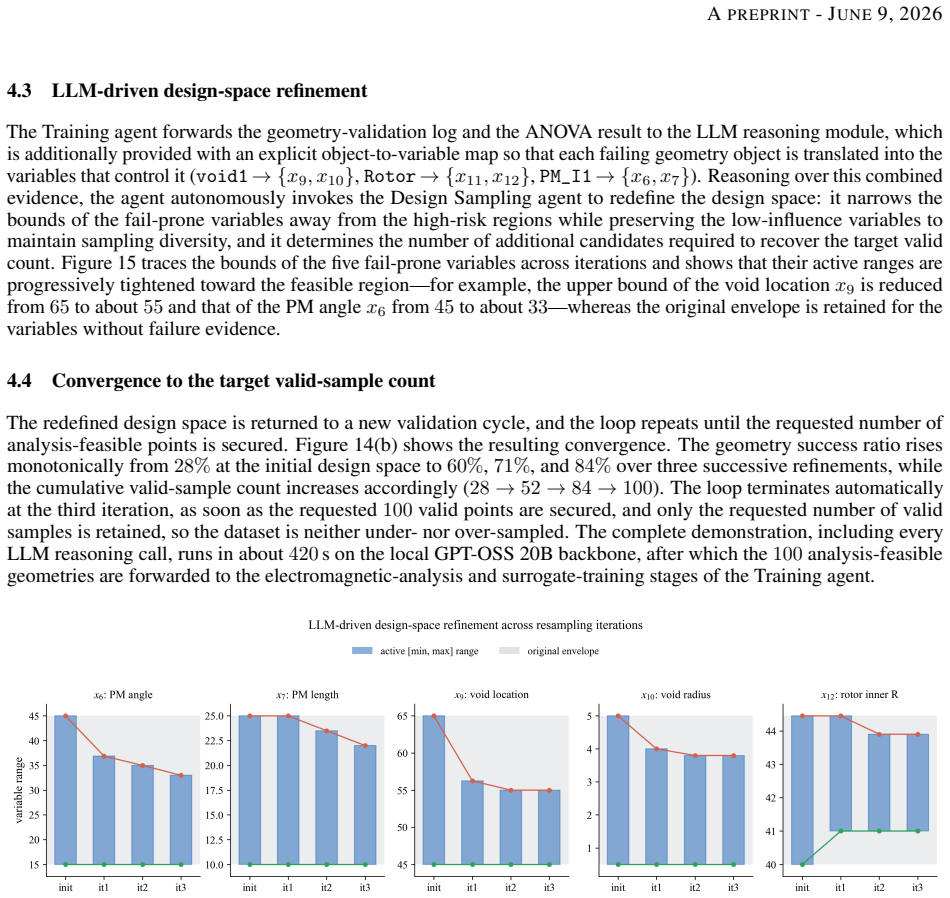
The load-bearing mechanism is the FEA–AI hybrid evaluator with an uncertainty-driven switch. A deep ensemble of five MLPs predicts each design's objective and its predictive variance; CV = sqrt(variance)/|mean| is compared to a switching threshold (3% in the experiments). Low-CV candidates are evaluated by the surrogate alone; high-CV candidates trigger FEA, and those FEA labels are added to the training set for online retuning. A second mechanism is the log-informed resampling loop: geometry-validation and solver-failure logs, combined with ANOVA effect sizes, are read by an LLM that narrows failure-prone variable bounds and regenerates DOE samples until the requested valid-sample count is
Load-bearing premise
The entire comparison lives inside a single electromagnetic FEA simulator whose iron-loss model uses material coefficients 'fitted to lamination material data' that are not reported; if that simulation or those coefficients are biased, the hybrid advantage may not survive contact with a real motor.
What would settle it
Measure the same three optimization strategies against a physical dynamometer benchmark or with a different FEA mesh and material dataset: the central claim fails if the hybrid strategy no longer finds the best design when the simulator's ground truth is changed or replaced by hardware measurements.
If this is right
- Under a fixed FEA budget, surrogate-assisted search can explore an order of magnitude more candidates than FEA-only search without sacrificing final design quality.
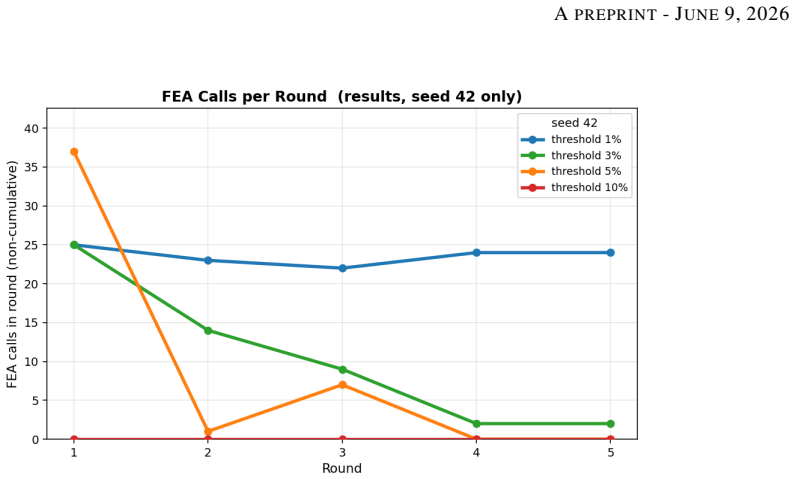
- Online retraining with uncertainty-triggered FEA labels drives per-round FEA cost and predictive uncertainty down together (FEA calls per round drop from 26.5 to 4.2 over five rounds).
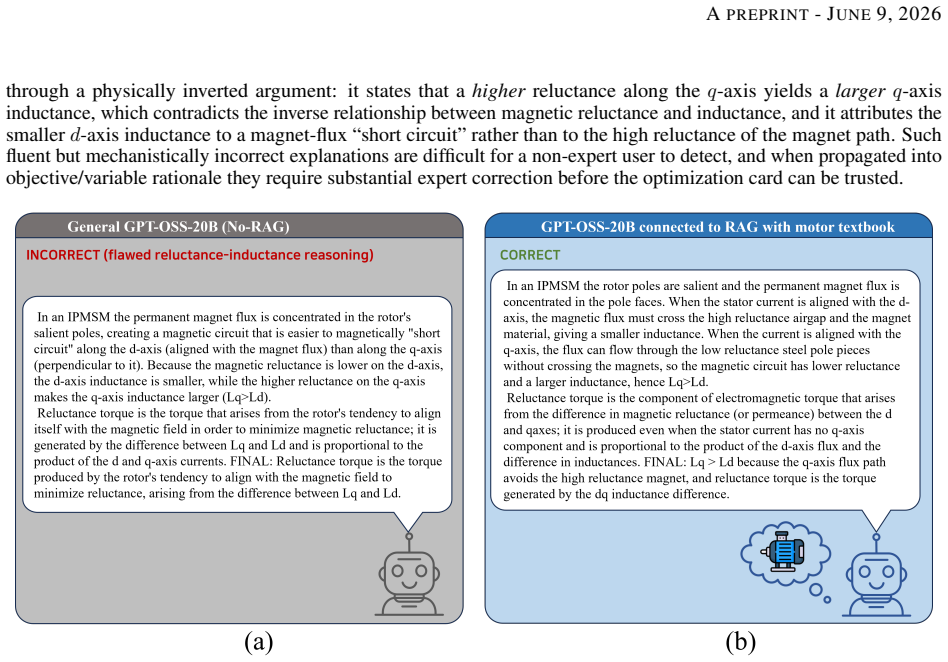
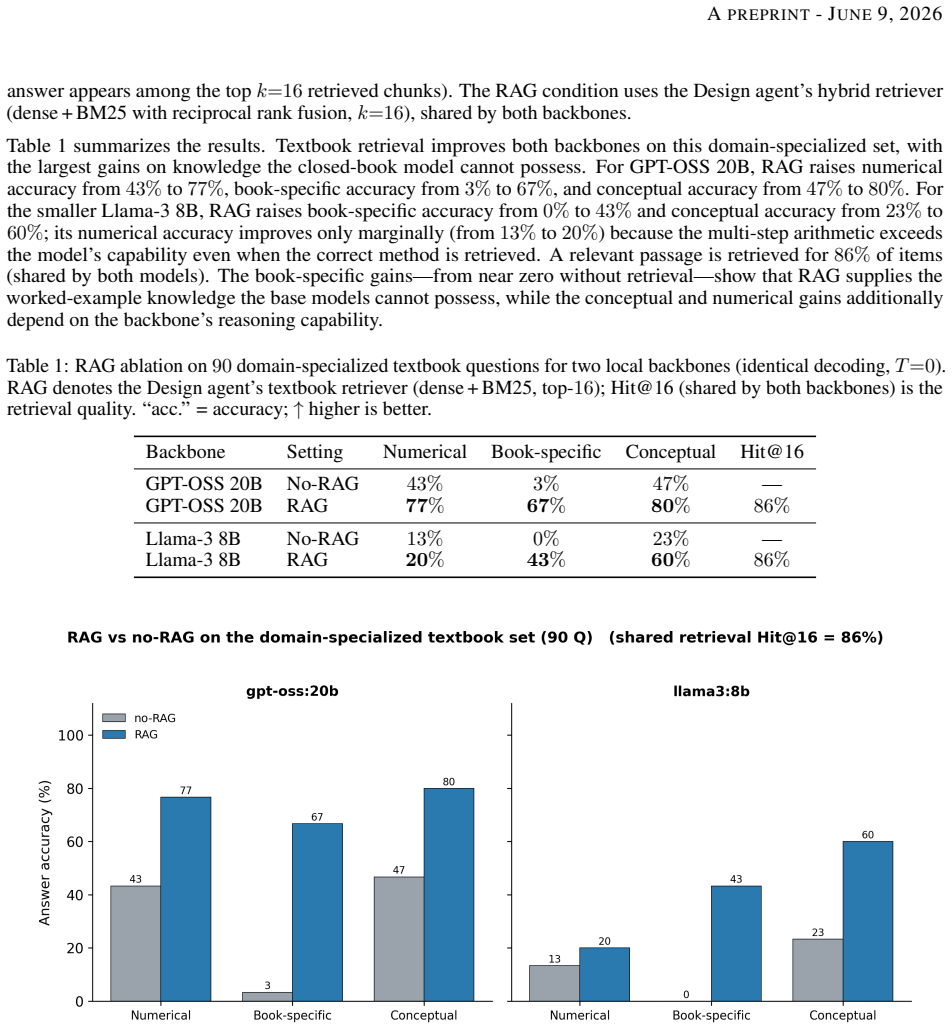
- RAG-grounded problem definition makes the setup phase less dependent on expert knowledge, turning near-zero book-specific lookup accuracy into 67% for a local LLM.
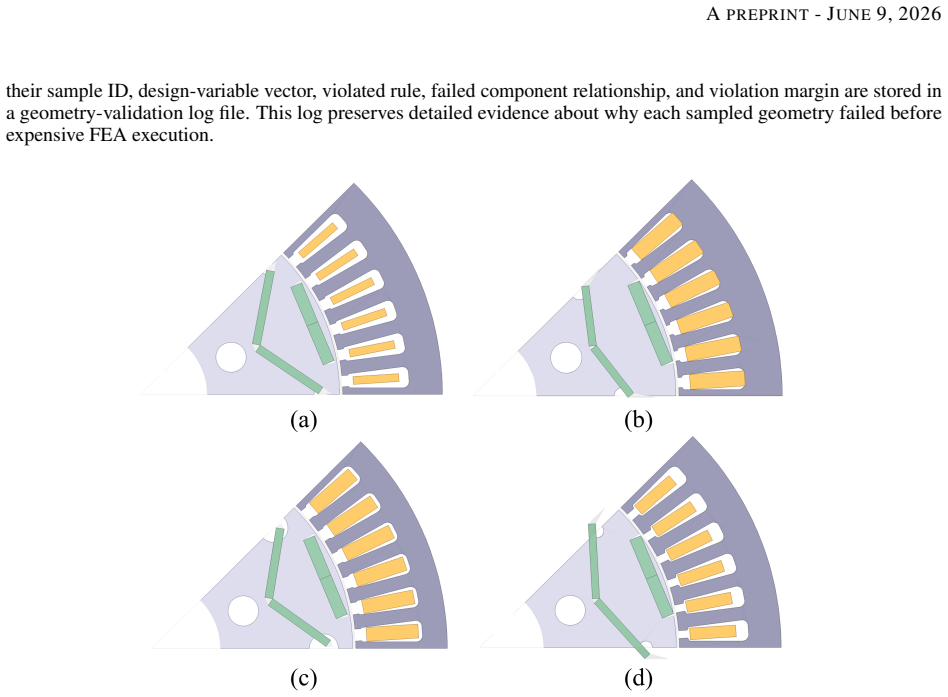
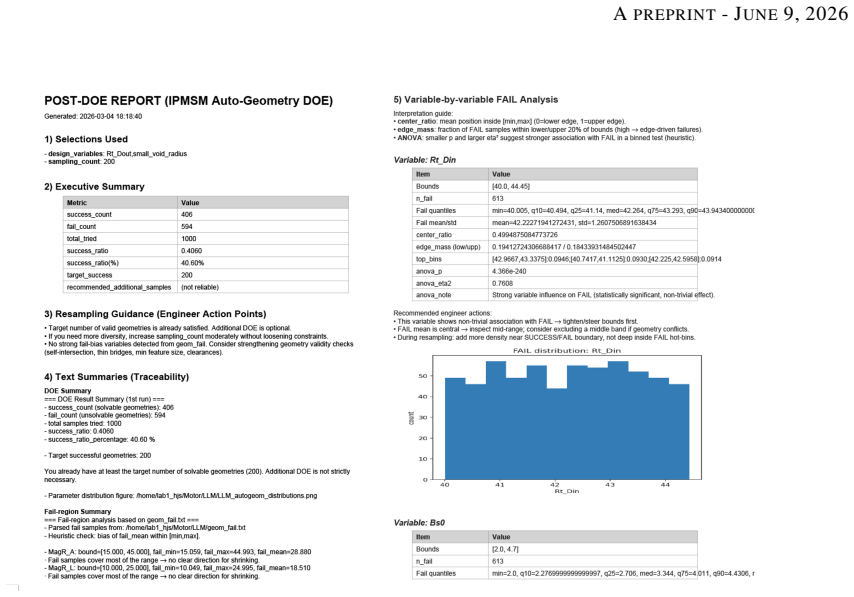
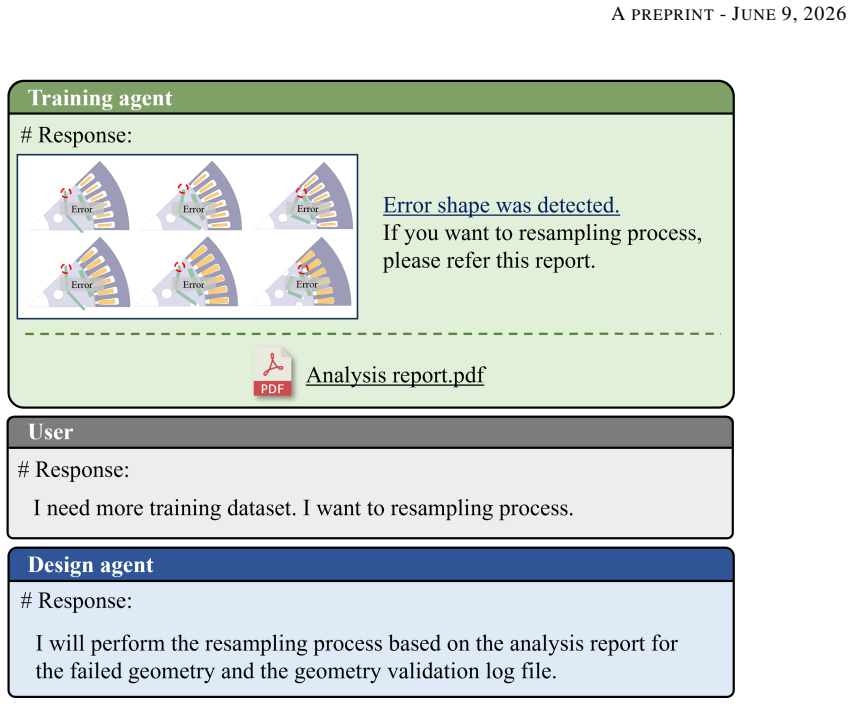
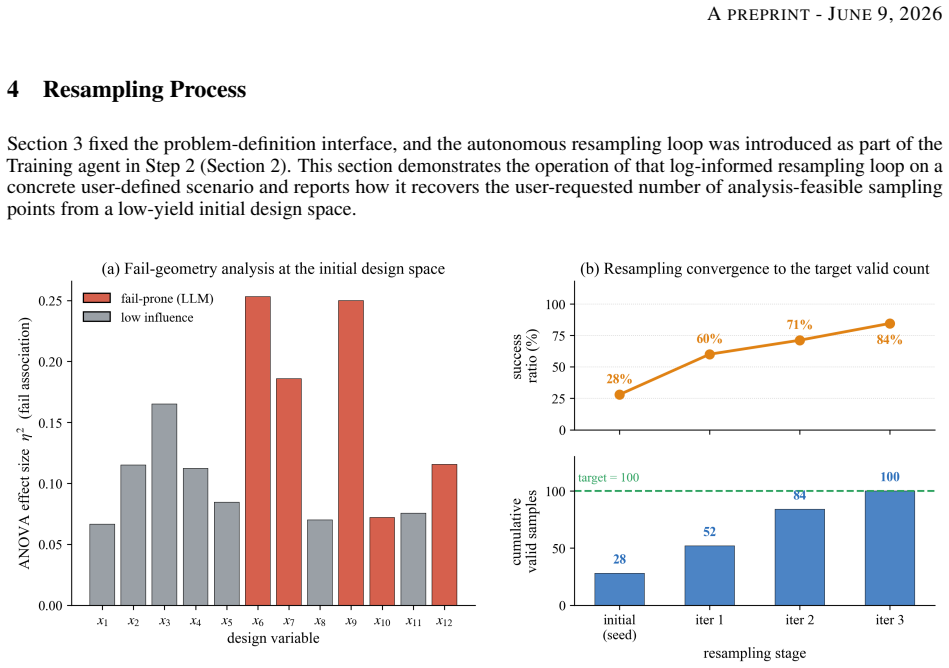
- LLM-driven resampling recovers analysis-feasible training data from wide design spaces, raising geometry success from 28% to 84% and securing the exact target sample count.
- The same switching principle is claimed to extend to multi-objective search, with 22.5% higher hypervolume than FEA-only under an equal budget.
Where Pith is reading between the lines
- If the mechanism generalizes, the fixed 3% threshold could itself become a closed-loop controller tuned online from the surrogate's uncertainty trajectory; the paper's abstract gestures at this, though the reported experiments fix the threshold.
- The hybrid evaluator's logic is agnostic to the simulator: any expensive oracle—mechanical stress, thermal, or experimental test—could replace FEA, so the same switching rule could apply to multi-physics design optimization.
- A direct testable extension: on a benchmark with known optimum, vary the FEA budget (e.g., 50, 150, 500) and measure whether the hybrid advantage grows, since the paper predicts larger computational savings in the thousands-of-evaluations regime.
Editorial analysis
A structured set of objections, weighed in public.
Referee Report
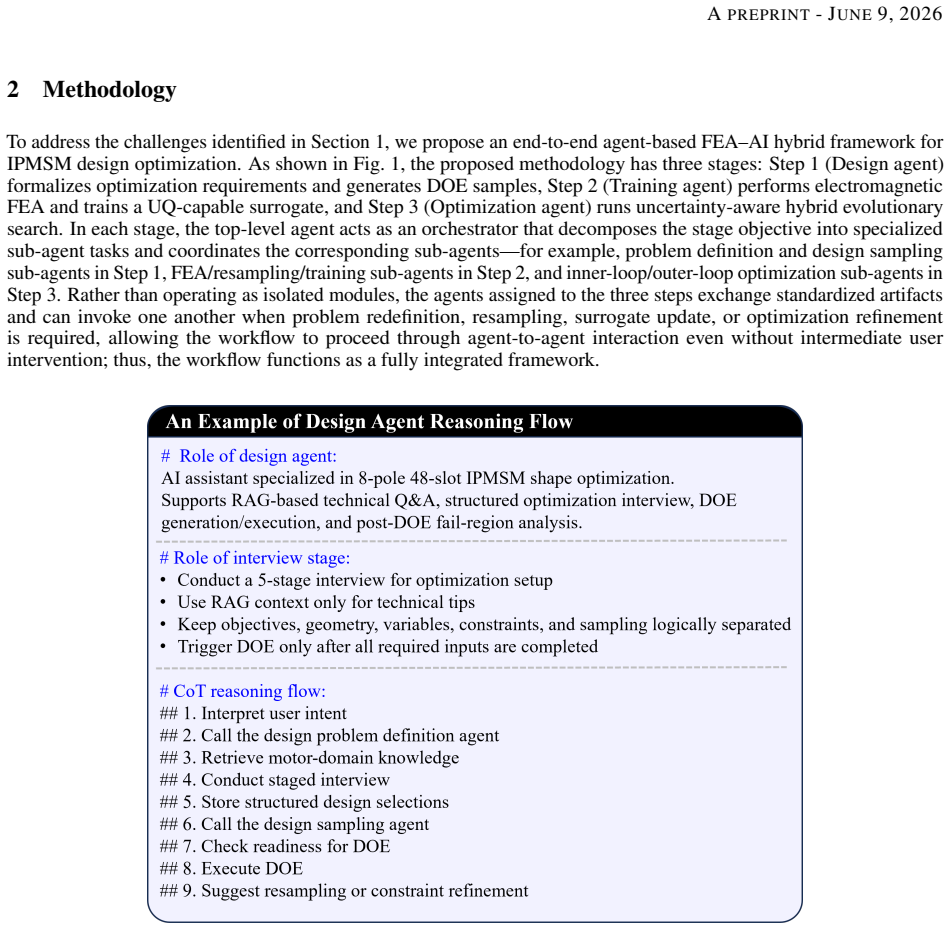
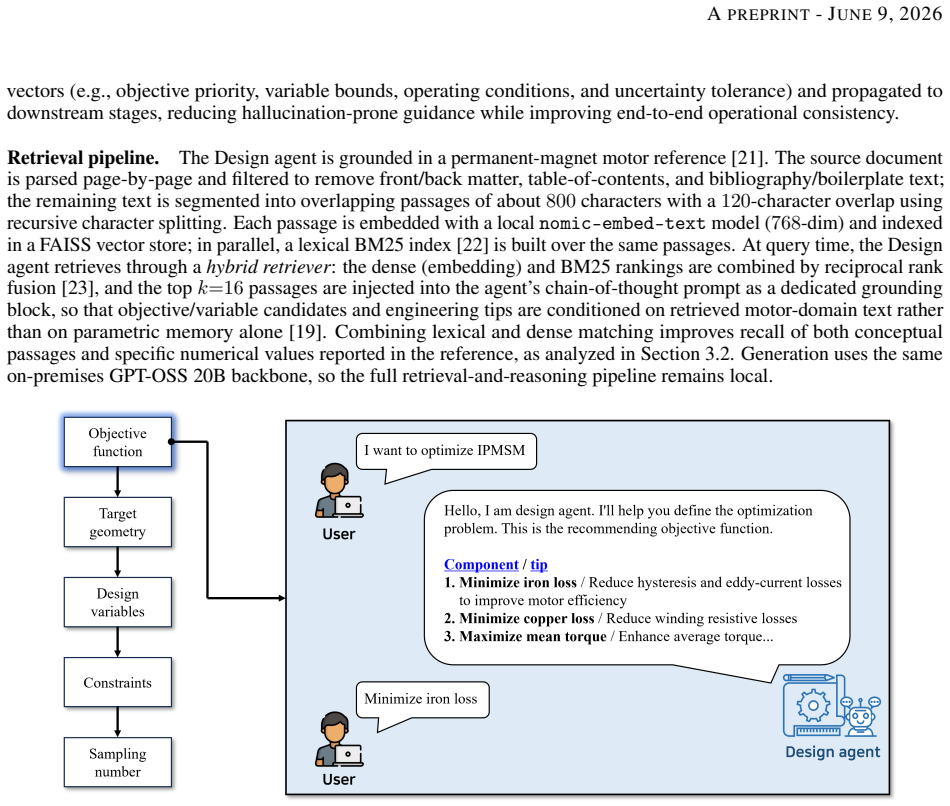
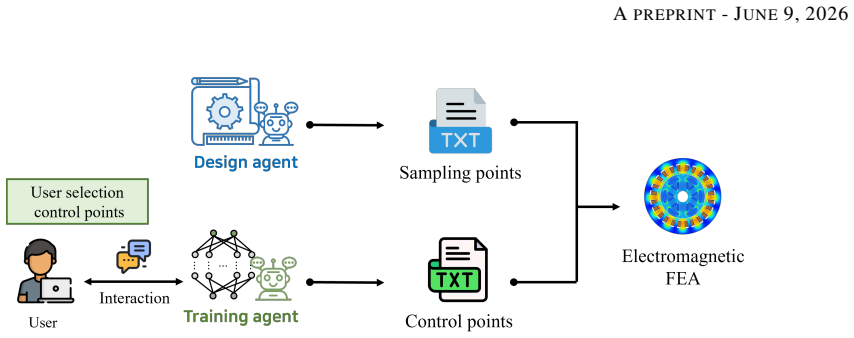
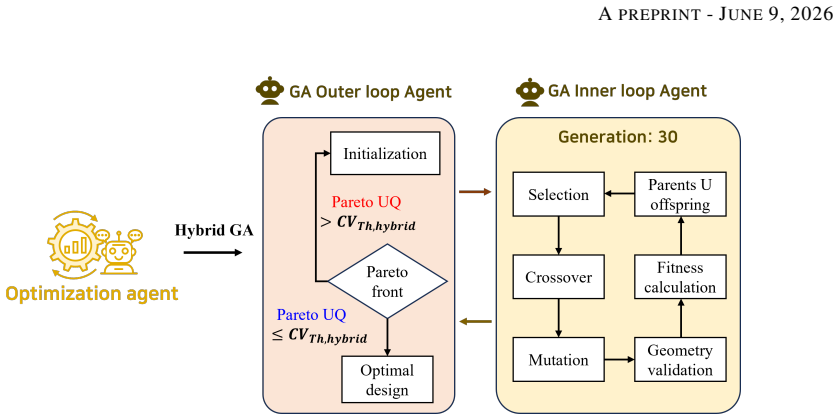
Summary. The paper presents an end-to-end multi-agent LLM framework for IPMSM design optimization. A Design agent uses RAG to convert natural-language requirements into a structured optimization card and DOE plan; a Training agent runs electromagnetic FEA, logs geometry/solver failures, performs ANOVA-based LLM resampling to recover feasible samples, and trains a β-NLL deep-ensemble surrogate; an Optimization agent runs a GA with CV-threshold-based switching between surrogate inference and FEA, with online retraining and round-wise active learning. Reported results include RAG accuracy gains (e.g., 43%→77% numerical, 3%→67% book-specific for GPT-OSS 20B), a resampling feasibility improvement from 28% to 84%, and a matched 150-FEA-call comparison in which the hybrid GA reports 1.6658 kW versus 1.6780 kW for FEA-only and 1.8098 kW for AI-only. The abstract additionally claims large multi-objective hypervolume gains, 52–55% time reductions, and an adaptively updated uncertainty threshold, none of which appear in the experimental section.
Significance. If the central claim were fully established, the work would be a useful contribution to simulation-driven design automation: an uncertainty-aware hybrid evaluator with automated problem setup and failure-driven resampling is a plausible and practically relevant paradigm. The paper has several strengths: it reports explicit GA settings and matched FEA-call budgets, repeats experiments over four seeds, uses fixed decoding in the RAG ablation, and provides a concrete validation-log/ANOVA resampling demonstration. However, the headline hybrid-versus-FEA-only advantage is not statistically supported, the switching threshold is selected in-sample on the same problem, and multiple abstract claims are unsupported by the reported experiments. These issues are load-bearing for the paper's main contribution, so the manuscript needs substantive revision before it can be accepted.
major comments (4)
- [§5.3, Fig. 21] The central claim that the hybrid GA "achieves the best objective performance" rests on a 0.0122 kW (≈0.7%) gap over FEA-only, averaged over four seeds, with no per-seed values, standard deviations, or significance test. Section 5.2 (Fig. 20) shows four-seed averaged best objectives varying by about 0.37 kW across thresholds (1.5676–1.9366 kW), so run-level dispersion is evidently substantial; with n=4, a 0.7% gap is not distinguishable from seed noise. Please report per-seed results and a paired test or equivalent, and either provide evidence for the ordering or soften the conclusion. In addition, the final hybrid design has top-K CV=5.1%, above the 3% switching threshold, and the comparison run stops by FEA-budget exhaustion rather than by the method's own termination criterion; the reliability advantage is therefore not demonstrated by the implemented comparison.
- [Abstract vs §5–§6] The abstract promises results that do not appear in the experiments: "up to 44% lower iron loss" in single-objective optimization, "22.5% higher hypervolume" and "90–92% of FEA-only hypervolume" in multi-objective optimization, "52–55%" computation-time reduction, and a "controller agent" that "adaptively updates the uncertainty threshold", yielding "5.8% lower" loss. Section 5 contains only a single-objective iron-loss case with a fixed 3% threshold; no multi-objective/hypervolume data, no adaptive-threshold experiment, and no 44% or 5.8% comparisons appear. Section 6 explicitly states that an adaptive switching strategy is future work. These abstract claims must be removed or substantiated by the corresponding experiments.
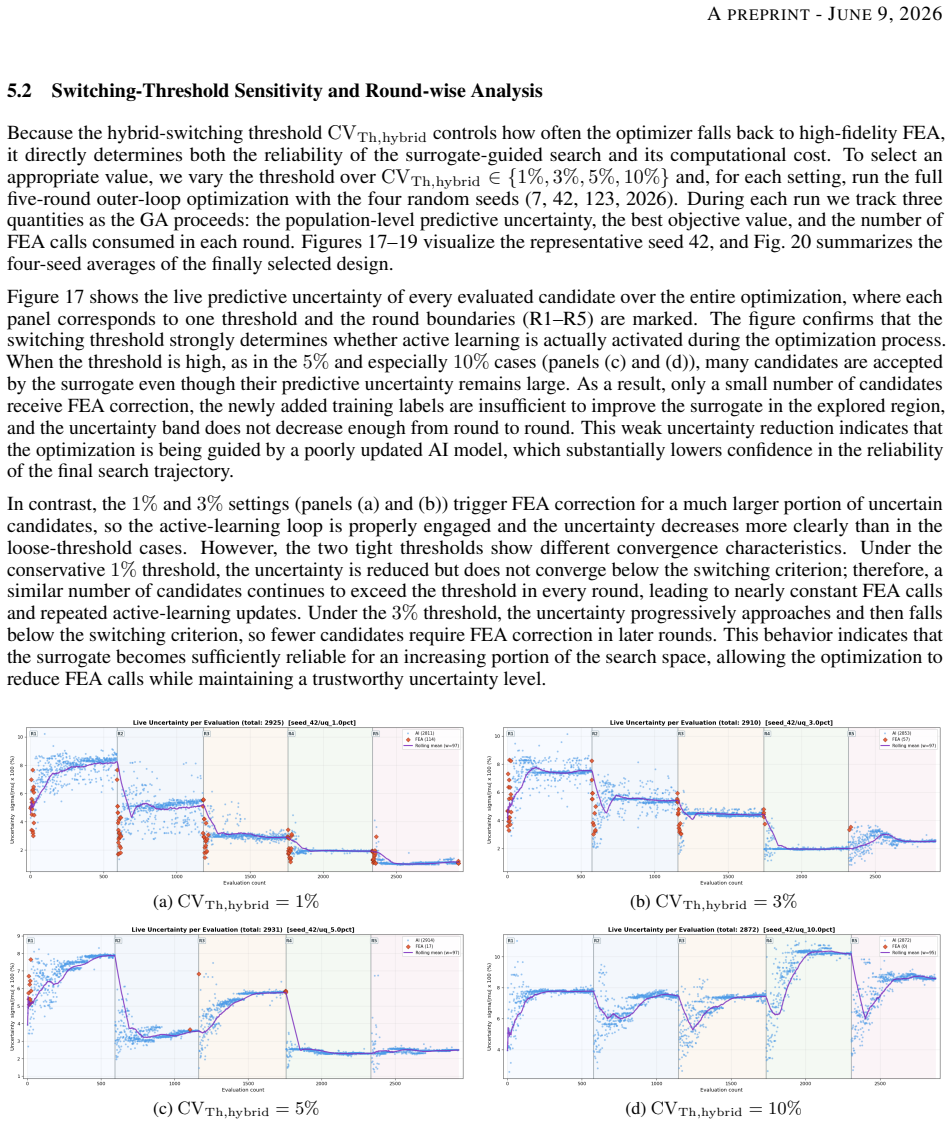
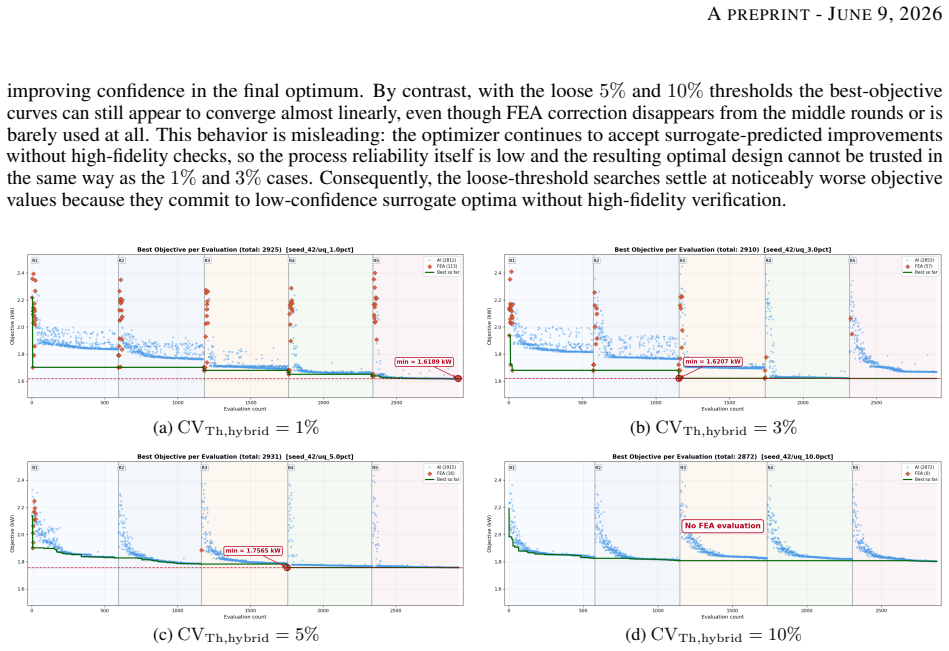
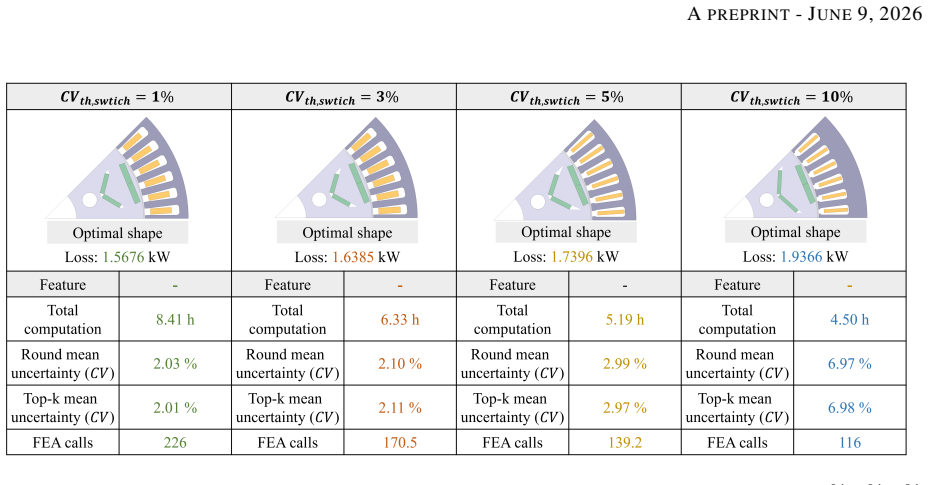
- [§5.2, Fig. 20] The 3% switching threshold is selected by inspecting the same problem on which the final comparison in §5.3 is run, and the reported hybrid advantage is then obtained using that selected threshold. This is in-sample selection; the advantage may partly reflect the threshold choice rather than a general property of the hybrid pipeline. Because Fig. 20 shows the threshold strongly affects the result (1%: 1.5676 kW; 3%: 1.6385 kW; 5%: 1.7396 kW; 10%: 1.9366 kW), the authors should treat the threshold as a hyperparameter, e.g., via nested/independent validation, sensitivity analysis that does not feed into the reported comparison, or an explicit statement that the 3% result is a tuned upper bound.
- [§2.3, Eq. (2)] All loss values and therefore all strategy comparisons are produced by Ansys Maxwell 2D with a modified Bertotti model whose coefficients are described only as "fitted to the lamination material data". The coefficient values, material grade, and FEA mesh/solver settings are not provided, so the absolute losses are not reproducible. Because iron loss is the sole optimization objective, a biased loss calibration could change the ranking of geometries even though all three strategies share the same simulator. Please report the coefficients and FEA settings, and ideally validate a subset of designs against measurements or a public benchmark, or clearly frame the results as simulation-relative.
minor comments (4)
- [Throughout] The manuscript repeatedly types "ANOV A" where "ANOVA" is meant; Section 5.3's title "Comparing Study" should be "Comparative Study".
- [§5.2 vs Table 2] Fig. 20 reports round/top-K mean uncertainties of 2.10%/2.11% for the 3% threshold, while Table 2 reports round 5 top-K mean uncertainty of 2.74%. The definitions should be clarified so the reader can tell whether these are final-design averages or per-round averages.
- [§3.2] The RAG evaluation uses 90 questions derived from the same textbook that serves as the retrieval corpus, and conceptual answers are judged by an LLM against gold key points. This design inflates expected RAG gains; a human expert assessment or at least inter-annotator agreement would strengthen the claim.
- [Reproducibility] No code, data, or FEA model files are provided. Given the paper's emphasis on a reproducible workflow, a data/code availability statement and release of the agent prompt templates, DOE sets, and surrogate code are needed.
Circularity Check
No circular derivation: the hybrid result is an empirical comparison; threshold tuning and abstract overclaims are correctness/statistical issues, not definitional circularity.
full rationale
The load-bearing claim—that the FEA–AI hybrid GA gives the best objective under a matched 150-FEA budget—is an empirical benchmark result (Fig. 21), not a derivation from assumptions. The three strategies consume the same 150 FEA calls and the reported losses are averaged outcomes over four seeds. No equation defines the hybrid advantage in terms of the experimental inputs. The CV threshold is selected by sensitivity analysis in §5.2 and then used in §5.3; this is in-sample hyperparameter selection and would need a significance or hold-out check, but it is not a definitional reduction: the comparison is re-run under the selected configuration and the ordering could in principle have differed. The abstract's claim that 'a controller agent adaptively updates the uncertainty threshold ... eliminating manual tuning' is contradicted by the Limitations section, which states the threshold 'was selected through sensitivity analysis and then fixed at 3%' and that adaptive switching is future work; the 44%/22.5% abstract numbers also do not appear in the §5.3 single-objective comparison. These are reporting/overclaim problems, not circular steps. The two self-citations ([9], [12]) are background references and are not load-bearing for the central claim, and no uniqueness theorem or ansatz is imported from prior author work. The RAG evaluation uses questions derived from the same textbook used as the retrieval corpus, which is appropriate for testing retrieval behavior rather than circular. Overall, no circular step meeting the paper's own equations or a self-citation chain was identified.
Axiom & Free-Parameter Ledger
free parameters (8)
- Hybrid switching threshold CV_Th,hybrid =
3% (selected from {1,3,5,10}%)
- Deep-ensemble architecture =
M=5 MLPs, 12-64-64-2, softplus variance head
- β-NLL reweighting β =
0.5
- GA operators and population =
pop 25, 30 generations, tournament k=3, SBX p=0.9 η=15, mutation p=0.2 η=20
- FEA budget split =
100 training + 50 online correction = 150
- DOE count and resampling target =
100 initial, 100 valid target, 3 iterations (success 28→84%)
- Retrieval hyperparameters =
top-k=16, chunk 800 chars, overlap 120
- Surrogate training hyperparameters =
lr=1e-3, batch 32, max 300 epochs, patience 50, fine-tune 30 epochs
axioms (7)
- domain assumption Ansys Maxwell 2D FEA provides a valid ground truth for iron loss in the IPMSM geometry
- domain assumption Bertotti/Steinmetz loss coefficients in Eq. (2) accurately model core loss
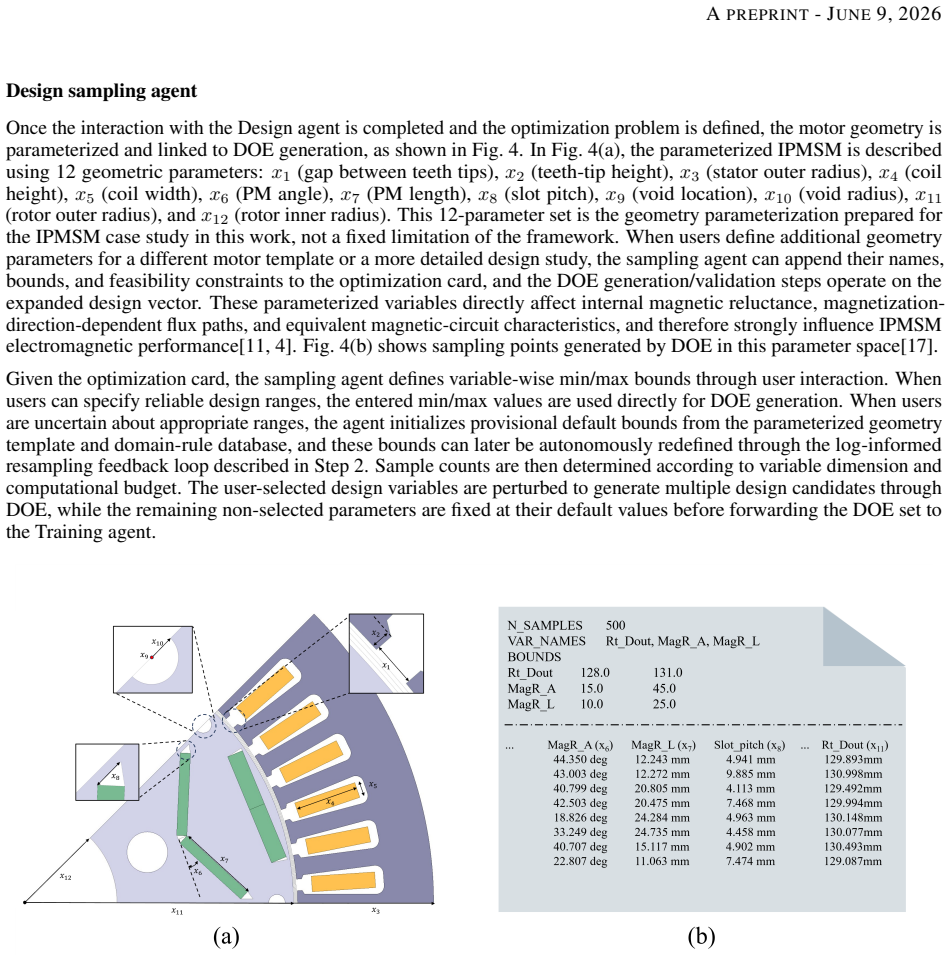
- domain assumption The 12-parameter geometry parameterization plus rule-based validator covers the relevant feasible design space
- domain assumption Deep-ensemble coefficient of variation CV(x) is a calibrated reliability signal for triggering FEA
- domain assumption The retrieval corpus [21] is authoritative and sufficient for motor-design problem definition
- domain assumption The LLM judge used for conceptual answers is unbiased
- domain assumption β-NLL loss with β=0.5 improves heteroscedastic uncertainty training as reported in [25]
read the original abstract
This study presents a large language model (LLM)-based multi-agent framework for interior permanent magnet synchronous motor (IPMSM) design optimization that mitigates limitations of conventional workflows: expertise-dependent problem setup and data preparation, the prohibitive computational cost of finite element analysis (FEA), and the unreliability of AI surrogates in unexplored regions. To this end, we first introduce a Design agent that formulates the optimization problem in natural language, leveraging retrieval-augmented generation to improve answer accuracy on motor design problems from below 50% to 67-80%. Furthermore, a Training agent autonomously repairs improperly defined design spaces by reasoning over solver failure history, raising the success ratio of the geometry sampling from 28% to 84% for AI training. Additionally, to resolve cost and reliability simultaneously, an Optimization agent employs an uncertainty-aware FEA-AI hybrid model: the AI surrogate is the primary evaluator, and FEA is selectively invoked where predictive uncertainty is high. Under the same FEA budget, this hybrid model achieves up to 44% lower iron loss in single-objective and 22.5% higher hypervolume in multi-objective optimization than conventional FEA-only search. Under the same evaluation budget, it reduces computation time by 52-55% while retaining 90-92% of FEA-only hypervolume. Conversely, AI-only search converges to false optima, leaving half its Pareto designs infeasible. Notably, a controller agent adaptively updates the uncertainty threshold that triggers FEA each round, eliminating manual tuning and achieving 5.8% lower single objective iron loss than with a fixed threshold. These results establish domain specialized LLM agents with uncertainty-aware hybrid evaluation as a reliable, scalable paradigm for simulation-driven design automation.
Figures
Reference graph
Works this paper leans on
-
[1]
Research on the performances and parameters of interior pmsm used for electric vehicles.IEEE Transactions on Industrial Electronics, 63(6):3533–3545, 2016
Xiangdong Liu, Hao Chen, Jing Zhao, and Anouar Belahcen. Research on the performances and parameters of interior pmsm used for electric vehicles.IEEE Transactions on Industrial Electronics, 63(6):3533–3545, 2016
2016
-
[2]
Comparison of induction and pm synchronous motor drives for ev application including design examples.IEEE Transactions on Industry Applications, 48(6):2322–2332, 2012
Gianmario Pellegrino, Alfredo Vagati, Barbara Boazzo, and Paolo Guglielmi. Comparison of induction and pm synchronous motor drives for ev application including design examples.IEEE Transactions on Industry Applications, 48(6):2322–2332, 2012
2012
-
[3]
Tae-Hyuk Ji, Chan-Ho Kim, Seok-Won Jung, and Sang-Yong Jung. Design method of ipmsm using multi-objective optimization considering mechanical stress for high-speed electric vehicles.Journal of Electrical Engineering & Technology, 19(4):2481–2489, 2024
2024
-
[4]
Multimodal design optimization of v-shaped magnet ipm synchronous machines.IEEE Transactions on Energy Conversion, 33(3):1547–1556, 2018
Buddhika De Silva Guruwatta Vidanalage, Mohammad Sedigh Toulabi, and Shaahin Filizadeh. Multimodal design optimization of v-shaped magnet ipm synchronous machines.IEEE Transactions on Energy Conversion, 33(3):1547–1556, 2018
2018
-
[5]
Design of a 35 kw permanent magnet synchronous motor for electric vehicle equipped with non-uniform air gap rotor.IEEE Transactions on Industry Applications, 59(1):1184–1198, 2022
Feng Liu, Xiuhe Wang, and Zezhi Xing. Design of a 35 kw permanent magnet synchronous motor for electric vehicle equipped with non-uniform air gap rotor.IEEE Transactions on Industry Applications, 59(1):1184–1198, 2022
2022
-
[6]
Tomoki Nakata, Masayuki Sanada, Shigeo Morimoto, and Yukinori Inoue. Automatic design of ipmsms using a genetic algorithm combined with the coarse-mesh fem for enlarging the high-efficiency operation area.IEEE Transactions on Industrial Electronics, 64(12):9721–9728, 2017
2017
-
[7]
A survey on large language model based autonomous agents.Frontiers of Computer Science, 18(6):186345, 2024
Lei Wang, Chen Ma, Xie Feng, Jiahui Zhang, Zeyu Duan, Bowen Zhao, Yuting Wang, Zhendong Zhang, Bo Yang, Qinglong Zheng, et al. A survey on large language model based autonomous agents.Frontiers of Computer Science, 18(6):186345, 2024
2024
-
[8]
Evaluation of different large language model agent frameworks for design engineering tasks
Alejandro Pradas Gómez, Massimo Panarotto, and Ola Isaksson. Evaluation of different large language model agent frameworks for design engineering tasks. InProceedings of NordDesign 2024: Design in the Era of Digitalization, AI and Augmented Intelligence, pages 693–702, 2024
2024
-
[9]
Generative ai-driven design optimization: Eight key application scenarios.JMST Advances, 7(1):105–111, 2025
Namwoo Kang. Generative ai-driven design optimization: Eight key application scenarios.JMST Advances, 7(1):105–111, 2025
2025
-
[10]
Meyarivan
Kalyanmoy Deb, Amrit Pratap, Sameer Agarwal, and T. Meyarivan. A fast and elitist multiobjective genetic algorithm: Nsga-ii.IEEE Transactions on Evolutionary Computation, 6(2):182–197, 2002
2002
-
[11]
Optimal shape design to improve torque characteristics of interior permanent magnet synchronous motor for small electric vehicles.Microsystem Technologies, 31(5):1203–1217, 2025
Hyeon-Jun Kim and Soo-Whang Baek. Optimal shape design to improve torque characteristics of interior permanent magnet synchronous motor for small electric vehicles.Microsystem Technologies, 31(5):1203–1217, 2025
2025
-
[12]
Topology optimization via machine learning and deep learning: a review.Journal of Computational Design and Engineering, 10(4):1736–1766, 2023
Seungyeon Shin, Dongju Shin, and Namwoo Kang. Topology optimization via machine learning and deep learning: a review.Journal of Computational Design and Engineering, 10(4):1736–1766, 2023
2023
-
[13]
Multi-objective surrogate optimization of mixed-variable ipm motor design problem with admm-based approach.Optimization and Engineering, pages 1–26, 2025
Tatsuya Asanuma and Yoshihiro Kanno. Multi-objective surrogate optimization of mixed-variable ipm motor design problem with admm-based approach.Optimization and Engineering, pages 1–26, 2025
2025
-
[14]
Simple and scalable predictive uncertainty estimation using deep ensembles
Balaji Lakshminarayanan, Alexander Pritzel, and Charles Blundell. Simple and scalable predictive uncertainty estimation using deep ensembles. InAdvances in Neural Information Processing Systems, 2017
2017
-
[15]
Comparative study of different data-driven surrogate models for optimization of synchronous reluctance machine.IEEE Transactions on Industry Applications, 2025
Yuancong Gong, Andreas Gneiting, Chongshen Zhao, Nejila Parspour, and Hao Chen. Comparative study of different data-driven surrogate models for optimization of synchronous reluctance machine.IEEE Transactions on Industry Applications, 2025
2025
-
[16]
Topology optimization for a spoke-type permanent magnet synchronous motor based on a siamese convolutional network
Yidan Ma, Zaixin Song, Yongtao Liang, and Jianfu Cao. Topology optimization for a spoke-type permanent magnet synchronous motor based on a siamese convolutional network. In2024 27th International Conference on Electrical Machines and Systems (ICEMS), pages 3346–3351. IEEE, 2024
2024
-
[17]
M. D. McKay, R. J. Beckman, and W. J. Conover. A comparison of three methods for selecting values of input variables in the analysis of output from a computer code.Technometrics, 21(2):239–245, 1979
1979
-
[18]
Survey of hallucination in natural language generation.ACM Computing Surveys, 55(12):248:1– 248:38, 2023
Ziwei Ji, Nayeon Lee, Rita Frieske, Tiezheng Yu, Dan Su, Yan Xu, Etsuko Ishii, Yejin Bang, Andrea Madotto, and Pascale Fung. Survey of hallucination in natural language generation.ACM Computing Surveys, 55(12):248:1– 248:38, 2023
2023
-
[19]
uttler, Mike Lewis, Wen-tau Yih, Tim Rockt
Patrick Lewis, Ethan Perez, Aleksandra Piktus, Fabio Petroni, Vladimir Karpukhin, Naman Goyal, Heinrich K"uttler, Mike Lewis, Wen-tau Yih, Tim Rockt"aschel, Sebastian Riedel, and Douwe Kiela. Retrieval-augmented generation for knowledge-intensive nlp tasks. InAdvances in Neural Information Processing Systems, 2020. 25 APREPRINT- JUNE9, 2026
2020
-
[20]
Retrieval augmentation reduces hallucination in conversation
Kurt Shuster, Spencer Poff, Moya Chen, Douwe Kiela, and Jason Weston. Retrieval augmentation reduces hallucination in conversation. InFindings of the Association for Computational Linguistics: EMNLP 2021, pages 3784–3803, 2021
2021
-
[21]
CRC press, 2009
Jacek F Gieras.Permanent magnet motor technology: design and applications. CRC press, 2009
2009
-
[22]
The probabilistic relevance framework: BM25 and beyond.Foundations and Trends in Information Retrieval, 3(4):333–389, 2009
Stephen Robertson and Hugo Zaragoza. The probabilistic relevance framework: BM25 and beyond.Foundations and Trends in Information Retrieval, 3(4):333–389, 2009
2009
-
[23]
Cormack, Charles L
Gordon V . Cormack, Charles L. A. Clarke, and Stefan Büttcher. Reciprocal rank fusion outperforms Condorcet and individual rank learning methods. InProceedings of the 32nd International ACM SIGIR Conference on Research and Development in Information Retrieval, pages 758–759. ACM, 2009
2009
-
[24]
What uncertainties do we need in bayesian deep learning for computer vision? In Advances in Neural Information Processing Systems, volume 30, 2017
Alex Kendall and Yarin Gal. What uncertainties do we need in bayesian deep learning for computer vision? In Advances in Neural Information Processing Systems, volume 30, 2017
2017
-
[25]
Maximilian Seitzer, Arash Tavakoli, Dimitrije Antic, and Georg Martius. On the pitfalls of heteroscedastic uncertainty estimation with probabilistic neural networks.arXiv preprint arXiv:2203.09168, 2022
Pith/arXiv arXiv 2022
-
[26]
Uncertainty of measurement: a review of the rules for calculating uncertainty components through functional relationships.The Clinical Biochemist Reviews, 33(2):49, 2012
Ian Farrance and Richard Frenkel. Uncertainty of measurement: a review of the rules for calculating uncertainty components through functional relationships.The Clinical Biochemist Reviews, 33(2):49, 2012. 26
2012
discussion (0)
Sign in with ORCID, Apple, or X to comment. Anyone can read and Pith papers without signing in.