Helicity-Resolved Spatiotemporal Mapping of Chiral Plexcitons in Helicoids
Pith reviewed 2026-06-27 15:51 UTC · model grok-4.3
The pith
Helicity of light selectively addresses distinct hybrid responses in chiral plexcitons formed by gold helicoids and J-aggregates, with gap localization accelerating relaxation.
A machine-rendered reading of the paper's core claim, the machinery that carries it, and where it could break.
Core claim
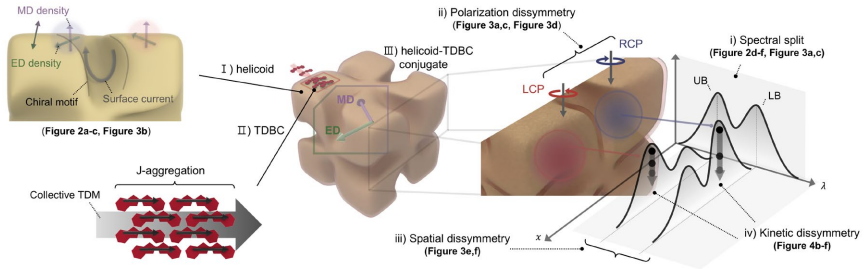
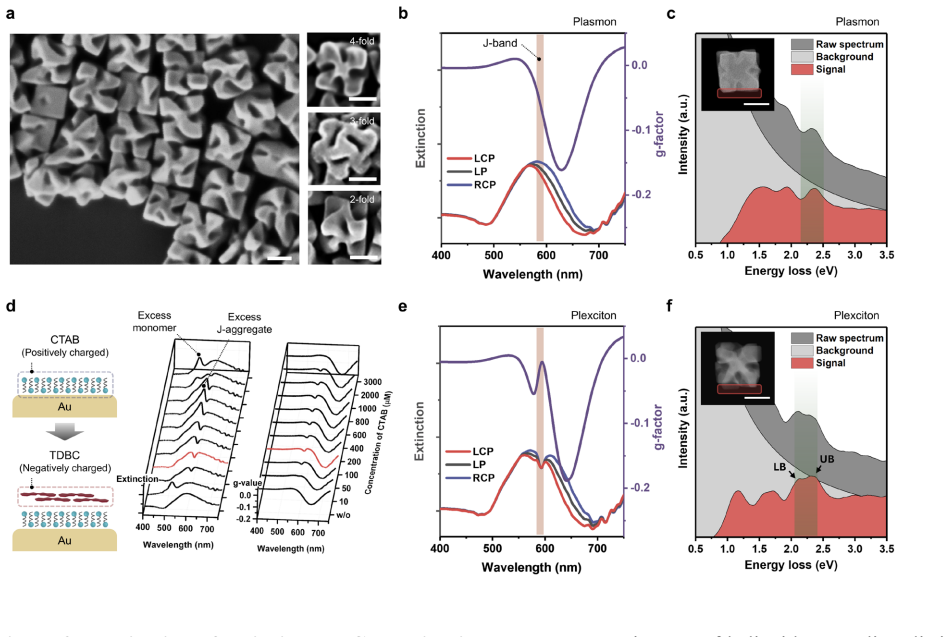
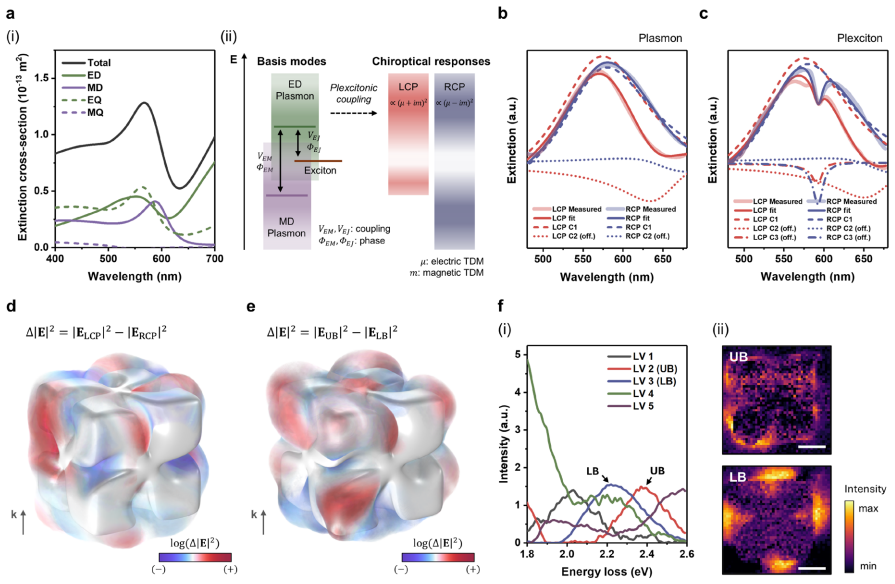
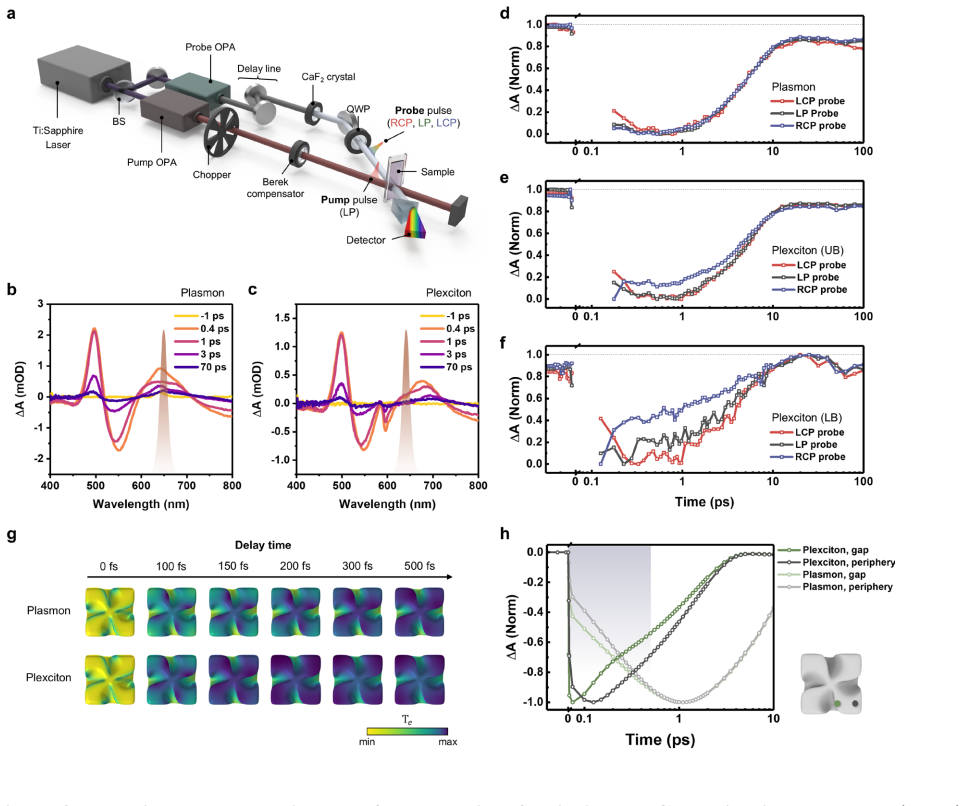
Within a non-Hermitian framework, the microscopic origin of the helicoid chiroptical response and its coupling to the excitonic transition is traced, revealing how the helicity of light selectively addresses distinct hybrid responses. At the spatiotemporal extreme, the gap-localized response not only enhances polarization-sensitive contrast but also strengthens the local hybrid interaction, leading to accelerated ultrafast relaxation. Together these measurements provide a physically grounded picture of chiral plexcitonic coupling.
What carries the argument
The gap-localized response in the helicoid-plexciton system, which couples structural chirality to excitonic transitions and responds selectively to light helicity.
If this is right
- Chirality acts as a practical control parameter for selectively steering nanoscale energy pathways and dynamics.
- Helicity of light can address distinct hybrid responses in plexcitonic systems.
- Gap localization strengthens local hybrid interactions while enhancing polarization-sensitive contrast.
- Space-, time-, and polarization-resolved measurements benchmark the chiral plexcitonic coupling.
Where Pith is reading between the lines
- The approach could be extended to other chiral nanoparticle shapes to test whether gap localization universally accelerates relaxation.
- These results point toward possible design rules for chiral light-matter interfaces that route energy along helicity-dependent paths.
- Incorporating temporal mapping with varying J-aggregate densities might isolate how coupling strength scales with the observed acceleration.
Load-bearing premise
The non-Hermitian framework combined with the chosen functionalization isolates the microscopic origin of the chiroptical response without confounding contributions from fabrication variability or additional loss channels.
What would settle it
Measurements showing identical ultrafast relaxation rates and polarization contrast for opposite light helicities, or no acceleration specifically tied to gap sites, would falsify the selective addressing and gap-localization claims.
Figures
read the original abstract
Plasmon-exciton hybrids, or plexcitons, offer deeply subwavelength light-matter interactions with versatile pathways for energy redistribution. Incorporating chirality into such systems is particularly compelling, enabling spin-sensitive optical functionality that can operate on ultrafast timescales and within ultracompact volumes. Despite recent progress in chiral plexcitonic systems, how structural chirality and plasmon-exciton coupling determine chiroptical spectra and ultrafast energy flow remains elusive. Here we realize chiral plexcitons by functionalizing intrinsically chiral gold helicoid nanoparticles with molecular J-aggregates. Within a non-Hermitian framework, we trace the microscopic origin of the helicoid chiroptical response and its coupling to the excitonic transition, revealing how the helicity of light selectively addresses distinct hybrid responses. At the spatiotemporal extreme, we find that the gap-localized response not only enhances polarization-sensitive contrast but also strengthens the local hybrid interaction, leading to accelerated ultrafast relaxation. Together, these space-, time-, and polarization-resolved measurements provide a physically grounded and experimentally benchmarked picture of chiral plexcitonic coupling, identifying chirality as a practical control parameter for selectively steering nanoscale energy pathways and dynamics.
Editorial analysis
A structured set of objections, weighed in public.
Referee Report
Summary. The manuscript reports the realization of chiral plexcitons via functionalization of intrinsically chiral gold helicoid nanoparticles with molecular J-aggregates. Within a non-Hermitian framework the authors trace the microscopic origin of the helicoid chiroptical response and its coupling to the excitonic transition, showing that light helicity selectively addresses distinct hybrid responses. Spatiotemporal mapping at the gap-localized extreme indicates that this localization enhances polarization-sensitive contrast, strengthens the local hybrid interaction, and produces accelerated ultrafast relaxation, thereby identifying chirality as a control parameter for nanoscale energy pathways.
Significance. If the non-Hermitian model and the experimental mapping hold, the work supplies a physically grounded, experimentally benchmarked description of chiral plexcitonic coupling. The demonstration that structural chirality can selectively steer ultrafast energy flow in deeply subwavelength volumes would be of clear interest for spin-sensitive nanophotonics and chiral optoelectronics.
major comments (1)
- [Abstract] Abstract (paragraph on the non-Hermitian framework and gap-localized response): the central claim that the chosen functionalization and non-Hermitian treatment isolate the microscopic origin of the chiroptical response rests on the assumption that fabrication variability and additional loss channels do not confound the observed helicity selectivity and accelerated relaxation; without explicit controls, simulations, or error analysis this assumption remains load-bearing and unverified.
Simulated Author's Rebuttal
We thank the referee for their careful review and constructive comments. We address the single major comment below.
read point-by-point responses
-
Referee: [Abstract] Abstract (paragraph on the non-Hermitian framework and gap-localized response): the central claim that the chosen functionalization and non-Hermitian treatment isolate the microscopic origin of the chiroptical response rests on the assumption that fabrication variability and additional loss channels do not confound the observed helicity selectivity and accelerated relaxation; without explicit controls, simulations, or error analysis this assumption remains load-bearing and unverified.
Authors: We appreciate the referee highlighting this point. The manuscript already includes direct experimental comparisons of chiroptical spectra for bare helicoids versus J-aggregate-functionalized helicoids, as well as helicity-dependent responses, to isolate the plexcitonic contribution. The non-Hermitian framework incorporates loss channels explicitly through the imaginary parts of the gold and molecular dielectric functions. Nevertheless, to make controls more explicit, the revised manuscript will add: (i) statistical error bars and variability analysis from repeated measurements across multiple particles, (ii) electromagnetic simulations sampling geometric variations within typical fabrication tolerances, and (iii) additional control data sets. These revisions will directly verify that fabrication variability and unaccounted losses do not confound the reported helicity selectivity or accelerated relaxation. revision: yes
Circularity Check
No circularity identified; abstract-only text provides no equations or derivation chain to inspect
full rationale
The supplied document consists solely of the abstract, which summarizes experimental realizations of chiral plexcitons and invokes a non-Hermitian framework without presenting any equations, fitted parameters, self-citations, or explicit derivation steps. No load-bearing claims of the form 'X derives Y' can be examined for reduction to inputs by construction. Per the analysis rules, circularity requires quotable paper text exhibiting a specific reduction (e.g., a prediction equivalent to a fitted quantity); absent such material, the finding is no significant circularity. The central claims rest on spatiotemporal measurements and a described framework whose independence from the reported results cannot be assessed here but also cannot be flagged as circular.
Axiom & Free-Parameter Ledger
axioms (1)
- domain assumption Non-Hermitian framework accurately captures the microscopic origin of the helicoid chiroptical response and plexciton coupling
Reference graph
Works this paper leans on
-
[1]
Im, S. W. et al. Synthesis of chiral gold helicoid nanoparticles using glutathione. Nat. Protoc. 20, 1082–1096 (2025)
2025
-
[2]
Tatikolov, A. S. & Costa, S. M. B. Effects of normal and reverse micellar environment on the spectral properties, isomerization and aggregation of a hydrophilic cyanine dye. Chem. Phys. Lett. 346, 233– 240 (2001)
2001
-
[3]
Ryu, J. et al. Dimensionality reduction and unsupervised clustering for EELS-SI. Ultramicroscopy 231, 113314 (2021)
2021
-
[4]
& Kaivola, M
Grahn, P., Shevchenko, A. & Kaivola, M. Electromagnetic multipole theory for optical nanomaterials. New J. Phys. 14, 093033 (2012)
2012
-
[5]
Kim, J. W. et al. Controlling the size and circular dichroism of chiral gold helicoids. Mater. Adv. 2, 6988–6995 (2021)
2021
-
[6]
Han, J. H. et al. Isotropic Size Control of Chiral Gold Helicoids. J. Phys. Chem. C 129, 7020–7030 (2025)
2025
-
[7]
& Zhang, W
Wu, F., Li, N., Ding, B. & Zhang, W. Plasmon–Exciton Strong Coupling Effects of the Chiral Hybrid Nanostructures Based on the Plexcitonic Born–Kuhn Model. ACS Photonics 10, 1356–1366 (2023)
2023
-
[8]
Chiral Nanophotonics
Schäferling, M. Chiral Nanophotonics. vol. 205 (Springer, 2017)
2017
-
[9]
Finkelstein-Shapiro, D. et al. Understanding radiative transitions and relaxation pathways in plexcitons. Chem 7, 1092–1107 (2021)
2021
-
[10]
& Pullerits, T
Finkelstein-Shapiro, D., Mante, P.-A., Balci, S., Zigmantas, D. & Pullerits, T. Non-Hermitian Hamiltonians for linear and nonlinear optical response: A model for plexcitons. J. Chem. Phys. 158, 104104 (2023)
2023
-
[11]
Zhu, J. et al. Strong Light–Matter Interactions in Chiral Plasmonic–Excitonic Systems Assembled on DNA Origami. Nano Lett. 21, 3573–3580 (2021)
2021
-
[12]
Han, J. H. et al. Neural-Network-Enabled Design of a Chiral Plasmonic Nanodimer for Target- Specific Chirality Sensing. ACS Nano 17, 2306–2317 (2023)
2023
-
[13]
H., Ippen, E
Sun, C.-K., Vallée, F., Acioli, L. H., Ippen, E. P. & Fujimoto, J. G. Femtosecond-tunable measurement of electron thermalization in gold. Phys. Rev. B 50, 15337–15348 (1994). 14.Kim, A. S., Goswami, A., Taghinejad, M. & Cai, W. Phototransformation of achiral metasurfaces into handedness-selectable transient chiral media. Proc. Natl. Acad. Sci. 121, e23187...
1994
discussion (0)
Sign in with ORCID, Apple, or X to comment. Anyone can read and Pith papers without signing in.