The impact of interfacial chemistry on the band offset of GaAs/Ga₂O₃ heterostructures
Pith reviewed 2026-06-27 15:51 UTC · model grok-4.3
The pith
Interface stoichiometry determines whether GaAs/Ga2O3 heterostructures have type-I or type-II band alignment.
A machine-rendered reading of the paper's core claim, the machinery that carries it, and where it could break.
Core claim
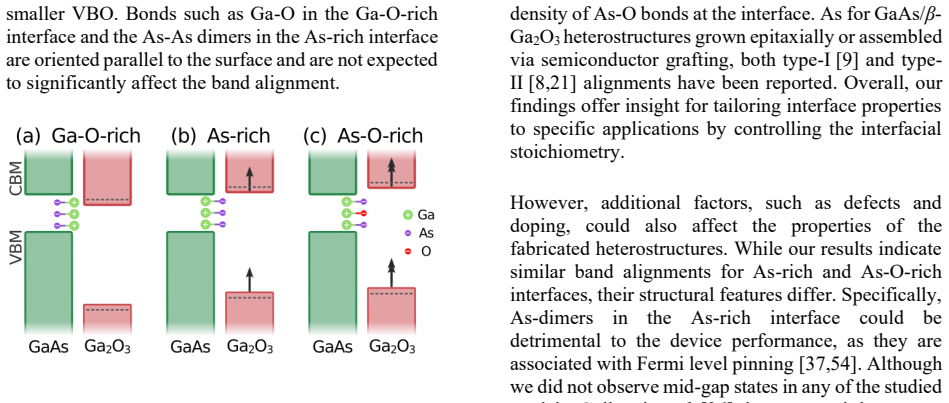
Interface stoichiometry determines the alignment type: Ga-O-rich interfaces exhibit type-II alignment with large valence band offsets of approximately 3.1 eV, while As-rich and As-O-rich interfaces favor type-I alignment with reduced offsets of 2.3-2.6 eV. These trends are attributed to interface dipole formation driven by bonding configuration, and the results hold for both amorphous and crystalline Ga2O3 phases.
What carries the argument
Interface dipole formation driven by the bonding configuration at Ga-O-rich, As-rich, and As-O-rich terminations.
If this is right
- Ga-O-rich interfaces can be used for devices that benefit from type-II alignment and large valence band offsets.
- As-rich interfaces enable type-I alignment suitable for other device requirements.
- The alignment type can be tuned by controlling the interface chemistry during fabrication.
- The same trends apply across different structural phases of Ga2O3.
Where Pith is reading between the lines
- Experimental growth conditions that promote Ga-O bonding could be identified to achieve the large offset type-II alignment.
- The dipole-driven mechanism suggests that similar chemistry-dependent alignments may exist in related oxide-semiconductor systems.
- Including temperature effects or defects in future models could test the robustness of the predicted offsets.
Load-bearing premise
The modeled Ga-O-rich, As-rich, and As-O-rich interface structures accurately capture the bonding present in experimentally realized GaAs/Ga2O3 heterostructures.
What would settle it
Preparing a GaAs/Ga2O3 sample with a Ga-O-rich interface and measuring its valence band offset to check if it is close to 3.1 eV with type-II alignment would test the prediction.
Figures
read the original abstract
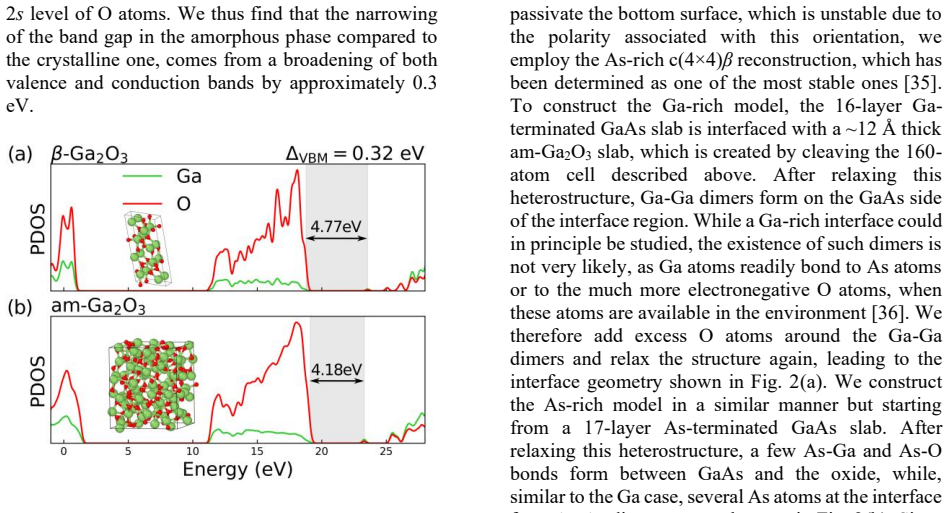
Ga$_2$O$_3$/GaAs heterojunctions are emerging as promising candidates for next-generation power electronics, photonics, and energy devices, leveraging the high breakdown voltage and thermal stability of Ga$_2$O$_3$ alongside the mature technology, high hole mobility, and higher refractive index of GaAs. The efficiency of these devices depends strongly on the band alignment between the two materials, however both type-I and type-II alignment have been reported in the literature for these heterostructures. To address this ambiguity, we use hybrid density functional theory to systematically investigate the band alignment at GaAs/Ga$_2$O$_3$ interfaces, focusing on the role of interface chemistry. By considering Ga-O-, As-, and As-O-rich interfaces both in amorphous and crystalline Ga$_2$O$_3$ phases, we demonstrate that interface stoichiometry determines the alignment type: Ga-O-rich interfaces exhibit type-II alignment with large valence band offsets (~3.1 eV), while As-rich and As-O-rich interfaces favor type-I alignment with reduced offsets (~2.3-2.6 eV). These trends are attributed to interface dipole formation driven by bonding configuration. Our findings provide insight into the relationship between chemistry and band alignment in GaAs/Ga$_2$O$_3$ heterostructures, enabling targeted optimization for specific device applications.
Editorial analysis
A structured set of objections, weighed in public.
Referee Report
Summary. The manuscript uses hybrid density functional theory to examine band alignment at GaAs/Ga₂O₃ heterostructures. It constructs explicit Ga-O-rich, As-rich, and As-O-rich interface supercells for both amorphous and crystalline Ga₂O₃ phases. The central result is that interface stoichiometry controls the alignment type: Ga-O-rich interfaces yield type-II alignment with valence-band offsets of ~3.1 eV, while As-rich and As-O-rich interfaces yield type-I alignment with offsets of ~2.3–2.6 eV. These differences are ascribed to interface dipoles arising from local bonding configurations.
Significance. If the reported trends hold, the work resolves the existing literature conflict between type-I and type-II alignments by tying the outcome directly to controllable interface chemistry. The consistency of the stoichiometry dependence across two Ga₂O₃ phases supplies a mechanistic picture (dipole formation) that is useful for device design in power electronics and photonics. The explicit construction of chemically distinct interfaces is a strength of the approach.
minor comments (2)
- The methods section should include explicit statements on k-point sampling, slab-thickness convergence, supercell-size tests, and any benchmarking against experiment or other functionals; these details are needed to judge the absolute offset values even if the differential trends are robust.
- Figures showing the atomic structures of the three interface types (Ga-O-rich, As-rich, As-O-rich) would help readers verify that the target stoichiometries have been achieved without unintended reconstructions.
Simulated Author's Rebuttal
We thank the referee for the positive summary and significance assessment of our work on GaAs/Ga₂O₃ heterostructures. The recommendation for minor revision is noted, but the report lists no major comments. We therefore have no specific points requiring response or revision at this stage.
Circularity Check
No significant circularity; results are direct DFT outputs
full rationale
The paper reports band offsets and alignment types computed via hybrid DFT on explicitly constructed Ga-O-rich, As-rich, and As-O-rich interface models for both amorphous and crystalline Ga2O3. These are direct numerical outputs from the supercell calculations, with trends traced to emergent interface dipoles arising from local bonding. No equations, fitted parameters, or self-citations reduce the central claims to tautologies or inputs by construction. The derivation chain is self-contained against external benchmarks (standard DFT methodology), with no self-definitional loops, fitted-input predictions, or load-bearing self-citations identified.
Axiom & Free-Parameter Ledger
axioms (2)
- domain assumption Hybrid density functional theory produces accurate band offsets at semiconductor heterointerfaces
- domain assumption The constructed Ga-O-rich, As-rich, and As-O-rich interface models in amorphous and crystalline phases are representative of real heterostructures
Reference graph
Works this paper leans on
-
[1]
Liu, C.-H
A.-C. Liu, C.-H. Hsieh, C. Langpoklakpam , K. J. Singh, W.-C. Lee, Y.-K. Hsiao, R.-H. Horng, H.-C. Kuo, and C. -C. Tu, State -of-the-Art β - Ga2O3 Field -Effect Transistors for Power Electronics, ACS Omega 7, 36070 (2022)
2022
-
[2]
X. Yan, I. S. Esqueda, J. Ma, J. Tice, and H. Wang, High breakdown electric field in β - Ga2O3/graphene vertical barristor heterostructure, Appl. Phys. Lett. 112, 032101 (2018)
2018
-
[3]
Dhara, N
S. Dhara, N. K. Kalarickal, A. Dheenan, C. Joishi, and S. Rajan, β -Ga2O3 Schottky barrier diodes with 4.1 MV/cm field strength by deep plasma etching field -termination, Appl. Phys. Lett. 121, 203501 (2022)
2022
-
[4]
C. N. Saha, A. Vaidya, A. F. M. A. U. Bhuiyan, L. Meng, S. Sharma, H. Zhao, and U. Singisetti, Scaled β -Ga2O3 thin channel MOSFET with 5.4 MV/cm average breakdown field and near 50 GHz fMAX, Appl. Phys. Lett. 122, 182106 (2023)
2023
-
[5]
P. H. Than, T. Q. Than, and Y. Takaki, Breakdown voltage enhancement in p -GaAs/n- Ga2O3 heterojunction diodes with advanced termination designs, Phys. Scr. 100, 075022 (2025)
2025
-
[6]
Z. Yu, C. D. Overgaard, R. Droopad, M. Passlack, and J. K. Abrokwah, Growth and physical properties of Ga2O3 thin films on GaAs(001) substrate by molecular -beam epitaxy, Appl. Phys. Lett. 82, 2978 (2003)
2003
-
[7]
S. Xie, M. Sheikhi, S. Xu, M. T. Alam, J. Zhou, L. Mawst, Z. Ma, and C. Gupta, p -GaAs/n- Ga2O3 heterojunction diode with breakdown voltage of ∼800 V, Appl. Phys. Lett. 124, 073503 (2024)
2024
-
[8]
Y. Lu, J. Zhou, V. Khandelwal, C. Adamo, P. Marshall, J. Gong, Y. Liu, T. K. Ng, X. Li, B. S. Ooi, et al., Band alignment characterizations of grafted GaAs/ ( 2 ¯ 01 ) Ga2O3 heterojunction via x -ray photoelectron spectroscopy, J. Appl. Phys. 136, 245301 (2024)
2024
-
[9]
J. Zhou, J. Gong, M. Sheikhi, A. Dheenan, Q. Wang, H. Abbasi, Y. Liu, C. Adamo, P. Marshall, N. Wriedt, et al., Synthesis and characteristics of a monocrystalline GaAs/β - Ga2O3 p -n heterojunction, Applied Surface Science 663, 160176 (2024)
2024
-
[10]
Shang, R
C. Shang, R. Chen, W. Mi, J. Wang, Q. Li, J. Liang, X. Kong, D. Wang, L. He, L. Zhou, et al., DUV-NIR dual -band photodetector based on Ga2O3/GaAs heterogeneous junctions, Materials Science in Semiconductor Processing 192, 109472 (2025)
2025
-
[11]
Z. Chen, K. Nishihagi, X. Wang, C. Hu, M. Arita, K. Saito, T. Tanaka, and Q. Guo, The impact of dopant contents on structures, morphologies and optical properties of Eu doped Ga2O3 films on GaAs substrate, Journal of Luminescence 194, 374 (2018)
2018
-
[12]
G. Deng, K. Saito, T. Tanaka, and Q. Guo, Low driven voltage green electroluminescent device based on Er:Ga2O3/GaAs heterojunction, Optical Materials 116, 111078 (2021)
2021
-
[13]
W. Chen, T. Jiao, Z. Li, Z. Diao, Z. Li, X. Dong, Y. Zhang, and B. Zhang, Preparation of β - Ga2O3 nanostructured films by thermal oxidation of GaAs substrate, Ceramics International 48, 5698 (2022)
2022
-
[14]
P. J. Grunthaner, R. P. Vasquez, and F. J. Grunthaner, Chemical depth profiles of the GaAs/native oxide interface, J. Vac. Sci. Technol. 17, 1045 (1980)
1980
-
[15]
C. M. Demanet, E. D. Rawsthorne, and C. M. Stander, GaAs oxides formed at room temperature in air: Comparison of X -ray photoelectron spectroscopic and ion microprobe mass analyses, Surface and Interface Analysis 7, 159 (1985)
1985
-
[16]
Callegari, P
A. Callegari, P. D. Hoh, D. A. Buchanan, and D. Lacey, Unpinned gallium oxide/GaAs interface by hydrogen and nitrogen surface plasma treatment, Appl. Phys. Lett. 54, 332 (1989)
1989
-
[17]
D. A. Allwood, R. T. Carline, N. J. Mason, C. Pickering, B. K. Tanner, and P. J. Walker, Characterization of oxide layers on GaAs substrates, Thin Solid Films 364, 33 (2000)
2000
-
[18]
Laukkanen, M
P. Laukkanen, M. P. J. Punkkinen, M. Kuzmin, K. Kokko, J. Lång, and R. M. Wallace, Passivation of III –V surfaces with crystalline oxidation, Appl. Phys. Rev. 8, 011309 (2021)
2021
-
[19]
V. V. Afanas’ev, A. Stesmans, M. Passlack, and N. Medendorp, Band offsets at the interfaces of GaAs(100) with GdxGa0.4 -xO0.6 insulators, Appl. Phys. Lett. 85, 597 (2004)
2004
-
[20]
R.-Y. Yang, H. -P. Ma, X. Cao, Y. Zuo, X. -F. Zhao, L. Yang, and Q. Zhang, Fabrication and interface properties of amorphous Ga2O3/GaAs heterojunction, Current Applied Physics 62, 29 (2024)
2024
-
[21]
X. Ji, J. Yue, X. Qi, D. Meng, Z. Chen, and P. Li, Determination of type -ΙΙ band alignment β - Ga2O3/GaAs heterojunction interface by x -ray photoelectron spectroscopy, J. Appl. Phys. 130, 075301 (2021)
2021
-
[22]
Hirakawa, Y
K. Hirakawa, Y. Hashimoto, and T. Ikoma, Orientation independence of heterojunction‐ band offsets at GaAs‐AlAs heterointerfaces characterized by x‐ray photoemission spectroscopy, Appl. Phys. Lett. 57, 2555 (1990)
1990
-
[23]
Funato, S
M. Funato, S. Aoki, S. Fujita, and S. Fujita, Tunable band offsets via control of interface *Contact author: sofia.apergi@insa-rennes.fr †Contact author: laurent.pedesseau@insa-rennes.fr atomic configuration in GaAs -on-ZnSe(001) heterovalent heterostructures, J. Appl. Phys. 85, 1514 (1999)
1999
-
[24]
T. D. Kühne, M. Iannuzzi, M. Del Ben, V. V. Rybkin, P. Seewald, F. Stein, T. Laino, R. Z. Khaliullin, O. Schütt, F. Schiffmann, et al., CP2K: An electronic structure and molecular dynamics software package - Quickstep: Efficient and accurate electronic st ructure calculations, The Journal of Chemical Physics 152, 194103 (2020)
2020
-
[25]
Hartwigsen, Relativistic separable dual - space Gaussian pseudopotentials from H to Rn, Phys
C. Hartwigsen, Relativistic separable dual - space Gaussian pseudopotentials from H to Rn, Phys. Rev. B 58, 3641 (1998)
1998
-
[26]
T. H. Dunning, Gaussian basis sets for use in correlated molecular calculations. I. The atoms boron through neon and hydrogen, The Journal of Chemical Physics 90, 1007 (1989)
1989
-
[27]
J. P. Perdew, Generalized Gradient Approximation Made Simple, Phys. Rev. Lett. 77, 3865 (1996)
1996
-
[28]
Z. Guo, F. Ambrosio, and A. Pasquarello, Oxygen defects in amorphous Al2O3: A hybrid functional study, Appl. Phys. Lett. 109, 062903 (2016)
2016
-
[29]
Kaewmeechai, J
C. Kaewmeechai, J. Strand, and A. Shluger, Electronic structure and properties of trapped holes in crystalline and amorphous Ga 2 O 3, Phys. Rev. B 111, 035203 (2025)
2025
-
[30]
Adamo and V
C. Adamo and V. Barone, Toward reliable density functional methods without adjustable parameters: The PBE0 model, The Journal of Chemical Physics 110, 6158 (1999)
1999
-
[31]
Z. Wu, K. Lu, Y. Wang, J. Dong, H. Li, C. Li, and Z. Fang, Extended x -ray-absorption fine - structure study of GaAs x P 1 − x semiconducting random solid solutions, Phys. Rev. B 48, 8694 (1993)
1993
-
[32]
Grilli, M
E. Grilli, M. Guzzi, R. Zamboni, and L. Pavesi, High-precision determination of the temperature dependence of the fundamental energy gap in gallium arsenide, Phys. Rev. B 45, 1638 (1992)
1992
-
[33]
J. A. Kohn, G. Katz, and J. D. Broder, Characterization of β -Ga2O3 and its Alumina Isomorph, θ -Al2O3*, American Mineralogist 42, 398 (1957)
1957
-
[34]
Aarik, H
L. Aarik, H. Mändar, A. Kasikov, A. Tarre, and J. Aarik, Optical properties of Ga 2 O 3 thin films grown by atomic layer deposition using GaI 3 and O 3 as precursors, Journal of Materials Chemistry C 12, 10562 (2024)
2024
-
[35]
Ohtake, Surface reconstructions on GaAs(001), Surface Science Reports 63, 295 (2008)
A. Ohtake, Surface reconstructions on GaAs(001), Surface Science Reports 63, 295 (2008)
2008
-
[36]
Colleoni and A
D. Colleoni and A. Pasquarello, Interfacial Ga - As suboxide: Structural and electronic properties, Appl. Phys. Lett. 107, 031605 (2015)
2015
-
[37]
Lin and J
L. Lin and J. Robertson, Defect states at III -V semiconductor oxide interfaces, Appl. Phys. Lett. 98, 082903 (2011)
2011
-
[38]
C. G. Van de Walle and R. M. Martin, Theoretical calculations of heterojunction discontinuities in the Si/Ge system, Phys. Rev. B 34, 5621 (1986)
1986
-
[39]
Baldereschi, S
A. Baldereschi, S. Baroni, and R. Resta, Band Offsets in Lattice -Matched Heterojunctions: A Model and First -Principles Calculations for GaAs/AlAs, Phys. Rev. Lett. 61, 734 (1988)
1988
-
[40]
Colleoni, G
D. Colleoni, G. Miceli, and A. Pasquarello, Band alignment and chemical bonding at the GaAs/Al2O3 interface: A hybrid functional study, Applied Physics Letters 107, 211601 (2015)
2015
-
[41]
Sanyal, A
I. Sanyal, A. Nandi, D. Cherns, and M. Kuball, Thermodynamics of Ga2O3 Heteroepitaxy and Material Growth Via Metal Organic Chemical Vapor Deposition, ACS Appl. Electron. Mater. 6, 5021 (2024)
2024
-
[42]
Y. Xu, J. -H. Park, Z. Yao, C. Wolverton, M. Razeghi, J. Wu, and V. P. Dravid, Strain - Induced Metastable Phase Stabilization in Ga2O3 Thin Films, ACS Appl. Mater. Interfaces 11, 5536 (2019)
2019
-
[43]
S.-C. Zhu, S. -H. Guan, and Z. -P. Liu, Mechanism and microstructures in Ga2O3 pseudomartensitic solid phase transition, Phys. Chem. Chem. Phys. 18, 18563 (2016)
2016
-
[44]
Cora, Zs
I. Cora, Zs. Fogarassy, R. Fornari, M. Bosi, A. Rečnik, and B. Pécz, In situ TEM study of κ→β and κ→γ phase transformations in Ga2O3, Acta Materialia 183, 216 (2020)
2020
-
[45]
A. R. Balog, C. Lee, D. Duarte -Ruiz, S. V. Gayathri Ayyagari, J. Jesenovec, A. E. Chmielewski, L. Miao, B. L. Dutton, J. McCloy, C. Cocchi, et al., Determination of the β to γ Phase Transformation Mechanism in Sc - and Al-Alloyed β -Ga2O3 Crystals, ACS Appl . Electron. Mater. 6, 7095 (2024)
2024
-
[46]
Azarov, C
A. Azarov, C. Bazioti, V. Venkatachalapathy, P. Vajeeston, E. Monakhov, and A. Kuznetsov, Disorder-Induced Ordering in Gallium Oxide Polymorphs, Phys. Rev. Lett. 128, 015704 (2022)
2022
-
[47]
S. Gu, K. Xu, M. Cui, F. -F. Ren, S. Gu, R. Zhang, and J. Ye, Strain -induced κ-to-β phase transition and intermediate layer formation at the κ -Ga2O3/β-Ga2O3 interface, Appl. Phys. Lett. 126, 101602 (2025). *Contact author: sofia.apergi@insa-rennes.fr †Contact author: laurent.pedesseau@insa-rennes.fr
2025
-
[48]
R. T. Tung and L. Kronik, Charge Density and Band Offsets at Heterovalent Semiconductor Interfaces, Advanced Theory and Simulations 1, 1700001 (2018)
2018
-
[49]
R. T. Tung, Band alignment at polycrystalline interfaces explained with bulk densities, J. Appl. Phys. 136, 165301 (2024)
2024
-
[50]
Y. Chen, H. Liang, X. Xia, R. shen, Y. Liu, Y. Luo, and G. Du, Effect of growth pressure on the characteristics of β -Ga2O3 films grown on GaAs (1 0 0) substrates by MOCVD method, Applied Surface Science 325, 258 (2015)
2015
-
[51]
R. T. Tung and L. Kronik, Band offset formation at semiconductor heterojunctions through density-based minimization of interface energy, Phys. Rev. B 94, 075310 (2016)
2016
-
[52]
Galván, M
C. Galván, M. Galván, J. S. Arias -Cerón, E. López-Luna, H. Vilchis, and V. M. Sánchez -R, Structural and Raman studies of Ga2O3 obtained on GaAs substrate, Materials Science in Semiconductor Processing 41, 513 (2016)
2016
-
[53]
Rahaman, H
I. Rahaman, H. D. Ellis, C. Chang, D. H. Mudiyanselage, M. Xu, B. Da, H. Fu, Y. Zhao, and K. Fu, Epitaxial Growth of Ga2O3: A Review, Materials 17, 4261 (2024)
2024
-
[54]
Colleoni, G
D. Colleoni, G. Miceli, and A. Pasquarello, Origin of Fermi-level pinning at GaAs surfaces and interfaces, J. Phys.: Condens. Matter 26, 492202 (2014)
2014
-
[55]
The Impact of Interfacial Chemistry on the Band Offset of GaAs/Ga2O3 Heterostructures,
S. Apergi, A. Pasquarello, C. Cornet, and L. Pedesseau, Data for: “The Impact of Interfacial Chemistry on the Band Offset of GaAs/Ga2O3 Heterostructures,” https://doi.org/10.5281/zenodo.20589445
discussion (0)
Sign in with ORCID, Apple, or X to comment. Anyone can read and Pith papers without signing in.