REVIEW 2 major objections 61 references
Representing acoustic metamaterials as sequences lets a generative model solve inverse design for broadband responses more accurately than image or template approaches.
Reviewed by Pith at T0; open to challenge. T0 means a machine referee read the full paper against a public rubric. the ladder, T0–T4 →
T0 review · grok-4.3
2026-06-27 15:13 UTC pith:OOC6TPST
load-bearing objection Sequence representation plus external-solver RL is a sensible step for AMM inverse design, but the 45% error reduction sits on thin reported evidence. the 2 major comments →
Physics-Guided Sequence-Based Generative Framework for Acoustic Metamaterial Inverse Design
The pith
A machine-rendered reading of the paper's core claim, the machinery that carries it, and where it could break.
Core claim
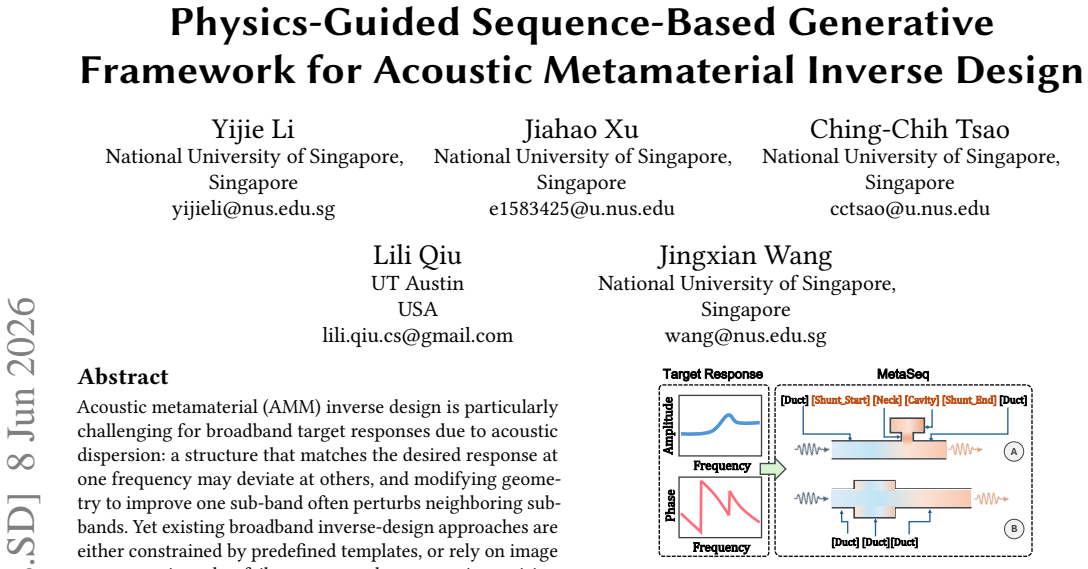
MetaSeq introduces a language that represents each acoustic metamaterial as a structured sequence, rather than as a pixel grid or fixed template. This representation preserves precise geometry, explicitly encodes connectivity, and casts inverse design as a sequence-to-sequence task from target response to structure sequence. MetaSeq further constructs a balanced, high-fidelity dataset with efficient calibration and complexity-based sampling, then combines supervised pretraining with reinforcement learning fine-tuning guided by a physics-based solver and validity checker.
What carries the argument
The sequence language for AMMs that preserves precise geometry and explicitly encodes connectivity, turning inverse design into a sequence-to-sequence generation task.
Load-bearing premise
The sequence language fully preserves the geometric precision and structural connectivity required for accurate acoustic performance.
What would settle it
Fabricate the top MetaSeq-generated structure and measure its actual transmission or reflection spectrum across the target band; if measured error exceeds the reported 45 percent reduction relative to the best baseline, the simulation-to-reality transfer claim fails.
If this is right
- Inverse design becomes possible directly from broadband target responses without being limited to predefined templates.
- Structural connectivity is maintained explicitly, avoiding the loss of acoustic paths that occurs in image-based encodings.
- Physics-solver feedback during reinforcement learning improves consistency across multiple frequencies simultaneously.
- Complexity-based sampling produces training data that better covers the space of manufacturable geometries.
Where Pith is reading between the lines
- The same sequence representation could be tested on other wave phenomena such as elastic or electromagnetic metamaterials where connectivity likewise governs performance.
- Extending the sequence vocabulary to three-dimensional or multi-material stacks would test whether the approach scales beyond planar designs.
- Because the method separates representation from the solver, it could be paired with faster surrogate models to reduce the cost of the RL fine-tuning stage.
Editorial analysis
A structured set of objections, weighed in public.
Referee Report
Summary. The paper introduces MetaSeq, a physics-guided sequence-based generative framework for inverse design of acoustic metamaterials targeting broadband responses. It proposes a structured sequence language to represent AMM geometries (claimed to preserve precise geometry and explicit connectivity better than image or template methods), constructs a balanced high-fidelity dataset via calibration and complexity-based sampling, and combines supervised pretraining with RL fine-tuning that uses an external physics solver and validity checker for rewards. The central empirical claim is that MetaSeq achieves a 45% reduction in response error relative to the best of five baselines, with validation against COMSOL simulations.
Significance. If the performance result and representation fidelity hold under detailed scrutiny, the work would offer a meaningful advance in handling acoustic dispersion for broadband AMM design by moving beyond constrained templates or lossy image encodings. The integration of physics-based guidance in the RL stage is a positive methodological feature, though the absence of supporting evaluation details currently limits assessment of its broader impact on the field.
major comments (2)
- [Abstract] Abstract: the headline claim that MetaSeq reduces response error by 45% over the best baseline is presented without error bars, dataset size, baseline implementation details, or description of how the 45% figure was computed. This information is load-bearing for the central performance claim and prevents checking for post-hoc choices or evaluation leakage.
- [Abstract] Abstract (representation introduction): the assertion that the sequence language 'preserves precise geometry, explicitly encodes connectivity, and overcomes the limitations of image-based or template-based methods' lacks any quantitative bound on representation error, enumeration of unrepresentable structures, or ablation removing the connectivity encoding. This is load-bearing for attributing the reported error reduction to the proposed method rather than to an incomplete search space.
Simulated Author's Rebuttal
We thank the referee for the constructive comments on our manuscript. We address each major comment point by point below and agree that the abstract requires strengthening to better support the central claims.
read point-by-point responses
-
Referee: [Abstract] Abstract: the headline claim that MetaSeq reduces response error by 45% over the best baseline is presented without error bars, dataset size, baseline implementation details, or description of how the 45% figure was computed. This information is load-bearing for the central performance claim and prevents checking for post-hoc choices or evaluation leakage.
Authors: We agree that the abstract as currently written does not contain these supporting details, which limits immediate verifiability of the headline result. The body of the manuscript reports the evaluation protocol, but to make the abstract self-contained we will revise it to state the dataset size, note that error bars are computed over multiple independent runs, briefly indicate how baselines were implemented, and describe the relative-error formula used for the 45% figure. This revision will be incorporated in the next version of the manuscript. revision: yes
-
Referee: [Abstract] Abstract (representation introduction): the assertion that the sequence language 'preserves precise geometry, explicitly encodes connectivity, and overcomes the limitations of image-based or template-based methods' lacks any quantitative bound on representation error, enumeration of unrepresentable structures, or ablation removing the connectivity encoding. This is load-bearing for attributing the reported error reduction to the proposed method rather than to an incomplete search space.
Authors: We acknowledge that the abstract presents the representation advantages without accompanying quantitative support or ablation evidence. The sequence encoding is constructed to be exact (zero representation error) for all geometries inside the considered design space, but the manuscript does not currently supply a numerical bound on error outside that space, an explicit enumeration of excluded structures, or a dedicated ablation on connectivity. We will therefore revise the abstract to qualify the claim and will add the requested quantitative discussion, enumeration, and ablation reference to the main text in the revised manuscript. revision: yes
Circularity Check
No significant circularity in derivation chain
full rationale
The paper introduces a sequence representation for AMMs and trains via supervised pretraining plus RL whose rewards come from an external physics solver and validity checker. The headline 45% error reduction is measured on COMSOL simulations against independent baselines, not re-expressed from quantities fitted inside the training loop or from self-citations. No self-definitional equations, fitted-input predictions, or load-bearing self-citation chains appear in the abstract or described method; the representation is presented as an engineering choice whose fidelity is asserted rather than derived by construction from the performance metric.
Axiom & Free-Parameter Ledger
read the original abstract
Acoustic metamaterial (AMM) inverse design is particularly challenging for broadband target responses due to acoustic dispersion: a structure that matches the desired response at one frequency may deviate at others, and modifying geometry to improve one sub-band often perturbs neighboring sub-bands. Yet existing broadband inverse-design approaches are either constrained by predefined templates, or rely on image representations that fail to preserve the geometric precision and structural connectivity required by acoustic structures. We present MetaSeq, a physics-guided, sequence-based generative framework for acoustic metamaterial inverse design. At its core, MetaSeq introduces a language that represents each AMM as a structured sequence, rather than as a pixel grid or fixed template. This representation preserves precise geometry, explicitly encodes connectivity, and casts inverse design as a sequence-to-sequence task from target response to structure sequence. MetaSeq further constructs a balanced, high-fidelity dataset with efficient calibration and complexity-based sampling. To address the one-to-many nature of inverse design, MetaSeq combines supervised pretraining with reinforcement learning fine-tuning guided by a physics-based solver and validity checker. Extensive evaluations against COMSOL and five baselines show that MetaSeq reduces response error by 45% over the best baseline.
Figures


Reference graph
Works this paper leans on
-
[1]
Inverse design of broadband acoustic metasurfaces for reflective wave- front modulation through the topology optimization method.Applied Acoustics, 204:109247, 2023
2023
-
[2]
Journal of Sound and Vibration, 596:118789, 2025
Acoustic structure inverse design and optimization using deep learning. Journal of Sound and Vibration, 596:118789, 2025
2025
-
[3]
Performance prediction and inverse design of cylindrical plate-type acoustic metamaterials based on deep learning.Applied Acoustics, 234:110633, 2025
2025
-
[4]
A new inverse design method for sound-absorbing metamaterial based on deep learning.Applied Acoustics, 241:111024, 2026
2026
-
[5]
Amirkulova, Peter Lai, and Diego Soto
Feruza A. Amirkulova, Peter Lai, and Diego Soto. Design of acoustic metamaterials using conditional wasserstein generative adversarial networks. InProceedings of the International Congress on Acoustics, 2022
2022
-
[6]
Multifunctional metasurface design with a generative adversarial network.Advanced optical materials, 9(5):2001433, 2021
Sensong An, Bowen Zheng, Hong Tang, Mikhail Y Shalaginov, Li Zhou, Hang Li, Myungkoo Kang, Kathleen A Richardson, Tian Gu, Juejun Hu, et al. Multifunctional metasurface design with a generative adversarial network.Advanced optical materials, 9(5):2001433, 2021
2021
-
[7]
Acous- tic metasurfaces.Nature Reviews Materials, 3:460–472, 2018
Badreddine Assouar, Bin Liang, Ying Wu, Yong Li, and Yun Jing. Acous- tic metasurfaces.Nature Reviews Materials, 3:460–472, 2018
2018
-
[8]
Bendsøe and Ole Sigmund.Topology Optimization: Theory, Methods, and Applications
Martin P. Bendsøe and Ole Sigmund.Topology Optimization: Theory, Methods, and Applications. Springer, 2004
2004
-
[9]
Wright, and Sam H
Eun Bok, Jong Jin Park, Haejin Choi, Chung Kyu Han, Oliver B. Wright, and Sam H. Lee. Metasurface for water-to-air sound transmission. Physical Review Letters, 120(4):044302, 2018
2018
-
[10]
John Wiley & Sons, 2013
Michel Bruneau.Fundamentals of acoustics. John Wiley & Sons, 2013
2013
-
[11]
Collision detection using axis aligned bounding boxes
Panpan Cai, Chandrasekaran Indhumathi, Yiyu Cai, Jianmin Zheng, Yi Gong, Teng Sam Lim, and Peng Wong. Collision detection using axis aligned bounding boxes. InSimulations, Serious Games and Their Applications, pages 1–14. Springer, 2013
2013
-
[12]
A unified approach to parallel depth-first traversals of general trees.Information Processing Letters, 38(1):49–55, 1991
Calvin C-Y Chen, Sajal K Das, and Selim G Akl. A unified approach to parallel depth-first traversals of general trees.Information Processing Letters, 38(1):49–55, 1991
1991
-
[13]
Broadband acoustic focusing by airy-like beams based on acoustic metasurfaces.Journal of Applied Physics, 123(4), 2018
Di-Chao Chen, Xing-Feng Zhu, Qi Wei, Da-Jian Wu, and Xiao-Jun Liu. Broadband acoustic focusing by airy-like beams based on acoustic metasurfaces.Journal of Applied Physics, 123(4), 2018
2018
-
[14]
Approximation by superpositions of a sigmoidal function.Mathematics of control, signals and systems, 2(4):303–314, 1989
George Cybenko. Approximation by superpositions of a sigmoidal function.Mathematics of control, signals and systems, 2(4):303–314, 1989
1989
-
[15]
Bert: Pre-training of deep bidirectional transformers for language understanding
Jacob Devlin, Ming-Wei Chang, Kenton Lee, and Kristina Toutanova. Bert: Pre-training of deep bidirectional transformers for language understanding. InProceedings of the 2019 conference of the North American chapter of the association for computational linguistics: human language technologies, volume 1 (long and short papers), pages 4171– 4186, 2019
2019
-
[16]
Acoustic metamateri- als.MRS bulletin, 33(10):931–934, 2008
Lee Fok, Muralidhar Ambati, and Xiang Zhang. Acoustic metamateri- als.MRS bulletin, 33(10):931–934, 2008
2008
-
[17]
Adaptive metasurface-based acoustic imaging using joint optimization
Yongjian Fu, Yongzhao Zhang, Yu Lu, Lili Qiu, Yi-Chao Chen, Yezhou Wang, Mei Wang, Yijie Li, Ju Ren, and Yaoxue Zhang. Adaptive metasurface-based acoustic imaging using joint optimization. InPro- ceedings of the 22nd Annual International Conference on Mobile Systems, Applications and Services, pages 492–504, 2024
2024
-
[18]
Pushing the limits of acoustic spatial perception via incident angle encoding.Pro- ceedings of the ACM on Interactive, Mobile, Wearable and Ubiquitous Technologies, 8(2):1–28, 2024
Yongjian Fu, Yongzhao Zhang, Hao Pan, Yu Lu, Xinyi Li, Lili Chen, Ju Ren, Xiong Li, Xiaosong Zhang, and Yaoxue Zhang. Pushing the limits of acoustic spatial perception via incident angle encoding.Pro- ceedings of the ACM on Interactive, Mobile, Wearable and Ubiquitous Technologies, 8(2):1–28, 2024
2024
-
[19]
Linear hinge loss and average margin.Advances in neural information processing systems, 11, 1998
Claudio Gentile and Manfred KK Warmuth. Linear hinge loss and average margin.Advances in neural information processing systems, 11, 1998
1998
-
[20]
A phase- gradient acoustic metasurface for broadband duct noise attenuation in the presence of flow.International Journal of Mechanical Sciences, 237:107822, 2023
Jingwen Guo, Renhao Qu, Yi Fang, Wei Yi, and Xin Zhang. A phase- gradient acoustic metasurface for broadband duct noise attenuation in the presence of flow.International Journal of Mechanical Sciences, 237:107822, 2023
2023
-
[21]
Matrix formulation in acoustics: the transfer matrix method
Iván Herrero Durá, Alejandro Cebrecos Ruiz, Luis Miguel García Raffi, and Vicente Romero-García. Matrix formulation in acoustics: the transfer matrix method. 2019
2019
-
[22]
Adap- tive genetic algorithm for optical metasurfaces design.Scientific reports, 8(1):11040, 2018
Samad Jafar-Zanjani, Sandeep Inampudi, and Hossein Mosallaei. Adap- tive genetic algorithm for optical metasurfaces design.Scientific reports, 8(1):11040, 2018
2018
-
[23]
Topology optimization for nano-photonics.Laser & Photonics Reviews, 5(2):308–321, 2011
Jakob Søndergaard Jensen and Ole Sigmund. Topology optimization for nano-photonics.Laser & Photonics Reviews, 5(2):308–321, 2011
2011
-
[24]
Genetic algorithms in engi- neering electromagnetics.IEEE Antennas and propagation Magazine, 39(4):7–21, 1997
J Michael Johnson and V Rahmat-Samii. Genetic algorithms in engi- neering electromagnetics.IEEE Antennas and propagation Magazine, 39(4):7–21, 1997. Conference’17, July 2017, Washington, DC, USA , Yijie Li, Jiahao Xu, Ching-Chih Tsao, Lili Qiu, and Jingxian Wang
1997
-
[25]
Minhyeok Lee. Gelu activation function in deep learning: a com- prehensive mathematical analysis and performance.arXiv preprint arXiv:2305.12073, 2023
-
[26]
Binary codes capable of correcting dele- tions, insertions, and reversals
Vladimir I Levenshtein et al. Binary codes capable of correcting dele- tions, insertions, and reversals. InSoviet physics doklady, volume 10, pages 707–710. Soviet Union, 1966
1966
-
[27]
Cum- mer
Dennis Li, Lucian Zigoneanu, Bogdan-Ioan Popa, and Steven A. Cum- mer. Design of an acoustic metamaterial lens using genetic algorithms. The Journal of the Acoustical Society of America, 132(4):2823–2833, 2012
2012
-
[28]
On sampling top-k recommendation evaluation
Dong Li, Ruoming Jin, Jing Gao, and Zhi Liu. On sampling top-k recommendation evaluation. InProceedings of the 26th ACM SIGKDD International Conference on Knowledge Discovery & Data Mining, pages 2114–2124, 2020
2020
-
[29]
Sound insulation performance of double membrane-type acoustic metamateri- als combined with a helmholtz resonator.Applied Acoustics, 205:109297, 2023
Hong-Ze Li, Xu-Chang Liu, Qi Liu, Shuang Li, Jin-Shui Yang, Li-Li Tong, Sheng-Bo Shi, Rüdiger Schmidt, and Kai-Uwe Schröder. Sound insulation performance of double membrane-type acoustic metamateri- als combined with a helmholtz resonator.Applied Acoustics, 205:109297, 2023
2023
-
[30]
Mudis: An audio-independent, wide-angle, and leak-free multi-directional speaker
Yijie Li, Juntao Zhou, Dian Ding, Yi-Chao Chen, Lili Qiu, Jiadi Yu, and Guangtao Xue. Mudis: An audio-independent, wide-angle, and leak-free multi-directional speaker. InProceedings of the 30th Annual International Conference on Mobile Computing and Networking, pages 263–278, 2024
2024
-
[31]
Acoustic metasurface-based perfect absorber with deep subwavelength thickness.Applied Physics Letters, 108(6):063502, 2016
Yong Li and Badreddine Assouar. Acoustic metasurface-based perfect absorber with deep subwavelength thickness.Applied Physics Letters, 108(6):063502, 2016
2016
-
[32]
Extreme acoustic metamaterial by coiling up space.Physical review letters, 108(11):114301, 2012
Zixian Liang and Jensen Li. Extreme acoustic metamaterial by coiling up space.Physical review letters, 108(11):114301, 2012
2012
-
[33]
Achromatic transmitted acoustic lens arrayed by cascaded helmholtz resonators.Applied Physics Express, 16(1):014004, 2023
Cheng Lü, Shuai Tang, Jin-Lei Wu, Yanbo Pei, and Yongyuan Jiang. Achromatic transmitted acoustic lens arrayed by cascaded helmholtz resonators.Applied Physics Express, 16(1):014004, 2023
2023
-
[34]
Deep learning-based design method for acoustic metasurface dual- feature fusion.Materials, 17(9):2166, 2024
Qiang Lv, Huanlong Zhao, Zhen Huang, Guoqiang Hao, and Wei Chen. Deep learning-based design method for acoustic metasurface dual- feature fusion.Materials, 17(9):2166, 2024
2024
-
[35]
Acoustic metasurface with hybrid resonances.Nature Materials, 13:873–878, 2014
Guancong Ma, Mengxin Yang, Shu Xiao, Zhaoxiong Yang, and Ping Sheng. Acoustic metasurface with hybrid resonances.Nature Materials, 13:873–878, 2014
2014
-
[36]
Deep learning for the design of photonic structures.Nature photonics, 15(2):77–90, 2021
Wei Ma, Zhaocheng Liu, Zhaxylyk A Kudyshev, Alexandra Boltasseva, Wenshan Cai, and Yongmin Liu. Deep learning for the design of photonic structures.Nature photonics, 15(2):77–90, 2021
2021
-
[37]
Piggott, Weiliang Jin, Jelena Vuck- ović, and Alejandro W
Sean Molesky, Zin Lin, Alexander Y. Piggott, Weiliang Jin, Jelena Vuck- ović, and Alejandro W. Rodriguez. Inverse design in nanophotonics. Nature Photonics, 12(11):659–670, 2018
2018
-
[38]
A portable and stealthy inaudible voice attack based on acoustic metamaterials.IEEE Transactions on Information Forensics and Security, 2025
Zhiyuan Ning, Juan He, Zhanyong Tang, Weihang Hu, and Xiaojiang Chen. A portable and stealthy inaudible voice attack based on acoustic metamaterials.IEEE Transactions on Information Forensics and Security, 2025
2025
-
[39]
Metaguardian: Enhancing voice assistant security through advanced acoustic meta- materials
Zhiyuan Ning, Zheng Wang, and Zhanyong Tang. Metaguardian: Enhancing voice assistant security through advanced acoustic meta- materials. InProceedings of the 31st Annual International Conference on Mobile Computing and Networking, pages 788–801, 2025
2025
-
[40]
Topology optimization of acous- tic metasurfaces by using a two-scale homogenization method.Applied Mathematical Modelling, 98:465–497, 2021
Yuki Noguchi and Takayuki Yamada. Topology optimization of acous- tic metasurfaces by using a two-scale homogenization method.Applied Mathematical Modelling, 98:465–497, 2021
2021
-
[41]
Multilayer perceptron and neural networks.WSEAS transactions on circuits and systems, 8(7):579–588, 2009
Marius-Constantin Popescu, Valentina E Balas, Liliana Perescu- Popescu, and Nikos Mastorakis. Multilayer perceptron and neural networks.WSEAS transactions on circuits and systems, 8(7):579–588, 2009
2009
-
[42]
Broadband sound absorption using multiple hybrid resonances of acoustic metasurfaces.International Journal of Mechanical Sciences, 229:107508, 2022
Hyeonbin Ryoo and Wonju Jeon. Broadband sound absorption using multiple hybrid resonances of acoustic metasurfaces.International Journal of Mechanical Sciences, 229:107508, 2022
2022
-
[43]
Learning to modulate pre-trained models in rl.Advances in Neural Information Processing Systems, 36:38231–38265, 2023
Thomas Schmied, Markus Hofmarcher, Fabian Paischer, Razvan Pas- canu, and Sepp Hochreiter. Learning to modulate pre-trained models in rl.Advances in Neural Information Processing Systems, 36:38231–38265, 2023
2023
-
[44]
DeepSeekMath: Pushing the Limits of Mathematical Reasoning in Open Language Models
Zhihong Shao, Peiyi Wang, Qihao Zhu, Runxin Xu, Junxiao Song, Xiao Bi, Haowei Zhang, Mingchuan Zhang, YK Li, Yang Wu, et al. Deepseekmath: Pushing the limits of mathematical reasoning in open language models.arXiv preprint arXiv:2402.03300, 2024
work page internal anchor Pith review Pith/arXiv arXiv 2024
-
[45]
Nelder-mead algorithm.Scholarpedia, 4(7):2928, 2009
Saša Singer and John Nelder. Nelder-mead algorithm.Scholarpedia, 4(7):2928, 2009
2009
-
[46]
Numeracy for language models: Evaluating and improving their ability to predict numbers
Georgios Spithourakis and Sebastian Riedel. Numeracy for language models: Evaluating and improving their ability to predict numbers. In Proceedings of the 56th Annual Meeting of the Association for Computa- tional Linguistics (Volume 1: Long Papers), pages 2104–2115, 2018
2018
-
[47]
Broad- band acoustic focusing via binary rectangular cavity/helmholtz res- onator metasurface.Journal of Applied Physics, 129(15), 2021
Shuai Tang, Bin Ren, Yuxin Feng, Jie Song, and Yongyuan Jiang. Broad- band acoustic focusing via binary rectangular cavity/helmholtz res- onator metasurface.Journal of Applied Physics, 129(15), 2021
2021
-
[48]
Attention is all you need.Advances in neural information processing systems, 30, 2017
Ashish Vaswani, Noam Shazeer, Niki Parmar, Jakob Uszkoreit, Llion Jones, Aidan N Gomez, Łukasz Kaiser, and Illia Polosukhin. Attention is all you need.Advances in neural information processing systems, 30, 2017
2017
-
[49]
Metasonic: Advancing robot localization with directional embedded acoustic signals.IEEE Robotics and Automation Letters, 2025
Junling Wang, Zhenlin An, and Yi Guo. Metasonic: Advancing robot localization with directional embedded acoustic signals.IEEE Robotics and Automation Letters, 2025
2025
-
[50]
Wavefront modulation and sub- wavelength diffractive acoustics with an acoustic metasurface.Nature communications, 5(1):5553, 2014
Yangbo Xie, Wenqi Wang, Huanyang Chen, Adam Konneker, Bogdan- Ioan Popa, and Steven A Cummer. Wavefront modulation and sub- wavelength diffractive acoustics with an acoustic metasurface.Nature communications, 5(1):5553, 2014
2014
-
[51]
Inverse design on customised absorption of acoustic metamaterials with high degrees of freedom by deep learning.Mechanical Systems and Signal Processing, 237:112989, 2025
Jiahui Yan, Yingli Li, Guohui Yin, Song Yao, Yong Peng, et al. Inverse design on customised absorption of acoustic metamaterials with high degrees of freedom by deep learning.Mechanical Systems and Signal Processing, 237:112989, 2025
2025
-
[52]
Development of adjustable paral- lel helmholtz acoustic metamaterial for broad low-frequency sound absorption band.Materials, 15(17):5938, 2022
Xiaocui Yang, Fei Yang, Xinmin Shen, Enshuai Wang, Xiaonan Zhang, Cheng Shen, and Wenqiang Peng. Development of adjustable paral- lel helmholtz acoustic metamaterial for broad low-frequency sound absorption band.Materials, 15(17):5938, 2022
2022
-
[53]
Flat optics with designer metasur- faces.Nature materials, 13(2):139–150, 2014
Nanfang Yu and Federico Capasso. Flat optics with designer metasur- faces.Nature materials, 13(2):139–150, 2014
2014
-
[54]
Learning to inversely design acoustic metamaterials for enhanced performance
Hongjia Zhang, Jiawei Liu, Weitong Ma, Haitao Yang, Yang Wang, Haibin Yang, Honggang Zhao, Dianlong Yu, and Jihong Wen. Learning to inversely design acoustic metamaterials for enhanced performance. Acta Mechanica Sinica, 39(7):722426, 2023
2023
-
[55]
Remote whispering metamaterial for non-radiative transceiving of ultra-weak sound.Nature Communications, 12(1):3670, 2021
Jin Zhang, Wei Rui, Chengrong Ma, Ying Cheng, Xiaojun Liu, and Johan Christensen. Remote whispering metamaterial for non-radiative transceiving of ultra-weak sound.Nature Communications, 12(1):3670, 2021
2021
-
[56]
A Survey of Large Language Models
Wayne Xin Zhao, Kun Zhou, Junyi Li, Tianyi Tang, Xiaolei Wang, Yupeng Hou, Yingqian Min, Beichen Zhang, Junjie Zhang, Zican Dong, et al. A survey of large language models.arXiv preprint arXiv:2303.18223, 1(2):1–124, 2023
work page internal anchor Pith review Pith/arXiv arXiv 2023
-
[57]
Metagen: Llm-driven generative framework for intelligent metasurface element
Yizhe Zhao, Lili Chen, Xinyi Li, Yue-Jiang Dong, Ju Ren, and Yaoxue Zhang. Metagen: Llm-driven generative framework for intelligent metasurface element. InProceedings of the 23rd Annual International Conference on Mobile Systems, Applications and Services, pages 333–346, 2025
2025
-
[58]
M2silent: Enabling multi-user silent speech interactions via multi-directional speakers in shared spaces
Juntao Zhou, Dian Ding, Yijie Li, Yu Lu, Yida Wang, Yongzhao Zhang, Yi-Chao Chen, and Guangtao Xue. M2silent: Enabling multi-user silent speech interactions via multi-directional speakers in shared spaces. In Proceedings of the 2025 CHI Conference on Human Factors in Computing Systems, pages 1–19, 2025
2025
-
[59]
Reverse design of broadband sound absorption structure based on deep learning method
Yihong Zhou, Lifeng Ma, Xi Kang, and Zhiyuan Zhu. Reverse design of broadband sound absorption structure based on deep learning method. Physics-Guided Sequence-Based Generative Framework for Acoustic Metamaterial Inverse Design Conference’17, July 2017, Washington, DC, USA Scientific Reports, 15:1946, 2025
2017
-
[60]
Al- gorithm 778: L-bfgs-b: Fortran subroutines for large-scale bound- constrained optimization.ACM Transactions on mathematical software (TOMS), 23(4):550–560, 1997
Ciyou Zhu, Richard H Byrd, Peihuang Lu, and Jorge Nocedal. Al- gorithm 778: L-bfgs-b: Fortran subroutines for large-scale bound- constrained optimization.ACM Transactions on mathematical software (TOMS), 23(4):550–560, 1997
1997
-
[61]
Parameter prediction and inverse design of metamaterial acoustic absorber based on artificial neural network.Acta Acustica, 50(2):257–267, 2025
Yuanzhou Zhu, Chun Gong, Ye Gu, Houyou Long, Ying Cheng, and Xiaojun Liu. Parameter prediction and inverse design of metamaterial acoustic absorber based on artificial neural network.Acta Acustica, 50(2):257–267, 2025. A Overlap Checker The overlap checker is a geometric validation algorithm (Algo. 1) designed to verify the spatial feasibility of a struc-...
2025
discussion (0)
Sign in with ORCID, Apple, or X to comment. Anyone can read and Pith papers without signing in.