Quantum Reference Fields Transformations in Linearized Quantum Gravity
Pith reviewed 2026-06-27 15:34 UTC · model grok-4.3
The pith
In linearized quantum gravity, unitary transformations between quantum reference field perspectives implement local quantum coordinate changes analogous to diffeomorphisms with quantum gauge parameters.
A machine-rendered reading of the paper's core claim, the machinery that carries it, and where it could break.
Core claim
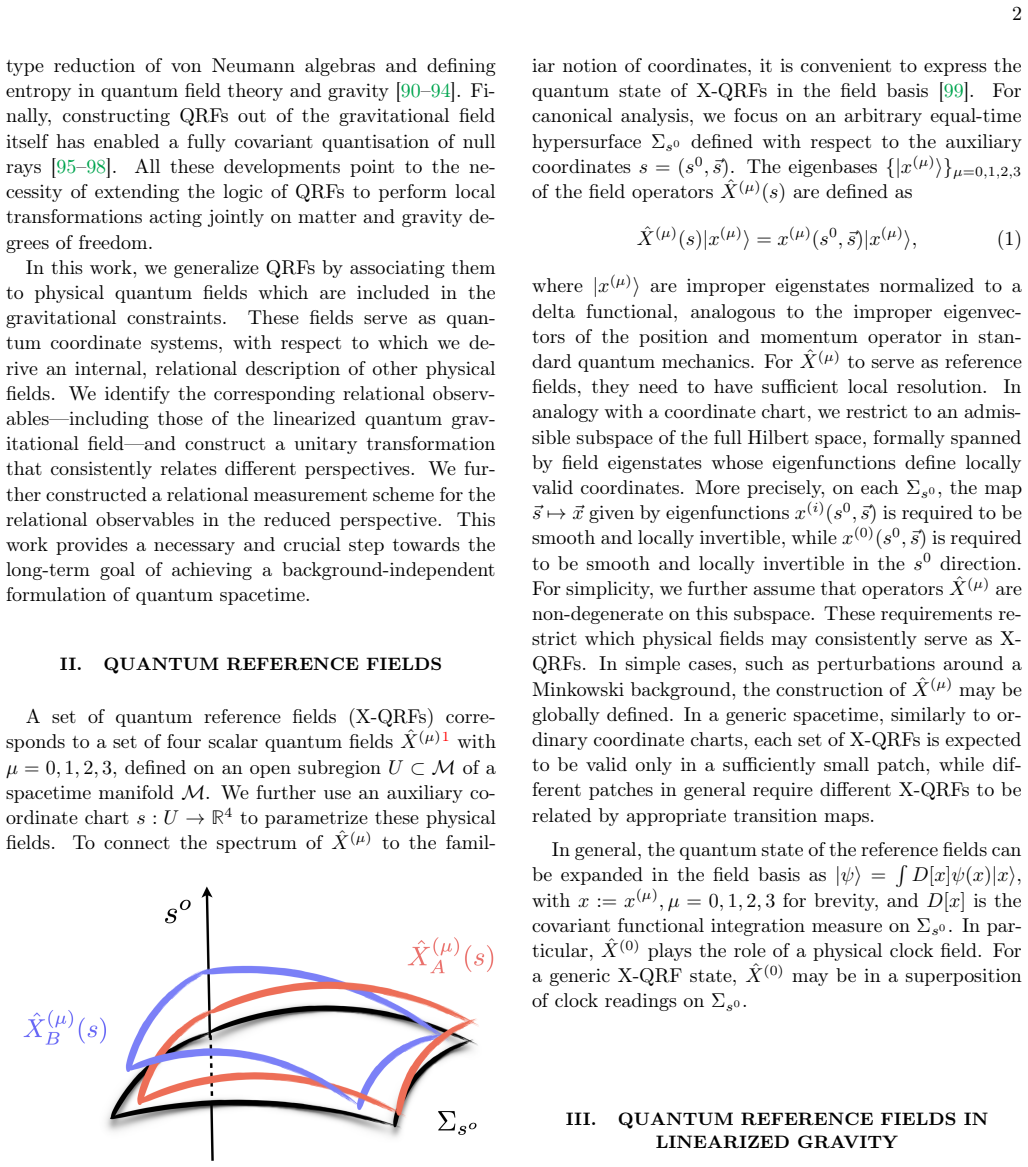
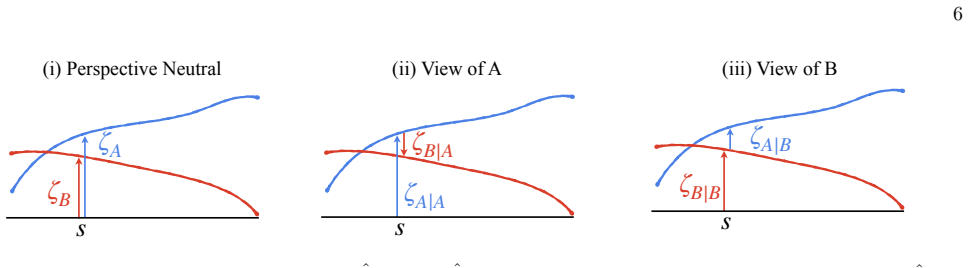
Quantum reference fields, defined as four dynamical scalar fields entering the constraints, permit reduced descriptions of relational observables in each perspective. The unitary transformations connecting these perspectives act on the linearized gravitational field in a manner structurally analogous to a linearized diffeomorphism, except that the classical gauge parameter is replaced by a physical quantum field.
What carries the argument
The unitary transformations relating the reduced descriptions in different quantum reference field perspectives, which implement local quantum coordinate changes on the gravitational field.
If this is right
- Relational gauge-invariant observables admit reduced descriptions from the perspective of each of the four quantum reference fields.
- The unitary maps act on the linearized gravitational field with the structure of a diffeomorphism whose parameter is a quantum field.
- A relational von Neumann measurement scheme allows operational access to the reduced observables from within one quantum reference field perspective.
- Matter and gravitational degrees of freedom can be specified entirely relationally with respect to internal quantum systems.
Where Pith is reading between the lines
- Similar unitary maps could be derived in other gauge theories if dynamical scalar fields are used as references.
- The construction might connect to clock-based relational approaches by providing explicit transformations between field perspectives.
- If the scalar fields interact with other matter, new constraints on their stress-energy tensors could appear in the reduction process.
Load-bearing premise
The perspective-neutral construction of quantum reference frames applies directly to four dynamical scalar fields whose stress-energy tensors enter the gravitational constraints, without extra consistency conditions or modifications to the dynamics.
What would settle it
A explicit calculation showing that the derived unitary maps fail to preserve gauge invariance of the observables or do not produce the expected diffeomorphism-like action on the gravitational perturbations would falsify the claim.
Figures
read the original abstract
Diffeomorphism invariance is a central feature of general relativity. Without external reference structures, matter and geometry must be specified relationally, with respect to internal subsystems serving as reference frames. In quantum gravity, these reference systems must themselves be treated as quantum, motivating the use of quantum reference frames. In this work, we address how such a relational description could be formulated within linearized quantum gravity. To this purpose, we introduce quantum reference fields, i.e. sets of four dynamical scalar fields whose stress-energy tensors enter the gravitational constraints. These fields extend the notion of quantum reference frames to local field-theoretic reference systems, allowing matter and gravitational degrees of freedom to be described relationally with respect to physical quantum systems. By generalizing the perspective-neutral construction of quantum reference frames, we show that relational, gauge invariant observables admit reduced descriptions in the perspective of each quantum reference field, and we derive the unitary transformations relating them. The resulting unitary maps implement local quantum coordinate changes between different internal perspectives, and act on the linearized gravitational field with an analogous structure to a linearized diffeomorphism, but with the classical gauge parameter replaced by a physical quantum field. Finally, we construct a relational von Neumann-type measurement scheme, showing how the corresponding reduced observables can be accessed operationally from the perspective of a quantum reference field.
Editorial analysis
A structured set of objections, weighed in public.
Referee Report
Summary. The paper introduces 'quantum reference fields' as four dynamical scalar fields whose stress-energy tensors enter the linearized gravitational constraints. It generalizes the perspective-neutral quantum reference frame construction to derive reduced descriptions of relational, gauge-invariant observables from the perspective of each such field, obtains unitary transformations between these perspectives that implement local quantum coordinate changes, and shows that these unitaries act on the linearized gravitational field in a manner analogous to a linearized diffeomorphism but with the gauge parameter replaced by a physical quantum field. A relational von Neumann-type measurement scheme is also constructed to access the reduced observables operationally.
Significance. If the central technical steps hold, the result would provide a concrete relational framework for describing matter and geometry with respect to internal quantum field-theoretic references in linearized quantum gravity. The explicit construction of the unitary maps and the operational measurement scheme would constitute a non-trivial extension of existing QRF methods, potentially enabling new calculations of perspective-dependent effects in quantum gravity.
major comments (2)
- [Construction of quantum reference fields and reduced descriptions] The central claim that the perspective-neutral construction generalizes directly to four dynamical scalar fields (with their stress-energy tensors inserted into the constraints) requires that the constraint algebra closes without extra terms or modifications to the linearized dynamics. No explicit verification of this closure or of the preservation of the physical state space under the operator-valued references is supplied; this is load-bearing for the existence of the reduced descriptions and the unitary maps.
- [Unitary transformations between perspectives] The claimed analogy between the derived unitary transformations and linearized diffeomorphisms (with classical gauge parameter replaced by a quantum field) must be shown to preserve the correct action on the metric and matter perturbations while remaining consistent with the linearized constraints. The manuscript should demonstrate this explicitly, including the commutation relations or explicit operator action on the fields.
minor comments (2)
- Notation for the quantum reference fields and their stress-energy tensors should be introduced with explicit definitions early in the text to aid readability.
- The abstract and introduction would benefit from a brief statement of the key technical assumption (constraint algebra closure) that enables the generalization.
Simulated Author's Rebuttal
We thank the referee for their careful reading of the manuscript and for the constructive comments, which help clarify the presentation of our results. We address each major comment below and will revise the manuscript to incorporate the requested explicit verifications.
read point-by-point responses
-
Referee: [Construction of quantum reference fields and reduced descriptions] The central claim that the perspective-neutral construction generalizes directly to four dynamical scalar fields (with their stress-energy tensors inserted into the constraints) requires that the constraint algebra closes without extra terms or modifications to the linearized dynamics. No explicit verification of this closure or of the preservation of the physical state space under the operator-valued references is supplied; this is load-bearing for the existence of the reduced descriptions and the unitary maps.
Authors: We agree that an explicit verification of constraint algebra closure would strengthen the manuscript. The perspective-neutral framework assumes a first-class constraint system, and the insertion of the scalar fields' stress-energy tensors preserves this structure in the linearized regime. In the revised version, we will add an appendix providing the explicit computation of the relevant commutators (or Poisson brackets in the classical limit) of the modified constraints, confirming closure without extraneous terms and the invariance of the physical state space under the operator-valued references. revision: yes
-
Referee: [Unitary transformations between perspectives] The claimed analogy between the derived unitary transformations and linearized diffeomorphisms (with classical gauge parameter replaced by a quantum field) must be shown to preserve the correct action on the metric and matter perturbations while remaining consistent with the linearized constraints. The manuscript should demonstrate this explicitly, including the commutation relations or explicit operator action on the fields.
Authors: We appreciate the request for greater explicitness on this point. The unitaries are derived within the relational, gauge-invariant construction, which ensures consistency with the constraints by construction. In the revision, we will include additional calculations demonstrating the explicit action of these unitaries on the metric perturbations and matter fields, verifying the analogy to a linearized diffeomorphism with the quantum reference field serving as the gauge parameter. Relevant commutation relations will also be provided to illustrate the operator-level implementation. revision: yes
Circularity Check
Minor self-citation in generalizing perspective-neutral QRF construction; derivation remains independent of fitted inputs or definitional loops.
full rationale
The paper's central step is a direct generalization of the perspective-neutral QRF construction to four dynamical scalar fields whose stress-energy tensors enter the constraints. This generalization is stated without reduction of the resulting unitary maps or reduced observables to any fitted parameter or self-referential definition. No equation equates a derived quantity to an input by construction, and the abstract supplies no indication that the constraint algebra closure or physical state space preservation is smuggled in via self-citation. The skeptic concern identifies an assumption rather than a circular reduction. This yields a low circularity score consistent with normal self-citation that is not load-bearing.
Axiom & Free-Parameter Ledger
axioms (2)
- domain assumption Diffeomorphism invariance requires relational descriptions with respect to internal subsystems.
- ad hoc to paper The perspective-neutral construction of quantum reference frames extends to local field-theoretic reference systems.
invented entities (1)
-
quantum reference fields
no independent evidence
Reference graph
Works this paper leans on
-
[1]
The spatial derivative of the source is small∂j ˆT 0i(⃗ s′)∼ O(h 2) 15
-
[2]
quantum coordinates
Thevalueofquantumreferencefieldisveryclosetothebackgroundcoordinatecharts: ˆζ(j) = ˆX(j) −sjˆ1∼ O(h). If one of the above conditions is satisfied, the second commutator h ˆK, h ˆK, ˆCi(⃗ s) ii vanishes within our order of approximation. We obtain, at anys0 ˆTA · ˆCi(s)· ˆT † A = ˆT 0i A (s) (1− O(h)).(D9) A similar derivation holds for the scalar constrai...
-
[3]
The setup is the following:
Brief introduction to Von Neumann measurement scheme In quantum mechanics, the von Neumann (vN) measurement scheme provides a way to understand the measurement procedure by coupling a measurement device, sayM, to the systemSone wants to measure. The setup is the following:
-
[4]
Long before the measurement starts, the quantum state ofMandSare prepared in a product state, i.e.ˆωM 0 ⊗ˆρS, whereˆωM 0 is a fiducial state that is chosen conveniently depending on the physical situation
-
[5]
This can be written using a Hamiltonian formulation as ˆHint = ˆOM Sδ(t−t 0), where ˆOM S is the joint observable onMandS
At some timet0, an impulsive interaction couplesMandS. This can be written using a Hamiltonian formulation as ˆHint = ˆOM Sδ(t−t 0), where ˆOM S is the joint observable onMandS. Notice that the action of ˆHint can be 21 written on the state as CM S ˆωM 0 ⊗ˆρS = ← −T e− i ℏ R dt ˆHint(t) ˆωM 0 ⊗ˆρS − →T e i ℏ R dt ˆHint(t) = =e − i ℏ ˆOM S ˆωM 0 ⊗ˆρS e i ℏ...
-
[6]
Hence, overall we have pn = Tr h CM S ˆωM 0 ⊗ˆρS ˆΠM n i ,(H2) with ˆΠM n =|ϕ n⟩M ⟨ϕn|
Finally, one obtains the probability of detecting an outcomenby projecting on a state|ϕn⟩M of the device. Hence, overall we have pn = Tr h CM S ˆωM 0 ⊗ˆρS ˆΠM n i ,(H2) with ˆΠM n =|ϕ n⟩M ⟨ϕn|. For example, if ˆOM S = ˆpM ⊗ ˆOS, withˆpM being the momentum of the device, we choose as our fiducial state the perfectly localized state at position zero, i.e.ˆω...
-
[7]
In general, measurements in quantum field theory are very subtle
The measurement scheme in a quantum reference field Let us now explain how the von Neumann measurement scheme in Appendix H1 extends to the case of X-QRFs. In general, measurements in quantum field theory are very subtle. For instance, it has been shown that superluminal signalling and lack of covariance arise from a too simplistic use of instantaneous st...
-
[8]
Rovelli, What is observable in classical and quantum gravity?, Class
C. Rovelli, What is observable in classical and quantum gravity?, Class. Quant. Grav.8, 297 (1991),https:// doi.org/10.1088/0264-9381/8/2/011
-
[9]
Rovelli, Partial observables, Phys
C. Rovelli, Partial observables, Phys. Rev. D65, 124013 (2002), arXiv:gr-qc/0110035
Pith/arXiv arXiv 2002
-
[10]
Dittrich, Partial and complete observables for canon- ical general relativity, Class
B. Dittrich, Partial and complete observables for canon- ical general relativity, Class. Quant. Grav.23, 6155 (2006), arXiv:gr-qc/0507106
Pith/arXiv arXiv 2006
-
[11]
Dittrich, Partial and complete observables for hamiltonian constrained systems, Gen
B. Dittrich, Partial and complete observables for hamiltonian constrained systems, Gen. Rel. Grav.39, 1891 (2007),https://doi.org/10.1007/ s10714-007-0495-2
2007
-
[12]
Tambornino, Relational Observables in Gravity: a Review, SIGMA8, 017 (2012), arXiv:1109.0740 [gr-qc]
J. Tambornino, Relational Observables in Gravity: a Review, SIGMA8, 017 (2012), arXiv:1109.0740 [gr-qc]
Pith/arXiv arXiv 2012
-
[13]
R. Brunetti, K. Fredenhagen, and K. Rejzner, Quan- tum gravity from the point of view of locally covariant quantum field theory, Commun. Math. Phys.345, 741 (2016), arXiv:1306.1058 [math-ph]
Pith/arXiv arXiv 2016
-
[14]
S. B. Giddings, Quantum gravity observables: obser- vation, algebras, and mathematical structure, (2025), arXiv:2505.22708 [hep-th]
arXiv 2025
-
[15]
A. Baldazzi, K. Falls, and R. Ferrero, Relational observ- ables in asymptotically safe gravity, Annals Phys.440, 168822 (2022), arXiv:2112.02118 [hep-th]
arXiv 2022
-
[16]
C. Goeller, P. A. Hoehn, and J. Kirklin, Diffeomorphism-invariant observables and dynami- cal frames in gravity: reconciling bulk locality with general covariance, (2022), arXiv:2206.01193 [hep-th]
arXiv 2022
-
[17]
Donnelly and S
W. Donnelly and S. B. Giddings, Observables, gravita- tional dressing, and obstructions to locality and subsys- tems, Phys. Rev. D94, 104038 (2016)
2016
-
[18]
B. S. DeWitt, Quantum theory of gravity. I. The canon- ical theory, Phys. Rev.160, 1113 (1967)
1967
-
[19]
C. J. Isham, Canonical quantum gravity and the prob- lem of time, NATO Sci. Ser. C409, 157 (1993), arXiv:gr-qc/9210011
Pith/arXiv arXiv 1993
-
[20]
Anderson, The Problem of Time in Quantum Grav- ity, (2010), arXiv:1009.2157 [gr-qc]
E. Anderson, The Problem of Time in Quantum Grav- ity, (2010), arXiv:1009.2157 [gr-qc]
Pith/arXiv arXiv 2010
-
[21]
Bondi, M
H. Bondi, M. G. J. van der Burg, and A. W. K. Metzner, Gravitational Waves in General Relativity. VII. Waves from Axi-Symmetric Isolated Systems, Proceedings of the Royal Society of London Series A269, 21 (1962)
1962
-
[22]
Sachs, Asymptotic symmetries in gravitational the- ory, Phys
R. Sachs, Asymptotic symmetries in gravitational the- ory, Phys. Rev.128, 2851 (1962)
1962
-
[23]
Penrose, Asymptotic properties of fields and space- times, Phys
R. Penrose, Asymptotic properties of fields and space- times, Phys. Rev. Lett.10, 66 (1963)
1963
-
[24]
J. D. Brown and M. Henneaux, Central charges in the canonical realization of asymptotic symmetries: An ex- ample from three dimensional gravity, Communications in Mathematical Physics104, 207 (1986)
1986
-
[25]
W. Donnelly and L. Freidel, Local subsystems in gauge theory and gravity, JHEP09, 102, arXiv:1601.04744 [hep-th]
-
[26]
Strominger,Lectures on the Infrared Structure of Gravity and Gauge Theory(Princeton University Press,
A. Strominger,Lectures on the Infrared Structure of Gravity and Gauge Theory(Princeton University Press,
-
[27]
Ashtekar,Lectures on nonperturbative canonical gravity, Vol
A. Ashtekar,Lectures on nonperturbative canonical gravity, Vol. 6 (1991)
1991
-
[28]
Rovelli,Quantum gravity, Cambridge Monographs on Mathematical Physics (Univ
C. Rovelli,Quantum gravity, Cambridge Monographs on Mathematical Physics (Univ. Pr., Cambridge, UK, 2004)
2004
-
[29]
T.Thiemann,Modern Canonical Quantum General Rel- ativity(Cambridge University Press, 2007)
2007
-
[30]
Oriti, The group field theory approach to quantum gravity, Approaches to Quantum Gravity , 310 (2009)
D. Oriti, The group field theory approach to quantum gravity, Approaches to Quantum Gravity , 310 (2009)
2009
-
[31]
Baratin, F
A. Baratin, F. Girelli, and D. Oriti, Diffeomorphisms in group field theories, Phys. Rev. D83, 104051 (2011)
2011
-
[32]
Freidel and D
L. Freidel and D. Louapre, Diffeomorphisms and spin foam models, Nuclear Physics B662, 279 (2003)
2003
-
[33]
W. Donnelly and S. B. Giddings, Observables, gravita- tional dressing, and obstructions to locality and subsys- tems,Phys.Rev.D94,104038(2016),arXiv:1607.01025 [hep-th]
Pith/arXiv arXiv 2016
-
[34]
Chen, Bulk amplitude and degree of divergence in 4d spin foams, Phys
L.-Q. Chen, Bulk amplitude and degree of divergence in 4d spin foams, Phys. Rev. D94, 104025 (2016), arXiv:1602.01825 [gr-qc]
Pith/arXiv arXiv 2016
- [35]
-
[36]
Steinhaus, Coarse Graining Spin Foam Quantum Gravity—A Review, Front
S. Steinhaus, Coarse Graining Spin Foam Quantum Gravity—A Review, Front. in Phys.8, 295 (2020), arXiv:2007.01315 [gr-qc]
arXiv 2020
-
[37]
E. Witten, A background-independent algebra in quan- tum gravity, JHEP03, 077, arXiv:2308.03663 [hep-th]
-
[38]
Rovelli, QUANTUM REFERENCE SYSTEMS, Class
C. Rovelli, QUANTUM REFERENCE SYSTEMS, Class. Quant. Grav.8, 317 (1991)
1991
-
[39]
K. V. Kuchar and C. G. Torre, Gaussian reference fluid and interpretation of quantum geometrodynamics, Phys. Rev. D43, 419 (1991)
1991
-
[40]
J. D. Brown and K. V. Kuchar, Dust as a standard of space and time in canonical quantum gravity, Phys. Rev. D51, 5600 (1995), arXiv:gr-qc/9409001
Pith/arXiv arXiv 1995
-
[41]
J. D. Brown and D. Marolf, On relativistic material ref- erence systems, Phys. Rev. D53, 1835 (1996), arXiv:gr- qc/9509026
arXiv 1996
-
[42]
K. Giesel and T. Thiemann, Algebraic quantum grav- ity (AQG). IV. Reduced phase space quantisation of loop quantum gravity, Class. Quant. Grav.27, 175009 (2010), arXiv:0711.0119 [gr-qc]
Pith/arXiv arXiv 2010
-
[43]
K. Giesel and T. Thiemann, Scalar Material Reference Systems and Loop Quantum Gravity, Class. Quant. Grav.32, 135015 (2015), arXiv:1206.3807 [gr-qc]
arXiv 2015
-
[44]
K. Giesel and A. Vetter, Reduced loop quantiza- tion with four Klein–Gordon scalar fields as refer- ence matter, Class. Quant. Grav.36, 145002 (2019), arXiv:1610.07422 [gr-qc]
arXiv 2019
-
[45]
P. A. Hoehn, A. Russo, and A. R. H. Smith, Matter relative to quantum hypersurfaces, Phys. Rev. D109, 105011 (2024), arXiv:2308.12912 [quant-ph]. 25
arXiv 2024
-
[46]
T. Thiemann, (Quantum) reference frames, relational observables, gauge reduction and physical interpreta- tion, (2026), arXiv:2603.04072 [quant-ph]
arXiv 2026
-
[47]
Aharonov and L
Y. Aharonov and L. Susskind, Charge Superselection Rule, Phys. Rev.155, 1428 (1967)
1967
-
[48]
Aharonov and T
Y. Aharonov and T. Kaufherr, Quantum frames of ref- erence, Phys. Rev. D30, 368 (1984)
1984
-
[49]
S. D. Bartlett, T. Rudolph, and R. W. Spekkens, Ref- erence frames, superselection rules, and quantum infor- mation, Rev. Mod. Phys.79, 555 (2007), arXiv:0610030 [quant-ph]
2007
-
[50]
G. Gour and R. W. Spekkens, The resource theory of quantum reference frames: manipulations and mono- tones,NewJ.Phys.10,033023,arXiv:0711.0043[quant- ph]
-
[51]
M. C. Palmer, F. Girelli, and S. D. Bartlett, Chang- ing quantum reference frames, Phys. Rev. A89, 052121 (2014), arXiv:1307.6597 [quant-ph]
Pith/arXiv arXiv 2014
-
[52]
B. N. Katz, M. P. Blencowe, and K. C. Schwab, Mesoscopic mechanical resonators as quantum nonin- ertial reference frames, Phys. Rev. A92, 10.1103/phys- reva.92.042104 (2015), arXiv:1409.2137 [quant-ph]
work page internal anchor Pith review Pith/arXiv arXiv doi:10.1103/phys- 2015
-
[53]
A. R. H. Smith, M. Piani, and R. B. Mann, Quantum reference frames associated with noncompact groups: The case of translations and boosts and the role of mass,Phys.Rev.A94,012333(2016),arXiv:1602.07696 [quant-ph]
Pith/arXiv arXiv 2016
-
[54]
Phys.9, 156, arXiv:0612126 [quant-ph]
D.PoulinandJ.Yard,Dynamicsofaquantumreference frame, New J. Phys.9, 156, arXiv:0612126 [quant-ph]
-
[55]
T. Miyadera, L. Loveridge, and P. Busch, Approxi- mating relational observables by absolute quantities: a quantum accuracy-size trade-off, J. Phys. A49, 185301, arXiv:1510.02063 [quant-ph]
-
[56]
L. Loveridge, P. Busch, and T. Miyadera, Relativity of quantum states and observables, EPL (Europhysics Let- ters)117, 40004, arXiv:1604.02836 [quant-ph]
-
[57]
L. Loveridge, T. Miyadera, and P. Busch, Symme- try, reference frames, and relational quantities in quantum mechanics, Found. Phys.48, 135 (2018), arXiv:1703.10434 [quant-ph]
Pith/arXiv arXiv 2018
-
[58]
R. M. Angelo, N. Brunner, S. Popescu, A. J. Short, and P. Skrzypczyk, Physics within a quantum reference frame, J. Phys. A44, 145304, arXiv:1007.2292 [quant- ph]
-
[59]
F. Giacomini, E. Castro-Ruiz, and Č. Brukner, Quan- tum mechanics and the covariance of physical laws in quantum reference frames, Nat. Commun.10, 494 (2019), arXiv:1712.07207 [quant-ph]
Pith/arXiv arXiv 2019
-
[61]
A.Vanrietvelde, P.A.Hoehn,andF.Giacomini,Switch- ing quantum reference frames in the N-body problem and the absence of global relational perspectives, Quan- tum7, 1088 (2023), arXiv:1809.05093 [quant-ph]
arXiv 2023
-
[62]
P. A. Höhn, A. R. Smith, and M. P. Lock, Trinity of relationalquantumdynamics,Phys.Rev.D104,066001 (2021), arXiv:1912.00033 [quant-ph]
arXiv 2021
-
[63]
P. A. Höhn, Switching internal times and a new perspec- tive on the ‘wave function of the universe’, Universe5, 116 (2019), arXiv:1811.00611 [gr-qc]
Pith/arXiv arXiv 2019
-
[64]
F. Giacomini, E. Castro-Ruiz, and Č. Brukner, Rel- ativistic quantum reference frames: the operational meaning of spin, Phys. Rev. Lett.123, 090404 (2019), arXiv:1811.08228 [quant-ph]
arXiv 2019
-
[65]
P. A. Höhn, A. R. Smith, and M. P. Lock, Equiva- lence of Approaches to Relational Quantum Dynamics in Relativistic Settings, Front. in Phys.9, 181 (2021), arXiv:2007.00580 [gr-qc]
arXiv 2021
-
[66]
A. Ballesteros, F. Giacomini, and G. Gubitosi, The group structure of dynamical transformations between quantum reference frames, Quantum5, 470 (2021), arXiv:2012.15769 [quant-ph]
arXiv 2021
-
[67]
L. F. Streiter, F. Giacomini, and Č. Brukner, Rela- tivistic Bell Test within Quantum Reference Frames, Phys. Rev. Lett.126, 230403 (2021), arXiv:2008.03317 [quant-ph]
arXiv 2021
-
[68]
J. M. Yang, Switching Quantum Reference Frames for Quantum Measurement, Quantum4, 283 (2020), arXiv:1911.04903 [quant-ph]
arXiv 2020
-
[69]
E. Castro-Ruiz, F. Giacomini, A. Belenchia, and Č. Brukner, Quantum clocks and the temporal lo- calisability of events in the presence of gravitating quantum systems, Nat. Commun.11, 2672 (2020), arXiv:1908.10165 [quant-ph]
arXiv 2020
-
[70]
A.-C. de la Hamette and T. D. Galley, Quantum refer- ence frames for general symmetry groups, Quantum4, 367 (2020), arXiv:2004.14292 [quant-ph]
arXiv 2020
- [71]
-
[72]
J. Tuziemski, Decoherence and information encoding in quantum reference frames, (2020), arXiv:2006.07298 [quant-ph]
arXiv 2020
-
[73]
M. Mikusch, L. C. Barbado, and Č. Brukner, Transfor- mation of spin in quantum reference frames, Phys. Rev. Research3, 043138 (2021), arXiv:2103.05022 [quant- ph]
arXiv 2021
-
[74]
S. Ahmad Ali, T. D. Galley, P. A. Höhn, M. P. E. Lock, and A. R. H. Smith, Quantum Relativity of Subsystems, Phys. Rev. Lett.128, 170401 (2022), arXiv:2103.01232 [quant-ph]
arXiv 2022
-
[75]
P. A. Hoehn, M. Krumm, and M. P. Mueller, Inter- nal quantum reference frames for finite Abelian groups, J. Math. Phys.63, 112207 (2022), arXiv:2107.07545 [quant-ph]
arXiv 2022
-
[76]
E. Castro Ruiz and O. Oreshkov, Relative subsystems and quantum reference frame transformations, (2021), arXiv:2110.13199 [quant-ph]
arXiv 2021
-
[78]
A.-C.delaHamette, S.L.Ludescher,andM.P.Mueller, Entanglement-Asymmetry Correspondence for Internal Quantum Reference Frames, Phys. Rev. Lett.129, 260404 (2022), arXiv:2112.00046 [quant-ph]
arXiv 2022
-
[79]
F. Giacomini, Spacetime Quantum Reference Frames and superpositions of proper times, Quantum5, 508 (2021), arXiv:2101.11628 [quant-ph]
arXiv 2021
-
[80]
T. Carette, J. Głowacki, and L. Loveridge, Oper- ational Quantum Reference Frame Transformations, arXiv:2303.14002 [quant-ph]
-
[81]
J. Głowacki, L. Loveridge, and J. Waldron, Quan- tum Reference Frames on Finite Homogeneous Spaces, arXiv:2302.05354 [quant-ph]
-
[82]
P. A. Hoehn, I. Kotecha, and F. M. Mele, Quantum Frame Relativity of Subsystems, Correlations and Ther- modynamics, arXiv:2308.09131 [quant-ph]
discussion (0)
Sign in with ORCID, Apple, or X to comment. Anyone can read and Pith papers without signing in.