REVIEW 3 minor
PhysScene: A Scene Graph Dataset for Scientific Visual Reasoning in Physics Experiments
T0 review · 0 major / 3 minor · reviewed 2026-06-27 · grok-4.3
Pith's one-line read PhysScene is the first scene graph dataset built for physics experiments rather than everyday scenes.
desk verdict PhysScene is a standard dataset release claiming to be the first scene-graph collection for physics experiments, with emphasis on functional relations, but its value is hard to judge without the actual data and results. read the letter →
The pith
A machine-rendered reading of the paper's core claim, the machinery that carries it, and where it could break.
The reading
What carries the argument
Scene graphs that record objects together with their pairwise functional relations inside structured physics experiment setups.
What would settle it
If models trained only on generic scene graph datasets achieve comparable accuracy and relation prediction scores on PhysScene images as they do on natural-image benchmarks, the claimed need for a physics-specific dataset would be weakened.
Extended reading notes
Core claim
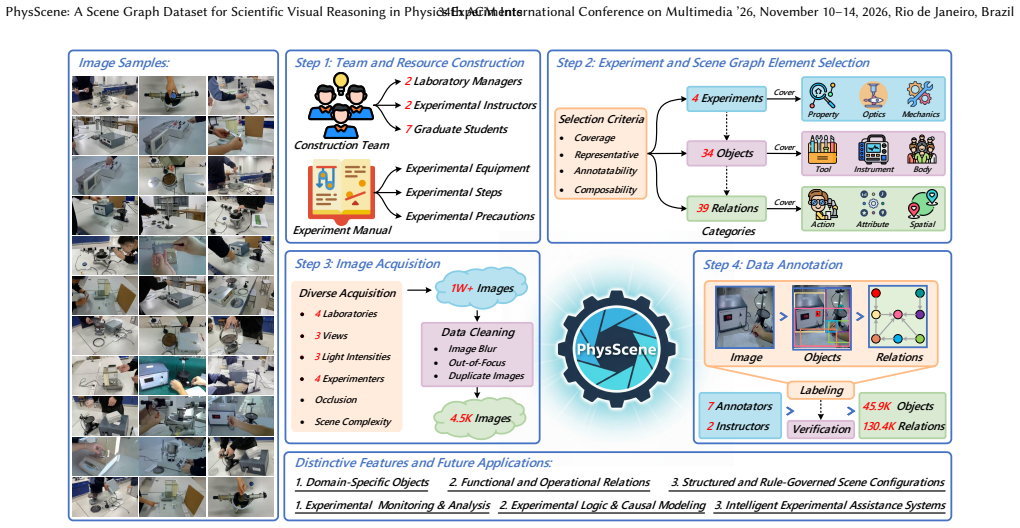
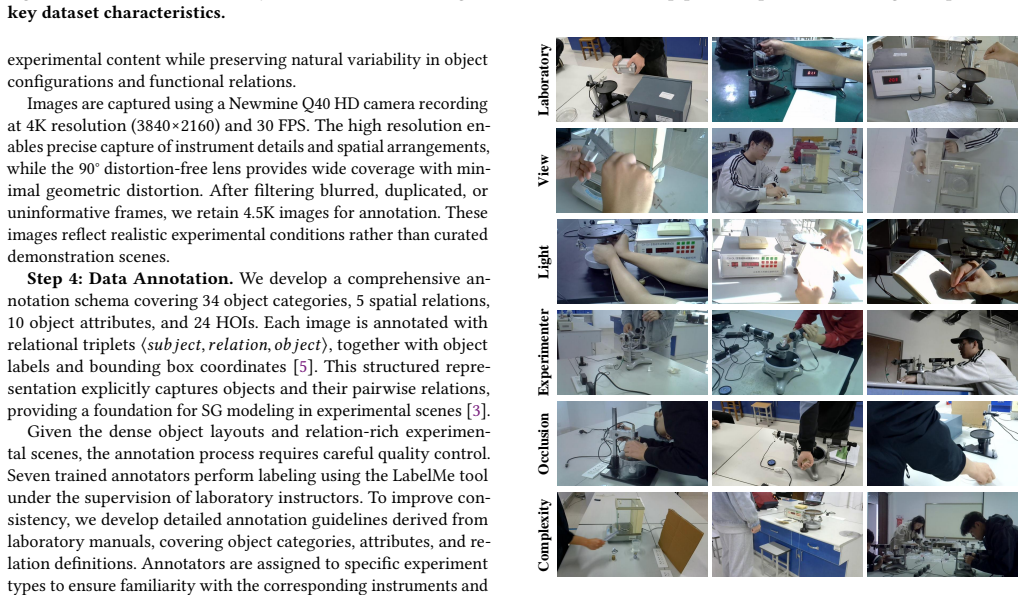
PhysScene is the first scene graph dataset tailored to physics experiments. It encompasses specialized instruments, structured experimental setups, and functional relations intrinsic to experimental environments, enabling reasoning that extends beyond spatial co-occurrence to logical dependencies. Rather than pursuing large data scale, PhysScene focuses on strong semantic constraints and high relation density in experimental scenes, posing new challenges for existing scene parsing algorithms while offering opportunities for further improvements.
Load-bearing premise
Existing scene graph datasets focus mainly on generic natural scenes and therefore leave domain-specific experimental scenes underexplored.
Editorial extensions
If this is right
- Scene parsing algorithms must now handle logical dependencies among lab instruments in addition to spatial layout.
- The dataset supplies a concrete testbed for measuring progress on scientific visual reasoning tasks.
- Development of monitoring and analysis systems for physics experiments gains a dedicated evaluation resource.
- High relation density and semantic constraints in the data expose where current methods fall short.
Reading between the lines
- The same construction approach could be repeated for other laboratory domains such as chemistry or biology to create comparable testbeds.
- Trained models could eventually support automated logging or safety checks that track whether an experiment is following its intended functional sequence.
- The emphasis on functional over purely spatial relations suggests future scene graph work may need explicit modules for causal or procedural links.
Editorial analysis
A structured set of objections, weighed in public.
Referee Report
Summary. The paper introduces PhysScene, the first scene graph dataset tailored to physics experiments. It claims that existing SG datasets focus on generic natural contexts, while PhysScene includes specialized instruments, structured experimental setups, and functional relations intrinsic to experimental environments. The dataset emphasizes strong semantic constraints and high relation density rather than large scale, posing new challenges for scene parsing algorithms. Extensive analyses and experiments are presented to show that PhysScene complements existing benchmarks and establishes a valuable testbed for scientific visual reasoning. The dataset is released publicly via GitHub.
Significance. If the dataset indeed supplies functional relations and logical dependencies in physics lab scenes that go beyond spatial co-occurrence in generic datasets, it would fill a documented niche and support progress in domain-specific relational reasoning. The standard dataset-contribution structure (gap identification, targeted collection with high relation density, complementarity demonstration) is internally consistent, and the public release aids reproducibility.
minor comments (3)
- Abstract and introduction: the assertion that PhysScene is 'the first' SG dataset for physics experiments requires an explicit comparison table or paragraph citing the closest prior datasets (e.g., Visual Genome, CLEVR, or any lab-specific efforts) to substantiate the novelty claim.
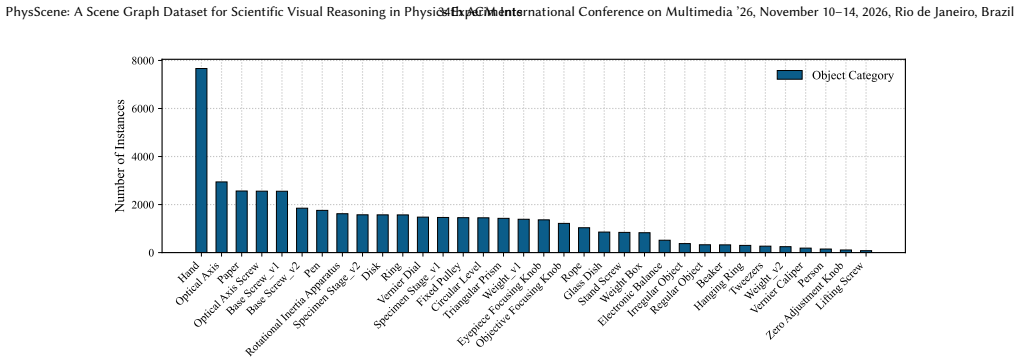
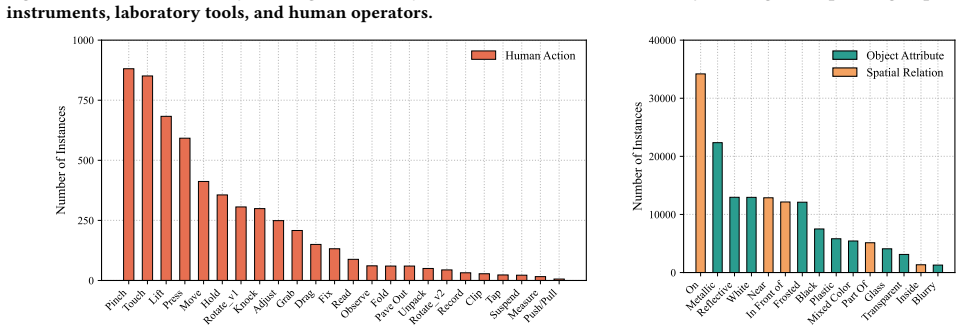
- Dataset description section: statistics on number of scenes, objects per scene, relation types, and relation density should be presented in a table early in the paper so readers can evaluate the 'high relation density' claim without needing to inspect the GitHub repository.
- Experiments section: the claim that PhysScene 'poses new challenges for existing scene parsing algorithms' should be supported by at least one quantitative baseline result (e.g., SG generation mAP or relation prediction accuracy) on PhysScene versus a generic dataset, even if only as a preliminary result.
Simulated Author's Rebuttal
We thank the referee for the positive summary, significance assessment, and recommendation of minor revision. The report contains no major comments, so there are no specific points to address point-by-point.
Circularity Check
No significant circularity; dataset contribution is self-contained
full rationale
The paper introduces PhysScene as a new scene-graph dataset for physics experiments. It contains no equations, derivations, fitted parameters, or predictions that could reduce to inputs by construction. The central claim (first dataset tailored to this domain with functional relations) is a standard novelty argument supported by comparison to existing benchmarks; it does not rely on self-citation chains, uniqueness theorems from the same authors, or any self-definitional loop. The contribution stands on the released data and analyses rather than any internal reduction.
Assumptions & free parameters
Cite this review
Pith. "Pith review of PhysScene: A Scene Graph Dataset for Scientific Visual Reasoning in Physics Experiments." pith.science (2026). https://pith.science/paper/7EOY7PMR
@misc{pith2026260609368,
  author       = {Pith},
  title        = {Pith review of: PhysScene: A Scene Graph Dataset for Scientific Visual Reasoning in Physics Experiments},
  year         = {2026},
  howpublished = {\url{https://pith.science/paper/7EOY7PMR}},
  note         = {Machine review of arXiv:2606.09368}
}
read the original abstract
Scene Graphs (SGs) provide structured representations of visual scenes by modeling objects and their pairwise relationships. Despite recent progress, existing datasets primarily focus on generic natural contexts, leaving domain-specific and function-oriented scenes largely underexplored. This limitation restricts the evaluation of relational reasoning in scientific experimental scenes, thereby hindering the development of intelligent monitoring, analysis, and related applications in such scenes. To address this gap, we introduce PhysScene, the first SG dataset tailored to physics experiments. PhysScene encompasses specialized instruments, structured experimental setups, and functional relations intrinsic to experimental environments, enabling reasoning that extends beyond spatial co-occurrence to logical dependencies. Rather than pursuing large data scale, PhysScene focuses on strong semantic constraints and high relation density in experimental scenes, posing new challenges for existing scene parsing algorithms while offering opportunities for further improvements. Extensive analyses and experiments show that PhysScene complements existing benchmarks and establishes a valuable testbed for advancing scientific visual reasoning. The dataset is publicly available at https://github.com/ZMH-SDUST/PhysScene.
Figures
Figures from the paper (1 more)
Reviewed June 27, 2026 · model on record in the stance chip above.
Discussion (0). Continue with ORCID to comment.