Experimental observation of hyperbolic spacetime dynamics
Pith reviewed 2026-06-27 15:23 UTC · model grok-4.3
The pith
Photonic waveguide arrays emulate fermionic wave packet dynamics in Lorentzian AdS spacetime.
A machine-rendered reading of the paper's core claim, the machinery that carries it, and where it could break.
Core claim
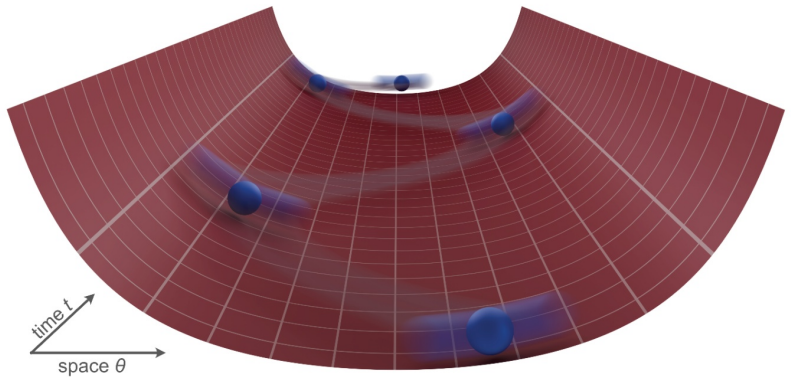
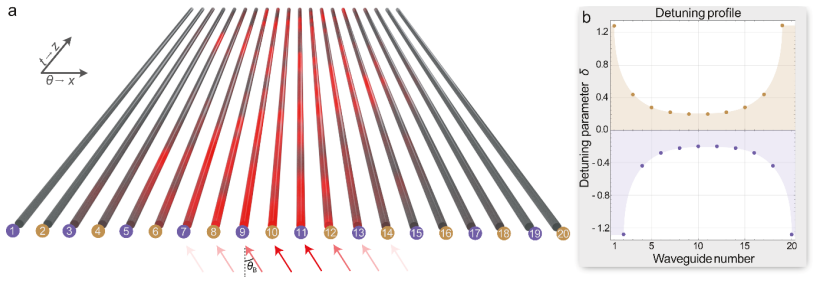
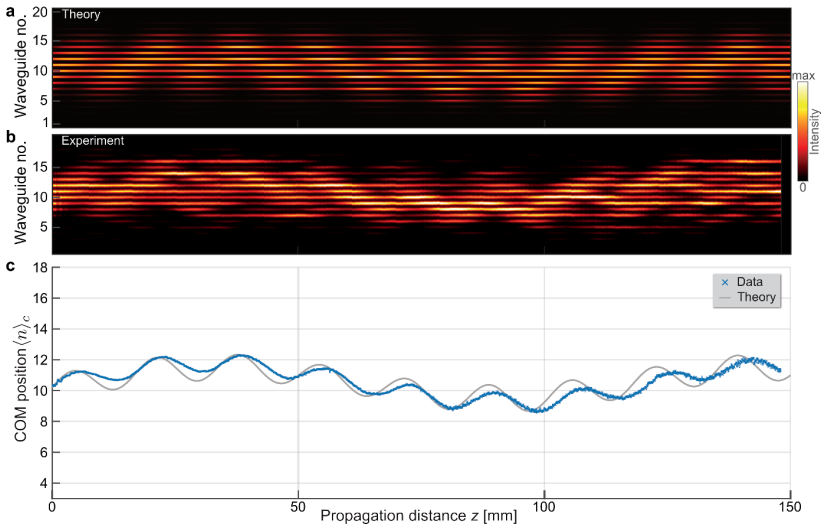
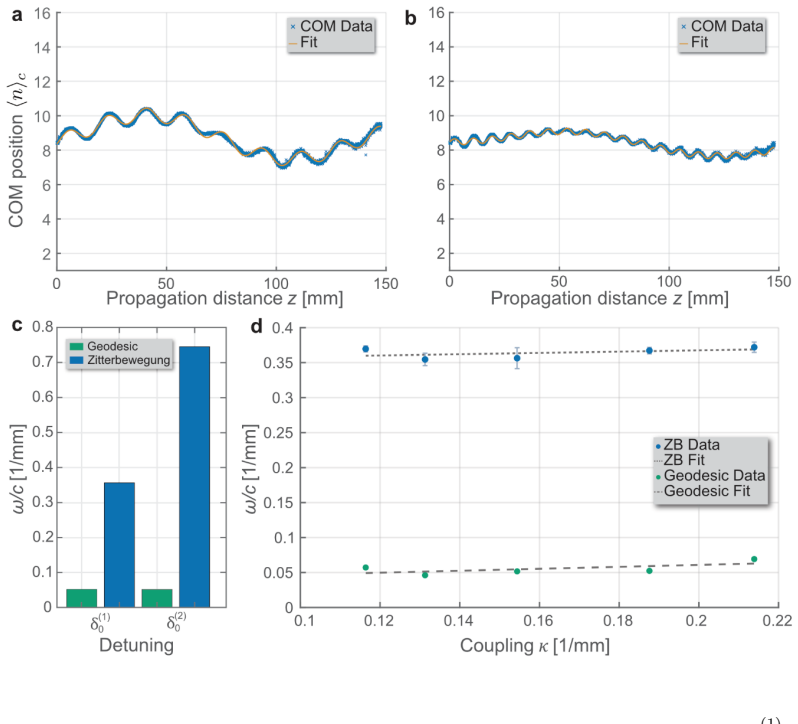
By mapping the Dirac equation in curved spacetime onto the propagation of light in engineered waveguide arrays, we directly observe gravitational confinement of relativistic wave packets and resolve their center-of-mass motion in real time. We identify a characteristic superposition of slow geodesic oscillations governed solely by spacetime curvature and fast Zitterbewegung arising from relativistic particle--antiparticle interference. While the geodesic frequency is independent of fermion mass, the Zitterbewegung frequency exhibits a distinct joint dependence on mass and curvature, revealing a curvature-induced modification of relativistic quantum dynamics.
What carries the argument
Mapping of the Dirac equation in curved spacetime onto light propagation in engineered waveguide arrays that enables real-time tracking of wave-packet center-of-mass motion.
If this is right
- Geodesic oscillation frequency depends only on spacetime curvature and is independent of fermion mass.
- Zitterbewegung frequency exhibits a joint dependence on both mass and curvature.
- The experiment supplies the first quantitative access to fermionic bulk dynamics in emulated AdS2 spacetime with Lorentzian signature.
- The platform forms a scalable analog system for exploring dynamical aspects of holography.
Where Pith is reading between the lines
- Waveguide designs of this type could be adapted to emulate other curved spacetime geometries.
- The clean separation of geodesic and Zitterbewegung contributions offers a route to test quantum-field-theory predictions in curved backgrounds.
- Extending the arrays to time-dependent curvature profiles could simulate dynamical gravitational effects.
- Corresponding boundary observables could be measured to probe AdS/CFT-type relations within the same platform.
Load-bearing premise
The engineered waveguide arrays accurately reproduce the Dirac equation in curved spacetime, with platform-specific effects not altering the observed frequencies or confinement behavior.
What would settle it
If measured center-of-mass oscillation frequencies in the waveguide experiment deviate from the predicted values for geodesic motion and Zitterbewegung derived from the curved-spacetime Dirac equation, the claimed emulation accuracy would be falsified.
Figures
read the original abstract
Understanding quantum dynamics in curved spacetime is a central challenge at the intersection of quantum mechanics and gravity. Anti-de-Sitter (AdS) spacetime plays a pivotal role in the context of the AdS/CFT correspondence, which relates gravitational dynamics in the AdS bulk to a conformal field theory (CFT) living on its boundary. Despite its foundational importance, direct experimental access to dynamical quantum phenomena in Lorentzian AdS spacetime has so far remained out of reach. Here, we report the first experimental emulation of fermionic wave packet dynamics in Lorentzian AdS spacetime using a photonic platform. By mapping the Dirac equation in curved spacetime onto the propagation of light in engineered wave\-guide arrays, we directly observe gravitational confinement of relativistic wave packets and resolve their center-of-mass motion in real time. We identify a characteristic superposition of slow geodesic oscillations governed solely by spacetime curvature and fast Zitterbewegung arising from relativistic particle--antiparticle interference. While the geodesic frequency is independent of fermion mass, the Zitterbewegung frequency exhibits a distinct joint dependence on mass and curvature, revealing a curvature-induced modification of relativistic quantum dynamics. Our results provide the first quantitative experimental access to fermionic bulk dynamics in emulated AdS$_2$ spacetime with Lorentzian signature. This establishes a scalable analog platform that may potentially be used for exploring dynamical aspects of holography.
Editorial analysis
A structured set of objections, weighed in public.
Referee Report
Summary. The manuscript claims the first experimental emulation of fermionic wave-packet dynamics in Lorentzian AdS2 spacetime via a photonic waveguide array that maps the position-dependent Dirac operator. It reports direct observation of gravitational confinement together with a superposition of slow geodesic oscillations (governed solely by curvature, independent of fermion mass) and fast Zitterbewegung (showing joint mass-curvature dependence), thereby providing quantitative access to bulk dynamics in an emulated AdS spacetime with Lorentzian signature.
Significance. If the waveguide-to-Dirac mapping is shown to be free of platform artifacts and the frequency extraction is robust, the result would constitute a significant advance in analog gravity: the first quantitative experimental realization of relativistic quantum dynamics in curved spacetime. The separation into a curvature-only geodesic frequency and a mass-curvature-dependent Zitterbewegung frequency supplies a falsifiable signature that could be used to test holographic ideas in a controllable laboratory setting.
major comments (2)
- [Abstract and §3] Abstract and §3 (results): the abstract states that two frequency components have been identified and that the geodesic frequency is independent of fermion mass, yet supplies no raw data, error bars, fitting procedures, or exclusion criteria. Without these it is impossible to assess whether the extracted frequencies support the central claim or whether platform-specific effects have been ruled out.
- [§2] §2 (mapping): the claim that the engineered couplings implement the exact position-dependent Dirac operator for Lorentzian AdS2 requires an error budget showing that discretization, evanescent-field overlap approximations, and propagation losses do not introduce an effective position-dependent mass or potential. If such artifacts are present, the observed separation into geodesic and Zitterbewegung components could be an artifact rather than a signature of the target spacetime.
minor comments (2)
- The notation AdS2 should be clarified as (1+1)-dimensional Lorentzian anti-de Sitter space to avoid confusion with Euclidean or higher-dimensional cases.
- Figure captions should explicitly state the number of waveguide sites, the range of propagation distances used for Fourier analysis, and the fitting window for frequency extraction.
Simulated Author's Rebuttal
We thank the referee for the constructive and detailed report. We address the major comments point by point below, providing clarifications from the manuscript and supplementary material while indicating revisions where they strengthen the presentation.
read point-by-point responses
-
Referee: [Abstract and §3] Abstract and §3 (results): the abstract states that two frequency components have been identified and that the geodesic frequency is independent of fermion mass, yet supplies no raw data, error bars, fitting procedures, or exclusion criteria. Without these it is impossible to assess whether the extracted frequencies support the central claim or whether platform-specific effects have been ruled out.
Authors: The abstract is a concise overview and does not contain raw data by standard convention. Section 3 and its figures display the measured center-of-mass trajectories with error bars obtained from multiple waveguide-array realizations; the two-frequency decomposition is obtained via Fourier analysis followed by nonlinear least-squares fitting, with the full procedure and robustness checks (including signal-to-noise thresholds for data retention) given in the Methods section. We will revise §3 to cross-reference these elements explicitly and add a short paragraph summarizing the fitting stability and exclusion criteria. revision: partial
-
Referee: [§2] §2 (mapping): the claim that the engineered couplings implement the exact position-dependent Dirac operator for Lorentzian AdS2 requires an error budget showing that discretization, evanescent-field overlap approximations, and propagation losses do not introduce an effective position-dependent mass or potential. If such artifacts are present, the observed separation into geodesic and Zitterbewegung components could be an artifact rather than a signature of the target spacetime.
Authors: Section 2 presents the analytic derivation of the position-dependent couplings from the Lorentzian AdS2 Dirac operator. The supplementary material contains a quantitative error analysis: full-wave simulations of the paraxial Helmholtz equation with the fabricated coupling profile show that discretization and overlap approximations induce <4% deviation from the target metric factor, while propagation losses contribute a uniform attenuation without generating an effective position-dependent mass term. The observed frequency separation remains robust under these perturbations. We will incorporate a dedicated error-budget paragraph into §2 of the revised manuscript. revision: yes
Circularity Check
No circularity: experimental observation rests on direct measurements, not self-referential derivation
full rationale
The paper reports an experimental emulation of Dirac dynamics in AdS spacetime via engineered waveguide arrays. Central claims concern observed frequencies of geodesic oscillations and Zitterbewegung extracted from real-time propagation data. No derivation chain is presented that reduces a 'prediction' to a fitted input by construction, nor does any load-bearing step rely on self-citation of an unverified uniqueness theorem or ansatz. The waveguide-to-Dirac mapping is an engineering premise whose fidelity is an external assumption, not a circular reduction internal to the reported results. This is the expected outcome for a primarily experimental work whose outputs are measured quantities rather than algebraically forced equalities.
Axiom & Free-Parameter Ledger
Reference graph
Works this paper leans on
-
[1]
N. D. Birrell and P. C. W. Davies.Quantum Fields in Curved Space. Cambridge: Cambridge University Press, 1982.doi:10.1017/CBO9780511622632
-
[2]
Wald.Quantum Field Theory in Curved Spacetime and Black Hole Thermodynamics
Robert M. Wald.Quantum Field Theory in Curved Spacetime and Black Hole Thermodynamics. Chicago, IL: University of Chicago Press, 1994
1994
-
[3]
The Large-N Limit of Superconformal Field Theories and Su- pergravity
Juan Maldacena. “The Large-N Limit of Superconformal Field Theories and Su- pergravity”. In:International Journal of Theoretical Physics38 (1999), pp. 1113– 1133
1999
-
[4]
Gauge Theory Correlators from Non-Critical String Theory
S. S. Gubser, Igor R. Klebanov, and Alexander M. Polyakov. “Gauge theory correlators from noncritical string theory”. In:Phys. Lett. B428 (1998), pp. 105– 114.doi:10.1016/S0370-2693(98)00377-3. arXiv:hep-th/9802109
work page internal anchor Pith review Pith/arXiv arXiv doi:10.1016/s0370-2693(98)00377-3 1998
-
[5]
Anti de Sitter Space and Holography
Edward Witten. “Anti de Sitter Space and Holography”. In:Advances in Theo- retical and Mathematical Physics2 (1998), pp. 253–291. 23
1998
-
[6]
Cambridge University Press, 2015
Martin Ammon and Johanna Erdmenger.Gauge/Gravity Duality: Foundations and Applications. Cambridge University Press, 2015
2015
-
[7]
Carlos Barcelo, Stefano Liberati, and Matt Visser. “Analogue gravity”. In:Living Rev. Rel.8 (2005), p. 12.doi:10.12942/lrr-2005-12. arXiv:gr-qc/0505065
-
[8]
Carlos Barceló, Stefano Liberati, and Matt Visser. “Analogue Gravity”. In:Living Reviews in Relativity14.1 (2011), p. 3.doi: 10 . 12942 / lrr - 2011 - 3.url: https://doi.org/10.12942/lrr-2011-3
-
[9]
Analogue Simulations of Quantum Gravity with Fluids
Samuel L. Braunstein et al. “Analogue Simulations of Quantum Gravity with Fluids”. In:Nature Reviews Physics5.10 (2023), pp. 612–622.doi:10.1038/ s42254-023-00630-y.url:https://doi.org/10.1038/s42254-023-00630-y
-
[10]
Hyperbolic lattices in circuit quantum electrodynamics
Alicia J. Kollár, Mattias Fitzpatrick, and Andrew A. Houck. “Hyperbolic lattices in circuit quantum electrodynamics”. In:Nature571.7763 (2019), pp. 45–50.doi: 10.1038/s41586-019-1348-3
-
[11]
Simulating Hyperbolic Space on a Circuit Board
P. M. Lenggenhager et al. “Simulating Hyperbolic Space on a Circuit Board”. In: Nature Communications13 (2022), p. 4373
2022
-
[13]
Integration of Full Divertor Detachment with Improved Core Confinement for Tokamak Fusion Plasmas
Jingming Chen et al. “Space and Space-Time Topologies in a Type-II Hyperbolic Lattice”. In:Nature Communications17 (2026), p. 4142.doi:10.1038/s41467- 026-70706-7
-
[14]
Graph-based emulation ofd-dimensional curved spaces with superconductingarrays
Mehmet Dede et al. “Graph-based emulation ofd-dimensional curved spaces with superconductingarrays”.In:(May2026).arXiv: 2605.28942 [cond-mat.supr-con]
-
[15]
Eugenio Calabi and Lawrence Markus. “Relativistic Space Forms”. In:Annals of Mathematics75.1 (1962), pp. 63–76.doi:10.2307/1970427
-
[16]
Nguyen Phuoc Khanh Tho.Geodesics in the (Anti-)de Sitter Spacetime. 2016. doi:10.48550/arXiv.1605.05046. arXiv:1605.05046 [gr-qc]
work page internal anchor Pith review Pith/arXiv arXiv doi:10.48550/arxiv.1605.05046 2016
-
[17]
Akademie der Wissenschaften in Kommission bei W
Erwin Schrödinger.Über die kräftefreie Bewegung in der relativistischen Quan- tenmechanik. Akademie der Wissenschaften in Kommission bei W. de Gruyter u. Company, 1930
1930
-
[18]
Classical Simulation of Relativistic Zitterbewegung in Photonic Lattices
Felix Dreisow et al. “Classical Simulation of Relativistic Zitterbewegung in Photonic Lattices”. In:Phys. Rev. Lett.105 (14 Sept. 2010), p. 143902.doi: 10.1103/PhysRevLett.105.143902 .url: https://link.aps.org/doi/10. 1103/PhysRevLett.105.143902
-
[19]
Quantum Simulation of the Dirac Equation
R. Gerritsma et al. “Quantum Simulation of the Dirac Equation”. In:Nature463 (2010), pp. 68–71
2010
-
[20]
Observable Zitterbe- wegung in curved spacetimes
Archil Kobakhidze, Adrian Manning, and Anca Tureanu. “Observable Zitterbe- wegung in curved spacetimes”. In:Physics Letters B757 (June 2016), pp. 84– 91.issn: 0370-2693.doi: 10 . 1016 / j . physletb . 2016 . 03 . 049.url: http : //dx.doi.org/10.1016/j.physletb.2016.03.049
-
[21]
Writing Waveguides in Glass with a Femtosecond Laser
K. M. Davis et al. “Writing Waveguides in Glass with a Femtosecond Laser”. In: Optics Letters21 (1996), pp. 1729–1731. 24
1996
-
[22]
Discrete optics in femtosecond-laser-written photonic structures
Alexander Szameit and Stefan Nolte. “Discrete optics in femtosecond-laser-written photonic structures”. In:Journal of Physics B: Atomic, Molecular and Optical Physics43.16 (July 2010), p. 163001.doi: 10.1088/0953-4075/43/16/163001. url:https://dx.doi.org/10.1088/0953-4075/43/16/163001
-
[23]
Simulating Holographic Conformal Field Theories on Hyperbolic Lattices
S. Dey et al. “Simulating Holographic Conformal Field Theories on Hyperbolic Lattices”. In:Physical Review Letters133 (2024), p. 061603
2024
-
[24]
Chen et al.Space and Space-Time Topologies in a Type-II Hyperbolic Lattice
J. Chen et al.Space and Space-Time Topologies in a Type-II Hyperbolic Lattice. Publication details not provided
-
[25]
Green, John H
Michael B. Green, John H. Schwarz, and Edward Witten.Superstring Theory: 25th Anniversary Edition, volume 2 : loop amplitudes, annomalies and phenomenology. Cambridge Monographs on Mathematical Physics. Cambridge University Press, 2012
2012
-
[26]
Dirac field inAdS2 and representations of ˜SL(2,R )
David Serrano Blanco. “Dirac field inAdS2 and representations of ˜SL(2,R )”. In: Journal of Mathematical Physics64.3 (Mar. 2023), p. 032301.issn: 0022-2488. doi: 10.1063/5.0135971. eprint: https://pubs.aip.org/aip/jmp/article- pdf / doi / 10 . 1063 / 5 . 0135971 / 18145820 / 032301 _ 1 _ 5 . 0135971 . pdf.url: https://doi.org/10.1063/5.0135971
-
[27]
Photonic analog of Zitterbewegung in binary waveguide arrays
S. Longhi. “Photonic analog of Zitterbewegung in binary waveguide arrays”. In: Optics Letters35.2 (Jan. 2010), pp. 235–237.issn: 1539-4794.doi:10.1364/ol. 35.000235.url:http://dx.doi.org/10.1364/OL.35.000235
work page doi:10.1364/ol 2010
-
[28]
Joseph Maciejko and Steven Rayan. “Hyperbolic band theory”. In:Science Advances7.36 (2021).issn: 2375-2548.doi: 10.1126/sciadv.abe9170 .url: http://dx.doi.org/10.1126/sciadv.abe9170
-
[29]
Dirac equation in 2-dimensional curved spacetime, particle creation, and coupled waveguide arrays
Christian Koke, Changsuk Noh, and Dimitris G. Angelakis. “Dirac equation in 2-dimensional curved spacetime, particle creation, and coupled waveguide arrays”. In:Annals of Physics374 (Nov. 2016), pp. 162–178.issn: 0003-4916. doi: 10.1016/j.aop.2016.08.013.url: http://dx.doi.org/10.1016/j.aop. 2016.08.013
-
[30]
Christian Koke, Changsuk Noh, and Dimitris G. Angelakis. “Dirac equation on a square waveguide lattice with site-dependent coupling strengths and the gravitational Aharonov-Bohm effect”. In:Physical Review A102.1 (July 2020). issn: 2469-9934.doi: 10.1103/physreva.102.013514 .url: http://dx.doi. org/10.1103/PhysRevA.102.013514
-
[31]
Bulk Reconstruction for Spinor Fields in AdS/CFT
V. F. Foit, Daniel Kabat, and Gilad Lifschytz. “Bulk Reconstruction for Spinor Fields in AdS/CFT”. In:Journal of High Energy Physics2020 (2020), p. 129
2020
-
[32]
Breitenlohner-Freedman Bound on Hyperbolic Tilings
P. Basteiro et al. “Breitenlohner-Freedman Bound on Hyperbolic Tilings”. In: Physical Review Letters130 (2023), p. 091604
2023
-
[33]
Einstein-Podolsky-Rosen Correlation in a Gravitational Field
Hiroaki Terashima and Masahito Ueda. “Einstein-Podolsky-Rosen Correlation in a Gravitational Field”. In:Physical Review A69 (2004), p. 032113
2004
-
[34]
Localized qubits in curved spacetimes
Matthew C. Palmer, Maki Takahashi, and Hans F. Westman. “Localized qubits in curved spacetimes”. In:Annals of Physics327.4 (Apr. 2012), pp. 1078–1131. issn: 0003-4916.doi: 10.1016/j.aop.2011.10.009.url: http://dx.doi.org/ 10.1016/j.aop.2011.10.009. 25
-
[35]
The bizarre anti-de Sitter spacetime
Leszek M. Sokolowski. “The bizarre anti-de Sitter spacetime”. In:International Journal of Geometric Methods in Modern Physics13 (2016), p. 1630016.url: https://api.semanticscholar.org/CorpusID:119261206
2016
-
[36]
Nakahara.Geometry, topology and physics
M. Nakahara.Geometry, topology and physics. Bristol, UK: Hilger (1990) 505 p. (Graduate student series in physics). 2003.url:http://www.slac.stanford. edu/spires/find/hep/www?key=7208855
1990
-
[37]
Cambridge University Press, 2013
Mark Thomson.Modern Particle Physics. Cambridge University Press, 2013
2013
-
[38]
Zitterbewegung in the AdS Cosmic String Space-Time
N.N. Konobeeva and M.B. Belonenko. “Zitterbewegung in the AdS Cosmic String Space-Time.”In:Russ Phys J 62, 205–209 (2019). https://doi.org/10.1007/s11182- 019-01702-2(2019). 26
discussion (0)
Sign in with ORCID, Apple, or X to comment. Anyone can read and Pith papers without signing in.