Neutrino monitoring of explosions for excluding fission yield
Pith reviewed 2026-06-27 14:03 UTC · model grok-4.3
The pith
Neutrino detectors in the ton to tens-of-kiloton range can set useful limits on fission yield for chemical explosions up to 100 km away.
A machine-rendered reading of the paper's core claim, the machinery that carries it, and where it could break.
Core claim
Nuclear fission produces neutrinos, so the absence of a neutrino signal can be used to set a limit on the fission content of an explosion. This capability could be employed on former nuclear test sites to assure regulators, international monitors, or other observers that activities involving chemical explosions do not exceed a designated limit for nuclear fission. The analysis indicates that detectors with active mass in the ton- to tens-of-kiloton range can set potentially useful limits on the fission yield of large chemical explosions at the Nevada National Security Site at source-to-detector distances up to 100 km, assuming detection by inverse beta decay with realistic background levels.
What carries the argument
Inverse beta decay detection of antineutrinos from fission to set upper limits on fission yield based on non-observation of events.
If this is right
- Detectors of ton to tens of kiloton active mass suffice for useful limits at 100 km.
- This applies to large chemical explosions at the Nevada National Security Site.
- The approach fails at longer ranges.
- It also fails for subcritical nuclear experiments.
Where Pith is reading between the lines
- Such monitoring could integrate into broader nuclear non-proliferation verification systems.
- Detector networks might cover multiple test sites globally.
- Improvements in background rejection could push the range further.
Load-bearing premise
Background rates from natural radioactivity and cosmic rays can be controlled or subtracted at the levels needed to reach the quoted sensitivity at 100 km.
What would settle it
A direct measurement of background event rates at a proposed detector site that are significantly higher than the realistic levels assumed, which would prevent achieving the required sensitivity.
Figures
read the original abstract
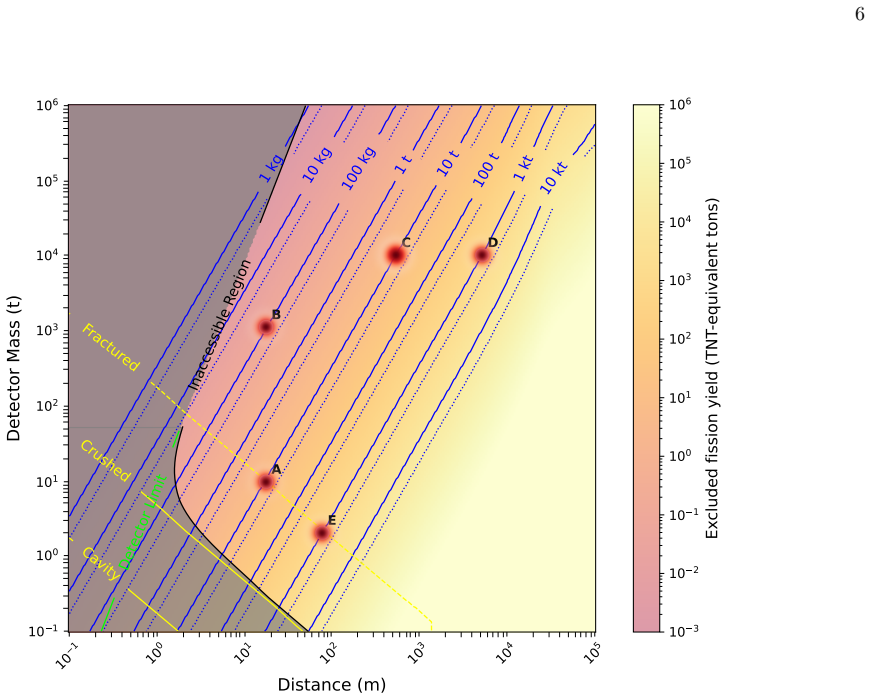
Nuclear fission produces neutrinos, so the absence of a neutrino signal can be used to set a limit on the fission content of an explosion. This capability could be employed on former nuclear test sites to assure regulators, international monitors, or other observers that activities involving chemical explosions do not exceed a designated limit for nuclear fission. This paper quantifies the neutrino detector masses that would be required to set fission yield limits at source-to-detector distances up to 100 km, assuming detection by inverse beta decay with realistic background levels. The analysis indicates that detectors with active mass in the ton- to tens-of-kiloton range can set potentially useful limits on the fission yield of large chemical explosions at the Nevada National Security Site. In contrast, inverse beta decay detectors are not well suited to excluding fission yield at longer range or in the subcritical nuclear experiments that have occurred at some test sites following the cessation of explosive nuclear testing.
Editorial analysis
A structured set of objections, weighed in public.
Referee Report
Summary. The paper claims that the absence of an inverse-beta-decay neutrino signal can be used to set limits on the fission yield of chemical explosions. Using standard IBD cross sections and realistic background levels drawn from prior literature, it calculates the active detector masses (tons to tens of kilotons) required to obtain useful limits at source-to-detector distances up to 100 km, with explicit application to the Nevada National Security Site; the same approach is shown to be unsuitable for longer ranges or subcritical nuclear experiments.
Significance. If the background model is validated, the work supplies a concrete, falsifiable sensitivity curve that links detector mass and distance to fission-yield exclusion power. It thereby offers a quantitative basis for a new monitoring modality that relies on well-established particle-physics quantities rather than on quantities fitted to the paper's own data.
major comments (1)
- [background model and sensitivity calculation] The 100 km sensitivity result is load-bearing on the residual background rate after subtraction. The manuscript states that 'realistic background levels' are assumed but does not supply an explicit rate calculation, shielding model, or error budget (e.g., in the section presenting the mass-versus-distance curves) that demonstrates the subtracted background is low enough for the quoted scaling to hold. This assumption is taken from external literature rather than derived internally; a concrete reference or derivation is required to secure the central claim.
minor comments (2)
- Notation for detector mass and distance should be defined once at first use and used consistently in all figures and equations.
- The abstract and conclusion should explicitly state the numerical fission-yield limit (e.g., in kt TNT equivalent) that corresponds to the 'useful' threshold adopted in the analysis.
Simulated Author's Rebuttal
We thank the referee for their careful and constructive review. The single major comment is addressed below; we agree that additional explicit detail on the background model is warranted and will revise the manuscript accordingly.
read point-by-point responses
-
Referee: [background model and sensitivity calculation] The 100 km sensitivity result is load-bearing on the residual background rate after subtraction. The manuscript states that 'realistic background levels' are assumed but does not supply an explicit rate calculation, shielding model, or error budget (e.g., in the section presenting the mass-versus-distance curves) that demonstrates the subtracted background is low enough for the quoted scaling to hold. This assumption is taken from external literature rather than derived internally; a concrete reference or derivation is required to secure the central claim.
Authors: We agree that the residual background rate after subtraction is load-bearing for the 100 km curves and that the manuscript would be strengthened by making the assumptions more explicit in the relevant section. The quoted 'realistic background levels' were taken from the established IBD literature (reactor-neutrino experiments at comparable depths and with similar muon-veto and pulse-shape cuts). In the revised manuscript we will add a short dedicated paragraph (or subsection) immediately preceding or within the mass-versus-distance presentation that (i) states the numerical residual rate adopted (events per ton per year after all cuts), (ii) cites the specific external references used for that rate and for the shielding/overburden assumptions at the Nevada National Security Site, and (iii) supplies a brief error budget based on the uncertainties reported in those references. This addition will not alter the numerical results or conclusions but will render the central claim self-contained and directly traceable. revision: yes
Circularity Check
No significant circularity detected
full rationale
The paper quantifies required detector masses for IBD-based neutrino monitoring of fission yields using standard cross sections and background estimates drawn from prior literature. No load-bearing steps reduce by construction to self-defined quantities, fitted parameters renamed as predictions, or self-citation chains. The derivation relies on external, independently verifiable inputs (IBD rates, cosmic/natural backgrounds) rather than internal fits or ansatze, making the result self-contained against external benchmarks.
Axiom & Free-Parameter Ledger
free parameters (2)
- background rate
- detection efficiency
axioms (2)
- standard math Inverse beta decay is the dominant detection channel and its cross section is known to sufficient precision.
- domain assumption Backgrounds at the Nevada site can be modeled accurately enough that the absence of signal translates directly into a fission-yield limit.
Reference graph
Works this paper leans on
-
[1]
Reines, The Neutrino: From Poltergeist to Particle (Nobel Lecture, 1995)
F. Reines, The Neutrino: From Poltergeist to Particle (Nobel Lecture, 1995)
1995
-
[2]
H. W. Kruse, R. Loncoski, and J. M. Mack, Antineutrino detector forνoscillation studies at fission weapon tests and at LAMPF, IEEE (1981)
1981
-
[3]
A. Bernstein, N. Bowden, B. L. Goldblum, P. Huber, I. Jovanovic, and J. Mattingly,Colloquium: Neutrino detectors as tools for nuclear security, Rev. Mod. Phys. 92, 011003 (2020), arXiv:1908.07113 [physics.soc-ph]
-
[4]
O. A. Akindele and R. Carr, Concepts for neutrino appli- cations, Annual Review of Nuclear and Particle Science 74, 10.1146/annurev-nucl-102122-023751 (2024)
-
[5]
Bernstein, T
A. Bernstein, T. West, and V. Gupta, An assessment of antineutrino detection as a tool for monitoring nuclear explosions, Science and Global Security (2001)
2001
-
[6]
R. Carr, F. Dalnoki-Veress, and A. Bernstein, Sensi- tivity of seismically-cued antineutrino detectors to nu- clear explosions, Phys. Rev. Applied10, 024014 (2018), arXiv:1712.04001 [nucl-ex]
work page internal anchor Pith review Pith/arXiv arXiv 2018
-
[7]
C. M. Snelson, C. R. Bradley, W. R. Walter, T. H. Antoun, R. A. Abbott, K. Jones, V. D. Chipman, and L. Montoya,The Source Physics Experiment (SPE) Sci- ence Plan, Tech. Rep. (Lawrence Livermore National Laboratory (LLNL), Livermore, CA (United States), 2022)
2022
-
[8]
S. C. Myers, G. Abbott, T. Alexander, E. Alger, A. Al- varez, N. Annabelle, T. Antoun, G. Auld, A. Malach, H. Banuelos,et al.,A multi-Physics Experiment for Low-Yield Nuclear Explosion Monitoring, Tech. Rep. (Lawrence Livermore National Laboratory (LLNL), Liv- ermore, CA (United States), 2024)
2024
-
[9]
B. L. Eric Cheung and I. Watson, Exclusive: Satellite images show increased activity at nuclear test sites in Russia, China and US, CNN (2023)
2023
-
[10]
Osborn, Russia accuses US of nuclear testing site ac- tivity, says it won’t test unless US does, Reuters (2023)
A. Osborn, Russia accuses US of nuclear testing site ac- tivity, says it won’t test unless US does, Reuters (2023)
2023
-
[11]
National Nuclear Security Administration, NNSA demonstrates transparency in its operations and sup- port for the Comprehensive Nuclear-Test-Ban Treaty by hosting visitors at Sandia and Nevada site, Press release (2024), accessed: 2024-07-15
2024
-
[12]
Serber,The Los Alamos Primer: The First Lectures on How to Build an Atomic Bomb(University of Califor- nia Press, Berkeley, CA, USA, 1992)
R. Serber,The Los Alamos Primer: The First Lectures on How to Build an Atomic Bomb(University of Califor- nia Press, Berkeley, CA, USA, 1992)
1992
- [13]
-
[14]
The angular distribution of the reaction $\bar{\nu}_e + p \to e^+ + n$
P. Vogel and J. F. Beacom, Angular distribution of neu- tron inverse beta decay, anti-neutrino(e) + p→e + + n, Phys. Rev.D60, 053003 (1999), arXiv:hep-ph/9903554 [hep-ph]
work page internal anchor Pith review Pith/arXiv arXiv 1999
-
[15]
Navaset al.(Particle Data Group), Review of particle physics, Phys
S. Navaset al.(Particle Data Group), Review of particle physics, Phys. Rev. D110, 030001 (2024)
2024
-
[16]
Ashenfelteret al.(PROSPECT), The PROSPECT Re- actor Antineutrino Experiment, Nucl
J. Ashenfelteret al.(PROSPECT), The PROSPECT Re- actor Antineutrino Experiment, Nucl. Instrum. Meth. A 922, 287 (2019), arXiv:1808.00097 [physics.ins-det]
-
[17]
H. Almaz´ anet al.(STEREO), STEREO neutrino spec- trum of 235U fission rejects sterile neutrino hypothesis, Nature613, 257 (2023), arXiv:2210.07664 [hep-ex]
-
[18]
Sterile neutrino search at NEOS Experiment
Y. Koet al.(NEOS), Sterile Neutrino Search at the NEOS Experiment, Phys. Rev. Lett.118, 121802 (2017), arXiv:1610.05134 [hep-ex]
work page internal anchor Pith review Pith/arXiv arXiv 2017
-
[19]
N. S. Bowdenet al., Experimental results from an an- tineutrino detector for cooperative monitoring of nu- clear reactors, Nucl. Instrum. Meth. A572, 985 (2007), arXiv:physics/0612152
work page internal anchor Pith review Pith/arXiv arXiv 2007
-
[20]
Achkaret al., Comparison of anti-neutrino reactor spectrum models with the Bugey-3 measurements, Phys
B. Achkaret al., Comparison of anti-neutrino reactor spectrum models with the Bugey-3 measurements, Phys. Lett. B374, 243 (1996). 9
1996
- [21]
-
[22]
B. Yanget al., RENE experiment for the sterile neutrino search using reactor neutrinos (2025), arXiv:2507.22376 [hep-ex]
-
[23]
J. K. Ahnet al.(RENO), Observation of Reactor Electron Antineutrino Disappearance in the RENO Experiment, Phys. Rev. Lett.108, 191802 (2012), arXiv:1204.0626 [hep-ex]
work page internal anchor Pith review Pith/arXiv arXiv 2012
-
[24]
F. P. Anet al.(Daya Bay), The Detector System of The Daya Bay Reactor Neutrino Experiment, Nucl. Instrum. Meth. A811, 133 (2016), arXiv:1508.03943 [physics.ins- det]
work page internal anchor Pith review Pith/arXiv arXiv 2016
-
[25]
de Kerretet al.(Double Chooz), The Double Chooz antineutrino detectors, Eur
H. de Kerretet al.(Double Chooz), The Double Chooz antineutrino detectors, Eur. Phys. J. C82, 804 (2022), arXiv:2201.13285 [physics.ins-det]
-
[26]
Precision Measurement of Neutrino Oscillation Parameters with KamLAND
S. Abeet al.(KamLAND), Precision Measurement of Neutrino Oscillation Parameters with KamLAND, Phys. Rev. Lett.100, 221803 (2008), arXiv:0801.4589 [hep-ex]
work page internal anchor Pith review Pith/arXiv arXiv 2008
-
[27]
A. Abuslemeet al.(JUNO), JUNO physics and de- tector, Prog. Part. Nucl. Phys.123, 103927 (2022), arXiv:2104.02565 [hep-ex]
-
[28]
T. Andersonet al., Eos: conceptual design for a demon- strator of hybrid optical detector technology, JINST18 (02), P02009, arXiv:2211.11969 [physics.ins-det]
-
[29]
E. Kemp, W. Vieira dos Santos, J. C. dos Anjos, P. Chi- menti, L. F. Gomez Gonzalez, G. P. Guedes, H. P. Lima, R. Antunes N´ obrega, I. M. Pepe, and D. Barbosa dos Santos Ribeiro, Results from ON-OFF Analysis of the Neutrinos-Angra Detector, Braz. J. Phys.55, 39 (2025), arXiv:2407.20397 [hep-ex]
-
[30]
Allegaet al.(SNO+), Initial measurement of reac- tor antineutrino oscillation at SNO+, Eur
A. Allegaet al.(SNO+), Initial measurement of reac- tor antineutrino oscillation at SNO+, Eur. Phys. J. C 85, 17 (2025), [Erratum: Eur.Phys.J.C 85, 296 (2025)], arXiv:2405.19700 [hep-ex]
-
[31]
Fukudaet al.(Super-Kamiokande), The Super- Kamiokande detector, Nucl
Y. Fukudaet al.(Super-Kamiokande), The Super- Kamiokande detector, Nucl. Instrum. Meth. A501, 418 (2003)
2003
-
[32]
First gadolinium loading to Super-Kamiokande,
K. Abeet al.(Super-Kamiokande), First gadolinium loading to Super-Kamiokande, Nucl. Instrum. Meth. A 1027, 166248 (2022), arXiv:2109.00360 [physics.ins-det]
-
[33]
Hyper-Kamiokande Design Report
K. Abeet al.(Hyper-Kamiokande), Hyper-Kamiokande Design Report (2018), arXiv:1805.04163 [physics.ins- det]
work page internal anchor Pith review Pith/arXiv arXiv 2018
-
[34]
J. Ross, The mobile antineutrino demonstrator project, in2023 IEEE Nuclear Science Symposium, Medical Imaging Conference and International Symposium on Room-Temperature Semiconductor Detectors (NSS MIC RTSD)(2023) pp. 1–1
2023
-
[35]
Y. Abreuet al.(SoLid), SoLid: a short baseline re- actor neutrino experiment, JINST16(02), P02025, arXiv:2002.05914 [physics.ins-det]
-
[36]
Search for sterile neutrinos at the DANSS experiment
I. Alekseevet al.(DANSS), Search for sterile neutrinos at the DANSS experiment, Phys. Lett. B787, 56 (2018), arXiv:1804.04046 [hep-ex]
work page internal anchor Pith review Pith/arXiv arXiv 2018
-
[37]
A. Haghighat, P. Huber, S. Li, J. M. Link, C. Mariani, J. Park, and T. Subedi, Observation of Reactor Antineu- trinos with a Rapidly-Deployable Surface-Level Detector, Phys. Rev. Applied13, 034028 (2020), arXiv:1812.02163 [physics.ins-det]
-
[38]
O. Benevides Rodrigueset al., Prototype reactor- antineutrino detector based on 6Li-doped pulse-shape- discriminating plastic scintillator, Phys. Rev. Applied24, 054023 (2025), arXiv:2505.05696 [physics.ins-det]
-
[39]
Reactor antineutrino monitoring with a plastic scintillator array as a new safeguards method
S. Oguri, Y. Kuroda, Y. Kato, R. Nakata, Y. Inoue, C. Ito, and M. Minowa, Reactor antineutrino moni- toring with a plastic scintillator array as a new safe- guards method, Nucl. Instrum. Meth. A757, 33 (2014), arXiv:1404.7309 [physics.ins-det]
work page internal anchor Pith review Pith/arXiv arXiv 2014
-
[40]
Bridgeset al., VIDARR: monitoring reactor anti- neutrinos using a plastic scintillator detector in a mobile laboratory, JINST17(10), P10009
K. Bridgeset al., VIDARR: monitoring reactor anti- neutrinos using a plastic scintillator detector in a mobile laboratory, JINST17(10), P10009
-
[41]
Broadway, Sweetwater, TX 79556, USA, 2021) revision Date: Jul 2021
Eljen Technology,Neutron/Gamma PSD Liquid Scin- tillator EJ-301, EJ-309: Product Data Sheet EJ-309, Product Data Sheet WJ-309 (Eljen Technology, 1300 W. Broadway, Sweetwater, TX 79556, USA, 2021) revision Date: Jul 2021
2021
-
[42]
F. P. Anet al.(Daya Bay), Observation of electron- antineutrino disappearance at Daya Bay, Phys. Rev. Lett.108, 171803 (2012), arXiv:1203.1669 [hep-ex]
work page internal anchor Pith review Pith/arXiv arXiv 2012
-
[43]
Allegaet al.(SNO+), Evidence of Antineutrinos from Distant Reactors using Pure Water at SNO+, Phys
A. Allegaet al.(SNO+), Evidence of Antineutrinos from Distant Reactors using Pure Water at SNO+, Phys. Rev. Lett.130, 091801 (2023), arXiv:2210.14154 [nucl-ex]
-
[44]
M. Andriamiradoet al.((PROSPECT)), Final Measure- ment of the U235 Antineutrino Energy Spectrum with the PROSPECT-I Detector at HFIR, Phys. Rev. Lett. 131, 021802 (2023), arXiv:2212.10669 [nucl-ex]
-
[45]
Andersonet al., Eos: conceptual design for a demon- strator of hybrid optical detector technology, Journal of Instrumentation18(02), P02009
T. Andersonet al., Eos: conceptual design for a demon- strator of hybrid optical detector technology, Journal of Instrumentation18(02), P02009
-
[46]
Stroujkova, M
A. Stroujkova, M. Carnevale, and O. Voro- biev, Cavity radius scaling for underground ex- plosions in hard rock, Bulletin of the Seismo- logical Society of America106, 2500 (2016), https://pubs.geoscienceworld.org/ssa/bssa/article- pdf/106/6/2500/2643634/2500.pdf
2016
-
[47]
L. A. Rogers, Estimating the size of the cavity and sur- rounding failed region for underground nuclear explosions from scaling rules, Symposium on Engineering with Nu- clear Explosives , p. 519–544 (1970)
1970
-
[48]
Glasstone and P
S. Glasstone and P. J. Dolan,The Effects of Nuclear Weapons, 3rd ed. (U.S. Department of Defense and En- ergy, Washington, D.C., 1977)
1977
-
[49]
S. L. Jones and F. N. von Hippel, Transparency measures for subcritical experiments under the CTBT, Science and Global Security6, 291 (1997)
1997
-
[50]
W. J. Hannon, The non-proliferation experiment, inThe non-proliferation experiment(Lawrence Livermore Na- tional Lab., CA (United States), 1994)
1994
-
[51]
M. Foxe, T. Bowyer, R. Carr, J. Orrell, and B. VanDe- vender, Antineutrino detectors remain impractical for nu- clear explosion monitoring, Pure and Applied Geophysics 178, 2753 (2020)
2020
discussion (0)
Sign in with ORCID, Apple, or X to comment. Anyone can read and Pith papers without signing in.