I Was Scrolling and Then I Saw a Pregnant Strawberry
Pith reviewed 2026-06-27 14:52 UTC · model grok-4.3
The pith
Generative AI fruit dramas embed stories of female betrayal and reproduction in a cute style that launders their ideological messages for social media circulation.
A machine-rendered reading of the paper's core claim, the machinery that carries it, and where it could break.
Core claim
AI minidramas reproduce deeply gendered narrative structures in which female characters are systematically associated with moral transgression, sexual betrayal, and reproductive capacity, and several plots also encode the logic of racialization; the generative AI aesthetic of softness, roundness, and visual cuteness functions as a mechanism of aesthetic laundering that neutralizes the ideological weight of these narratives and enables their circulation despite content moderation systems.
What carries the argument
Aesthetic laundering through the generative AI aesthetic of softness, roundness, and visual cuteness, which neutralizes ideological content in the video narratives.
If this is right
- The videos allow narratives linking women to transgression and reproduction to reach large audiences without triggering content filters.
- Several plots apply moral loading to visible bodily differences through the same visual format.
- The affordances of generative AI make both the creation and the spread of these narratives technically straightforward.
- Close reading of the videos reveals consistent ties between female characters and reproductive capacity across multiple series.
Where Pith is reading between the lines
- Similar laundering effects could appear in other short-form AI video formats on the same platforms.
- Platform moderation systems may need to examine narrative structures separately from visual style.
- Creators could test whether changing the aesthetic parameters reduces the frequency of the observed plot patterns.
Load-bearing premise
The gendered and racialized patterns arise from the generative AI process itself rather than from user choices or platform selection, and the cute visual style actively neutralizes the content rather than merely appearing with it.
What would settle it
Generating hundreds of similar videos from neutral prompts that avoid any mention of gender or race and then measuring whether the same patterns of female betrayal, pregnancy, and racialized plots still appear at high rates.
Figures
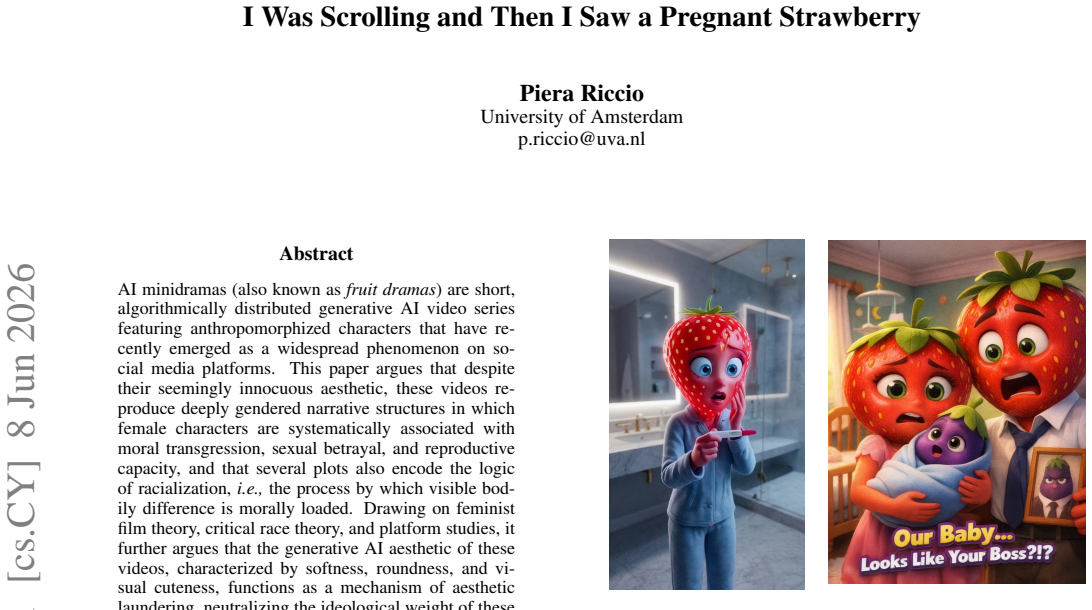
read the original abstract
AI minidramas (also known as fruit dramas) are short, algorithmically distributed generative AI video series featuring anthropomorphized characters that have recently emerged as a widespread phenomenon on social media platforms. This paper argues that despite their seemingly innocuous aesthetic, these videos reproduce deeply gendered narrative structures in which female characters are systematically associated with moral transgression, sexual betrayal, and reproductive capacity, and that several plots also encode the logic of racialization, i.e., the process by which visible bodily difference is morally loaded. Drawing on feminist film theory, critical race theory, and platform studies, it further argues that the generative AI aesthetic of these videos, characterized by softness, roundness, and visual cuteness, functions as a mechanism of aesthetic laundering, neutralizing the ideological weight of these narratives and enabling their circulation despite content moderation systems. This paper approaches these questions through personal observation and close reading, reflecting on the specific affordances of generative AI that make this phenomenon both possible and culturally consequential for the field of computational creativity.
Editorial analysis
A structured set of objections, weighed in public.
Referee Report
Summary. The paper examines the recent emergence of AI-generated minidramas (fruit dramas) on social media, short videos with anthropomorphized characters. It claims that these videos reproduce deeply gendered narrative structures systematically associating female characters with moral transgression, sexual betrayal, and reproductive capacity, with several plots also encoding racialization; it further argues that the soft, round, cute generative AI aesthetic functions as aesthetic laundering that neutralizes ideological content and enables circulation despite moderation.
Significance. If the observed patterns and their attribution to generative AI affordances hold after methodological strengthening, the work would contribute to computational creativity and platform studies by identifying how new AI video forms can embed and launder established ideological tropes from feminist film theory and critical race theory. It draws attention to a culturally consequential phenomenon at the intersection of generative models and algorithmic distribution.
major comments (2)
- [Approach section / abstract] The abstract and the section describing the approach state that the analysis proceeds through personal observation and close reading to support claims of systematic association and 'several plots,' yet no sampling method, total number of videos examined, selection criteria, or checks against selection bias are reported. This directly undercuts the load-bearing generalization from specific examples to the asserted patterns.
- [Central argument on aesthetic laundering] The central claim that the generative AI aesthetic itself functions as a mechanism of aesthetic laundering (neutralizing ideological weight) requires separation from prompt engineering, user selection, or platform recommendation effects. The manuscript provides no inspection of prompts, no comparison to non-AI content, and no ruling out of alternative explanations, leaving the attribution to model affordances unsupported.
Simulated Author's Rebuttal
We thank the referee for the constructive comments, which help clarify the scope and evidentiary basis of our analysis. We address each major comment below and indicate planned revisions to the manuscript.
read point-by-point responses
-
Referee: [Approach section / abstract] The abstract and the section describing the approach state that the analysis proceeds through personal observation and close reading to support claims of systematic association and 'several plots,' yet no sampling method, total number of videos examined, selection criteria, or checks against selection bias are reported. This directly undercuts the load-bearing generalization from specific examples to the asserted patterns.
Authors: We agree that the methodological description requires strengthening to support the generalizations presented. The study is grounded in sustained personal observation of the emerging genre across platforms, with examples selected for close reading based on recurrence of narrative elements. In revision we will expand the Approach section to specify the observation process (algorithmic feeds, targeted searches for terms such as 'fruit drama' and 'AI strawberry'), an approximate count of videos viewed (more than 150 across repeated sessions), and explicit selection criteria for the cases discussed (those exemplifying the dominant tropes of transgression and reproduction). We will also qualify the term 'systematic' to reflect the qualitative, non-probabilistic nature of the sample and note the absence of formal bias checks as a limitation of this initial account. These changes will make the evidentiary basis transparent without altering the core interpretive claims. revision: partial
-
Referee: [Central argument on aesthetic laundering] The central claim that the generative AI aesthetic itself functions as a mechanism of aesthetic laundering (neutralizing ideological weight) requires separation from prompt engineering, user selection, or platform recommendation effects. The manuscript provides no inspection of prompts, no comparison to non-AI content, and no ruling out of alternative explanations, leaving the attribution to model affordances unsupported.
Authors: We accept that the manuscript does not empirically isolate the contribution of model affordances from prompt engineering or platform effects. The laundering argument rests on the observed uniformity of the soft, rounded, cute visual register across videos produced by multiple users and models, a register that is difficult to achieve consistently with traditional animation techniques. In revision we will add an explicit discussion distinguishing model-level visual priors (documented in the technical literature on diffusion-based video generators) from user prompts, while acknowledging that direct prompt inspection was not performed. We will also note the lack of a systematic non-AI comparison as a boundary condition on the claim and suggest it as an avenue for future work. The revised text will present the aesthetic-laundering mechanism as a plausible account supported by the visual evidence rather than a definitively isolated causal factor. revision: partial
Circularity Check
No circularity: interpretive close reading draws on external theory without internal reduction
full rationale
The paper advances claims via personal observation and close reading of AI minidramas, invoking feminist film theory, critical race theory, and platform studies as external interpretive lenses. No equations, fitted parameters, predictions, or self-referential derivations appear; the central assertions about gendered narratives and aesthetic laundering rest on direct textual analysis rather than any step that reduces to the paper's own inputs or prior self-citations. The method is self-contained against external benchmarks of qualitative cultural analysis.
Axiom & Free-Parameter Ledger
axioms (1)
- domain assumption Feminist film theory and critical race theory supply appropriate lenses for identifying gendered and racialized narrative structures in visual media.
invented entities (1)
-
aesthetic laundering
no independent evidence
Reference graph
Works this paper leans on
-
[1]
Margaret Boden , title =
-
[2]
Minds and Machines , publisher =
Graeme Ritchie , title =. Minds and Machines , publisher =. 2007 , pages =
2007
-
[3]
Asuncion and D.J
A. Asuncion and D.J. Newman. UCI Machine Learning Repository
-
[4]
Proceedings of the Twenty-Second AAAI Conference on Artificial Intelligence (AAAI-07) , year =
Tony Veale and Yanfen Hao , title =. Proceedings of the Twenty-Second AAAI Conference on Artificial Intelligence (AAAI-07) , year =
-
[5]
Proceedings of the National Academy of Sciences , volume =
Siwei Lyu and Daniel Rockmore and Hany Farid , title =. Proceedings of the National Academy of Sciences , volume =. 2004 , pages =
2004
-
[6]
Procedural semantics as a theory of meaning
Woods, W.A. Procedural semantics as a theory of meaning. Elements of Discourse Understanding
-
[7]
The Sense of Humor: Explorations of a Personality Characteristic , publisher =
-
[8]
1990 , INSTITUTION =
Mark Kantrowitz , TITLE =. 1990 , INSTITUTION =
1990
-
[9]
Forty-second International Conference on Machine Learning Position Paper Track , year=
Position: The categorization of race in ml is a flawed premise , author=. Forty-second International Conference on Machine Learning Position Paper Track , year=
-
[10]
https://doi.org/10.1145/3772363.3778773
Doh, Miriam and Riccio, Piera and H\". Between and Beyond: Designing for Identity Complexity in HCI , year =. Proceedings of the Extended Abstracts of the 2026 CHI Conference on Human Factors in Computing Systems , articleno =. doi:10.1145/3772363.3778771 , abstract =
-
[11]
, author=
Algorithmic Censorship of Art: A Proposed Research Agenda. , author=. ICCC , pages=
-
[12]
Proceedings of the 2024 CHI Conference on Human Factors in Computing Systems , pages=
Exposed or erased: algorithmic censorship of nudity in art , author=. Proceedings of the 2024 CHI Conference on Human Factors in Computing Systems , pages=
2024
-
[13]
2013 , publisher=
Femmes fatales , author=. 2013 , publisher=
2013
-
[14]
The sexual subject , pages=
Visual pleasure and narrative cinema , author=. The sexual subject , pages=. 2013 , publisher=
2013
-
[15]
2019 , publisher=
Bad feminist: essays , author=. 2019 , publisher=
2019
-
[16]
2008 , publisher=
The aftermath of feminism: Gender, culture and social change , author=. 2008 , publisher=
2008
-
[17]
AI Fruit Trend: TikTok and Instagram Videos About Cheating Fruit Take Off Amid Australian Pornhub Ban , year =
-
[18]
AI Influence: Pet and Fruit Microdramas Take the Internet by Storm , year =
-
[19]
The Vertical Revolution: How Microdramas Became a Multi-Billion Dollar Global Phenomenon , year =
-
[20]
Proceedings of the 15th International Conference on Computational Creativity (ICCC'24) , year =
Broad, Terence , title =. Proceedings of the 15th International Conference on Computational Creativity (ICCC'24) , year =
-
[21]
, author=
Computational Creativity in Meme Generation: A Multimodal Approach. , author=. ICCC , pages=
-
[22]
2014 , publisher=
Racial formation in the United States , author=. 2014 , publisher=
2014
-
[23]
Social theory re-wired , pages=
Black skin, white masks , author=. Social theory re-wired , pages=. 2016 , publisher=
2016
-
[24]
2014 , publisher=
Killing the black body: Race, reproduction, and the meaning of liberty , author=. 2014 , publisher=
2014
-
[25]
PMLA , volume=
Our aesthetic categories , author=. PMLA , volume=. 2010 , publisher=
2010
-
[26]
2018 , publisher=
Custodians of the Internet: Platforms, content moderation, and the hidden decisions that shape social media , author=. 2018 , publisher=
2018
-
[27]
2024 , howpublished =
Downey, Tony , title =. 2024 , howpublished =
2024
-
[28]
Science , volume=
Art and the science of generative AI , author=. Science , volume=. 2023 , publisher=
2023
-
[29]
2014 , publisher=
Gilles Deleuze: key concepts , author=. 2014 , publisher=
2014
-
[30]
2019 , publisher=
A new philosophy of society , author=. 2019 , publisher=
2019
-
[31]
Communication theory , pages=
The medium is the message , author=. Communication theory , pages=. 2017 , publisher=
2017
-
[32]
, author=
Cultural myths and supports for rape. , author=. Journal of personality and social psychology , volume=. 1980 , publisher=
1980
-
[33]
2006 , publisher=
Millennial monsters: Japanese toys and the global imagination , author=. 2006 , publisher=
2006
-
[34]
2018 , publisher=
Empowered: Popular feminism and popular misogyny , author=. 2018 , publisher=
2018
-
[35]
AI & society , volume=
Intersectional analysis of visual generative AI: the case of stable diffusion , author=. AI & society , volume=. 2025 , publisher=
2025
-
[36]
2024 , month = dec, url =
Eryk Salvaggio , title =. 2024 , month = dec, url =
2024
-
[37]
Sociology compass , volume=
The persistent problem of colorism: Skin tone, status, and inequality , author=. Sociology compass , volume=. 2007 , publisher=
2007
-
[38]
2026 , howpublished =
Think. 2026 , howpublished =
2026
-
[39]
2026 , howpublished =
Opinion: We Should Probably Stop Engaging with the. 2026 , howpublished =
2026
-
[40]
Allison, A. 2006. Millennial monsters: Japanese toys and the global imagination , volume 13. Univ of California Press
2006
-
[41]
Banet-Weiser, S. 2018. Empowered: Popular feminism and popular misogyny . Duke University Press
2018
-
[42]
BBC News . 2026. Think Love Island is bad? wait till you meet the AI fruit version. https://www.bbc.com/news/articles/ckgr35y26q7o. Accessed: April 2026
2026
-
[43]
Broad, T. 2024. Is computational creativity flourishing on the dead internet? In Proceedings of the 15th International Conference on Computational Creativity (ICCC'24)
2024
-
[44]
Burt, M. R. 1980. Cultural myths and supports for rape. Journal of personality and social psychology 38(2):217
1980
-
[45]
Dazed MENA . 2026. Opinion: We should probably stop engaging with the AI fruit dramas. https://www.dazed.me/tech/opinion-we-should-probably-stop-engaging-with-the-ai-fruit-dramas. Accessed: April 2026
2026
-
[46]
DeLanda, M. 2019. A new philosophy of society
2019
-
[47]
Doane, M. A. 2013. Femmes fatales . Routledge
2013
-
[48]
Doh, M.; H \"o ltgen, B.; Riccio, P.; and Oliver, N. M. 2025. Position: The categorization of race in ml is a flawed premise. In Forty-second International Conference on Machine Learning Position Paper Track
2025
-
[49]
Doh, M.; Riccio, P.; H\" o ltgen, B.; Lopez Calderon, O.; Munarini, M.; Canali, C.; Ogolla, S.; and Oliver, N. 2026. Between and beyond: Designing for identity complexity in hci. In Proceedings of the Extended Abstracts of the 2026 CHI Conference on Human Factors in Computing Systems , CHI EA '26. New York, NY, USA: Association for Computing Machinery
2026
-
[50]
Downey, T. 2024. Unveiling aesthetic laundering: When AI bias meets human context. https://medium.com/@TonyDowney/unveiling-aesthetic-laundering-c38c42d1369b. Medium. Accessed: April 2026
2024
-
[51]
R.; Groh, M.; Herman, L.; Leach, N.; et al
Epstein, Z.; Hertzmann, A.; of Human Creativity, I.; Akten, M.; Farid, H.; Fjeld, J.; Frank, M. R.; Groh, M.; Herman, L.; Leach, N.; et al. 2023. Art and the science of generative ai. Science 380(6650):1110--1111
2023
-
[52]
Fanon, F. 2016. Black skin, white masks. In Social theory re-wired . Routledge. 394--401
2016
-
[53]
Gillespie, T. 2018. Custodians of the Internet: Platforms, content moderation, and the hidden decisions that shape social media . Yale University Press
2018
-
[54]
Hunter, M. 2007. The persistent problem of colorism: Skin tone, status, and inequality. Sociology compass 1(1):237--254
2007
-
[55]
a \"a skel \
J \"a \"a skel \"a inen, P.; Sharma, N. K.; Pallett, H.; and sberg, C. 2025. Intersectional analysis of visual generative ai: the case of stable diffusion. AI & society 40(6):4341--4362
2025
-
[56]
M.; and Martins, P
Lopes, J.; Cunha, J. M.; and Martins, P. 2024. Computational creativity in meme generation: A multimodal approach. In ICCC , 402--406
2024
-
[57]
McRobbie, A. 2008. The aftermath of feminism: Gender, culture and social change
2008
-
[58]
Mulvey, L. 2013. Visual pleasure and narrative cinema. In The sexual subject . Routledge. 22--34
2013
-
[59]
Ngai, S. 2010. Our aesthetic categories. PMLA 125(4):948--958
2010
-
[60]
Omi, M., and Winant, H. 2014. Racial formation in the United States . Routledge
2014
-
[61]
L.; Escolano, F.; and Oliver, N
Riccio, P.; Oliver, J. L.; Escolano, F.; and Oliver, N. 2022. Algorithmic censorship of art: A proposed research agenda. In ICCC , 359--363
2022
-
[62]
Riccio, P.; Hofmann, T.; and Oliver, N. 2024. Exposed or erased: algorithmic censorship of nudity in art. In Proceedings of the 2024 CHI Conference on Human Factors in Computing Systems , 1--17
2024
-
[63]
Roberts, D. 2014. Killing the black body: Race, reproduction, and the meaning of liberty . Vintage
2014
-
[64]
Salvaggio, E. 2024. Slop infrastructures 1 & 2. Cybernetic Forests. Accessed: 2026-01-07
2024
-
[65]
Stivale, C. J. 2014. Gilles Deleuze: key concepts . Routledge
2014
discussion (0)
Sign in with ORCID, Apple, or X to comment. Anyone can read and Pith papers without signing in.