Revealing Wavelength- and Size-Dependent CO2 Reduction Selectivity via Operando Scanning Photo-Electrochemical Microscopy
Pith reviewed 2026-06-27 14:49 UTC · model grok-4.3
The pith
Tuning photon energy on plasmonic Au/p-GaN electrodes switches CO2 reduction from selective CO production to H2 evolution via hot-carrier energies.
A machine-rendered reading of the paper's core claim, the machinery that carries it, and where it could break.
Core claim
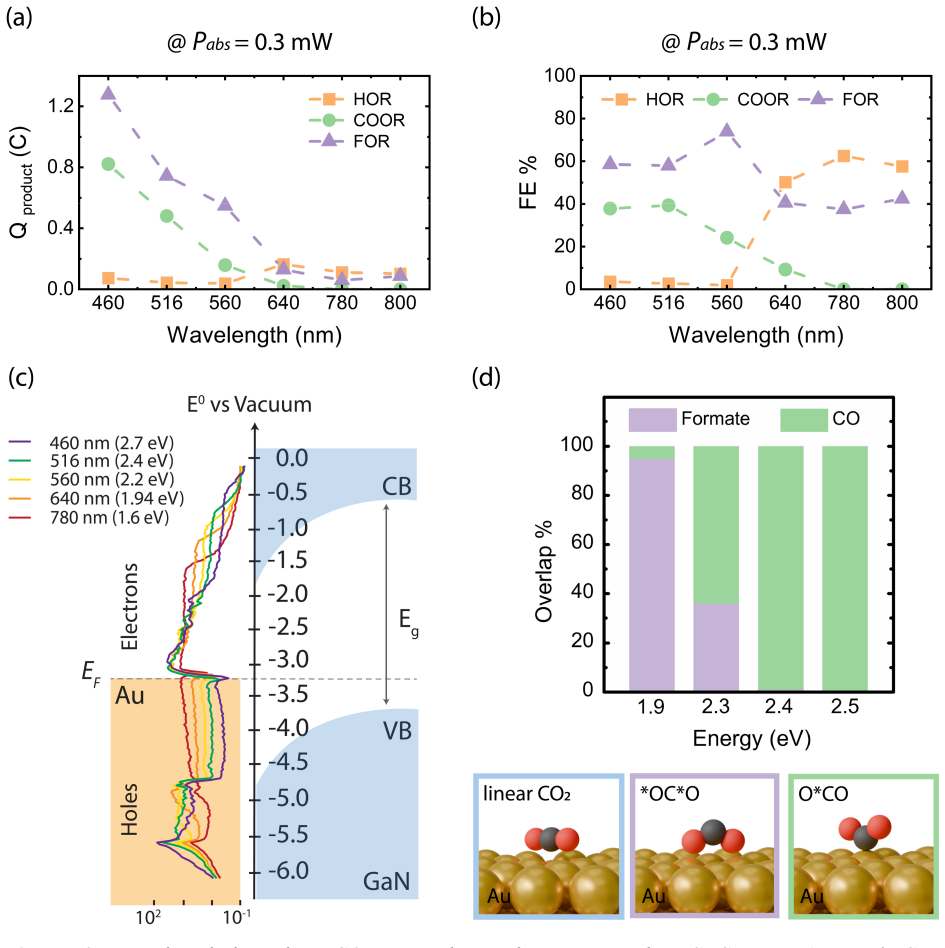
On plasmonic Au/p-GaN photocathodes, interband excitation at 460-560 nm drives selective CO production while intraband excitation at 640-800 nm favors H2 evolution. Constant absorbed power across wavelengths plus linear power dependence isolate the role of hot-carrier energy. DFT shows progressive increase in overlap between hot-electron states and the CO-producing intermediate with higher photon energy. Selectivity is further gated by geometry: sub-100 nm structures sustain activity while ~300 nm nanodisks lose it due to transport losses, matching ab initio transport calculations.
What carries the argument
wavelength-tuned hot-carrier excitation pathway on plasmonic Au/p-GaN, isolated by constant-power operando scanning photo-electrochemical microscopy (photo-SECM)
If this is right
- Higher-energy interband photons increase CO selectivity over formate by improving state overlap with the relevant intermediate.
- Hot-carrier transport distance limits activity, so only nanostructures under 100 nm maintain full CO2R performance.
- Photon energy, carrier transport length, and particle geometry must be designed together to achieve target selectivity.
- Photo-SECM enables spatially resolved mapping of these coupled parameters during operation.
Where Pith is reading between the lines
- The same wavelength-control principle could be tested on other plasmonic metals or semiconductor junctions to broaden product options beyond CO and H2.
- Integrating size-selective fabrication with wavelength-tunable illumination might allow dynamic switching of output chemicals in a single device.
- If transport losses scale with material mean free path, similar geometry constraints should appear in related plasmon-driven reductions such as nitrogen or oxygen.
Load-bearing premise
Holding absorbed power constant across wavelengths and confirming linear power dependence fully separates electronic hot-carrier effects from any remaining photonic or photothermal contributions.
What would settle it
Observation of wavelength-dependent selectivity changes that persist after equalizing hot-carrier energies (for example by adjusting intensities independently of wavelength) or that match thermal rather than electronic predictions would falsify the electronically driven pathway.
Figures
read the original abstract
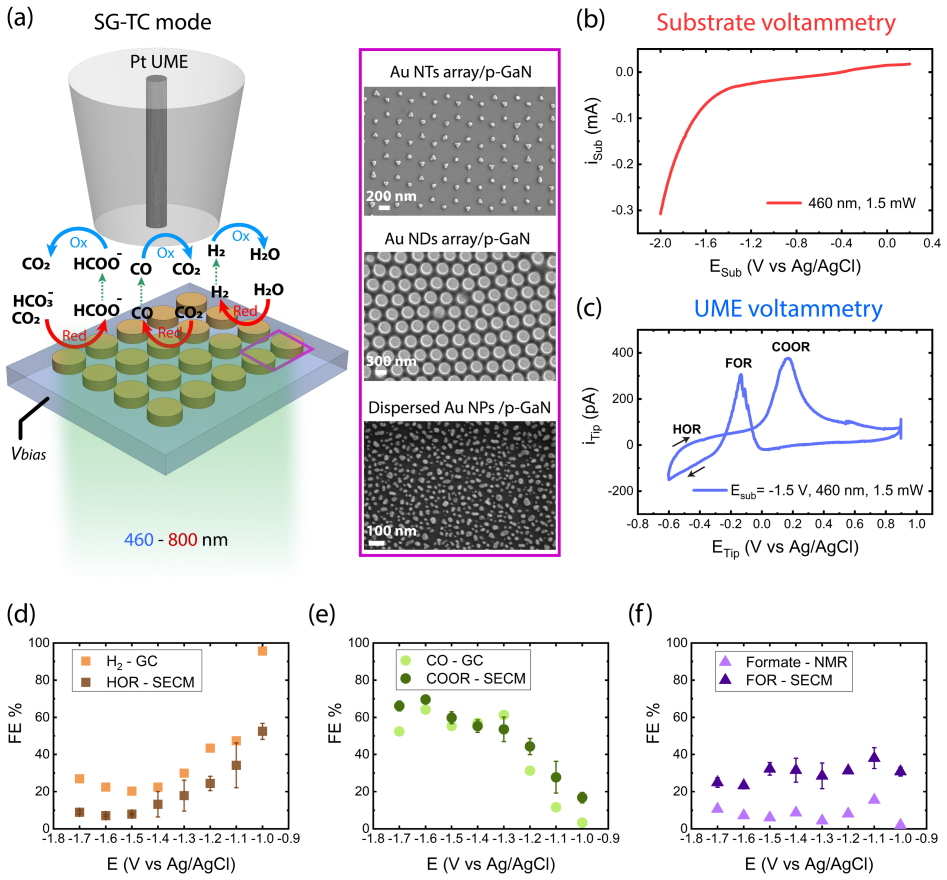
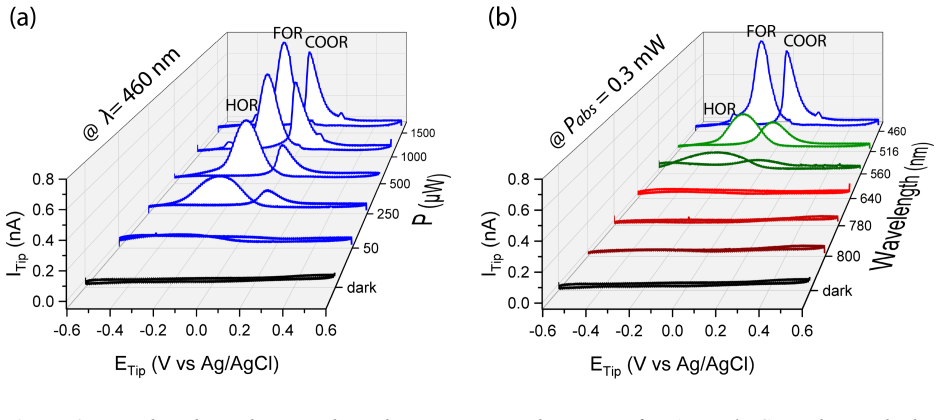
Controlling product selectivity in plasmonic catalysis, particularly in CO2 reduction (CO2R), remains a central unsolved challenge with direct implications for light-driven fuel and chemical synthesis. Here, we deploy quantitative operando scanning photoelectrochemical microscopy (photo-SECM) to provide a direct demonstration that tuning photon energy switches CO2R selectivity through an electronically driven pathway. On plasmonic Au/p-GaN photocathodes, interband excitation (460-560 nm) drives selective CO production while intraband excitation (640-800 nm) favors H2 evolution. By maintaining constant absorbed power across wavelengths and confirming linear power dependence, we isolate the role of hot-carrier energy from photonic and photothermal contributions. Density functional theory calculations reveal that higher-energy interband excitation progressively increases the overlap between hot-electron-accessible states and the CO-producing intermediate, selectively promoting CO over formate, in excellent agreement with experiment. We further show that selectivity is geometrically gated by hot-carrier transport: sub-100 nm nanostructures sustain CO2R activity, while ~300 nm nanodisks suffer transport losses that suppress it, consistent with ab initio hot-carrier transport calculations. Together, these results establish photon energy, carrier transport, and nanostructure geometry as coupled design parameters for plasmonic CO2R selectivity, resolve a longstanding debate on the origin of plasmon-driven selectivity effects, and position photo-SECM as a broadly applicable operando platform for photo(electro)catalysis.
Editorial analysis
A structured set of objections, weighed in public.
Referee Report
Summary. The manuscript uses quantitative operando scanning photoelectrochemical microscopy (photo-SECM) on plasmonic Au/p-GaN photocathodes to claim that photon energy directly controls CO2 reduction selectivity via hot-carrier energy distributions: interband excitation (460-560 nm) selectively drives CO production while intraband excitation (640-800 nm) favors H2 evolution. Constant absorbed power is maintained across wavelengths with confirmed linear power dependence to exclude photonic and photothermal effects; DFT calculations show improved overlap between hot-electron states and CO intermediates for higher-energy excitation, in excellent agreement with experiment; sub-100 nm structures sustain activity while ~300 nm nanodisks suffer transport losses, consistent with ab initio transport calculations.
Significance. If the absorbed-power normalization robustly isolates electronic effects, the work supplies direct evidence resolving debates on the origin of plasmon-driven selectivity in CO2R and identifies photon energy, carrier transport, and geometry as coupled design levers. The operando microscopy platform and combination with DFT plus transport calculations are positive features that could be broadly applicable.
major comments (1)
- [Experimental section on power normalization and absorbed-power determination] The central claim that selectivity differences arise purely from hot-carrier energy (rather than residual intensity variations) rests on holding absorbed power constant from 460-800 nm. If the wavelength-dependent absorption used for normalization was obtained from thin-film or simulated spectra instead of direct measurement on the precise Au/p-GaN nanostructures under operando electrolyte conditions, local field enhancements and interface absorption can vary strongly with wavelength, leaving a possible photonic-intensity contribution. Please specify the exact method, data source, and validation for the absorbed-power values applied to the nanostructures.
Simulated Author's Rebuttal
We thank the referee for their careful reading of the manuscript, positive assessment of its significance, and constructive comment. We address the major comment point-by-point below.
read point-by-point responses
-
Referee: [Experimental section on power normalization and absorbed-power determination] The central claim that selectivity differences arise purely from hot-carrier energy (rather than residual intensity variations) rests on holding absorbed power constant from 460-800 nm. If the wavelength-dependent absorption used for normalization was obtained from thin-film or simulated spectra instead of direct measurement on the precise Au/p-GaN nanostructures under operando electrolyte conditions, local field enhancements and interface absorption can vary strongly with wavelength, leaving a possible photonic-intensity contribution. Please specify the exact method, data source, and validation for the absorbed-power values applied to the nanostructures.
Authors: We agree that explicit documentation of the absorbed-power determination is essential to support the claim. The normalization was performed using absorption spectra measured directly on the fabricated Au/p-GaN nanostructures (both nanodisks and smaller structures) immersed in the CO2-saturated electrolyte within the photo-SECM cell, acquired via the same optical path and objective used for the operando experiments. These data were cross-validated against FDTD simulations of the exact nanostructure geometries and against thin-film reference spectra to quantify any interface-specific contributions. Linear power dependence was confirmed at each wavelength on the same structures. We have revised the Experimental Methods and Supporting Information to include the raw absorption spectra, the precise normalization formula, and the validation comparisons. revision: yes
Circularity Check
No significant circularity; central claims rest on independent measurements and separate calculations
full rationale
The paper's derivation chain relies on operando photo-SECM experiments that enforce constant absorbed power and verify linear power dependence as controls, plus independent DFT calculations whose outputs are compared to (but not fitted from) the measured selectivity trends. No step reduces a prediction to a fitted parameter from the same dataset, nor does any load-bearing premise collapse to a self-citation whose content is unverified outside the present work. Geometric transport effects are likewise cross-checked against separate ab initio transport calculations. The chain therefore remains self-contained against external benchmarks.
Axiom & Free-Parameter Ledger
axioms (2)
- domain assumption Constant absorbed power and linear power dependence isolate hot-carrier energy from photonic and photothermal contributions
- domain assumption DFT calculations correctly capture the overlap between hot-electron-accessible states and CO-producing intermediates
Reference graph
Works this paper leans on
-
[1]
Effect of nanostructure size on CO2RR selectivity and hot-carrier transport in Au/p-GaN photocathodes. (a, b) Consumed charge (Qproduct, top) and Faradaic efficiencies (FE%, bottom) for COOR, FOR, and HOR at the Pt UME tip under illumination of (a) Au NTs/p-GaN and (b) Au NDs/p-GaN photocathodes at excitation wavelengths of 460 -800 nm (absorbed power = 0...
-
[2]
J.; Heo, J.; Mohan, V .; Jain, P
(3) Devasia, D.; Wilson, A. J.; Heo, J.; Mohan, V .; Jain, P. K. A Rich Catalog of C–C Bonded Species Formed in CO2 Reduction on a Plasmonic Photocatalyst. Nat. Commun. 2021, 12 (1),
2021
-
[3]
https://doi.org/10.1038/s41467-021-22868-9. (4) DuChene, J. S.; Tagliabue, G.; Welch, A. J.; Cheng, W.-H.; Atwater, H. A. Hot Hole Collection and Photoelectrochemical CO2 Reduction with Plasmonic Au/p-GaN Photocathodes. Nano Lett. 2018, 18 (4), 2545–2550. https://doi.org/10.1021/acs.nanolett.8b00241. (5) Li, R.; Cheng, W.-H.; Richter, M. H.; DuChene, J. S...
-
[4]
https://doi.org/10.1149/1.2044046. (14) Zhang, J.; Pietro, W. J.; Lever, A. B. P. Rotating Ring-Disk Electrode Analysis of CO2 Reduction Electrocatalyzed by a Cobalt Tetramethylpyridoporphyrazine on the Disk and Detected as CO on a Platinum Ring. J. Electroanal. Chem. 1996, 403 (1), 93–100. https://doi.org/10.1016/0022-0728(95)04270-9. (15) Kiani, F.; Bow...
-
[5]
(22) Gu, X.; Wang, Z.; Li, J.; Ni, G.; Liu, L.; Zhan, D.; Peng, J
https://doi.org/10.1038/s42004-020-00399-6. (22) Gu, X.; Wang, Z.; Li, J.; Ni, G.; Liu, L.; Zhan, D.; Peng, J. Highthroughput Screening of CuBi Bimetallic Catalyst Array for Electrocatalytic CO2 Reduction Reaction by Scanning Electrochemical Microscope. ChemPhysChem 2024, 25 (21), e202400536. https://doi.org/10.1002/cphc.202400536. (23) Kai, T.; Zhou, M.;...
-
[6]
https://doi.org/10.1038/ncomms6788. (31) Brown, A. M.; Sundararaman, R.; Narang, P.; Goddard, W. A. I.; Atwater, H. A. Nonradiative Plasmon Decay and Hot Carrier Dynamics: Effects of Phonons, Surfaces, and Geometry. ACS Nano 2016, 10 (1), 957–966. https://doi.org/10.1021/acsnano.5b06199. (32) Baffou, G.; Bordacchini, I.; Baldi, A.; Quidant, R. Simple Expe...
-
[7]
18 (33) Yu, Y.; Sundaresan, V.; Willets, K
https://doi.org/10.1038/s41377-020-00345-0. 18 (33) Yu, Y.; Sundaresan, V.; Willets, K. A. Hot Carriers versus Thermal Effects: Resolving the Enhancement Mechanisms for Plasmon-Mediated Photoelectrochemical Reactions. J. Phys. Chem. C 2018, 122 (9), 5040–5048. https://doi.org/10.1021/acs.jpcc.7b12080. (34) Kumari, G.; Zhang, X.; Devasia, D.; Heo, J.; Jain...
discussion (0)
Sign in with ORCID, Apple, or X to comment. Anyone can read and Pith papers without signing in.