The Map of Parameter Space in Double Microwave Shielding
Pith reviewed 2026-06-27 14:22 UTC · model grok-4.3
The pith
Double microwave shielding maps a four-dimensional parameter space to locate regimes of strong loss suppression and tunable dipolar interactions that remain free of field-linked bound states.
A machine-rendered reading of the paper's core claim, the machinery that carries it, and where it could break.
Core claim
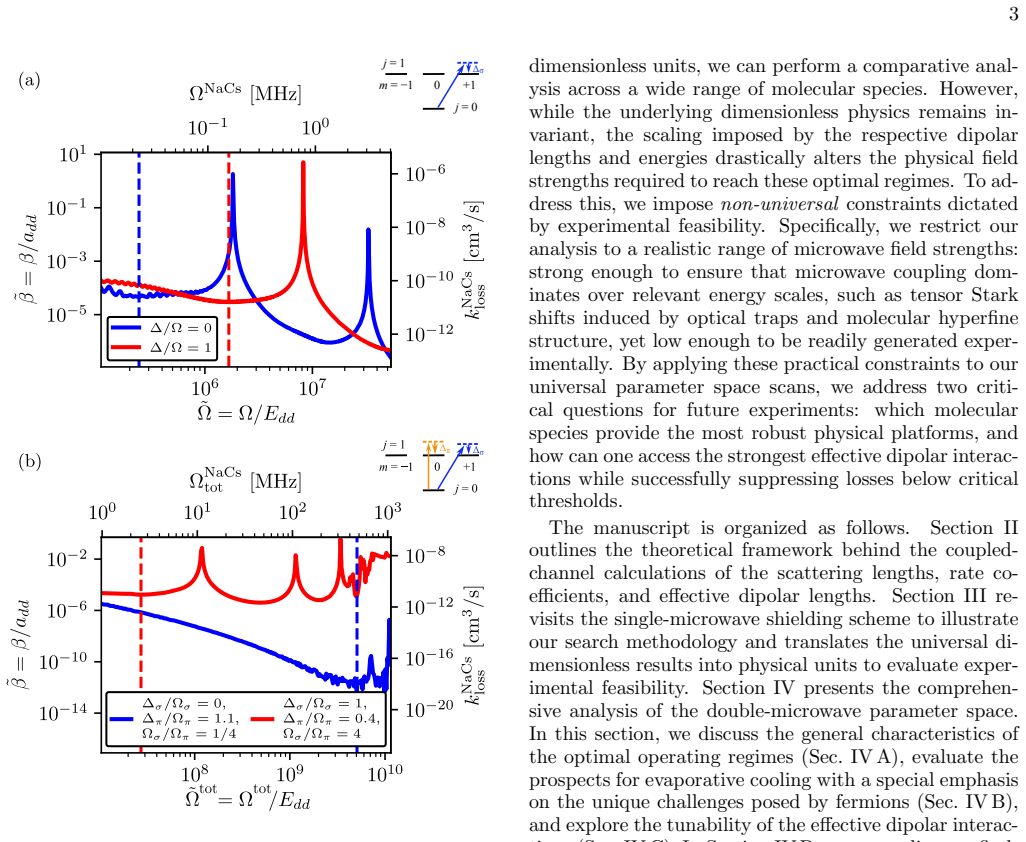
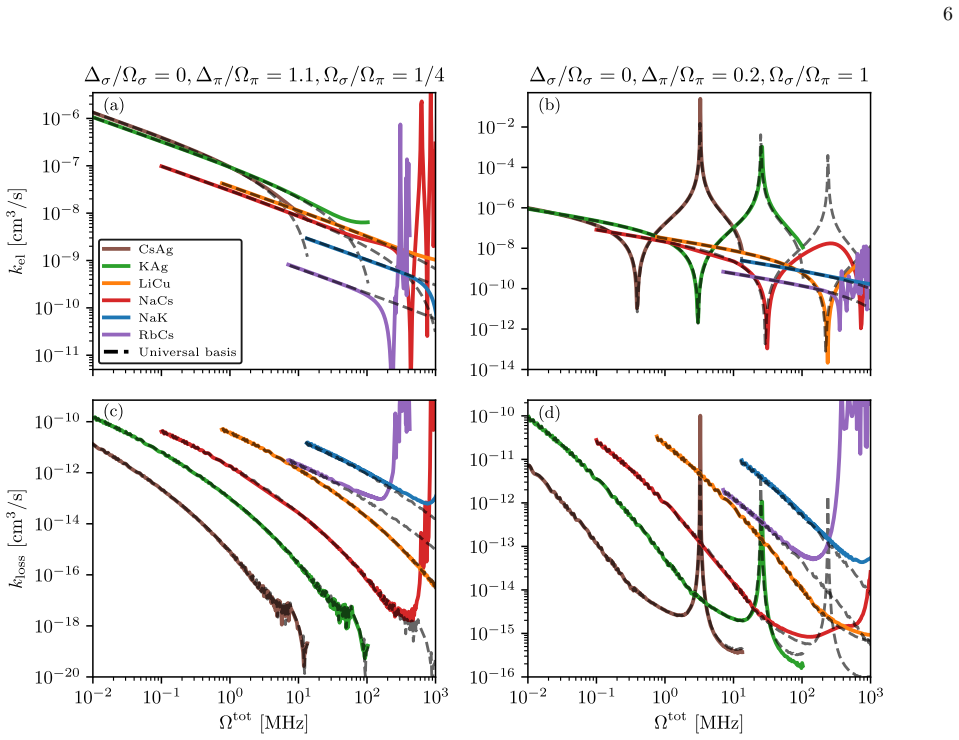
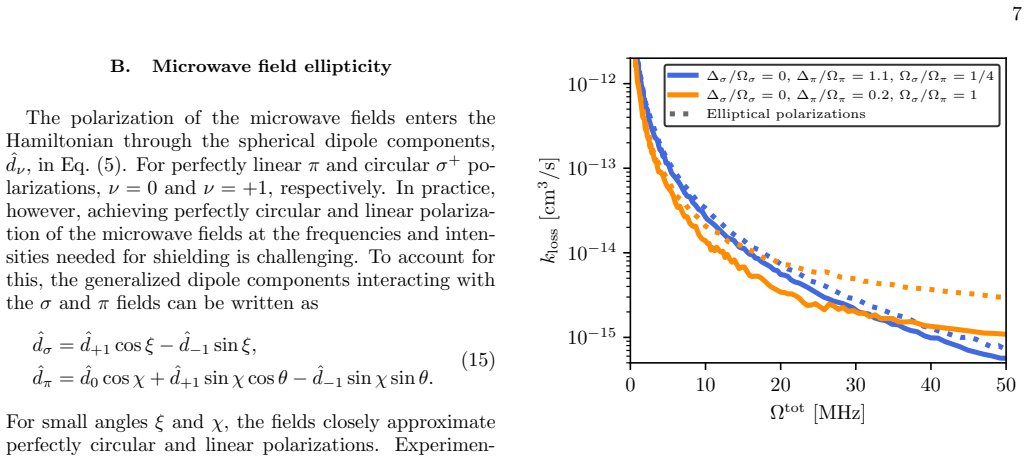
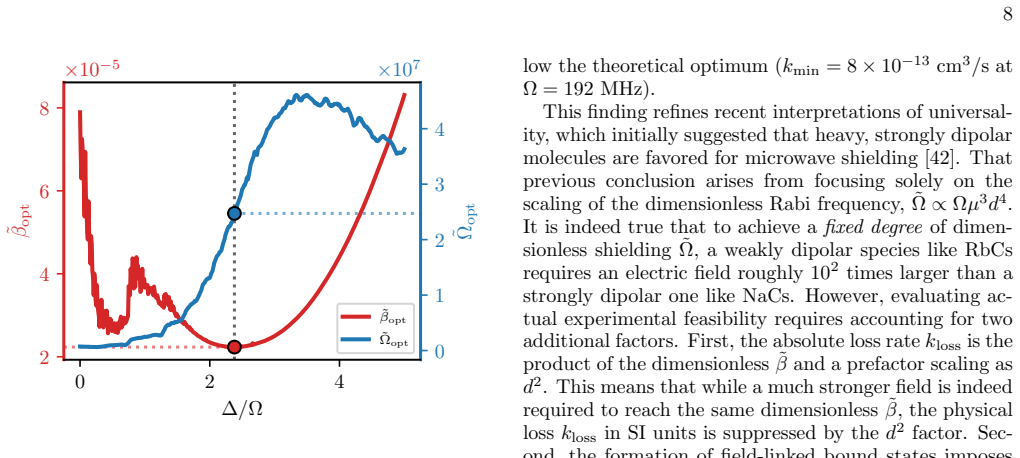
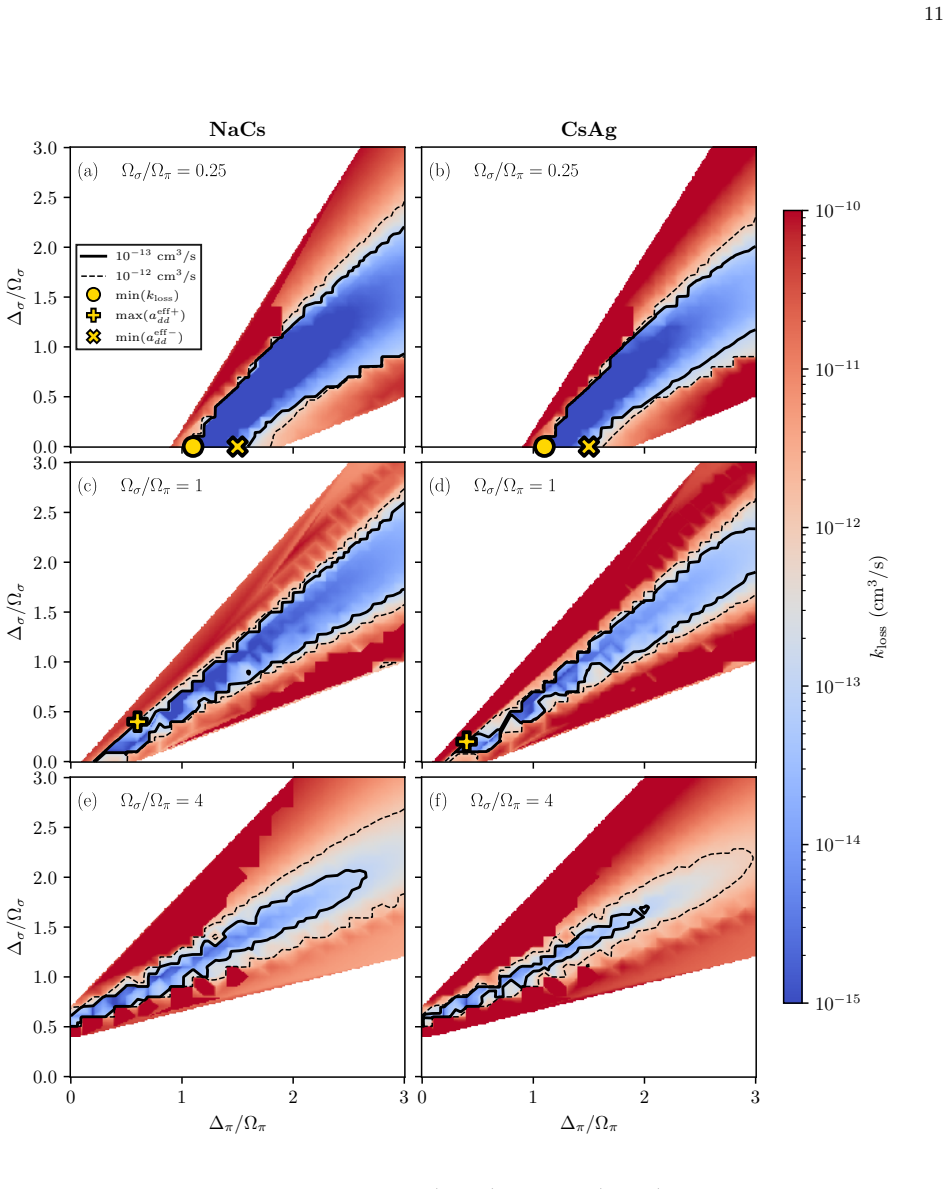
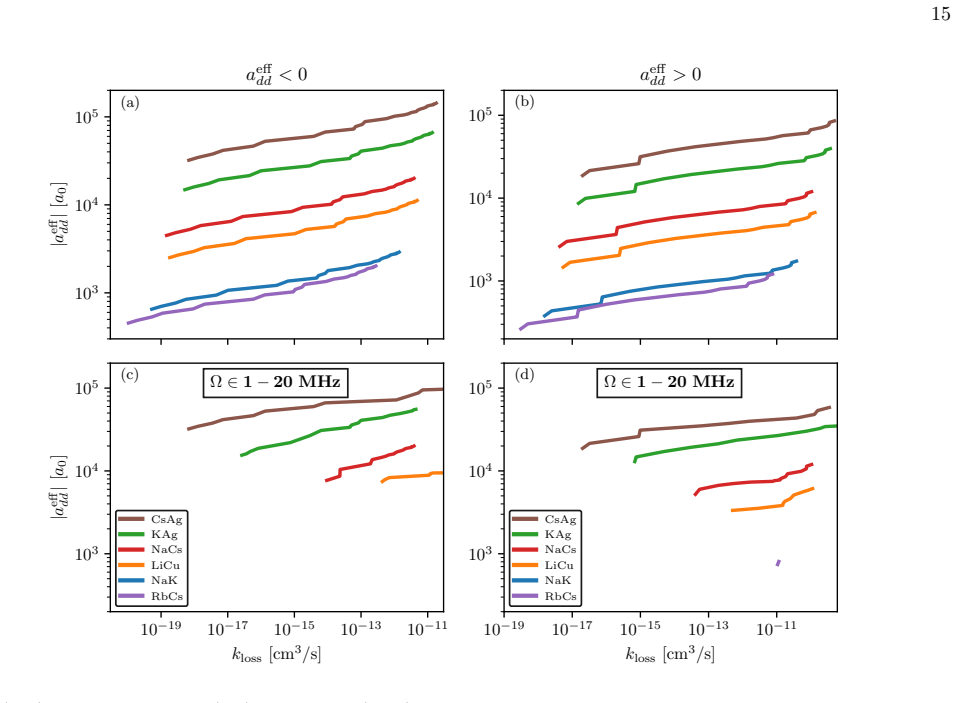
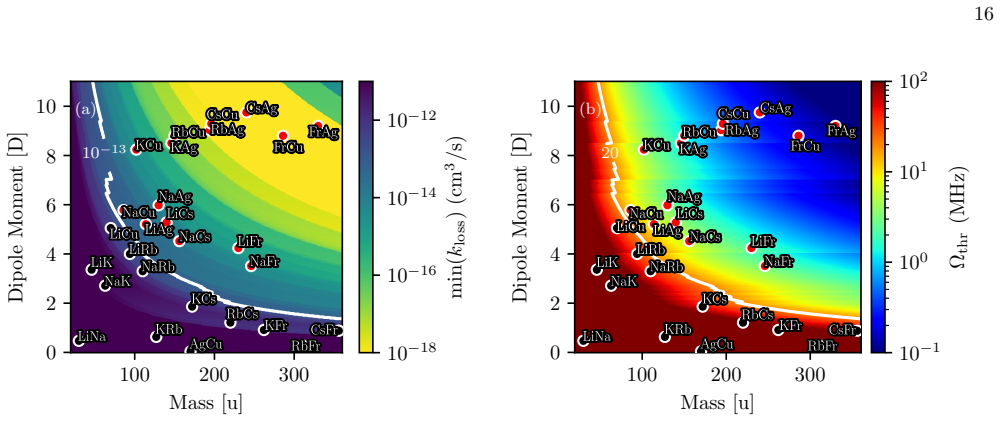
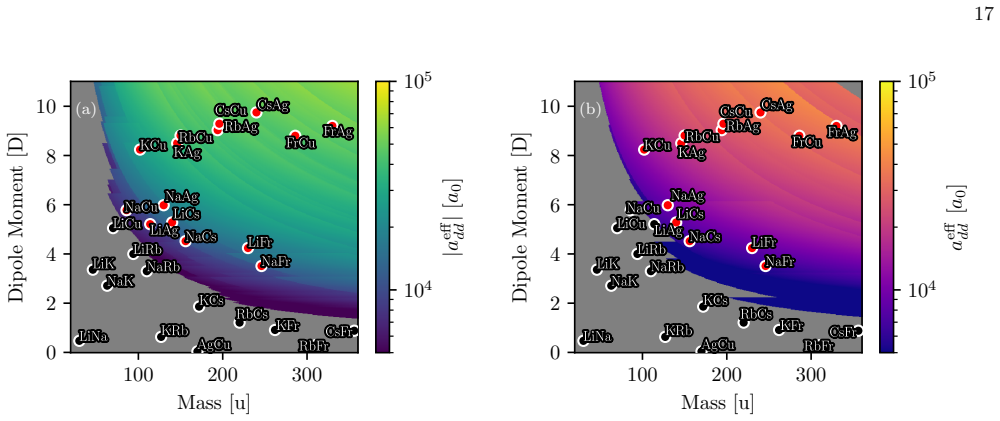
By exploiting the universality of the scattering problem, the authors construct a four-dimensional map over the detunings and intensities of σ+- and π-polarized microwaves. They locate regions that are strictly free of field-linked bound states, suppress two-body losses sufficiently for typical ultracold lifetimes, permit elastic-to-inelastic ratios adequate for evaporative cooling, and allow substantial tuning of the effective dipolar interaction. Heavy strongly dipolar molecules emerge as the platforms that realize these conditions at the lowest field strengths.
What carries the argument
The four-dimensional parameter space spanned by the detunings and intensities of the σ+ and π microwave fields, which sets the height and shape of the long-range repulsive barrier.
If this is right
- Configurations exist that keep the system strictly free of field-linked bound states while suppressing losses below typical ultracold lifetimes.
- Elastic-to-inelastic collision ratios in the mapped regimes remain high enough for efficient evaporative cooling.
- The effective dipolar interaction can be tuned over a substantial range inside the optimal regimes.
- Heavy strongly dipolar molecules achieve the required performance at moderate field strengths.
- These regimes support the conditions previously used to realize molecular Bose-Einstein condensates and self-bound droplets.
Where Pith is reading between the lines
- The same map could guide the choice of specific molecular species for quantum-simulation platforms that require both long lifetimes and tunable interactions.
- Verification of the predicted loss suppression in one heavy molecule would test whether the universality assumption holds across the broader set of candidates.
- Lower field requirements for heavy molecules may ease integration with other experimental techniques that are sensitive to strong static or microwave fields.
- The identified regimes might be combined with additional control fields to further extend the range of accessible interaction strengths.
Load-bearing premise
The scattering problem is universal enough that a generic model without molecule-specific short-range potentials accurately describes shielding for real species.
What would settle it
Direct measurement of two-body loss rates or spectroscopic detection of field-linked bound states for a heavy dipolar molecule at one of the parameter combinations the map identifies as optimal.
Figures
read the original abstract
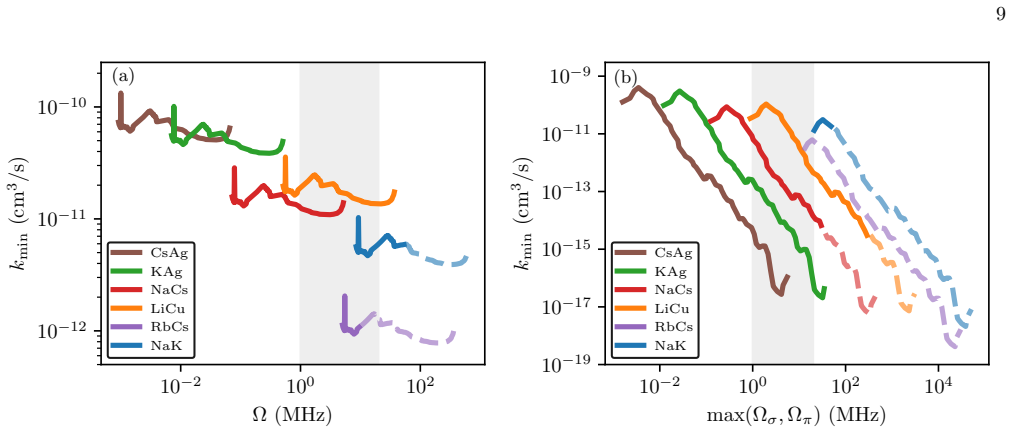
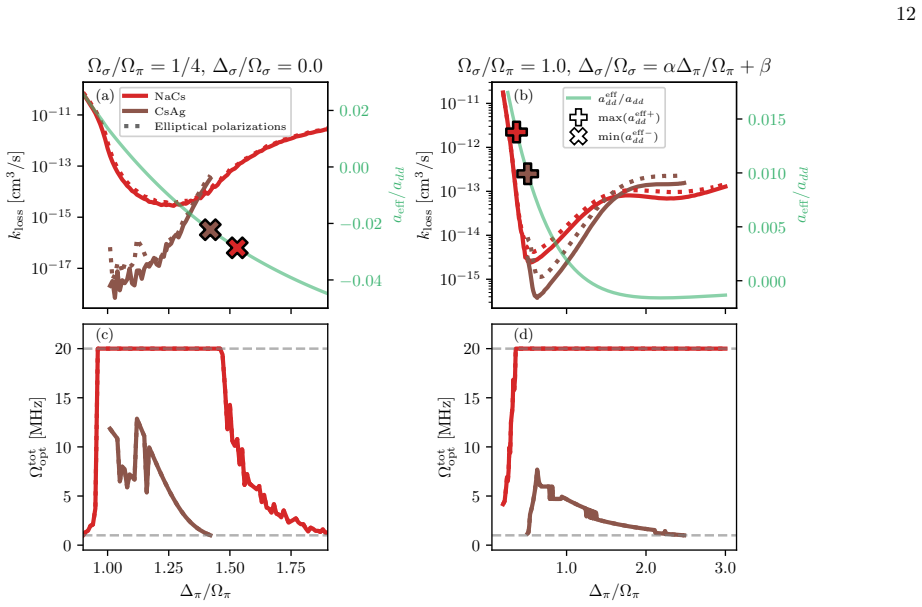
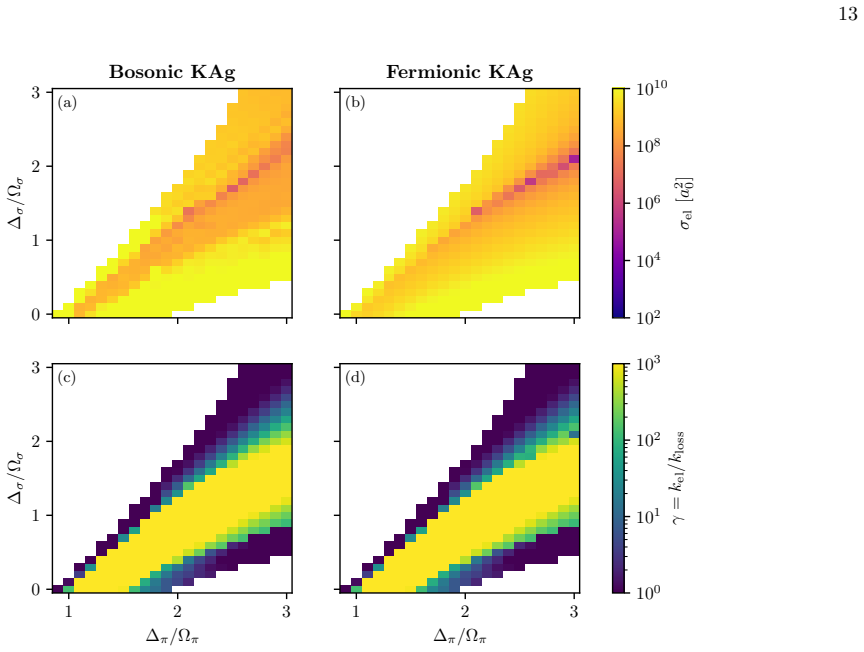
Double microwave shielding employs $\sigma^{+}$- and $\pi$-polarized microwave fields, tuned close to the lowest rotational transition, to engineer a long-range repulsive barrier between polar molecules. By preventing molecules from reaching the short range, this technique suppresses detrimental two-body losses and recently enabled the realization of molecular Bose-Einstein condensates and self-bound droplets. Yet, the optimal operating regimes of the shielding mechanism remain largely unexplored. Here, by leveraging the underlying universality of the scattering problem, we systematically map the four-dimensional microwave parameter space-spanned by the detunings and intensities of the two fields-to identify configurations that maximize both shielding efficiency and interaction tunability. We define optimal operating regimes as configurations that are strictly free of field-linked bound states while sufficiently suppressing two-body losses to exceed typical lifetimes of ultracold samples. In these regimes, we evaluate the elastic-to-inelastic collision ratios required for efficient evaporative cooling and explore the accessible tuning range of the effective dipolar interactions. Finally, to identify the best platforms for future quantum simulation experiments, we conduct a global survey of candidate molecular species under realistic field constraints. We identify heavy, strongly dipolar molecules as the most promising candidates, demonstrating that they can achieve extreme loss suppression alongside robust interaction tunability using only moderate field strengths.
Editorial analysis
A structured set of objections, weighed in public.
Referee Report
Summary. The manuscript maps the four-dimensional parameter space (detunings and intensities of σ^{+}- and π-polarized microwaves) for double microwave shielding of polar molecules. It identifies regimes that are strictly free of field-linked bound states while achieving sufficient two-body loss suppression for typical ultracold lifetimes, evaluates elastic-to-inelastic ratios for evaporative cooling, explores the tunable range of effective dipolar interactions, and surveys candidate species under realistic field constraints, concluding that heavy, strongly dipolar molecules are the most promising platforms.
Significance. If the universality of the long-range scattering model holds, the work supplies a practical guide for optimizing shielding parameters in molecular BEC and droplet experiments. The systematic four-dimensional scan and the explicit ranking of molecular species under moderate fields constitute a concrete contribution to the field.
major comments (1)
- [Scattering model and species survey sections] The central claim that the four-dimensional map 'applies directly' to real species (final survey section) rests on the asserted universality of the generic long-range model. The abstract and methods description do not specify the short-range boundary conditions or provide an explicit check that short-range corrections remain negligible inside the identified optimal windows; if these conditions shift field-linked bound states or modify the effective barrier height, both the 'strictly free of bound states' criterion and the quoted loss-suppression factors become molecule-dependent rather than universal.
Simulated Author's Rebuttal
We thank the referee for their careful reading of the manuscript and for the constructive feedback. We appreciate the positive assessment of the four-dimensional mapping and species survey. We address the single major comment below.
read point-by-point responses
-
Referee: [Scattering model and species survey sections] The central claim that the four-dimensional map 'applies directly' to real species (final survey section) rests on the asserted universality of the generic long-range model. The abstract and methods description do not specify the short-range boundary conditions or provide an explicit check that short-range corrections remain negligible inside the identified optimal windows; if these conditions shift field-linked bound states or modify the effective barrier height, both the 'strictly free of bound states' criterion and the quoted loss-suppression factors become molecule-dependent rather than universal.
Authors: We thank the referee for raising this point on the range of validity of the long-range model. The shielding mechanism is designed precisely so that the repulsive barrier keeps the wave-function amplitude negligible at short range; field-linked bound states are supported by the long-range microwave-dressed potentials and are therefore captured within the model. Nevertheless, the referee is correct that the manuscript does not explicitly state the short-range boundary condition or quantify the residual short-range probability inside the reported windows. In the revised manuscript we will (i) add a sentence in the Methods section specifying the hard-wall boundary condition employed at a small cutoff radius and (ii) include a short supplementary figure or paragraph demonstrating that, for representative optimal parameters, the short-range probability density is suppressed by several orders of magnitude relative to the long-range region. These additions will make the universality assumption explicit without changing any numerical results or conclusions. revision: yes
Circularity Check
No significant circularity; derivation from generic scattering model is self-contained.
full rationale
The paper derives its four-dimensional parameter map by solving the scattering problem under an asserted universal long-range model, then applies the resulting regimes to candidate species. No quoted step reduces a claimed prediction to a fitted input by construction, renames a known result, or relies on a load-bearing self-citation whose content is itself unverified. The universality assumption and omission of short-range potentials are explicit model choices whose validity is external to the derivation chain; the map itself is computed from the model equations rather than being tautological with its inputs. This is the normal case of a model-based survey whose central claims remain independently falsifiable.
Axiom & Free-Parameter Ledger
axioms (2)
- domain assumption Universality of the scattering problem allows a single four-dimensional map to apply across molecular species
- domain assumption Absence of field-linked bound states plus loss suppression below a lifetime threshold defines an optimal regime
Reference graph
Works this paper leans on
-
[1]
The microwave frequencies are characterized by their detuning, ∆ ν =ω ν −ω 0,0;1,ν from the bare j= 0, m= 0→1, νtransition
The Rabi frequency for thej= 0→1 transition is given byℏΩ ν =dE ν/ √ 3, whereE ν is the corresponding elec- tric field strength,dis the permanent dipole moment of the molecule, andN 0,ν is the reference number of photons. The microwave frequencies are characterized by their detuning, ∆ ν =ω ν −ω 0,0;1,ν from the bare j= 0, m= 0→1, νtransition. We omit hyp...
-
[2]
Conversely, the effective loss rate in the experiment cannot be slower than the one- body loss set, for example, by off-resonant scattering of the trap light. Assuming a one-body lifetime of∼1 s, any further suppression of two-body loss rate provides no ad- ditional benefit. Therefore, we limitk loss from below at 10−13 cm3/s. Figure 8 presents the uncons...
-
[3]
Hutzler, Ana Maria Rey, and Tanya Zelevinsky
David DeMille, Nicholas R. Hutzler, Ana Maria Rey, and Tanya Zelevinsky. Quantum sensing and metrology for fundamental physics with molecules.Nature Physics, 20(5):741–749, May 2024
2024
-
[4]
Ul- tracold chemistry as a testbed for few-body physics.Na- ture Physics, 20(5):722–729, May 2024
Tijs Karman, Micha l Tomza, and Jes´ us P´ erez-R´ ıos. Ul- tracold chemistry as a testbed for few-body physics.Na- ture Physics, 20(5):722–729, May 2024. 18
2024
-
[5]
Bimolecular chemistry in the ultracold regime.Annual Review of Physical Chemistry, 73(Volume 73, 2022):73–96, 2022
Yu Liu and Kang-Kuen Ni. Bimolecular chemistry in the ultracold regime.Annual Review of Physical Chemistry, 73(Volume 73, 2022):73–96, 2022
2022
-
[6]
R. V. Krems. Cold controlled chemistry.Physical Chem- istry Chemical Physics, 10(28):4079, 2008
2008
-
[7]
Cornish, Michael R
Simon L. Cornish, Michael R. Tarbutt, and Kaden R. A. Hazzard. Quantum computation and quantum simulation with ultracold molecules.Nature Physics, 20(5):730–740, May 2024
2024
-
[8]
Many-body physics with ultracold gases.Rev
Immanuel Bloch, Jean Dalibard, and Wilhelm Zwerger. Many-body physics with ultracold gases.Rev. Mod. Phys., 80:885–964, Jul 2008
2008
-
[9]
Feshbach resonances in ultracold gases.Rev
Cheng Chin, Rudolf Grimm, Paul Julienne, and Eite Tiesinga. Feshbach resonances in ultracold gases.Rev. Mod. Phys., 82:1225–1286, Apr 2010
2010
-
[10]
The physics of dipolar bosonic quantum gases
T Lahaye, C Menotti, L Santos, M Lewenstein, and T Pfau. The physics of dipolar bosonic quantum gases. Reports on Progress in Physics, 72(12):126401, Novem- ber 2009
2009
-
[11]
Dipolar physics: a review of experiments with magnetic quantum gases.Reports on Progress in Physics, 86(2):026401, December 2022
Lauriane Chomaz, Igor Ferrier-Barbut, Francesca Fer- laino, Bruno Laburthe-Tolra, Benjamin L Lev, and Tilman Pfau. Dipolar physics: a review of experiments with magnetic quantum gases.Reports on Progress in Physics, 86(2):026401, December 2022
2022
-
[12]
Micheli, G
A. Micheli, G. K. Brennen, and P. Zoller. A toolbox for lattice-spin models with polar molecules.Nature Physics, 2(5):341–347, April 2006
2006
-
[13]
Self-bound dipolar droplets and supersolids in molecular bose-einstein condensates.Phys
Matthias Schmidt, Lucas Lassabli` ere, Goulven Qu´ em´ ener, and Tim Langen. Self-bound dipolar droplets and supersolids in molecular bose-einstein condensates.Phys. Rev. Res., 4:013235, Mar 2022
2022
-
[14]
D. DeMille. Quantum computation with trapped polar molecules.Phys. Rev. Lett., 88:067901, Jan 2002
2002
-
[15]
Julienne
Zbigniew Idziaszek and Paul S. Julienne. Universal rate constants for reactive collisions of ultracold molecules. Phys. Rev. Lett., 104:113202, Mar 2010
2010
-
[16]
Ospelkaus, K.-K
S. Ospelkaus, K.-K. Ni, D. Wang, M. H. G. de Miranda, B. Neyenhuis, G. Qu´ em´ ener, P. S. Julienne, J. L. Bohn, D. S. Jin, and J. Ye. Quantum-state controlled chemi- cal reactions of ultracold potassium-rubidium molecules. Science, 327(5967):853–857, 2010
2010
-
[17]
Hutson, C
Tetsu Takekoshi, Lukas Reichs¨ ollner, Andreas Schinde- wolf, Jeremy M. Hutson, C. Ruth Le Sueur, Olivier Dulieu, Francesca Ferlaino, Rudolf Grimm, and Hanns- Christoph N¨ agerl. Ultracold dense samples of dipolar rbcs molecules in the rovibrational and hyperfine ground state.Phys. Rev. Lett., 113:205301, Nov 2014
2014
-
[18]
Molony, Philip D
Peter K. Molony, Philip D. Gregory, Zhonghua Ji, Bo Lu, Michael P. K¨ oppinger, C. Ruth Le Sueur, Caroline L. Blackley, Jeremy M. Hutson, and Simon L. Cornish. Cre- ation of ultracold 87Rb133Cs molecules in the rovibra- tional ground state.Phys. Rev. Lett., 113:255301, Dec 2014
2014
-
[19]
Will, and Martin W
Jee Woo Park, Sebastian A. Will, and Martin W. Zwierlein. Ultracold dipolar gas of fermionic 23Na40K molecules in their absolute ground state.Phys. Rev. Lett., 114:205302, May 2015
2015
-
[20]
Creation of an ultracold gas of ground-state dipolar 23Na87Rb molecules.Phys
Mingyang Guo, Bing Zhu, Bo Lu, Xin Ye, Fudong Wang, Romain Vexiau, Nadia Bouloufa-Maafa, Goulven Qu´ em´ ener, Olivier Dulieu, and Dajun Wang. Creation of an ultracold gas of ground-state dipolar 23Na87Rb molecules.Phys. Rev. Lett., 116:205303, May 2016
2016
-
[21]
Gonz´ alez-Mart´ ınez, Goulven Qu´ em´ ener, and Dajun Wang
Xin Ye, Mingyang Guo, Maykel L. Gonz´ alez-Mart´ ınez, Goulven Qu´ em´ ener, and Dajun Wang. Collisions of ul- tracold ¡sup¿23¡/sup¿na¡sup¿87¡/sup¿rb molecules with controlled chemical reactivities.Science Advances, 4(1):eaaq0083, 2018
2018
-
[22]
Ultracold sticky colli- sions: Theoretical and experimental status.The Journal of Physical Chemistry A, 127(3):729–741, January 2023
Roman Bause, Arthur Christianen, Andreas Schindewolf, Immanuel Bloch, and Xin-Yu Luo. Ultracold sticky colli- sions: Theoretical and experimental status.The Journal of Physical Chemistry A, 127(3):729–741, January 2023
2023
-
[23]
Ruzic, and John L
Michael Mayle, Brandon P. Ruzic, and John L. Bohn. Statistical aspects of ultracold resonant scattering.Phys. Rev. A, 85:062712, Jun 2012
2012
-
[24]
Ruzic, and John L
Michael Mayle, Goulven Qu´ em´ ener, Brandon P. Ruzic, and John L. Bohn. Scattering of ultracold molecules in the highly resonant regime.Phys. Rev. A, 87:012709, Jan 2013
2013
-
[25]
Zwierlein, Gerrit C
Arthur Christianen, Martin W. Zwierlein, Gerrit C. Groenenboom, and Tijs Karman. Photoinduced two- body loss of ultracold molecules.Phys. Rev. Lett., 123:123402, Sep 2019
2019
-
[26]
Avdeenkov, Masatoshi Kajita, and John L
Alexander V. Avdeenkov, Masatoshi Kajita, and John L. Bohn. Suppression of inelastic collisions of polar 1Σ state molecules in an electrostatic field.Phys. Rev. A, 73:022707, Feb 2006
2006
-
[27]
H. P. B¨ uchler, E. Demler, M. Lukin, A. Micheli, N. Prokof’ev, G. Pupillo, and P. Zoller. Strongly cor- related 2d quantum phases with cold polar molecules: Controlling the shape of the interaction potential.Phys. Rev. Lett., 98:060404, Feb 2007
2007
-
[28]
A. V. Gorshkov, P. Rabl, G. Pupillo, A. Micheli, P. Zoller, M. D. Lukin, and H. P. B¨ uchler. Suppression of inelastic collisions between polar molecules with a repulsive shield. Phys. Rev. Lett., 101:073201, Aug 2008
2008
-
[29]
N. R. Cooper and G. V. Shlyapnikov. Stable topological superfluid phase of ultracold polar fermionic molecules. Phys. Rev. Lett., 103:155302, Oct 2009
2009
-
[30]
Tijs Karman and Jeremy M. Hutson. Microwave shield- ing of ultracold polar molecules.Phys. Rev. Lett., 121:163401, Oct 2018
2018
-
[31]
Control- ling the scattering length of ultracold dipolar molecules
Lucas Lassabli` ere and Goulven Qu´ em´ ener. Control- ling the scattering length of ultracold dipolar molecules. Phys. Rev. Lett., 121:163402, Oct 2018
2018
-
[32]
Tobias, Jun-Ru Li, Luigi De Marco, and Jun Ye
Giacomo Valtolina, Kyle Matsuda, William G. Tobias, Jun-Ru Li, Luigi De Marco, and Jun Ye. Dipolar evapo- ration of reactive molecules to below the fermi tempera- ture.Nature, 588(7837):239–243, December 2020
2020
-
[33]
Tobias, Giacomo Valtolina, Goulven Qu´ em´ ener, and Jun Ye
Kyle Matsuda, Luigi De Marco, Jun-Ru Li, William G. Tobias, Giacomo Valtolina, Goulven Qu´ em´ ener, and Jun Ye. Resonant collisional shielding of reactive molecules using electric fields.Science, 370(6522):1324–1327, De- cember 2020
2020
-
[34]
Tobias, Kyle Matsuda, Calder Miller, Giacomo Valtolina, Luigi De Marco, Reuben R
Jun-Ru Li, William G. Tobias, Kyle Matsuda, Calder Miller, Giacomo Valtolina, Luigi De Marco, Reuben R. W. Wang, Lucas Lassabli` ere, Goulven Qu´ em´ ener, John L. Bohn, and Jun Ye. Tuning of dipolar interactions and evaporative cooling in a three-dimensional molecular quantum gas.Nature Physics, 17(10):1144–1148, 2021
2021
-
[35]
Yu, Tijs Karman, Eunmi Chae, Kang-Kuen Ni, Wolfgang Ketterle, and John M
Lo¨ ıc Anderegg, Sean Burchesky, Yicheng Bao, Scar- lett S. Yu, Tijs Karman, Eunmi Chae, Kang-Kuen Ni, Wolfgang Ketterle, and John M. Doyle. Observation of microwave shielding of ultracold molecules.Science, 373(6556):779–782, August 2021
2021
-
[36]
Evaporation of microwave-shielded polar molecules to quantum degeneracy.Nature, 19 607(7920):677–681, July 2022
Andreas Schindewolf, Roman Bause, Xing-Yan Chen, Marcel Duda, Tijs Karman, Immanuel Bloch, and Xin-Yu Luo. Evaporation of microwave-shielded polar molecules to quantum degeneracy.Nature, 19 607(7920):677–681, July 2022
2022
-
[37]
Observation of Bose–Einstein condensation of dipolar molecules.Nature, 631(8020):289–293, June 2024
Niccol` o Bigagli, Weijun Yuan, Siwei Zhang, Boris Bula- tovic, Tijs Karman, Ian Stevenson, and Sebastian Will. Observation of Bose–Einstein condensation of dipolar molecules.Nature, 631(8020):289–293, June 2024
2024
-
[38]
Bose-einstein conden- sate of ultracold sodium-rubidium molecules with tun- able dipolar interactions, 2025
Zhaopeng Shi, Zerong Huang, Fulin Deng, Wei-Jian Jin, Su Yi, Tao Shi, and Dajun Wang. Bose-einstein conden- sate of ultracold sodium-rubidium molecules with tun- able dipolar interactions, 2025
2025
-
[39]
Three-body recombination of ultracold microwave-shielded polar molecules.Phys
Ian Stevenson, Shayamal Singh, Ahmed Elkamshishy, Niccol´ o Bigagli, Weijun Yuan, Siwei Zhang, Chris H Greene, and Sebastian Will. Three-body recombination of ultracold microwave-shielded polar molecules.Phys. Rev. Lett., 133(26):263402, 2024
2024
-
[40]
Extreme loss suppression and wide tun- ability of dipolar interactions in an ultracold molecular gas, 2025
Weijun Yuan, Siwei Zhang, Niccol` o Bigagli, Haneul Kwak, Claire Warner, Tijs Karman, Ian Stevenson, and Sebastian Will. Extreme loss suppression and wide tun- ability of dipolar interactions in an ultracold molecular gas, 2025
2025
-
[41]
Double microwave shielding.PRX Quantum, 6:020358, Jun 2025
Tijs Karman, Niccol` o Bigagli, Weijun Yuan, Siwei Zhang, Ian Stevenson, and Sebastian Will. Double microwave shielding.PRX Quantum, 6:020358, Jun 2025
2025
-
[42]
Two- and many-body physics of ultracold molecules dressed by dual microwave fields.Nature Communica- tions, 16(1), December 2025
Fulin Deng, Xinyuan Hu, Wei-Jian Jin, Su Yi, and Tao Shi. Two- and many-body physics of ultracold molecules dressed by dual microwave fields.Nature Communica- tions, 16(1), December 2025
2025
-
[43]
Observation of self-bound droplets of ultracold dipolar molecules.Nature, 651(8106):601–606, March 2026
Siwei Zhang, Weijun Yuan, Niccol` o Bigagli, Haneul Kwak, Tijs Karman, Ian Stevenson, and Sebastian Will. Observation of self-bound droplets of ultracold dipolar molecules.Nature, 651(8106):601–606, March 2026
2026
-
[44]
Joy Dutta, Bijit Mukherjee, and Jeremy M. Hutson. Uni- versality in the microwave shielding of ultracold polar molecules.Phys. Rev. Res., 7:023164, May 2025
2025
-
[45]
Tijs Karman and Jeremy M. Hutson. Microwave shield- ing of ultracold polar molecules with imperfectly circular polarization.Phys. Rev. A, 100:052704, Nov 2019
2019
-
[46]
Collisionally stable gas of bosonic dipolar ground-state molecules.Nature Physics, 19(11):1579–1584, Septem- ber 2023
Niccol` o Bigagli, Claire Warner, Weijun Yuan, Siwei Zhang, Ian Stevenson, Tijs Karman, and Sebastian Will. Collisionally stable gas of bosonic dipolar ground-state molecules.Nature Physics, 19(11):1579–1584, Septem- ber 2023
2023
-
[47]
Microwave shielding with far-from-circular polarization.Phys
Tijs Karman. Microwave shielding with far-from-circular polarization.Phys. Rev. A, 101:042702, Apr 2020
2020
-
[48]
Field-linked resonances of polar molecules.Nature, 614(7946):59–63, February 2023
Xing-Yan Chen, Andreas Schindewolf, Sebastian Ep- pelt, Roman Bause, Marcel Duda, Shrestha Biswas, Tijs Karman, Timon Hilker, Immanuel Bloch, and Xin-Yu Luo. Field-linked resonances of polar molecules.Nature, 614(7946):59–63, February 2023
2023
-
[49]
Liesbeth M. C. Janssen, Ad van der Avoird, and Gerrit C. Groenenboom. Quantum Reactive Scattering of Ultra- cold NH(X 3Σ−) Radicals in a Magnetic Trap.Phys. Rev. Lett., 110:063201, Feb 2013
2013
-
[50]
Quasi-universal dipolar scattering in cold and ultracold gases.New Jour- nal of Physics, 11(5):055039, May 2009
J L Bohn, M Cavagnero, and C Ticknor. Quasi-universal dipolar scattering in cold and ultracold gases.New Jour- nal of Physics, 11(5):055039, May 2009
2009
-
[51]
Gonz´ alez-Mart´ ınez, John L
Maykel L. Gonz´ alez-Mart´ ınez, John L. Bohn, and Goul- ven Qu´ em´ ener. Adimensional theory of shielding in ultra- cold collisions of dipolar rotors.Phys. Rev. A, 96:032718, Sep 2017
2017
-
[52]
Highly polar molecules consisting of a copper or silver atom interacting with an alkali-metal or alkaline-earth-metal atom.Phys
Micha l ´Smia lkowski and Micha l Tomza. Highly polar molecules consisting of a copper or silver atom interacting with an alkali-metal or alkaline-earth-metal atom.Phys. Rev. A, 103:022802, Feb 2021
2021
-
[53]
Dagdigian and Lennard Wharton
Paul J. Dagdigian and Lennard Wharton. Molecular beam electric deflection and resonance spectroscopy of the heteronuclear alkali dimers: 39K7Li, Rb7Li, 39K23Na, Rb23Na, and 133Cs23Na.The Journal of Chemical Physics, 57(4):1487–1496, August 1972
1972
-
[54]
Microwave shielding of bosonic narb molecules.Phys
Junyu Lin, Guanghua Chen, Mucan Jin, Zhaopeng Shi, Fulin Deng, Wenxian Zhang, Goulven Qu´ em´ ener, Tao Shi, Su Yi, and Dajun Wang. Microwave shielding of bosonic narb molecules.Phys. Rev. X, 13:031032, Sep 2023
2023
-
[55]
The evaporative cooling of a gas of caesium atoms in the hydrodynamic regime.Journal of Physics B: Atomic, Molecular and Optical Physics, 36(16):3533–3540, Au- gust 2003
Z-Y Ma, A M Thomas, C J Foot, and S L Cornish. The evaporative cooling of a gas of caesium atoms in the hydrodynamic regime.Journal of Physics B: Atomic, Molecular and Optical Physics, 36(16):3533–3540, Au- gust 2003
2003
discussion (0)
Sign in with ORCID, Apple, or X to comment. Anyone can read and Pith papers without signing in.