Parahydrogen Cooling of Nuclear Spin Chains at Hypogeomagnetic Fields
Pith reviewed 2026-06-27 16:49 UTC · model grok-4.3
The pith
Parahydrogen hyperpolarization at low magnetic fields cools a 12-spin nuclear chain below its thermal entropy.
A machine-rendered reading of the paper's core claim, the machinery that carries it, and where it could break.
Core claim
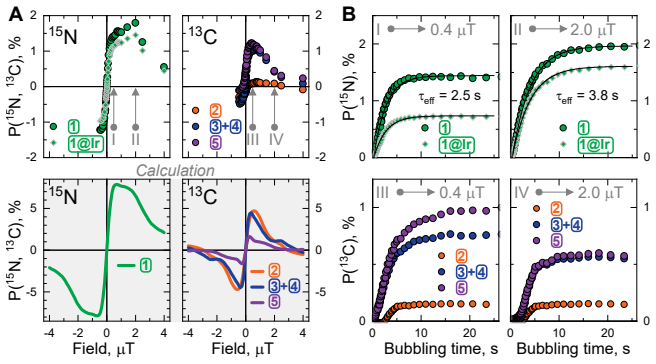
Using parahydrogen-based SABRE at hypogeomagnetic fields, the 12-spin chain reaches a von Neumann entropy S/k of 8.274 at 0.52 uT, below the unpolarized reference of 8.318, corresponding to an entropy deficit of -0.043/k. This is accompanied by experimental nuclear spin temperatures of 52 mK for the 15N subensemble and 257 mK for 13C, with the full network showing greater cooling due to multi-spin correlations.
What carries the argument
Parahydrogen SABRE at hypogeomagnetic fields, which transfers polarization and generates non-equilibrium multi-spin orders in the chemically engineered spin chain.
If this is right
- Rapid field cycling to 9.4 T allows site-resolved NMR readout of the hyperpolarized states.
- The precisely determined coupling network provides a benchmarked Hamiltonian for quantum simulation protocols.
- Initialization of quantum simulators from highly mixed states becomes feasible at room temperature.
- The approach demonstrates cooling through creation of correlated multi-spin orders beyond single-spin polarization.
Where Pith is reading between the lines
- Similar low-field SABRE could be applied to other molecular spin networks to achieve even lower entropies.
- This entropy reduction might enable observation of quantum effects or entanglement in larger spin systems at ambient conditions.
- The method could be combined with other control techniques to further reduce entropy for quantum information tasks.
Load-bearing premise
The calculation of the full spin system's von Neumann entropy assumes that single-spin polarizations and inferred multi-spin orders completely specify the density matrix, with negligible unmeasured coherences or relaxation during cycling.
What would settle it
Direct measurement showing the total entropy of the 12-spin system exceeding the thermal value, or absence of the predicted multi-spin orders at 0.52 uT, would falsify the cooling claim.
Figures
read the original abstract
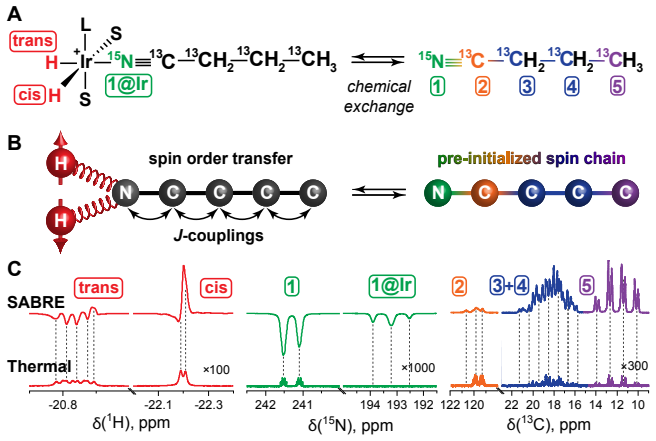
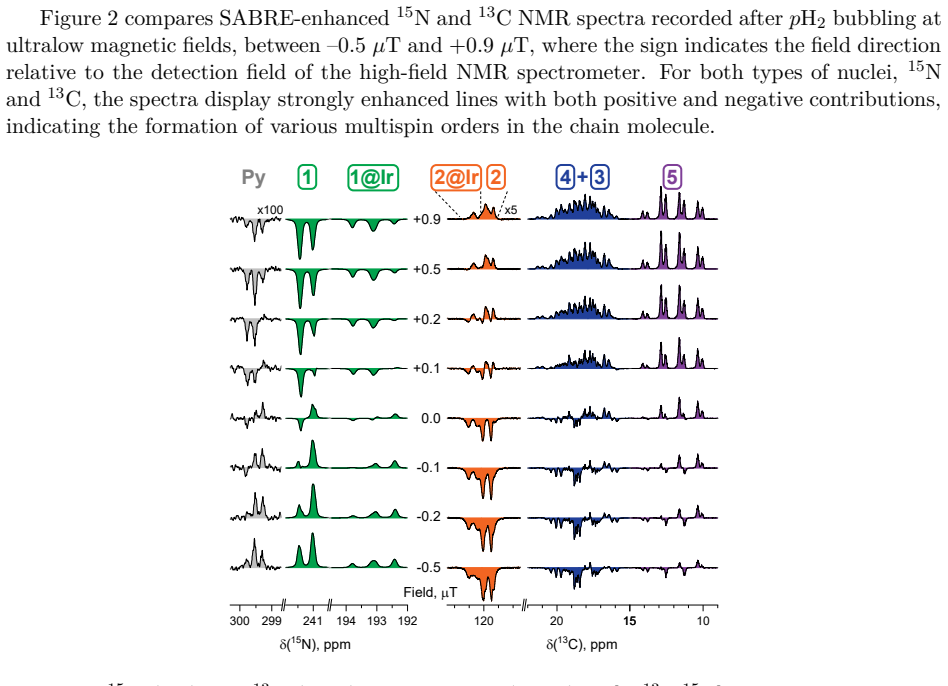
Solution-state molecular nuclear spin networks are promising quantum simulators because their scalar-coupling Hamiltonians are chemically programmable, precisely measurable, and coherent at room temperature. Their main limitation for quantum information science is initialization: thermal Boltzmann polarization produces highly mixed, high-entropy states. Here, we use parahydrogen-based Signal Amplification by Reversible Exchange (SABRE) at hypogeomagnetic fields (i.e., magnetic fields below Earth field) to hyperpolarize the chemically engineered 12-spin chain [U-13C,15N]-butyronitrile. SABRE generates percent-level 13C and 15N polarization and prepares non-equilibrium multi-spin orders across the network. A von Neumann entropy analysis of such a hyperpolarized system shows that, at the optimal transfer field of 0.52 uT, the full spin system could reach S/k = 8.274, compared with S/k = 8.318 for the unpolarized reference, giving (S-Sth)/k = -0.043. Experimentally, nuclear spin temperatures of 52 mK and 257 mK are achieved for 15N and 13C subensembles, respectively. The larger entropy deficit of the full network than of individual subsystems indicates correlated multi-spin order beyond single-spin polarizations. Rapid field cycling to 9.4 T enables site-resolved NMR readout, while the precisely determined coupling network provides an experimentally benchmarked Hamiltonian for testing quantum-simulation, quantum-control, and Hamiltonian-learning protocols.
Editorial analysis
A structured set of objections, weighed in public.
Referee Report
Summary. The manuscript demonstrates parahydrogen SABRE hyperpolarization of the 12-spin chain in [U-13C,15N]-butyronitrile at hypogeomagnetic fields, reporting percent-level 13C/15N polarizations, effective spin temperatures of 52 mK (15N) and 257 mK (13C), and a von Neumann entropy reduction for the full network to S/k = 8.274 (vs. thermal reference 8.318) at the optimal 0.52 µT transfer field, yielding (S-Sth)/k = -0.043 and indicating multi-spin correlations beyond single-spin polarization.
Significance. If the entropy calculation holds after full verification, the result would establish correlated multi-spin order and net cooling in a room-temperature, chemically programmable nuclear spin network with a precisely known scalar-coupling Hamiltonian, providing a benchmarked platform for quantum simulation, control, and Hamiltonian learning protocols. The field-cycling readout to 9.4 T for site-resolved NMR is a practical strength.
major comments (2)
- [Abstract / entropy analysis] Abstract and entropy analysis: the central claim of (S-Sth)/k = -0.043 rests on constructing the full 12-spin density matrix from measured single-spin polarizations plus inferred multi-spin orders. No experimental bounds, error bars, or data-processing details are supplied on the size of unmeasured coherences or relaxation-induced mixing during rapid field cycling, so it is not possible to verify whether the reported entropy deficit is robust or an artifact of the reconstruction assumption.
- [Results / experimental methods] The experimental polarization values and the precise procedure for inferring multi-spin orders from the SABRE data at 0.52 µT are not reported with sufficient quantitative detail (including uncertainties and any relaxation corrections) to allow independent reproduction of the entropy numbers or the sub-ensemble temperatures.
minor comments (2)
- Specify the exact functional form used to convert measured polarizations into the multi-spin density-matrix elements and state whether any coherences were assumed zero by construction.
- Add a table or figure showing the raw polarization data, fitted orders, and the step-by-step entropy computation with propagated uncertainties.
Simulated Author's Rebuttal
We thank the referee for the careful review and constructive comments on the entropy analysis and experimental details. We address each major comment below and have revised the manuscript to supply the requested quantitative information, error bars, and procedural clarifications.
read point-by-point responses
-
Referee: [Abstract / entropy analysis] Abstract and entropy analysis: the central claim of (S-Sth)/k = -0.043 rests on constructing the full 12-spin density matrix from measured single-spin polarizations plus inferred multi-spin orders. No experimental bounds, error bars, or data-processing details are supplied on the size of unmeasured coherences or relaxation-induced mixing during rapid field cycling, so it is not possible to verify whether the reported entropy deficit is robust or an artifact of the reconstruction assumption.
Authors: We acknowledge that the entropy deficit calculation depends on the measured single-spin polarizations together with the multi-spin orders generated by the SABRE mechanism. In the revised manuscript we will add experimental error bars on all polarization values, report the field-cycling timing and estimated relaxation corrections during transfer to 9.4 T, and provide quantitative bounds on possible unmeasured coherences derived from the known scalar-coupling network and measured T1/T2 times. These additions will allow independent assessment of whether the reported (S-Sth)/k = -0.043 is robust. revision: yes
-
Referee: [Results / experimental methods] The experimental polarization values and the precise procedure for inferring multi-spin orders from the SABRE data at 0.52 µT are not reported with sufficient quantitative detail (including uncertainties and any relaxation corrections) to allow independent reproduction of the entropy numbers or the sub-ensemble temperatures.
Authors: We agree that additional quantitative detail is required for reproducibility. The revised manuscript will include the site-resolved polarization values with uncertainties, the explicit procedure used to infer the multi-spin orders from the 0.52 µT SABRE data (including how the known Hamiltonian constrains the orders), and any relaxation corrections applied. This will permit independent reproduction of the reported spin temperatures (52 mK for 15N, 257 mK for 13C) and the full-network entropy value. revision: yes
Circularity Check
No circularity: entropy values computed directly from measured polarizations and known Hamiltonian
full rationale
The paper computes von Neumann entropy for the 12-spin system from experimentally measured single-spin polarizations of 13C and 15N together with the precisely determined scalar-coupling Hamiltonian. No step reduces a claimed prediction or uniqueness result to a fitted parameter or self-citation chain by construction. The reported (S-Sth)/k = -0.043 is an output of that calculation rather than an input. Self-citations, if present for SABRE methodology, are not load-bearing for the entropy deficit claim. The derivation is therefore self-contained against external benchmarks.
Axiom & Free-Parameter Ledger
free parameters (1)
- optimal transfer field =
0.52 uT
axioms (1)
- standard math von Neumann entropy S = -k Tr(ρ log ρ) can be evaluated from the reconstructed density matrix of the 12-spin system
Reference graph
Works this paper leans on
-
[1]
Security in quantum cryptography.Rev
Christopher Portmann and Renato Renner. Security in quantum cryptography.Rev. Mod. Phys., 94(2):025008, 2022
2022
-
[2]
Ex- perimental quantum cryptography.J
Charles H Bennett, François Bessette, Gilles Brassard, Louis Salvail, and John Smolin. Ex- perimental quantum cryptography.J. Cryptol., 5(1):3–28, 1992
1992
-
[3]
Practical quantum advantage in quantum simulation
Andrew J Daley, Immanuel Bloch, Christian Kokail, Stuart Flannigan, Natalie Pearson, Matthias Troyer, and Peter Zoller. Practical quantum advantage in quantum simulation. Nature, 607(7920):667–676, 2022
2022
-
[4]
The physical implementation of quantum computation.Fortschr
David P DiVincenzo. The physical implementation of quantum computation.Fortschr. Phys., 48(9-11):771–783, 2000
2000
-
[5]
Cambridge university press, 2010
Michael A Nielsen and Isaac L Chuang.Quantum computation and quantum information. Cambridge university press, 2010
2010
-
[6]
On the power of quantum computation.SIAM J
Daniel R Simon. On the power of quantum computation.SIAM J. Comput., 26(5):1474–1483, 1997. 10
1997
-
[7]
Implementation of a quantum algorithm on a nuclear magnetic resonance quantum computer.J
Jonathan A Jones and Michele Mosca. Implementation of a quantum algorithm on a nuclear magnetic resonance quantum computer.J. Chem. Phys., 109(5):1648–1653, 1998
1998
-
[8]
NMR quantum computing.Angew
Steffen J Glaser. NMR quantum computing.Angew. Chem. Int. Ed., 40(1):147–149, 2001
2001
-
[9]
An implementation of the Deutsch–Jozsa algorithm on a three-qubit nmr quantum computer.Chem
Noah Linden, Herve Barjat, and Ray Freeman. An implementation of the Deutsch–Jozsa algorithm on a three-qubit nmr quantum computer.Chem. Phys. Lett., 296(1-2):61–67, 1998
1998
-
[10]
Experimental realization of a quantum algorithm.Nature, 393(6681):143–146, 1998
Isaac L Chuang, Lieven MK Vandersypen, Xinlan Zhou, Debbie W Leung, and Seth Lloyd. Experimental realization of a quantum algorithm.Nature, 393(6681):143–146, 1998
1998
-
[11]
Ensemble quantum computing by NMR spectroscopy.Proc
David G Cory, Amr F Fahmy, and Timothy F Havel. Ensemble quantum computing by NMR spectroscopy.Proc. Natl. Acad. Sci., 94(5):1634–1639, 1997
1997
-
[12]
Experimental realization of Shor’s quantum factoring algo- rithm using nuclear magnetic resonance.Nature, 414(6866):883–887, 2001
Lieven MK Vandersypen, Matthias Steffen, Gregory Breyta, Costantino S Yannoni, Mark H Sherwood, and Isaac L Chuang. Experimental realization of Shor’s quantum factoring algo- rithm using nuclear magnetic resonance.Nature, 414(6866):883–887, 2001
2001
-
[13]
Implementation of a quantum search algorithm on a quantum computer.Nature, 393(6683):344–346, 1998
Jonathan A Jones, Michele Mosca, and Rasmus H Hansen. Implementation of a quantum search algorithm on a quantum computer.Nature, 393(6683):344–346, 1998
1998
-
[14]
Bulk spin-resonance quantum computation.Science, 275(5298):350–356, 1997
Neil A Gershenfeld and Isaac L Chuang. Bulk spin-resonance quantum computation.Science, 275(5298):350–356, 1997
1997
-
[15]
Hamiltonian engineering with constrained optimization for quantum sensing and control.New J
Michael F O’Keeffe, Lior Horesh, John F Barry, Danielle A Braje, and Isaac L Chuang. Hamiltonian engineering with constrained optimization for quantum sensing and control.New J. Phys., 21(2):023015, 2019
2019
-
[16]
Robust higher-order Hamiltonian engineering for quantum sensing with strongly interacting systems.Phys
HengyunZhou, LeighSMartin, MatthewTyler, OksanaMakarova, NathanielLeitao, Hongkun Park, and Mikhail D Lukin. Robust higher-order Hamiltonian engineering for quantum sensing with strongly interacting systems.Phys. Rev. Lett., 131(22):220803, 2023
2023
-
[17]
RobustHamiltonianengineeringforinteracting qudit systems.Phys
Hengyun Zhou, Haoyang Gao, Nathaniel T Leitao, Oksana Makarova, Iris Cong, Alexander M Douglas, LeighSMartin, andMikhailDLukin. RobustHamiltonianengineeringforinteracting qudit systems.Phys. Rev. X, 14(3):031017, 2024
2024
-
[18]
Robust dynamic Hamiltonian engineering of many-body spin systems.Phys
Joonhee Choi, Hengyun Zhou, Helena S Knowles, Renate Landig, Soonwon Choi, and Mikhail D Lukin. Robust dynamic Hamiltonian engineering of many-body spin systems.Phys. Rev. X, 10(3):031002, 2020
2020
-
[19]
Floquet Hamil- tonian engineering of an isolated many-body spin system.Science, 374(6571):1149–1152, 2021
Sebastian Geier, Nithiwadee Thaicharoen, Clement Hainaut, Titus Franz, Andre Salzinger, Annika Tebben, David Grimshandl, Gerhard Zürn, and Matthias Weidemüller. Floquet Hamil- tonian engineering of an isolated many-body spin system.Science, 374(6571):1149–1152, 2021
2021
-
[20]
Algorithmic approach to simulate Hamiltonian dynamics and an NMR simulation of quantum state transfer.Phys
Ashok Ajoy, Rama Koteswara Rao, Anil Kumar, and Pranaw Rungta. Algorithmic approach to simulate Hamiltonian dynamics and an NMR simulation of quantum state transfer.Phys. Rev. A, 85(3):030303, 2012
2012
-
[21]
Quantum simulation via filtered hamiltonian engineering: Application to perfect quantum transport in spin networks.Phys
Ashok Ajoy and Paola Cappellaro. Quantum simulation via filtered hamiltonian engineering: Application to perfect quantum transport in spin networks.Phys. Rev. Lett., 110(22):220503, 2013
2013
-
[22]
Arbitrary precision composite pulses for NMR quantum computing.J
William G Alway and Jonathan A Jones. Arbitrary precision composite pulses for NMR quantum computing.J. Magn. Reson., 189(1):114–120, 2007. 11
2007
-
[23]
Approaching five-bit NMR quantum computing.Phys
R Marx, AF Fahmy, John M Myers, W Bermel, and SJ Glaser. Approaching five-bit NMR quantum computing.Phys. Rev. A, 62(1):012310, 2000
2000
-
[24]
NMR techniques for quantum control and computation.Rev
Lieven MK Vandersypen and Isaac L Chuang. NMR techniques for quantum control and computation.Rev. Mod. Phys., 76(4):1037–1069, 2004
2004
-
[25]
Productoperator formalism for the description of NMR pulse experiments.Prog
OWSoerensen, GWEich, MalcolmHLevitt, GBodenhausen, andRRErnst. Productoperator formalism for the description of NMR pulse experiments.Prog. Nucl. Magn. Reson. Spectrosc., 16:163–192, 1984
1984
-
[26]
High-field nmr characterization and indirect j-spectroscopy of a nuclear spin chain [u-13c, 15n]-butyronitrile, 2026
Alexey Kiryutin, Ivan Zhukov, Danil Markelov, Erik Van Dyke, Alexandra Yurkovskaya, and Danila Barskiy. High-field nmr characterization and indirect j-spectroscopy of a nuclear spin chain [u-13c, 15n]-butyronitrile, 2026
2026
-
[27]
Collective long-lived zero- quantum coherences in aliphatic chains.J
Kirill F Sheberstov, Anna Sonnefeld, and Geoffrey Bodenhausen. Collective long-lived zero- quantum coherences in aliphatic chains.J. Chem. Phys., 160(14), 2024
2024
-
[28]
Long-lived states of methylene protons in achiral molecules.Sci
AnnaSonnefeld, AikyRazanahoera, PhilippePelupessy, GeoffreyBodenhausen, andKirillShe- berstov. Long-lived states of methylene protons in achiral molecules.Sci. Adv., 8(48):eade2113, 2022
2022
-
[29]
Polychromatic excitation of delocalized long-lived proton spin states in aliphatic chains.Phys
Anna Sonnefeld, Geoffrey Bodenhausen, and Kirill Sheberstov. Polychromatic excitation of delocalized long-lived proton spin states in aliphatic chains.Phys. Rev. Lett., 129(18):183203, 2022
2022
-
[30]
Aliphatic chains as one-dimensional XY spin chains.arXiv preprint, 2512.23759, 2025
Kirill F Sheberstov. Aliphatic chains as one-dimensional XY spin chains.arXiv preprint, 2512.23759, 2025
arXiv 2025
-
[31]
Bulk quantum com- putation with nuclear magnetic resonance: theory and experiment.Proceedings of the Royal Society of London
Isaac L Chuang, Neil Gershenfeld, Mark G Kubinec, and Debbie W Leung. Bulk quantum com- putation with nuclear magnetic resonance: theory and experiment.Proceedings of the Royal Society of London. Series A: Mathematical, Physical and Engineering Sciences, 454(1969):447– 467, 1998
1969
-
[32]
Preparation of pseudo-pure states by line-selective pulses in nuclear magnetic resonance
Xinhua Peng, Xiwen Zhu, Ximing Fang, Mang Feng, Kelin Gao, Xiaodong Yang, and Maili Liu. Preparation of pseudo-pure states by line-selective pulses in nuclear magnetic resonance. Chem. Phys. Lett., 340(5-6):509–516, 2001
2001
-
[33]
Spatially encoded pseudopure states for nmr quantum-information processing.Phys
Yehuda Sharf, Timothy F Havel, and David G Cory. Spatially encoded pseudopure states for nmr quantum-information processing.Phys. Rev. A, 62(5):052314, 2000
2000
-
[34]
Ob- servations of quantum dynamics by solution-state NMR spectroscopy.Concept
Marco Pravia, Evan Fortunato, Yaakov Weinstein, Mark D Price, Grum Teklemariam, Richard J Nelson, Yehuda Sharf, Shyamal Somaroo, CH Tseng, Timothy F Havel, et al. Ob- servations of quantum dynamics by solution-state NMR spectroscopy.Concept. Magn. Reson. A, 11(4):225–238, 1999
1999
-
[35]
Complexity of digital quantum simulation in the low-energy subspace: Applications and a lower bound.Quantum, 8:1409, 2024
Weiyuan Gong, Shuo Zhou, and Tongyang Li. Complexity of digital quantum simulation in the low-energy subspace: Applications and a lower bound.Quantum, 8:1409, 2024
2024
-
[36]
TheusefulnessofNMRquantumcomputing.Science, 277(5332):1688–1690, 1997
WarrenS.Warren. TheusefulnessofNMRquantumcomputing.Science, 277(5332):1688–1690, 1997. 12
1997
-
[37]
Increase in signal-to- noise ratio of> 10,000 times in liquid-state nmr.Proc
Jan H Ardenkjær-Larsen, Björn Fridlund, Andreas Gram, Georg Hansson, Lennart Hansson, Mathilde H Lerche, Rolf Servin, Mikkel Thaning, and Klaes Golman. Increase in signal-to- noise ratio of> 10,000 times in liquid-state nmr.Proc. Natl. Acad. Sci., 100(18):10158–10163, 2003
2003
-
[38]
Delivering strong 1H nuclear hyperpolarization levels and long magnetic lifetimes through signal amplification by reversible exchange.Proc
Peter J Rayner, Michael J Burns, Alexandra M Olaru, Philip Norcott, Marianna Fekete, Gary GR Green, Louise AR Highton, Ryan E Mewis, and Simon B Duckett. Delivering strong 1H nuclear hyperpolarization levels and long magnetic lifetimes through signal amplification by reversible exchange.Proc. Nat. Acad. Sci., 114(16):E3188–E3194, 2017
2017
-
[39]
Rapid initial-state preparation for the quantum simulation of strongly correlated molecules.PRX Quantum, 6(2):020327, 2025
Dominic W Berry, Yu Tong, Tanuj Khattar, Alec White, Tae In Kim, Guang Hao Low, Sergio Boixo, Zhiyan Ding, Lin Lin, Seunghoon Lee, et al. Rapid initial-state preparation for the quantum simulation of strongly correlated molecules.PRX Quantum, 6(2):020327, 2025
2025
-
[40]
Toward reliability in the NISQ era: Robust interval guarantee for quantum measurements on approximate states.Phys
Maurice Weber, Abhinav Anand, Alba Cervera-Lierta, Jakob S Kottmann, Thi Ha Kyaw, Bo Li, Alan Aspuru-Guzik, Ce Zhang, and Zhikuan Zhao. Toward reliability in the NISQ era: Robust interval guarantee for quantum measurements on approximate states.Phys. Rev. Res, 4(3):033217, 2022
2022
-
[41]
Quantum state preparation for multivariate functions.Quantum, 9:1703, 2025
Matthias Rosenkranz, Eric Brunner, Gabriel Marin-Sanchez, Nathan Fitzpatrick, Silas Dilkes, Yao Tang, Yuta Kikuchi, and Marcello Benedetti. Quantum state preparation for multivariate functions.Quantum, 9:1703, 2025
2025
-
[42]
NMR implementation of a molecular hydrogen quantum simulation with adiabatic state preparation
Jiangfeng Du, Nanyang Xu, Xinhua Peng, Pengfei Wang, Sanfeng Wu, and Dawei Lu. NMR implementation of a molecular hydrogen quantum simulation with adiabatic state preparation. Phys. Rev. Lett., 104(3):030502, 2010
2010
-
[43]
Parahydrogen and synthesis allow dramatically enhanced nuclear alignment.J
C Russell Bowers and Daniel P Weitekamp. Parahydrogen and synthesis allow dramatically enhanced nuclear alignment.J. Am. Chem. Soc., 109(18):5541–5542, 1987
1987
-
[44]
Implementing Grover’s quantum search on a para-hydrogen based pure state NMR quantum computer.Chem
MS Anwar, D Blazina, HA Carteret, SB Duckett, and JA Jones. Implementing Grover’s quantum search on a para-hydrogen based pure state NMR quantum computer.Chem. Phys. Lett., 400(1-3):94–97, 2004
2004
-
[45]
Generation and interrogation of a pure nuclear spin state by parahydrogen-enhanced NMR spectroscopy: a defined initial state for quantum computation.Magn
Damir Blazina, Simon B Duckett, TK Halstead, CM Kozak, RJK Taylor, M Sabieh Anwar, Jonathan A Jones, and Hilary A Carteret. Generation and interrogation of a pure nuclear spin state by parahydrogen-enhanced NMR spectroscopy: a defined initial state for quantum computation.Magn. Reson. Chem., 43(3):200–208, 2005
2005
-
[46]
Nuclear magnetic resonance quantum computing exploiting the pure spin state of para hydrogen.J
Patrick Hübler, Joachim Bargon, and Steffen J Glaser. Nuclear magnetic resonance quantum computing exploiting the pure spin state of para hydrogen.J. Chem. Phys., 113(6):2056–2059, 2000
2056
-
[47]
Preparinghighpurityinitialstatesfornuclearmagneticresonance quantum computing.Phys
M Sabieh Anwar, Damir Blazina, Hilary A Carteret, Simon B Duckett, TK Halstead, JA Jones, CMKozak, andRJKTaylor. Preparinghighpurityinitialstatesfornuclearmagneticresonance quantum computing.Phys. Review Lett., 93(4):040501, 2004
2004
-
[48]
Reversible interactions with para-hydrogen enhance NMR sensitivity by polariza- tion transfer.Science, 323(5922):1708–1711, 2009
Ralph W Adams, Juan A Aguilar, Kevin D Atkinson, Michael J Cowley, Paul IP Elliott, Simon B Duckett, Gary GR Green, Iman G Khazal, Joaquin Lopez-Serrano, and David C Williamson. Reversible interactions with para-hydrogen enhance NMR sensitivity by polariza- tion transfer.Science, 323(5922):1708–1711, 2009. 13
2009
-
[49]
Signal amplification by reversible exchange (SABRE): From discovery to diagnosis.Angew
Peter J Rayner and Simon B Duckett. Signal amplification by reversible exchange (SABRE): From discovery to diagnosis.Angew. Chem. Int. Ed., 57(23):6742–6753, 2018
2018
-
[50]
Microtesla SABRE enables 10% nitrogen-15 nuclear spin polarization.J
Thomas Theis, Milton L Truong, Aaron M Coffey, Roman V Shchepin, Kevin W Waddell, Fan Shi, Boyd M Goodson, Warren S Warren, and Eduard Y Chekmenev. Microtesla SABRE enables 10% nitrogen-15 nuclear spin polarization.J. Am. Chem. Soc., 137(4):1404–1407, 2015
2015
-
[51]
Milton L Truong, Thomas Theis, Aaron M Coffey, Roman V Shchepin, Kevin W Waddell, Fan Shi, Boyd M Goodson, Warren S Warren, and Eduard Y Chekmenev.15N hyperpolarization by reversible exchange using SABRE-SHEATH.J. Phys. Chem. C, 119(16):8786–8797, 2015
2015
-
[52]
Evidence for coherent transfer of para-hydrogen-induced polarization at low magnetic fields.J
Alexey S Kiryutin, Alexandra V Yurkovskaya, Robert Kaptein, Hans-Martin Vieth, and Kon- stantin L Ivanov. Evidence for coherent transfer of para-hydrogen-induced polarization at low magnetic fields.J. Phys. Chem. Lett., 4(15):2514–2519, 2013
2013
-
[53]
Artificial intelligence for quantum computing.Nat Commun., 16(1):10829, 2025
Yuri Alexeev, Marwa H Farag, Taylor L Patti, Mark E Wolf, Natalia Ares, Alan Aspuru-Guzik, Simon C Benjamin, Zhenyu Cai, Shuxiang Cao, Christopher Chamberland, et al. Artificial intelligence for quantum computing.Nat Commun., 16(1):10829, 2025
2025
-
[54]
A fast field-cycling device for high-resolution NMR: Design and application to spin relaxation and hyperpolarization experiments.J
Alexey S Kiryutin, Andrey N Pravdivtsev, Konstantin L Ivanov, Yuri A Grishin, Hans-Martin Vieth, and Alexandra V Yurkovskaya. A fast field-cycling device for high-resolution NMR: Design and application to spin relaxation and hyperpolarization experiments.J. Magn. Reson., 263:79–91, 2016
2016
-
[55]
Improving sabre hyperpolarization with highly nonintuitive pulse sequences: Moving beyond avoided crossings to describe dynamics.Sci
Shannon L Eriksson, Jacob R Lindale, Xiaoqing Li, and Warren S Warren. Improving sabre hyperpolarization with highly nonintuitive pulse sequences: Moving beyond avoided crossings to describe dynamics.Sci. Adv., 8(11):eabl3708, 2022
2022
-
[56]
Multi-axis fields boost sabre hyperpolarization.Proc
Jacob R Lindale, Loren L Smith, Mathew W Mammen, Shannon L Eriksson, Lucas M Ever- hart, and Warren S Warren. Multi-axis fields boost sabre hyperpolarization.Proc. Nat. Acad. Sci., 121(14):e2400066121, 2024
2024
-
[57]
Kozinenko, Bogdan A
Vitaly P. Kozinenko, Bogdan A. Rodin, James Eills, Ilai Schwartz, Stephan Knecht, and Laurynas Dagys. Improved SABRE hyperpolarisation using pulse sequences to reduce effective coupling, 2026
2026
-
[58]
Net NMR alignment by adiabatic transport of parahydrogen addition products to high magnetic field.Chem
Michael G Pravica and Daniel P Weitekamp. Net NMR alignment by adiabatic transport of parahydrogen addition products to high magnetic field.Chem. Phys. Lett., 145(4):255–258, 1988
1988
-
[59]
Parahydrogen- induced polarization transfer to19F in perfluorocarbons for19F NMR spectroscopy and MRI
Markus Plaumann, Ute Bommerich, Thomas Trantzschel, Denise Lego, Sonja Dillenberger, Grit Sauer, Joachim Bargon, Gerd Buntkowsky, and Johannes Bernarding. Parahydrogen- induced polarization transfer to19F in perfluorocarbons for19F NMR spectroscopy and MRI. Chem. Eur. J., 19(20):6334–6339, 2013
2013
-
[60]
Kiryutin, Vitaly P
Alexey S. Kiryutin, Vitaly P. Kozinenko, and Alexandra V. Yurkovskaya. Photo-SABRE: Nuclear spin hyperpolarization of cis-trans photoswitchable molecules by parahydrogen. ChemPhotoChem, 8(1):e202300151, 2024
2024
-
[61]
Levitt and Christian Bengs
Malcolm H. Levitt and Christian Bengs. Hyperpolarization and the physical boundary of liouville space.Magn. Reson., 2:395–407, 2021. 14
2021
-
[62]
A universal bound on spin dynamics.J
Ole W Sørensen. A universal bound on spin dynamics.J. Magn. Reson., 86(2):435–440, 1990
1990
-
[63]
Christian Deppner, Waldemar Herr, Merle Cornelius, Peter Stromberger, Tammo Sternke, Christoph Grzeschik, Alexander Grote, Jan Rudolph, Sven Herrmann, Markus Krutzik, An- dre Wenzlawski, Robin Corgier, Eric Charron, David Guery-Odelin, Naceur Gaaloul, Claus Lämmerzahl, Achim Peters, Patrick Windpassinger, and Ernst M. Rasel. Collective-mode enhanced matte...
2021
-
[64]
Physics-informed hamiltonian learning for large-scale optoelectronic property prediction.Nat
Martin Schwade, Shaoming Zhang, Frederik Vonhoff, Frederico P Delgado, and David A Egger. Physics-informed hamiltonian learning for large-scale optoelectronic property prediction.Nat. Commun., 2652, 2026
2026
-
[65]
Real- and imaginary-time evolution with compressed quantum circuits.PRX Quantum, 2(1):010342, 2021
Sheng-Hsuan Lin, Rohit Dilip, Andrew G Green, Adam Smith, and Frank Pollmann. Real- and imaginary-time evolution with compressed quantum circuits.PRX Quantum, 2(1):010342, 2021
2021
-
[66]
Gard, Jacek Jakowski, Swarnadeep Majumder, George S
Kübra Yeter-Aydeniz, Bryan T. Gard, Jacek Jakowski, Swarnadeep Majumder, George S. Barron, George Siopsis, Travis S. Humble, and Raphael C. Pooser. Benchmarking quantum chemistry computations with variational, imaginary time evolution, and krylov space solver algorithms.Adv. Quant. Technol., 4(7):2100012, 2021
2021
-
[67]
Swendsen
Joseph Albert and Robert H. Swendsen. Detecting multi-spin interactions in the inverse ising problem.Physica A Stat. Mech. Appl., 483:293–298, 2017
2017
-
[68]
Brown, and Lyndon Emsley
SylvianCadars, JulienSein, LuminitaDuma, AnneLesage, TranN.Pham, JayH.Baltisberger, Steven P. Brown, and Lyndon Emsley. The refocused INADEQUATE MAS NMR experiment in multiple spin-systems: Interpreting observed correlation peaks and optimising lineshapes. J. Magn. Reson., 188(1):24–34, 2007
2007
-
[69]
Non-equilibrium dynamics of spin-lattice coupling.Nat
Hiroki Ueda, Roman Mankowsky, Eugenio Paris, Mathias Sander, Yunpei Deng, Biaolong Liu, Ludmila Leroy, Abhishek Nag, Elizabeth Skoropata, Chennan Wang, et al. Non-equilibrium dynamics of spin-lattice coupling.Nat. Commun., 14(1):7778, 2023
2023
-
[70]
Field-cycling NMR experiments in an ultra-wide magnetic field range: relaxation and coherent polarization transfer.Phys
IvanVZhukov, AlexeySKiryutin, AlexandraVYurkovskaya, YuriAGrishin, Hans-MartinVi- eth, and Konstantin L Ivanov. Field-cycling NMR experiments in an ultra-wide magnetic field range: relaxation and coherent polarization transfer.Phys. Chem. Chem. Phys., 20(18):12396– 12405, 2018
2018
-
[71]
Kiryutin, Alexandra Yurkovskaya, Herbert Zimmerman, Hans-Martin Vieth, and Konstantin L
Alexey S. Kiryutin, Alexandra Yurkovskaya, Herbert Zimmerman, Hans-Martin Vieth, and Konstantin L. Ivanov. Complete magnetic field dependence of SABRE-derived polarization. Magn. Reson. Chem, 56(7):651–662, 2018
2018
-
[72]
Kiryutin, Grit Sauer, Sara Hadjiali, Alexandra V
Alexey S. Kiryutin, Grit Sauer, Sara Hadjiali, Alexandra V. Yurkovskaya, Hergen Breitzke, and Gerd Buntkowsky. A highly versatile automatized setup for quantitative measurements of PHIP enhancements.J. Magn. Reson., 285(18):26–36, 2017
2017
-
[73]
Cheshkov, K.F
D.A. Cheshkov, K.F. Sheberstov, D.O. Sinitsyn, and V.A. Chertkov. ANATOLIA: NMR software for spectral analysis of total lineshape.Magnetic Resonance in Chemistry, 56(6):449– 457, 2018
2018
-
[74]
Synthesis, struc- ture and catalytic activity of the first iridium (I) siloxide versus chloride complexes with 1, 3-mesitylimidazolin-2-ylidene ligand.J
Ireneusz Kownacki, Maciej Kubicki, Karol Szubert, and Bogdan Marciniec. Synthesis, struc- ture and catalytic activity of the first iridium (I) siloxide versus chloride complexes with 1, 3-mesitylimidazolin-2-ylidene ligand.J. of Organomet. Chem., 693(2):321–328, 2008. 15
2008
discussion (0)
Sign in with ORCID, Apple, or X to comment. Anyone can read and Pith papers without signing in.