Bi-S network origin of cation-disorder stability and dispersive band edges in AgBiS2
Pith reviewed 2026-06-27 15:36 UTC · model grok-4.3
The pith
The three-dimensional Bi-S network stabilizes cation disorder in AgBiS2 while preserving dispersive conduction bands.
A machine-rendered reading of the paper's core claim, the machinery that carries it, and where it could break.
Core claim
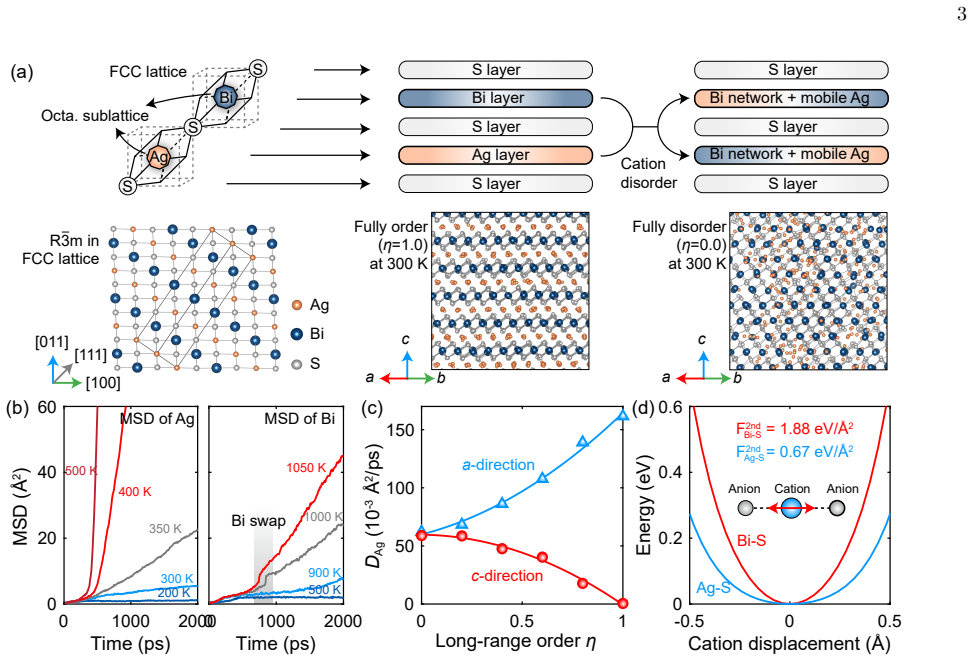
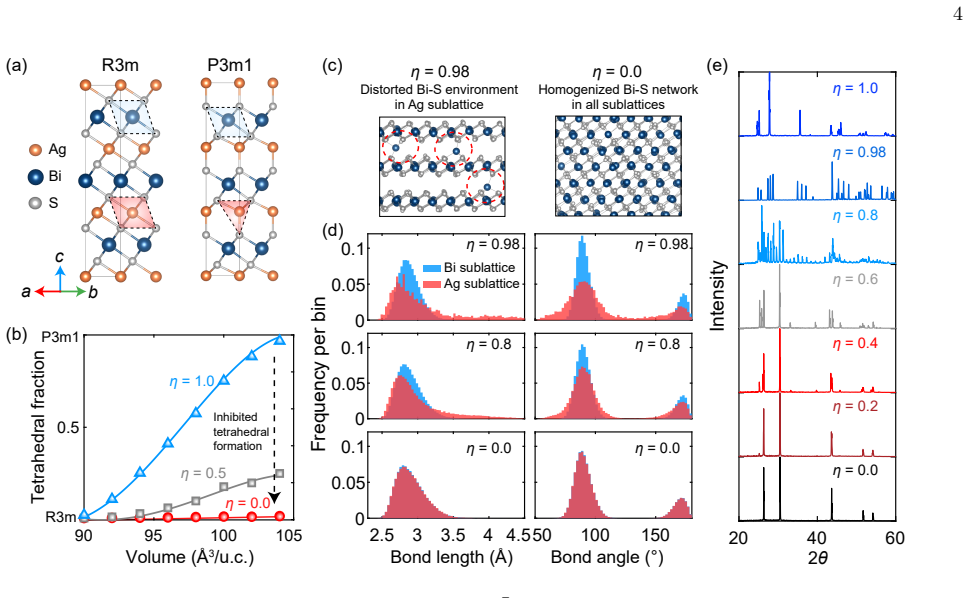
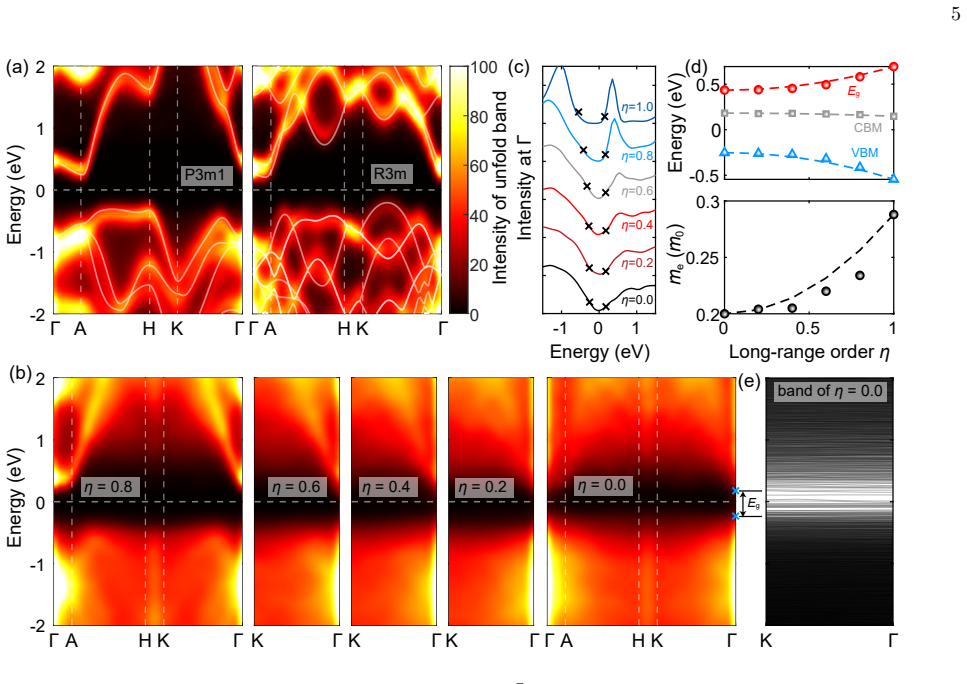
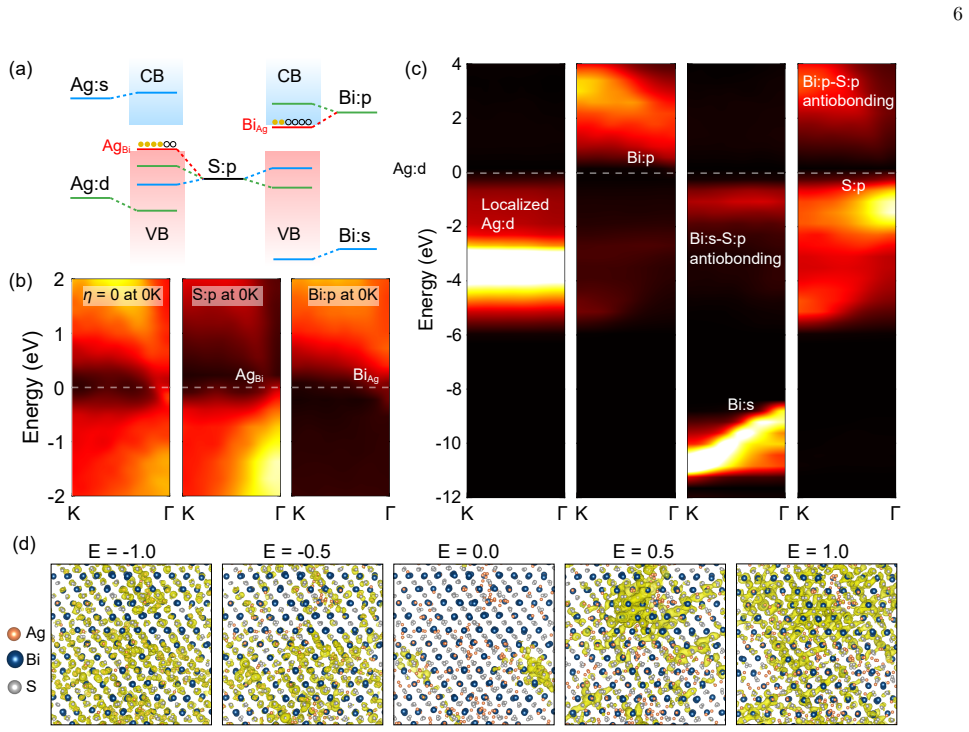
We identify the three-dimensional Bi-S network as the central structural motif governing both disorder stability and band-edge electronic states. At weak disorder, Ag/Bi exchange competes with the off-centering tendency of the Ag sublattice, producing strongly distorted local environments and convoluted diffraction signatures. With increasing disorder, BiS6-like units connect into a continuous Bi-S network, which stabilizes the rocksalt-like disordered phase. Despite strong cation disorder, AgBiS2 retains clear semiconductor-like band dispersion and develops a direct band gap. The connected Bi:p-S:p states supported by the Bi-S network preserve a dispersive conduction-band edge and a small e
What carries the argument
The three-dimensional Bi-S network formed by connected BiS6 units, which stabilizes the disordered rocksalt-like phase and supports dispersive Bi:p-S:p conduction-band states.
If this is right
- At weak disorder Ag/Bi exchange competes with Ag off-centering to create distorted environments that hinder ordered-phase identification by diffraction.
- Increasing disorder allows BiS6 units to connect into a continuous network that stabilizes the rocksalt-like phase.
- The Bi-S network enables retention of semiconductor-like band dispersion and a direct gap despite cation disorder.
- Connected Bi:p-S:p states preserve a dispersive conduction-band edge and small electron effective mass.
- Ag disorder localizes valence states by breaking long-range Ag-S bonding periodicity.
Where Pith is reading between the lines
- The Bi-S network motif may generalize to other nonisovalent alloys for engineering disorder-tolerant semiconductors.
- Targeted local-structure measurements of Bi-S connectivity could resolve remaining ambiguities between ordered and disordered phases.
- Modifications focused on the Bi-S sublattice could tune band edges while preserving the disorder-stabilizing network.
Load-bearing premise
The machine-learning interatomic potential combined with the deep-learning Hamiltonian accurately captures the coupled structural and electronic evolution of AgBiS2 at large length scales.
What would settle it
Local structural probes that map Bi-S connectivity in the disordered phase and test whether a continuous three-dimensional Bi-S network forms with the predicted band dispersion and direct gap.
Figures
read the original abstract
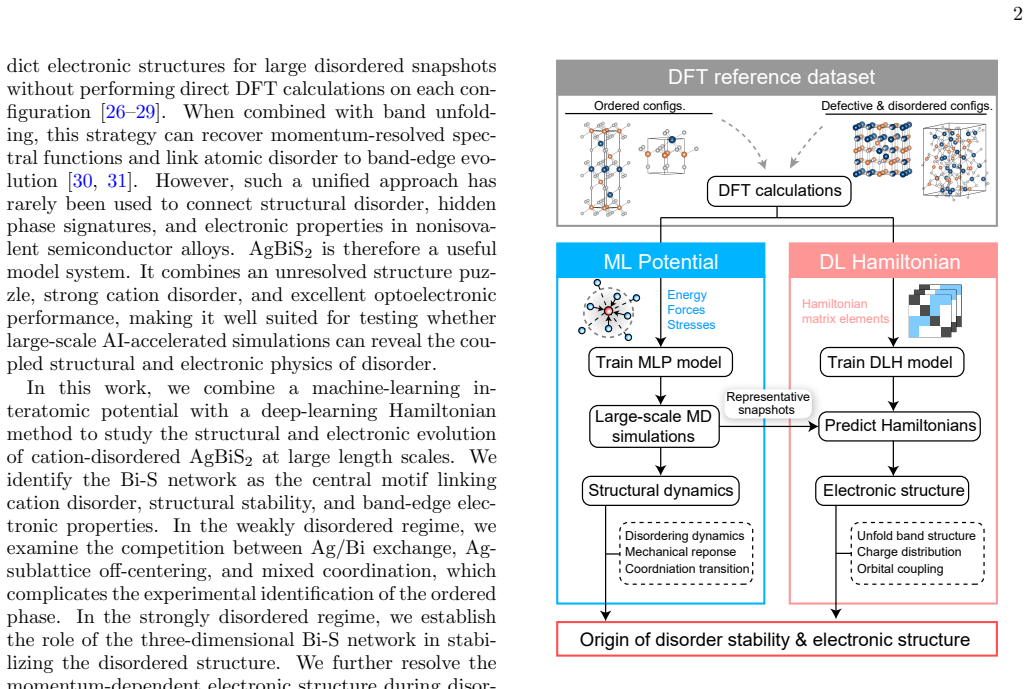
Cation-disordered AgBiS2 is a promising lead-free optoelectronic material, but both its ordered structure and the microscopic origin of its favorable electronic properties remain debated. Theory has proposed a mixed-coordination tendency with tetrahedral AgS4 and octahedral BiS6 units, whereas experiments mainly report octahedrally coordinated ordered and cation-disordered phases, together with local cation off-centering. Here, we combine a machine-learning interatomic potential with a deep-learning Hamiltonian to resolve the coupled structural and electronic evolution of AgBiS2 at large length scales. We identify the three-dimensional Bi-S network as the central structural motif governing both disorder stability and band-edge electronic states. At weak disorder, Ag/Bi exchange competes with the off-centering tendency of the Ag sublattice, producing strongly distorted local environments and convoluted diffraction signatures that hinder the identification of the ordered phase. With increasing disorder, BiS6-like units connect into a continuous Bi-S network, which stabilizes the rocksalt-like disordered phase. Despite strong cation disorder, AgBiS2 retains clear semiconductor-like band dispersion and develops a direct band gap. The connected Bi:p-S:p states supported by the Bi-S network preserve a dispersive conduction-band edge and a small electron effective mass. In contrast, mobile Ag disrupts the long-range periodicity of Ag-S bonding, leading to strongly localized valence states. These results clarify the structural controversy in ordered AgBiS2 and establish a unified physical picture of disorder stability and optoelectronic response in nonisovalent semiconductor alloys.
Editorial analysis
A structured set of objections, weighed in public.
Referee Report
Summary. The paper claims that the three-dimensional Bi-S network is the central structural motif in AgBiS2 that stabilizes the cation-disordered rocksalt-like phase and preserves dispersive, direct-gap band edges (with Bi:p-S:p character at the conduction edge) despite strong Ag/Bi disorder; Ag mobility instead localizes valence states. This is obtained from large-scale simulations combining a machine-learning interatomic potential with a deep-learning Hamiltonian, which are used to track the evolution from weak disorder (competing Ag off-centering and exchange) to connected BiS6 networks at higher disorder.
Significance. If the simulations are accurate, the work supplies a unified microscopic picture that resolves the structural controversy between mixed-coordination and octahedral models and explains the retention of useful optoelectronic properties in this nonisovalent alloy. The large-length-scale capability enabled by the ML methods is a clear methodological strength.
major comments (1)
- [Methods] Methods section (model construction and validation): No training data, validation metrics, error bars, or cross-validation against DFT (or experiment) on cation-disordered supercells are described for either the machine-learning interatomic potential or the deep-learning Hamiltonian. This is load-bearing for the central claim, because the reported Bi-S network connectivity, off-centering statistics, rocksalt stabilization, and Bi:p-S:p dispersion all derive directly from these models' outputs at large scales; without such controls the fidelity of the network motif conclusions cannot be assessed.
minor comments (1)
- [Abstract] Abstract: the phrase 'clear semiconductor-like band dispersion' is used without quantifying the effective masses or comparing to the ordered phase; a brief numerical statement would strengthen the claim.
Simulated Author's Rebuttal
We thank the referee for the positive assessment of our work and the constructive comment on the Methods section. We address the concern below and will revise the manuscript accordingly.
read point-by-point responses
-
Referee: [Methods] Methods section (model construction and validation): No training data, validation metrics, error bars, or cross-validation against DFT (or experiment) on cation-disordered supercells are described for either the machine-learning interatomic potential or the deep-learning Hamiltonian. This is load-bearing for the central claim, because the reported Bi-S network connectivity, off-centering statistics, rocksalt stabilization, and Bi:p-S:p dispersion all derive directly from these models' outputs at large scales; without such controls the fidelity of the network motif conclusions cannot be assessed.
Authors: We agree that the absence of explicit training details, validation metrics, error bars, and cross-validation on disordered supercells limits the ability to assess model fidelity, and this information should have been included. The original manuscript omitted these for brevity while focusing on results. In the revised version we will expand the Methods section (and add a dedicated supplementary note) to report: the DFT training sets used (including ordered and cation-disordered supercells), mean-absolute errors on energies, forces and eigenvalues, ensemble-based error bars, and explicit cross-validation against direct DFT calculations performed on smaller disordered cells as well as available experimental lattice and local-structure data. These additions will directly substantiate the Bi-S network and band-edge conclusions. revision: yes
Circularity Check
No significant circularity; results from external ML models without self-referential fitting
full rationale
The derivation relies on a machine-learning interatomic potential combined with a deep-learning Hamiltonian to simulate large-scale structural and electronic properties. The abstract and provided text contain no equations, self-citations, or statements indicating that target outputs (Bi-S network connectivity, disorder stability, or band dispersion) were used as training inputs or defined in terms of themselves. The central claim emerges from simulation outputs compared against experimental trends, with no reduction by construction or load-bearing self-citation chain. This is a standard application of trained models and qualifies as self-contained against external benchmarks.
Axiom & Free-Parameter Ledger
axioms (2)
- domain assumption The machine-learning interatomic potential reproduces the relevant DFT energies, forces, and structural motifs for AgBiS2 configurations.
- domain assumption The deep-learning Hamiltonian maps atomic configurations to accurate electronic band edges and effective masses.
Reference graph
Works this paper leans on
-
[1]
Rathore, R
E. Rathore, R. Juneja, S. P. Culver, N. Minafra, A. K. Singh, W. G. Zeier, and K. Biswas, Chem. Mater.31, 2106 (2019)
2019
-
[2]
Y. Wang, S. R. Kavanagh, I. Burgu´ es-Ceballos, A. Walsh, D. O. Scanlon, and G. Konstantatos, Nat. Photon.16, 235 (2022)
2022
-
[3]
Righetto, Y
M. Righetto, Y. Wang, K. A. Elmestekawy, C. Q. Xia, M. B. Johnston, G. Konstantatos, and L. M. Herz, Adv. Mater.35, 2305009 (2023)
2023
-
[4]
Liang, C.-N
H.-P. Liang, C.-N. Li, R. Zhou, X. Xu, X. Zhang, J. Yang, and S.-H. Wei, J. Am. Chem. Soc.146, 16222 (2024)
2024
-
[5]
W. Yang, T. Sun, X. Ma, H. Yu, H. Shi, Y. Hu, J. Huang, Z. Liu, Y. Xu, X. Li, Y. Shen, and M. Wang, ACS Energy Lett.10, 58 (2025)
2025
-
[6]
Y. Liu, Z. Ni, L. Peng, H. Wu, Z. Liu, Y. Wang, W. Ma, and G. Konstantatos, ACS Energy Lett.10, 2068 (2025)
2068
-
[7]
K. T. Chang, W. Liang, S. Gong, P. H. Yeung, J. Feng, X. Chen, and H. Lu, J. Am. Chem. Soc.147, 14015 (2025)
2025
-
[8]
Tesfaye and D
F. Tesfaye and D. Lindberg, J. Mater. Sci.51, 5750 (2016)
2016
-
[9]
Band-like transport and cation off-centring in ag/bi-based solar absorbers,
Y.-T. Huang, Y. Wang, G. Fields, P. Cong, Y. Wang, J. E. N. Swallow, A. Roy, J. M. Woolley, V. Ro- taru, M. Guc, L. van Turnhout, M. Aouane, E. Suard, D. Kubicki, A. P´ erez-Rodr´ ıguez, A. Sadhanala, A. Rao, D. Friedrich, R. S. Weatherup, S. J. Clarke, S. R. Kavanagh, and R. L. Z. Hoye, “Band-like transport and cation off-centring in ag/bi-based solar ab...
arXiv 2026
-
[10]
Sarker, T
P. Sarker, T. Harrington, C. Toher, C. Oses, M. Samiee, J.-P. Maria, D. W. Brenner, K. S. Vecchio, and S. Cur- tarolo, Nat. Commun.9, 4980 (2018)
2018
-
[11]
J. K. Larsen, J. J. S. Scragg, N. Ross, and C. Platzer- Bj¨ orkman, ACS Appl. Energy Mater.3, 7520 (2020)
2020
-
[12]
Divilov, H
S. Divilov, H. Eckert, D. Hicks, C. Oses, C. Toher, R. Friedrich, M. Esters, M. J. Mehl, A. C. Zettel, Y. Led- erer, E. Zurek, J.-P. Maria, D. W. Brenner, X. Campi- longo, S. Filipovi´ c, W. G. Fahrenholtz, C. J. Ryan, C. M. DeSalle, R. J. Crealese, D. E. Wolfe, A. Calzolari, and S. Curtarolo, Nature625, 66 (2024)
2024
-
[13]
Q. Wang, Z. Yao, J. Wang, H. Guo, C. Li, D. Zhou, X. Bai, H. Li, B. Li, M. Wagemaker, and C. Zhao, Nature 629, 341 (2024)
2024
-
[14]
Grinberg, V
I. Grinberg, V. R. Cooper, and A. M. Rappe, Nature 419, 909 (2002)
2002
-
[15]
Ma, H.-X
J. Ma, H.-X. Deng, J.-W. Luo, and S.-H. Wei, Phys. Rev. B90, 115201 (2014)
2014
-
[16]
Nakatsuka and Y
S. Nakatsuka and Y. Nose, J. Phys. Chem. C121, 1040 (2017)
2017
-
[17]
W. Liu, H. Liang, Y. Duan, and Z. Wu, Phys. Rev. Mater.3, 125405 (2019)
2019
-
[18]
J. J. Cordell, G. J. Tucker, A. Tamboli, and S. Lany, APL Mater.10, 011112 (2022)
2022
-
[19]
Liang, S
H.-P. Liang, S. Geng, T. Jia, C.-N. Li, X. Xu, X. Zhang, and S.-H. Wei, Phys. Rev. B109, 035205 (2024)
2024
-
[20]
Seko and I
A. Seko and I. Tanaka, Phys. Rev. B91, 024106 (2015)
2015
-
[21]
S. D. Baranovskii, A. V. Nenashev, D. Hertel, F. Geb- hard, and K. Meerholz, ACS Omega7, 45741 (2022)
2022
-
[22]
Liang, C.-N
H.-P. Liang, C.-N. Li, X.-R. Tang, X. Xu, C. Qiu, Q.-S. Huang, and S.-H. Wei, Sci. China-Phys. Mech. Astron. 69, 247311 (2026)
2026
-
[23]
R. Su, J. Yu, P. Guan, and W. Wang, Sci. China Mater. 67, 3298 (2024)
2024
-
[24]
F. Li, Z. Zhang, H. Liu, W. Zhu, T. Wang, M. Park, J. Zhang, N. B onninghoff, X. Feng, H. Zhang, J. Luan, J. Wang, X. Liu, T. Chang, J. P. Chu, Y. Lu, Y. Liu, P. Guan, and Y. Yang, Nat. Mater.23, 52 (2024)
2024
-
[25]
Y. Chen, Q. an Li, H. Liang, H. Kang, G. Dong, K. Zhang, L. Wang, H. Liu, S. Zhang, J. Li, B. Xu, X. Yang, S. Gao, R. Su, and P. Guan, Acta Mater.312, 122241 (2026)
2026
-
[26]
Zhong, H
Y. Zhong, H. Yu, J. Yang, X. Guo, H. Xiang, and X. Gong, Chin. Phys. Lett.41, 077103 (2024)
2024
-
[27]
Z. Tang, H. Li, P. Lin, X. Gong, G. Jin, L. He, H. Jiang, X. Ren, W. Duan, and Y. Xu, Nat. Commun.15, 8815 (2024)
2024
-
[28]
X. Ma, H. Chen, R. He, Z. Yu, S. Prokhorenko, Z. Wen, Z. Zhong, J. ´I˜ niguez Gonz´ alez, L. Bellaiche, D. Wu, and Y. Yang, npj Comput. Mater.11, 70 (2025)
2025
-
[29]
Y. Li, Y. Wang, B. Zhao, X. Gong, Y. Wang, Z. Tang, Z. Wang, Z. Yuan, J. Li, M. Sun, Z. Chen, H. Tao, B. Wu, Y. Yu, H. Li, F. H. da Jornada, W. Duan, and Y. Xu, arXiv preprint arXiv:2601.02938 (2026)
arXiv 2026
-
[30]
Popescu and A
V. Popescu and A. Zunger, Phys. Rev. B85, 085201 (2012). 9
2012
-
[31]
S. G. Mayo, F. Yndurain, and J. M. Soler, J. Phys.: Condens. Matter32, 205902 (2020)
2020
-
[32]
Kresse and J
G. Kresse and J. Hafner, Phys. Rev. B47, 558 (1993)
1993
-
[33]
Kresse and J
G. Kresse and J. Hafner, Phys. Rev. B49, 14251 (1994)
1994
-
[34]
Kresse and J
G. Kresse and J. Furthm¨ uller, Phys. Rev. B54, 11169 (1996)
1996
-
[35]
Hohenberg and W
P. Hohenberg and W. Kohn, Phys. Rev.136, B864 (1964)
1964
-
[36]
Kohn and L
W. Kohn and L. J. Sham, Phys. Rev.140, A1133 (1965)
1965
-
[37]
J. P. Perdew, K. Burke, and M. Ernzerhof, Phys. Rev. Lett.77, 3865 (1996)
1996
-
[38]
Ozaki, Phys
T. Ozaki, Phys. Rev. B67, 155108 (2003)
2003
-
[39]
Ozaki and H
T. Ozaki and H. Kino, Phys. Rev. B69, 195113 (2004)
2004
-
[40]
Lejaeghere, G
K. Lejaeghere, G. Bihlmayer, T. Bj¨ orkman,et al., Science 351, aad3000 (2016)
2016
-
[41]
D. B. Laks, S.-H. Wei, and A. Zunger, Phys. Rev. Lett. 69, 3766 (1992)
1992
-
[42]
Zhang, A
Y. Zhang, A. Mascarenhas, S.-H. Wei, and L.-W. Wang, Phys. Rev. B80, 045206 (2009)
2009
-
[43]
Thongtem, N
T. Thongtem, N. Tipcompor, and S. Thongtem, Mater. Lett.64, 755 (2010)
2010
-
[44]
J. Kang, X. Zhang, and S.-H. Wei, Chin. Phys. B31, 107105 (2022)
2022
-
[45]
K. Ide, K. Nomura, H. Hosono, and T. Kamiya, physica status solidi (a)216, 1800372 (2019)
2019
-
[46]
Hosono and H
H. Hosono and H. Kumomi,Amorphous Oxide Semicon- ductors: IGZO and Related Materials for Display and Memory(John Wiley & Sons, 2022)
2022
discussion (0)
Sign in with ORCID, Apple, or X to comment. Anyone can read and Pith papers without signing in.