AI-Driven Analytics of Team-Teaching Talk: Acoustic Patterns across Experience, Cohorts and the Learning Design
Pith reviewed 2026-07-05 18:29 UTC · model glm-5.2
The pith
Experienced teachers modulate their voices more in team-taught classrooms
A machine-rendered reading of the paper's core claim, the machinery that carries it, and where it could break.
Core claim
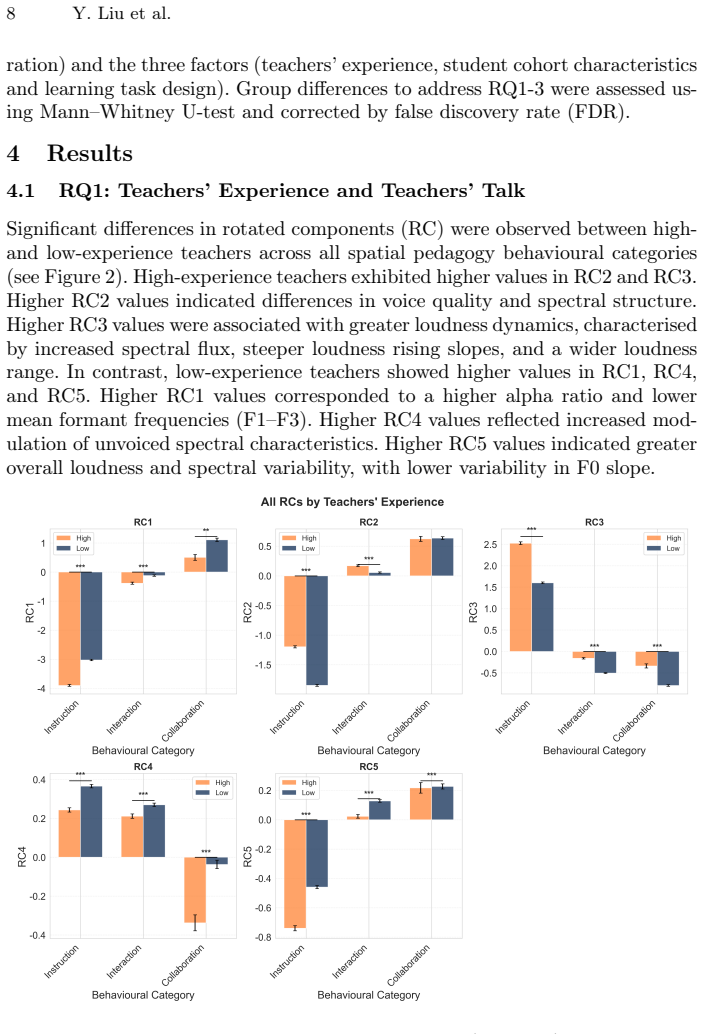
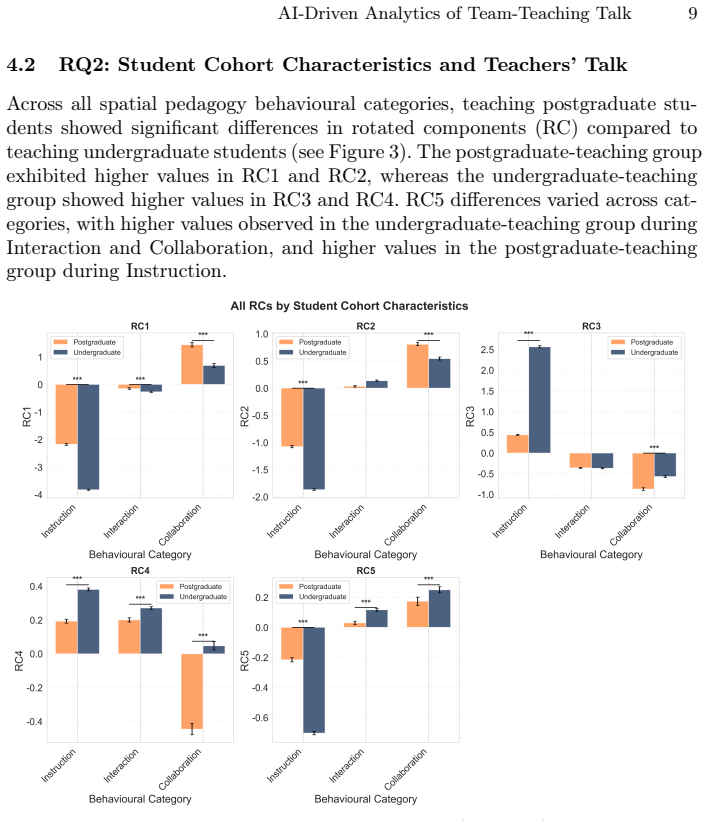
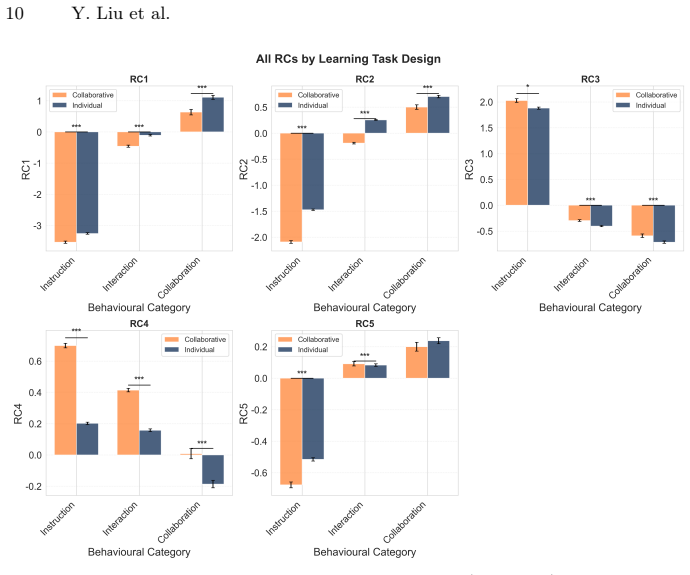
The paper's central discovery is that loudness dynamics — a composite acoustic measure capturing how sharply and widely a teacher's volume rises and falls — differ systematically across three contextual axes in team-teaching settings. High-experience teachers show greater loudness variation than low-experience teachers; undergraduate classes elicit greater loudness variation than postgraduate classes; and collaborative tasks elicit greater loudness variation than individual tasks. The authors interpret this as evidence that experienced teachers use volume modulation as a deliberate pedagogical strategy to manage classroom interaction, and that the communicative demands of different cohorts (
What carries the argument
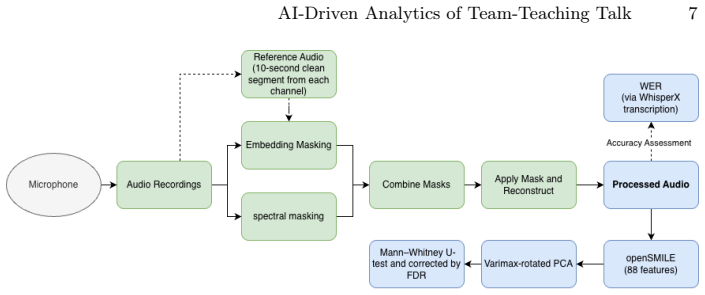
The central machinery is a pipeline combining spatial pedagogy behaviour coding with automated acoustic feature extraction. Audio from headset-wearing teachers in team-teaching classrooms is preprocessed to remove cross-talk using spectral masking and speaker-embedding-based masking. Eighty-eight acoustic features are then extracted per second using openSMILE, z-score normalized, and reduced via varimax-rotated PCA to five rotated components (RC1–RC5). RC3, labeled 'loudness dynamics,' carries the paper's main finding: it loads on spectral flux, loudness rising slope, and loudness range. Group comparisons across experience, cohort, and task design are then performed using Mann–Whitney U-test
If this is right
- Automated acoustic analysis could become a scalable formative-feedback tool for teacher professional development, giving less experienced teachers concrete data on their vocal modulation patterns relative to peers.
- If loudness dynamics reflect pedagogical intent rather than individual voice characteristics, they could serve as a proxy measure for teacher engagement and instructional adaptability in large-scale classroom analytics.
- The finding that collaborative tasks elicit greater loudness variation suggests that vocal modulation may be a coordination mechanism in multi-teacher settings, not just a solo-teaching phenomenon.
- Extending the analysis to the teaching team as the unit of study could reveal whether teachers coordinate their acoustic profiles — for example, whether one teacher's loudness rise cues another's shift in role.
Where Pith is reading between the lines
- The interpretation that loudness variation reflects deliberate pedagogical intent (foregrounding key information) is plausible but not directly tested; a controlled study pairing acoustic data with moment-to-moment pedagogical coding or teacher self-reports would be needed to confirm causation.
- The median split on experience (≤2 vs >2 years) is a coarse binarization; a continuous analysis might reveal whether the relationship between experience and loudness dynamics is linear or threshold-based.
- If individual voice characteristics, personality, or class size confound the results, the systematic attribution to experience, cohort, and task design would weaken; a replication controlling for these factors would test robustness.
- The cross-talk mitigation pipeline reduced word error rate from 158% to 21%, which is a substantial improvement but still leaves residual transcription noise that could affect acoustic feature reliability in overlapping-speech segments.
Load-bearing premise
The study assumes that the observed acoustic differences are caused by the contextual factors (experience, cohort, task design) rather than by confounding variables such as individual voice characteristics, personality, class size, or teacher-team composition. With 12 teachers from a single course at one university, and no control for these factors, the claim that loudness variation reflects pedagogical intent rather than individual traits remains an interpretation.
What would settle it
If a replication controlling for individual voice characteristics, class size, and teacher-team composition found no systematic relationship between experience level, cohort, or task design and loudness dynamics, the central claim would be undermined.
Figures
read the original abstract
As classroom cohorts expand, team teaching is increasingly used to integrate the expertise and pedagogical perspectives of multiple teachers. Yet, there is limited empirical understanding of how team teaching unfolds in practice, particularly regarding differences in teachers' contributions across experience levels, student cohorts, and learning task design. Prior research on team teaching has largely relied on retrospective self-reports or small-scale observations, offering limited insight into the micro-level processes through which team teaching is enacted. Teacher talk offers a scalable lens on these processes. While research in individual teaching contexts shows that acoustic features of speech (e.g., voice quality, intonation, and loudness) can shape student learning, evidence from team-teaching settings remains scarce. Moreover, capturing such features through manual observation or transcription is especially challenging in team-teaching classrooms, where multiple teachers speak across extended sessions and spatial locations, limiting scalability without automation. Grounded in spatial pedagogy theory and team-teaching research, this paper presents an AI-based speech processing approach to analyse classroom talk in team-teaching settings. We analysed 36 recorded undergraduate and postgraduate sessions involving 12 teachers. Spatial pedagogy behaviours were coded and acoustic features extracted to examine variation across teachers' experience, student cohorts, and the learning task design. The results reveal systematic differences, most notably in loudness dynamics: high-experience teachers, undergraduate classes and collaborative learning tasks exhibited greater loudness variation, suggesting more frequent modulation of volume to foreground key information and support classroom interaction and engagement.
Editorial analysis
A structured set of objections, weighed in public.
Referee Report
Summary. This paper presents an AI-based speech processing approach to analyze teacher talk in team-teaching classrooms. The authors analyze 34 sessions (36 originally, 2 excluded due to audio issues) from a database course at Monash University, involving 12 teachers. They extract 88 acoustic features per 1-second segment using openSMILE, reduce dimensionality via PCA (5 rotated components, 58% cumulative variance), and compare groups using Mann-Whitney U-tests with FDR correction across three factors: teacher experience (high vs. low, median split at 2 years), student cohort (undergraduate vs. postgraduate), and learning task design (individual vs. collaborative). The central claim is that acoustic features—particularly loudness dynamics (RC3)—vary systematically across these factors, with high-experience teachers, undergraduate classes, and collaborative tasks exhibiting greater loudness variation. The study integrates spatial pedagogy coding with acoustic analysis, which is a novel combination for team-teaching settings.
Significance. The paper addresses a genuine gap: acoustic analysis of teacher talk has not been applied to team-teaching settings, and the combination of spatial pedagogy coding with automated acoustic feature extraction is methodologically interesting. The audio preprocessing pipeline (spectral masking + ECAPA-TDNN speaker embeddings) and the reduction of WER from 158% to 21% demonstrate practical engineering effort. The coding scheme extending Lim et al.'s spatial pedagogy framework to team-teaching contexts (refining Interactional into Interaction and Collaboration) is a useful contribution. However, the statistical inferential framework has a load-bearing issue (see Major Comment 1) that undermines the strength of the empirical claims as currently presented.
major comments (2)
- §3.5: The Mann-Whitney U-tests are applied to 1-second audio segments, which are autocorrelated within sessions. Consecutive 1-second frames from the same teacher in the same session are not independent observations, violating the independence assumption of the Mann-Whitney U-test. With 34 sessions of 2-hour recordings, the number of segments is on the order of tens of thousands, massively inflating effective degrees of freedom and producing artificially small p-values. FDR correction does not address this because it operates on already-invalid p-values. This affects all significance asterisks in Figures 2–4 and thus the evidence for 'systematic differences' across all three RQs. A proper analysis would aggregate to the level of independent units (session × teacher or teacher-level means) or use mixed-effects models with teacher and session as random effects.
- §3.5, Table 2: The PCA is fit on the full set of 1-second segments, meaning component loadings may be dominated by within-session autocorrelation structure rather than between-group variation. The five rotated components explain only 58% of cumulative variance, with RC1 alone accounting for 39.76% and the remaining four components explaining 2.48–7.31% each. The interpretation of RC3 (loudness dynamics, 5.81% variance) as the central finding is based on a component that captures a small fraction of total variance. The paper should justify why this component is theoretically meaningful for group comparisons rather than merely statistically separable, and should report whether PCA results are robust to aggregation level.
minor comments (7)
- §3.2: The median split on teaching experience (≤2 vs >2 years) is coarse and discards information. With 12 teachers ranging from 0 to 9 years, a continuous analysis or a more principled threshold (e.g., based on prior literature on teacher development milestones) would strengthen the claims. At minimum, the distribution of experience values should be reported.
- §3.1: The abstract states 36 sessions were analyzed, but the methods clarify that 2 sessions were excluded due to microphone issues, yielding 34 sessions. The abstract should be corrected.
- §3.3: Inter-rater reliability (Cohen's Kappa = 0.75) is reported on one pilot session only. The remaining sessions were coded by unspecified number of raters without continued reliability checks. This should be acknowledged as a limitation.
- Figures 2–4: The bar plots show mean values with 95% confidence intervals, but the CI computation method is not specified. Given the autocorrelation issue, these CIs are likely misleadingly narrow. At minimum, this should be noted or resolved.
- §5.1: The interpretation that loudness variation reflects 'foregrounding key information' and 'supporting classroom interaction and engagement' is an inference not directly measured. The paper would benefit from grounding this interpretation in the coded spatial pedagogy behaviours (e.g., showing that loudness variation co-occurs with specific behavioural categories) or acknowledging this as speculative.
- §3.4: The WER of 21% is described as 'acceptable' citing Munteanu et al. (2006), but that benchmark is for webcast transcripts, not classroom audio with cross-talk. The suitability of this threshold for the present acoustic analysis (which does not depend on transcription accuracy) should be clarified, or the WER discussion should be reframed as a preprocessing quality check rather than a validity benchmark.
- Table 2: The variance explained values (39.76%, 7.31%, 5.81%, 2.73%, 2.48%) sum to 58.09%, but the table header says 58%. Minor rounding inconsistency. Also, the loading signs and magnitudes should be checked for consistency with the interpretive labels.
Simulated Author's Rebuttal
We thank the referee for a careful and constructive review. The referee correctly identifies a genuine statistical issue (autocorrelation inflating degrees of freedom in the Mann-Whitney tests) and raises a valid question about the theoretical justification of RC3. We will revise the statistical analysis and strengthen the theoretical framing accordingly.
read point-by-point responses
-
Referee: §3.5: The Mann-Whitney U-tests are applied to 1-second audio segments, which are autocorrelated within sessions. Consecutive 1-second frames from the same teacher in the same session are not independent observations, violating the independence assumption of the Mann-Whitney U-test. With 34 sessions of 2-hour recordings, the number of segments is on the order of tens of thousands, massively inflating effective degrees of freedom and producing artificially small p-values. FDR correction does not address this because it operates on already-invalid p-values. This affects all significance asterisks in Figures 2–4 and thus the evidence for 'systematic differences' across all three RQs. A proper analysis would aggregate to the level of independent units (session × teacher or teacher-level means) or use mixed-effects models with teacher and session as random effects.
Authors: The referee is correct on this point. Consecutive 1-second segments within a session are autocorrelated and cannot be treated as independent observations. FDR correction operates on already-inflated p-values and does not resolve the independence violation. We acknowledge this as a genuine error in the current manuscript. In the revision, we will re-run all group comparisons using linear mixed-effects models with teacher and session as random effects, treating session × teacher as the independent unit of analysis. We will re-generate Figures 2–4 with corrected p-values and revise all textual claims accordingly. If some previously significant differences do not survive the corrected analysis, we will report this transparently and scope our conclusions to match the evidence. We note that the descriptive patterns (direction of group differences in RC3) may still hold, but the inferential evidence must be re-established on a valid statistical footing. revision: yes
-
Referee: §3.5, Table 2: The PCA is fit on the full set of 1-second segments, meaning component loadings may be dominated by within-session autocorrelation structure rather than between-group variation. The five rotated components explain only 58% of cumulative variance, with RC1 alone accounting for 39.76% and the remaining four components explaining 2.48–7.31% each. The interpretation of RC3 (loudness dynamics, 5.81% variance) as the central finding is based on a component that captures a small fraction of total variance. The paper should justify why this component is theoretically meaningful for group comparisons rather than merely statistically separable, and should report whether PCA results are robust to aggregation level.
Authors: The referee raises two valid concerns. First, fitting PCA on raw 1-second segments risks having component structure driven by within-session autocorrelation rather than meaningful between-group variation. We will address this by re-fitting PCA at the aggregated level (session × teacher means within each spatial pedagogy behavioural category) and reporting whether the component structure is robust to aggregation. Second, we agree that the theoretical justification for RC3's importance needs to be made explicit rather than inferred from statistical separability alone. In the revision, we will strengthen the theoretical argument: loudness dynamics (spectral flux, loudness rising slope, loudness range) are grounded in prior prosody research showing that volume modulation serves pedagogical functions such as foregrounding key information, signalling transitions, and managing interactional engagement (Hämäläinen et al., 2018; Sikveland et al., 2021). The fact that RC3 captures a modest proportion of total variance does not preclude its pedagogical relevance—small-variance components can capture socially meaningful variation—but we will make this argument explicitly rather than leaving it implicit. We will also report the aggregation-level PCA results as a robustness check. revision: yes
Circularity Check
No circularity: empirical study with externally defined categories and data-driven PCA
full rationale
This paper is an empirical observational study, not a derivation chain. The central claim—that acoustic features of teacher talk vary systematically across experience levels, cohorts, and task design—is tested against externally defined group categories (median split on years of experience, UG vs PG enrollment, individual vs collaborative task annotation). The PCA (§3.5) is data-driven and fit on the full set of 1-second audio segments; the component loadings are not defined in terms of the grouping variables. The Mann-Whitney U-tests compare PCA component scores across these external groups. No step in the analysis pipeline reduces to its inputs by construction: the acoustic features are extracted via openSMILE from audio recordings, the spatial pedagogy coding scheme is adapted from Alfredo et al. [1] but is not used to define the acoustic outcomes, and the grouping variables are independent of the feature extraction and dimensionality reduction. Self-citations (Alfredo et al. 2025 for the coding scheme; Liu et al. 2025 for related work on behavioural transitions) are not load-bearing for the statistical claims—they provide methodological context, not the result itself. The coding scheme citation is to a dashboard tool paper, not to a uniqueness theorem or ansatz that would force the present findings. The interpretation that loudness variation reflects pedagogical intent (foregrounding key information) is an explanatory framing in the discussion, not a derived result. The statistical validity concerns (autocorrelation inflating Mann-Whitney p-values, PCA fit on autocorrelated data) are correctness risks, not circularity: they concern whether the tests are valid, not whether the results are forced by construction. No fitted parameter is renamed as a prediction, no derivation reduces to its inputs by definition, and no self-citation chain substitutes for an independent mathematical fact. The study is self-contained against its external benchmarks.
Axiom & Free-Parameter Ledger
free parameters (3)
- PCA component count (5) =
5
- Experience median split threshold (2 years) =
2 years
- Audio segment length (1 second) =
1 second
axioms (4)
- domain assumption Spatial pedagogy space types (Authoritative, Interactional, Supervisory, Personal) capture pedagogically meaningful classroom behaviours.
- domain assumption Acoustic features extracted from 1-second segments reflect pedagogically meaningful vocal modulation rather than noise or artefacts.
- domain assumption Cross-talk mitigation via spectral masking and ECAPA-TDNN sufficiently preserves acoustic features for downstream comparison.
- ad hoc to paper Mann-Whitney U-tests on 1-second segments are valid for detecting group differences despite non-independence of observations within sessions.
Reference graph
Works this paper leans on
-
[1]
Alfredo, R., Mejia-Domenzain, P., Echeverria, V., Rahayu, D., Zhao, L., Alajlan, H., Swiecki, Z., Käser, T., Gašević, D., Martinez-Maldonado, R.: Teamteachingviz: Benefits, challenges, and ethical considerations of using a multimodal analytics dashboard to support team teaching reflection. In: Proc. Int. Conf. Learning An- alytics & Knowledge. pp. 58–69 (...
-
[2]
Innovation in Language Learning and Teaching18(1), 59–77 (2024)
Álvarez, I., Fuertes Gutiérrez, M., Gallardo Barbarroja, M.: Team teaching in languages: a scoping review of approaches and practices in higher edu- cation. Innovation in Language Learning and Teaching18(1), 59–77 (2024). https://doi.org/10.1080/17501229.2023.2229798
-
[3]
Teaching and Teacher Education41, 92–110 (2014)
Baeten, M., Simons, M.: Student teachers’ team teaching: Models, effects, and conditions for implementation. Teaching and Teacher Education41, 92–110 (2014). https://doi.org/10.1016/j.tate.2014.03.010
-
[4]
WhisperX: Time-Accurate Speech Transcription of Long-Form Audio
Bain, M., Huh, J., Han, T., Zisserman, A.: Whisperx: Time-accurate speech transcription of long-form audio. arXiv preprint arXiv:2303.00747 (2023). https://doi.org/10.48550/arXiv.2303.00747
work page internal anchor Pith review Pith/arXiv arXiv doi:10.48550/arxiv.2303.00747 2023
-
[5]
Journal of Language, Identity & Education24(5), 1078–1092 (2025)
Bonacina-Pugh, F., Zhang, H.: The interactional organisation of co-teaching in language educational settings: the case of mandarin language teaching in scotland. Journal of Language, Identity & Education24(5), 1078–1092 (2025). https://doi.org/10.1080/15348458.2023.2263093
- [6]
-
[7]
Buckingham Shum, S., Echeverria, V., Martinez-Maldonado, R.: The multimodal matrix as a quantitative ethnography methodology. In: Int. Conf. on Quantita- tive Ethnography. pp. 26–40. Springer (2019). https://doi.org/10.1007/978-3-030- 33232-7_3 AI-Driven Analytics of Team-Teaching Talk 13
-
[8]
Focus on exceptional children28(1995)
Cook, L., Friend, M.: Co-teaching: Guidelines for creating effective practices. Focus on exceptional children28(1995)
work page 1995
-
[9]
Journal of English for Academic Purposes6(4), 336–355 (2007)
Csomay, E.: A corpus-based look at linguistic variation in classroom interaction: Teacher talk versus student talk in american university classes. Journal of English for Academic Purposes6(4), 336–355 (2007). https://doi.org/10.1016/j.jeap.2007.09.004
-
[10]
Higher Education84(2), 415–434 (2022)
Dang, T.K.A., Carbone, A., Ye, J., Vu, T.T.P.: How academics man- age individual differences to team teach in higher education: a sociocul- tural activity theory perspective. Higher Education84(2), 415–434 (2022). https://doi.org/10.1007/s10734-021-00777-6
-
[11]
Teaching and Teacher Education172(2026)
De Weerdt, D., Simons, M., Struyf, E.: Team teaching or solo teach- ing? evidence from a crossover experiment on the effects of team teach- ing on student achievement. Teaching and Teacher Education172(2026). https://doi.org/10.1016/j.tate.2026.105403
-
[12]
Review of Educational Research95(5), 1053–1098 (2025)
De Weerdt, D., Simons, M., Struyf, E., Tack, H.: Studying the effectiveness of team teaching: A systematic review on the conceptual and methodological credibility of experimental studies. Review of Educational Research95(5), 1053–1098 (2025). https://doi.org/10.3102/00346543241262807
-
[13]
Education Sciences13(9) (2023)
Decuyper, A., Tack, H., Vanblaere, B., Simons, M., Vanderlinde, R.: Collaboration and shared responsibility in team teaching: a large-scale survey study. Education Sciences13(9) (2023). https://doi.org/10.3390/educsci13090896
-
[14]
Decuyper, A., Tack, H., Vanblaere, B., Simons, M., Vanderlinde, R.: The complexity of team teaching models: the relationship with collab- oration and shared responsibility. Educational Studies pp. 1–16 (2024). https://doi.org/10.1080/03055698.2024.2416106
-
[15]
Desplanques, B., Thienpondt, J., Demuynck, K.: Ecapa-tdnn: Emphasized channel attention, propagation and aggregation in tdnn based speaker verification. arXiv preprint arXiv:2005.07143 (2020). https://doi.org/10.48550/arXiv.2005.07143
work page internal anchor Pith review Pith/arXiv arXiv doi:10.48550/arxiv.2005.07143 2005
-
[16]
Eyben, F., Wöllmer, M., Schuller, B.: Opensmile: the munich versatile and fast open-source audio feature extractor. In: Proc. ACM Int. Conf. Multimedia. pp. 1459–1462 (2010). https://doi.org/10.1145/1873951.1874246
-
[17]
Frontline Learning Research6(3), 204–227 (2018)
Hämäläinen, R., De Wever, B., Waaramaa, T., Laukkanen, A.M., Lämsä, J.: It’s not only what you say, but how you say it: Investigating the potential of prosodic analysis as a method to study teacher’s talk. Frontline Learning Research6(3), 204–227 (2018). https://doi.org/10.14786/flr.v6i3.371
-
[18]
Huang, G.Y., Chen, J., Liu, H., Fu, W., Ding, W., Tang, J., Yang, S., Li, G., Liu, Z.: Neural multi-task learning for teacher question detection in online classrooms. In: Int. Conf. on AI in Education. pp. 269–281. Springer (2020). https://doi.org/10.1007/978-3-030-52237-7_22
-
[19]
beautiful work, you’re rock stars!
Hunkins, N., Kelly, S., D’Mello, S.: “beautiful work, you’re rock stars!”: Teacher analytics to uncover discourse that supports or undermines student motivation, identity, and belonging in classrooms. In: Proc. Int. Conf. Learning Analytics & Knowledge. pp. 230–238 (2022). https://doi.org/10.1145/3506860.3506896
-
[20]
Jensen, E., L. Pugh, S., K. D’Mello, S.: A deep transfer learning approach to modelingteacherdiscourseintheclassroom.In:Proc.Int.Conf.LearningAnalytics & Knowledge. pp. 302–312 (2021). https://doi.org/10.1145/3448139.3448168
-
[21]
Kim, Y., Han, J.Y., Fung, F.M.: Does team teaching improve stu- dent engagement in an age of digital learning. In: Proc. IEEE Int. Conf. Engineering, Technology & Education. pp. 910–914. IEEE (2021). https://doi.org/10.1109/TALE52509.2021.9678925 14 Y. Liu et al
-
[22]
Cambridge journal of education42(2), 235–251 (2012)
Lim, F.V., O’Halloran, K.L., Podlasov, A.: Spatial pedagogy: Mapping meanings in the use of classroom space. Cambridge journal of education42(2), 235–251 (2012). https://doi.org/10.1080/0305764X.2012.676629
-
[23]
Liu, Y., Nawaz, S., Saqr, M., Lopez-Pernas, S., Alfredo, R., Mejia-Domenzain, P., Rahayu, D., Martinez-Maldonado, R.: Behavioural transitions in team teaching: Comparing low and high experience teachers via transition network analysis. In: Proc. ASCILITE 2025 Conf.: Future-Focused: Educating in an Era of Continuous Change (2025). https://doi.org/10.65106/...
-
[24]
Mandel, M.I., Narayanan, A.: Analysis-by-synthesis feature estimation for ro- bust automatic speech recognition using spectral masks. In: Proc. IEEE Int. Conf. Acoustics, Speech and Signal Processing (ICASSP). IEEE (2014). https://doi.org/10.1109/ICASSP.2014.6854052
-
[25]
Education Sciences13(11) (2023)
Mariën, D., Vanderlinde, R., Struyf, E.: Teaching in a shared class- room: Unveiling the effective teaching behavior of beginning team teach- ing teams using a qualitative approach. Education Sciences13(11) (2023). https://doi.org/10.3390/educsci13111075
- [26]
-
[27]
Annual Review of Psychology49(1), 345–375 (1998)
Palincsar, A.S.: Social constructivist perspectives on teaching and learning. Annual Review of Psychology49(1), 345–375 (1998). https://doi.org/10.1146/annurev.psych.49.1.345
-
[28]
Schlotterbeck, D., Jiménez, A., Araya, R., Caballero, D., Uribe, P., Van der MolenMoris,J.:“teacher,canyousayitagain?"improvingautomaticspeechrecog- nition performance over classroom environments with limited data. In: Int. Conf. on AI in Education. pp. 269–280. Springer (2022). https://doi.org/10.1007/978-3- 031-11644-5_22
-
[29]
Journal of Teaching English for Specific and Academic Purposes pp
Shinde, S.M., Shinde, M.B.: Effectiveness of cooperative learning tech- niques in teaching communication skills: Esp learners’perspective. Journal of Teaching English for Specific and Academic Purposes pp. 001–012 (2022). https://doi.org/10.22190/JTESAP2201001S
-
[30]
Linguistics and education61(2021)
Sikveland, R.O., Solem, M.S., Skovholt, K.: How teachers use prosody to guide students towards an adequate answer. Linguistics and education61(2021). https://doi.org/10.1016/j.linged.2020.100886
-
[31]
Suresh, A., Jacobs, J., Clevenger, C., Lai, V., Tan, C., Martin, J.H., Sum- ner, T.: Using ai to promote equitable classroom discussions: The talkmoves application. In: Int. Conf. on AI in Education. pp. 344–348. Springer (2021). https://doi.org/10.1007/978-3-030-78270-2_61
-
[32]
Tong, Z., An, F., Cui, Y.: Exploring teacher discourse patterns: Comparative in- sights from novice and expert teachers in junior high school efl contexts. Heliyon 10(16) (2024). https://doi.org/10.1016/j.heliyon.2024.e36435
-
[33]
International Journal of Educational Research 123(2024)
Wang, D., Tao, Y., Chen, G.: Artificial intelligence in classroom discourse: A sys- tematic review of the past decade. International Journal of Educational Research 123(2024). https://doi.org/10.1016/j.ijer.2023.102275
-
[34]
Bi2Te3/Si thermophotovoltaic cells converting low temperature radiation into electricity
Wang, Y.Y., Acero, A., Chelba, C.: Is word error rate a good indicator for spoken language understanding accuracy. In: Proc. IEEE Workshop on Au- tomatic Speech Recognition and Understanding. pp. 577–582. IEEE (2003). https://doi.org/10.1109/ASRU.2003.1318504
work page internal anchor Pith review Pith/arXiv arXiv doi:10.1109/asru.2003.1318504 2003
-
[35]
Semiotica2025(263), 29–62 (2025)
Wu, X.: Spatial pedagogy: exploring semiotic functions of one teacher’s move- ment in an active learning classroom. Semiotica2025(263), 29–62 (2025). https://doi.org/10.1515/sem-2024-0017
discussion (0)
Sign in with ORCID, Apple, or X to comment. Anyone can read and Pith papers without signing in.