Anatomy of fast current-induced skyrmion motion in synthetic antiferromagnets
Pith reviewed 2026-06-27 15:58 UTC · model grok-4.3
The pith
Strong antiferromagnetic interlayer coupling reduces Gilbert damping in skyrmions by widening their magnonic gap and lowering magnon-electron scattering.
A machine-rendered reading of the paper's core claim, the machinery that carries it, and where it could break.
Core claim
The damping attenuation originates from a reconfigured magnon-electron scattering landscape; the strong antiferromagnetic interlayer RKKY exchange coupling increases the magnonic gap of skyrmion collective modes, thereby suppressing the thermal magnon population and the magnon-electron scattering rate that dominates damping in metallic ferromagnets. This establishes a dual-mechanism framework to fully explain the superior kinetics of SAF skyrmions: the macroscopic topological effect rectifies the motion direction, while the microscopic dissipation mechanism reduces the drag.
What carries the argument
The microscopic s-d model that connects the antiferromagnetic RKKY coupling to an enlarged magnonic gap in skyrmion collective modes, which suppresses the magnon population available for electron scattering.
If this is right
- Skyrmion velocity rises for a given current because the drag term proportional to damping shrinks in the Thiele equation.
- Energy efficiency improves since the same displacement requires less current density.
- The damping reduction is expected only in metallic systems where magnon-electron scattering sets the damping scale.
- The two mechanisms (topological compensation and damping reduction) act together to produce the high mobility reported in recent experiments.
Where Pith is reading between the lines
- The same gap-widening idea could be tested in other multilayer stacks to slow dissipation in domain-wall motion.
- If phonon or other scattering channels dominate at elevated temperature, the damping benefit would saturate.
- Tuning RKKY strength through spacer thickness offers a materials knob separate from topological design.
- The prediction could be checked by comparing damping extracted from ferromagnetic resonance in single versus coupled layers.
Load-bearing premise
Magnon-electron scattering is the dominant source of Gilbert damping in the metallic ferromagnets studied, and the s-d model plus Thiele framework accounts for the observed velocity change without extra scattering channels or fitting parameters.
What would settle it
Direct measurement of the Gilbert damping constant in isolated ferromagnetic layers versus matched synthetic antiferromagnet stacks; a clear reduction in the SAF case that scales with RKKY strength would confirm the mechanism.
Figures
read the original abstract
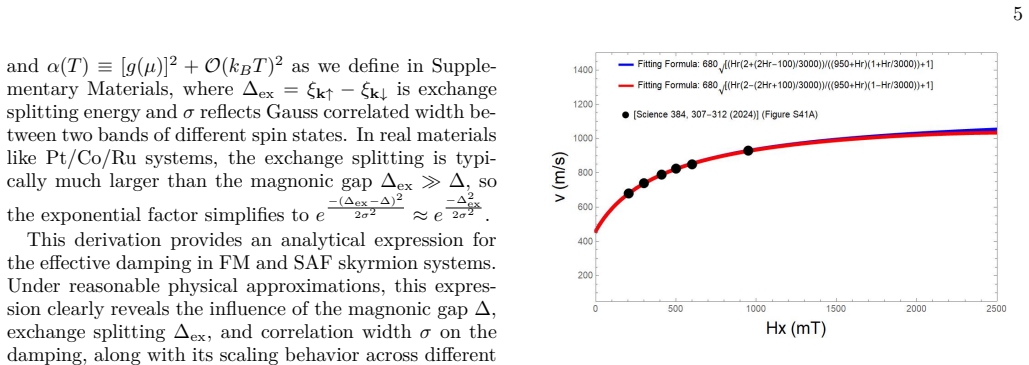
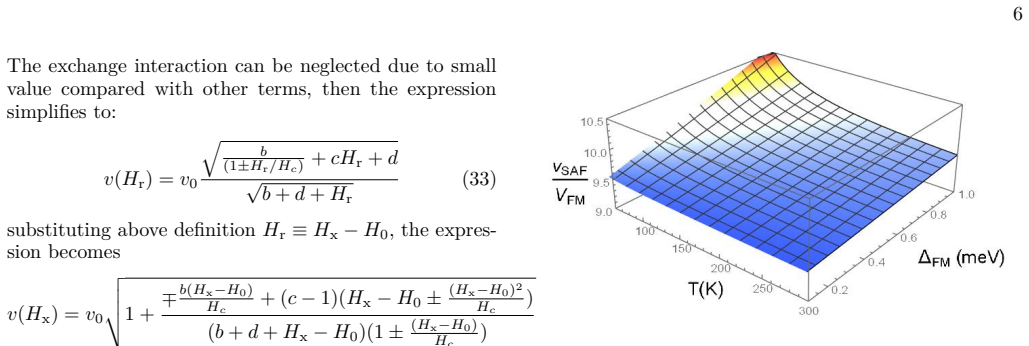
The high mobility of current-driven skyrmions in synthetic antiferromagnets (SAFs) is widely explained by the macroscopic suppression of the skyrmion Hall effect through gyrotropic force compensation. This established view, however, overlooks a concurrent and significant reduction in the Gilbert damping parameter {\alpha}, a key factor in the Thiele equation governing skyrmion velocity. Here, we show that this damping attenuation originates from a reconfigured magnon-electron scattering landscape. Using a microscopic s-d model, we demonstrate that the strong antiferromagnetic interlayer Ruderman-Kittel-Kasuya-Yosida (RKKY) exchange coupling in SAFs increases the magnonic gap of skyrmion collective modes, thereby suppressing the thermal magnon population and, consequently, the magnon-electron scattering rate that dominates damping in metallic ferromagnets. Our work establishes a dual-mechanism framework to fully explain the superior kinetics of SAF skyrmions: the macroscopic topological effect rectifies the motion direction, while the microscopic dissipation mechanism reduces the drag. This synergy enables high-speed and efficient motion, providing a fundamental elucidation of the enhanced mobility reported in recent studies such as the work by Pham et al. [Science 384, 307-312 (2024)].
Editorial analysis
A structured set of objections, weighed in public.
Referee Report
Summary. The manuscript claims that fast current-driven skyrmion motion in synthetic antiferromagnets arises from a dual mechanism: the established gyrotropic-force compensation that suppresses the skyrmion Hall effect, plus a microscopic reduction in Gilbert damping α. The latter is attributed to strong antiferromagnetic RKKY interlayer coupling that opens a gap in the skyrmion collective magnon modes, thereby suppressing the thermal magnon population and the magnon-electron scattering rate that the authors state dominates damping in metallic ferromagnets. The argument is developed within an s-d model and is offered as an explanation for the high velocities reported by Pham et al. (Science 2024).
Significance. If the quantitative mapping from RKKY gap to reduced scattering rate can be established without additional free parameters, the work would supply a microscopic complement to the macroscopic topological picture and help rationalize why SAF skyrmions exhibit both directional rectification and lower drag than their ferromagnetic counterparts.
major comments (3)
- [Abstract, §3] Abstract and §3 (s-d model section): the assertion that magnon-electron scattering 'dominates damping in metallic ferromagnets' is load-bearing for the central claim yet is stated without a derivation or numerical comparison showing that this channel exceeds spin-orbit torque, interfacial spin pumping, or impurity scattering once the SAF structure is introduced.
- [Abstract] Abstract: the causal chain 'RKKY → increased magnonic gap → suppressed thermal magnon population → lower scattering rate' is presented as a demonstration, but no explicit equations, gap values, or computed scattering-rate ratios are supplied, leaving the magnitude of the α reduction unquantified and unbenchmarked against measured damping constants or velocities.
- [§4] Thiele-equation analysis (presumably §4): the velocity prediction inherits the partitioning of damping sources; without an independent check that competing channels remain sub-dominant under RKKY coupling, the claimed reduction in α cannot be isolated from possible changes in other dissipation mechanisms.
minor comments (1)
- Notation for the magnonic gap and the s-d exchange parameter should be defined explicitly on first use rather than assumed from prior literature.
Simulated Author's Rebuttal
We thank the referee for the constructive and detailed report. The comments highlight important points regarding the justification and quantification of our central claims. We address each major comment below and indicate where revisions will be made to strengthen the manuscript.
read point-by-point responses
-
Referee: [Abstract, §3] Abstract and §3 (s-d model section): the assertion that magnon-electron scattering 'dominates damping in metallic ferromagnets' is load-bearing for the central claim yet is stated without a derivation or numerical comparison showing that this channel exceeds spin-orbit torque, interfacial spin pumping, or impurity scattering once the SAF structure is introduced.
Authors: We agree that an explicit justification strengthens the argument. The dominance of magnon-electron scattering in metallic ferromagnets is drawn from established literature on spin relaxation (e.g., works showing this channel exceeds others at room temperature in transition-metal systems). In revision we will add to §3 a concise order-of-magnitude comparison with spin-orbit torque, interfacial spin pumping, and impurity scattering, noting that the interlayer RKKY primarily modulates the bulk magnon population while leaving interfacial channels largely unchanged. revision: yes
-
Referee: [Abstract] Abstract: the causal chain 'RKKY → increased magnonic gap → suppressed thermal magnon population → lower scattering rate' is presented as a demonstration, but no explicit equations, gap values, or computed scattering-rate ratios are supplied, leaving the magnitude of the α reduction unquantified and unbenchmarked against measured damping constants or velocities.
Authors: Section 3 derives the magnon dispersion from the s-d Hamiltonian augmented by the antiferromagnetic RKKY term, which opens a gap Δ in the skyrmion collective modes; the thermal population then follows the Boltzmann factor exp(−Δ/kT) and the scattering rate is taken proportional to this population. To make the chain fully explicit we will insert the analytic expression for Δ_RKKY, evaluate it with representative SAF parameters (J_RKKY ∼ few meV), and provide the resulting numerical estimate for the scattering-rate ratio together with a comparison to reported damping values in SAFs versus ferromagnets. revision: yes
-
Referee: [§4] Thiele-equation analysis (presumably §4): the velocity prediction inherits the partitioning of damping sources; without an independent check that competing channels remain sub-dominant under RKKY coupling, the claimed reduction in α cannot be isolated from possible changes in other dissipation mechanisms.
Authors: The Thiele analysis employs the microscopically reduced α obtained from the s-d model. We maintain that spin-orbit torque and interfacial spin pumping are not altered by bulk RKKY in the same way as the magnon-electron channel. In revision we will add a short discussion in §4 arguing that the RKKY-induced gap selectively suppresses the thermal magnon population while other channels remain sub-dominant; if a fully parameter-free isolation is required this would need supplementary calculations beyond the present scope. revision: partial
Circularity Check
No circularity; derivation relies on independent s-d model without reduction to inputs by construction
full rationale
The paper advances a microscopic explanation via the s-d model for how RKKY coupling opens a magnonic gap that suppresses thermal magnons and thus the scattering rate dominating damping. No equations, fitted parameters, or self-citations are shown that would make any prediction equivalent to its inputs by definition. The dual-mechanism framework references external experimental work (Pham et al.) and presents the gap-suppression effect as a first-principles consequence of the model rather than a renaming or self-referential fit. The derivation chain is therefore self-contained.
Axiom & Free-Parameter Ledger
axioms (2)
- domain assumption Thiele equation governs skyrmion velocity under current drive
- domain assumption Magnon-electron scattering dominates Gilbert damping in the metallic ferromagnets considered
Reference graph
Works this paper leans on
-
[1]
Decomposition of the Correlation Function 4 Consider the complete four-point correlation function ⟨Tτa† q(τ)aq(0)c† k+q,↑(τ)ck,↓(τ)c† k,↓(0)ck+q,↑(0)⟩(12) Applying Wick’s theorem, this decomposes into ⟨Tτa† q(τ)aq(0)⟩·⟨Tτc† k+q,↑(τ)ck,↓(τ)c† k,↓(0)ck+q,↑(0)⟩ (13)
-
[2]
Simplification of the Bosonic Part The bosonic correlation function is simply the free magnon propagator ⟨Tτa† q(τ)aq(0)⟩=D0(q,τ) (14) In the Dyson equationD(q,iω n) =D 0(q,iωn) + D0(q,iωn)Σ(q,iωn)D(q,iωn), this factor is already in- cluded in the bare propagatorD 0(q,iωn)
-
[3]
magnetic Coulomb force
Detailed Calculation of the Fermionic Part The fermionic part requires detailed calculation ⟨Tτc† k+q,↑(τ)ck,↓(τ)c† k,↓(0)ck+q,↑(0)⟩=G↓ 0(k,τ)G↑ 0(k+q,−τ) (15) after Fourier transformation Σ(q,iωn) =− ∑ k |Jk,q|2 1 β ∑ iνn G↑ 0(k+q,iνn+iωn)G↓ 0(k,iνn) (16) where the free electron Green’s function isG σ 0 (k,iνn) = 1 iνn−ξkσ As is well-known, by using the ...
-
[4]
Nagaosa, and Y
N. Nagaosa, and Y. Tokura, Nat. Nanotech.8, 899-911 (2013)
2013
-
[5]
W. J. Jianget al., Science349, 283-286 (2015)
2015
-
[6]
W. J. Jianget al., Nat. Phys.13, 162-169 (2017)
2017
-
[7]
J. D. Zang, M. Mostovoy, J. H. Han, and N. Nagaosa, Phys. Rev. Lett.107, 136804 (2011)
2011
-
[8]
X. C. Zhang, Y. Zhou, and M. Ezawa, Nat. Commun.7, 10293 (2016)
2016
-
[9]
V. T. Phamet al., Science384, 307-312 (2024)
2024
-
[10]
Kambersk´ y, Phys
V. Kambersk´ y, Phys. Rev. B76, 134416 (2007)
2007
-
[11]
Kambersk´ y, Can
V. Kambersk´ y, Can. J. Phys.48, 2906 (1970)
1970
-
[12]
Gilmore, Y
K. Gilmore, Y. U. Idzerda, and M. D. Stiles, Phys. Rev. Lett.99, 027204 (2007)
2007
-
[13]
A. A. Thiele, Phys. Rev. Lett.30, 230 (1973)
1973
-
[14]
Kundu, Z
A. Kundu, Z. B. Siu, and M. B. A. Jalil, New J. Phys. 25, 013037 (2023)
2023
-
[15]
M. A. Ruderman, and C. Kittel, Phys. Rev.96, 99 (1954)
1954
-
[16]
Kasuya, Phys
T. Kasuya, Phys. Rev.106, 893 (1957)
1957
-
[17]
Yosida, Prog
K. Yosida, Prog. Theor. Phys.16, 45 (1956)
1956
-
[18]
J. A. Sobota, D. Tanaskovi´ c, and V. Dobrosavljevi´ c, Phys. Rev. B76, 245106 (2007)
2007
-
[19]
Wieser, E
R. Wieser, E. Y. Vedmedenko, and R. Wiesendanger, Phys. Rev. B81, 024405 (2010)
2010
-
[20]
W. C. Chen, Z. W. Tao, R. Z. Zhao, and X. F. Zhang, Nanotechnology30, 415401 (2019)
2019
-
[21]
B. A. Sanborn, Phys. Rev. B51, 14256 (1995)
1995
-
[22]
Herring, and E
C. Herring, and E. Vogt, Phys. Rev.101, 944 (1956)
1956
-
[23]
Zener, Phys
C. Zener, Phys. Rev.81, 440 (1951)
1951
-
[25]
J. O. Rantschler, R. D. McMichael, A. Castillo, A. J. Shapiro, W. F. Egelhoff, B. B. Maranville, D. Pu- lugurtha, A. P. Chen, and L. M. Connors, J. Appl. Phys. 101, 033911 (2007)
2007
-
[29]
H. X. Yang, G. Chen, and M. Chshiev, Nat. Mater.17, 605-609 (2018)
2018
-
[30]
H. X. Yang, J. H. Liang, and Q. R. Cui, Nat. Rev. Phys. 5, 43-61 (2023)
2023
-
[31]
Seradjeh, J
B. Seradjeh, J. E. Moore, and M. Franz, Phys. Rev. Lett. 103, 066402 (2009)
2009
-
[32]
Anatomy of fast current-induced skyrmion motion in synthetic antiferromagnets
R. Wang, O. Erten, B. G. Wang, and D. Y. Xing, Nat. Commun.10, 210 (2019). Supplementary Material for “Anatomy of fast current-induced skyrmion motion in synthetic antiferromagnets” W. C. Chen 1,2,∗ H. X. Yang 2,† and X. F. Zhang 1‡ 1Institute of Advanced Magnetic Materials, College of Materials and Environmental Engineering, Hangzhou Dianzi University, H...
2019
-
[33]
P. B. Allen, Phys. Rev. B3, 305 (1971)
1971
-
[34]
J. O. Rantschler, R. D. McMichael, A. Castillo, A. J. Shapiro, W. F. Egelhoff, B. B. Maranville, D. Pulugurtha, A. P. Chen, and L. M. Connors, J. Appl. Phys.101, 033911 (2007)
2007
-
[35]
Moriya, Phys
T. Moriya, Phys. Rev. Lett.4, 228 (1960)
1960
-
[36]
Moriya, Phys
T. Moriya, Phys. Rev.120, 91 (1960)
1960
-
[37]
H. X. Yang, A. Thiaville, S. Rohart, A. Fert, and M. Chshiev, Phys. Rev. Lett.115, 267210 (2015)
2015
discussion (0)
Sign in with ORCID, Apple, or X to comment. Anyone can read and Pith papers without signing in.