Stellar Obliquities of Young Systems, Atmospheres Undergoing Contraction and Escape (SOYSAUCE) II: a 135 Myr planet on an aligned orbit with transit timing variations
Pith reviewed 2026-06-27 14:42 UTC · model grok-4.3
The pith
A 3.6 Earth-radius planet at 135 million years old shows a near-aligned orbit around its star.
A machine-rendered reading of the paper's core claim, the machinery that carries it, and where it could break.
Core claim
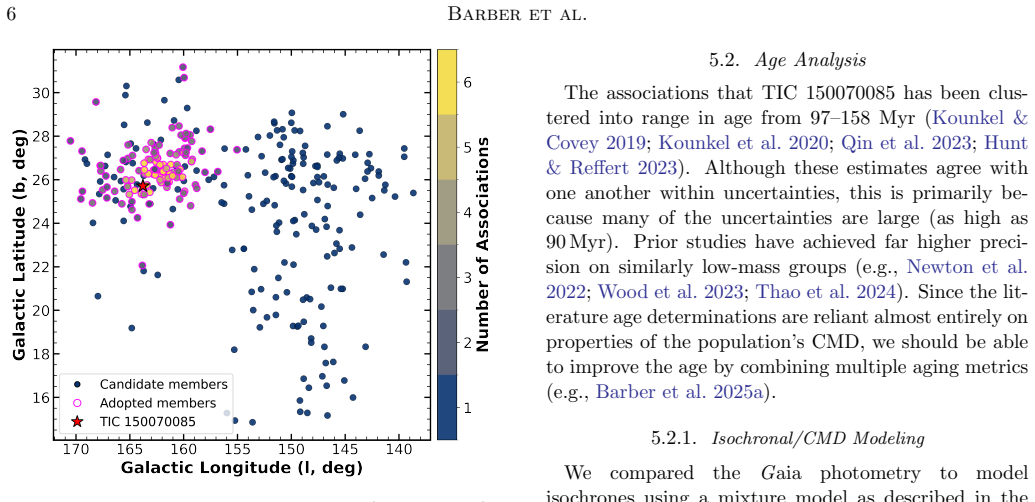
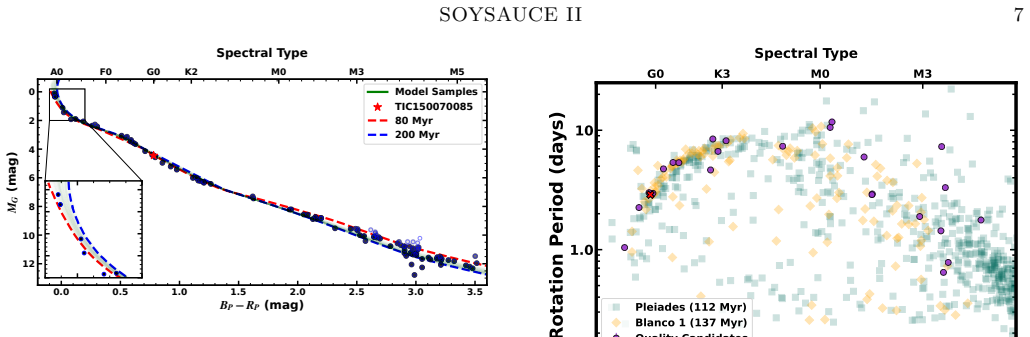
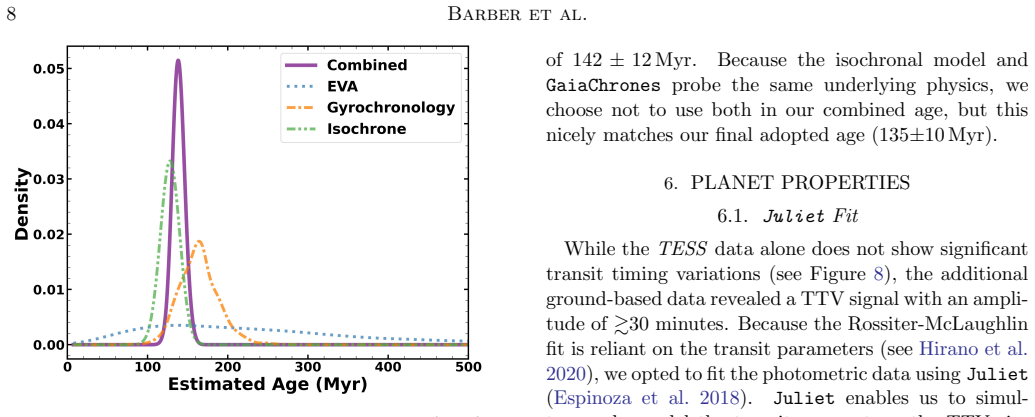
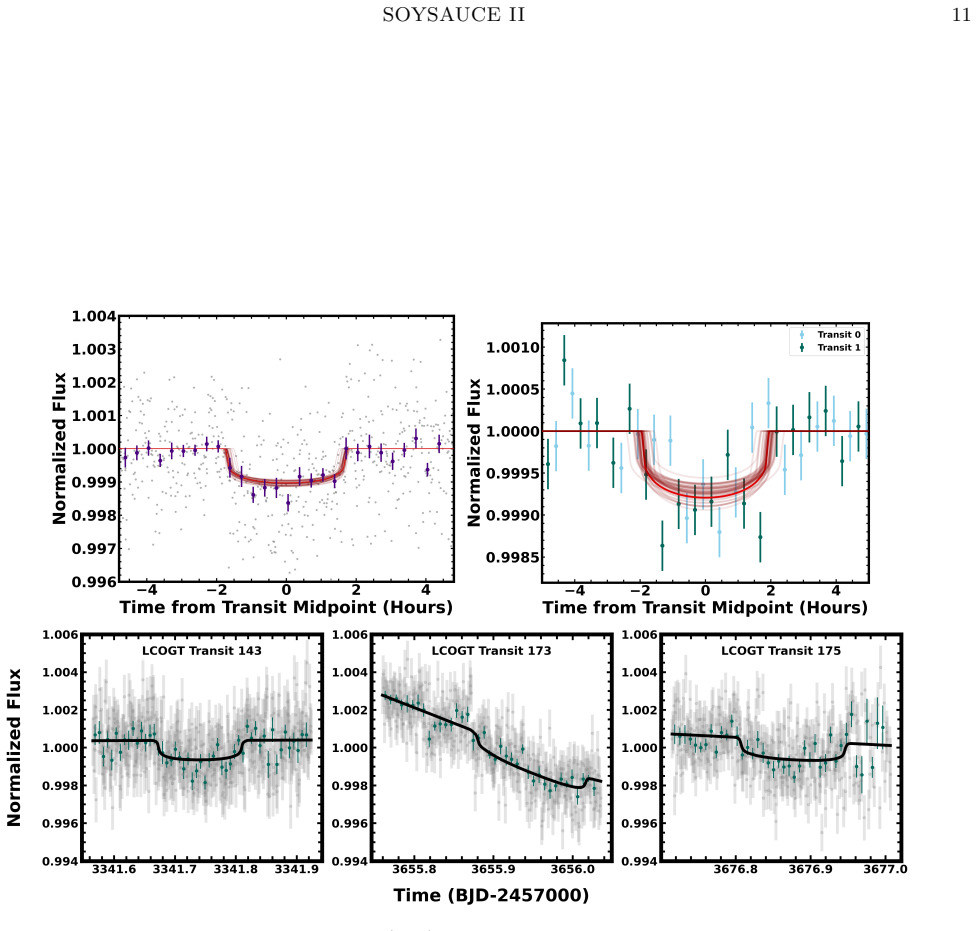
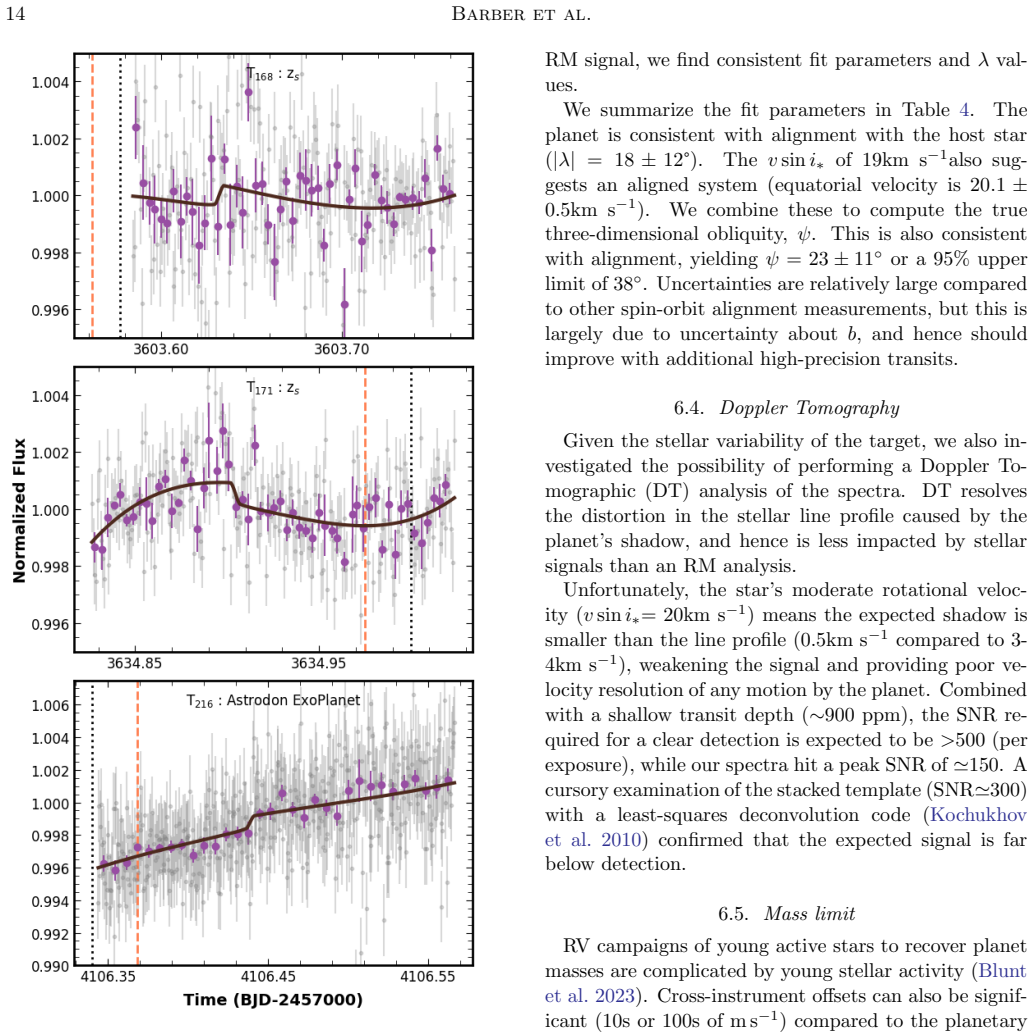
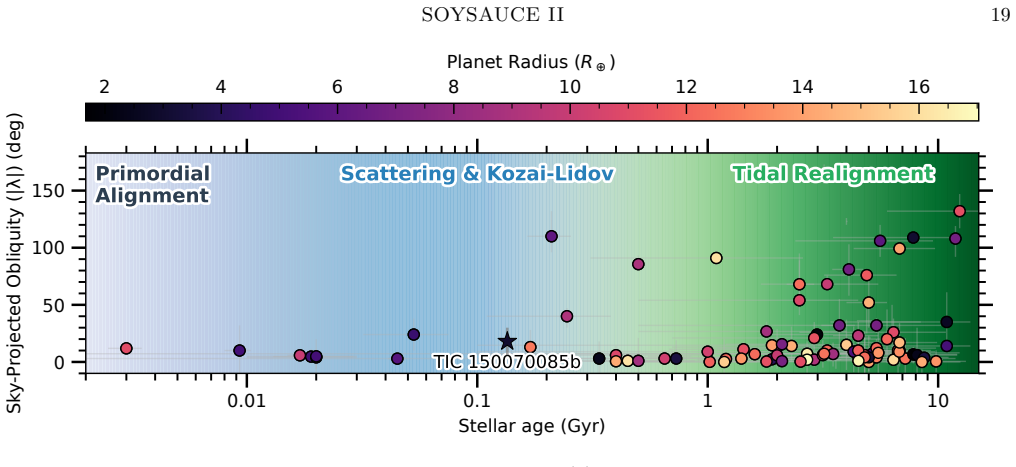
TIC 150070085 b is consistent with a near-aligned orbit with its host star (|λ| = 18 +/- 12°), in line with similarly aged transiting planets with measured λ values. The host star is confirmed as a member of Alessi 84, whose age is updated to 135 +/- 10 Myr from combined CMD, rotation, and variability properties.
What carries the argument
The Rossiter-McLaughlin signal measured with MAROON-X, which determines the sky-projected obliquity angle λ by tracking the distortion of stellar spectral lines during transit.
If this is right
- Planets in the 100-500 Myr range can have obliquities measured even with active host stars.
- Alignment at this age is consistent with the pattern seen in other young transiting planets.
- Transit timing variations can help confirm additional planets in young systems near mean-motion resonance.
- More systems in this age window are needed to trace how spin-orbit angles evolve from formation to Gyr ages.
Where Pith is reading between the lines
- The 3:2 resonance proximity and TTVs suggest the two planets interact dynamically, which could influence long-term obliquity evolution.
- If additional young planets are found aligned, models of disk migration or early tidal damping would need to explain why misalignment is rare before 500 Myr.
- Independent verification of the cluster membership or age through other indicators such as lithium abundance would test the youth classification used here.
Load-bearing premise
The host star is a confirmed member of Alessi 84 whose age can be reliably updated to 135 +/- 10 Myr from the group's combined CMD, rotation, and variability properties.
What would settle it
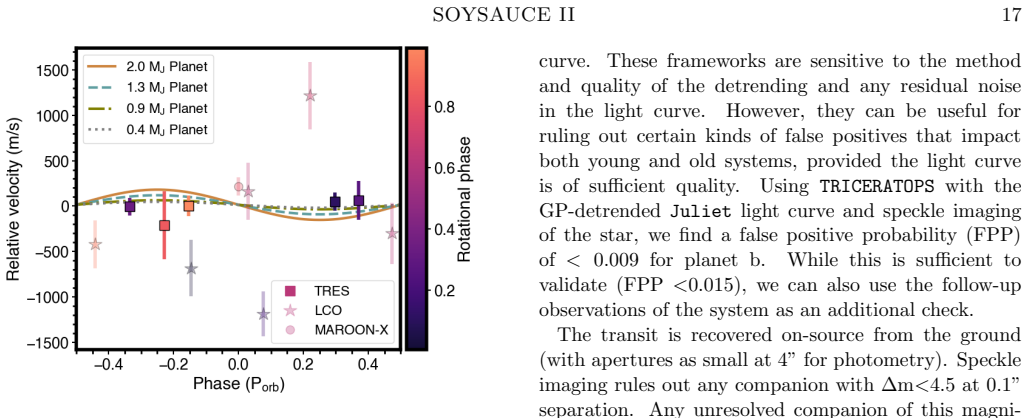
A follow-up Rossiter-McLaughlin observation that measures |λ| greater than 40 degrees with an uncertainty below 10 degrees would show the orbit is not near-aligned.
Figures
read the original abstract
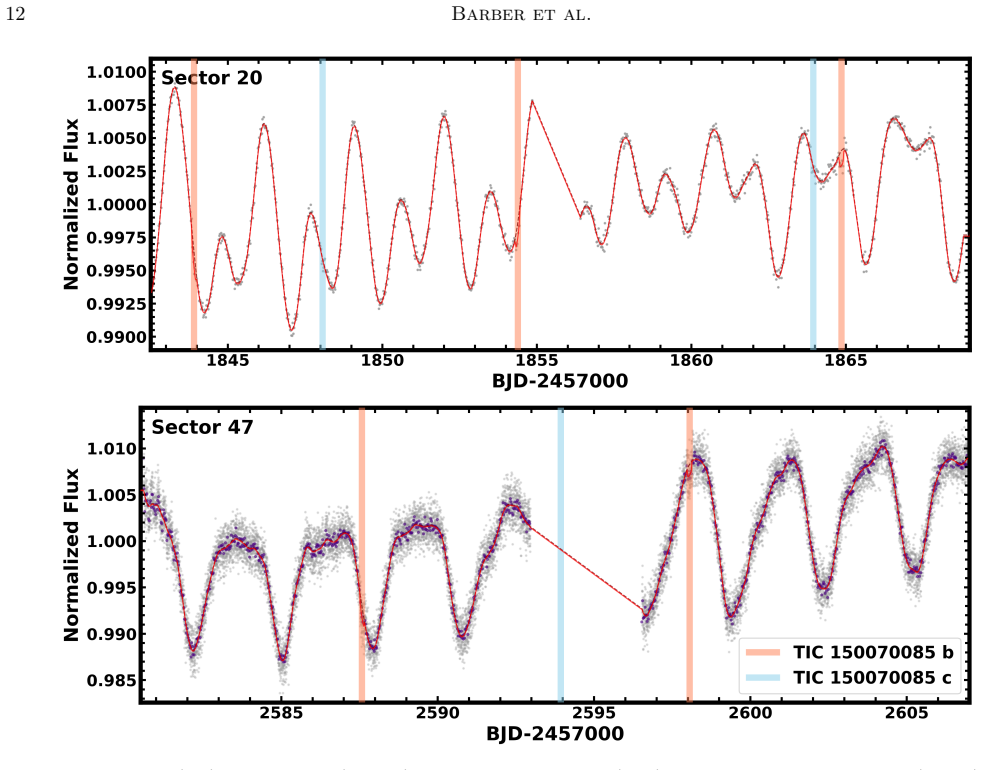
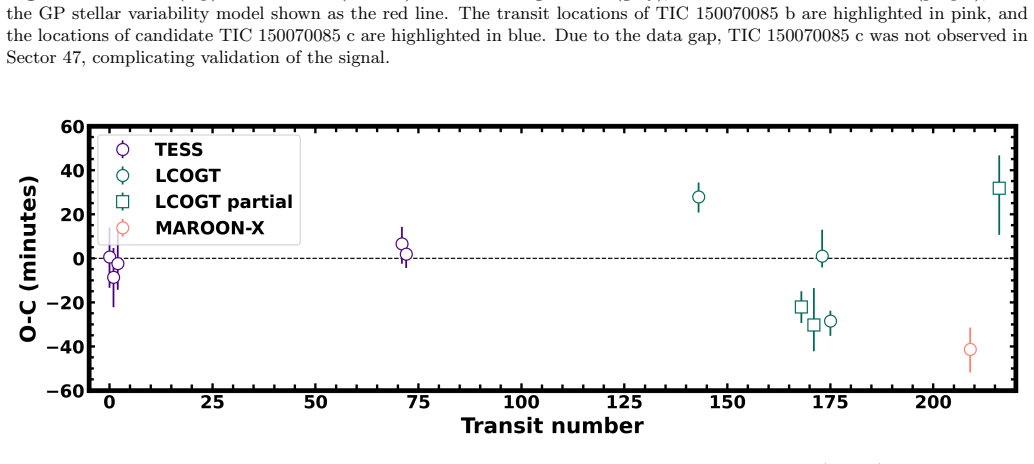
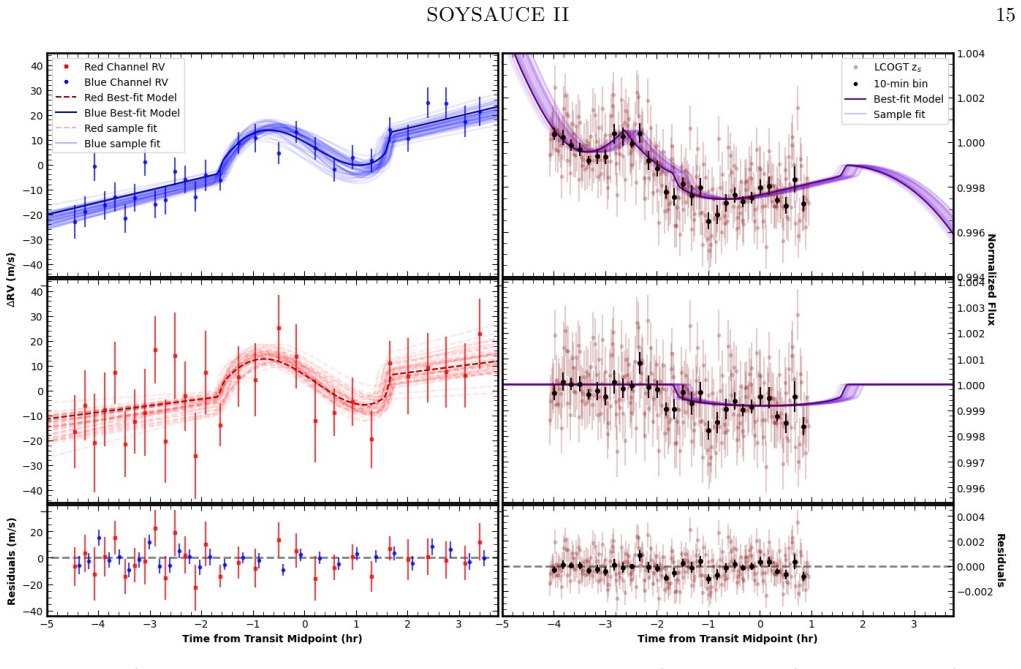
Young planets (<1 Gyr) provide opportunities to directly probe planet formation and evolution processes in action. However, due to heightened stellar activity, there is a lack of known transiting planets in adolescence (~100-500 Myr). Here we present the validation of TIC 150070085 b, a 3.6 R_E planet on a 10.47 day orbit, and report the candidate TIC 150070085 c, a 3.0 R_E planet on a 15.90 day orbit. While we are unable to validate the second signal, the proximity to mean motion resonance (3:2) and transit timing variations observed in the transits of TIC 150070085 b strongly suggest the signal is planetary. We confirm the host star as a member of Alessi 84 and combine the group's CMD, rotation, and variability properties to update the age to 135 +/- 10 Myr. We additionally use MAROON-X to observe the Rossiter-McLaughlin signal of TIC 150070085 b and measure the sky projected obliquity angle ($\lambda$). We find TIC 150070085 b is consistent with a near-aligned orbit with its host star (|$\lambda$| = 18 +/- 12$^\circ$), in line with similarly aged transiting planets with measured $\lambda$ values. Continued discovery and characterization of planets in this age regime are vital to link planetary infancy (<50 Myr) and maturity (>1 Gyr).
Editorial analysis
A structured set of objections, weighed in public.
Referee Report
Summary. The manuscript validates TIC 150070085 b (3.6 R_E, P=10.47 d) as a transiting planet, reports a candidate second planet (TIC 150070085 c) whose 3:2 near-resonance and TTVs on b support a planetary interpretation, confirms the host as an Alessi 84 member, updates the cluster age to 135 ± 10 Myr by combining CMD, rotation, and variability data, and measures the sky-projected obliquity via MAROON-X Rossiter-McLaughlin observations yielding |λ| = 18 ± 12°, consistent with other young transiting planets.
Significance. If the membership confirmation and age revision hold, the result supplies a rare obliquity measurement in the 100-500 Myr regime, directly linking the <50 Myr and >1 Gyr populations and testing whether alignment is already established by ~135 Myr.
major comments (1)
- [age determination paragraph] Age determination paragraph: the update of Alessi 84 to 135 ± 10 Myr by combining CMD, rotation periods, and variability is presented without quantitative membership probabilities, explicit weighting of the three indicators, or robustness checks against alternate isochrones or field contamination; because this age anchors both the 'young' classification and the comparative statement with other λ measurements, the central claim is load-bearing on this section.
minor comments (2)
- [Abstract] Abstract: the notation |λ| = 18 +/- 12° should be written with consistent uncertainty formatting and a brief statement of the RM model assumptions.
- [Abstract] The TTV interpretation for the candidate c is asserted from proximity to 3:2 resonance and observed timing variations, but no amplitude, period, or dynamical stability analysis is referenced in the provided abstract.
Simulated Author's Rebuttal
We thank the referee for their careful review and constructive feedback. We address the single major comment below and will revise the manuscript to strengthen the age determination section as requested.
read point-by-point responses
-
Referee: [age determination paragraph] Age determination paragraph: the update of Alessi 84 to 135 ± 10 Myr by combining CMD, rotation periods, and variability is presented without quantitative membership probabilities, explicit weighting of the three indicators, or robustness checks against alternate isochrones or field contamination; because this age anchors both the 'young' classification and the comparative statement with other λ measurements, the central claim is load-bearing on this section.
Authors: We agree that the age determination is central to the paper and that the current presentation would benefit from greater quantitative rigor. In the revised manuscript we will add quantitative membership probabilities for TIC 150070085, provide an explicit description of how the CMD, rotation, and variability indicators are weighted and combined, and include robustness checks using alternate isochrones together with an assessment of field contamination. These additions will be incorporated without changing the reported age value. revision: yes
Circularity Check
No circularity; age update and obliquity measurement are independent empirical steps
full rationale
The paper updates the age of Alessi 84 to 135 ± 10 Myr by combining the group's CMD, rotation periods, and variability properties after confirming membership, then reports a direct Rossiter-McLaughlin measurement of λ = 18 ± 12° for the planet. Neither step reduces to a self-definition, fitted input renamed as prediction, or self-citation chain; the age relies on standard stellar indicators applied to the group, and λ is extracted from spectroscopic data without equations that loop back to the reported values by construction. The comparative statement with other young planets draws on external literature values. The derivation chain remains self-contained against external benchmarks with no load-bearing reductions to inputs.
Axiom & Free-Parameter Ledger
Reference graph
Works this paper leans on
-
[1]
Intra-system uniformity: a natural outcome of dynamical sculpting. , keywords =. doi:10.1093/mnrasl/slad092 , archivePrefix =. 2304.02634 , primaryClass =
-
[2]
A systematic bias in template-based radial velocity extraction algorithms. , keywords =. doi:10.1051/0004-6361/202554955 , archivePrefix =. 2506.23261 , primaryClass =
-
[3]
Spectropolarimetric observations of active stars. , keywords =. doi:10.1093/mnras/291.4.658 , adsurl =
-
[4]
Dynamics of Protoplanetary Disks
Dynamics of Protoplanetary Disks. , keywords =. doi:10.1146/annurev-astro-081710-102521 , archivePrefix =. 1011.1496 , primaryClass =
work page internal anchor Pith review Pith/arXiv arXiv doi:10.1146/annurev-astro-081710-102521
-
[5]
The Transitional Disk around IRAS 04125+2902
The Transitional Disk around IRAS 04125+2902. , keywords =. doi:10.1088/0004-637X/807/2/156 , archivePrefix =. 1506.01007 , primaryClass =
work page internal anchor Pith review Pith/arXiv arXiv doi:10.1088/0004-637x/807/2/156
-
[6]
A Well-aligned Orbit for the 45 Myr-old Transiting Neptune DS Tuc Ab. , keywords =. doi:10.3847/2041-8213/ab7d3c , archivePrefix =. 1912.04095 , primaryClass =
-
[7]
Early Excitation of Spin-Orbit Misalignments in Close-in Planetary Systems
Early Excitation of Spin-Orbit Misalignments in Close-in Planetary Systems. , keywords =. doi:10.1088/0004-637X/790/1/42 , archivePrefix =. 1406.4183 , primaryClass =
work page internal anchor Pith review Pith/arXiv arXiv doi:10.1088/0004-637x/790/1/42
-
[8]
Disc planet misalignment from an unstable triple system: IRAS04125. , keywords =. doi:10.1093/mnrasl/slaf032 , archivePrefix =. 2504.07182 , primaryClass =
-
[9]
The significance of binaries with nearly identical components. , keywords =. doi:10.1086/112434 , adsurl =
-
[10]
The Updated Multiple Star Catalog
The Updated Multiple Star Catalog. , keywords =. doi:10.3847/1538-4365/aaa1a5 , archivePrefix =. 1712.04750 , primaryClass =
work page internal anchor Pith review Pith/arXiv arXiv doi:10.3847/1538-4365/aaa1a5
-
[11]
Decay of Planetary Debris Disks. , keywords =. doi:10.1086/426937 , adsurl =
-
[12]
The Ages of Early-type Stars: Str \"o mgren Photometric Methods Calibrated, Validated, Tested, and Applied to Hosts and Prospective Hosts of Directly Imaged Exoplanets. , keywords =. doi:10.1088/0004-637X/804/2/146 , archivePrefix =. 1501.03154 , primaryClass =
work page internal anchor Pith review Pith/arXiv arXiv doi:10.1088/0004-637x/804/2/146
-
[13]
SB9: The Ninth Catalogue of Spectroscopic Binary Orbits
S _ B ^ 9 : The ninth catalogue of spectroscopic binary orbits. , keywords =. doi:10.1051/0004-6361:20041213 , archivePrefix =. astro-ph/0406573 , primaryClass =
work page internal anchor Pith review Pith/arXiv arXiv doi:10.1051/0004-6361:20041213
-
[14]
Architecture and Dynamics of Kepler's Candidate Multiple Transiting Planet Systems
Architecture and Dynamics of Kepler's Candidate Multiple Transiting Planet Systems. , keywords =. doi:10.1088/0067-0049/197/1/8 , archivePrefix =. 1102.0543 , primaryClass =
work page internal anchor Pith review Pith/arXiv arXiv doi:10.1088/0067-0049/197/1/8
-
[15]
The orbital eccentricity of small planet systems
The Orbital Eccentricity of Small Planet Systems. , keywords =. doi:10.3847/1538-3881/aaf22f , archivePrefix =. 1807.00549 , primaryClass =
work page internal anchor Pith review Pith/arXiv arXiv doi:10.3847/1538-3881/aaf22f
-
[16]
Transit timing observations from Kepler - III. Confirmation of four multiple planet systems by a Fourier-domain study of anticorrelated transit timing variations. , keywords =. doi:10.1111/j.1365-2966.2012.20467.x , archivePrefix =. 1201.5412 , primaryClass =
-
[17]
Kepler-discovered Multiple-planet Systems near Period Ratios Suggestive of Mean-motion Resonances Are Young. , keywords =. doi:10.3847/1538-3881/ad110e , archivePrefix =. 2312.02260 , primaryClass =
-
[18]
Constraining the entropy of formation from young transiting planets. , keywords =. doi:10.1093/mnras/staa2784 , archivePrefix =. 2009.03919 , primaryClass =
-
[19]
The Prevalence of Resonance Among Young, Close-in Planets. arXiv e-prints , keywords =. doi:10.48550/arXiv.2406.06885 , archivePrefix =. 2406.06885 , primaryClass =
-
[20]
The Hot-Jupiter Kepler-17b: Discovery, Obliquity from Stroboscopic Starspots, and Atmospheric Characterization. , keywords =. doi:10.1088/0067-0049/197/1/14 , archivePrefix =. 1107.5750 , primaryClass =
work page internal anchor Pith review Pith/arXiv arXiv doi:10.1088/0067-0049/197/1/14
-
[21]
, month = may, pages =
-
[22]
Low False Positive Rate of Kepler Candidates Estimated From A Combination Of Spitzer And Follow-Up Observations. , keywords =. doi:10.1088/0004-637X/804/1/59 , archivePrefix =. 1503.03173 , primaryClass =
work page internal anchor Pith review Pith/arXiv arXiv doi:10.1088/0004-637x/804/1/59
-
[23]
Three Small Planets Transiting a Hyades Star
Three Small Planets Transiting a Hyades Star. , keywords =. doi:10.3847/1538-3881/aaa841 , archivePrefix =. 1710.07203 , primaryClass =
work page internal anchor Pith review Pith/arXiv arXiv doi:10.3847/1538-3881/aaa841
-
[24]
Ages of Young Stars. Protostars and Planets VI , year = 2014, editor =. doi:10.2458/azu_uapress_9780816531240-ch010 , archivePrefix =. 1311.7024 , primaryClass =
work page internal anchor Pith review Pith/arXiv arXiv doi:10.2458/azu_uapress_9780816531240-ch010 2014
-
[25]
Architecture of Kepler's Multi-transiting Systems. II. New Investigations with Twice as Many Candidates. , keywords =. doi:10.1088/0004-637X/790/2/146 , archivePrefix =. 1202.6328 , primaryClass =
work page internal anchor Pith review Pith/arXiv arXiv doi:10.1088/0004-637x/790/2/146
-
[26]
The period ratio distribution of Kepler's candidate multiplanet systems
The period ratio distribution of Kepler's candidate multiplanet systems. , keywords =. doi:10.1093/mnras/stv104 , archivePrefix =. 1409.3320 , primaryClass =
work page internal anchor Pith review Pith/arXiv arXiv doi:10.1093/mnras/stv104
-
[27]
Very Low Density Planets around Kepler-51 Revealed with Transit Timing Variations and an Anomaly Similar to a Planet-Planet Eclipse Event. , keywords =. doi:10.1088/0004-637X/783/1/53 , archivePrefix =. 1401.2885 , primaryClass =
work page internal anchor Pith review Pith/arXiv arXiv doi:10.1088/0004-637x/783/1/53
-
[28]
arXiv , author =:1905.05193 , journal =
doi:10.3847/2041-8213/ab322d , eid =. arXiv , author =:1905.05193 , journal =
-
[29]
doi:10.1117/12.2233418 , eid =
, date-added =. doi:10.1117/12.2233418 , eid =
-
[30]
doi:10.1117/12.856790 , editor =
Software and Cyberinfrastructure for Astronomy , date-added =. doi:10.1117/12.856790 , editor =
-
[31]
, keywords =. doi:10.1086/667698 , eprint =
work page internal anchor Pith review doi:10.1086/667698
-
[32]
, keywords =. doi:10.1086/667697 , eprint =
work page internal anchor Pith review doi:10.1086/667697
-
[33]
doi:10.1086/674989 , journal =
-
[34]
arXiv , author =:2108.09109 , journal =
doi:10.3847/1538-3881/ac3000 , eid =. arXiv , author =:2108.09109 , journal =
-
[35]
doi:10.3847/1538-3881/aa9070 , eid =. arXiv , arxivurl =:1709.09670 , journal =
work page internal anchor Pith review Pith/arXiv arXiv doi:10.3847/1538-3881/aa9070
-
[36]
The Astropy Project: Building an inclusive, open-science project and status of the v2.0 core package
doi:10.3847/1538-3881/aabc4f , eid =. arXiv , author =:1801.02634 , journal =
work page internal anchor Pith review Pith/arXiv arXiv doi:10.3847/1538-3881/aabc4f
-
[37]
doi:10.3847/0004-637X/818/1/46 , eid =. arXiv , arxivurl =:1512.00483 , journal =
work page internal anchor Pith review Pith/arXiv arXiv doi:10.3847/0004-637x/818/1/46
-
[38]
doi:10.1093/mnras/sty2238 , eprint =
, keywords =. doi:10.1093/mnras/sty2238 , eprint =
-
[39]
2015, PASP, 127, 1161, doi: 10.1086/683602
, keywords =. doi:10.1086/683602 , eprint =
work page internal anchor Pith review doi:10.1086/683602
-
[40]
Fast and scalable Gaussian process modeling with applications to astronomical time series
doi:10.3847/1538-3881/aa9332 , eid =. arXiv , author =:1703.09710 , journal =
work page internal anchor Pith review Pith/arXiv arXiv doi:10.3847/1538-3881/aa9332
- [41]
-
[42]
doi:10.1093/mnras/stt1435 , eprint =
, keywords =. doi:10.1093/mnras/stt1435 , eprint =
-
[43]
arXiv , author =:2302.02183 , journal =
doi:10.48550/arXiv.2302.02183 , eid =. arXiv , author =:2302.02183 , journal =
-
[44]
arXiv , author =:2403.03261 , journal =
doi:10.3847/1538-3881/ad3108 , eid =. arXiv , author =:2403.03261 , journal =
-
[45]
doi:10.1088/0004-637X/808/2/126 , eid =. arXiv , arxivurl =:1505.02814 , journal =
work page internal anchor Pith review Pith/arXiv arXiv doi:10.1088/0004-637x/808/2/126
-
[47]
Scalable Backpropagation for Gaussian Processes using Celerite. Research Notes of the American Astronomical Society , year = 2018, month = feb, volume = 2, number = 1, pages =. doi:10.3847/2515-5172/aaaf6c , adsurl =
-
[48]
Stellar Obliquities in Exoplanetary Systems. , keywords =. doi:10.1088/1538-3873/ac6c09 , archivePrefix =. 2203.05460 , primaryClass =
-
[49]
, month = sep, pages =
-
[50]
arXiv e-prints , month = may, pages =
-
[51]
arXiv , author =:2110.09531 , journal =
doi:10.3847/1538-3881/ac511d , eid =. arXiv , author =:2110.09531 , journal =
-
[52]
arXiv , author =:2102.06066 , journal =
doi:10.3847/1538-3881/abdf53 , eid =. arXiv , author =:2102.06066 , journal =
-
[53]
Monthly Notices of the Royal Astronomical Society , volume =
Hirano, Teruyuki and Gaidos, Eric and Harakawa, Hiroki and Hodapp, Klaus W and Kotani, Takayuki and Kudo, Tomoyuki and Kurokawa, Takashi and Kuzuhara, Masayuki and Mann, Andrew W and Nishikawa, Jun and Omiya, Masashi and Serizawa, Takuma and Tamura, Motohide and Thao, Pa Chia and Ueda, Akitoshi and Vievard, Sebastien , title = ". Monthly Notices of the Ro...
-
[54]
arXiv , author =:2211.07728 , journal =
doi:10.3847/1538-3881/aca07a , eid =. arXiv , author =:2211.07728 , journal =
-
[55]
The Obliquity of HIP 67522 b: A 17 Myr Old Transiting Hot, Jupiter-sized Planet. , keywords =. doi:10.3847/2041-8213/ac3485 , archivePrefix =. 2109.04174 , primaryClass =
-
[56]
TESS Hunt for Young and Maturing Exoplanets (THYME). XI. An Earth-sized Planet Orbiting a Nearby, Solar-like Host in the 400 Myr Ursa Major Moving Group. , keywords =. doi:10.3847/1538-3881/ad1039 , archivePrefix =. 2401.04785 , primaryClass =
-
[57]
ascl:1812.013 , adsurl =
Lightkurve: Kepler and TESS time series analysis in Python. ascl:1812.013 , adsurl =
-
[58]
Measurements of Transit Timing Variations for WASP-5b
Measurements of Transit Timing Variations for WASP-5b. , keywords =. doi:10.1093/pasj/63.1.287 , archivePrefix =. 1009.5769 , primaryClass =
work page internal anchor Pith review Pith/arXiv arXiv doi:10.1093/pasj/63.1.287
-
[59]
A transiting warm super-Jovian planet around HD 114082, a young star with a debris disk
Radial velocity survey for planets around young stars (RVSPY). A transiting warm super-Jovian planet around HD 114082, a young star with a debris disk. , keywords =. doi:10.1051/0004-6361/202244747 , archivePrefix =. 2211.08294 , primaryClass =
-
[60]
Almost All of Kepler's Multiple Planet Candidates are Planets
doi:10.1088/0004-637X/750/2/112 , eid =. arXiv , author =:1201.5424 , journal =
work page internal anchor Pith review Pith/arXiv arXiv doi:10.1088/0004-637x/750/2/112
-
[61]
doi:10.1088/0004-637X/784/1/45 , eid =. arXiv , author =:1402.6534 , journal =
work page internal anchor Pith review Pith/arXiv arXiv doi:10.1088/0004-637x/784/1/45
-
[62]
arXiv , author =:2212.03266 , journal =
doi:10.3847/1538-3881/aca8fc , eid =. arXiv , author =:2212.03266 , journal =
-
[63]
and David, Trevor J
Feinstein, Adina D. and David, Trevor J. and Montet, Benjamin T. and Foreman-Mackey, Daniel and Livingston, John H. and Mann, Andrew W. , doi =. V1298 Tau with TESS: Updated Ephemerides, Radii, and Period Constraints from a Second Transit of V1298 Tau e , url =. The Astrophysical Journal Letters , note =. 2022 , bdsk-url-1 =
2022
-
[64]
A Warm Jupiter-sized Planet Transiting the Pre-main-sequence Star V1298 Tau. , keywords =. doi:10.3847/1538-3881/ab290f , archivePrefix =. 1902.09670 , primaryClass =
-
[66]
arXiv , author =:2012.13238 , journal =
doi:10.1051/0004-6361/202040235 , eid =. arXiv , author =:2012.13238 , journal =
-
[67]
TOI-942b: A Prograde Neptune in a 60 Myr Old Multi-transiting System. , keywords =. doi:10.3847/2041-8213/ac13a9 , archivePrefix =. 2106.14968 , primaryClass =
-
[68]
A planet within the debris disk around the pre-main-sequence star AU Microscopii. , keywords =. doi:10.1038/s41586-020-2400-z , archivePrefix =. 2006.13248 , primaryClass =
-
[69]
Ward , doi =
Hidekazu Tanaka and William R. Ward , doi =. Three-dimensional Interaction between a Planet and an Isothermal Gaseous Disk. II. Eccentricity Waves and Bending Waves , url =. The Astrophysical Journal , month =. 2004 , bdsk-url-1 =
2004
-
[70]
Monthly Notices of the Royal Astronomical Society , volume =
Mori, Mayuko and Ikuta, Kai and Fukui, Akihiko and Narita, Norio and de Leon, Jerome P and Livingston, John H and Ikoma, Masahiro and Kawai, Yugo and Kawauchi, Kiyoe and Murgas, Felipe and Palle, Enric and Parviainen, Hannu and Rodríguez, Gareb Fernández and Terada, Yuka and Watanabe, Noriharu and Tamura, Motohide , title = ". Monthly Notices of the Royal...
-
[71]
The GAPS Programme at TNG. XXXVII. A precise density measurement of the young ultra-short period planet TOI-1807 b. , keywords =. doi:10.1051/0004-6361/202243743 , archivePrefix =. 2206.03496 , primaryClass =
-
[72]
Morris and Leslie Hebb and James R
Brett M. Morris and Leslie Hebb and James R. A. Davenport and Graeme Rohn and Suzanne L. Hawley , doi =. The Starspots of HAT-P-11: Evidence for a Solar-like Dynamo , url =. The Astrophysical Journal , month =. 2017 , bdsk-url-1 =
2017
-
[73]
Breaking the chains: hot super-Earth systems from migration and disruption of compact resonant chains. , keywords =. doi:10.1093/mnras/stx1232 , archivePrefix =. 1703.03634 , primaryClass =
work page internal anchor Pith review Pith/arXiv arXiv doi:10.1093/mnras/stx1232
-
[74]
Diving Beneath the Sea of Stellar Activity: Chromatic Radial Velocities of the Young AU Mic Planetary System. , keywords =. doi:10.3847/1538-3881/ac2c80 , archivePrefix =. 2109.13996 , primaryClass =
-
[75]
Rapid contraction of giant planets orbiting the 20-million-year-old star V1298 Tau. Nature Astronomy , keywords =. doi:10.1038/s41550-021-01533-7 , archivePrefix =. 2111.09193 , primaryClass =
-
[76]
arXiv , author =:2206.03989 , journal =
doi:10.3847/1538-3881/ac7b29 , eid =. arXiv , author =:2206.03989 , journal =
-
[77]
arXiv , author =:2308.13039 , journal =
doi:10.3847/1538-3881/acf4f0 , eid =. arXiv , author =:2308.13039 , journal =
-
[78]
arXiv , author =:2110.10707 , journal =
doi:10.3847/1538-3881/ac6271 , eid =. arXiv , author =:2110.10707 , journal =
-
[79]
Hot Jupiters from Coplanar High-eccentricity Migration
Hot Jupiters from Coplanar High-eccentricity Migration. , keywords =. doi:10.1088/0004-637X/805/1/75 , archivePrefix =. 1409.8296 , primaryClass =
work page internal anchor Pith review Pith/arXiv arXiv doi:10.1088/0004-637x/805/1/75
-
[80]
Handbook of Exoplanets , year = 2018, editor =
The Rossiter-McLaughlin Effect in Exoplanet Research. Handbook of Exoplanets , year = 2018, editor =. doi:10.1007/978-3-319-55333-7_2 , adsurl =
-
[81]
Secular Dynamics in Hierarchical Three-Body Systems
Secular dynamics in hierarchical three-body systems. , keywords =. doi:10.1093/mnras/stt302 , archivePrefix =. 1107.2414 , primaryClass =
work page internal anchor Pith review Pith/arXiv arXiv doi:10.1093/mnras/stt302
-
[82]
Origins of Hot Jupiters. , keywords =. doi:10.1146/annurev-astro-081817-051853 , archivePrefix =. 1801.06117 , primaryClass =
work page internal anchor Pith review Pith/arXiv arXiv doi:10.1146/annurev-astro-081817-051853
discussion (0)
Sign in with ORCID, Apple, or X to comment. Anyone can read and Pith papers without signing in.