Discovery and Spectroscopic Characterization of a Distant, Compact Milky Way Satellite in Gemini
Pith reviewed 2026-06-27 16:05 UTC · model grok-4.3
The pith
A compact ultra-faint system in Gemini is confirmed as a bound Milky Way satellite at 120 kpc with four member stars.
A machine-rendered reading of the paper's core claim, the machinery that carries it, and where it could break.
Core claim
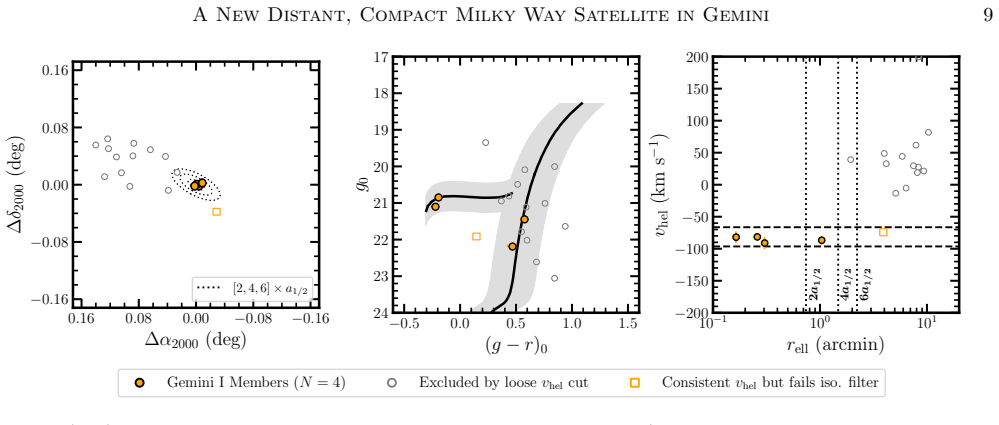
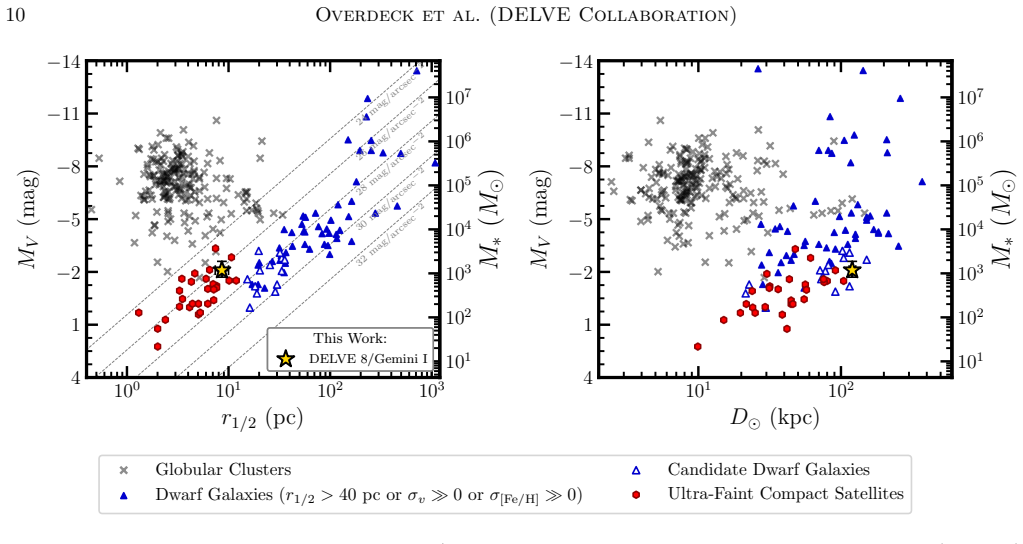
The system is an ultra-faint (M_V = -2.1) compact (r_1/2 = 8.6 pc) Milky Way satellite at a heliocentric distance of 120 kpc. Medium-resolution spectroscopy identifies four members with mean radial velocity v_hel = -82.7 km/s, confirming the system as bound, and places an upper limit [Fe/H] ≲ -2.5 on the metallicity of its brightest star, supporting classification as either an ancient star cluster or ultra-faint dwarf galaxy.
What carries the argument
Photometric detection via cross-matched search algorithms on wide-field imaging data combined with spectroscopic identification of member stars to establish binding and metallicity.
If this is right
- The physical properties place the system in the regime of ambiguous ultra-faint compact halo satellites that cannot be confidently classified as dwarf galaxies or star clusters from morphology alone.
- The metallicity upper limit supports the presence of an ancient stellar population in the system.
- The discovery of similar faint distant systems is expected to become more common with upcoming surveys.
Where Pith is reading between the lines
- Follow-up proper-motion measurements could further test whether the stars form a coherent kinematic group.
- The object adds one more data point to the census of known outer-halo satellites whose nature remains ambiguous between clusters and galaxies.
- The cross-matching approach used for initial detection may increase completeness for similar low-surface-brightness objects in existing imaging datasets.
Load-bearing premise
That four spectroscopically confirmed members are sufficient to establish the system as a gravitationally bound satellite rather than a chance alignment or foreground contamination.
What would settle it
Additional radial velocity measurements or proper motion data showing that the four stars do not share a common space motion or velocity dispersion consistent with gravitational binding.
Figures
read the original abstract
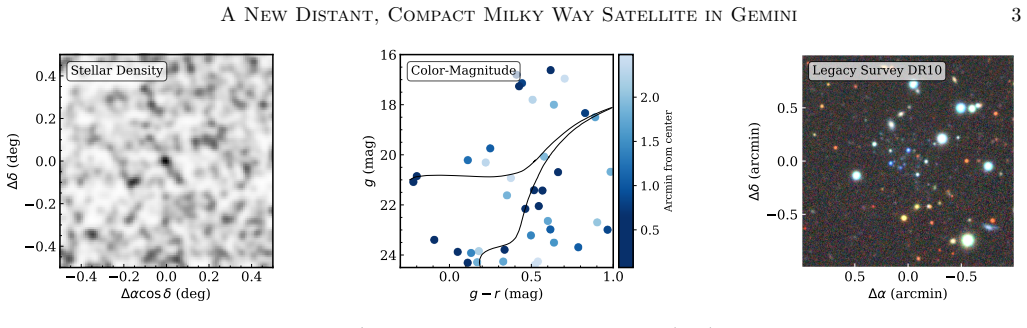
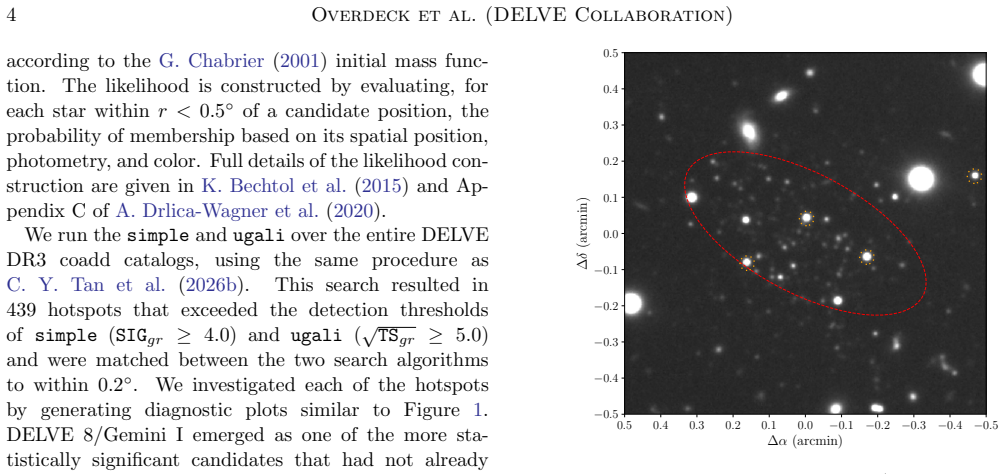
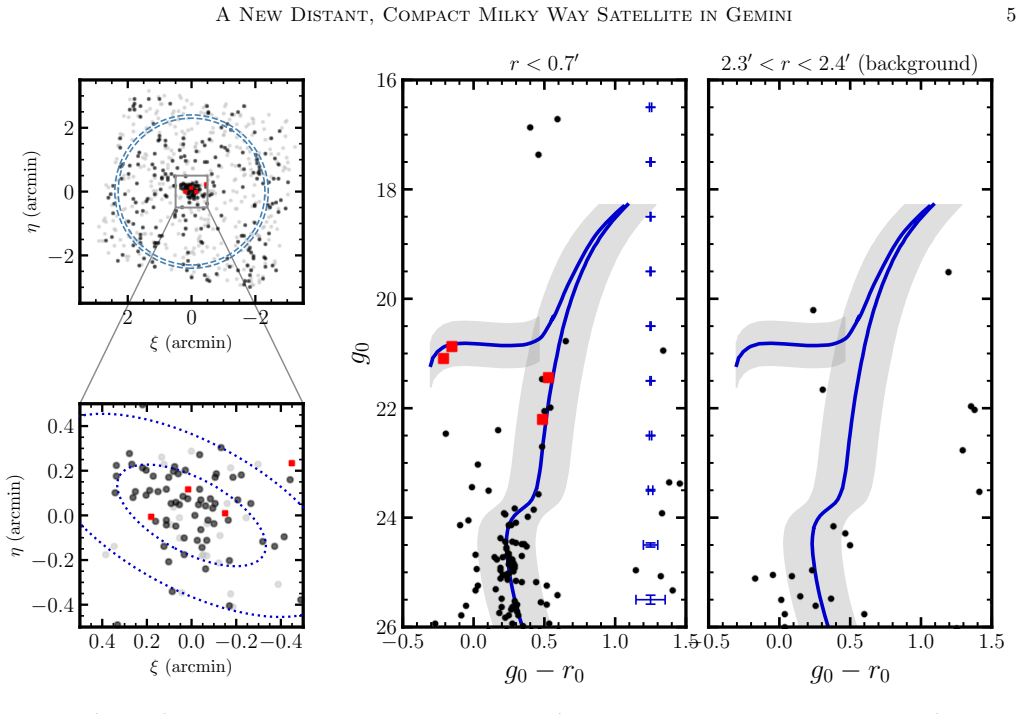
We present the discovery of a compact Milky Way satellite in the constellation of Gemini. This system was discovered by cross-matching detections from two independent search algorithms applied to Blanco/DECam data from the third data release of the DECam Local Volume Exploration survey (DELVE DR3), and confirmed with deeper imaging from Gemini/GMOS-N. Based on these data, we determine that the system is an ultra-faint ($M_V = -2.1^{+0.4}_{-0.6}$), compact ($r_{1/2} = 8.6^{+1.4}_{-1.2}$ pc) system located at a heliocentric distance of $120^{+7}_{-6}$ kpc. These physical properties place the system in the regime of ambiguous, ultra-faint compact Milky Way halo satellites that cannot be confidently classified as dwarf galaxies or star clusters from morphology alone; we therefore name the system DELVE 8/Gemini I. From medium-resolution Keck/DEIMOS spectroscopy, we securely identify four members including two blue horizontal branch stars, confirming the system as a bound satellite moving at a mean radial velocity of $v_{\rm hel} = -82.7^{+3.7}_{-3.9} {\rm km\,s}^{-1}$. We also use these spectra to place an upper limit of $\rm [Fe/H] \lesssim -2.5$ on the metallicity of DELVE 8/Gemini I's brightest star, supporting the classification of the system as either an ancient star cluster or ultra-faint dwarf galaxy. The discovery of faint, distant systems similar to DELVE 8/Gemini I is expected to become more common with upcoming surveys.
Editorial analysis
A structured set of objections, weighed in public.
Referee Report
Summary. The manuscript reports the discovery of DELVE 8/Gemini I, a compact ultra-faint Milky Way satellite in Gemini found via cross-matching of two independent search algorithms on DELVE DR3 Blanco/DECam photometry and confirmed with deeper Gemini/GMOS-N imaging. Photometric analysis yields M_V = -2.1^{+0.4}_{-0.6}, r_{1/2} = 8.6^{+1.4}_{-1.2} pc at a heliocentric distance of 120^{+7}_{-6} kpc. Medium-resolution Keck/DEIMOS spectroscopy identifies four members (including two blue horizontal branch stars) with mean radial velocity v_hel = -82.7^{+3.7}_{-3.9} km s^{-1} and places an upper limit [Fe/H] ≲ -2.5 on the brightest star, supporting classification as either an ancient star cluster or ultra-faint dwarf galaxy.
Significance. If the spectroscopic membership holds, the result adds a valuable data point to the census of faint, distant Milky Way halo satellites in the morphologically ambiguous regime, with implications for the satellite luminosity function and dark matter substructure. The paper's use of public survey data plus targeted follow-up imaging and spectroscopy provides a clear, reproducible methodology that will scale to future wide-field surveys.
major comments (1)
- [Keck/DEIMOS spectroscopy results] Keck/DEIMOS spectroscopy results (as summarized in the abstract): the claim that four spectroscopically confirmed members 'confirm the system as a bound satellite' is load-bearing for the central result but lacks a quantified false-positive rate, velocity dispersion, or Monte Carlo assessment against a Galactic halo model at 120 kpc. Individual velocities, membership probabilities, and the probability of chance alignment are not reported, leaving the binding inference dependent on an untested assumption of coherence.
minor comments (2)
- [Abstract] Abstract: the description of the two search algorithms could be expanded with one sentence on their independence to strengthen the discovery narrative.
- Notation: asymmetric uncertainties are presented clearly but should be accompanied by a brief methods statement on how they were derived from the photometric and spectroscopic fits.
Simulated Author's Rebuttal
We thank the referee for their constructive review and for identifying the need for more rigorous quantification of the spectroscopic membership. We respond to the major comment below and will revise the manuscript to address it.
read point-by-point responses
-
Referee: [Keck/DEIMOS spectroscopy results] Keck/DEIMOS spectroscopy results (as summarized in the abstract): the claim that four spectroscopically confirmed members 'confirm the system as a bound satellite' is load-bearing for the central result but lacks a quantified false-positive rate, velocity dispersion, or Monte Carlo assessment against a Galactic halo model at 120 kpc. Individual velocities, membership probabilities, and the probability of chance alignment are not reported, leaving the binding inference dependent on an untested assumption of coherence.
Authors: We agree that the current version of the manuscript does not include the requested quantitative assessments. In the revised manuscript we will add the individual radial velocities and photometric properties of the four members in a dedicated table. We will compute and report membership probabilities for each star using a Bayesian framework that incorporates radial velocity, on-sky position relative to the center, and color-magnitude information. We will also include a Monte Carlo assessment that draws from a Galactic halo model at 120 kpc to estimate the false-positive rate for observing four stars with the observed velocity coherence by chance, along with the probability of chance alignment. The velocity dispersion (or 95% upper limit) derived from the four members will be reported explicitly. These additions will be placed in Section 4 (Spectroscopic Results) and supported by a new appendix describing the methodology. The two blue horizontal branch stars already provide strong supporting evidence due to their rarity, and this will be folded into the membership probabilities. revision: yes
Circularity Check
No circularity: observational discovery and direct measurements
full rationale
The paper reports discovery via cross-matching in DELVE DR3 imaging, confirmation with Gemini/GMOS-N deeper imaging, and Keck/DEIMOS spectroscopy identifying four members (including two BHB stars) to establish heliocentric distance, physical size, luminosity, and mean radial velocity. These are direct observational inferences from data, with no derivations, fitted parameters presented as predictions, self-citations forming the load-bearing chain, or ansatzes smuggled in. The binding inference from N=4 members is a standard small-sample interpretation (correctness risk noted separately by skeptic), not a reduction to self-definition or fitted input. Paper is self-contained against external benchmarks with no circular steps.
Axiom & Free-Parameter Ledger
free parameters (2)
- heliocentric distance
- half-light radius
axioms (2)
- domain assumption Standard stellar isochrones and population models accurately convert observed photometry to physical parameters such as distance and metallicity.
- domain assumption Coherent radial velocities of a small number of stars indicate gravitational binding rather than projection effects.
Reference graph
Works this paper leans on
-
[1]
Abbott, T. M. C., Adam´ ow, M., Aguena, M., et al. 2021, ApJS, 255, 20, doi: 10.3847/1538-4365/ac00b3
-
[2]
Ahvazi, N., Benson, A., Sales, L. V., et al. 2024, MNRAS, 529, 3387, doi: 10.1093/mnras/stae761
-
[3]
Ahvazi, N., Pace, A. B., Garling, C. T., et al. 2025, arXiv e-prints, arXiv:2511.15808, doi: 10.48550/arXiv.2511.15808
-
[4]
2018, PASJ, 70, S4, doi: 10.1093/pasj/psx066
Aihara, H., Arimoto, N., Armstrong, R., et al. 2018, PASJ, 70, S4, doi: 10.1093/pasj/psx066
work page internal anchor Pith review doi:10.1093/pasj/psx066 2018
-
[5]
2016, kbarbary/sep: v1.0.0, v1.0.0 Zenodo, doi: 10.5281/zenodo.159035
Barbary, K., Boone, K., McCully, C., et al. 2016, kbarbary/sep: v1.0.0, v1.0.0 Zenodo, doi: 10.5281/zenodo.159035
-
[6]
2015, ApJ, 807, 50, doi: 10.1088/0004-637X/807/1/50
Bechtol, K., Drlica-Wagner, A., Balbinot, E., et al. 2015, ApJ, 807, 50, doi: 10.1088/0004-637X/807/1/50
-
[7]
Belokurov, V., Zucker, D. B., Evans, N. W., et al. 2006, ApJL, 647, L111, doi: 10.1086/507324
-
[8]
Frenk, C. S. 2002, MNRAS, 333, 156, doi: 10.1046/j.1365-8711.2002.05387.x
-
[9]
Bressan, A., Marigo, P., Girardi, L., et al. 2012, MNRAS, 427, 127, doi: 10.1111/j.1365-2966.2012.21948.x
-
[10]
Bullock, J. S., & Boylan-Kolchin, M. 2017, ARA&A, 55, 343, doi: 10.1146/annurev-astro-091916-055313
-
[11]
Bullock, J. S., Kravtsov, A. V., & Weinberg, D. H. 2000, ApJ, 539, 517, doi: 10.1086/309279
-
[12]
Cantu, S. A., Pace, A. B., Marshall, J., et al. 2021, ApJ, 916, 81, doi: 10.3847/1538-4357/ac0443
-
[13]
2007, A&A, 466, 181, doi: 10.1051/0004-6361:20066825
Carraro, G., Zinn, R., & Moni Bidin, C. 2007, A&A, 466, 181, doi: 10.1051/0004-6361:20066825
-
[14]
Cerny, W., Mart´ ınez-V´ azquez, C. E., Drlica-Wagner, A., et al. 2023, ApJ, 953, 1, doi: 10.3847/1538-4357/acdd78
-
[15]
Cerny, W., Li, T. S., Pace, A. B., et al. 2026, arXiv e-prints, arXiv:2602.17652, doi: 10.48550/arXiv.2602.17652 A New Distant, Compact Milky Way Satellite in Gemini13
-
[16]
2001, ApJ, 554, 1274, doi: 10.1086/321401
Chabrier, G. 2001, ApJ, 554, 1274, doi: 10.1086/321401
-
[17]
Chambers, K. C., Magnier, E. A., Metcalfe, N., et al. 2016, ArXiv e-prints. https://arxiv.org/abs/1612.05560
Pith/arXiv arXiv 2016
-
[18]
2015, MNRAS, 452, 1068, doi: 10.1093/mnras/stv1281
Chen, Y., Bressan, A., Girardi, L., et al. 2015, MNRAS, 452, 1068, doi: 10.1093/mnras/stv1281
-
[19]
2014, MNRAS, 444, 2525, doi: 10.1093/mnras/stu1605
Chen, Y., Girardi, L., Bressan, A., et al. 2014, MNRAS, 444, 2525, doi: 10.1093/mnras/stu1605
-
[20]
C., Jerjen, H., Kim, D., & Schirmer, M
Conn, B. C., Jerjen, H., Kim, D., & Schirmer, M. 2018, ApJ, 852, 68, doi: 10.3847/1538-4357/aa9eda DES Collaboration, Abbott, T., Abdalla, F. B., et al. 2016, MNRAS, 460, 1270, doi: 10.1093/mnras/stw641
-
[21]
Dey, A., Schlegel, D. J., Lang, D., et al. 2019, AJ, 157, 168, doi: 10.3847/1538-3881/ab089d
-
[22]
Drlica-Wagner, A., Bechtol, K., Rykoff, E. S., et al. 2015, ApJ, 813, 109, doi: 10.1088/0004-637X/813/2/109
-
[23]
2020, ApJ, 893, 47, doi: 10.3847/1538-4357/ab7eb9
Drlica-Wagner, A., Bechtol, K., Mau, S., et al. 2020, ApJ, 893, 47, doi: 10.3847/1538-4357/ab7eb9
-
[24]
Drlica-Wagner, A., Carlin, J. L., Nidever, D. L., et al. 2021, ApJS, 256, 2, doi: 10.3847/1538-4365/ac079d
-
[25]
Drlica-Wagner, A., Ferguson, P. S., Adam´ ow, M., et al. 2022, ApJS, 261, 38, doi: 10.3847/1538-4365/ac78eb
-
[26]
2020, MNRAS, 491, 4591, doi: 10.1093/mnras/stz3349
Errani, R., & Pe˜ narrubia, J. 2020, MNRAS, 491, 4591, doi: 10.1093/mnras/stz3349
-
[27]
Faber, S. M., Phillips, A. C., Kibrick, R. I., et al. 2003, in Society of Photo-Optical Instrumentation Engineers (SPIE) Conference Series, Vol. 4841, Instrument Design and Performance for Optical/Infrared Ground-based Telescopes, ed. M. Iye & A. F. M. Moorwood, 1657–1669, doi: 10.1117/12.460346
-
[28]
Flaugher, B., Diehl, H. T., Honscheid, K., et al. 2015, AJ, 150, 150, doi: 10.1088/0004-6256/150/5/150
-
[29]
and Lang, Dustin and Goodman, Jonathan , year=
Foreman-Mackey, D., Hogg, D. W., Lang, D., & Goodman, J. 2013, PASP, 125, 306, doi: 10.1086/670067
-
[30]
Fu, S. W., Weisz, D. R., Starkenburg, E., et al. 2023, ApJ, 958, 167, doi: 10.3847/1538-4357/ad0030
-
[31]
2026, arXiv e-prints, arXiv:2602.10202, doi: 10.48550/arXiv.2602.10202
Geha, M. 2026, arXiv e-prints, arXiv:2602.10202, doi: 10.48550/arXiv.2602.10202
-
[32]
Geha, M., Pelliccia, D., Prochaska, J. X., et al. 2026, ApJ, 999, 140, doi: 10.3847/1538-4357/ae290d
-
[33]
Geringer-Sameth, A., Koushiappas, S. M., & Walker, M. 2015, ApJ, 801, 74, doi: 10.1088/0004-637X/801/2/74
-
[34]
2014, AJ, 148, 53, doi: 10.1088/0004-6256/148/3/53
Gullikson, K., Dodson-Robinson, S., & Kraus, A. 2014, AJ, 148, 53, doi: 10.1088/0004-6256/148/3/53
-
[35]
Gutcke, T. A. 2024, ApJ, 971, 103, doi: 10.3847/1538-4357/ad5c62
-
[36]
Gwyn, S., McConnachie, A. W., Cuillandre, J.-C., et al. 2025, AJ, 170, 324, doi: 10.3847/1538-3881/ae03ab
-
[37]
2017, in Astronomical Society of the Pacific Conference Series, Vol
Hirst, P., & Cardenes, R. 2017, in Astronomical Society of the Pacific Conference Series, Vol. 512, Astronomical Data Analysis Software and Systems XXV, ed. N. P. F
2017
-
[38]
2019, PASJ, 71, 94, doi: 10.1093/pasj/psz076
Homma, D., Chiba, M., Komiyama, Y., et al. 2019, PASJ, 71, 94, doi: 10.1093/pasj/psz076
-
[39]
2024, PASJ, 76, 733, doi: 10.1093/pasj/psae044
Homma, D., Chiba, M., Komiyama, Y., et al. 2024, PASJ, 76, 733, doi: 10.1093/pasj/psae044
-
[40]
2013, A&A, 553, A6, doi: 10.1051/0004-6361/201219058 Ivezi´ c,ˇZ., Kahn, S
Husser, T.-O., Wende-von Berg, S., Dreizler, S., et al. 2013, A&A, 553, A6, doi: 10.1051/0004-6361/201219058 Ivezi´ c,ˇZ., Kahn, S. M., Tyson, J. A., et al. 2019, ApJ, 873, 111, doi: 10.3847/1538-4357/ab042c
work page internal anchor Pith review doi:10.1051/0004-6361/201219058 2013
-
[41]
Kirby, E. N., Cohen, J. G., Guhathakurta, P., et al. 2013, ApJ, 779, 102, doi: 10.1088/0004-637X/779/2/102
-
[42]
Koposov, S., de Jong, J. T. A., Belokurov, V., et al. 2007, ApJ, 669, 337, doi: 10.1086/521422
-
[43]
E., Belokurov, V., Torrealba, G., & Evans, N
Koposov, S. E., Belokurov, V., Torrealba, G., & Evans, N. W. 2015, ApJ, 805, 130, doi: 10.1088/0004-637X/805/2/130
-
[44]
Turner, J. E. H. 2019, in Astronomical Society of the Pacific Conference Series, Vol. 523, Astronomical Data Analysis Software and Systems XXVII, ed. P. J. Teuben, M. W. Pound, B. A. Thomas, & E. M. Warner, 321
2019
-
[45]
Laevens, B. P. M., Martin, N. F., Ibata, R. A., et al. 2015a, ApJL, 802, L18, doi: 10.1088/2041-8205/802/2/L18
-
[46]
Laevens, B. P. M., Martin, N. F., Bernard, E. J., et al. 2015b, ApJ, 813, 44, doi: 10.1088/0004-637X/813/1/44
-
[47]
Ostheimer, J. C. 2003, ApJ, 599, 1082, doi: 10.1086/379504
-
[48]
Manwadkar, V., & Kravtsov, A. V. 2022, MNRAS, 516, 3944, doi: 10.1093/mnras/stac2452
-
[49]
Martin, N. F., de Jong, J. T. A., & Rix, H.-W. 2008, ApJ, 684, 1075, doi: 10.1086/590336 Mart´ ınez-V´ azquez, C. E., Salinas, R., & Vivas, A. K. 2021, AJ, 161, 120, doi: 10.3847/1538-3881/abd55e
-
[50]
2023, MNRAS, 520, 5225, doi: 10.1093/mnras/stad321
Mateu, C. 2023, MNRAS, 520, 5225, doi: 10.1093/mnras/stad321
-
[51]
Mau, S., Cerny, W., Pace, A. B., et al. 2020, ApJ, 890, 136, doi: 10.3847/1538-4357/ab6c67
-
[52]
McDaniel, A., Ajello, M., Karwin, C. M., et al. 2024, PhRvD, 109, 063024, doi: 10.1103/PhysRevD.109.063024
-
[53]
McQuinn, K. B. W., Brown, A., Buckley, M., et al. 2025, Discovery of Very Low-Mass Galaxy Candidates within the Local Group,, HST Proposal. Cycle 33, ID. #18066
2025
-
[54]
Morganson, E., Gruendl, R. A., Menanteau, F., et al. 2018, PASP, 130, 074501, doi: 10.1088/1538-3873/aab4ef
-
[55]
Nadler, E. O., Wechsler, R. H., Bechtol, K., et al. 2020, ApJ, 893, 48, doi: 10.3847/1538-4357/ab846a 14Overdeck et al. (DELVE Collaboration)
-
[56]
Navabi, M., Carrera, R., No¨ el, N. E. D., et al. 2026, MNRAS, 546, stag019, doi: 10.1093/mnras/stag019
-
[57]
Okamoto, T., Gao, L., & Theuns, T. 2008, MNRAS, 390, 920, doi: 10.1111/j.1365-2966.2008.13830.x
-
[58]
2013, MNRAS, 433, 1966, doi: 10.1093/mnras/stt865
Ortolani, S., Bica, E., & Barbuy, B. 2013, MNRAS, 433, 1966, doi: 10.1093/mnras/stt865
-
[59]
Pace, A. B. 2025, The Open Journal of Astrophysics, 8, 142, doi: 10.33232/001c.144859
-
[60]
2014, AJ, 148, 19, doi: 10.1088/0004-6256/148/1/19
Paust, N., Wilson, D., & van Belle, G. 2014, AJ, 148, 19, doi: 10.1088/0004-6256/148/1/19
-
[61]
Plummer, H. C. 1911, MNRAS, 71, 460, doi: 10.1093/mnras/71.5.460
-
[62]
The Journal of Open Source Software , keywords =
Prochaska, J., Hennawi, J., Westfall, K., et al. 2020, The Journal of Open Source Software, 5, 2308, doi: 10.21105/joss.02308
-
[63]
Zaggia, S. R. 1998, AJ, 115, 648, doi: 10.1086/300200
-
[64]
Santos-Santos, I. M. E., Frenk, C. S., & Navarro, J. F. 2026, arXiv e-prints, arXiv:2604.09539, doi: 10.48550/arXiv.2604.09539
work page internal anchor Pith review Pith/arXiv arXiv doi:10.48550/arxiv.2604.09539 2026
-
[65]
Simon, J. D. 2019, ARA&A, 57, 375, doi: 10.1146/annurev-astro-091918-104453
-
[66]
Simon, J. D., Brown, T. M., Drlica-Wagner, A., et al. 2021, ApJ, 908, 18, doi: 10.3847/1538-4357/abd31b
-
[67]
Simon, J. D., Li, T. S., Ji, A. P., et al. 2024, ApJ, 976, 256, doi: 10.3847/1538-4357/ad85dd
-
[68]
Smith, S. E. T., Jensen, J., Roediger, J., et al. 2023, AJ, 166, 76, doi: 10.3847/1538-3881/acdd77
-
[70]
Smith, S. E. T., Cerny, W., Hayes, C. R., et al. 2024b, ApJ, 961, 92, doi: 10.3847/1538-4357/ad0d9f
-
[71]
Somerville, R. S. 2002, ApJL, 572, L23, doi: 10.1086/341444
-
[72]
Speagle, J. S. 2020, MNRAS, 493, 3132, doi: 10.1093/mnras/staa278
-
[73]
Stetson, P. B. 1987, PASP, 99, 191, doi: 10.1086/131977
-
[74]
Y., Cerny, W., Drlica-Wagner, A., et al
Tan, C. Y., Cerny, W., Drlica-Wagner, A., et al. 2025, ApJ, 979, 176, doi: 10.3847/1538-4357/ad9b0c
-
[76]
Tan, C. Y., Cerny, W., Pace, A. B., et al. 2026b, ApJ, 1000, 46, doi: 10.3847/1538-4357/ae43e2
-
[77]
Y., Drlica-Wagner, A., Pace, A
Tan, C. Y., Drlica-Wagner, A., Pace, A. B., et al. 2026c, ApJ, 1000, 87, doi: 10.3847/1538-4357/ae4479
-
[78]
2014, MNRAS, 445, 4287, doi: 10.1093/mnras/stu2029
Tang, J., Bressan, A., Rosenfield, P., et al. 2014, MNRAS, 445, 4287, doi: 10.1093/mnras/stu2029
-
[79]
Taylor, E. D., Read, J. I., Orkney, M. D. A., et al. 2025, Nature, 645, 327, doi: 10.1038/s41586-025-09494-x
-
[80]
2025, The Open Journal of Astrophysics, 8, 89, doi: 10.33232/001c.142072
Tsiane, K., Mau, S., Drlica-Wagner, A., et al. 2025, The Open Journal of Astrophysics, 8, 89, doi: 10.33232/001c.142072
-
[81]
2021, MNRAS, 501, 2279, doi: 10.1093/mnras/staa3673
Vasiliev, E., Belokurov, V., & Erkal, D. 2021, MNRAS, 501, 2279, doi: 10.1093/mnras/staa3673
-
[82]
Walker, M. G., Mateo, M., Olszewski, E. W., et al. 2006, AJ, 131, 2114, doi: 10.1086/500193
discussion (0)
Sign in with ORCID, Apple, or X to comment. Anyone can read and Pith papers without signing in.