Bootstrap Cone of the Multicritical Deconfined Quantum Critical Point
Pith reviewed 2026-06-27 15:16 UTC · model grok-4.3
The pith
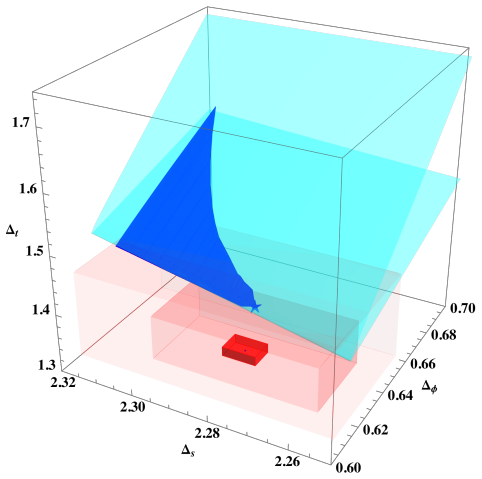
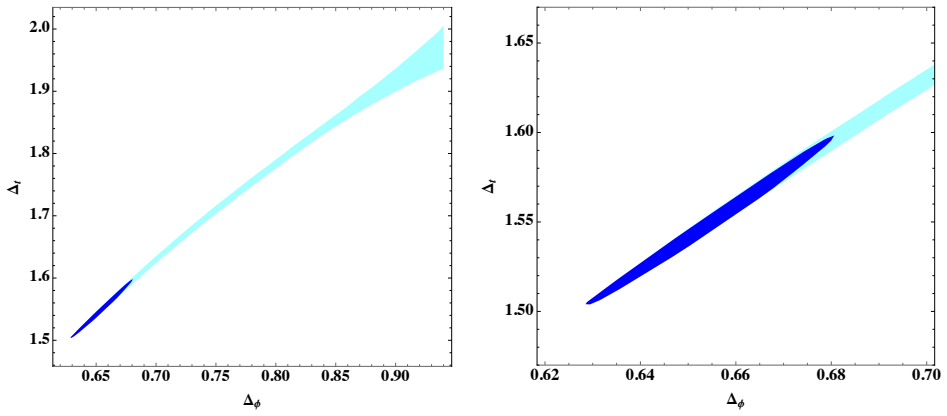
Bootstrap analysis forms a cone whose apex matches DQCP numerical data and supports a unitary fixed point with a relevant SO(5) singlet scalar.
A machine-rendered reading of the paper's core claim, the machinery that carries it, and where it could break.
Core claim
The bootstrap cone unifies the QMC and the fuzzy sphere data into a unitary conformal field theory with a relevant SO(5) singlet scalar, thus strongly supporting the multicriticality scenario of DQCP.
What carries the argument
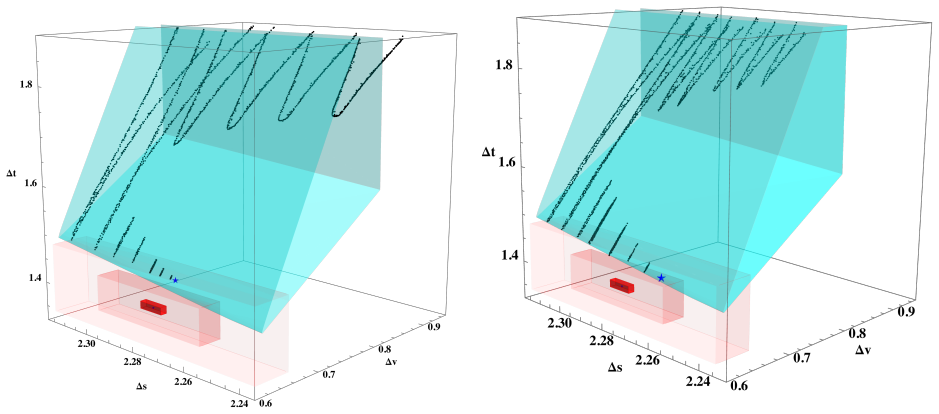
The bootstrap cone in three-dimensional parameter space, obtained after imposing a suitable sparseness condition, whose apex is located by the navigator algorithm and whose extremal solutions reproduce DQCP data.
If this is right
- The DQCP is a genuine unitary fixed point rather than a walking regime near complex fixed points.
- A relevant SO(5) singlet scalar operator controls the flow away from the fixed point.
- OPE coefficients and higher operator dimensions extracted from bootstrap match those measured on the fuzzy sphere.
- The phase diagram of two-dimensional quantum magnets contains this multicritical point.
Where Pith is reading between the lines
- If the unification holds, other numerical signatures of multicriticality, such as specific finite-size scaling forms, should appear in larger QMC simulations.
- The same sparseness-assisted cone technique may be tested on related models with emergent SO(5) symmetry.
- A mismatch at higher operator levels would indicate that the apparent agreement is accidental rather than evidence of a single CFT.
Load-bearing premise
Large-scale QMC results nearly saturate the bootstrap bounds and the chosen sparseness condition is valid.
What would settle it
A clear mismatch between the bootstrap-extracted OPE coefficients or higher spectrum and the corresponding fuzzy-sphere measurements would show that the data do not lie at a single unitary fixed point.
Figures
read the original abstract
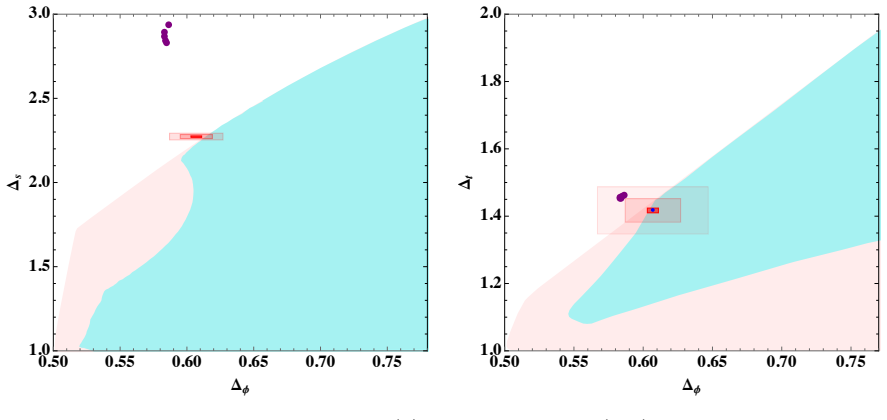
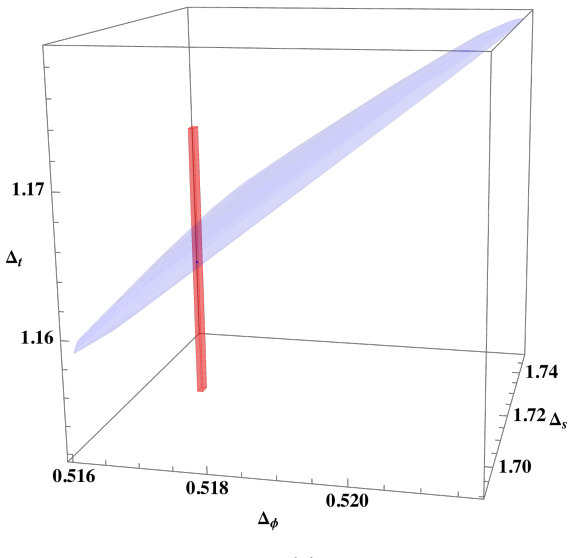
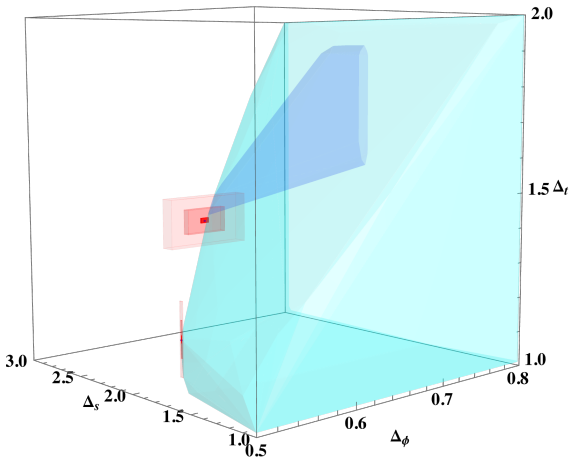
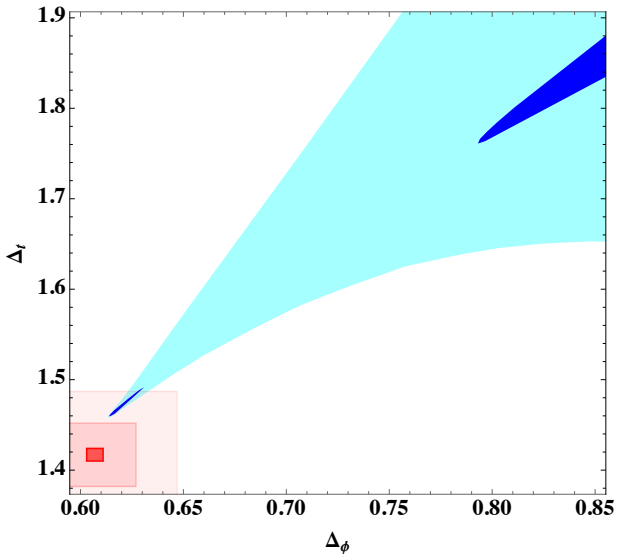
The deconfined quantum critical point (DQCP) provides a prominent example of the unconventional phase transitions beyond the Landau-Ginzburg-Wilson paradigm and its nature has been controversial for decades. The DQCP has been extensively studied and the results lead to two opposite scenarios with pseudo-criticality or multicriticality. The pseudo-criticality is a prevailing scenario of DQCP which interprets the approximately scale invariant numerical results with the walking behavior near complex fixed points. In contrast, the multicriticality scenario conjectures the DQCP is a unitary fixed point with a relevant $SO(5)$ singlet scalar. In this work we provide substantial evidence for the multicriticality scenario using conformal bootstrap. We start with the observation that the large scale Quantum Monte Carlo (QMC) results nearly saturate the bootstrap bounds. After imposing suitable sparseness condition the bootstrap bound forms a sharp cone in the three-dimensional parameter space. The bootstrap cone is close to the QMC data. We use the navigator algorithm to locate the apex of the cone and extract the extremal solutions. We find striking consistencies between the bootstrap solutions and the fuzzy sphere data of DQCP, including the coefficients in the operator product expansions (OPEs) and the higher spectrum! The bootstrap cone unifies the QMC and the fuzzy sphere data into a unitary conformal field theory with a relevant $SO(5)$ singlet scalar, thus strongly supporting the multicriticality scenario of DQCP. The agreement between the conformal bootstrap, QMC and fuzzy sphere results is a surprise towards solving DQCP and decoding the profound phase diagram of the two-dimensional quantum magnets.
Editorial analysis
A structured set of objections, weighed in public.
Referee Report
Summary. The paper claims that large-scale QMC data nearly saturate bootstrap bounds for the DQCP; imposing a suitable sparseness condition sharpens these into a cone in three-dimensional parameter space whose apex is located via the navigator algorithm. The resulting extremal solutions exhibit striking consistencies with fuzzy-sphere data in OPE coefficients and higher spectrum, supporting the multicriticality scenario of a unitary CFT with a relevant SO(5) singlet scalar and unifying QMC and fuzzy-sphere results.
Significance. If the sparseness condition is independently justified, the work would be significant for providing concrete evidence favoring multicriticality over pseudo-criticality in the DQCP by demonstrating quantitative agreement across bootstrap, QMC, and fuzzy-sphere methods in both low-lying OPE data and higher spectrum. The use of the navigator to extract extremal solutions and the reported consistencies constitute a strength in reproducibility of the numerical bootstrap output.
major comments (2)
- [Abstract] Abstract, paragraph beginning 'We start with the observation...': the sparseness condition is introduced after noting near-saturation by QMC data and is described only as 'suitable'; because this condition is what converts the bounds into the sharp cone whose apex is claimed to match the DQCP point and to yield the relevant SO(5) singlet, an a-priori derivation or robustness test independent of the target data is required for the central claim.
- [Abstract] The navigator implementation and extraction of extremal solutions (mentioned in the abstract): without explicit documentation of the spectrum truncation, the precise sparseness parameters, and any post-selection criteria used to locate the apex, it is impossible to assess whether the reported consistencies in OPE coefficients and higher spectrum are robust or sensitive to these choices.
minor comments (1)
- Notation for the three-dimensional parameter space and the definition of the cone apex should be introduced with explicit equations rather than descriptive text.
Simulated Author's Rebuttal
We thank the referee for their careful reading and constructive comments on our manuscript. We address the major comments point by point below.
read point-by-point responses
-
Referee: [Abstract] Abstract, paragraph beginning 'We start with the observation...': the sparseness condition is introduced after noting near-saturation by QMC data and is described only as 'suitable'; because this condition is what converts the bounds into the sharp cone whose apex is claimed to match the DQCP point and to yield the relevant SO(5) singlet, an a-priori derivation or robustness test independent of the target data is required for the central claim.
Authors: We agree that the sparseness condition is central to sharpening the bounds into a cone and that its presentation as 'suitable' warrants more explicit justification. In the manuscript the choice is guided by general expectations for the spectrum of an SO(5)-symmetric CFT (a gap above the stress tensor in the singlet channel), but we acknowledge that an independent robustness test strengthens the claim. In the revised version we will add a dedicated subsection that derives the sparseness parameters from unitarity and crossing symmetry considerations alone, followed by a parameter scan that varies the sparseness threshold without reference to QMC or fuzzy-sphere data and shows that the cone apex location and the existence of a relevant SO(5) singlet remain stable. revision: yes
-
Referee: [Abstract] The navigator implementation and extraction of extremal solutions (mentioned in the abstract): without explicit documentation of the spectrum truncation, the precise sparseness parameters, and any post-selection criteria used to locate the apex, it is impossible to assess whether the reported consistencies in OPE coefficients and higher spectrum are robust or sensitive to these choices.
Authors: We agree that explicit documentation of the numerical procedures is necessary for reproducibility. While the main text contains the bootstrap setup, the abstract reference to the navigator and extremal solutions would benefit from expanded detail. In the revised manuscript we will add an appendix that specifies the spectrum truncation (number of derivatives and operators retained per channel), the exact sparseness parameters, and the post-selection criteria applied to navigator output. We will also include a brief sensitivity analysis showing how the reported OPE coefficients and higher spectrum change under modest variations of these parameters. revision: yes
Circularity Check
Sparseness condition selected after QMC observation to produce matching cone
specific steps
-
fitted input called prediction
[abstract]
"We start with the observation that the large scale Quantum Monte Carlo (QMC) results nearly saturate the bootstrap bounds. After imposing suitable sparseness condition the bootstrap bound forms a sharp cone in the three-dimensional parameter space. The bootstrap cone is close to the QMC data."
The sparseness condition is introduced immediately after noting QMC near-saturation and is described as 'suitable' to produce a sharp cone stated to lie close to that same QMC data; the resulting cone and its apex are therefore partly forced by the choice of condition rather than an independent derivation.
full rationale
Bootstrap bounds derive independently from crossing symmetry and unitarity. The load-bearing step is the post-observation imposition of a 'suitable sparseness condition' that converts loose bounds into a sharp cone whose apex is then shown to match QMC data and unify with fuzzy-sphere results. This condition is not derived a priori but chosen to sharpen the bound around the observed saturation point, introducing mild dependence on the target numerical input. The fuzzy-sphere OPE and spectrum comparisons remain independent, so the circularity is partial rather than total. No self-citations, ansatze, or renamings are load-bearing in the provided text.
Axiom & Free-Parameter Ledger
free parameters (1)
- sparseness condition parameters
axioms (2)
- standard math Crossing symmetry and unitarity of the CFT operator spectrum
- domain assumption The DQCP is described by an SO(5)-symmetric CFT
Reference graph
Works this paper leans on
-
[1]
Deconfined quantum critical points,
T. Senthil, A. Vishwanath, L. Balents, S. Sachdev, and M. P. A. Fisher, “Deconfined quantum critical points,”Science303no. 5663, (2004) 1490–1494
2004
-
[2]
Quantum criticality beyond the landau–ginzburg–wilson paradigm,
T. Senthil, L. Balents, S. Sachdev, A. Vishwanath, and M. P. A. Fisher, “Quantum criticality beyond the landau–ginzburg–wilson paradigm,”Physical Review B70 (2004) 144407,arXiv:cond-mat/0312617
Pith/arXiv arXiv 2004
-
[3]
Deconfined quantum critical points: a review,
T. Senthil, “Deconfined quantum critical points: a review,” 2023. https://arxiv.org/abs/2306.12638
arXiv 2023
-
[4]
Emergent SO(5) symmetry at the N´ eel to valence-bond-solid transition,
A. Nahum, P. Serna, J. T. Chalker, M. Ortu˜ no, and A. M. Somoza, “Emergent SO(5) symmetry at the N´ eel to valence-bond-solid transition,”Physical Review Letters115(2015) 267203
2015
-
[5]
A. Tanaka and X. Hu, “Many-body spin berry phases emerging from theπ-flux state: Competition between antiferromagnetism and the valence-bond-solid state,” Physical Review Letters95(2005) 036402,arXiv:cond-mat/0501365
Pith/arXiv arXiv 2005
-
[6]
Competing orders, nonlinear sigma models, and topological terms in quantum magnets,
T. Senthil and M. P. A. Fisher, “Competing orders, nonlinear sigma models, and topological terms in quantum magnets,”Physical Review B74(2006) 064405, arXiv:cond-mat/0510459
Pith/arXiv arXiv 2006
-
[7]
A duality web in 2 + 1 dimensions and condensed matter physics,
N. Seiberg, T. Senthil, C. Wang, and E. Witten, “A duality web in 2 + 1 dimensions and condensed matter physics,”Annals of Physics374(2016) 395–433, arXiv:1606.01989 [hep-th]
Pith/arXiv arXiv 2016
-
[8]
Deconfined quantum critical points: Symmetries and dualities,
C. Wang, A. Nahum, M. A. Metlitski, C. Xu, and T. Senthil, “Deconfined quantum critical points: Symmetries and dualities,”Physical Review X7(2017) 031051, arXiv:1703.02426 [cond-mat.str-el]
Pith/arXiv arXiv 2017
-
[9]
Duality between (2 + 1)dQuantum Critical Points,
T. Senthil, D. T. Son, C. Wang, and C. Xu, “Duality between (2 + 1)dQuantum Critical Points,”Phys. Rept.827(2019) 1–48,arXiv:1810.05174 [cond-mat.str-el]
arXiv 2019
-
[10]
4-spin plaquette singlet state in the shastry–sutherland compound SrCu 2(BO3)2,
M. E. Zayed, C. R¨ uegg, J. Larrea J., A. M. L¨ auchli, C. Panagopoulos, S. S. Saxena, M. Ellerby, D. F. McMorrow, T. Str¨ assle, S. Klotz, G. Hamel, R. A. Sadykov, V. Pomjakushin, M. Boehm, M. Jim´ enez-Ruiz, A. Schneidewind, E. Pomjakushina, 19 M. Stingaciu, K. Conder, and H. M. Rønnow, “4-spin plaquette singlet state in the shastry–sutherland compound ...
2017
-
[11]
Signatures of a deconfined phase transition on the shastry–sutherland lattice: Applications to quantum critical SrCu2(BO3)2,
J. Y. Lee, Y.-Z. You, S. Sachdev, and A. Vishwanath, “Signatures of a deconfined phase transition on the shastry–sutherland lattice: Applications to quantum critical SrCu2(BO3)2,”Physical Review X9no. 4, (2019) 041037
2019
-
[12]
Quantum phases of SrCu 2(BO3)2 from high-pressure thermodynamics,
J. Guo, G. Sun, B. Zhao, L. Wang, W. Hong, V. A. Sidorov, N. Ma, Q. Wu, S. Li, Z. Y. Meng, A. W. Sandvik, and L. Sun, “Quantum phases of SrCu 2(BO3)2 from high-pressure thermodynamics,”Physical Review Letters124no. 20, (2020) 206602
2020
-
[13]
Discovery of quantum phases in the shastry–sutherland compound SrCu 2(BO3)2 under extreme conditions of field and pressure,
Z. Shi, S. Dissanayake, P. Corboz, W. Steinhardt, D. Graf, D. M. Silevitch, H. A. Dabkowska, T. F. Rosenbaum, F. Mila, and S. Haravifard, “Discovery of quantum phases in the shastry–sutherland compound SrCu 2(BO3)2 under extreme conditions of field and pressure,”Nature Communications13no. 1, (2022) 2301
2022
-
[14]
Proximate deconfined quantum critical point in srcu 2(bo3)2,
Y. Cui, L. Liu, H. Lin, K.-H. Wu, W. Hong, X. Liu, C. Li, Z. Hu, N. Xi, S. Li, R. Yu, A. W. Sandvik, and W. Yu, “Proximate deconfined quantum critical point in srcu 2(bo3)2,”Science380no. 6650, (2023) 1179–1184,arXiv:2204.08133 [cond-mat.str-el]
arXiv 2023
-
[15]
Deconfined quantum critical point lost in pressurized srcu 2(bo3)2,
J. Guo, P. Wang, C. Huang, B.-B. Chen, W. Hong, S. Cai, J. Zhao, J. Han, X. Chen, Y. Zhou, S. Li, Q. Wu, Z. Y. Meng, and L. Sun, “Deconfined quantum critical point lost in pressurized srcu 2(bo3)2,”Communications Physics8(2025) 72, arXiv:2310.20128 [cond-mat.str-el]
arXiv 2025
-
[16]
Two plaquette-singlet phases and emergent SO(5) deconfined quantum criticality in SrCu 2(BO3)2,
H. Lin, L. Liu, Y. Cui, K.-H. Wu, W. Hong, X. Liu, C. Li, Z. Hu, N. Xi, S. Li, R. Yu, A. W. Sandvik, and W. Yu, “Two plaquette-singlet phases and emergent SO(5) deconfined quantum criticality in SrCu 2(BO3)2,” 2024
2024
-
[17]
Two plaquette-singlet phases and emergent so(5) deconfined quantum criticality in srcu2(bo3)2,
Y. Cui, K. Du, Z. Wu, S. Li, P. Yang, Y. Chen, X. Xu, H. Chen, C. Li, J. Liu, B. Wang, W. Hong, S. Li, Z. Xie, J. Cheng, B. Normand, R. Yu, and W. Yu, “Two plaquette-singlet phases and emergent so(5) deconfined quantum criticality in srcu2(bo3)2,” 2025.https://arxiv.org/abs/2411.00302
arXiv 2025
-
[18]
Emergent photons and transitions in the O(3) sigma model with hedgehog suppression,
O. I. Motrunich and A. Vishwanath, “Emergent photons and transitions in the O(3) sigma model with hedgehog suppression,”Physical Review B70(2004) 075104. 20
2004
-
[19]
Evidence for deconfined quantum criticality in a two-dimensional Heisenberg model with four-spin interactions,
A. W. Sandvik, “Evidence for deconfined quantum criticality in a two-dimensional Heisenberg model with four-spin interactions,”Physical Review Letters98(2007) 227202
2007
-
[20]
Scaling in the fan of an unconventional quantum critical point,
R. G. Melko and R. K. Kaul, “Scaling in the fan of an unconventional quantum critical point,”Physical Review Letters100(2008) 017203
2008
-
[21]
From an antiferromagnet to a valence bond solid: Evidence for a first-order phase transition,
F.-J. Jiang, M. Nyfeler, S. Chandrasekharan, and U.-J. Wiese, “From an antiferromagnet to a valence bond solid: Evidence for a first-order phase transition,” Journal of Statistical Mechanics: Theory and Experiment2008(2008) P02009
2008
-
[22]
Deconfined criticality: Generic first-order transition in the SU(2) symmetry case,
A. B. Kuklov, M. Matsumoto, N. V. Prokof’ev, B. V. Svistunov, and M. Troyer, “Deconfined criticality: Generic first-order transition in the SU(2) symmetry case,” Physical Review Letters101(2008) 050405
2008
-
[23]
Continuous quantum phase transition between an antiferromagnet and a valence-bond solid in two dimensions: Evidence for logarithmic corrections to scaling,
A. W. Sandvik, “Continuous quantum phase transition between an antiferromagnet and a valence-bond solid in two dimensions: Evidence for logarithmic corrections to scaling,”Physical Review Letters104(2010) 177201
2010
-
[24]
Antiferromagnetic to valence-bond-solid transitions in two-dimensional SU(N) heisenberg models with multispin interactions,
J. Lou, A. W. Sandvik, and N. Kawashima, “Antiferromagnetic to valence-bond-solid transitions in two-dimensional SU(N) heisenberg models with multispin interactions,”Physical Review B80(2009) 180414
2009
-
[25]
Impurity spin texture at a deconfined quantum critical point,
A. Banerjee, K. Damle, and F. Alet, “Impurity spin texture at a deconfined quantum critical point,”Physical Review B82(2010) 155139
2010
-
[26]
Lattice model for the SU(N) N´ eel to valence-bond solid quantum phase transition at large N,
R. K. Kaul and A. W. Sandvik, “Lattice model for the SU(N) N´ eel to valence-bond solid quantum phase transition at large N,”Physical Review Letters108(2012) 137201
2012
-
[27]
Quantum phase transitions in bilayer SU(N) antiferromagnets,
R. K. Kaul, “Quantum phase transitions in bilayer SU(N) antiferromagnets,” Physical Review B85(2012) 180411
2012
-
[28]
Corrections to scaling in the critical theory of deconfined criticality,
L. Bartosch, “Corrections to scaling in the critical theory of deconfined criticality,” Physical Review B88(2013) 195140
2013
-
[29]
Deconfined criticality flow in the Heisenberg model with ring-exchange interactions,
K. Chen, Y. Huang, Y. Deng, A. B. Kuklov, N. V. Prokof’ev, and B. V. Svistunov, “Deconfined criticality flow in the Heisenberg model with ring-exchange interactions,”Physical Review Letters110(2013) 185701. 21
2013
-
[30]
N´ eel-state to valence-bond-solid transition on the honeycomb lattice: Evidence for deconfined criticality,
S. Pujari, K. Damle, and F. Alet, “N´ eel-state to valence-bond-solid transition on the honeycomb lattice: Evidence for deconfined criticality,”Physical Review Letters 111(2013) 087203
2013
-
[31]
Deconfined quantum criticality, scaling violations, and classical loop models,
A. Nahum, J. T. Chalker, P. Serna, M. Ortu˜ no, and A. M. Somoza, “Deconfined quantum criticality, scaling violations, and classical loop models,”Physical Review X 5(2015) 041048
2015
-
[32]
Scaling dimensions of higher-charge monopoles at deconfined critical points,
G. J. Sreejith and S. Powell, “Scaling dimensions of higher-charge monopoles at deconfined critical points,”Physical Review B92(2015) 184413
2015
-
[33]
Critical behavior in the cubic dimer model at nonzero monomer density,
G. J. Sreejith and S. Powell, “Critical behavior in the cubic dimer model at nonzero monomer density,”Physical Review B89(2014) 014404
2014
-
[34]
Quantum criticality with two length scales,
H. Shao, W. Guo, and A. W. Sandvik, “Quantum criticality with two length scales,”Science352(2016) 213–216
2016
-
[35]
Dirac fermions with competing orders: Non-Landau transition with emergent symmetry,
T. Sato, M. Hohenadler, and F. F. Assaad, “Dirac fermions with competing orders: Non-Landau transition with emergent symmetry,”Physical Review Letters119 (2017) 197203
2017
-
[36]
Superconductivity from the condensation of topological defects in a quantum spin-Hall insulator,
Y. Liu, Z. Wang, T. Sato, M. Hohenadler, C. Wang, W. Guo, and F. F. Assaad, “Superconductivity from the condensation of topological defects in a quantum spin-Hall insulator,”Nature Communications10(2019) 2658
2019
-
[37]
Multicritical deconfined quantum criticality and lifshitz point of a helical valence-bond phase,
B. Zhao, J. Takahashi, and A. W. Sandvik, “Multicritical deconfined quantum criticality and lifshitz point of a helical valence-bond phase,”Physical Review Letters125(2020) 257204,arXiv:2005.10184 [cond-mat.str-el]
arXiv 2020
-
[38]
Phases of the (2+1) dimensional SO(5) nonlinear sigma model with topological term,
Z. Wang, M. P. Zaletel, R. S. K. Mong, and F. F. Assaad, “Phases of the (2+1) dimensional SO(5) nonlinear sigma model with topological term,”Physical Review Letters126(2021) 045701
2021
-
[39]
Emergence of gapless quantum spin liquid from deconfined quantum critical point,
W.-Y. Liu, J. Hasik, S.-S. Gong, D. Poilblanc, W.-Q. Chen, and Z.-C. Gu, “Emergence of gapless quantum spin liquid from deconfined quantum critical point,”Physical Review X12(2022) 031039
2022
-
[40]
Gapless quantum spin liquid and global phase diagram of the spin-1/2J 1–J2 square antiferromagnetic Heisenberg model,
W.-Y. Liu, S.-S. Gong, Y.-B. Li, D. Poilblanc, W.-Q. Chen, and Z.-C. Gu, “Gapless quantum spin liquid and global phase diagram of the spin-1/2J 1–J2 square antiferromagnetic Heisenberg model,”Science Bulletin67(2022) 1034–1041. 22
2022
-
[41]
Scaling of entanglement entropy at deconfined quantum criticality,
J. Zhao, Y.-C. Wang, Z. Yan, M. Cheng, and Z. Y. Meng, “Scaling of entanglement entropy at deconfined quantum criticality,”Physical Review Letters128no. 1, (2022) 010601,arXiv:2107.06305 [cond-mat.str-el]
arXiv 2022
-
[42]
Z. Zhou, L. Hu, W. Zhu, and Y.-C. He, “The SO(5) deconfined phase transition under the fuzzy-sphere microscope: Approximate conformal symmetry, pseudocriticality, and operator spectrum,”Physical Review X14(2024) 021044, arXiv:2306.16435 [cond-mat.str-el]
arXiv 2024
-
[44]
B.-B. Chen, X. Zhang, Y.-C. Wang, K. Sun, and Z. Y. Meng, “Phases of (2 + 1)d SO(5) nonlinear sigma model with a topological term on a sphere: Multicritical point and disorder phase,”Physical Review Letters132(2024) 246503, arXiv:2307.05307 [cond-mat.str-el]
arXiv 2024
-
[45]
Diagnosing quantum phase transition order and deconfined criticality via entanglement entropy,
Z. Deng, L. Liu, W. Guo, and H. Q. Lin, “Diagnosing quantum phase transition order and deconfined criticality via entanglement entropy,”Physical Review Letters 133(2024) 100402,arXiv:2401.12838 [cond-mat.str-el]
arXiv 2024
-
[46]
J. D’Emidio and A. W. Sandvik, “Entanglement entropy and deconfined criticality: Emergent SO(5) symmetry and proper lattice bipartition,”Physical Review Letters 133(2024) 166702,arXiv:2401.14396 [cond-mat.str-el]
arXiv 2024
-
[47]
B.-B. Chen, X. Zhang, and Z. Y. Meng, “Emergent conformal symmetry at the multicritical point of (2 + 1)d SO(5) model with wess-zumino-witten term on sphere,”Physical Review B110(2024) 125153,arXiv:2405.04470 [cond-mat.str-el]
arXiv 2024
-
[48]
so(5) multicriticality in two-dimensional quantum magnets,
J. Takahashi, H. Shao, B. Zhao, W. Guo, and A. W. Sandvik, “so(5) multicriticality in two-dimensional quantum magnets,” 2024
2024
-
[49]
Y. Zhu, Z. Liu, Z. Wang, Y.-C. Wang, and Z. Yan, “Bipartite entanglement and surface criticality: The extra contribution of the nonordinary edge in entanglement,” Physical Review Letters136(2026) 046501,arXiv:2508.07277 [cond-mat.str-el]. 23
arXiv 2026
-
[50]
Y. D. Liao, B.-B. Chen, F. F. Assaad, L. Janssen, and Z. Y. Meng, “Numerical evidence of a critical point in the (2+1)d so(5) nonlinear sigma model with wess-zumino-witten term,” 2026.https://arxiv.org/abs/2605.03700
Pith/arXiv arXiv 2026
-
[51]
Conformal Bootstrap Dashing Hopes of Emergent Symmetry,
Y. Nakayama and T. Ohtsuki, “Conformal Bootstrap Dashing Hopes of Emergent Symmetry,”Phys. Rev. Lett.117no. 13, (2016) 131601,arXiv:1602.07295 [cond-mat.str-el]
Pith/arXiv arXiv 2016
-
[52]
The conformal bootstrap: Theory, numerical techniques, and applications,
D. Poland, S. Rychkov, and A. Vichi, “The conformal bootstrap: Theory, numerical techniques, and applications,”Reviews of Modern Physics91(2019) 015002, arXiv:1805.04405 [hep-th]
Pith/arXiv arXiv 2019
-
[53]
Bootstrapping conformal QED 3 and deconfined quantum critical point,
Z. Li, “Bootstrapping conformal QED 3 and deconfined quantum critical point,” JHEP11(2022) 005,arXiv:1812.09281 [hep-th]
arXiv 2022
-
[54]
Walking, weak first-order transitions, and complex cfts,
V. Gorbenko, S. Rychkov, and B. Zan, “Walking, weak first-order transitions, and complex cfts,”Journal of High Energy Physics2018no. 10, (2018) 108, arXiv:1807.11512 [hep-th]
Pith/arXiv arXiv 2018
-
[55]
Walking, weak first-order transitions, and complex cfts ii: Two-dimensional potts model atq >4,
V. Gorbenko, S. Rychkov, and B. Zan, “Walking, weak first-order transitions, and complex cfts ii: Two-dimensional potts model atq >4,”SciPost Physics5(2018) 050,arXiv:1808.04380 [hep-th]
Pith/arXiv arXiv 2018
-
[56]
Theory of deconfined pseudocriticality,
R. Ma and C. Wang, “Theory of deconfined pseudocriticality,”Physical Review B 102(2020) 020407,arXiv:1912.12315 [cond-mat.str-el]
arXiv 2020
-
[57]
W. Zhu, C. Han, E. Huffman, J. S. Hofmann, and Y.-C. He, “Uncovering Conformal Symmetry in the 3D Ising Transition: State-Operator Correspondence from a Quantum Fuzzy Sphere Regularization,”Phys. Rev. X13no. 2, (2023) 021009,arXiv:2210.13482 [cond-mat.stat-mech]
arXiv 2023
-
[58]
Operator Product Expansion Coefficients of the 3D Ising Criticality via Quantum Fuzzy Spheres,
L. Hu, Y.-C. He, and W. Zhu, “Operator Product Expansion Coefficients of the 3D Ising Criticality via Quantum Fuzzy Spheres,”Phys. Rev. Lett.131no. 3, (2023) 031601,arXiv:2303.08844 [cond-mat.stat-mech]
arXiv 2023
-
[59]
Bootstrapping Deconfined Quantum Tricriticality,
S. M. Chester and N. Su, “Bootstrapping Deconfined Quantum Tricriticality,”Phys. Rev. Lett.132no. 11, (2024) 111601,arXiv:2310.08343 [hep-th]
arXiv 2024
-
[60]
Bounding scalar operator dimensions in 4d cft,
R. Rattazzi, V. S. Rychkov, E. Tonni, and A. Vichi, “Bounding scalar operator dimensions in 4d cft,”JHEP12(2008) 031,arXiv:0807.0004 [hep-th]. 24
Pith/arXiv arXiv 2008
-
[61]
The conformal bootstrap,
D. Poland and D. Simmons-Duffin, “The conformal bootstrap,”Nature Phys.12 no. 6, (2016) 535–539
2016
-
[62]
New developments in the numerical conformal bootstrap,
S. Rychkov and N. Su, “New developments in the numerical conformal bootstrap,” Rev. Mod. Phys.96no. 4, (2024) 045004,arXiv:2311.15844 [hep-th]
arXiv 2024
-
[63]
A Semidefinite Program Solver for the Conformal Bootstrap,
D. Simmons-Duffin, “A Semidefinite Program Solver for the Conformal Bootstrap,” JHEP06(2015) 174,arXiv:1502.02033 [hep-th]
Pith/arXiv arXiv 2015
-
[64]
Scaling the semidefinite program solver SDPB,
W. Landry and D. Simmons-Duffin, “Scaling the semidefinite program solver SDPB,”arXiv:1909.09745 [hep-th]
arXiv 1909
-
[65]
Y.-C. He, J. Rong, and N. Su, “Non-Wilson-Fisher kinks ofO(N) numerical bootstrap: from the deconfined phase transition to a putative new family of CFTs,” SciPost Phys.10no. 5, (2021) 115,arXiv:2005.04250 [hep-th]
arXiv 2021
-
[66]
Bootstrapping the simplest deconfined quantum critical point,
S. M. Chester, A. Piazza, M. Reehorst, and N. Su, “Bootstrapping the simplest deconfined quantum critical point,”Phys. Rev. D113no. 8, (2026) L081701, arXiv:2507.06283 [hep-th]
arXiv 2026
-
[67]
Monopoles in cp N−1 model via the state-operator correspondence,
M. A. Metlitski, M. Hermele, T. Senthil, and M. P. A. Fisher, “Monopoles in cp N−1 model via the state-operator correspondence,”Phys. Rev. B78(Dec, 2008) 214418. https://link.aps.org/doi/10.1103/PhysRevB.78.214418
-
[68]
Scaling dimensions of monopole operators in theCP Nb−1 theory in 2 + 1 dimensions,
E. Dyer, M. Mezei, S. S. Pufu, and S. Sachdev, “Scaling dimensions of monopole operators in theCP Nb−1 theory in 2 + 1 dimensions,”JHEP06(2015) 037, arXiv:1504.00368 [hep-th]. [Erratum: JHEP 03, 111 (2016)]
Pith/arXiv arXiv 2015
-
[69]
Bootstrapping theO(N) vector models,
F. Kos, D. Poland, and D. Simmons-Duffin, “Bootstrapping theO(N) vector models,”JHEP06(2014) 091,arXiv:1307.6856 [hep-th]
Pith/arXiv arXiv 2014
-
[70]
Carving out OPE space and precise O(2) model critical exponents,
S. M. Chester, W. Landry, J. Liu, D. Poland, D. Simmons-Duffin, N. Su, and A. Vichi, “Carving out OPE space and precise O(2) model critical exponents,” JHEP06(2020) 142,arXiv:1912.03324 [hep-th]
arXiv 2020
-
[71]
Bootstrapping Heisenberg Magnets and their Cubic Instability,
S. M. Chester, W. Landry, J. Liu, D. Poland, D. Simmons-Duffin, N. Su, and A. Vichi, “Bootstrapping Heisenberg Magnets and their Cubic Instability,”Phys. Rev. D104no. 10, (2021) 105013,arXiv:2011.14647 [hep-th]. 25
arXiv 2021
-
[72]
Bootstrapping the 3d Ising Stress Tensor,
C.-H. Chang, V. Dommes, R. S. Erramilli, A. Homrich, P. Kravchuk, A. Liu, M. S. Mitchell, D. Poland, and D. Simmons-Duffin, “Bootstrapping the 3d Ising Stress Tensor,”JHEP03(2025) 136,arXiv:2411.15300 [hep-th]
arXiv 2025
-
[73]
A unified theory based on SO(5) symmetry of superconductivity and antiferromagnetism,
S.-C. Zhang, “A unified theory based on SO(5) symmetry of superconductivity and antiferromagnetism,”Science275no. 5303, (1997) 1089–1096
1997
-
[74]
SO(5) theory of antiferromagnetism and superconductivity,
E. Demler, W. Hanke, and S.-C. Zhang, “SO(5) theory of antiferromagnetism and superconductivity,”Reviews of Modern Physics76(2004) 909–974, arXiv:cond-mat/0405038 [cond-mat.str-el]
Pith/arXiv arXiv 2004
-
[75]
Multicritical phenomena in O(n1)⊕O(n 2)-symmetric theories,
P. Calabrese, A. Pelissetto, and E. Vicari, “Multicritical phenomena in O(n1)⊕O(n 2)-symmetric theories,”Physical Review B67(2003) 054505, arXiv:cond-mat/0209580
Pith/arXiv arXiv 2003
-
[76]
Instability of theO(5) multicritical behavior in the SO(5) theory of high-T c superconductors,
M. Hasenbusch, A. Pelissetto, and E. Vicari, “Instability of theO(5) multicritical behavior in the SO(5) theory of high-T c superconductors,”Physical Review B72 (2005) 014532,arXiv:cond-mat/0502327
Pith/arXiv arXiv 2005
-
[77]
Three-dimensionalO(N)-invariantϕ 4 models at criticality for N≥4,
M. Hasenbusch, “Three-dimensionalO(N)-invariantϕ 4 models at criticality for N≥4,”Physical Review B105(2022) 054428,arXiv:2112.03783 [hep-lat]
arXiv 2022
-
[78]
Bootstrapping the O(N) Archipelago,
F. Kos, D. Poland, D. Simmons-Duffin, and A. Vichi, “Bootstrapping the O(N) Archipelago,”JHEP11(2015) 106,arXiv:1504.07997 [hep-th]
Pith/arXiv arXiv 2015
-
[79]
Navigator function for the conformal bootstrap,
M. Reehorst, S. Rychkov, D. Simmons-Duffin, B. Sirois, N. Su, and B. van Rees, “Navigator function for the conformal bootstrap,”SciPost Physics11no. 3, (2021) 072,arXiv:2104.09518 [hep-th]
arXiv 2021
-
[80]
Critical structure factors of bilinear fields in O(n) vector models,
P. Calabrese, A. Pelissetto, and E. Vicari, “Critical structure factors of bilinear fields in O(n) vector models,”Phys. Rev. E65(Apr, 2002) 046115. https://link.aps.org/doi/10.1103/PhysRevE.65.046115
-
[81]
O(5) multicriticality in the 3D two flavor SU(2) lattice gauge Higgs model,
C. Bonati and I. Soler Calero, “O(5) multicriticality in the 3D two flavor SU(2) lattice gauge Higgs model,”Physical Review E112(2025) 024112, arXiv:2505.03446 [hep-lat]
arXiv 2025
discussion (0)
Sign in with ORCID, Apple, or X to comment. Anyone can read and Pith papers without signing in.