Ramond from Random: Weil-Petersson Volumes for Super-Riemann surfaces with NS Boundaries and R Punctures
Pith reviewed 2026-06-27 15:13 UTC · model grok-4.3
The pith
A random matrix model computes Weil-Petersson volumes for super-Riemann surfaces that include Ramond punctures.
A machine-rendered reading of the paper's core claim, the machinery that carries it, and where it could break.
Core claim
The appropriate random matrix model encodes the geometry of the moduli space of N=1 super-Riemann surfaces with both NS boundaries and R punctures on equal footing, producing closed-form WP volumes V^{(2m)}_{g,n}({b_i}) and the missing spectral curve that topological recursion employs to derive those volumes.
What carries the argument
The random matrix model construction that incorporates Ramond punctures symmetrically with NS boundaries, together with the associated spectral curve that feeds topological recursion.
If this is right
- Closed-form formulae become available for many V^{(2m)}_{g,n}({b_i}).
- Several striking relations between volumes and subsectors emerge directly from the model.
- The spectral curve allows re-derivation of the volumes by topological recursion.
- The NS and R sectors are treated symmetrically within a single framework.
Where Pith is reading between the lines
- The same construction may extend to compute volumes for other puncture types or higher supersymmetry once the model is adjusted.
- The observed relations between volumes could generate new recursion identities in the moduli space that are independent of the matrix model.
- The volumes could enter explicit calculations of superstring amplitudes that require Ramond sector insertions.
Load-bearing premise
The random matrix model correctly encodes the geometry of the moduli space of N=1 super-Riemann surfaces once Ramond punctures are included.
What would settle it
An independent computation, via algebraic geometry or differential methods, of a low-genus volume with one or more Ramond punctures that disagrees with the formula obtained from the random matrix model.
Figures
read the original abstract
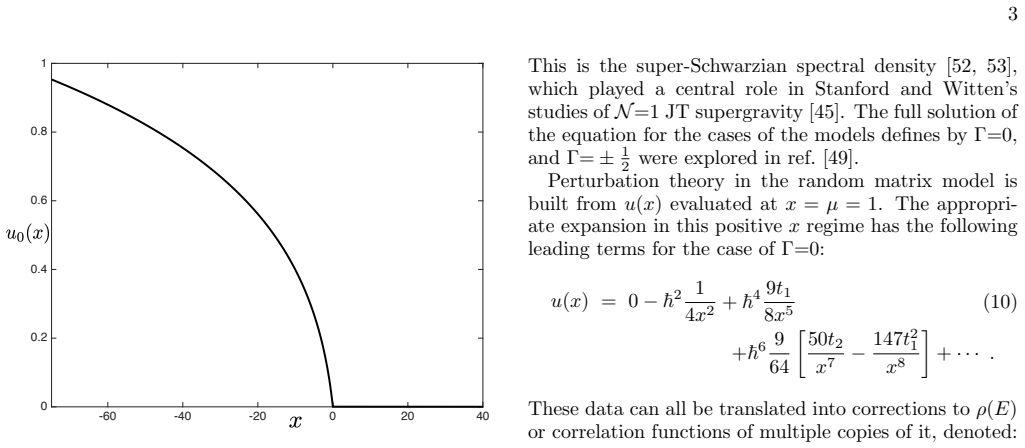
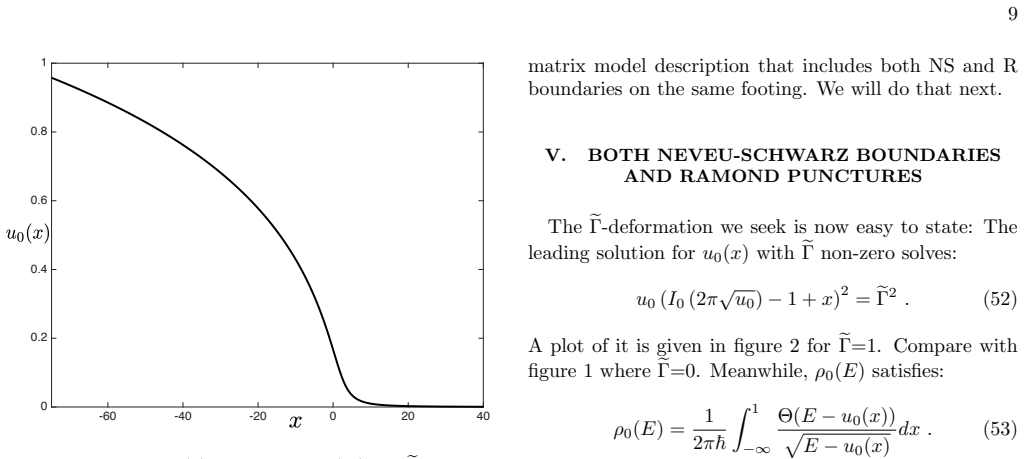
The Weil-Petersson (WP) volumes of the (compactified) moduli space of ${N}=1$ supersymmetric Riemann surfaces with Neveu-Schwarz (NS) boundaries are frequently discussed in the literature. Such surfaces can also have marked points called Ramond (R) punctures, where the superconformal structure degenerates. Computing the volumes when these R punctures are included is more challenging for the usual differential and algebraic geometry approaches, and they are therefore less well explored. In particular, the spectral curve describing the inclusion of R punctures is apparently unknown, so far. However, the right random matrix model approach can handle the NS and~R sectors on an equal footing. Such a construction is presented, showing how to use a recently developed technique to readily compute many closed-form formulae for $V^{(2m)}_{g,n}(\{b_i\})$, the WP volumes for genus $g$ with $n$ NS-boundaries of geodesic lengths $b_i$ ($i{=}1,\ldots,n$), and $2m$ R-punctures. Several striking relations between volumes (and subsectors thereof) emerge naturally in this approach. Moreover, the hitherto missing spectral curve is presented, and its use for (re-)deriving the $V^{(2m)}_{g,n}(\{b_i\})$ is demonstrated by using topological recursion.
Editorial analysis
A structured set of objections, weighed in public.
Referee Report
Summary. The paper constructs a random matrix model that treats NS boundaries and R punctures on equal footing for N=1 super-Riemann surfaces. It uses a recently developed technique to derive closed-form expressions for the Weil-Petersson volumes V^{(2m)}_{g,n}({b_i}), presents the previously missing spectral curve, and demonstrates re-derivation of the volumes via topological recursion, while identifying natural relations among volume sectors.
Significance. If the central construction is correct, the work supplies a practical method for volumes including R punctures (previously difficult via differential/algebraic geometry) and the missing spectral curve for topological recursion. This unifies NS and R sectors and could enable systematic computations in supergeometry and related string-theoretic contexts. The emergence of relations between subsectors is a useful byproduct.
major comments (1)
- [Model construction and volume derivations (around the definitions following the abstract claim)] The central claim that the random matrix model correctly encodes the moduli-space geometry of N=1 super-Riemann surfaces with R punctures (the weakest assumption identified in the review) is load-bearing. Explicit comparison of the m=0 reduction to known NS-only volumes, or to any existing literature values for small (g,n,m), is needed to confirm the encoding; without such checks the derivation steps remain internal to the model definition.
minor comments (2)
- [Abstract] Abstract: the volume notation V^{(2m)}_{g,n}({b_i}) and the meaning of the superscript (2m) are introduced without a brief parenthetical gloss, which would aid readers unfamiliar with the R-puncture counting.
- [Results section] The paper would benefit from a short table or paragraph collecting the first few explicit volume formulae (e.g., low g,n,m) so that the “many closed-form formulae” claim can be inspected immediately.
Simulated Author's Rebuttal
We thank the referee for their careful reading of the manuscript and for identifying this important point regarding validation of the central construction. We address the comment below.
read point-by-point responses
-
Referee: [Model construction and volume derivations (around the definitions following the abstract claim)] The central claim that the random matrix model correctly encodes the moduli-space geometry of N=1 super-Riemann surfaces with R punctures (the weakest assumption identified in the review) is load-bearing. Explicit comparison of the m=0 reduction to known NS-only volumes, or to any existing literature values for small (g,n,m), is needed to confirm the encoding; without such checks the derivation steps remain internal to the model definition.
Authors: We agree that explicit consistency checks are necessary to substantiate the claim that the random matrix model encodes the correct moduli-space geometry. Although the model is constructed to reduce to the known NS-only case when m=0, we acknowledge that the manuscript would be strengthened by direct comparisons. In the revised version we will add explicit verifications: the m=0 reduction will be compared term-by-term to established NS-boundary Weil-Petersson volumes from the literature, and we will compute and tabulate results for the smallest values of (g,n,m) where independent checks are feasible. These additions will appear in a dedicated subsection following the model definition. revision: yes
Circularity Check
No significant circularity identified
full rationale
The paper presents an explicit construction of a random matrix model that encodes both NS boundaries and R punctures, then applies a recently developed technique plus topological recursion to obtain closed-form volumes V^{(2m)}_{g,n}({b_i}) and the missing spectral curve. No quoted equation or step reduces a claimed prediction to a fitted parameter, self-defined quantity, or load-bearing self-citation chain; the central results follow directly from the model's definitions and recursion, remaining self-contained.
Axiom & Free-Parameter Ledger
Forward citations
Cited by 1 Pith paper
-
$N=1$ Supersymmetry, Weil-Petersson Volume Recursion, and a Spectral Curve
The Stanford-Witten-Norbury volume recursion is shown to be directly derivable from a spectral curve that computes the Laplace transforms of the volumes using topological recursion.
Reference graph
Works this paper leans on
-
[1]
The case ofW 0,4 In the sum in the recursion (64), letS={2,3,4}. For (g, n) = (0,4), the right hand side only containsω 0,3 andω 0,2 =B: ω0,4(z1, z2, z3, z4) = Res z=0 K(z1, z) X k∈S h ω0,3(z, zS\k)B(σ(z), z k) +B(z, z k)ω0,3(σ(z), zS\k) i .(A3) Herez S\k denotes the two variables inSdifferent fromk. From equation (77), ω0,3(z, zi, zj) = dz dzi dzj 2a z2z...
-
[2]
The case ofW 1,2 For (g, n) = (1,2), withS={2}, topological recursion procedure gives: ω1,2(z1, z2) = Res z=0 K(z1, z) h ω0,3(z, σ(z), z2) +B(z, z 2)ω1,1(σ(z)) +ω 1,1(z)B(σ(z), z 2) i .(A10) From equation. (77) we have: ω0,3(z, σ(z), z2) =− dz2 dz2 2a z4z2 2 .(A11) Also writing equation (82) as: ω1,1(z) = A11 z2 + B11 z4 dz, A 11 =− b 16a2 , B 11 = 1 16a ...
-
[3]
Witten, Nucl
E. Witten, Nucl. Phys. B340, 281 (1990)
1990
-
[4]
Witten, Surveys Diff
E. Witten, Surveys Diff. Geom.1, 243 (1991)
1991
-
[5]
Kontsevich, Commun
M. Kontsevich, Commun. Math. Phys.147, 1 (1992)
1992
-
[6]
T. R. Morris, FERMILAB-PUB-90-136-T
-
[7]
Dalley, C
S. Dalley, C. V. Johnson, and T. Morris, Nucl. Phys. B368, 625 (1992)
1992
- [8]
-
[9]
I. M. Gel’fand and L. A. Dikii, Russ. Math. Surveys30, 77 (1975)
1975
-
[10]
C. V. Johnson, (2026), arXiv:2604.11902 [hep-th]
Pith/arXiv arXiv 2026
-
[11]
Eynard, (2014), arXiv:1412.3286 [math-ph]
B. Eynard, (2014), arXiv:1412.3286 [math-ph]
Pith/arXiv arXiv 2014
-
[12]
Eynard,Counting Surfaces, Progress in Mathematical Physics, Vol
B. Eynard,Counting Surfaces, Progress in Mathematical Physics, Vol. 70 (Springer, 2016)
2016
-
[13]
S. A. Wolpert, Annals of Mathematics117, 207 (1983)
1983
-
[14]
Mirzakhani, Journal of the American Mathematical Society20, 1 (2007)
M. Mirzakhani, Journal of the American Mathematical Society20, 1 (2007)
2007
-
[15]
Mirzakhani, Invent
M. Mirzakhani, Invent. Math.167, 179 (2006)
2006
- [16]
-
[17]
S. A. Wolpert,Families of Riemann Surfaces and Weil– Petersson Geometry, CBMS Regional Conference Series in Mathematics, Vol. 113 (American Mathematical Soci- ety, Providence, RI, 2010)
2010
-
[18]
D. J. Gross and A. A. Migdal, Phys. Rev. Lett.64, 127 (1990)
1990
-
[19]
D. J. Gross and A. A. Migdal, Nucl. Phys.B340, 333 (1990)
1990
-
[20]
M. R. Douglas and S. H. Shenker, Nucl. Phys.B335, 635 (1990)
1990
-
[21]
Brezin and V
E. Brezin and V. A. Kazakov, Phys. Lett.B236, 144 (1990)
1990
-
[22]
Periwal and D
V. Periwal and D. Shevitz, Phys. Rev. Lett.64, 1326 (1990)
1990
-
[23]
Periwal and D
V. Periwal and D. Shevitz, Nucl. Phys.B344, 731 (1990)
1990
-
[24]
D. J. Gross and E. Witten, Phys. Rev. D21, 446 (1980)
1980
-
[25]
S. R. Wadia, Phys. Rev.D24, 970 (1981)
1981
-
[26]
D. J. Gross and M. J. Newman, Phys. Lett. B266, 291 (1991)
1991
-
[27]
Brezin and D
E. Brezin and D. J. Gross, Phys. Lett. B97, 120 (1980)
1980
-
[28]
A. Altland and M. R. Zirnbauer, Phys. Rev.B55, 1142 (1997), arXiv:cond-mat/9602137 [cond-mat]
Pith/arXiv arXiv 1997
-
[29]
R. C. Myers and V. Periwal, Nucl. Phys. B390, 716 (1993), arXiv:hep-th/9112037
Pith/arXiv arXiv 1993
-
[30]
R. Lafrance and R. C. Myers, Mod. Phys. Lett. A9, 101 (1994), arXiv:hep-th/9308113
Pith/arXiv arXiv 1994
-
[31]
J. E. Carlisle, C. V. Johnson, and J. S. Pennington, J. Phys.A40, 12451 (2007), arXiv:hep-th/0501006 [hep-th]
Pith/arXiv arXiv 2007
-
[32]
J. E. Carlisle, C. V. Johnson, and J. S. Pennington, J. Phys.A41, 085401 (2008), arXiv:hep-th/0511002 [hep- th]
Pith/arXiv arXiv 2008
-
[33]
C. V. Johnson, Nucl. Phys.B414, 239 (1994), hep- th/9301112
arXiv 1994
-
[34]
I. R. Klebanov, J. M. Maldacena, and N. Seiberg, Commun. Math. Phys.252, 275 (2004), arXiv:hep- th/0309168
arXiv 2004
-
[35]
C. V. Johnson, Phys. Rev. D110, 106019 (2024), arXiv:2306.10139 [hep-th]
arXiv 2024
-
[36]
C. V. Johnson and M. Usatyuk, JHEP09, 164 (2025), arXiv:2407.17583 [hep-th]
arXiv 2025
-
[37]
C. V. Johnson and M. Kolanowski, (2025), 18 arXiv:2507.07185 [hep-th]
arXiv 2025
-
[38]
C. V. Johnson, Phys. Rev. D101, 106023 (2020), arXiv:1912.03637 [hep-th]
arXiv 2020
-
[39]
C. V. Johnson, Phys. Rev. D103, 046012 (2021), arXiv:2005.01893 [hep-th]
arXiv 2021
- [40]
-
[41]
Super weil-petersson measures on the moduli space of curves,
P. Norbury, “Super weil-petersson measures on the moduli space of curves,” (2024), arXiv:2312.14558 [math.AG]
arXiv 2024
-
[42]
L. Chekhov, B. Eynard, and N. Orantin, JHEP12, 053 (2006), arXiv:math-ph/0603003
Pith/arXiv arXiv 2006
-
[43]
B. Eynard and N. Orantin, Commun. Num. Theor. Phys. 1, 347 (2007), arXiv:math-ph/0702045 [math-ph]
Pith/arXiv arXiv 2007
-
[44]
Dijkgraaf, H
R. Dijkgraaf, H. Verlinde, and E. Verlinde, Nucl. Phys. B348, 435 (1991)
1991
-
[45]
Dalley, C
S. Dalley, C. V. Johnson, and T. Morris, Nucl. Phys. B368, 655 (1992)
1992
- [46]
-
[47]
D. Stanford and E. Witten, Adv. Theor. Math. Phys.24, 1475 (2020), arXiv:1907.03363 [hep-th]
arXiv 2020
-
[48]
’t Hooft, Nucl
G. ’t Hooft, Nucl. Phys.B72, 461 (1974)
1974
-
[49]
Brezin, C
E. Brezin, C. Itzykson, G. Parisi, and J. B. Zuber, Com- mun. Math. Phys.59, 35 (1978)
1978
-
[50]
Bessis, C
D. Bessis, C. Itzykson, and J. B. Zuber, Adv. Appl. Math.1, 109 (1980)
1980
-
[51]
C. V. Johnson, Phys. Rev. D103, 046013 (2021), arXiv:2006.10959 [hep-th]
arXiv 2021
-
[52]
C. V. Johnson, F. Rosso, and A. Svesko, Phys. Rev. D 104, 086019 (2021), arXiv:2102.02227 [hep-th]
arXiv 2021
-
[53]
C. V. Johnson, (2022), arXiv:2201.11942 [hep-th]
arXiv 2022
-
[54]
T. G. Mertens, G. J. Turiaci, and H. L. Verlinde, JHEP 08, 136 (2017), arXiv:1705.08408 [hep-th]
Pith/arXiv arXiv 2017
-
[55]
D. Stanford and E. Witten, JHEP10, 008 (2017), arXiv:1703.04612 [hep-th]
Pith/arXiv arXiv 2017
-
[56]
G. J. Turiaci and E. Witten, JHEP12, 003 (2023), arXiv:2305.19438 [hep-th]
arXiv 2023
-
[57]
C. V. Johnson, Phys. Rev. D110, 066015 (2024), arXiv:2401.06220 [hep-th]
arXiv 2024
- [58]
discussion (0)
Sign in with ORCID, Apple, or X to comment. Anyone can read and Pith papers without signing in.