Temporal Sheaf Neural Networks with Dynamic Orthogonal Transport
Pith reviewed 2026-06-27 16:58 UTC · model grok-4.3
The pith
Temporal Sheaf Neural Networks capture node-specific evolving semantics by transporting states between time-varying orthogonal frames rather than using a shared embedding space.
A machine-rendered reading of the paper's core claim, the machinery that carries it, and where it could break.
Core claim
TSNN equips each node with a time-varying orthogonal frame parameterized by low-rank Householder products, performs explicit orthogonal transport between frames for state comparison, and uses a geometric-residual decoder for predictions. It proves that the symmetric degree-normalized sheaf Laplacian is orthogonally similar to the graph Laplacian and that the diffusion is a metric-gradient step on the sheaf Dirichlet energy with descent guarantees. On benchmarks, it matches or exceeds prior methods, with largest gains on heterogeneous graphs.
What carries the argument
Time-varying orthogonal frames per node with explicit transport between them, using low-rank Householder products for parameterization and geometric-residual decoding.
If this is right
- TSNN achieves state-of-the-art or better performance on TGB v2 and DGB benchmarks for temporal link prediction.
- Improvements are largest on graphs with strong node-role heterogeneity.
- The model is strictly causal, using only pre-event history.
- The updates have monotone-descent and non-expansiveness guarantees on the combinatorial sheaf Dirichlet energy.
- Frame drift affects updates only linearly.
Where Pith is reading between the lines
- Similar frame-based transport could extend to other temporal graph tasks like forecasting or anomaly detection.
- The approach may connect to geometric deep learning methods that use local coordinate systems.
- Testing on graphs with varying degrees of heterogeneity could quantify when the transport mechanism provides the most benefit.
- Since hidden states are preserved exactly under frame updates, the method might integrate well with memory-efficient recurrent architectures.
Load-bearing premise
Modeling node-specific and evolving interaction semantics requires explicit transport between per-node time-varying orthogonal frames rather than operating directly in a shared global embedding space.
What would settle it
A controlled experiment where a standard global-embedding temporal GNN is modified to have the same number of parameters and trained on the same heterogeneous graphs, and it matches or exceeds TSNN performance.
Figures
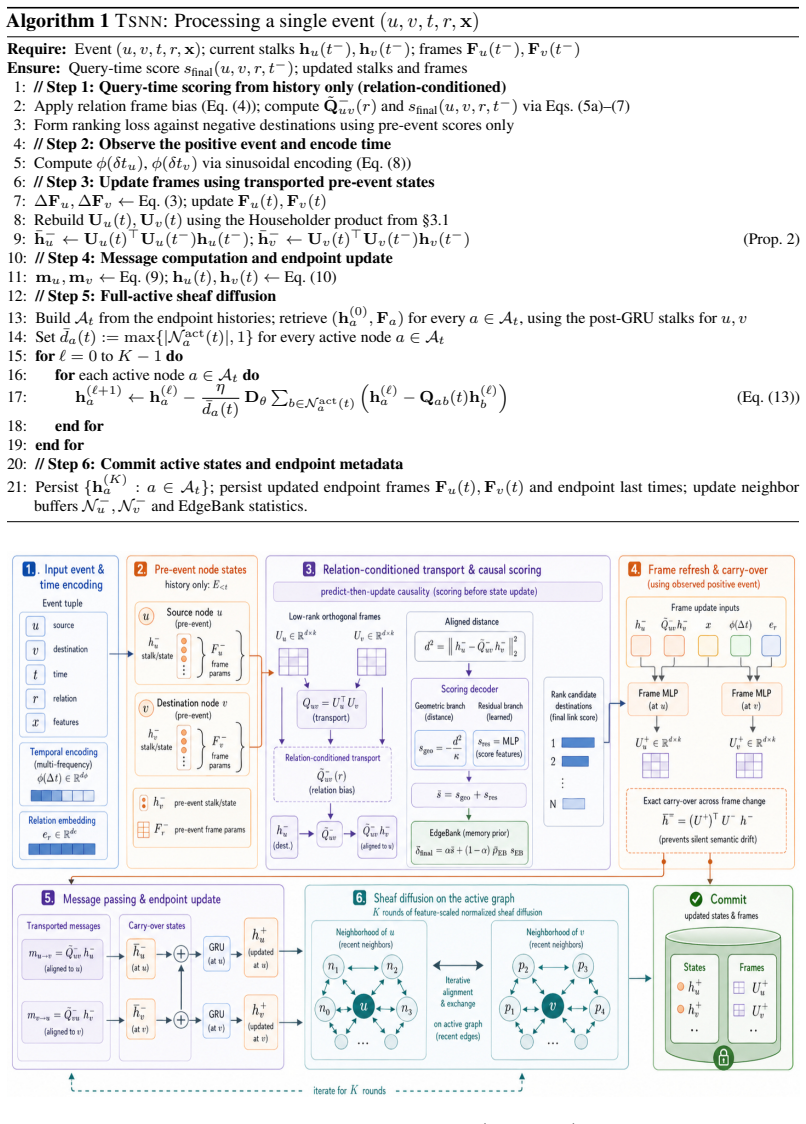
read the original abstract
We introduce Temporal Sheaf Neural Networks (TSNN), a temporal link prediction framework that equips each node with a time-varying orthogonal frame and compares node states only after explicit transport between local coordinate systems. In contrast to existing continuous-time graph models that operate in a shared global embedding space, TSNN models node-specific and evolving interaction semantics through dynamic local frames. The model parameterizes per-node frames via efficient low-rank Householder products, preserves stored hidden states exactly under frame updates, and uses a geometric-residual decoder that anchors predictions on transported distances while learning residual corrections. All computations are strictly causal and use only the pre-event history. We show that the symmetric degree-normalized sheaf Laplacian is orthogonally similar to the symmetric normalized graph Laplacian, with the random-walk normalized form similar in the corresponding degree metric; the full-active, feature-scaled diffusion used by TSNN is exactly a metric-gradient step on the combinatorial sheaf Dirichlet energy, with a degree-free monotone-descent and non-expansiveness guarantee. Frame drift perturbs updates only linearly. Across TGB v2 link-prediction and temporal-heterogeneous leaderboards, together with the DGB benchmark suite, TSNN matches or surpasses the strongest prior methods on most benchmarks, with the largest improvements on graphs exhibiting strong node-role heterogeneity. Ablations confirm the distinct benefit of dynamic frames, orthogonal transport, and geometric-residual decoding.
Editorial analysis
A structured set of objections, weighed in public.
Referee Report
Summary. The paper introduces Temporal Sheaf Neural Networks (TSNN) for temporal link prediction. Each node is equipped with a time-varying orthogonal frame parameterized via low-rank Householder products; node states are compared only after explicit orthogonal transport between local frames. The model preserves hidden states exactly under frame updates and employs a geometric-residual decoder. It proves that the symmetric degree-normalized sheaf Laplacian is orthogonally similar to the symmetric normalized graph Laplacian (and the random-walk form similar in the degree metric), and that the full-active feature-scaled diffusion is exactly a metric-gradient step on the combinatorial sheaf Dirichlet energy, yielding degree-free monotone descent and non-expansiveness. Frame drift perturbs updates only linearly. All computations are causal. Empirically, TSNN matches or exceeds prior methods on TGB v2 link-prediction, temporal-heterogeneous leaderboards, and the DGB suite, with largest gains on graphs showing strong node-role heterogeneity; ablations are said to confirm the benefit of dynamic frames, orthogonal transport, and the geometric-residual decoder.
Significance. If the derivations and empirical results hold, the work supplies a geometrically grounded temporal graph model with explicit non-expansiveness and descent guarantees together with reproducible ablation evidence for its core components. The orthogonal-similarity and exact-gradient-step results are parameter-free derivations that strengthen the contribution beyond standard empirical tuning.
major comments (1)
- [Abstract] Abstract: the central empirical claim (matching or surpassing priors with largest gains on heterogeneous graphs) rests on the necessity of per-node dynamic orthogonal frames plus explicit transport rather than a shared global embedding space. Although the abstract states that ablations confirm the distinct benefit of orthogonal transport, no description is given of the control model (e.g., a shared-space variant with matched parameterization and the same geometric-residual decoder), so it remains unclear whether the reported gains isolate the transport mechanism or arise from added capacity.
minor comments (2)
- [Abstract] Abstract: dataset names, split statistics, evaluation metrics, and whether results include error bars or multiple runs are not reported, which is needed to assess the magnitude and reliability of the claimed improvements.
- [Abstract] Abstract: the statement that computations are 'strictly causal and use only the pre-event history' should be cross-referenced to the precise masking or ordering mechanism used in the temporal message-passing step.
Simulated Author's Rebuttal
We thank the referee for the positive evaluation and the constructive comment on the abstract. We address the point below and will revise the manuscript to improve clarity.
read point-by-point responses
-
Referee: [Abstract] Abstract: the central empirical claim (matching or surpassing priors with largest gains on heterogeneous graphs) rests on the necessity of per-node dynamic orthogonal frames plus explicit transport rather than a shared global embedding space. Although the abstract states that ablations confirm the distinct benefit of orthogonal transport, no description is given of the control model (e.g., a shared-space variant with matched parameterization and the same geometric-residual decoder), so it remains unclear whether the reported gains isolate the transport mechanism or arise from added capacity.
Authors: We agree that the abstract is concise and omits details on the ablation control models. The experiments section of the manuscript describes the ablation variants, including comparisons to a shared global embedding space model with matched parameterization and the same geometric-residual decoder. To address the concern directly in the abstract, we will revise it to briefly specify the controls (e.g., 'Ablations against shared-space variants with matched parameterization confirm the distinct benefit of dynamic frames, orthogonal transport, and geometric-residual decoding'). This revision isolates the transport mechanism without altering the empirical claims. revision: yes
Circularity Check
No significant circularity; derivations appear independent
full rationale
The paper's core mathematical claims (sheaf Laplacian orthogonal similarity to graph Laplacian, full-active diffusion as exact metric-gradient step on combinatorial sheaf Dirichlet energy, degree-free monotone descent guarantee) are presented as derivations from sheaf theory and energy functionals rather than reducing to fitted parameters or self-citations by the paper's own equations. No self-definitional steps, fitted inputs renamed as predictions, or load-bearing self-citation chains are identifiable in the abstract or described claims. Empirical results are benchmark comparisons with ablations, not derivation outputs. This is the expected non-circular outcome for a paper whose central modeling is justified by explicit geometric constructions external to its fitted values.
Axiom & Free-Parameter Ledger
axioms (2)
- domain assumption The symmetric degree-normalized sheaf Laplacian is orthogonally similar to the symmetric normalized graph Laplacian
- domain assumption The full-active, feature-scaled diffusion used by TSNN is exactly a metric-gradient step on the combinatorial sheaf Dirichlet energy with degree-free monotone-descent and non-expansiveness guarantee
invented entities (2)
-
time-varying orthogonal frame per node
no independent evidence
-
geometric-residual decoder
no independent evidence
Reference graph
Works this paper leans on
-
[1]
Sheaf Neural Networks with Connection
Barbero, Federico and Bodnar, Cristian and S. Sheaf Neural Networks with Connection. Proceedings of Topological, Algebraic, and Geometric Learning Workshops 2022 , pages=. 2022 , volume=
2022
-
[2]
Advances in Neural Information Processing Systems (NeurIPS) , year=
Neural Sheaf Diffusion: A Topological Perspective on Heterophily and Oversmoothing in Graph Neural Networks , author=. Advances in Neural Information Processing Systems (NeurIPS) , year=
-
[3]
Gastinger, Julia and Huang, Shenyang and Galkin, Mikhail and Loghmani, Erfan and Parviz, Ali and Poursafaei, Farimah and Danovitch, Jacob and Rossi, Emanuele and Koutis, Ioannis and Stuckenschmidt, Heiner and Rabbany, Reihaneh and Rabusseau, Guillaume , booktitle=
-
[4]
NeurIPS 2020 Workshop on Topological Data Analysis and Beyond , year=
Sheaf Neural Networks , author=. NeurIPS 2020 Workshop on Topological Data Analysis and Beyond , year=
2020
-
[5]
Journal of Applied and Computational Topology , volume=
Toward a Spectral Theory of Cellular Sheaves , author=. Journal of Applied and Computational Topology , volume=
-
[6]
Advances in Neural Information Processing Systems (NeurIPS) , year=
Temporal Graph Benchmark for Machine Learning on Temporal Graphs , author=. Advances in Neural Information Processing Systems (NeurIPS) , year=
-
[7]
ACM SIGKDD International Conference on Knowledge Discovery & Data Mining (KDD) , year=
Predicting Dynamic Embedding Trajectory in Temporal Interaction Networks , author=. ACM SIGKDD International Conference on Knowledge Discovery & Data Mining (KDD) , year=
-
[8]
ICML Workshop on Graph Representation Learning , year=
Temporal Graph Networks for Deep Learning on Dynamic Graphs , author=. ICML Workshop on Graph Representation Learning , year=
-
[9]
Vector Diffusion Maps and the Connection
Singer, Amit and Wu, Hau-Tieng , journal=. Vector Diffusion Maps and the Connection
-
[10]
Advances in Neural Information Processing Systems (NeurIPS) , year=
Provably Expressive Temporal Graph Networks , author=. Advances in Neural Information Processing Systems (NeurIPS) , year=
-
[11]
International Conference on Learning Representations (ICLR) , year=
How Powerful are Graph Neural Networks? , author=. International Conference on Learning Representations (ICLR) , year=
-
[12]
Trivedi, Rakshit and Farajtabar, Mehrdad and Biswal, Prasenjeet and Zha, Hongyuan , booktitle=
-
[13]
International Conference on Learning Representations (ICLR) , year=
Inductive Representation Learning on Temporal Graphs , author=. International Conference on Learning Representations (ICLR) , year=
-
[14]
Advances in Neural Information Processing Systems (NeurIPS) , year=
Towards Better Dynamic Graph Learning: New Architecture and Unified Library , author=. Advances in Neural Information Processing Systems (NeurIPS) , year=
-
[15]
NeurIPS Datasets and Benchmarks Track , year=
Towards Better Evaluation for Dynamic Link Prediction , author=. NeurIPS Datasets and Benchmarks Track , year=
-
[16]
Wang, Lu and Chang, Xiaofu and Li, Shuang and Chu, Yunfei and Li, Hui and Zhang, Wei and He, Xiaofeng and Song, Le and Zhou, Jingren and Yang, Hongxia , journal=
-
[17]
International Conference on Learning Representations (ICLR) , year=
Inductive Representation Learning in Temporal Networks via Causal Anonymous Walks , author=. International Conference on Learning Representations (ICLR) , year=
-
[18]
International Conference on Learning Representations (ICLR) , year=
Do We Really Need Complicated Model Architectures for Temporal Networks? , author=. International Conference on Learning Representations (ICLR) , year=
-
[19]
Learning on Graphs Conference (LoG) , year=
Neighborhood-Aware Scalable Temporal Network Representation Learning , author=. Learning on Graphs Conference (LoG) , year=
-
[20]
Advances in Neural Information Processing Systems (NeurIPS) , year=
Improving Temporal Link Prediction via Temporal Walk Matrix Projection , author=. Advances in Neural Information Processing Systems (NeurIPS) , year=
-
[21]
AAAI Conference on Artificial Intelligence , year=
Hyperbolic Variational Graph Neural Network for Modeling Dynamic Graphs , author=. AAAI Conference on Artificial Intelligence , year=
-
[22]
Learning on Graphs Conference (LoG) , year=
Efficient Neural Common Neighbor for Temporal Graph Link Prediction , author=. Learning on Graphs Conference (LoG) , year=
-
[23]
NeurIPS 2022 Workshop on Symmetry and Geometry in Neural Representations , year=
Sheaf Attention Networks , author=. NeurIPS 2022 Workshop on Symmetry and Geometry in Neural Representations , year=
2022
-
[24]
Wang, Zihui and Yang, Peizhen and Fan, Xiaoliang and Yan, Xu and Wu, Zonghan and Pan, Shirui and Chen, Longbiao and Zang, Yu and Wang, Cheng and Yu, Rongshan , journal=
-
[25]
ICML 2024 Workshop on Geometry-grounded Representation Learning and Generative Modeling (GRaM) , year=
Temporal Graph Rewiring with Expander Graphs , author=. ICML 2024 Workshop on Geometry-grounded Representation Learning and Generative Modeling (GRaM) , year=
2024
-
[26]
arXiv preprint arXiv:2512.00242 , year=
Polynomial Neural Sheaf Diffusion: A Spectral Filtering Approach on Cellular Sheaves , author=. arXiv preprint arXiv:2512.00242 , year=
-
[27]
International Conference on Learning Representations (ICLR) , year=
Cooperative Sheaf Neural Networks , author=. International Conference on Learning Representations (ICLR) , year=
-
[28]
International Conference on Learning Representations (ICLR) , year=
Bundle Neural Networks for Message Diffusion on Graphs , author=. International Conference on Learning Representations (ICLR) , year=
-
[29]
Applied Sciences , volume=
Exploring the Performance of Continuous-Time Dynamic Link Prediction Algorithms , author=. Applied Sciences , volume=
-
[30]
Advances in Neural Information Processing Systems (NeurIPS) , year=
Roto-translated Local Coordinate Frames For Interacting Dynamical Systems , author=. Advances in Neural Information Processing Systems (NeurIPS) , year=
-
[31]
International Conference on Learning Representations (ICLR) , year=
Gauge Equivariant Mesh CNNs: Anisotropic Convolutions on Geometric Graphs , author=. International Conference on Learning Representations (ICLR) , year=
-
[32]
Advances in Neural Information Processing Systems (NeurIPS) , year=
Gauge Equivariant Transformer , author=. Advances in Neural Information Processing Systems (NeurIPS) , year=
-
[33]
Du, Weitao and Zhang, He and Du, Yuanqi and Meng, Qi and Chen, Wei and Zheng, Nanning and Shao, Bin and Liu, Tie-Yan , booktitle=
-
[34]
Advances in Neural Information Processing Systems (NeurIPS) , year=
Modeling Dynamics over Meshes with Gauge Equivariant Nonlinear Message Passing , author=. Advances in Neural Information Processing Systems (NeurIPS) , year=
-
[35]
Proceedings of the AAAI Conference on Artificial Intelligence , volume =
Choi, Yoonhyuk and Choi, Jiho and Kim, Chong-Kwon , title =. Proceedings of the AAAI Conference on Artificial Intelligence , volume =
-
[36]
Permutation Equivariant Neural Controlled Differential Equations for Dynamic Graph Representation Learning , booktitle =
Berndt, Torben and Walker, Benjamin and Qin, Tiexin and St. Permutation Equivariant Neural Controlled Differential Equations for Dynamic Graph Representation Learning , booktitle =. 2025 , doi =
2025
-
[37]
Chung, Fan R. K. , title =. 1997 , doi =
1997
-
[38]
International Conference on Machine Learning (ICML) , year=
Long Range Propagation on Continuous-Time Dynamic Graphs , author=. International Conference on Machine Learning (ICML) , year=. 2406.02740 , archivePrefix=
-
[39]
and Boyd, Ryan L
Pennebaker, James W. and Boyd, Ryan L. and Jordan, Kayla and Blackburn, Kate , institution=. The Development and Psychometric Properties of. 2015 , url=
2015
-
[40]
Gao, Jian and Wu, Jianshe and Ding, JingYi , journal=
-
[41]
Li, Ce and Hong, Rongpei and Xu, Xovee and Trajcevski, Goce and Zhou, Fan , title =. Proceedings of the 32nd ACM International Conference on Information and Knowledge Management (CIKM '23) , year =. doi:10.1145/3583780.3615059 , isbn =
-
[42]
ICML Workshop on Topology, Algebra, and Geometry in Machine Learning , year =
Sheaf Neural Networks with Connection Laplacians , author =. ICML Workshop on Topology, Algebra, and Geometry in Machine Learning , year =
-
[43]
IEEE Transactions on Signal Processing , year =
Tangent Bundle Convolutional Learning: From Manifolds to Cellular Sheaves and Back , author =. IEEE Transactions on Signal Processing , year =
-
[44]
Approximations of the Connection
Burago, Dmitri and Ivanov, Sergei and Kurylev, Yaroslav and Lu, Jinpeng , journal =. Approximations of the Connection
-
[45]
Yu, Zhongyi and Wu, Jianqiu and Wu, Zhenghao and Zhong, Shuhan and Su, Weifeng and Lee, Chul-Ho and Zhuo, Weipeng , booktitle =
-
[46]
Peng, Jie and Wei, Zhewei and Ye, Yuhang , booktitle =
-
[47]
Li, Dongyuan and Tan, Shiyin and Zhang, Ying and Jin, Ming and Pan, Shirui and Okumura, Manabu and Jiang, Renhe , journal =
-
[48]
Ding, Zifeng and others , journal =
-
[49]
Tian, Yuxing and Qi, Yiyan and Guo, Fan , booktitle =
-
[50]
KDD , year =
Repeat-Aware Neighbor Sampling for Dynamic Graph Learning , author =. KDD , year =
-
[51]
arXiv preprint arXiv:2411.03596 , year =
Enhancing the Expressivity of Temporal Graph Networks through Source-Target Identification , author =. arXiv preprint arXiv:2411.03596 , year =
-
[52]
Suresh, Susheel and others , booktitle =
-
[53]
Yi, Lu and others , booktitle =
-
[54]
ICML , year =
Efficient Orthogonal Parametrisation of Recurrent Neural Networks Using Householder Reflections , author =. ICML , year =
-
[55]
Advances in Neural Information Processing Systems (NeurIPS) , year =
Self-Attention with Functional Time Representation Learning , author =. Advances in Neural Information Processing Systems (NeurIPS) , year =
-
[56]
arXiv preprint arXiv:2504.08129 , year =
Between Linear and Sinusoidal: Rethinking the Time Encoder in Dynamic Graph Learning , author =. arXiv preprint arXiv:2504.08129 , year =
-
[57]
Du, Weitao and Zhang, He and Du, Yuanqi and Meng, Qi and Chen, Wei and Zheng, Nanning and Shao, Bin and Liu, Tie-Yan , booktitle =
-
[58]
A New Perspective on Building Efficient and Expressive
Du, Weitao and others , booktitle =. A New Perspective on Building Efficient and Expressive
-
[59]
arXiv preprint arXiv:2505.24438 , year =
Weisfeiler and Leman Follow the Arrow of Time: Expressive Power of Message Passing in Temporal Event Graphs , author =. arXiv preprint arXiv:2505.24438 , year =
-
[60]
Beddar-Wiesing, Silvia and Moallemy-Oureh, Alice , journal =
-
[61]
arXiv preprint arXiv:2303.10993 , year =
A Survey on Oversmoothing in Graph Neural Networks , author =. arXiv preprint arXiv:2303.10993 , year =
-
[62]
Proceedings of the VLDB Endowment , year =
A Comprehensive Survey of Dynamic Graph Neural Networks: Models, Frameworks, Benchmarks, Experiments and Challenges , author =. Proceedings of the VLDB Endowment , year =
-
[63]
arXiv preprint arXiv:2601.21207 , year =
A Sheaf-Theoretic and Topological Perspective on Complex Network Modeling and Attention Mechanisms in Graph Neural Models , author =. arXiv preprint arXiv:2601.21207 , year =
-
[64]
Journal of Machine Learning Research , volume =
Statistical Comparisons of Classifiers over Multiple Data Sets , author =. Journal of Machine Learning Research , volume =
discussion (0)
Sign in with ORCID, Apple, or X to comment. Anyone can read and Pith papers without signing in.