Minimalist Genetic Programming
Pith reviewed 2026-06-27 16:05 UTC · model grok-4.3
The pith
When given the right atomic building blocks, Minimalist Genetic Programming recovers exact ground truth models on symbolic regression tasks where standard GP fails.
A machine-rendered reading of the paper's core claim, the machinery that carries it, and where it could break.
Core claim
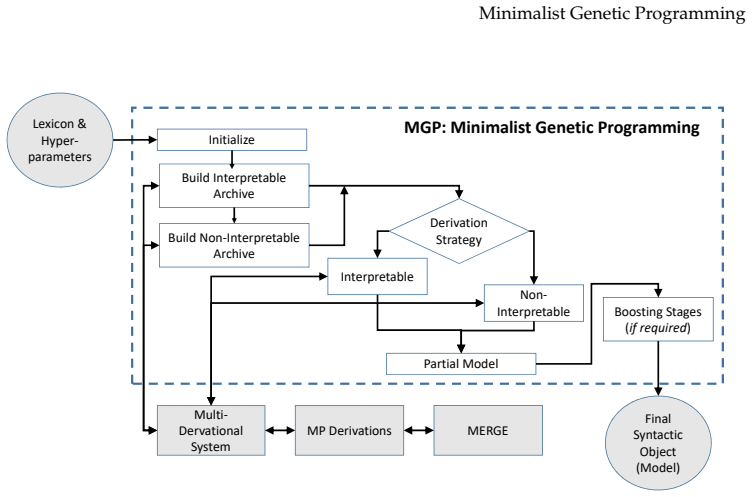
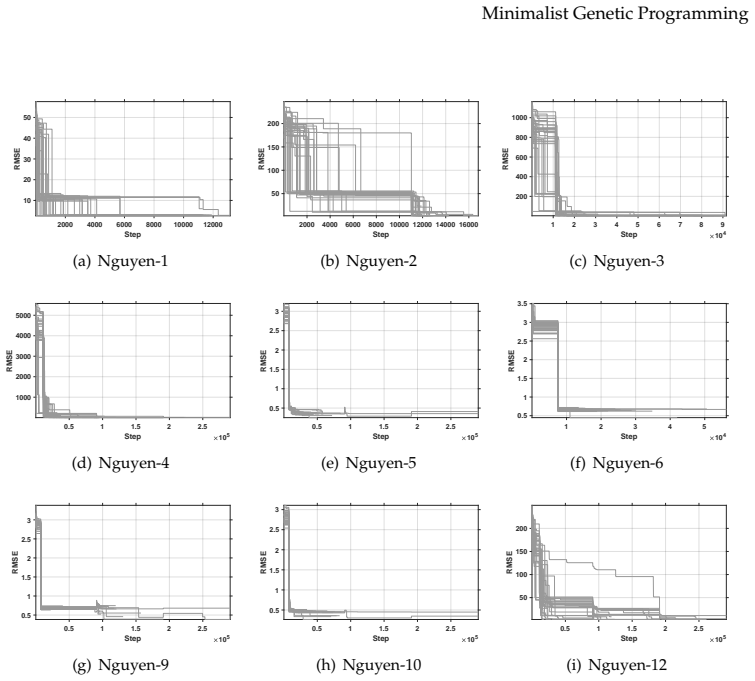
MGP is able to discover the core building blocks of the symbolic expressions, and to incrementally combine them using MERGE. When a proper lexicon of atomic syntactic objects is chosen, MGP consistently produces the exact ground truth model on symbolic regression tasks where standard GP struggles.
What carries the argument
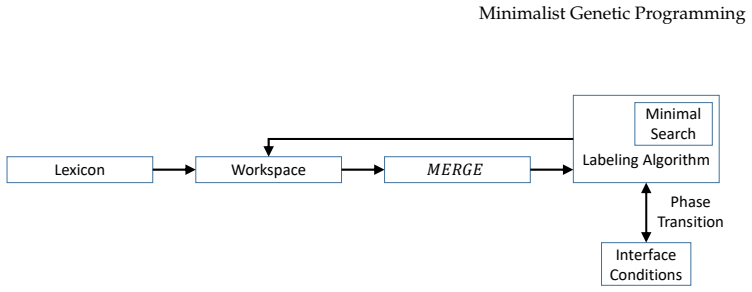
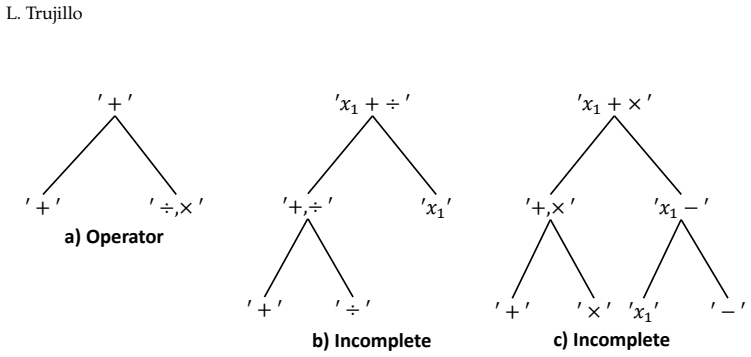
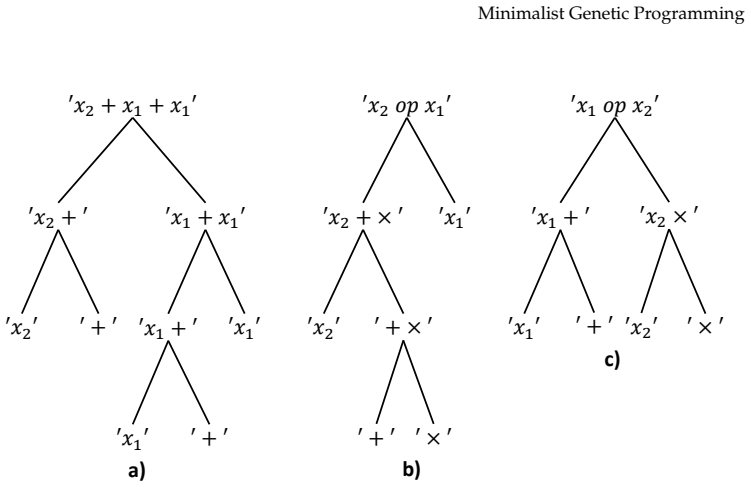
The MERGE operator, a binary set formation process that constructs complex syntactic structures incrementally from a lexicon of atomic objects.
If this is right
- MGP avoids bloat by using incremental derivation instead of evolutionary growth.
- It can recover exact models without the search overhead of GP when the lexicon is appropriate.
- The minimalist approach shows that program induction can be solved through syntactic merging rather than optimization.
- Insights from human language syntax are relevant to constructing symbolic models in AI.
Where Pith is reading between the lines
- If the lexicon must be chosen by hand, the method shifts the problem from search to lexicon design for new tasks.
- Automating lexicon selection could combine MGP with other methods to handle a wider range of problems.
- This derivation view might apply to other program induction domains beyond symbolic regression.
- Testing on problems where the ground truth is not known could reveal if the method generalizes without oracle knowledge of the target.
Load-bearing premise
A proper lexicon of atomic syntactic objects can be chosen in advance for the target problem.
What would settle it
Running MGP on one of the benchmark symbolic regression tasks with the stated proper lexicon and observing that it does not recover the exact ground truth model.
Figures
read the original abstract
Genetic programming (GP) is based on two important insights. First, that any learning task can fundamentally be posed as a program induction problem, where the goal is to construct a symbolic hierarchical model that is expressed as a syntax tree. Second, to pose this task as a search problem, and use evolution to locate the desired model. Since it was proposed, GP has produced notable results in a wide range of tasks and problem domains. This work presents an alternative view by modifying the second core insight of GP, posing the problem as a syntactic derivation task instead. In particular, this paper presents Minimalist Genetic Programming (MGP), an algorithm that like GP is biologically inspired, but instead of evolution it takes inspiration from the Minimalist Program to human language, in which syntax is understood as an optimal solution to the problem of linking two other mental systems. In minimalism, the core computational process is a binary set formation operator called $MERGE$, than can be used to incrementally construct complex syntactic structures using a simple Markovian process. MGP is able to discover the core building blocks of the symbolic expressions, and to incrementally combined them using $MERGE$. The proposed system is benchmarked on symbolic regression tasks that are known to be difficult to solve with standard GP systems because of the propensity for bloat. Results show that when a proper lexicon of atomic syntactic objects are chosen, MGP is able to consistently produce the exact ground truth model on a set of symbolic regression where standard GP struggles to do the same. The insights provided by minimalism are shown to be relevant to the problem of program induction, and should be explored further based on the potential exhibited by MGP in this work.
Editorial analysis
A structured set of objections, weighed in public.
Referee Report
Summary. The paper proposes Minimalist Genetic Programming (MGP), which reframes program induction as a syntactic derivation task using the binary MERGE operator from the Minimalist Program in linguistics rather than evolutionary search. It claims that, when a proper lexicon of atomic syntactic objects is chosen in advance, MGP consistently recovers exact ground-truth models on bloat-prone symbolic regression tasks where standard GP fails to do so.
Significance. If the central claim holds with a general, target-independent lexicon procedure, the work would establish a non-evolutionary, Markovian derivation method capable of exact recovery in symbolic regression, offering a potential alternative to GP that avoids bloat while drawing on linguistic syntax insights.
major comments (2)
- [Abstract] Abstract: the claim that 'MGP is able to consistently produce the exact ground truth model on a set of symbolic regression' is presented without any experimental details, data sets, lexicon selection procedure, quantitative metrics, or comparison protocol, rendering the central empirical result unverifiable from the manuscript.
- [Abstract] Abstract: the performance difference versus standard GP is conditioned on pre-selecting a 'proper lexicon of atomic syntactic objects' chosen in advance by the experimenter; no procedure is given for constructing this lexicon without knowledge of the target expression's operators and terminals, making the assumption load-bearing for any claim of a general advantage over evolutionary search.
Simulated Author's Rebuttal
We thank the referee for their comments. We address each major point below regarding the abstract. We will revise the abstract to include more experimental context while preserving its brevity.
read point-by-point responses
-
Referee: [Abstract] Abstract: the claim that 'MGP is able to consistently produce the exact ground truth model on a set of symbolic regression' is presented without any experimental details, data sets, lexicon selection procedure, quantitative metrics, or comparison protocol, rendering the central empirical result unverifiable from the manuscript.
Authors: The abstract provides a high-level summary of the contribution. The full manuscript details the symbolic regression benchmarks, the lexicons employed for each task, the exact-recovery metric, and comparisons against standard GP. To improve verifiability from the abstract itself, we will add a brief clause referencing the evaluation protocol and the conditional nature of the results. revision: yes
-
Referee: [Abstract] Abstract: the performance difference versus standard GP is conditioned on pre-selecting a 'proper lexicon of atomic syntactic objects' chosen in advance by the experimenter; no procedure is given for constructing this lexicon without knowledge of the target expression's operators and terminals, making the assumption load-bearing for any claim of a general advantage over evolutionary search.
Authors: The manuscript already qualifies its empirical claim with the phrase 'when a proper lexicon of atomic syntactic objects are chosen.' No general, target-independent lexicon-construction procedure is presented because the work focuses on the MERGE-based Markovian derivation process once suitable atomic objects are supplied. The paper does not assert an unconditional advantage over GP; the lexicon requirement is explicit and load-bearing by design. Future extensions could address automated lexicon discovery, but that lies beyond the current scope. revision: no
Circularity Check
No significant circularity in derivation chain
full rationale
The paper presents MGP as an alternative to evolutionary search by reframing program induction as incremental syntactic derivation via the MERGE operator drawn from linguistic theory. The central mechanism (binary set formation to build syntax trees from a lexicon) is described independently of any fitted parameters or self-referential definitions. Results are reported under the explicit condition of a pre-chosen lexicon, which parallels the standard practice of specifying function/terminal sets in GP rather than constituting a fitted input renamed as a prediction. No equations, uniqueness theorems, or self-citations are invoked to force the outcome by construction, and the derivation remains self-contained against the stated syntactic process.
Axiom & Free-Parameter Ledger
free parameters (1)
- lexicon of atomic syntactic objects
axioms (1)
- domain assumption Syntax is an optimal solution to linking mental systems via a binary set formation operator MERGE that constructs structures through a simple Markovian process.
Reference graph
Works this paper leans on
-
[1]
Koza , title =
John R. Koza , title =. 2010 , month = may, publisher =
2010
-
[2]
Genetic programming
Koza, John R. Genetic programming
-
[3]
Artificial intelligence: a guide for thinking humans , isbn =
Mitchell, Melanie , year =. Artificial intelligence: a guide for thinking humans , isbn =
-
[4]
A proposal for the
McCarthy, John and Minsky, Marvin L and Rochester, Nathaniel and Shannon, Claude E , year=. A proposal for the
-
[5]
A new taxonomy of global optimization algorithms , volume =
Stork, J\". A new taxonomy of global optimization algorithms , volume =. Natural Computing , publisher =. 2020 , month = Nov, pages =. doi:10.1007/s11047-020-09820-4 , number =
-
[6]
A History of Metaheuristics , ISBN =
S\". A History of Metaheuristics , ISBN =. 2018 , pages =. doi:10.1007/978-3-319-07153-4_4-1 , booktitle =
-
[7]
The Evolutionary Origins of Hierarchy , volume =
Mengistu, Henok and Huizinga, Joost and Mouret, Jean-Baptiste and Clune, Jeff , editor =. The Evolutionary Origins of Hierarchy , volume =. PLOS Computational Biology , publisher =. 2016 , month = June, pages =. doi:10.1371/journal.pcbi.1004829 , number =
-
[8]
and Affenzeller, Michael , year =
Kronberger, Gabriel and Burlacu, Bogdan and Kommenda, Michael and Winkler, Stephan M. and Affenzeller, Michael , year =. Symbolic Regression , ISBN =. doi:10.1201/9781315166407 , publisher =
-
[9]
Explainable and interpretable machine learning and data mining , volume =
Atzmueller, Martin and F\". Explainable and interpretable machine learning and data mining , volume =. Data Mining and Knowledge Discovery , publisher =. 2024 , month = jul, pages =. doi:10.1007/s10618-024-01041-y , number =
-
[10]
Nature , volume=
Mathematical discoveries from program search with large language models , author=. Nature , volume=. 2024 , publisher=
2024
-
[11]
Rhyme and Reason: An Introduction to Minimalist Syntax , ISBN =
Uriagereka, Juan , year =. Rhyme and Reason: An Introduction to Minimalist Syntax , ISBN =. doi:10.7551/mitpress/5949.001.0001 , publisher =
-
[12]
Commentary for the GPEM peer commentary special section on W
Castelli, Mauro , year =. Commentary for the GPEM peer commentary special section on W. B. Langdon’s “Jaws 30” , volume =. Genetic Programming and Evolvable Machines , publisher =. doi:10.1007/s10710-023-09468-w , number =
-
[13]
Saini, Anil Kumar and Spector, Lee , title =. 2021 , isbn =. doi:10.1145/3449726.3459544 , booktitle =
-
[14]
1976 , publisher=
The Selfish Gene , author=. 1976 , publisher=
1976
-
[15]
Silva, Sara and Dignum, Stephen and Vanneschi, Leonardo , year =. Operator equalisation for bloat free genetic programming and a survey of bloat control methods , volume =. Genetic Programming and Evolvable Machines , publisher =. doi:10.1007/s10710-011-9150-5 , number =
-
[16]
Langdon, W. B. and Poli, R. , year =. Fitness Causes Bloat , ISBN =. doi:10.1007/978-1-4471-0427-8_2 , booktitle =
-
[17]
1995 , publisher =
The Minimalist Program , author =. 1995 , publisher =
1995
-
[18]
2016 , publisher=
Why Only Us: Language and Evolution , author=. 2016 , publisher=
2016
-
[19]
Fitch, W. Tecumseh , year =. Toward a computational framework for cognitive biology: Unifying approaches from cognitive neuroscience and comparative cognition , volume =. Physics of Life Reviews , publisher =. doi:10.1016/j.plrev.2014.04.005 , number =
-
[20]
Fitch, W. Tecumseh , title =. Origins of Human Language: Continuities and Discontinuities with Nonhuman Primates , editor =. 2017 , pages =. doi:10.3726/b12405 , isbn =
-
[21]
Uy, Nguyen Quang and Hoai, Nguyen Xuan and O’Neill, Michael and McKay, R. I. and Galván-López, Edgar , year =. Semantically-based crossover in genetic programming: application to real-valued symbolic regression , volume =. Genetic Programming and Evolvable Machines , publisher =. doi:10.1007/s10710-010-9121-2 , number =
-
[22]
and Legrand, Pierrick and Silva, Sara and Castelli, Mauro and Vanneschi, Leonardo and Sch\"
Trujillo, Leonardo and Z-Flores, Emigdio and Juárez-Smith, Perla S. and Legrand, Pierrick and Silva, Sara and Castelli, Mauro and Vanneschi, Leonardo and Sch\". Local Search is Underused in Genetic Programming , ISBN =. 2018 , pages =. doi:10.1007/978-3-319-97088-2_8 , booktitle =
-
[23]
2007 , publisher=
The Nature of Things , author=. 2007 , publisher=
2007
-
[24]
Carolin Strobl, Anne-Laure Boulesteix, Achim Zeileis, and Torsten Hothorn
Shwartz-Ziv, Ravid and Armon, Amitai , year =. Tabular data: Deep learning is not all you need , volume =. doi:10.1016/j.inffus.2021.11.011 , journal =
-
[25]
1965 , publisher=
Aspects of the Theory of Syntax , author=. 1965 , publisher=
1965
-
[26]
Introduction: workspace, MERGE and labelling , volume =
Pan, Victor Junnan and Saito, Mamoru and Du, Yuqiao , year =. Introduction: workspace, MERGE and labelling , volume =. The Linguistic Review , publisher =. doi:10.1515/tlr-2024-2001 , number =
-
[27]
Syntactic theory of mathematical expressions , volume =
Matsumoto, Daiki and Nakai, Tomoya , year =. Syntactic theory of mathematical expressions , volume =. doi:10.1016/j.cogpsych.2023.101606 , journal =
-
[28]
Constructions in Minimalism: A Functional Perspective on Cyclicity , volume =
Trotzke, Andreas , year =. Constructions in Minimalism: A Functional Perspective on Cyclicity , volume =. doi:10.3389/fpsyg.2020.02152 , journal =
-
[29]
Structures and Beyond: The Cartography of Syntactic Structures, Volume 3 , editor=
Beyond Explanatory Adequacy , author=. Structures and Beyond: The Cartography of Syntactic Structures, Volume 3 , editor=. 2004 , publisher=
2004
-
[30]
Reports of the Keio Institute of Cultural and Linguistic Studies , volume=
Generative procedure revisited , author=. Reports of the Keio Institute of Cultural and Linguistic Studies , volume=. 2019 , publisher=
2019
-
[31]
1957 , publisher =
Chomsky, Noam , title =. 1957 , publisher =
1957
-
[32]
Proceedings of the 21st Annual Penn Linguistics Colloquium , editor =
Alec Marantz , title =. Proceedings of the 21st Annual Penn Linguistics Colloquium , editor =. 1997 , publisher =
1997
-
[33]
Nordlyd , volume=
Nanosyntax: A short primer to a new approach to language , author=. Nordlyd , volume=. 2010 , url=
2010
-
[34]
Chomsky, Noam and Seely, T. Daniel and Berwick, Robert C. and Fong, Sandiway and Huybregts, M. A. C. and Kitahara, Hisatsugu and McInnerney, Andrew and Sugimoto, Yushi , year =. Merge and the Strong Minimalist Thesis , ISBN =. doi:10.1017/9781009343244 , publisher =
-
[35]
Grammatical Evolution , ISBN =
O’Neill, Michael and Ryan, Conor , year =. Grammatical Evolution , ISBN =. doi:10.1007/978-1-4615-0447-4 , publisher =
-
[36]
and Hoai, Nguyen Xuan and Whigham, Peter Alexander and Shan, Yin and O’Neill, Michael , year =
McKay, Robert I. and Hoai, Nguyen Xuan and Whigham, Peter Alexander and Shan, Yin and O’Neill, Michael , year =. Grammar-based Genetic Programming: a survey , volume =. Genetic Programming and Evolvable Machines , publisher =. doi:10.1007/s10710-010-9109-y , number =
-
[37]
1871 , publisher=
The Descent of Man, and Selection in Relation to Sex , author=. 1871 , publisher=
-
[38]
and Campelo, Felipe and Dorigo, Marco and Ruiz, Rubén and Sevaux, Marc and S\"
Aranha, Claus and Camacho Villalón, Christian L. and Campelo, Felipe and Dorigo, Marco and Ruiz, Rubén and Sevaux, Marc and S\". Metaphor-based metaheuristics, a call for action: the elephant in the room , volume =. Swarm Intelligence , publisher =. 2021 , month = Nov, pages =. doi:10.1007/s11721-021-00202-9 , number =
-
[39]
Metaheuristics—the metaphor exposed , volume =
S\". Metaheuristics—the metaphor exposed , volume =. International Transactions in Operational Research , publisher =. 2013 , month = Feb, pages =. doi:10.1111/itor.12001 , number =
-
[40]
2015 , publisher=
Why Greatness Cannot Be Planned: The Myth of the Objective , author=. 2015 , publisher=
2015
-
[41]
Evolutionary Computation , volume=
Evolving neural networks through augmenting topologies , author=. Evolutionary Computation , volume=. 2002 , publisher=
2002
-
[42]
and Thomson, Peter , title =
Miller, Julian F. and Thomson, Peter , title =. Proceedings of the European Conference on Genetic Programming , pages =. 2000 , isbn =
2000
-
[43]
2007 , isbn =
Markus Brameier and Wolfgang Banzhaf , title =. 2007 , isbn =
2007
-
[44]
Kuppuraju, N. and GANESAN, S. and MISTREE, F. and SOBIESKI, J. S. , year =. HIERARCHICAL DECISION MAKING IN SYSTEM DESIGN , volume =. Engineering Optimization , publisher =. doi:10.1080/03052158508902491 , number =
-
[45]
Sakallioglu, Berfin and Santos, Frederico J. J. B. and Parra, Daniel and Qiu, Yuxin and Nicolau, Miguel and Trujillo, Leonardo and Hidalgo, J. Ignacio , year =. Combining Grammatical Evolution with LLM-based Local Search to Improve Interpretability , ISBN =. doi:10.1007/978-3-032-23607-4_14 , booktitle =
-
[46]
, title =
Orzechowski, Patryk and La Cava, William and Moore, Jason H. , title =. 2018 , isbn =
2018
-
[47]
Contemporary Symbolic Regression Methods and their Relative Performance , volume =
La Cava, William and Orzechowski, Patryk and Burlacu, Bogdan and de Franca, Fabricio and Virgolin, Marco and Jin, Ying and Kommenda, Michael and Moore, Jason , booktitle =. Contemporary Symbolic Regression Methods and their Relative Performance , volume =
-
[48]
2019 , month = may, publisher =
Cynthia Rudin , title =. 2019 , month = may, publisher =
2019
-
[49]
Virgolin, Marco and De Lorenzo, Andrea and Medvet, Eric and Randone, Francesca , title =. 2020 , isbn =. doi:10.1007/978-3-030-58115-2_6 , booktitle =
-
[50]
Proceedings of the 25th ACM SIGKDD International Conference on Knowledge Discovery & Data Mining , pages =
Rudin, Cynthia , title =. Proceedings of the 25th ACM SIGKDD International Conference on Knowledge Discovery & Data Mining , pages =. 2019 , isbn =
2019
-
[51]
Proceedings of the 2020 Genetic and Evolutionary Computation Conference Companion , pages =
Burlacu, Bogdan and Kronberger, Gabriel and Kommenda, Michael , title =. Proceedings of the 2020 Genetic and Evolutionary Computation Conference Companion , pages =. 2020 , publisher =
2020
-
[52]
Genetic Programming and Evolvable Machines , volume=
Genetic programming and autoconstructive evolution with the Push programming language , author=. Genetic Programming and Evolvable Machines , volume=. 2002 , publisher=
2002
-
[53]
, title =
Moraglio, Alberto and Krawiec, Krzysztof and Johnson, Colin G. , title =. Proceedings of the 12th International Conference on Parallel Problem Solving from Nature - Volume Part I , series =. 2012 , location =
2012
-
[54]
2014 , isbn =
Arnaldo, Ignacio and Krawiec, Krzysztof and O'Reilly, Una-May , title =. 2014 , isbn =
2014
-
[55]
Evolving multidimensional transformations for symbolic regression with
Luis Mu. Evolving multidimensional transformations for symbolic regression with. 2018 , month = sep, publisher =
2018
-
[56]
2015 , publisher =
Luis Mu. 2015 , publisher =
2015
-
[57]
Transfer learning in constructive induction with Genetic Programming , journal =
Luis Mu. Transfer learning in constructive induction with Genetic Programming , journal =. 2019 , month = nov, publisher =
2019
-
[58]
Introduction to Linear Regression Analysis
Montgomery, Douglas C and Peck, Elizabeth A and Vining, G Geoffrey. Introduction to Linear Regression Analysis
-
[59]
2022 , month = apr, publisher =
Yingjie Tian and Yuqi Zhang , title =. 2022 , month = apr, publisher =
2022
-
[60]
Leonardo Trujillo and Emigdio Z-Flores and Perla S. Ju. Local Search is Underused in Genetic Programming , booktitle =. 2018 , publisher =
2018
-
[61]
2008 , month = dec, publisher =
H IBA , title =. 2008 , month = dec, publisher =
2008
-
[62]
Chaos, Solitons
Indranil Pan and Saptarshi Das , title =. Chaos, Solitons. 2015 , month = jul, publisher =
2015
-
[63]
Falco and A
I. Falco and A. Cioppa and E. Tarantino , title =
-
[64]
Mathematical methods for physicists
Arfken, George B and Weber, Hans J and Harris, Frank E. Mathematical methods for physicists
-
[65]
2011 , publisher =
Trent McConaghy , title =. 2011 , publisher =
2011
-
[66]
Moore , title =
William La Cava and Sara Silva and Kourosh Danai and Lee Spector and Leonardo Vanneschi and Jason H. Moore , title =. 2019 , month = feb, publisher =
2019
-
[67]
arXiv preprint arXiv:2002.04803 , year=
Machine Learning in Python: Main developments and technology trends in data science, machine learning, and artificial intelligence , author=. arXiv preprint arXiv:2002.04803 , year=
-
[68]
ECML PKDD Workshop: Languages for Data Mining and Machine Learning , year =
Lars Buitinck and Gilles Louppe and Mathieu Blondel and Fabian Pedregosa and Andreas Mueller and Olivier Grisel and Vlad Niculae and Peter Prettenhofer and Alexandre Gramfort and Jaques Grobler and Robert Layton and Jake VanderPlas and Arnaud Joly and Brian Holt and Ga. ECML PKDD Workshop: Languages for Data Mining and Machine Learning , year =
-
[69]
GSGP-CUDA — A CUDA framework for Geometric Semantic Genetic Programming , journal =
Leonardo Trujillo and Jose Manuel. GSGP-CUDA — A CUDA framework for Geometric Semantic Genetic Programming , journal =. 2022 , issn =
2022
-
[70]
Proceedings of the Genetic and Evolutionary Computation Conference , pages =
Helmuth, Thomas and McPhee, Nicholas Freitag and Spector, Lee , title =. Proceedings of the Genetic and Evolutionary Computation Conference , pages =. 2018 , isbn =
2018
-
[71]
2014 , publisher =
Vijay Ingalalli and Sara Silva and Mauro Castelli and Leonardo Vanneschi , title =. 2014 , publisher =
2014
-
[72]
, title =
Langdon, William B. , title =. Proceedings of the Genetic and Evolutionary Computation Conference Companion , pages =. 2022 , isbn =
2022
-
[73]
2019 , eprint=
Learning concise representations for regression by evolving networks of trees , author=. 2019 , eprint=
2019
-
[74]
Proceedings of the 22nd ACM SIGKDD International Conference on Knowledge Discovery and Data Mining , series =
Chen, Tianqi and Guestrin, Carlos , title =. Proceedings of the 22nd ACM SIGKDD International Conference on Knowledge Discovery and Data Mining , series =. 2016 , isbn =
2016
-
[75]
and Cabral, Ana I
Batista, João E. and Cabral, Ana I. R. and Vasconcelos, Maria J. P. and Vanneschi, Leonardo and Silva, Sara , TITLE =. Remote Sensing , VOLUME =. 2021 , NUMBER =
2021
-
[76]
2021 , month = may, publisher =
Yu Yang and Xin Wang and Xin Zhao and Min Huang and Qibing Zhu , title =. 2021 , month = may, publisher =
2021
-
[77]
Infrared Physics
Zheng Zhou and Yu Yang and Gan Zhang and Libing Xu and Mingqing Wang , title =. Infrared Physics. 2023 , month = mar, publisher =
2023
-
[78]
Chandrashekar, Girish and Sahin, Ferat , title =. Comput. Electr. Eng. , month =. 2014 , issue_date =
2014
-
[79]
Fast Genetic Algorithm for feature selection
Mohammed Ghaith Altarabichi and S. Fast Genetic Algorithm for feature selection. 2023 , month = jan, publisher =
2023
-
[80]
A Genetic Programming approach for feature selection in highly dimensional skewed data , journal =
Felipe Viegas and Leonardo Rocha and Marcos Gon. A Genetic Programming approach for feature selection in highly dimensional skewed data , journal =. 2018 , month = jan, publisher =
2018
discussion (0)
Sign in with ORCID, Apple, or X to comment. Anyone can read and Pith papers without signing in.