Multiphase images of a powerful supernova-driven wind in the early Universe
Pith reviewed 2026-06-27 12:58 UTC · model grok-4.3
The pith
A galaxy 1.1 billion years after the Big Bang drives a wind that removes gas at twice its star-formation rate.
A machine-rendered reading of the paper's core claim, the machinery that carries it, and where it could break.
Core claim
The paper establishes that a massive galaxy at z=5.3 hosts a multiphase supernova-driven wind whose mass-loss rate is twice the star-formation rate. The wind is plausibly merger-triggered and could exhaust the galaxy's cold gas reservoir within 100 Myr. Its mass and energetics are consistent with local starburst-driven superwinds, indicating that stellar feedback efficiency has remained relatively constant since the early universe.
What carries the argument
The multiphase outflow traced by cold-gas and ionized-gas emission lines, whose observed luminosities and velocities are converted to total mass and outflow rate.
If this is right
- Merger activity can launch winds strong enough to quench star formation in massive galaxies at high redshift.
- Such winds provide one route to the rapid appearance of quiescent massive galaxies early in cosmic history.
- The similarity to local superwinds indicates that supernova feedback operated with comparable efficiency 12 billion years ago.
Where Pith is reading between the lines
- If many high-redshift mergers launch comparable winds, the mechanism could explain the observed abundance of early quiescent galaxies.
- Mapping the same emission lines in additional z greater than 5 systems would test how common such outflows are.
- Correcting for projection and multiphase effects in future data sets would tighten the outflow-rate estimate.
Load-bearing premise
The conversion of observed emission-line luminosities and velocities into total gas masses and outflow rates must be accurate without large unseen corrections for projection, missing gas phases, or other driving mechanisms.
What would settle it
A direct measurement of the galaxy's total cold-gas mass or three-dimensional velocity field that yields an outflow rate much lower than twice the star-formation rate would falsify the quenching claim.
Figures
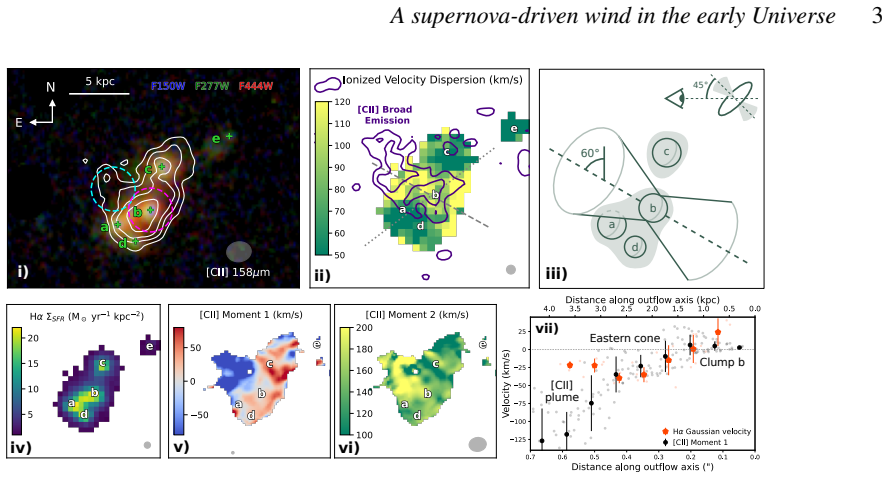
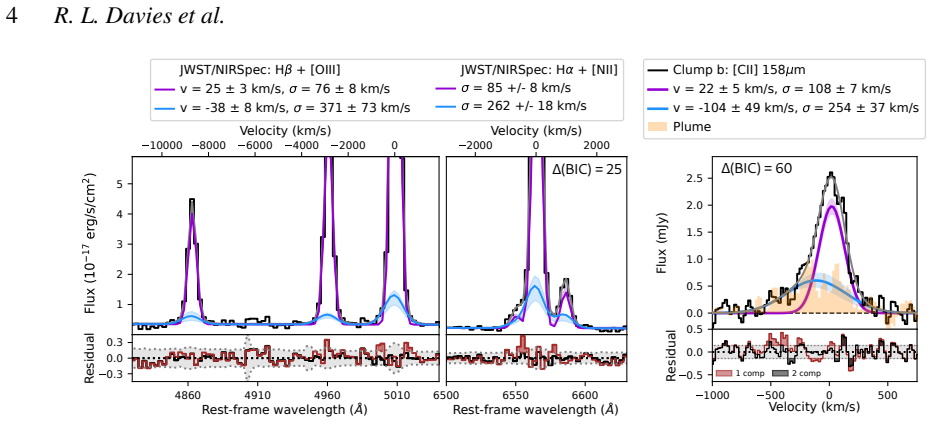
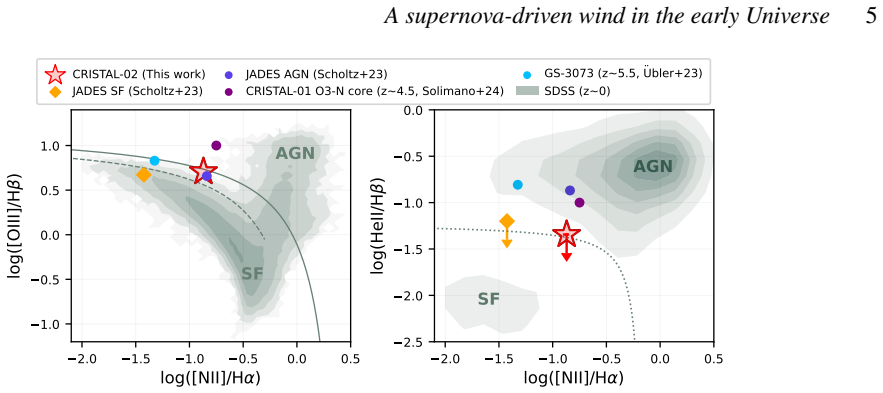
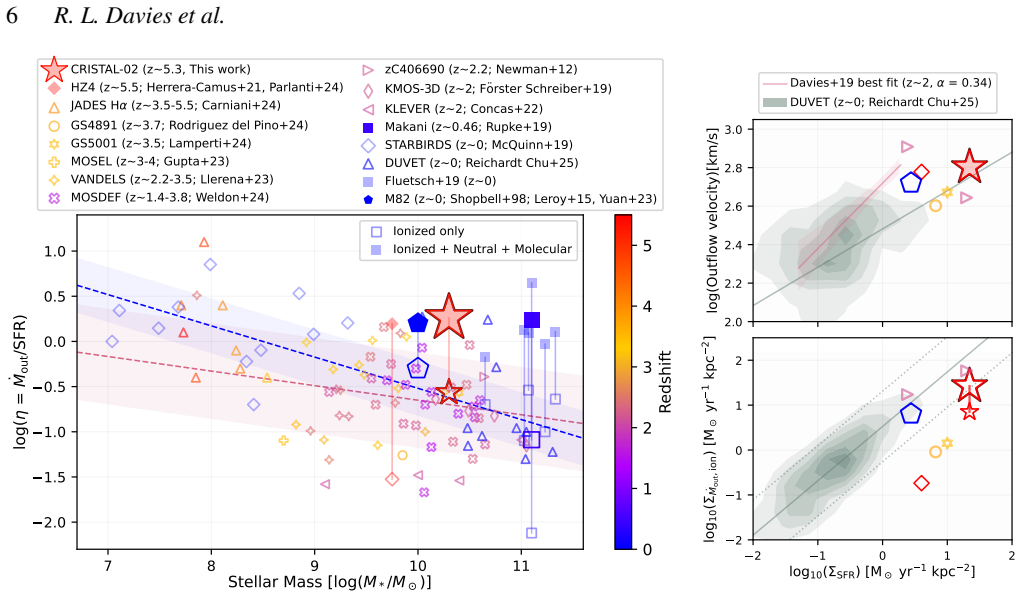
read the original abstract
Galactic winds are considered a likely driver of rapid quenching in early massive galaxies, but until now there has been no direct evidence that such systems drive winds powerful enough to meaningfully suppress their star-formation. We present resolved cold gas and ionized gas observations of a powerful supernova-driven wind in a massive galaxy 1.1 billion years after the Big Bang (at $z$=5.3). The outflow, likely triggered by ongoing merger activity, is removing gas at twice the rate of star-formation and could plausibly eject all the cold gas from the galaxy within 100 Myr. Our results suggest that powerful merger-driven outflows may be a key mechanism to produce abundant massive quiescent galaxies in the early Universe when a large fraction of massive galaxies are interacting. The mass and energetics of this distant outflow are consistent with nearby starburst-driven superwinds, suggesting that the efficiency of stellar feedback has remained relatively constant over the last 12 billion years of cosmic history.
Editorial analysis
A structured set of objections, weighed in public.
Referee Report
Summary. The manuscript presents resolved cold and ionized gas observations of a massive galaxy at z=5.3, reporting a powerful supernova-driven wind likely triggered by merger activity. The outflow is claimed to remove gas at twice the star-formation rate and to be capable of ejecting all cold gas within 100 Myr, with mass and energetics consistent with local starburst-driven superwinds, implying constant stellar feedback efficiency over 12 Gyr.
Significance. If the quantitative results hold after detailed scrutiny of the derivations, this would constitute the first direct evidence that supernova-driven winds in the early universe are powerful enough to quench star formation, supporting merger-driven outflows as a key mechanism for producing massive quiescent galaxies at high redshift and indicating that stellar feedback efficiency has not evolved strongly since z~5.
major comments (2)
- [Abstract and outflow rate derivation section] Abstract and the section deriving outflow properties: the headline claims (outflow rate twice the SFR; full cold-gas ejection in <100 Myr) rest on conversion of observed line luminosities and velocity widths to total gas masses and Ṁ_out, but no information is supplied on the specific conversion factors, error budgets, data quality, projection corrections, or tests for unseen phases/AGN contributions. This is load-bearing for the central claim and must be addressed with explicit sensitivity analysis.
- [Wind driving mechanism section] The section on wind driving mechanism: the assertion that the wind is supernova-driven and merger-triggered requires quantitative comparison of the observed energetics to expected supernova input and merger-induced turbulence; without this, alternative contributions (e.g., AGN) cannot be ruled out at the level needed to support the quenching argument.
minor comments (1)
- [Abstract] The abstract would benefit from a one-sentence statement of the primary datasets (e.g., ALMA [C II], CO) used to derive the quoted numbers.
Simulated Author's Rebuttal
We thank the referee for their thoughtful and constructive report. The two major comments identify areas where additional methodological transparency and quantitative comparisons will strengthen the manuscript. We address each point below and have revised the relevant sections accordingly.
read point-by-point responses
-
Referee: [Abstract and outflow rate derivation section] Abstract and the section deriving outflow properties: the headline claims (outflow rate twice the SFR; full cold-gas ejection in <100 Myr) rest on conversion of observed line luminosities and velocity widths to total gas masses and Ṁ_out, but no information is supplied on the specific conversion factors, error budgets, data quality, projection corrections, or tests for unseen phases/AGN contributions. This is load-bearing for the central claim and must be addressed with explicit sensitivity analysis.
Authors: We agree that the original manuscript did not provide sufficient detail on these derivations. In the revised version we have added an expanded 'Outflow Rate Derivation' subsection that explicitly lists the adopted conversion factors (X_CO = 0.8 M_⊙ (K km s⁻¹ pc²)⁻¹ for the molecular gas and the [C II]-to-H₂ scaling from Zanella et al. 2018), the full error budget (including statistical uncertainties on luminosities and line widths, 30% calibration uncertainty, and systematic terms), projection corrections assuming a range of inclinations, and a sensitivity analysis in which key parameters are varied by factors of 2–3. We also include a brief discussion of possible unseen phases and argue that AGN contributions are unlikely given the absence of X-ray or radio AGN signatures and the spatial distribution of the outflow. These additions make the headline claims traceable and reproducible. revision: yes
-
Referee: [Wind driving mechanism section] The section on wind driving mechanism: the assertion that the wind is supernova-driven and merger-triggered requires quantitative comparison of the observed energetics to expected supernova input and merger-induced turbulence; without this, alternative contributions (e.g., AGN) cannot be ruled out at the level needed to support the quenching argument.
Authors: We have revised the 'Wind Driving Mechanism' section to include the requested quantitative comparisons. The kinetic luminosity of the outflow is now compared directly to the expected supernova energy injection rate calculated from the observed SFR, a standard IMF, and 10⁵¹ erg per supernova, showing that supernovae supply sufficient energy within the uncertainties. We also compare the observed velocity dispersion and outflow morphology to expectations from merger-driven turbulence in high-redshift simulations. While deeper X-ray or radio data would be needed to exclude a low-level AGN contribution at high , the current multi-wavelength constraints and energetics are fully consistent with stellar feedback; we have added this caveat explicitly. revision: yes
Circularity Check
No circularity: observational measurements of outflow rates from line luminosities
full rationale
The paper presents resolved observations of cold and ionized gas in a z=5.3 galaxy, deriving outflow mass and rate from measured [C II], CO and Hα luminosities plus velocity widths using standard conversion factors. No load-bearing step reduces by the paper's own equations to a fitted parameter, self-citation chain, or ansatz smuggled from prior work by the same authors. The central claim (Ṁ_out ≈ 2 × SFR, ejection timescale <100 Myr) is an empirical inference from data, not a derivation that is equivalent to its inputs by construction. This matches the reader's assessment of score 0.0.
Axiom & Free-Parameter Ledger
free parameters (1)
- gas mass conversion factors
axioms (2)
- standard math Standard flat Lambda-CDM cosmology for converting redshift to physical distance, time since Big Bang, and luminosity distance at z=5.3
- domain assumption Observed velocity fields and line ratios trace bulk outflow motion rather than rotation or inflows
Reference graph
Works this paper leans on
-
[1]
The return of mass and energy to the interstellar medium by winds from early-type stars. , keywords =. doi:10.1086/160544 , adsurl =
-
[2]
The Gemini Deep Deep Survey. I. Introduction to the Survey, Catalogs, and Composite Spectra. , eprint =. doi:10.1086/383557 , adsurl =
-
[3]
Rest-frame UV and optical emission line diagnostics of ionized gas properties: a test case in a star-forming knot of a lensed galaxy at z 1.7. , keywords =. doi:10.1093/mnras/stz1987 , archivePrefix =. 1907.07665 , primaryClass =
work page internal anchor Pith review Pith/arXiv arXiv doi:10.1093/mnras/stz1987 1907
-
[4]
Discovery and properties of ultra-high redshift galaxies (9 < z < 12) in the JWST ERO SMACS 0723 Field. , keywords =. doi:10.1093/mnras/stac3347 , archivePrefix =. 2207.11217 , primaryClass =
-
[5]
The Connection Between Galaxies and Intergalactic Absorption Lines at Redshift 2<z<3
The Connection between Galaxies and Intergalactic Absorption Lines at Redshift 2< -0.5ex < -0.5ex 3. , keywords =. doi:10.1086/431753 , archivePrefix =. astro-ph/0505122 , primaryClass =
work page internal anchor Pith review Pith/arXiv arXiv doi:10.1086/431753
-
[6]
Metal Enrichment of the Intergalactic Medium at z=3 by Galactic Winds
Metal Enrichment of the Intergalactic Medium at z=3 by Galactic Winds. , keywords =. doi:10.1086/323070 , archivePrefix =. astro-ph/0006345 , primaryClass =
work page internal anchor Pith review Pith/arXiv arXiv doi:10.1086/323070
-
[7]
, archivePrefix = "arXiv", eprint =
The evolution of the hard X-ray luminosity function of AGN. , keywords =. 2010. doi:10.1111/j.1365-2966.2009.15829.x , archivePrefix =. 0910.1141 , primaryClass =
-
[8]
The evolution of the X-ray luminosity functions of unabsorbed and absorbed AGNs out to z~5
The evolution of the X-ray luminosity functions of unabsorbed and absorbed AGNs out to z̃ 5. , keywords =. 2015. doi:10.1093/mnras/stv1062 , archivePrefix =. 1503.01120 , primaryClass =
work page internal anchor Pith review Pith/arXiv arXiv doi:10.1093/mnras/stv1062 2015
-
[9]
The distribution of AGN accretion rates as a function of stellar mass and redshift
X-rays across the galaxy population - II. The distribution of AGN accretion rates as a function of stellar mass and redshift. , archivePrefix = "arXiv", eprint =. doi:10.1093/mnras/stx2700 , adsurl =
-
[10]
, archivePrefix = "arXiv", eprint =
Discovery of an Active Galactic Nucleus Driven Molecular Outflow in the Local Early-type Galaxy NGC 1266. , archivePrefix = "arXiv", eprint =. doi:10.1088/0004-637X/735/2/88 , adsurl =
-
[11]
, archivePrefix = "arXiv", eprint =
Escape, Accretion, or Star Formation? The Competing Depleters of Gas in the Quasar Markarian 231. , archivePrefix = "arXiv", eprint =. doi:10.1088/2041-8205/801/1/L17 , adsurl =
-
[12]
Suppression of Star Formation in NGC 1266
Suppression of Star Formation in NGC 1266. , keywords =. 2015. doi:10.1088/0004-637X/798/1/31 , archivePrefix =. 1410.4556 , primaryClass =
work page internal anchor Pith review Pith/arXiv arXiv doi:10.1088/0004-637x/798/1/31 2015
-
[13]
Shocked POststarburst Galaxy Survey. II. The Molecular Gas Content and Properties of a Subset of SPOGs. , keywords =. doi:10.3847/0004-637X/827/2/106 , archivePrefix =. 1604.01122 , primaryClass =
work page internal anchor Pith review Pith/arXiv arXiv doi:10.3847/0004-637x/827/2/106
-
[14]
, archivePrefix = "arXiv", eprint =
Searching for evidence of energetic feedback in distant galaxies: a galaxy wide outflow in a z \ 2 ultraluminous infrared galaxy. , archivePrefix = "arXiv", eprint =. doi:10.1111/j.1365-2966.2009.16046.x , adsurl =
-
[15]
, archivePrefix = "arXiv", eprint =
What drives the growth of black holes?. , archivePrefix = "arXiv", eprint =. doi:10.1016/j.newar.2011.11.003 , adsurl =
-
[16]
A first systematic study of [OIII] 88 μ m at z>8 : two luminous oxygen lines and a powerful ionized outflow in the first 600 million years. arXiv e-prints , keywords =. doi:10.48550/arXiv.2512.14486 , archivePrefix =. 2512.14486 , primaryClass =
-
[17]
, archivePrefix = "arXiv", eprint =
The MAPPINGS III Library of Fast Radiative Shock Models. , archivePrefix = "arXiv", eprint =. doi:10.1086/589652 , adsurl =
-
[18]
, archivePrefix = "arXiv", eprint =
Classification and analysis of emission-line galaxies using mean field independent component analysis. , archivePrefix = "arXiv", eprint =. doi:10.1093/mnras/stt151 , adsurl =
-
[19]
Physical Conditions in the Seyfert Galaxy NGC 2992. , eprint =. doi:10.1086/306718 , adsurl =
-
[20]
Integral Field Spectroscopy with the Gemini Multiobject Spectrograph. I. Design, Construction, and Testing. , keywords =. doi:10.1086/341712 , adsurl =
-
[21]
, keywords =
A comparative study of NA I and CA II infrared lines in stars, star clusters and galaxy nuclei : an alternative to the dwarf-enriched population. , keywords =
-
[22]
No evidence for excess AGN activity in recently quenched massive galaxies at cosmic noon. , keywords =. doi:10.1093/mnras/staf659 , archivePrefix =. 2504.15342 , primaryClass =
-
[23]
The Nature of LINERS. , eprint =. doi:10.1086/308388 , adsurl =
-
[24]
Local Luminous Infrared Galaxies. II. Active Galactic Nucleus Activity from Spitzer/Infrared Spectrograph Spectra. , archivePrefix = "arXiv", eprint =. doi:10.1088/0004-637X/744/1/2 , adsurl =
-
[25]
Black Hole-Galaxy Correlations without Self-Regulation
Black Hole-Galaxy Correlations without Self-regulation. , keywords =. 2013. doi:10.1088/0004-637X/770/1/5 , archivePrefix =. 1303.5058 , primaryClass =
work page internal anchor Pith review Pith/arXiv arXiv doi:10.1088/0004-637x/770/1/5 2013
-
[26]
, archivePrefix = "arXiv", eprint =
Common-Resolution Convolution Kernels for Space- and Ground-Based Telescopes. , archivePrefix = "arXiv", eprint =. doi:10.1086/662219 , adsurl =
-
[27]
doi:10.1146/annurev.aa.31.090193.002353 , journal =
Unified models for active galactic nuclei and quasars. , keywords =. doi:10.1146/annurev.aa.31.090193.002353 , adsurl =
-
[28]
Shock-enhanced C ^ + Emission and the Detection of H _ 2 O from the Stephan's Quintet Group-wide Shock Using Herschel. , keywords =. doi:10.1088/0004-637X/777/1/66 , archivePrefix =. 1309.1525 , primaryClass =
work page internal anchor Pith review Pith/arXiv arXiv doi:10.1088/0004-637x/777/1/66
-
[29]
Measuring Column Densities in Quasar Outflows: VLT Observations of QSO 2359-1241
Measuring Column Densities in Quasar Outflows: VLT Observations of QSO 2359-1241. , keywords =. 2008. doi:10.1086/588651 , archivePrefix =. 0807.0228 , primaryClass =
work page internal anchor Pith review Pith/arXiv arXiv doi:10.1086/588651 2008
-
[30]
, archivePrefix = "arXiv", eprint =
GOALS: The Great Observatories All-Sky LIRG Survey. , archivePrefix = "arXiv", eprint =. doi:10.1086/600092 , adsurl =
-
[31]
Long-slit optical spectroscopy of powerful far-infrared galaxies - The nature of the nuclear energy source. , keywords =. doi:10.1086/168164 , adsurl =
-
[32]
, year = 1966, month = nov, volume = 14, pages =
Atlas of Peculiar Galaxies. , year = 1966, month = nov, volume = 14, pages =. doi:10.1086/190147 , adsurl =
-
[33]
, archivePrefix = "arXiv", eprint =
Ionized gas outflows and global kinematics of low-z luminous star-forming galaxies. , archivePrefix = "arXiv", eprint =. doi:10.1051/0004-6361/201323324 , adsurl =
work page internal anchor Pith review doi:10.1051/0004-6361/201323324
-
[34]
, archivePrefix = "arXiv", eprint =
Mid-infrared properties of nearby low-luminosity AGN at high angular resolution. , archivePrefix = "arXiv", eprint =. doi:10.1051/0004-6361/201116693 , adsurl =
-
[35]
Cosmic Abundances as Records of Stellar Evolution and Nucleosynthesis , year = 2005, editor =
The Solar Chemical Composition. Cosmic Abundances as Records of Stellar Evolution and Nucleosynthesis , year = 2005, editor =
2005
-
[36]
, archiveprefix = "arXiv", eprint =
Astropy: A community Python package for astronomy. , archivePrefix = "arXiv", eprint =. doi:10.1051/0004-6361/201322068 , adsurl =
-
[37]
, archivePrefix = "arXiv", eprint =
The Astropy Project: Building an Open-science Project and Status of the v2.0 Core Package. , archivePrefix = "arXiv", eprint =. doi:10.3847/1538-3881/aabc4f , adsurl =
-
[38]
Revealing galaxy candidates out to z 16 with JWST observations of the lensing cluster SMACS0723. , keywords =. doi:10.1093/mnras/stac3144 , archivePrefix =. 2207.12338 , primaryClass =
-
[39]
Incidence, scaling relations and physical conditions of ionized gas outflows in MaNGA. , keywords =. doi:10.1093/mnras/stab780 , archivePrefix =. 2103.06291 , primaryClass =
-
[40]
Cool outflows in MaNGA: a systematic study and comparison to the warm phase. , keywords =. doi:10.1093/mnras/stac19010.48550/arXiv.2201.08079 , archivePrefix =. 2201.08079 , primaryClass =
work page doi:10.1093/mnras/stac19010.48550/arxiv.2201.08079
-
[41]
The Prevalence of Gas Outflows in Type 2 AGNs. II. 3D Biconical Outflow Models. , keywords =. doi:10.3847/0004-637X/828/2/97 , archivePrefix =. 1606.05348 , primaryClass =
work page internal anchor Pith review Pith/arXiv arXiv doi:10.3847/0004-637x/828/2/97
-
[42]
The independence of neutral and ionized gas outflows in low-z galaxies
The Independence of Neutral and Ionized Gas Outflows in Low-z Galaxies. , keywords =. doi:10.3847/1538-4357/aaa42d , archivePrefix =. 1712.08944 , primaryClass =
work page internal anchor Pith review Pith/arXiv arXiv doi:10.3847/1538-4357/aaa42d
-
[43]
Active galactic nuclei from He II: a more complete census of AGN in SDSS galaxies yields a new population of low-luminosity AGN in highly star-forming galaxies. , keywords =. doi:10.1093/mnras/stw3283 , archivePrefix =. 1612.04815 , primaryClass =
work page internal anchor Pith review Pith/arXiv arXiv doi:10.1093/mnras/stw3283
-
[44]
The Fine-Scale Structure of the neutral Interstellar Medium in nearby Galaxies
The Fine-scale Structure of the Neutral Interstellar Medium in Nearby Galaxies. , keywords =. doi:10.1088/0004-6256/141/1/23 , archivePrefix =. 1008.1845 , primaryClass =
work page internal anchor Pith review Pith/arXiv arXiv doi:10.1088/0004-6256/141/1/23
-
[45]
CEERS Epoch 1 NIRCam Imaging: Reduction Methods and Simulations Enabling Early JWST Science Results. , keywords =. doi:10.3847/2041-8213/acbb08 , archivePrefix =. 2211.02495 , primaryClass =
-
[46]
, year = 1969, month = apr, volume =
Statistical Tests for the Origin of Absorption Lines Observed in Quasi-Stellar Sources. , year = 1969, month = apr, volume =. doi:10.1086/180337 , adsurl =
-
[47]
, eprint =
Hubble Space Telescope Images of a Sample of 20 Nearby Luminous Quasars. , eprint =
-
[48]
Quantifying the Bimodal Color-Magnitude Distribution of Galaxies. , eprint =. doi:10.1086/380092 , adsurl =
-
[49]
On the galaxy stellar mass function, the mass-metallicity relation and the implied baryonic mass function. , archivePrefix = "arXiv", eprint =. doi:10.1111/j.1365-2966.2008.13348.x , adsurl =
-
[50]
Classification parameters for the emission-line spectra of extragalactic objects. , keywords =. doi:10.1086/130766 , adsurl =
-
[51]
Revisiting the cosmic cooling crisis. , keywords =. doi:10.1111/j.1365-2966.2001.04667.x , archivePrefix =. astro-ph/0104041 , primaryClass =
-
[52]
Star Formation in Cluster Galaxies at 0.2 Z 0.55. , eprint =. doi:10.1086/310927 , adsurl =
-
[53]
Differential Galaxy Evolution in Cluster and Field Galaxies at z\ 0.3. , eprint =. doi:10.1086/308056 , adsurl =
-
[54]
Bright [CII] 158$\mu$m emission in a quasar host galaxy at $z=6.54$
Bright [C II] 158 m Emission in a Quasar Host Galaxy at z = 6.54. , keywords =. doi:10.1088/2041-8205/805/1/L8 , archivePrefix =. 1504.05216 , primaryClass =
work page internal anchor Pith review Pith/arXiv arXiv doi:10.1088/2041-8205/805/1/l8 2041
-
[55]
The Pan-STARRS1 Distant z > 5.6 Quasar Survey: More than 100 Quasars within the First Gyr of the Universe. , keywords =. doi:10.3847/0067-0049/227/1/11 , archivePrefix =. 1608.03279 , primaryClass =
work page internal anchor Pith review Pith/arXiv arXiv doi:10.3847/0067-0049/227/1/11
-
[56]
A Metal-poor Damped Ly System at Redshift 6.4. , keywords =. doi:10.3847/1538-4357/ab4129 , archivePrefix =. 1903.06186 , primaryClass =
-
[57]
Bao, Min and Chen, Yan-mei and Yuan, Qi-rong and Shi, Yong and Bizyaev, Dmitry and Yu, Xiao-ling and Gu, Qiu-sheng and Yu, Ying , title =. , volume =. 2019 , month =. doi:10.1093/mnras/stz2892 , eprint =
-
[58]
PHIBSS: Searching for Molecular Gas Outflows in Star-forming Galaxies at z = 0.5 2.6. , keywords =. doi:10.3847/1538-4357/addc6f , archivePrefix =. 2502.13226 , primaryClass =
-
[59]
Discovering AGN-driven winds through their infrared emission: II. Mass outflow rate and energetics
Discovering AGN-driven winds through their infrared emission - II. Mass outflow rate and energetics. , keywords =. 2019. doi:10.1093/mnras/stz1070 , archivePrefix =. 1903.11076 , primaryClass =
work page internal anchor Pith review Pith/arXiv arXiv doi:10.1093/mnras/stz1070 2019
-
[60]
A direct connection between the neutral and ionized outflow phases
Multiphase outflows in post-starburst E+A galaxies - II. A direct connection between the neutral and ionized outflow phases. , keywords =. doi:10.1093/mnras/staa1018 , archivePrefix =. 2004.04749 , primaryClass =
-
[61]
General sample properties and the prevalence of obscured starbursts
Multiphase outflows in post-starburst E+A galaxies - I. General sample properties and the prevalence of obscured starbursts. , keywords =. doi:10.1093/mnras/stab3232 , archivePrefix =. 2105.08071 , primaryClass =
-
[62]
Star formation and molecular gas properties of post-starburst galaxies. , keywords =. doi:10.1093/mnras/stad1792 , archivePrefix =. 2204.11881 , primaryClass =
-
[63]
Not So Windy After All: MUSE Disentangles AGN-driven Winds from Merger-induced Flows in Galaxies along the Starburst Sequence. , keywords =. doi:10.3847/1538-4357/ad39e9 , archivePrefix =. 2401.09576 , primaryClass =
-
[64]
Communications Physics , keywords =
Gravitational lensing reveals cool gas within 10-20 kpc around a quiescent galaxy. Communications Physics , keywords =. doi:10.1038/s42005-024-01778-4 , archivePrefix =. 2408.07984 , primaryClass =
-
[65]
CANDELS: The progenitors of compact quiescent galaxies at z~2
CANDELS: The Progenitors of Compact Quiescent Galaxies at z -0.5ex 2. , keywords =. 2013. doi:10.1088/0004-637X/765/2/104 , archivePrefix =. 1206.5000 , primaryClass =
work page internal anchor Pith review Pith/arXiv arXiv doi:10.1088/0004-637x/765/2/104 2013
-
[66]
CANDELS+3D-HST: compact SFGs at z~2-3, the progenitors of the first quiescent galaxies
CANDELS+3D-HST: Compact SFGs at z -0.5ex 2-3, the Progenitors of the First Quiescent Galaxies. , keywords =. 2014. doi:10.1088/0004-637X/791/1/52 , archivePrefix =. 1311.5559 , primaryClass =
work page internal anchor Pith review Pith/arXiv arXiv doi:10.1088/0004-637x/791/1/52 2014
-
[67]
Caught in the Act: Gas and Stellar Velocity Dispersions in a Fast Quenching Compact Star-Forming Galaxy at z -0.5ex 1.7. , keywords =. 2016. doi:10.3847/0004-637X/820/2/120 , archivePrefix =. 1503.07164 , primaryClass =
work page internal anchor Pith review Pith/arXiv arXiv doi:10.3847/0004-637x/820/2/120 2016
-
[68]
Sub-kiloparsec ALMA Imaging of Compact Star-forming Galaxies at z -0.5ex 2.5: Revealing the Formation of Dense Galactic Cores in the Progenitors of Compact Quiescent Galaxies. , keywords =. 2016. doi:10.3847/2041-8205/827/2/L32 , archivePrefix =. 1607.01011 , primaryClass =
work page internal anchor Pith review Pith/arXiv arXiv doi:10.3847/2041-8205/827/2/l32 2016
-
[69]
Tidally Triggered Star Formation in Close Pairs of Galaxies. , eprint =. doi:10.1086/308392 , adsurl =
-
[70]
Hot dust and the near-infrared bump in the continuum spectra of quasars and active galactic nuclei. , keywords =. doi:10.1086/165571 , adsurl =
-
[71]
On the optical-to-far-infrared spectral energy distributions of radio-quiet quasars. , keywords =. doi:10.1086/168629 , adsurl =
-
[72]
A Three-dimensional Diagnostic Diagram for Seyfert 2 Galaxies: Probing X-Ray Absorption and Compton Thickness. , eprint =. doi:10.1086/313202 , adsurl =
-
[73]
The Physical Conditions, Metallicity and Metal Abundance Ratios in a Highly Magnified Galaxy at z = 3.6252. , keywords =. 2014. doi:10.1088/0004-637X/790/2/144 , archivePrefix =. 1310.6695 , primaryClass =
work page internal anchor Pith review Pith/arXiv arXiv doi:10.1088/0004-637x/790/2/144 2014
-
[74]
An application to the Collinder 69 open cluster
VOSA: virtual observatory SED analyzer. An application to the Collinder 69 open cluster. , archivePrefix = "arXiv", eprint =. doi:10.1051/0004-6361:200810395 , adsurl =
-
[75]
Stellar population synthesis at the resolution of 2003. , eprint =. doi:10.1046/j.1365-8711.2003.06897.x , adsurl =
-
[76]
Discovery of excess O I absorption towards the z = 6.42 QSO SDSS J1148+5251
Discovery of Excess O I Absorption toward the z=6.42 QSO SDSS J1148+5251. , keywords =. doi:10.1086/500079 , archivePrefix =. astro-ph/0511541 , primaryClass =
work page internal anchor Pith review Pith/arXiv arXiv doi:10.1086/500079
-
[77]
High-Redshift Metals. I. The Decline of C IV at z > 5.3. , keywords =. doi:10.1088/0004-637X/698/2/1010 , archivePrefix =. 0812.2856 , primaryClass =
work page internal anchor Pith review Pith/arXiv arXiv doi:10.1088/0004-637x/698/2/1010
-
[78]
Detection of extended He II reionization in the temperature evolution of the intergalactic medium. , keywords =. doi:10.1111/j.1365-2966.2010.17507.x , archivePrefix =. 1008.2622 , primaryClass =
-
[79]
Iron and alpha-element Production in the First One Billion Years after the Big Bang
Iron and -element Production in the First One Billion Years after the Big Bang. , keywords =. doi:10.1088/0004-637X/744/2/91 , archivePrefix =. 1111.4843 , primaryClass =
work page internal anchor Pith review Pith/arXiv arXiv doi:10.1088/0004-637x/744/2/91
-
[80]
Evidence of patchy hydrogen reionization from an extreme Ly$\alpha$ trough below redshift six
Evidence of patchy hydrogen reionization from an extreme Ly trough below redshift six. , keywords =. doi:10.1093/mnras/stu2646 , archivePrefix =. 1407.4850 , primaryClass =
work page internal anchor Pith review Pith/arXiv arXiv doi:10.1093/mnras/stu2646
discussion (0)
Sign in with ORCID, Apple, or X to comment. Anyone can read and Pith papers without signing in.