KG-SoftMAP: Soft Knowledge-Graph Priors for Bayesian Network Structure Learning from Sparse Discrete Data
Pith reviewed 2026-06-27 14:16 UTC · model grok-4.3
The pith
KG-SoftMAP encodes weighted knowledge-graph priors as finite-strength logit terms to recover Bayesian network structures from sparse discrete data.
A machine-rendered reading of the paper's core claim, the machinery that carries it, and where it could break.
Core claim
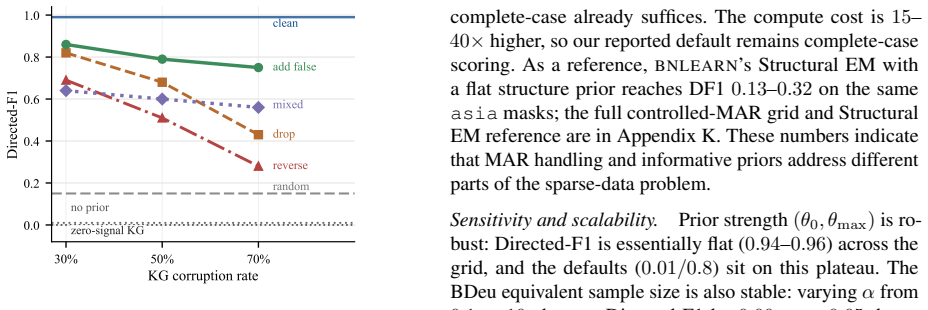
KG-SoftMAP encodes such a KG as a finite-strength, confidence-weighted edge prior and maximizes a MAP objective combining the BDeu score with a logit-form prior; the KG may be expert-curated or LLM-extracted. On synthetic benchmarks with known DAGs, KG-SoftMAP reaches Directed-F1 (DF1) 0.19--0.32 at observation rate ρ=0.05 and DF1 0.44--0.97 at ρ≥0.2, while every data-only learner tested stays near zero under the same sparse masks. Recovery tracks KG quality: controlled corruption degrades it smoothly, a zero-signal KG yields DF1 0.00, and a blindly LLM-extracted KG with imperfect precision and recall still drives substantial recovery.
What carries the argument
The logit-form edge prior derived from the weighted knowledge graph, added to the BDeu score to form the MAP objective that favors KG-suggested edges in proportion to their supplied .
If this is right
- At observation rate 0.05 the method recovers Directed-F1 between 0.19 and 0.32 on synthetic data with known DAGs.
- At observation rates 0.2 and above Directed-F1 rises to the range 0.44-0.97.
- Performance degrades smoothly under controlled corruption of the input knowledge graph and drops to zero when the graph carries no signal.
- An imperfect LLM-extracted knowledge graph still produces substantial structure recovery despite imperfect precision and recall.
- On real sparse educational data the resulting networks match logistic regression within 0.03 F1 while supplying inspectable concept graphs and calibrated posterior probabilities.
Where Pith is reading between the lines
- The approach suggests that modest amounts of noisy external knowledge can substitute for large volumes of joint observations in domains where data collection is costly.
- Because the prior strength is finite and tunable, the method remains robust to moderate errors in the supplied graph rather than requiring perfect domain knowledge.
- The same MAP construction could be applied to other score-based graphical model learners whenever a weighted knowledge source is available.
Load-bearing premise
The supplied knowledge graph encodes useful, non-misleading information about edge presence that can be faithfully represented by a logit-form prior of finite strength.
What would settle it
Running the method on a knowledge graph known to be unrelated to the true DAG and observing that Directed-F1 remains near zero, matching the data-only BDeu baseline, would show the prior adds no value.
Figures
read the original abstract
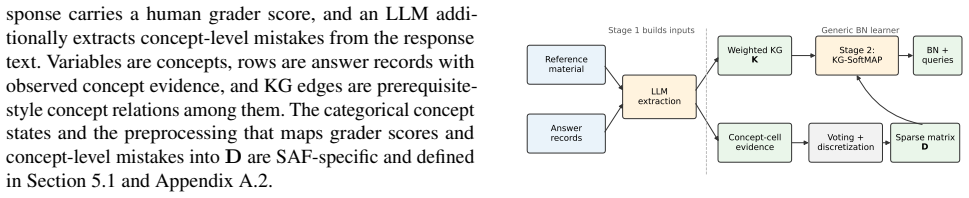
Learning Bayesian network (BN) structure from sparse discrete data is hard: when each instance records only a few variables, most variable pairs lack the joint observations needed for reliable scoring, and data-only methods recover little structure. However, imperfect domain knowledge, expressible as a weighted directed knowledge graph (KG), is often available. We propose KG-SoftMAP, which encodes such a KG as a finite-strength, confidence-weighted edge prior and maximizes a MAP objective combining the BDeu score with a logit-form prior; the KG may be expert-curated or LLM-extracted. On synthetic benchmarks with known DAGs, KG-SoftMAP reaches Directed-F1 (DF1) $0.19$--$0.32$ at observation rate $\rho=0.05$ and DF1 $0.44$--$0.97$ at $\rho\geq0.2$, while every data-only learner tested stays near zero under the same sparse masks. Recovery tracks KG quality: controlled corruption degrades it smoothly, a zero-signal KG yields DF1 $0.00$, and a blindly LLM-extracted KG with imperfect precision and recall still drives substantial recovery. On three real sparse educational datasets, the learned BN acts as a concept-level posterior model: on SAF it matches logistic regression (LR) within $0.03$ F1_FAIL while providing an inspectable concept graph, calibrated Fail probabilities, and tractable posterior queries from partial observations.
Editorial analysis
A structured set of objections, weighed in public.
Referee Report
Summary. The paper proposes KG-SoftMAP, a method for Bayesian network structure learning from sparse discrete data that augments the standard BDeu score with a finite-strength, confidence-weighted logit-form prior derived from an externally supplied directed knowledge graph (KG). The KG may be expert-curated or LLM-extracted. On synthetic benchmarks with known ground-truth DAGs, the method reports Directed-F1 scores of 0.19--0.32 at observation rate ρ=0.05 and 0.44--0.97 at ρ≥0.2, while data-only baselines remain near zero; performance tracks KG quality, degrades smoothly under controlled corruption, reaches DF1=0.00 with zero-signal KG, and still improves with imperfect LLM-extracted KGs. On three real sparse educational datasets the learned networks are evaluated as concept-level posterior models, matching logistic regression F1 within 0.03 on one dataset while enabling inspectable graphs and tractable queries.
Significance. If the empirical claims hold under the reported controls, the work supplies a practical mechanism for injecting soft domain knowledge into score-based structure learning precisely where data sparsity renders purely data-driven methods ineffective. Explicit ablation on KG corruption, zero-signal baselines, and LLM-derived graphs provides direct evidence that gains are not artifactual. The approach is falsifiable via the stated degradation behavior and supplies a concrete, inspectable output (the learned BN) on real data. These elements strengthen the contribution relative to prior work that either assumes perfect priors or lacks such quality-sensitivity tests.
minor comments (3)
- Abstract: the reported DF1 ranges and degradation behavior are stated without any reference to the number of synthetic graphs, the precise corruption model, or the statistical aggregation (means, intervals) used; adding one sentence summarizing the experimental protocol would improve verifiability without lengthening the abstract substantially.
- §4 (synthetic experiments): the description of how the logit-form prior strength is chosen (or whether it is cross-validated) is not explicit; a short paragraph or table entry clarifying the hyper-parameter selection procedure would aid reproducibility.
- Figure 3 (real-data results): axis labels and legend entries use abbreviations (SAF, LR, DF1) that are defined only in the caption; moving the definitions into the figure itself or adding a small key would improve standalone readability.
Simulated Author's Rebuttal
We thank the referee for their positive evaluation of KG-SoftMAP and for recommending minor revision. The summary accurately reflects the method's use of confidence-weighted logit priors from directed KGs (expert or LLM-derived) to augment BDeu scoring, the reported DF1 gains on sparse synthetic data, the quality-sensitivity ablations, and the real-data evaluation as inspectable posterior models. No major comments were provided in the report.
Circularity Check
No significant circularity
full rationale
The KG-SoftMAP method augments the standard BDeu score with an externally supplied knowledge-graph prior (expert-curated or LLM-extracted) inside a MAP objective. Performance is explicitly shown to track KG quality, reach DF1 0.00 with zero-signal KG, and degrade under controlled corruption. No equation or claim reduces a reported result to a fitted quantity defined from the target data, no self-citation chain is load-bearing, and the central improvement is tested against data-only baselines under the same sparse masks. The derivation is therefore self-contained against external benchmarks.
Axiom & Free-Parameter Ledger
axioms (1)
- domain assumption BDeu score provides a valid marginal likelihood for discrete Bayesian network structure scoring
Reference graph
Works this paper leans on
-
[1]
Annalen der Physik , volume =
Albert Einstein , title =. Annalen der Physik , volume =
-
[2]
1993 , publisher =
Michel Goossens and Frank Mittelbach and Alexander Samarin , title =. 1993 , publisher =
1993
-
[3]
Journal of Machine Learning Research , volume =
David Maxwell Chickering , title =. Journal of Machine Learning Research , volume =
-
[4]
Judea Pearl , title =
-
[5]
Nir Friedman and Michal Linial and Iftach Nachman and Dana P\'. Using. Journal of Computational Biology , volume =
-
[6]
Rodin and Eric Boerwinkle , title =
Andrei S. Rodin and Eric Boerwinkle , title =. Bioinformatics , volume =
-
[7]
Borsuk and Craig A
Mark E. Borsuk and Craig A. Stow and Kenneth H. Reckhow , title =. Ecological Modelling , volume =
-
[8]
Cooper , title =
Subramani Mani and Gregory F. Cooper , title =. Proceedings of the AMIA Annual Fall Symposium , pages =
-
[9]
Rajapakse and Juan Zhou , title =
Jagath C. Rajapakse and Juan Zhou , title =. NeuroImage , volume =
-
[10]
J. N. Li and Z. J. Wang and S. J. Palmer and M. J. McKeown , title =. NeuroImage , volume =
-
[11]
IIE Transactions , volume =
Jing Li and Jianjun Shi , title =. IIE Transactions , volume =
-
[12]
Peter Spirtes and Clark Glymour and Richard Scheines , title =
-
[13]
Maathuis , title =
Diego Colombo and Marloes H. Maathuis , title =. Journal of Machine Learning Research , volume =
-
[14]
Machine Learning , volume =
David Heckerman and Dan Geiger and David Maxwell Chickering , title =. Machine Learning , volume =
-
[15]
Cooper and Edward Herskovits , title =
Gregory F. Cooper and Edward Herskovits , title =. Machine Learning , volume =
-
[16]
Proceedings of the 7th Conference on Uncertainty in Artificial Intelligence , pages =
Wray Buntine , title =. Proceedings of the 7th Conference on Uncertainty in Artificial Intelligence , pages =
-
[17]
The Annals of Statistics , volume =
Gideon Schwarz , title =. The Annals of Statistics , volume =
-
[18]
Computational Intelligence , volume =
Wai Lam and Fahiem Bacchus , title =. Computational Intelligence , volume =
-
[19]
Proceedings of the 9th Conference on Uncertainty in Artificial Intelligence , pages =
Joe Suzuki , title =. Proceedings of the 9th Conference on Uncertainty in Artificial Intelligence , pages =
-
[20]
R. W. Robinson , title =. Combinatorial Mathematics V , volume =
-
[21]
Proceedings of the 19th Conference on Uncertainty in Artificial Intelligence , pages =
David Maxwell Chickering and David Heckerman and Christopher Meek , title =. Proceedings of the 19th Conference on Uncertainty in Artificial Intelligence , pages =
-
[22]
de Campos , title =
Silvia Acid and Luis M. de Campos , title =. Journal of Artificial Intelligence Research , volume =
-
[23]
Journal of Machine Learning Research , volume =
Robert Castelo and Tom Kocka , title =. Journal of Machine Learning Research , volume =
-
[24]
Learning
Pedro Larra\. Learning. IEEE Transactions on Systems, Man, and Cybernetics , volume =
-
[25]
Structure Learning of
Pedro Larra\. Structure Learning of. IEEE Transactions on Pattern Analysis and Machine Intelligence , volume =
-
[26]
Proceedings of the 5th International Workshop on Artificial Intelligence and Statistics , year =
David Maxwell Chickering and Dan Geiger and David Heckerman , title =. Proceedings of the 5th International Workshop on Artificial Intelligence and Statistics , year =
-
[27]
Proceedings of the 21st Conference on Uncertainty in Artificial Intelligence , pages =
Marc Teyssier and Daphne Koller , title =. Proceedings of the 21st Conference on Uncertainty in Artificial Intelligence , pages =
-
[28]
Xing , title =
Xun Zheng and Bryon Aragam and Pradeep Ravikumar and Eric P. Xing , title =. Advances in Neural Information Processing Systems , volume =
-
[29]
Proceedings of the 20th Conference on Uncertainty in Artificial Intelligence , pages =
Mikko Koivisto and Kismat Sood , title =. Proceedings of the 20th Conference on Uncertainty in Artificial Intelligence , pages =
-
[30]
A Simple Approach for Finding the Globally Optimal
Tomi Silander and Petri Myllym\". A Simple Approach for Finding the Globally Optimal. Proceedings of the 22nd Conference on Uncertainty in Artificial Intelligence , pages =
-
[31]
Proceedings of the 27th Conference on Uncertainty in Artificial Intelligence , pages =
James Cussens , title =. Proceedings of the 27th Conference on Uncertainty in Artificial Intelligence , pages =
-
[32]
Proceedings of the 13th International Conference on Artificial Intelligence and Statistics , pages =
Tommi Jaakkola and David Sontag and Amir Globerson and Marina Meila , title =. Proceedings of the 13th International Conference on Artificial Intelligence and Statistics , pages =
-
[33]
Estimating High-Dimensional Directed Acyclic Graphs with the
Markus Kalisch and Peter B\". Estimating High-Dimensional Directed Acyclic Graphs with the. Journal of Machine Learning Research , volume =
-
[34]
Journal of Statistical Software , volume =
Marco Scutari , title =. Journal of Statistical Software , volume =
-
[35]
Madsen and Frank Jensen and Antonio Salmer\'
Anders L. Madsen and Frank Jensen and Antonio Salmer\'. A Parallel Algorithm for. Knowledge-Based Systems , volume =
-
[36]
Brown and Constantin F
Ioannis Tsamardinos and Laura E. Brown and Constantin F. Aliferis , title =. Machine Learning , volume =
-
[37]
Advances in Neural Information Processing Systems , year =
Dimitris Margaritis and Sebastian Thrun , title =. Advances in Neural Information Processing Systems , year =
-
[38]
Jean-Philippe Pellet and Andr\'. Using. Journal of Machine Learning Research , volume =
-
[39]
Learning
Nir Friedman and Iftach Nachman and Dana P\'. Learning. Proceedings of the 15th Conference on Uncertainty in Artificial Intelligence , pages =
-
[40]
Proceedings of the 22nd National Conference on Artificial Intelligence , pages =
Mark Schmidt and Alexandru Niculescu-Mizil and Kevin Murphy , title =. Proceedings of the 22nd National Conference on Artificial Intelligence , pages =
-
[41]
Journal of the Royal Statistical Society: Series B , volume =
Robert Tibshirani , title =. Journal of the Royal Statistical Society: Series B , volume =
-
[42]
IEEE Transactions on Pattern Analysis and Machine Intelligence , volume =
Shuai Huang and Jing Li and Jieping Ye and Adam Fleisher and Kewei Chen and Teresa Wu and Eric Reiman , title =. IEEE Transactions on Pattern Analysis and Machine Intelligence , volume =
-
[43]
Proceedings of the 11th Conference on Uncertainty in Artificial Intelligence , pages =
Christopher Meek , title =. Proceedings of the 11th Conference on Uncertainty in Artificial Intelligence , pages =
-
[44]
Fleisher and Eric M
Xia Wu and Rui Li and Adam S. Fleisher and Eric M. Reiman and Kewei Chen and Ling Yao , title =. Human Brain Mapping , volume =
-
[45]
Proceedings of the 14th Conference on Uncertainty in Artificial Intelligence , pages =
Nir Friedman , title =. Proceedings of the 14th Conference on Uncertainty in Artificial Intelligence , pages =
-
[46]
International Journal of Approximate Reasoning , volume =
Mauro Scanagatta and Giorgio Corani and Marco Zaffalon and Jae-Seok Yoo and U Kang , title =. International Journal of Approximate Reasoning , volume =
-
[47]
Learning
Antonio Fern\'. Learning. International Journal of Uncertainty, Fuzziness and Knowledge-Based Systems , volume =
-
[48]
On the role of sparsity and
Ng, Ignavier and Ghassami, AmirEmad and Zhang, Kun , booktitle=. On the role of sparsity and
-
[49]
Bello, Kevin and Aragam, Bryon and Ravikumar, Pradeep , booktitle=
-
[50]
and Castellano, Javier M
de Campos, Luis M. and Castellano, Javier M. , journal=
-
[51]
On sensitivity of the
Silander, Tomi and Kontkanen, Petri and Myllym. On sensitivity of the. UAI , pages=
-
[52]
Proceedings of the AAAI Conference on Artificial Intelligence , volume=
Learning Bayesian networks with incomplete data by augmentation , author=. Proceedings of the AAAI Conference on Artificial Intelligence , volume=
-
[53]
, journal =
Lee, Jihyun and Corter, James E. , journal =. Diagnosis of Subtraction Bugs Using. 2011 , doi =
2011
-
[55]
Proceedings of the 41st International Conference on Machine Learning (ICML) , series =
Stable Differentiable Causal Discovery , author =. Proceedings of the 41st International Conference on Machine Learning (ICML) , series =
-
[56]
Advances in Neural Information Processing Systems 34 (NeurIPS) , year =
Lorch, Lars and Rothfuss, Jonas and Sch. Advances in Neural Information Processing Systems 34 (NeurIPS) , year =
-
[57]
Yu, Yue and Gao, Tian and Yin, Naiyu and Ji, Qiang , booktitle =
-
[59]
2025 , doi =
Ban, Taiyu and Chen, Lyuzhou and Lyu, Derui and Wang, Xiangyu and Zhu, Qinrui and Chen, Huanhuan , journal =. 2025 , doi =
2025
-
[60]
IEEE Transactions on Emerging Topics in Computational Intelligence , volume =
Harnessing the Power of Knowledge Graphs to Improve Causal Discovery , author =. IEEE Transactions on Emerging Topics in Computational Intelligence , volume =
-
[61]
Zhang, Yinghuan and Zhang, Yufei and Kordjamshidi, Parisa and Cui, Zijun , journal =
-
[63]
Realizing
Srivastava, Ashutosh and Nagalapatti, Lokesh and Jajoo, Gautam and Vashishtha, Aniket and Krishnamurthy, Parameswari and Sharma, Amit , journal =. Realizing
-
[64]
International Conference on Learning Representations (ICLR) , year =
Causal Modelling Agents: Causal Graph Discovery through Synergising Metadata- and Data-driven Reasoning , author =. International Conference on Learning Representations (ICLR) , year =
-
[65]
Bayesian Analysis , volume =
On the Prior and Posterior Distributions Used in Graphical Modelling , author =. Bayesian Analysis , volume =. 2013 , doi =
2013
-
[66]
Proceedings of the 34th International Joint Conference on Artificial Intelligence (IJCAI) , pages =
Large Language Models for Causal Discovery: Current Landscape and Future Directions , author =. Proceedings of the 34th International Joint Conference on Artificial Intelligence (IJCAI) , pages =. 2025 , doi =
2025
-
[67]
Findings of the Association for Computational Linguistics: NAACL 2025 , pages =
Causal Inference with Large Language Model: A Survey , author =. Findings of the Association for Computational Linguistics: NAACL 2025 , pages =. 2025 , doi =
2025
-
[68]
Advances in Neural Information Processing Systems 28 (NeurIPS) , year =
Deep Knowledge Tracing , author =. Advances in Neural Information Processing Systems 28 (NeurIPS) , year =
-
[69]
Proceedings of the 12th International Conference on Educational Data Mining (EDM) , year =
A Self-Attentive Model for Knowledge Tracing , author =. Proceedings of the 12th International Conference on Educational Data Mining (EDM) , year =
-
[70]
Proceedings of the 26th ACM SIGKDD International Conference on Knowledge Discovery and Data Mining (KDD) , year =
Context-Aware Attentive Knowledge Tracing , author =. Proceedings of the 26th ACM SIGKDD International Conference on Knowledge Discovery and Data Mining (KDD) , year =
-
[71]
Proceedings of the Seventh ACM Conference on Learning @ Scale (L@S) , year =
Towards an Appropriate Query, Key, and Value Computation for Knowledge Tracing , author =. Proceedings of the Seventh ACM Conference on Learning @ Scale (L@S) , year =
-
[72]
Liu, Zitao and others , booktitle =. simple
-
[73]
Liu, Zitao and others , booktitle =
-
[74]
Instructions and Guide for Diagnostic Questions: The
Wang, Zichao and others , journal =. Instructions and Guide for Diagnostic Questions: The
-
[75]
User Modeling and User-Adapted Interaction , volume =
Addressing the assessment challenge with an online system that tutors as it assesses , author =. User Modeling and User-Adapted Interaction , volume =
-
[76]
Proceedings of the 38th Conference on Uncertainty in Artificial Intelligence (UAI) , series =
Greedy Relaxations of the Sparsest Permutation Algorithm , author =. Proceedings of the 38th Conference on Uncertainty in Artificial Intelligence (UAI) , series =
-
[77]
Fast Scalable and Accurate Discovery of
Andrews, Bryan and Ramsey, Joseph and S. Fast Scalable and Accurate Discovery of. Advances in Neural Information Processing Systems 36 (NeurIPS) , year =
-
[78]
Proceedings of the 27th International Conference on Artificial Intelligence and Statistics (AISTATS) , series =
Self-Compatibility: Evaluating Causal Discovery without Ground Truth , author =. Proceedings of the 27th International Conference on Artificial Intelligence and Statistics (AISTATS) , series =
-
[79]
Machine Learning , volume =
Greedy structure learning from data that contain systematic missing values , author =. Machine Learning , volume =
-
[80]
Psychological Methods , volume =
Planned missing data designs in psychological research , author =. Psychological Methods , volume =
-
[81]
Consistent model selection of discrete
Balov, Nikolay , journal =. Consistent model selection of discrete. 2013 , doi =
2013
-
[82]
Statistical Analysis with Missing Data , author =
-
[83]
Castro, and Daniel C
Ahmed Abdulaal, Adamos Hadjivasiliou, Nina Monta \ n a-Brown, Tiantian He, Ayodeji Ijishakin, Ivana Drobnjak, Daniel C. Castro, and Daniel C. Alexander. Causal modelling agents: Causal graph discovery through synergising metadata- and data-driven reasoning. In International Conference on Learning Representations (ICLR), 2024
2024
discussion (0)
Sign in with ORCID, Apple, or X to comment. Anyone can read and Pith papers without signing in.