REVIEW 1 major objections 1 cited by
SkillResolve-Bench: Measuring and Resolving Same-Capability Ambiguity in Agent Skill Retrieval
T0 review · 1 major / 0 minor · reviewed 2026-06-27 · grok-4.3
Pith's one-line read Agent skill retrieval can eliminate exposure to risky same-capability variants by selecting family representatives.
desk verdict SkillResolve-Bench and the family-resolution method target same-capability ambiguity in agent skill retrieval with measurable gains on harmful sibling rate. read the letter →
The pith
A machine-rendered reading of the paper's core claim, the machinery that carries it, and where it could break.
The reading
What carries the argument
Within-family representative selection after resolving capability families, which prevents harmful sibling exposure in top-K results.
What would settle it
Running the benchmark on an independent collection of agent skills and checking if the HSR@3 remains zero for the SkillResolve method while maintaining the reported recall levels.
Extended reading notes
Core claim
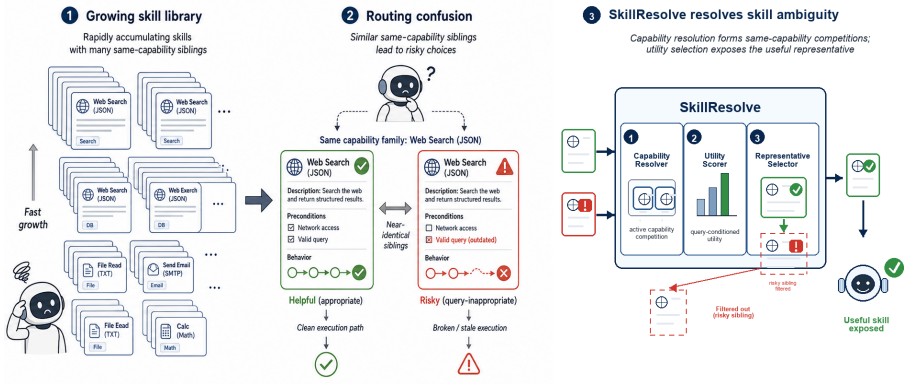
Each query in the benchmark pairs a helpful skill with a query-specific risky sibling that shares the capability family but can lead to execution problems. SkillResolve resolves active candidate families, scores query-conditioned utility from confusable library negatives and contract-profile cues, and selects one representative from each family before the final top-K list. Under the released family relation, SkillResolve reaches Recall@3 0.766 and NDCG@3 0.699 while keeping HSR@3=0. It improves over SkillRouter by 0.112 Recall@3 and 0.165 NDCG@3 while reducing HSR@3 from 0.693 to 0. Without representative selection, HSR@3 rises to 0.236 under the same scorer.
Load-bearing premise
The 661 helpful/risky pairs and the family relations supplied with the benchmark correctly capture genuine same-capability execution-risk distinctions that occur in real agent skill libraries, without artificial construction artifacts or unrepresentative sampling.
Editorial extensions
If this is right
- The representative selection mechanism reduces HSR@3 to 0 while preserving high Recall@3 and NDCG@3.
- Omitting representative selection increases HSR@3 to 0.236 with the same scoring function.
- SkillResolve improves Recall@3 by 0.112 and NDCG@3 by 0.165 compared to SkillRouter.
- The benchmark supports auditing through source-role evidence, cue/leakage checks, and query-disjoint splits.
Reading between the lines
- Libraries could adopt family annotations to support safer skill composition in agents.
- The approach may extend to other domains like code retrieval where similar implementations carry different risks.
- Real-world agent runs on benchmark tasks could test if lower HSR correlates with fewer failures.
Editorial analysis
A structured set of objections, weighed in public.
Referee Report
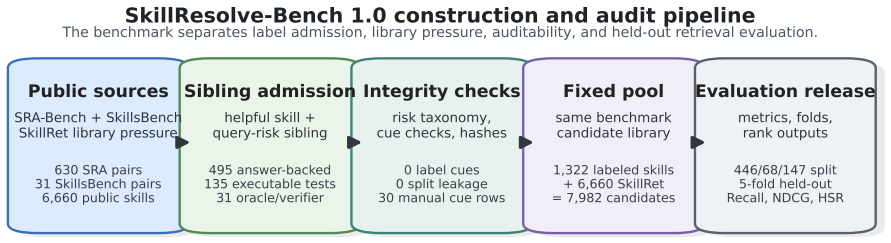
Summary. The paper claims that skill retrieval for agent libraries can surface the wrong same-capability representative, exposing execution risks even when the capability family is correct; it introduces SkillResolve-Bench (661 helpful/risky pairs, 7,982-candidate pool, query-disjoint splits, cue/leakage checks) and the SkillResolve method (family resolution + query-conditioned scoring + representative selection) that reports Recall@3=0.766, NDCG@3=0.699, HSR@3=0, outperforming SkillRouter by 0.112/0.165 while driving HSR@3 from 0.693 to 0, with an ablation showing HSR@3 rises to 0.236 without representative selection.
Significance. If the benchmark pairs and family relations validly reflect real execution-risk distinctions, the work identifies a practically important failure mode in agent skill retrieval and supplies both a measurable benchmark and a concrete mitigation (within-family representative selection) whose contribution is isolated by ablation; the released benchmark and explicit ablation isolating the representative-selection step are strengths that support reproducibility and mechanistic insight.
major comments (1)
- [Abstract] Abstract (benchmark construction paragraph): the headline metrics (Recall@3 0.766, NDCG@3 0.699, HSR@3=0) and the claim that representative selection turns capability retrieval into safer procedural exposure presuppose that the 661 helpful/risky pairs and released family relations capture genuine same-capability execution-risk distinctions arising in real libraries; the text lists source-role evidence, cue/leakage checks, and query-disjoint splits but supplies no inter-annotator agreement figures, quantitative bias audit, or sampling audit, leaving the zero-HSR result and the ablation unsupported for transfer.
Simulated Author's Rebuttal
We thank the referee for the constructive review and for acknowledging the practical importance of same-capability ambiguity as well as the strengths of the released benchmark and ablation. We address the single major comment below.
read point-by-point responses
-
Referee: [Abstract] Abstract (benchmark construction paragraph): the headline metrics (Recall@3 0.766, NDCG@3 0.699, HSR@3=0) and the claim that representative selection turns capability retrieval into safer procedural exposure presuppose that the 661 helpful/risky pairs and released family relations capture genuine same-capability execution-risk distinctions arising in real libraries; the text lists source-role evidence, cue/leakage checks, and query-disjoint splits but supplies no inter-annotator agreement figures, quantitative bias audit, or sampling audit, leaving the zero-HSR result and the ablation unsupported for transfer.
Authors: We agree that the manuscript would benefit from expanded quantitative validation of the benchmark construction. The 661 pairs were produced via deterministic source-role extraction from the original SkillRet library metadata together with the 6,660 public candidates; risk labels follow three explicitly defined execution-risk categories (stale resource, missing precondition, wrong procedure). Cue/leakage checks and query-disjoint splits were applied to eliminate trivial or contaminated queries. Because the labeling process was rule-based rather than free-form subjective annotation, inter-annotator agreement was not computed. In the revised version we will add a dedicated “Benchmark Construction Validation” subsection that reports: (i) a sampling audit giving the distribution of risk types and family sizes, (ii) a quantitative bias audit comparing family statistics in the 661-pair set against the full 7,982-candidate pool, and (iii) explicit discussion of how the source-role evidence supports transfer to other libraries. These additions will strengthen the support for the reported HSR@3=0 result and the ablation isolating representative selection. The ablation itself remains internally valid because it holds the scorer fixed and varies only the representative-selection step. revision: yes
Circularity Check
No circularity; empirical evaluation on newly introduced benchmark
full rationale
The paper introduces SkillResolve-Bench with 661 helpful/risky pairs and released family relations, then reports direct empirical metrics (Recall@3 0.766, NDCG@3 0.699, HSR@3=0) for SkillResolve versus baselines like SkillRouter on query-disjoint splits. No equations, fitted parameters, or self-citations appear in the provided text. The representative selection step uses the benchmark's supplied family relations to produce HSR@3=0, but this is an explicit design choice evaluated against fixed ground-truth pairs rather than a redefinition or statistical forcing of the reported gains. The ablation (HSR@3 rising to 0.236 without selection) is likewise a direct measurement. This matches the default case of a self-contained empirical study with no load-bearing reductions to inputs by construction.
Assumptions & free parameters
assumptions (2)
- domain assumption Skills sharing a capability family can be distinguished by execution-risk attributes such as resource staleness or precondition mismatch.
- domain assumption The benchmark construction with source-role evidence, cue/leakage checks, and query-disjoint splits produces unbiased test cases.
Cite this review
Pith. "Pith review of SkillResolve-Bench: Measuring and Resolving Same-Capability Ambiguity in Agent Skill Retrieval." pith.science (2026). https://pith.science/paper/3LT6FBMA
@misc{pith2026260610388,
  author       = {Pith},
  title        = {Pith review of: SkillResolve-Bench: Measuring and Resolving Same-Capability Ambiguity in Agent Skill Retrieval},
  year         = {2026},
  howpublished = {\url{https://pith.science/paper/3LT6FBMA}},
  note         = {Machine review of arXiv:2606.10388}
}
read the original abstract
Agent skill libraries are becoming routable software assets: a retrieved skill can contribute instructions, scripts, resource bindings, and execution assumptions to an agent. This makes skill retrieval more than broad relevance matching. A retriever can find the right capability family yet expose the wrong same-capability representative. We study this failure as same-capability execution-risk retrieval. Each query pairs a helpful skill with a query-specific risky sibling that shares the capability family but can lead execution toward a stale resource, missing precondition, or wrong procedure. We introduce SkillResolve-Bench 1.0, an auditable benchmark for this setting with 661 helpful/risky pairs, source-role and admission evidence, cue/leakage checks, query-disjoint splits, and a 7,982-candidate pool that includes 6,660 public SkillRet candidates. The benchmark reports helpful ranking together with harmful sibling rate (HSR@K), the top-K exposure of the risky sibling. We also provide SkillResolve, a reference method that resolves active candidate families, scores query-conditioned utility from confusable library negatives and contract-profile cues, and selects one representative from each family before the final top-K list. Under the released family relation, SkillResolve reaches Recall@3 0.766 and NDCG@3 0.699 while keeping HSR@3=0. It improves over SkillRouter by 0.112 Recall@3 and 0.165 NDCG@3 while reducing HSR@3 from 0.693 to 0. Without representative selection, HSR@3 rises to 0.236 under the same scorer, identifying within-family representative choice as the mechanism that turns capability retrieval into safer procedural exposure.
Figures
Forward citations
Cited by 1 Pith paper
-
From Relevance to Execution Utility: Reward-Aware Dynamic Execution Gating for Skill-Based LLM Agents
A lightweight post-retrieval gate trained on verifier feedback can skip most low-value LLM agent executions while retaining most of the achievable reward.
Reference graph
Works this paper leans on
-
[1]
2025 , howpublished =
Introducing Agent Skills , author =. 2025 , howpublished =
2025
-
[2]
2026 , eprint =
SkillRouter: Skill Routing for LLM Agents at Scale , author =. 2026 , eprint =
2026
-
[3]
2026 , eprint =
SkillRet: A Large-Scale Benchmark for Skill Retrieval in LLM Agents , author =. 2026 , eprint =
2026
-
[4]
2026 , eprint =
Skill Is Not Document: A Query-Conditional Benchmark and Two-Stage Retriever for LLM Agent Skill Routing , author =. 2026 , eprint =
2026
-
[5]
2026 , eprint =
Skill Retrieval Augmentation for Agentic AI , author =. 2026 , eprint =
2026
-
[6]
2026 , eprint =
SkillsVote: Lifecycle Governance of Agent Skills from Collection, Recommendation to Evolution , author =. 2026 , eprint =
2026
-
[7]
2026 , eprint =
How Well Do Agentic Skills Work in the Wild: Benchmarking LLM Skill Usage in Realistic Settings , author =. 2026 , eprint =
2026
-
[8]
2026 , eprint =
SkillSieve: A Hierarchical Triage Framework for Detecting Malicious AI Agent Skills , author =. 2026 , eprint =
2026
Show all 38 references
-
[9]
2026 , eprint =
Group of Skills: Group-Structured Skill Retrieval for Agent Skill Libraries , author =. 2026 , eprint =
2026
-
[10]
2026 , eprint =
Trace2Skill: Distill Trajectory-Local Lessons into Transferable Agent Skills , author =. 2026 , eprint =
2026
-
[11]
2026 , eprint =
SkillAdaptor: Self-Adapting Skills for LLM Agents from Trajectories , author =. 2026 , eprint =
2026
-
[12]
2024 , eprint =
BGE M3-Embedding: Multi-Lingual, Multi-Functionality, Multi-Granularity Text Embeddings Through Self-Knowledge Distillation , author =. 2024 , eprint =
2024
-
[13]
2026 , eprint =
SkillsBench: Benchmarking How Well Agent Skills Work Across Diverse Tasks , author =. 2026 , eprint =
2026
-
[14]
2026 , eprint =
OpenSkillEval: Automatically Auditing the Open Skill Ecosystem for LLM Agents , author =. 2026 , eprint =
2026
-
[15]
Proceedings of Agent Skills '26 , year =
What Keeps Agent Skills from Being Reusable? Evidence from 138K SKILL.md Files , author =. Proceedings of Agent Skills '26 , year =
-
[16]
2026 , eprint =
SkillReducer: Optimizing LLM Agent Skills for Token Efficiency , author =. 2026 , eprint =
2026
-
[17]
2026 , eprint =
SkillOps: Managing LLM Agent Skill Libraries as Self-Maintaining Software Ecosystems , author =. 2026 , eprint =
2026
-
[18]
2026 , eprint =
SkillOS: Towards Open-ended Skill Management for Large Language Model Agents , author =. 2026 , eprint =
2026
-
[19]
2026 , eprint =
Towards Secure Agent Skills: Architecture, Threat Taxonomy, and Security Analysis , author =. 2026 , eprint =
2026
-
[20]
2026 , eprint =
MalSkillBench: A Runtime-Verified Benchmark of Malicious Agent Skills , author =. 2026 , eprint =
2026
-
[21]
2026 , eprint =
SkillGuard: A Permission Framework for Agent Skills , author =. 2026 , eprint =
2026
-
[22]
2026 , eprint =
SkillTrojan: Backdoor Attacks on Skill-Based Agent Systems , author =. 2026 , eprint =
2026
-
[23]
2026 , eprint =
SkillSafetyBench: Evaluating Agent Safety under Skill-Facing Attack Surfaces , author =. 2026 , eprint =
2026
-
[24]
2026 , eprint =
Structured Security Auditing and Robustness Enhancement for Untrusted Agent Skills , author =. 2026 , eprint =
2026
-
[25]
2026 , eprint =
SkillGen: Verified Inference-Time Agent Skill Synthesis , author =. 2026 , eprint =
2026
-
[26]
2026 , eprint =
SkillGenBench: Benchmarking Skill Generation Pipelines for LLM Agents , author =. 2026 , eprint =
2026
-
[27]
2026 , eprint =
Skills on the Fly: Test-Time Adaptive Skill Synthesis for LLM Agents , author =. 2026 , eprint =
2026
-
[28]
2026 , eprint =
MUSE-Autoskill: Self-Evolving Agents via Skill Creation, Memory, Management, and Evaluation , author =. 2026 , eprint =
2026
-
[29]
2026 , eprint =
SkillSmith: Compiling Agent Skills into Boundary-Guided Runtime Interfaces , author =. 2026 , eprint =
2026
-
[30]
2026 , eprint =
A Comprehensive Survey on Agent Skills: Taxonomy, Techniques, and Applications , author =. 2026 , eprint =
2026
-
[31]
Proceedings of the First Workshop on Agent Skills , year =
SkillSeek: Plug-and-Play Skill Retrieval for Open-Source Agentic Workflows , author =. Proceedings of the First Workshop on Agent Skills , year =
-
[32]
2026 , eprint =
SkillRAE: Agent Skill-Based Context Compilation for Retrieval-Augmented Execution , author =. 2026 , eprint =
2026
-
[33]
2026 , eprint =
AIP: A Graph Representation for Learning and Governing Agent Skills , author =. 2026 , eprint =
2026
-
[34]
2026 , eprint =
Declarative Skills for AI Agents in Knowledge-Grounded Tool-Use Workflows , author =. 2026 , eprint =
2026
-
[35]
2026 , eprint =
Harnessing LLM Agents with Skill Programs , author =. 2026 , eprint =
2026
-
[36]
Proceedings of the First Workshop on Agent Skills , year =
SkillCompiler: A Unified Compilation Framework for Cross-Platform LLM Agent Skills , author =. Proceedings of the First Workshop on Agent Skills , year =
-
[37]
Proceedings of the 32nd International ACM SIGIR Conference on Research and Development in Information Retrieval , pages =
Reciprocal Rank Fusion Outperforms Condorcet and Individual Rank Learning Methods , author =. Proceedings of the 32nd International ACM SIGIR Conference on Research and Development in Information Retrieval , pages =
-
[38]
Foundations and Trends in Information Retrieval , volume =
The Probabilistic Relevance Framework: BM25 and Beyond , author =. Foundations and Trends in Information Retrieval , volume =
Reviewed June 27, 2026 · model on record in the stance chip above.
Discussion (0). Continue with ORCID to comment.