REVIEW 2 major objections 4 minor 12 references
From Relevance to Execution Utility: Reward-Aware Dynamic Execution Gating for Skill-Based LLM Agents
T0 review · 2 major / 4 minor · reviewed 2026-08-11 · deepseek-v4-flash
Pith's one-line read This paper introduces RADEG, a lightweight post-retrieval gate that predicts whether a query–bundle pair will earn verifier reward, and shows it can skip 68% of agent calls while retaining 61% of reward.
desk verdict Useful framing and a clean diagnostic, but the headline AUROC likely leaks same-query reward through the online head update; needs a stricter protocol before the central claim holds. read the letter →
The pith
A machine-rendered reading of the paper's core claim, the machinery that carries it, and where it could break.
The reading
What carries the argument
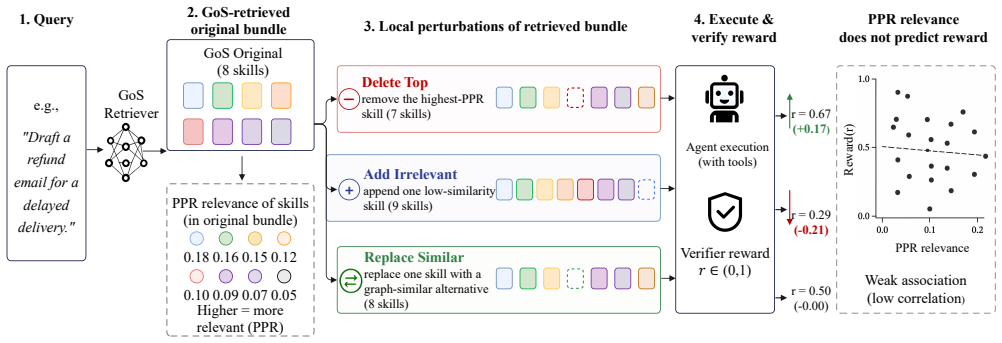
The load-bearing object is RADEG, a retriever-agnostic "execution gate" placed between skill retrieval and agent invocation: it outputs $g_{\theta}(q,b;\tau)=\mathbb{I}[s_{\theta}(q,b)\ge\tau]$, where the score $s_{\theta}(q,b)$ approximates $\Pr(r(q,b)>0\mid q,b)$ and the threshold $\tau$ controls the execute/skip trade-off. The score is produced by a frozen text encoder that maps the query and each skill's textual specification into embeddings, a mean-pooled bundle representation, a 776-dimension feature vector (query embedding, bundle embedding, a four-dimensional bundle-condition indicator, and four Graph-of-Skills PPR summary statistics), an MLP utility encoder, and a logistic execution head. Offline, the encoder and head are trained jointly with class-weighted binary cross-entropy on logged rollouts; online, only the warm-started logistic head is updated with observed verifier feedback, so the decision boundary adapts without retraining the retriever or the agent. The training data are generated by locally perturbing each retrieved bundle (delete top-PPR skill, add an irrelevant skill, replace with a graph-similar skill) to create matched same-query rollouts that isolate the effect of bundle composition on reward.
What would settle it
Re-run a sample of the 288 query-bundle pairs multiple times with non-zero sampling temperature under the same agent and verifier, and compute per-pair variance of verifier reward; if rewards flip between zero and positive across runs, or if a gate trained on single-run labels loses AUROC when evaluated against the averaged rewards, the single-rollout labeling assumption is violated.
Extended reading notes
Core claim
RADEG's central claim is that whether a retrieved skill bundle is worth executing can be scored before execution begins, using only the query, the bundle's text, and previously observed verifier feedback. The gate encodes the query and the mean-pooled bundle representation, feeds the concatenation through a small MLP, and trains a logistic head to estimate $\Pr(r(q,b)>0)$, the probability of non-zero verifier reward. Offline training uses class-weighted binary cross-entropy on logged rollouts; at deployment the encoder is frozen and only the logistic head is updated online as new verifier rewards arrive. To obtain supervision that controls for task difficulty, the authors construct matched same-query variants by deleting, adding, or replacing one skill in each retrieved bundle, so reward differences reflect bundle composition rather than query difficulty. The evaluation on 288 rollouts reports AUROC 0.717 and AUPRC 0.570, and at threshold 0.5 RADEG skips 68% of calls while retaining 61% of available reward, raising reward per executed call from 0.309 to 0.483.
Load-bearing premise
The method assumes that each query-bundle pair's single observed verifier reward is a reliable label for how useful that pair really is; if agent rollouts are stochastic, the gate may be predicting one run's luck rather than the bundle's worth.
Editorial extensions
If this is right
- Execution-utility prediction is a learnable, retriever-agnostic layer: RADEG can sit on top of any existing skill retriever and is evaluated with hybrid, BM25, and embedding retrieval.
- Fixed execution budgets become a ranking problem: given predicted utility scores, choosing the top K calls retains 40% of reward at a 20% budget, more than double the relevance-based gate's 15%.
- The gate transfers, with adaptation, across downstream agents: from a Claude-trained checkpoint, per-target AUROC reaches 0.733 on Qwen3.7-Max and 0.752 on GLM-5.2 after updating only the head.
- Because only the logistic head is updated online, the system can adapt to new verifier feedback at microsecond cost (about 75 microseconds per decision) instead of retraining the agent.
- Relevance scores such as Graph-of-Skills PPR carry almost no signal for non-zero reward (AUROC 0.435), so retrieval quality and execution utility should be optimized separately.
Reading between the lines
- Beyond the paper: if single-run rewards are noisy samples of a pair's true utility, the gate could be learning to predict one trajectory's luck; re-executing a sample of pairs multiple times and comparing AUROC against averaged rewards would test this directly.
- Beyond the paper: the matched-perturbation data-generation scheme could be reused as a self-supervised curriculum — an agent could generate its own delete, add, or replace variants online to bootstrap a gate when no logged rollouts exist.
- Beyond the paper: the fixed-budget results suggest a deployment policy that uses the gate's predicted scores to schedule executions rather than merely skip them, reserving scarce budget for the highest-scoring pairs while lower-scoring pairs wait.
- Beyond the paper: since exploration reveals labels for skipped calls, an epsilon-greedy deployment that occasionally executes low-scoring bundles trades a small cost for better future gating; the paper's reported degradation under selective feedback (AUROC 0.557 at epsilon 0) is consistent with this trade-off.
Editorial analysis
A structured set of objections, weighed in public.
Referee Report
Summary. The paper proposes RADEG, a post-retrieval, pre-execution gate for skill-based LLM agents. RADEG encodes a query and a retrieved skill bundle, predicts the probability of non-zero verifier reward, and decides whether to launch the expensive agent rollout; after deployment it updates only a logistic head from observed verifier feedback. The authors construct a 288-rollout dataset on SkillsBench by locally perturbing GoS bundles (delete, add, or replace one skill), find that aggregate PPR relevance has little predictive signal for reward, and report that RADEG achieves AUROC 0.717, skips 68% of calls, and retains 61% of verifier reward at threshold 0.5, outperforming PPR-based and random gating under matched execution budgets. Additional experiments cover cross-agent adaptation, generalization across retrievers and tool benchmarks, selective feedback with epsilon-greedy exploration, feature ablations, and runtime overhead.
Significance. The relevance-utility gap is a real and practically important problem, and the controlled perturbation design is a useful way to create supervision without hand-labeling. The paper shows good methodological hygiene in several respects: query-level splits, a 30-split uncertainty analysis for RADEG, a permutation test for PPR relevance, query-level bootstrap resampling for fixed-budget comparisons, and explicit measurements of the gate's runtime overhead. If the headline results survive a stricter evaluation protocol, RADEG would be a simple, retriever-agnostic, and cost-effective contribution to skill-based LLM agents. As reported, however, the central claim that execution utility can be predicted before a rollout is launched is not yet established, because the main evaluation allows the online head to receive same-query feedback within the held-out stream and because each query-bundle pair has only a single rollout whose reward is treated as a deterministic label.
major comments (2)
- [§5.1, §5.2, Table 3] The five-split evaluation is described as leakage-free, but the online update protocol in §4.4 lets the logistic head be updated with verifier feedback from one bundle variant of a held-out query before the remaining variants of the same query are scored. Since the four variants share a query and are reward-correlated, this within-query feedback can inflate the AUROC and the operational metrics in Table 3 relative to the deployment scenario in which only one bundle is retrieved per query. The paper itself concedes the issue for the cross-agent protocol in Technical Supplement C.3 ('feedback from an earlier bundle variant may influence predictions for later variants of the same query... a stricter evaluation should score all variants of a query before revealing any corresponding labels, or evaluate only one retrieved bundle per query'), but it does not address the same structural issue in the main five-split evaluation. Given that Static Head achieves AUROC 0.517, most of RADEG's reported advantage appears to come from the online head; the central claim therefore requires an evaluation in which all variants of a held-out query are scored before any label is revealed, or a single-bundle-per-query evaluation.
- [§3, §5.1] Each query-bundle pair is executed exactly once, and the resulting verifier reward is used as a deterministic label for both training and evaluation. If LLM agent rollouts are stochastic, a single rollout is a noisy draw from the distribution of outcomes for that pair, and the gate may be learning to predict one trajectory's luck rather than the pair's expected execution utility. The manuscript acknowledges stochastic execution variation only in Technical Supplement D.2 as a possible source of error in the case studies, not as a primary limitation of the learning protocol. The authors should either provide evidence that rewards are stable across repeated rollouts (for example, by repeating a subset of pairs with multiple independent rollouts and reporting agreement) or explicitly redefine the learning target as the reward of a single rollout under the fixed agent and verifier configuration, in which case the central claim about 'execution utility' should be qualified accordingly.
minor comments (4)
- [Table 3] The RADEG row contains a malformed entry ('0.5706861 0.483') and no uncertainty estimates for the baselines; since the paper's own 30-split analysis reports a standard deviation of 0.059 for RADEG's AUROC, reporting bootstrap or split-level intervals for all methods would clarify whether the gaps in Tables 3 and 4 are meaningful.
- [§6] The limitations paragraph does not mention the two most consequential threats identified above: same-query online updates within the held-out protocol and single-run rollout labels. These should be acknowledged explicitly even after a stricter evaluation is added.
- [Figure 2 and inline equations] Several figure captions and inline equations contain garbled or overlapping symbols, which makes the precise definitions hard to check; please regenerate the figure and proofread the tables.
- [Technical Supplement F] The cross-benchmark baselines 'Size-only' and 'GoS-based Gate' are not defined in the main text; the reader must infer their construction, so a one-sentence definition of each baseline belongs with the main results or in the supplement's setup.
Circularity Check
Headline AUROC rests on within-query online feedback: the paper's own TS C.3 concedes that rewards from one bundle variant can influence predictions for later variants of the same query, so the central 'pre-rollout prediction' claim is partly fitted to the target.
-
fitted input called prediction
[Technical Supplement C.3 (Cross-Agent Limitations); cf. Section 4.4 online update and Section 5.1 query-level splits]
"Although each rollout is scored before its own label is revealed, feedback from an earlier bundle variant may influence predictions for later variants of the same query. The protocol therefore avoids direct test-label leakage but does not represent a strict single-bundle-per-query deployment. A stricter evaluation should score all variants of a query before revealing any corresponding labels, or evaluate only one retrieved bundle per query."
The abstract claims RADEG 'predicts the execution utility of a query--bundle pair before the expensive rollout is launched,' and Table 3 reports the online-updating RADEG (AUROC 0.717) against Static Head (0.517). Under the query-level partition, all four bundle variants of a held-out query stay in the same evaluation stream, and Section 4.4 updates the logistic head on every observed verifier reward. Therefore, scores for the second through fourth variants of a held-out query are produced by a head already fitted to a same-query reward label. Because the variants share a query, these labels are correlated with the target, so the reported AUROC and operational metrics are partly forced by same-query outcome feedback rather than by pre-execution query--bundle features.
full rationale
Aside from the within-query online-feedback issue, the derivation is not circular: verifier reward is an external deterministic label, not a quantity defined by RADEG; the PPR permutation test shows retriever relevance carries no signal; the feature ablation shows the gate is not merely encoding perturbation category or PPR statistics; and Technical Supplement F evaluates RADEG on independent tool-agent benchmarks (tau-Bench, AgentDojo, ToolSandbox). Those provide real, non-circular evidence that query--bundle semantics can predict execution outcomes. However, the headline SkillsBench claim, which is the main support for 'predicts execution utility before the expensive rollout is launched,' is not established by the current protocol. TS C.3 concedes that feedback from an earlier bundle variant of a held-out query may influence predictions for later variants of the same query, and the stricter single-bundle-per-query evaluation is not performed. In addition, TS B.3 reports that under pure selective feedback (epsilon=0) AUROC drops to 0.557, close to Static Head's 0.517, while full-information replay (epsilon=1) gives 0.745; the main Table 3 numbers use the full-information setting, so part of the advertised online advantage comes from labels a deployed gate would never observe for skipped calls. This is the fitted-input-called-prediction pattern: the online head is fitted on same-query and skipped-call labels, and the fitted head's outputs are then reported as pre-rollout predictions. Score 6, not higher, because the target labels are external and the method has independent offline and cross-benchmark content; not lower, because the headline predictive metric is partially produced by fitting to labels that a pre-rollout gate would not have.
Assumptions & free parameters
free parameters (4)
- Execution threshold tau =
0.5
- Online learning rate eta =
not reported
- Offline MLP hyperparameters =
learning rate 1e-3, dropout 0.3, hidden dims 256/128/64
- Positive-class weight omega+ =
Nneg/Npos
assumptions (5)
- domain assumption The verifier reward from a single execution is a reliable ground-truth label for execution utility.
- domain assumption The three local perturbations, delete top, add irrelevant, and replace similar, span the relevant variation in bundle composition.
- domain assumption all-MiniLM-L6-v2 embeddings contain enough semantic signal to predict execution utility.
- domain assumption Held-out query-level splits from SkillsBench are representative of deployment conditions.
- domain assumption A logistic and MLP surrogate trained on 288 rollouts can generalize to unseen queries.
Cite this review
Pith. "Pith review of From Relevance to Execution Utility: Reward-Aware Dynamic Execution Gating for Skill-Based LLM Agents." pith.science (2026). https://pith.science/paper/I3DPSUGP
@misc{pith2026260809168,
  author       = {Pith},
  title        = {Pith review of: From Relevance to Execution Utility: Reward-Aware Dynamic Execution Gating for Skill-Based LLM Agents},
  year         = {2026},
  howpublished = {\url{https://pith.science/paper/I3DPSUGP}},
  note         = {Machine review of arXiv:2608.09168}
}
read the original abstract
Agent skills are increasingly used to equip large language model (LLM) agents with reusable procedural knowledge. Although recent work has substantially improved skill retrieval due to the increasing skill libraries, retrieving a plausible skill bundle does not guarantee that executing it is worthwhile. Since every skill-conditioned rollout is computationally expensive, deciding whether a retrieved bundle should be executed has become an increasingly important challenge. To this end, we introduce the Reward-Aware Dynamic Execution Gate (RADEG), a lightweight, retriever-agnostic decision layer between skill retrieval and agent execution. RADEG learns a low-cost surrogate model that predicts the execution utility of a query--bundle pair before the expensive rollout is launched. To obtain informative supervision while controlling for task difficulty, we locally perturb each retrieved bundle by deleting, adding, or replacing one skill, producing matched same-query rollouts that isolate the effect of bundle composition on verifier reward. During deployment, RADEG updates only a warm-started logistic head as new verifier feedback becomes available, enabling inexpensive adaptation of the execute/skip boundary without retraining either the retriever or the agent. Under a query-level held-out evaluation on 288 collected rollouts, RADEG substantially reduces unnecessary agent executions while preserving a large fraction of the downstream verifier reward. It consistently outperforms relevance-based and random gating across different execution budgets, demonstrating that execution-aware surrogate modeling provides a practical and cost-effective complement to skill retrieval.
Figures

Reference graph
Works this paper leans on
-
[2]
SkillRet: A Large- Scale Benchmark for Skill Retrieval in LLM Agents.arXiv preprint arXiv:2605.05726. Ding, J
-
[3]
SkillResolve-Bench: Measuring and Resolving Same-Capability Ambiguity in Agent Skill Retrieval
SkillResolve-Bench: Measuring and Resolv- ing Same-Capability Ambiguity in Agent Skill Retrieval. arXiv preprint arXiv:2606.10388. Gao, Y.; Li, Z.; Yuan, Y.; Ji, Z.; Ma, P.; and Wang, S
-
[4]
arXiv preprint arXiv:2603.29919
Skillreducer:Optimizingllmagentskillsfortokenefficiency. arXiv preprint arXiv:2603.29919. Huang, Z.; Xu, J.; Yang, Y.; Gong, Z.; Yang, Q.; Tian, M.; Wang, X.; Lv, C.; Gao, X.; Dai, Q.; Liu, B.; Qiu, K.; Yang, X.;Chen,D.;Zheng,X.;andLuo,C.2026. FromRawExpe- rience to Skill Consumption: A Systematic Study of Model- Generated Agent Skills.arXiv preprint arXi...
arXiv 2026
-
[5]
Learning When to Remember: Risk- Sensitive Contextual Bandits for Abstention-Aware Mem- ory Retrieval in LLM-Based Coding Agents.arXiv preprint arXiv:2604.27283. Kevin,C.;Malani,R.;Puvvadi,M.;Akkiraju,R.;Raghavan, N.; Puget, J.-F.; Gupta, M.; and Lee, S
-
[7]
Mi, Q.; Ma, Z.; Yang, M.; Li, H.; Wang, Y.; Zhang, H.; and Wang, J
Graph-of-Skills: Dependency-Aware Struc- tural Retrieval for Massive Agent Skills.arXiv preprint arXiv:2604.05333. Mi, Q.; Ma, Z.; Yang, M.; Li, H.; Wang, Y.; Zhang, H.; and Wang, J
-
[8]
Ong,I.;Almahairi,A.;Wu,V.;Chiang,W.-L.;Wu,T.;Gon- zalez,J.E.;Kadous,M.W.;andStoica,I.2025
Skill-Pro: Learning Reusable Skills from ExperienceviaNon-ParametricPPOforLLMAgents.arXiv preprint arXiv:2602.01869. Ong,I.;Almahairi,A.;Wu,V.;Chiang,W.-L.;Wu,T.;Gon- zalez,J.E.;Kadous,M.W.;andStoica,I.2025. RouteLLM: Learning to Route LLMs from Preference Data. InThe Thirteenth International Conference on Learning Represen- tations. Song, H.; and Wei, S
arXiv 2025
-
[9]
Wang, G.; Xie, Y.; Jiang, Y.; Mandlekar, A.; Xiao, C.; Zhu, Y.; Fan, L.; and Anandkumar, A
Skill Retrieval Augmentation for Agentic AI.arXiv preprint arXiv:2604.24594. Wang, G.; Xie, Y.; Jiang, Y.; Mandlekar, A.; Xiao, C.; Zhu, Y.; Fan, L.; and Anandkumar, A
-
[11]
Agent Skills for Large Language Models: Architecture, Acquisition, Security, and the Path Forward.arXiv preprint arXiv:2602.12430. Yang, G
Show all 12 references
-
[12]
From Relevance to Execution Utility: Reward-Aware Dynamic Execution Gating for Skill-Based LLM Agents
Group of Skills: Group- Structured Skill Retrieval for Agent Skill Libraries.arXiv preprint arXiv:2605.06978. Zheng, J.; Wang, D.; Zhang, X.; Huang, B.; Zhang, H.; Yu, D.; and Deng, S. 2026a. SkillSelect-Serve: Budget- Controllable and QoS-Aware Skill Service Recommenda- tiona...
-
[395]
SkillFlow: Scalable and Efficient Agent Skill Retrieval System.arXiv preprint arXiv:2504.06188
Li,F.;Tagkopoulos,P.;andTagkopoulos,I.2025. SkillFlow: Scalable and Efficient Agent Skill Retrieval System.arXiv preprint arXiv:2504.06188. Li, H.; Mu, C.; Chen, J.; Ren, S.; Cui, Z.; Zhang, Y.; Bai, L.;andHu,S.2026a. Organizing,Orchestrating,andBench- marking Agent Skills at ...
2025
-
[2024]
Transactions on Machine Learning Research
Voyager: An Open-EndedEmbodiedAgentwithLargeLanguageModels. Transactions on Machine Learning Research. Wang,Z.;Wen,W.;Ji,Q.;Qiao,R.;andSun,X.2026.SkillIs Not Document: A Query-Conditional Benchmark and Two- StageRetrieverforLLMAgentSkillRouting.arXivpreprint arXiv:2606.03565. ...
2026 arXiv
-
[2026]
Chen, L.; Zaharia, M.; and Zou, J
SkillDAG:Self-EvolvingTypedSkillGraphsforLLM Skill Selection at Scale.arXiv preprint arXiv:2606.03056. Chen, L.; Zaharia, M.; and Zou, J
Reviewed August 11, 2026 · model on record in the stance chip above.
Discussion (0). Continue with ORCID to comment.