Efficient Magic State Cultivation for sqrt{T} Gates
Pith reviewed 2026-06-27 13:27 UTC · model grok-4.3
The pith
Phase kickback checks generalize to cultivate √T magic states in doubled color codes.
A machine-rendered reading of the paper's core claim, the machinery that carries it, and where it could break.
Core claim
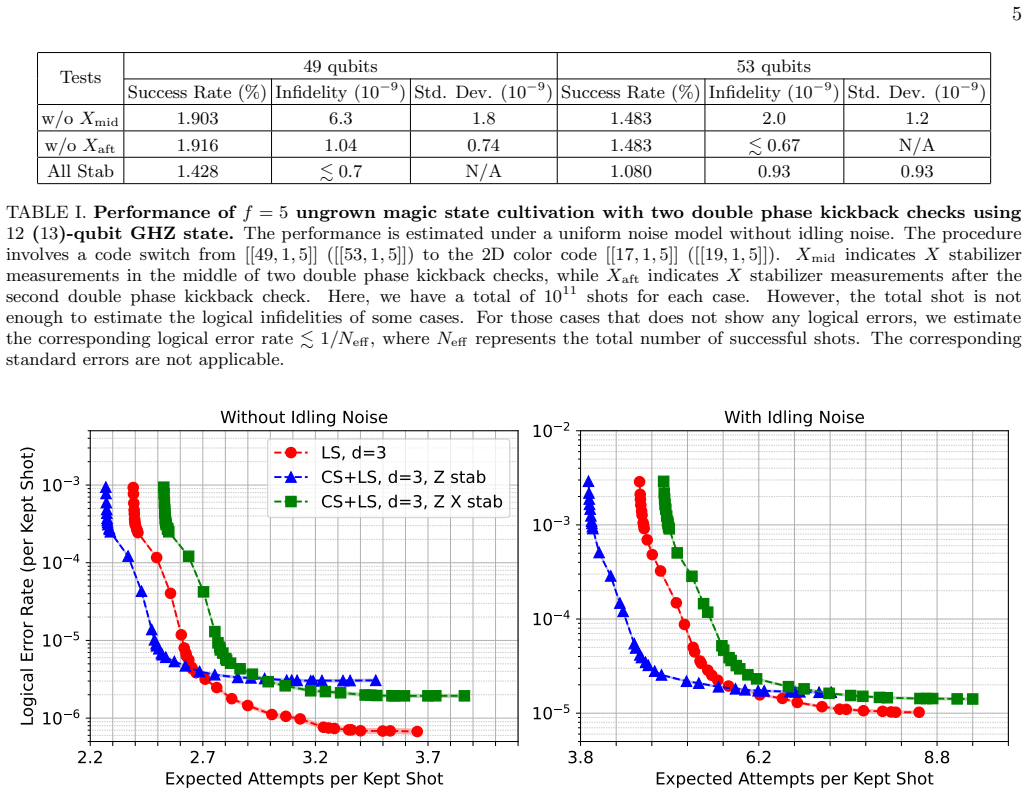
The authors show that phase kickback checks can be generalized for magic states at any Clifford hierarchy level in specific codes. They give a concrete example by cultivating the √T |+>_L state in the doubled color code and provide an escape strategy to large rotated surface codes via lattice surgery. State-vector simulations confirm that the cultivation performance for √T matches that observed for S states on the same code.
What carries the argument
Generalized phase kickback checks applied to the doubled color code for √T magic state cultivation
If this is right
- The √T state can be prepared with error rates comparable to S states.
- Lattice surgery allows transferring the cultivated state to surface code architectures.
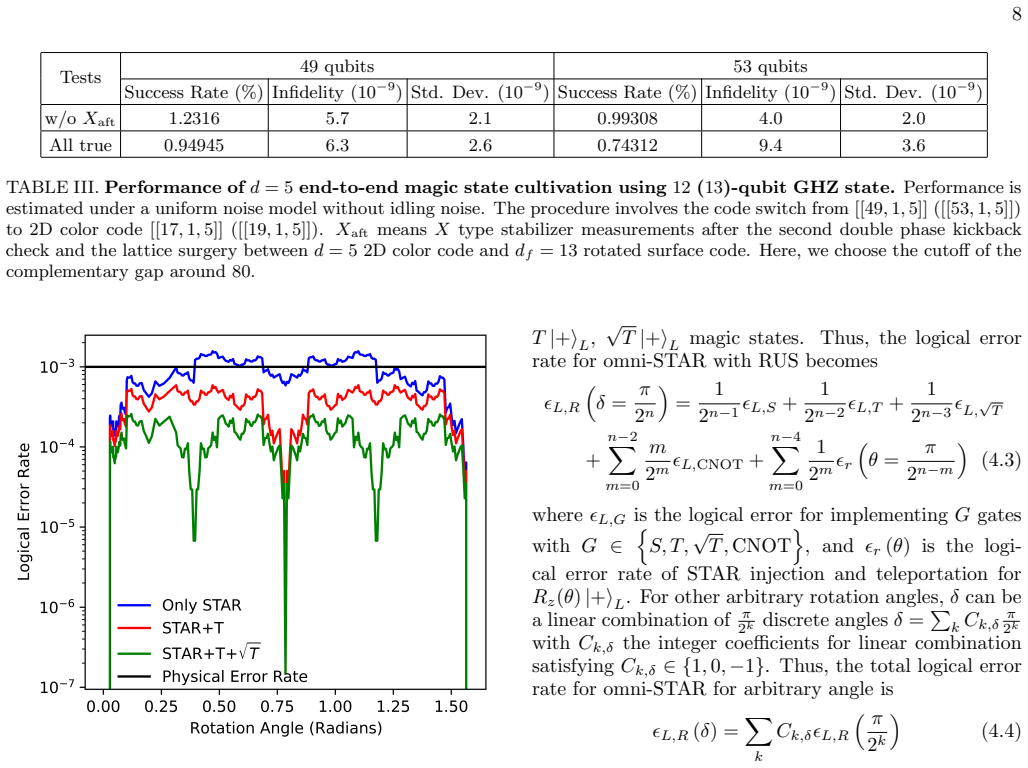
- This supports use in STAR architecture combined with T gates for early fault-tolerant computation.
- Gate synthesis overhead may decrease in fully fault-tolerant regimes.
Where Pith is reading between the lines
- Applying this to other higher-level magic states could further optimize gate implementations.
- The method might integrate with existing distillation protocols to lower overall costs.
- Testing on larger code distances could reveal scalability limits not captured in small simulations.
Load-bearing premise
The generalization of phase kickback checks to the √T level introduces no undetected error mechanisms in the doubled color code.
What would settle it
A detailed error analysis or larger-scale simulation revealing that the logical infidelity for √T cultivation grows faster with code distance than for lower-level states.
Figures
read the original abstract
Recently, experimental and theoretical quantum error correction methodology has seen remarkable breakthroughs. In particular, magic state cultivation has been shown to simplify magic-state preparation and make it feasible for near-term devices. However, recent research on magic state cultivation has focused primarily on the cultivation of $T\left| + \right>_L$. Only a few other magic state cultivation methods beyond $T\left| + \right>_L$ have been investigated. Here, we generalize phase kickback checks for magic states at arbitrary Clifford hierarchy levels in specific codes. We provide an example of cultivation of $\sqrt{T}\left| + \right>_L$ in the doubled color code and the corresponding escape strategy using lattice surgery from the color code to large rotated surface codes. Using state vector simulation for un-grown cultivation, we observe a strong consistence between $S\left| + \right>_L$ and $\sqrt{T}\left| + \right>_L$ cultivation's performance on the doubled color code. Finally, we discuss the application of the corresponding $\sqrt{T}\left| + \right>_L$ cultivation, incorporating the STAR architecture and $T$ gates, for early fault-tolerant quantum computing and its potential to shorten gate synthesis in the fully fault-tolerant quantum computing era.
Editorial analysis
A structured set of objections, weighed in public.
Referee Report
Summary. The manuscript generalizes phase kickback checks for magic-state cultivation to arbitrary Clifford-hierarchy levels and demonstrates the approach with an explicit construction for √T |+>_L in the doubled color code, together with a lattice-surgery escape protocol to rotated surface codes. Noiseless state-vector simulations of the un-grown circuit are reported to show performance consistency with prior S-state cultivation; applications to the STAR architecture and early fault-tolerant computing are discussed.
Significance. If the proposed checks suppress errors at the √T level without introducing undetected mechanisms, the work would usefully extend cultivation techniques beyond T states and supply a concrete integration path into surface-code architectures. The explicit escape strategy is a practical strength. The current evidence, however, consists solely of ideal simulations.
major comments (3)
- [Abstract] Abstract: the assertion of 'strong consistence' between S and √T cultivation rests on noiseless state-vector simulation of the un-grown circuit; no error budgets, detection-rate data, or analysis of the non-Clifford controlled operation in the kickback are supplied, so the central claim of efficient, generalizable cultivation lacks quantitative support for fault tolerance.
- [Cultivation construction and simulation section] Cultivation construction and simulation section: the phase-kickback check for √T involves a controlled non-Clifford gate whose hook or correlated errors are invisible to noiseless simulation; the manuscript provides no analysis showing that these errors are either absent or detected by the doubled-color-code stabilizers, leaving the generalization claim dependent on an untested assumption.
- [Escape-strategy section] Escape-strategy section: the lattice-surgery protocol from doubled color code to large rotated surface codes is described at the logical level only; no threshold or overhead calculation under a realistic noise model is given, so the claim that the full pipeline is efficient cannot yet be evaluated.
minor comments (2)
- [Abstract] The word 'consistence' in the abstract should read 'consistency'.
- Notation for the cultivated state (√T |+>_L) should be defined once at first use and used consistently thereafter.
Simulated Author's Rebuttal
We thank the referee for their careful reading and constructive comments on our manuscript. We address each major comment below with clarifications and proposed revisions.
read point-by-point responses
-
Referee: [Abstract] the assertion of 'strong consistence' between S and √T cultivation rests on noiseless state-vector simulation of the un-grown circuit; no error budgets, detection-rate data, or analysis of the non-Clifford controlled operation in the kickback are supplied, so the central claim of efficient, generalizable cultivation lacks quantitative support for fault tolerance.
Authors: We agree that the reported simulations are noiseless state-vector simulations of the un-grown circuit and do not include error budgets or detection rates under noise. The phrase 'strong consistency' in the abstract refers specifically to the comparable ideal-case performance metrics (e.g., success probabilities and state fidelities) observed between the S and √T protocols on the doubled color code. We do not claim quantitative fault-tolerance guarantees in this work. We will revise the abstract to explicitly state that the consistency is observed in noiseless simulations and to note that full error analysis under realistic noise models is reserved for future work. revision: yes
-
Referee: [Cultivation construction and simulation section] the phase-kickback check for √T involves a controlled non-Clifford gate whose hook or correlated errors are invisible to noiseless simulation; the manuscript provides no analysis showing that these errors are either absent or detected by the doubled-color-code stabilizers, leaving the generalization claim dependent on an untested assumption.
Authors: This is a substantive point. Noiseless simulations cannot capture hook or correlated errors from the controlled non-Clifford gate in the kickback. The manuscript relies on the assumption that the doubled color code stabilizers detect such errors analogously to the Clifford case, but we have not supplied an explicit error-propagation analysis or circuit-level simulation for the non-Clifford component. We will add a short discussion paragraph in the cultivation section outlining why the code's stabilizer structure is expected to detect these errors (based on the support of the controlled gate relative to the code stabilizers) while acknowledging that a full verification requires noisy simulation, which lies outside the present scope. revision: partial
-
Referee: [Escape-strategy section] the lattice-surgery protocol from doubled color code to large rotated surface codes is described at the logical level only; no threshold or overhead calculation under a realistic noise model is given, so the claim that the full pipeline is efficient cannot yet be evaluated.
Authors: We concur that the escape protocol is presented at the logical level without numerical threshold or overhead estimates under circuit noise. Such calculations would require large-scale Monte Carlo simulations that exceed the manuscript's focus on the cultivation construction and logical-level integration. We will revise the escape-strategy section to include an explicit statement that detailed resource and threshold analysis under realistic noise is left for subsequent work, while retaining the logical-level description as a concrete integration path. revision: yes
Circularity Check
No significant circularity; derivation is self-contained extension of external methods
full rationale
The paper generalizes phase-kickback checks to higher Clifford-hierarchy levels and demonstrates √T cultivation in the doubled color code via explicit circuit constructions and lattice-surgery escape. No equations or claims reduce to parameters fitted by the authors themselves, nor do any predictions loop back to inputs by construction. The work explicitly positions itself as an extension of externally published cultivation techniques rather than deriving its core claims from self-citations or ansatzes. State-vector simulations of the un-grown circuit verify ideal logical action but are not presented as fitted predictions. No self-definitional, uniqueness-imported, or renaming patterns appear in the derivation chain.
Axiom & Free-Parameter Ledger
Forward citations
Cited by 1 Pith paper
-
Cultivating logical catalysts for fault-tolerant dyadic phase rotations
A new cultivation protocol prepares reusable logical catalysts as eigenstates of high-period Clifford circuits to implement exact Z^{2^{-b}} phase gates with constant online depth in surface codes.
Reference graph
Works this paper leans on
-
[1]
The implemen- tation of phase kickback measurement for √ T|+⟩ L is visualized in Fig
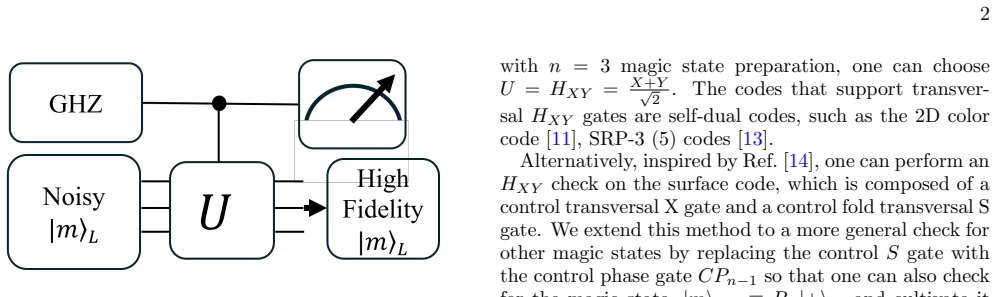
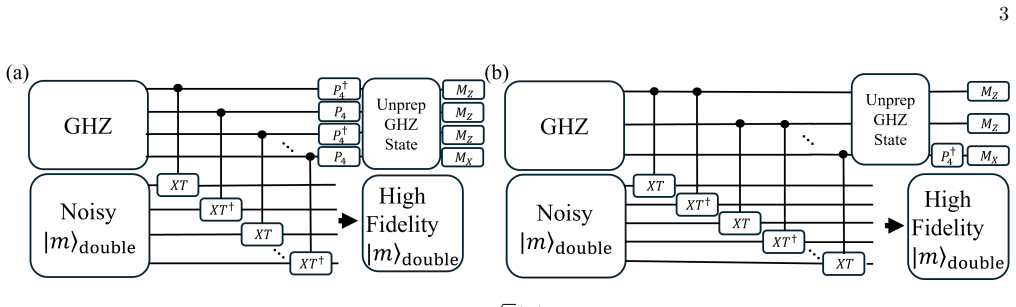
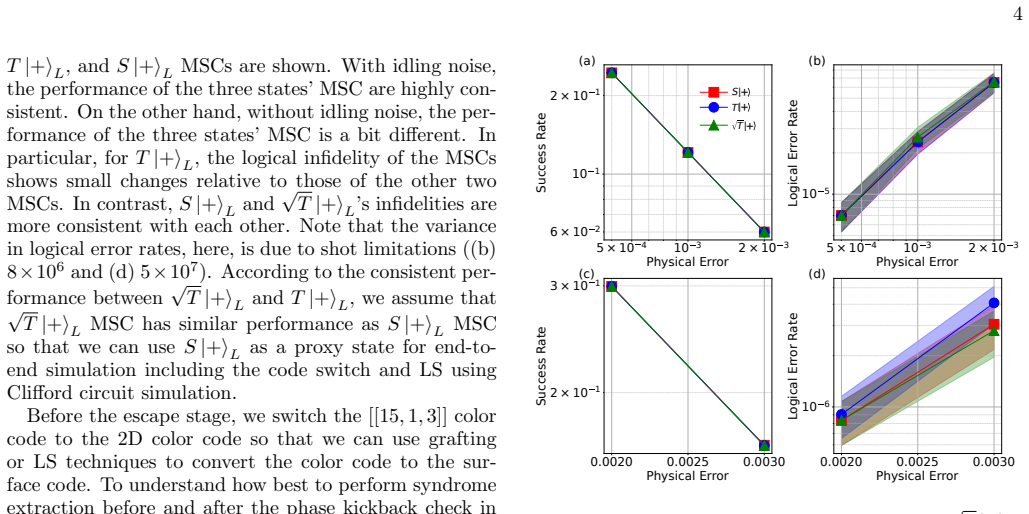
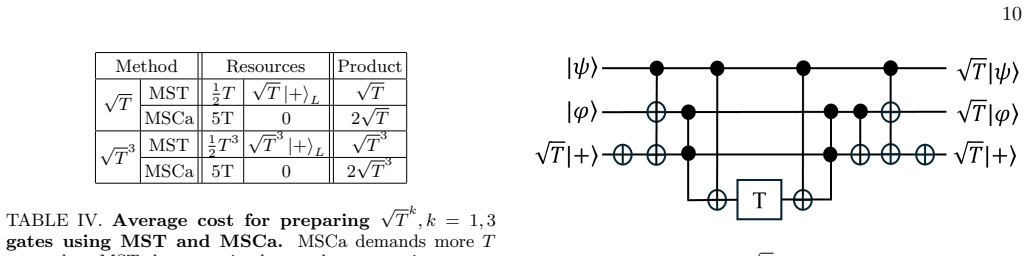
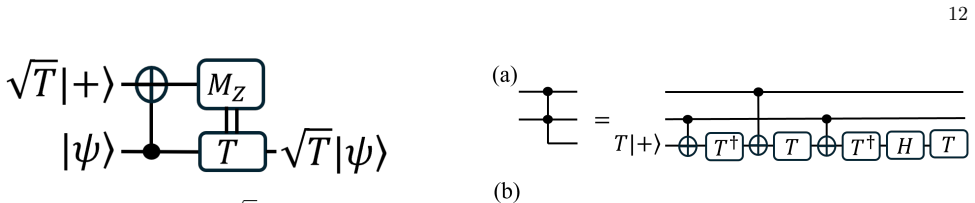
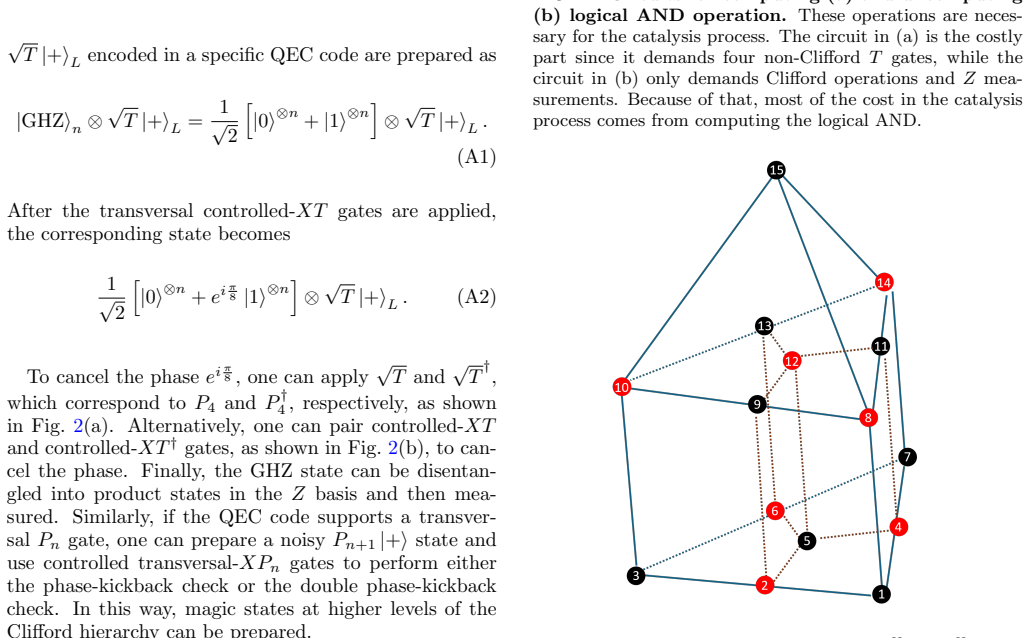
We next apply one round of syndrome measure- ment to postselect noisy outcome. The implemen- tation of phase kickback measurement for √ T|+⟩ L is visualized in Fig. 2. The double-phase kickback check is composed of a phase kickback measure- ment circuit and the corresponding reversal circuit. If one of measurement results gives 1, the shot is discarded
-
[2]
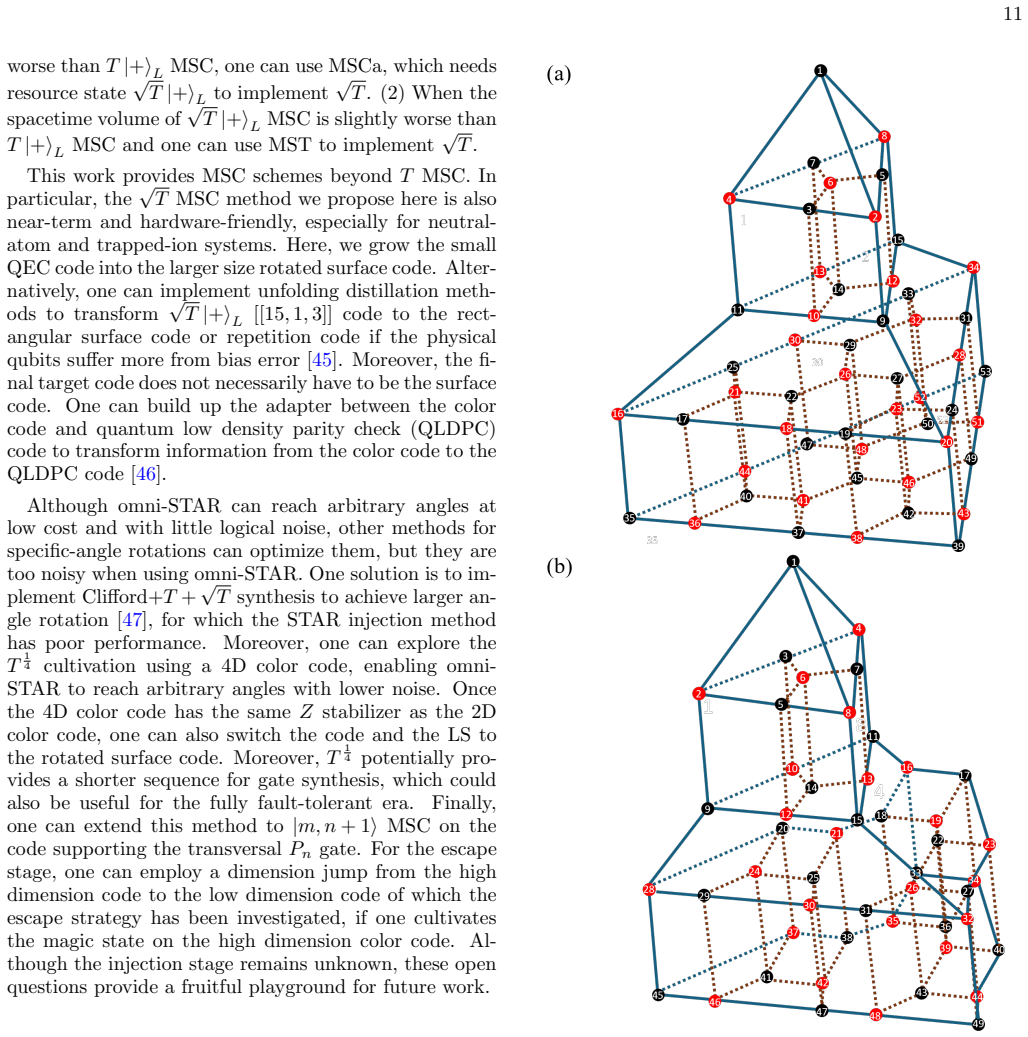
Alternatively, one can also code switch to a 2D color code via a one-way transver- sal CNOT gate [9, 30], and transform the 2D color code to a rotated surface code using LS [8]
During the escape stage, one directly switches to a rotated surface code via lattice surgery (LS) from the 3D code. Alternatively, one can also code switch to a 2D color code via a one-way transver- sal CNOT gate [9, 30], and transform the 2D color code to a rotated surface code using LS [8]. Before the escape stage, the high fidelity magic state is prepa...
-
[3]
LS represents lattice surgery betweend= 3 doubled color code andd f = 11 rotated surface code
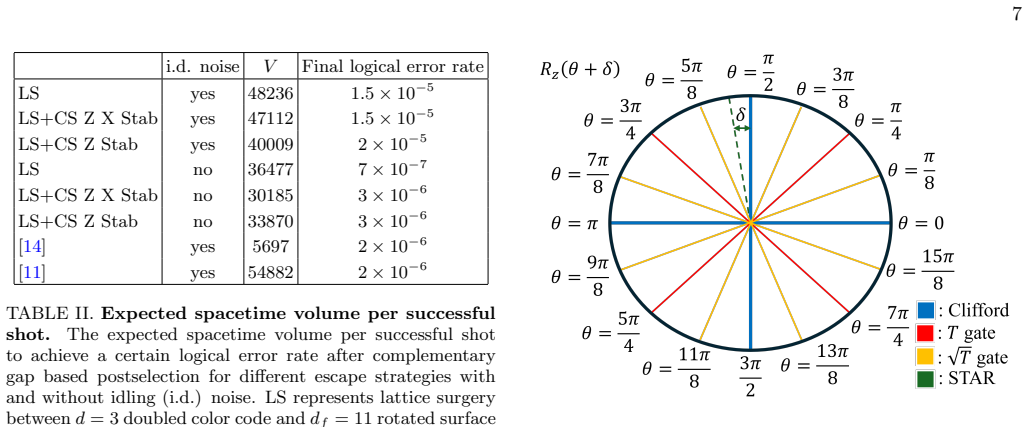
yes 54882 2×10 −6 TABLE II.Expected spacetime volume per successful shot.The expected spacetime volume per successful shot to achieve a certain logical error rate after complementary gap based postselection for different escape strategies with and without idling (i.d.) noise. LS represents lattice surgery betweend= 3 doubled color code andd f = 11 rotated...
-
[4]
The production of a seed for the catalysis
-
[5]
mixed fallback
The cost of the catalysis method which, to the best of our knowledge, demands 2.5Tgates for each √ T gate (Appendix A3 of [44]). For instance, seed production is a direct application for MSC of √ T|+⟩ L. Regarding the second point, if the cost for MSC of a√ T|+⟩ L state is sufficiently small compared to the cost of preparing theT|+⟩state, which is equival...
2023
-
[6]
Therefore, theZstabilizer measurements require 20 ancilla qubits, since the [[15,1,3]] code has 10 Zstabilizers
Approximate noisy circuit for state-vector p simulation In our state-vector simulation of ungrown MSC on the [[15,1,3]] code, we use Bell states to perform stabilizer measurements. Therefore, theZstabilizer measurements require 20 ancilla qubits, since the [[15,1,3]] code has 10 Zstabilizers. Similarly, theXstabilizer measurements require 8 ancilla qubits...
-
[7]
That is, after each gate, after qubit initialization, and before measurement, an error occurs with probabilityp
Noise Model Here, the idling noise model used in the noisy simu- lation is a uniform noise model with idling noise. That is, after each gate, after qubit initialization, and before measurement, an error occurs with probabilityp. In ad- dition, when qubits are idle, an error also occurs with probabilityp. For initialization and measurement, a bit- flip err...
-
[8]
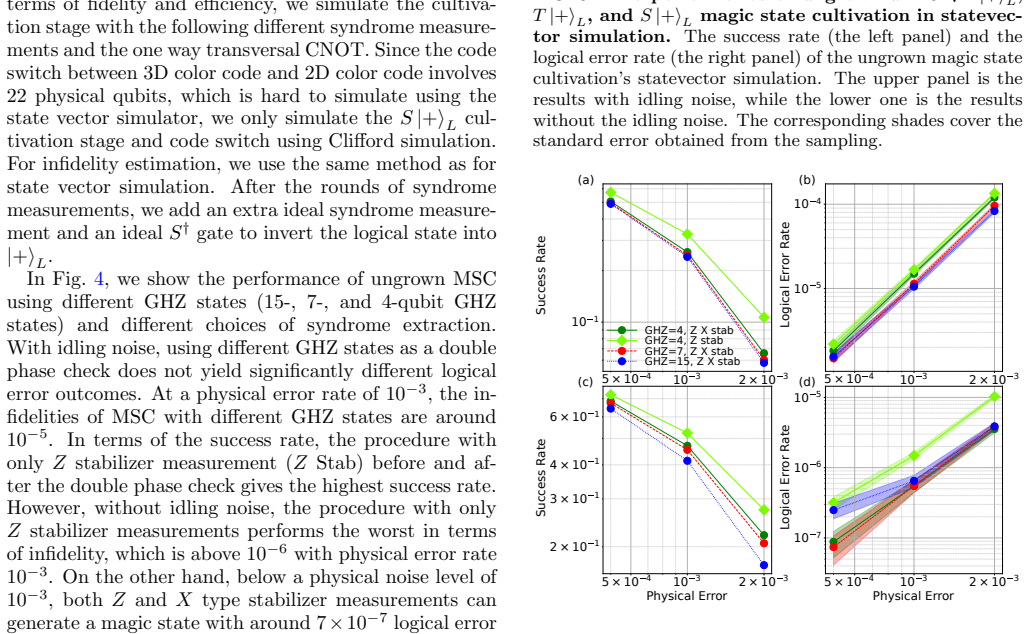
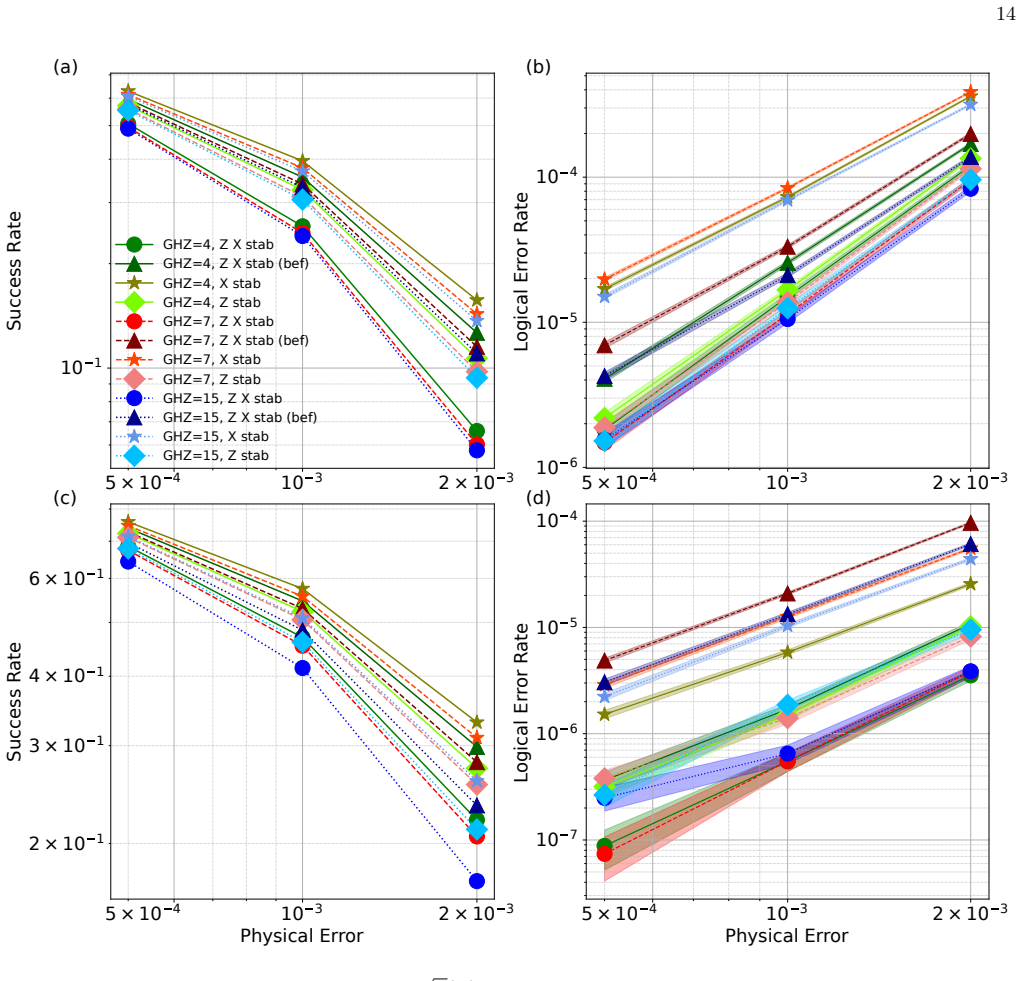
Additional Double Phase Kickback Check and code switch Simulation Here, we present additional ungrown MSC simula- tion results using code switching and different syndrome- extraction choices before and after the double phase- kickback measurement. For thed= 3 case, in addition to performing a complete syndrome measurement, denoted byZ XStab, and performin...
-
[9]
All qubits in the rotated surface-code patch are ini- tialized in|+⟩after the preparation ofT|+⟩ L on the 3D color code
-
[10]
14 are measured three times
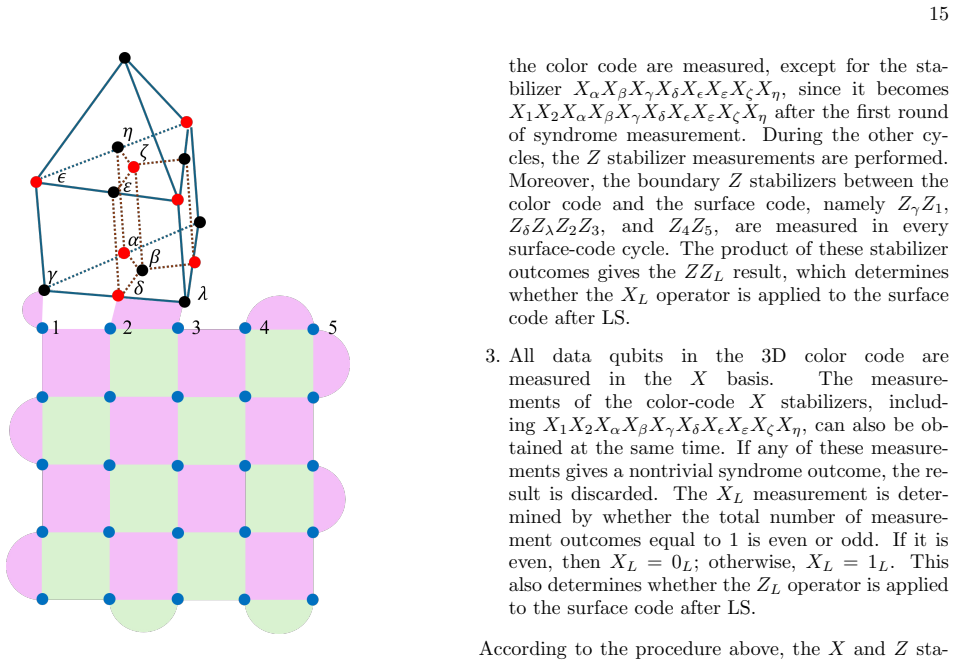
The surface-code stabilizers shown in Fig. 14 are measured three times. Meanwhile, theXorZ stabilizers of the 3D color code are measured. During the even-numbered cycles of the surface- code syndrome measurement, theXstabilizers of the color code are measured, except for the sta- bilizerX αXβXγXδXϵXεXζXη, since it becomes X1X2XαXβXγXδXϵXεXζXη after the fi...
-
[11]
transform
All data qubits in the 3D color code are measured in theXbasis. The measure- ments of the color-codeXstabilizers, includ- ingX 1X2XαXβXγXδXϵXεXζXη, can also be ob- tained at the same time. If any of these measure- ments gives a nontrivial syndrome outcome, the re- sult is discarded. TheX L measurement is deter- mined by whether the total number of measure...
-
[12]
Shor, Fault-tolerant quantum computation, inPro- ceedings of 37th Conference on Foundations of Computer Science(1996) pp
P. Shor, Fault-tolerant quantum computation, inPro- ceedings of 37th Conference on Foundations of Computer Science(1996) pp. 56–65
1996
-
[13]
Bravyi and A
S. Bravyi and A. Kitaev, Universal quantum computa- tion with ideal clifford gates and noisy ancillas, Phys. Rev. A71, 022316 (2005)
2005
-
[14]
Litinski, Magic State Distillation: Not as Costly as You Think, Quantum3, 205 (2019)
D. Litinski, Magic State Distillation: Not as Costly as You Think, Quantum3, 205 (2019)
2019
-
[15]
A. M. Souza, J. Zhang, C. A. Ryan, and R. Laflamme, Experimental magic state distillation for fault-tolerant quantum computing, Nature Communications2, 10.1038/ncomms1166 (2011)
-
[16]
N. C. Brown, J. P. Campora, C. Granade, B. Heim, S. Wernli, C. Ryan-Anderson, D. Lucchetti, A. Paetznick, M. Roetteler, K. Svore, and A. Chernoguzov, Advances in compilation for quantum hardware – A demonstration of magic state distillation and repeat-until-success proto- cols, arXiv 10.48550/arXiv.2310.12106 (2023)
-
[17]
R. S. Gupta, N. Sundaresan, T. Alexander, C. J. Wood, S. T. Merkel, M. B. Healy, M. Hillenbrand, T. Jochym- O’Connor, J. R. Wootton, T. J. Yoder, A. W. Cross, M. Takita, and B. J. Brown, Encoding a magic state with beyond break-even fidelity, Nature625, 259 (2024)
2024
-
[18]
Sales Rodriguez, J
P. Sales Rodriguez, J. M. Robinson, P. N. Jepsen, 19 Z X [[53,1,5]] Z2Z3Z5Z6 Z3Z4Z6Z7 Z5Z6Z7Z8 Z9Z10Z12Z14 Z10Z11Z13Z14 Z11Z12Z13Z14 Z1Z2Z5Z8 Z2Z5Z9Z12 Z2Z3Z9Z10 Z3Z4Z10Z11 Z16Z17Z25Z21 Z35Z36Z44Z40 Z17Z18Z21Z22 Z36Z37Z40Z41 Z18Z19Z23Z27Z26Z22 Z37Z38Z42Z46Z45Z41 Z19Z20...
2025
-
[19]
Y. Hirano, R. Toshio, T. Itogawa, and K. Fujii, Effi- cient magic state cultivation with lattice surgery, arXiv 10.48550/arXiv.2510.24615 (2025)
-
[20]
Daguerre and I
L. Daguerre and I. H. Kim, Code switching revisited: 20 Tests GHZ Success Rate (%) Infidelity (10−9) Std. Dev. (10 −9) w/o mid and sec check 49 3.318 80.8 7.0 w/o mid 49 1.167 17.1 5.4 w/oX mid andX aft 49 1.089 16.5 5.5 w/oX mid 49 0.8112 4.9 2.5 w/oX aft 49 0.8168 1.2 1.2 All Stab 49 0.6085 ≲1.64 N/A w/o mid and sec check 25 4.386 52.4 4.9 w/o mid 25 2....
2025
-
[21]
Daguerre, R
L. Daguerre, R. Blume-Kohout, N. C. Brown, D. Hayes, and I. H. Kim, Experimental demonstration of high- fidelity logical magic states from code switching, Phys. Rev. X15, 041008 (2025)
2025
-
[22]
Magic state cultivation: growing T states as cheap as CNOT gates
C. Gidney, N. Shutty, and C. Jones, Magic state cultiva- tion: growing T states as cheap as CNOT gates, arXiv 10.48550/arXiv.2409.17595 (2024)
work page internal anchor Pith review Pith/arXiv arXiv doi:10.48550/arxiv.2409.17595 2024
-
[23]
Y. Vaknin, S. Jacoby, A. Grimsmo, and A. Retzker, Effi- cient Magic State Cultivation on the Surface Code, arXiv 10.48550/arXiv.2502.01743 (2025)
-
[24]
Z.-H. Chen, M.-C. Chen, C.-Y. Lu, and J.-W. Pan, Ef- ficient Magic State Cultivation on$\mathbb{RP}ˆ2$, arXiv 10.48550/arXiv.2503.18657 (2025)
-
[25]
K. Sahay, P.-K. Tsai, K. Chang, Q. Su, T. B. Smith, S. Singh, and S. Puri, Fold-transversal surface code cul- tivation, arXiv 10.48550/arXiv.2509.05212 (2025)
-
[26]
J. Claes, Cultivating T states on the surface code with only two-qubit gates, arXiv 10.48550/arXiv.2509.05232 (2025)
-
[27]
E. Rosenfeld, C. Gidney, G. Roberts, A. Morvan, N. Lacroix, D. Kafri, J. Marshall, M. Li, V. Sivak, D. Abanin, A. Abbas, R. Acharya, L. A. Beni, G. Aigeldinger, R. Alcaraz, S. Alcaraz, T. I. Andersen, M. Ansmann, F. Arute, K. Arya, W. Askew, N. As- trakhantsev, J. Atalaya, R. Babbush, B. Ballard, J. C. Bardin, H. Bates, A. Bengtsson, M. B. Karimi, A. Bilm...
-
[28]
C. Chamberland and K. Noh, Very low overhead fault- tolerant magic state preparation using redundant ancilla encoding and flag qubits, npj Quantum Information6, 10.1038/s41534-020-00319-5 (2020)
-
[29]
Itogawa, Y
T. Itogawa, Y. Takada, Y. Hirano, and K. Fujii, Efficient magic state distillation by zero-level distillation, PRX Quantum6, 020356 (2025)
2025
-
[30]
J. E. Moussa, Transversal clifford gates on folded surface codes, Phys. Rev. A94, 042316 (2016)
2016
-
[31]
Z.-H. Chen, M.-C. Chen, C.-Y. Lu, and J.-W. Pan, Transversal Logical Clifford gates on rotated surface codes with reconfigurable neutral atom arrays, arXiv 10.48550/arXiv.2412.01391 (2024)
-
[32]
Dennis, Toward fault-tolerant quantum computation without concatenation, Phys
E. Dennis, Toward fault-tolerant quantum computation without concatenation, Phys. Rev. A63, 052314 (2001)
2001
-
[33]
Y. Liu, C. Zhao, A. Jaffe, and L. Chen, Extend the near- term magic-state factory via efficientc xyz cultivation,
-
[34]
Akahoshi, K
Y. Akahoshi, K. Maruyama, H. Oshima, S. Sato, and K. Fujii, Partially fault-tolerant quantum computing ar- chitecture with error-corrected clifford gates and space- time efficient analog rotations, PRX Quantum5, 010337 (2024)
2024
-
[35]
R. Toshio, Y. Akahoshi, J. Fujisaki, H. Oshima, S. Sato, and K. Fujii, Practical quantum advantage on partially fault-tolerant quantum computer, arXiv 10.48550/arXiv.2408.14848 (2024)
-
[36]
Ismail, I.-C
R. Ismail, I.-C. Chen, C. Zhao, R. Weiss, F. Liu, H. Zhou, S.-T. Wang, A. Sornborger, and M. Kornjaˇ ca, Transver- sal architecture for megaquop-scale quantum simulation with neutral atoms, PRX Quantum7, 020343 (2026)
2026
-
[37]
Akahoshi, R
Y. Akahoshi, R. Toshio, J. Fujisaki, H. Oshima, S. Sato, and K. Fujii, Compilation of trotter-based time evolution for partially fault-tolerant quantum computing architec- ture, PRX Quantum6, 040319 (2025)
2025
-
[38]
Kliuchnikov, K
V. Kliuchnikov, K. Lauter, R. Minko, A. Paetznick, and C. Petit, Shorter quantum circuits via single-qubit gate approximation, Quantum7, 1208 (2023)
2023
-
[39]
Kubica and M
A. Kubica and M. E. Beverland, Universal transversal 22 gates with color codes: A simplified approach, Phys. Rev. A91, 032330 (2015)
2015
-
[40]
Vasmer and A
M. Vasmer and A. Kubica, Morphing quantum codes, PRX Quantum3, 030319 (2022)
2022
-
[41]
Heußen and J
S. Heußen and J. Hilder, Efficient fault-tolerant code switching via one-way transversal CNOT gates, Quan- tum9, 1846 (2025)
2025
-
[42]
R. Wille, L. Berent, T. Forster, J. Kunasaikaran, K. Mato, T. Peham, N. Quetschlich, D. Rovara, A. Sander, L. Schmid, D. Schoenberger, Y. Stade, and L. Burgholzer, The MQT handbook: A summary of de- sign automation tools and software for quantum com- puting, inIEEE International Conference on Quantum Software (QSW)(2024) 2405.17543
arXiv 2024
-
[43]
Peham, L
T. Peham, L. Schmid, L. Berent, M. M¨ uller, and R. Wille, Automated synthesis of fault-tolerant state preparation circuits for quantum error-correction codes, PRX Quan- tum6, 020330 (2025)
2025
-
[44]
D. Forlivesi and D. Amaro, Flag at origin: a mod- ular fault-tolerant preparation for CSS codes, arXiv 10.48550/arXiv.2508.14200 (2025)
-
[45]
Takada and K
Y. Takada and K. Fujii, Improving threshold for fault-tolerant color-code quantum computing by flagged weight optimization, PRX Quantum5, 030352 (2024)
2024
-
[46]
Jochym-O’Connor and S
T. Jochym-O’Connor and S. D. Bartlett, Stacked codes: Universal fault-tolerant quantum computation in a two- dimensional layout, Phys. Rev. A93, 022323 (2016)
2016
-
[47]
S. Bravyi and A. Cross, Doubled Color Codes, arXiv 10.48550/arXiv.1509.03239 (2015)
work page internal anchor Pith review Pith/arXiv arXiv doi:10.48550/arxiv.1509.03239 2015
-
[48]
S. P. Jain and V. V. Albert, Transversal clifford and t-gate codes of short length and high distance, IEEE Journal on Selected Areas in Information Theory6, 127 (2025)
2025
-
[49]
Sullivan, Code conversion with the quantum golay code for a universal transversal gate set, Phys
M. Sullivan, Code conversion with the quantum golay code for a universal transversal gate set, Phys. Rev. A 109, 042416 (2024)
2024
-
[50]
F. Butt, L. Esser, and M. M¨ uller, Decoding 3d color codes with boundaries, arXiv 10.48550/arXiv.2512.13436 (2025)
-
[51]
I.-C. Chen, H. Pramod Patil, H. Zhou, and A. Sorn- borger, Efficient magic state factory via code switching,
-
[52]
C. Gidney, M. Newman, P. Brooks, and C. Jones, Yoked surface codes, arXiv 10.48550/arXiv.2312.04522 (2023)
-
[53]
Higgott and C
O. Higgott and C. Gidney, Sparse Blossom: correcting a million errors per core second with minimum-weight matching, Quantum9, 1600 (2025)
2025
-
[54]
Gidney and A
C. Gidney and A. G. Fowler, Efficient magic state fac- tories with a catalyzed|CCZ⟩to 2|T⟩transformation, Quantum3, 135 (2019)
2019
-
[55]
I. D. Kivlichan, C. Gidney, D. W. Berry, N. Wiebe, J. McClean, W. Sun, Z. Jiang, N. Rubin, A. Fowler, A. Aspuru-Guzik, H. Neven, and R. Babbush, Improved Fault-Tolerant Quantum Simulation of Condensed- Phase Correlated Electrons via Trotterization, Quantum 4, 296 (2020)
2020
-
[56]
D. Ruiz, J. Guillaud, C. Vuillot, and M. Mirrahimi, Un- folded distillation: very low-cost magic state preparation for biased-noise qubits, arXiv 10.48550/arxiv.2507.12511 (2025)
work page internal anchor Pith review Pith/arXiv arXiv doi:10.48550/arxiv.2507.12511 2025
-
[57]
Q. Xu, H. Zhou, D. Bluvstein, M. Cain, M. Kalinowski, J. Preskill, M. D. Lukin, and N. Maskara, Batched high- rate logical operations for quantum LDPC codes, arXiv 10.48550/arXiv.2510.06159 (2025)
- [58]
-
[59]
Tansuwannont and D
T. Tansuwannont and D. Leung, Achieving fault toler- ance on capped color codes with few ancillas, PRX Quan- tum3, 030322 (2022)
2022
discussion (0)
Sign in with ORCID, Apple, or X to comment. Anyone can read and Pith papers without signing in.