Cultivating logical catalysts for fault-tolerant dyadic phase rotations
Pith reviewed 2026-06-26 03:42 UTC · model grok-4.3
The pith
A surface-code protocol cultivates reusable logical catalysts that apply exact dyadic phase gates by phase kickback from Clifford eigenstates.
A machine-rendered reading of the paper's core claim, the machinery that carries it, and where it could break.
Core claim
The central claim is that a surface-code cultivation protocol produces reusable logical catalyst states implementing exact fine dyadic phase gates Z^{2^{-b}} by phase kickback; the catalyst is an eigenstate of a high-period Clifford circuit U with direct construction on O(2^b) logical qubits, and once cultivated each invocation uses a controlled-U gadget to apply the target phase exactly, removing Clifford+T synthesis error from the online gate and rendering online non-Clifford depth independent of logical accuracy. For the demonstration case of sqrt(T) the circuit U is a nine-qubit brickwork Clifford, controlled-U uses eight controlled-CNOTs, and cultivation proceeds from nine distance-thre
What carries the argument
The logical catalyst state: an eigenstate of a high-period Clifford circuit U, applied via controlled-U for phase kickback to realize exact Z^{2^{-b}}.
If this is right
- Online implementation of each target phase has constant depth independent of the desired logical accuracy.
- A single verification round suffices for the catalyst because the phase read-out itself supplies intrinsic fault tolerance.
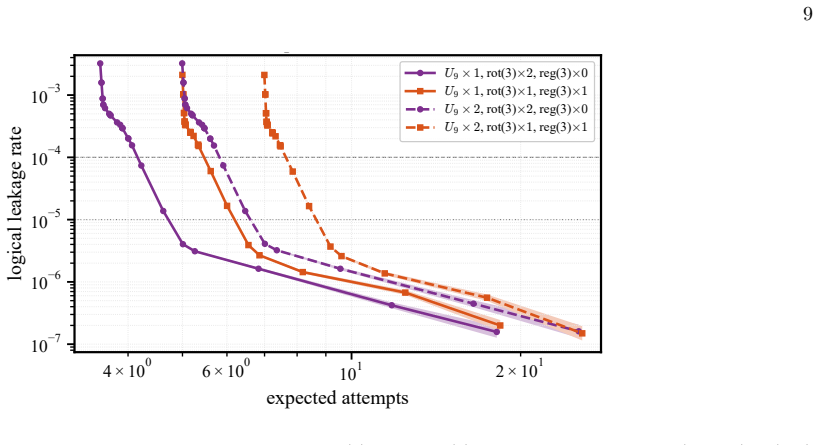
- The cultivated catalyst reaches leading error-corrected scaling when grown from distance-three to distance-seven blocks at physical error rate 10^{-3}.
- Clifford+T synthesis approximation error is eliminated from the online non-Clifford gate.
- The protocol trades offline, phase-specific cultivation effort for reusability and exactness in surface codes whose transversal gate sets are restricted.
Where Pith is reading between the lines
- If the O(2^b) qubit support generalizes without prohibitive overhead, the method could support arbitrarily fine dyadic phases at fixed online cost.
- The same cultivation pattern might extend to other Clifford eigenstates that realize non-dyadic phases or multi-qubit operations.
- Hybrid tensor-network plus stabilizer simulation techniques used here could be applied to test cultivation of catalysts at distances beyond seven.
Load-bearing premise
That an eigenstate of the chosen high-period Clifford circuit U exists and can be cultivated fault-tolerantly from distance-three rotated surface-code blocks to distance-seven blocks via logical-U checks, syndrome extraction, postselection, code growth, and complementary-gap decoding.
What would settle it
A simulation at physical error rate 10^{-3} showing that the logical leakage rate for the distance-seven catalyst remains above 10^{-6} after many attempts even with the single verification round and complementary-gap decoding.
Figures
read the original abstract
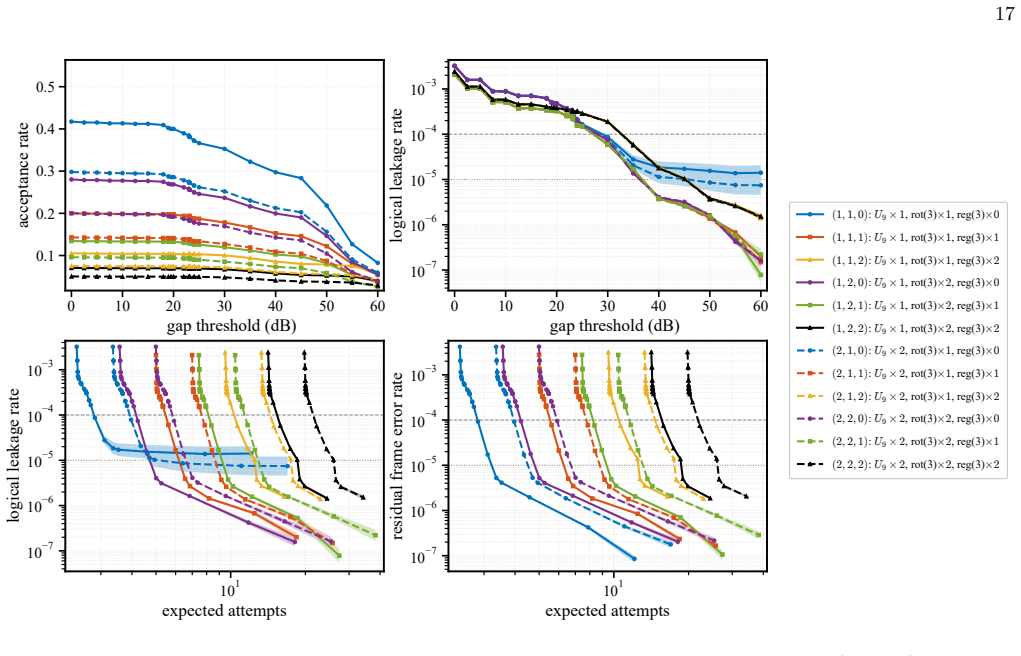
We introduce a surface-code cultivation protocol for reusable logical catalyst states that implement exact fine dyadic phase gates $Z^{2^{-b}}$ by phase kickback. The catalyst is an eigenstate of a high-period Clifford circuit $U$, with a direct construction supported on $O(2^b)$ logical qubits. Once cultivated, each invocation implements the target phase through a controlled-$U$ gadget, removing Clifford+$T$ synthesis approximation error from the online gate and making the online non-Clifford depth independent of the target logical accuracy. As a concrete demonstration, we construct a catalyst for $\sqrt{T}=Z^{1/8}$, where $U$ is a nine-qubit brickwork Clifford circuit and controlled-$U$ consists of eight controlled-CNOTs. Starting from nine distance-three rotated-surface-code blocks, we cultivate the catalyst through logical-$U$ checks, syndrome extraction and postselection, code growth, and complementary-gap decoding. Due to the intrinsic fault tolerance of the phase read-out, a \emph{single} verification round already reaches the leading error-corrected scaling, in contrast to the repeated logical checks required when cultivating single-qubit magic states. A hybrid tensor-network and stabilizer simulation shows that, at physical error rate $p=10^{-3}$, the postselected catalyst can be grown to distance-seven rotated-surface-code blocks with logical leakage rate $\sim 10^{-6}$ using around seven expected attempts, and can be suppressed further with stronger postselection. Compared with existing protocols, our approach trades offline, phase-specific catalyst cultivation for exactness, reusability, and constant-depth online implementation of fixed fine dyadic phases in codes with restricted transversal gate sets.
Editorial analysis
A structured set of objections, weighed in public.
Referee Report
Summary. The paper introduces a surface-code cultivation protocol for reusable logical catalyst states implementing exact dyadic phase gates Z^{2^{-b}} via phase kickback from eigenstates of high-period Clifford circuits U. For the concrete case of sqrt(T) = Z^{1/8}, U is a nine-qubit brickwork Clifford circuit; the protocol starts from nine distance-3 rotated surface-code blocks and cultivates to distance-7 blocks using logical-U checks, syndrome extraction, postselection, code growth, and complementary-gap decoding. It claims that a single verification round suffices to reach leading error-corrected scaling due to intrinsic fault tolerance of the phase readout, in contrast to repeated checks for magic states. A hybrid tensor-network/stabilizer simulation at p=10^{-3} reports ~10^{-6} logical leakage after ~7 expected attempts, with further suppression possible via stronger postselection. The approach trades offline cultivation for exactness, reusability, and constant online non-Clifford depth.
Significance. If the single-round scaling claim holds, the protocol would provide a method for exact, reusable fine-phase gates with distance-independent online depth in surface codes lacking transversal non-Clifford operations, potentially lowering overhead for high-precision rotations in fault-tolerant algorithms. The hybrid simulation approach and explicit construction of the 9-qubit U are concrete strengths that could be built upon.
major comments (2)
- [Cultivation protocol and simulation results (abstract and § on numerical benchmarks)] The central claim that a single verification round already reaches leading error-corrected scaling (p^{(d+1)/2} behavior) rests on the d=7 simulation result; no analytical argument, higher-distance data, or scaling analysis is provided to show that postselection and complementary-gap decoding preserve this scaling when distance increases beyond 7 while keeping only one verification round.
- [Numerical simulation paragraph] The simulation reports ~10^{-6} leakage at p=10^{-3} for d=7 after ~7 attempts, but the manuscript does not verify that the cultivated state remains an eigenstate of U under the full error model including leakage and correlated errors across the code growth steps.
minor comments (2)
- [Abstract and methods] The abstract and protocol description omit explicit values for postselection thresholds, number of syndrome extraction rounds per check, and the precise definition of complementary-gap decoding used in the simulation.
- [Construction of U and controlled-U] Notation for the controlled-U gadget (eight controlled-CNOTs) and the logical catalyst state preparation could be clarified with an explicit circuit diagram or equation reference.
Simulated Author's Rebuttal
We thank the referee for their careful reading of the manuscript and for highlighting these points. We respond to each major comment below, indicating planned revisions where appropriate.
read point-by-point responses
-
Referee: [Cultivation protocol and simulation results (abstract and § on numerical benchmarks)] The central claim that a single verification round already reaches leading error-corrected scaling (p^{(d+1)/2} behavior) rests on the d=7 simulation result; no analytical argument, higher-distance data, or scaling analysis is provided to show that postselection and complementary-gap decoding preserve this scaling when distance increases beyond 7 while keeping only one verification round.
Authors: The central claim rests on the intrinsic fault tolerance of the phase readout in the logical-U check, which extracts the eigenvalue without requiring repeated verification rounds as in standard magic-state cultivation. The d=7 hybrid simulation provides concrete numerical support for this at the simulated distance. We agree that the manuscript would benefit from an explicit discussion of the scaling argument. In revision we will expand the numerical benchmarks section with a qualitative analysis of how the combination of logical-U checks, postselection, and complementary-gap decoding is expected to preserve the leading p^{(d+1)/2} scaling for larger d, while clearly stating that higher-distance data are not yet available. revision: partial
-
Referee: [Numerical simulation paragraph] The simulation reports ~10^{-6} leakage at p=10^{-3} for d=7 after ~7 attempts, but the manuscript does not verify that the cultivated state remains an eigenstate of U under the full error model including leakage and correlated errors across the code growth steps.
Authors: The reported ~10^{-6} logical leakage is obtained from the hybrid tensor-network/stabilizer simulation that tracks the logical state throughout cultivation and postselection. This leakage figure directly quantifies the probability that the cultivated catalyst fails to implement the intended phase kickback. We acknowledge that the simulation does not exhaustively verify the eigenstate property under every possible microscopic leakage or correlated-error channel across all growth steps. In the revised manuscript we will add an explicit statement clarifying the modeling assumptions and the scope of the reported logical leakage rate. revision: yes
Circularity Check
No circularity: protocol construction and d=7 simulation are independent of self-referential fitting or load-bearing self-citation
full rationale
The paper presents an explicit construction of a nine-qubit brickwork Clifford circuit U whose eigenstate serves as the catalyst, followed by a concrete cultivation sequence (logical-U checks, syndrome extraction, postselection, code growth, complementary-gap decoding) from distance-3 to distance-7 rotated surface codes. The claim of leading error-corrected scaling with a single verification round is supported by a hybrid tensor-network/stabilizer simulation at p=10^{-3} that reports a numerical leakage rate; this numerical result is not obtained by fitting a parameter defined inside the paper and then relabeling it as a prediction, nor does any equation reduce the target logical rate to a quantity defined in terms of itself. No self-citation chain is invoked to justify uniqueness or to smuggle an ansatz, and the derivation chain remains self-contained against external benchmarks.
Axiom & Free-Parameter Ledger
axioms (2)
- domain assumption Surface codes admit fault-tolerant syndrome extraction, code growth, and complementary-gap decoding that preserve the logical eigenstate property under the stated error model.
- domain assumption There exists a high-period Clifford circuit U on O(2^b) qubits whose eigenstate enables exact phase kickback for Z^{2^{-b}}.
invented entities (1)
-
logical catalyst state (eigenstate of U)
no independent evidence
Reference graph
Works this paper leans on
-
[1]
Physical preparation and encoding 4
-
[2]
Logical-U 9 verification by phase estimation 4
-
[3]
Simulation protocol and results 6 A
Stabilizer measurement, code growth, and escape to Rot(7) 6 III. Simulation protocol and results 6 A. Hybrid simulation strategy 6
-
[4]
Front end: tensor-network state vector 6
-
[5]
Back end: stabilizer simulation of growth 7
-
[6]
Residual logical leakage 7 B. Simulation result 8 IV. Resource comparison 8 A. The competing methods 9 B. Where our protocol compares favorably (and unfavorably) 10 V. Conclusion and Outlook 11 References 12 ∗ yx639@cornell.edu † xw753@cornell.edu A. Unitary encoding circuit for rot(3) surface codes 13 B. Details of the logical measurement circuit ofU 9 1...
Pith/arXiv arXiv 2026
-
[7]
The nine physical qubits are then encoded into nine independent distance-three ro- tated surface code blocks using a unitary encoding circuit U ⊗9 enc
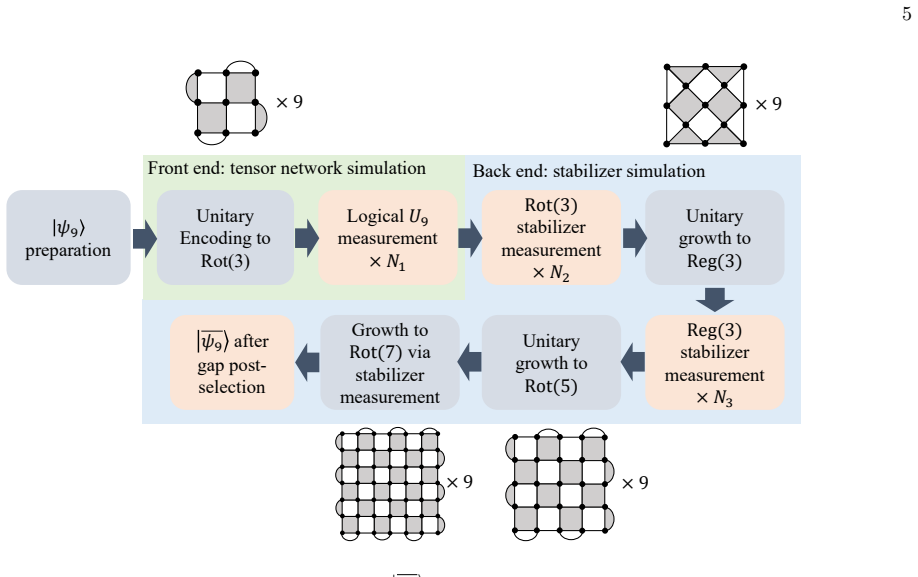
Physical preparation and encoding The cultivation begins with a physical nine-qubit state on the|ψ 9⟩orbit, which can be initialized by any of sev- eral methods consistent with the protocol’s noise budget, such as a direct unitary synthesis or a physical quantum phase estimation (QPE). The nine physical qubits are then encoded into nine independent distan...
-
[8]
Since the target eigenvaluee iπ/8 =e 2πi/16 corresponds to one of sixteen possible eigenphases, four ancilla bits suffice to resolve it
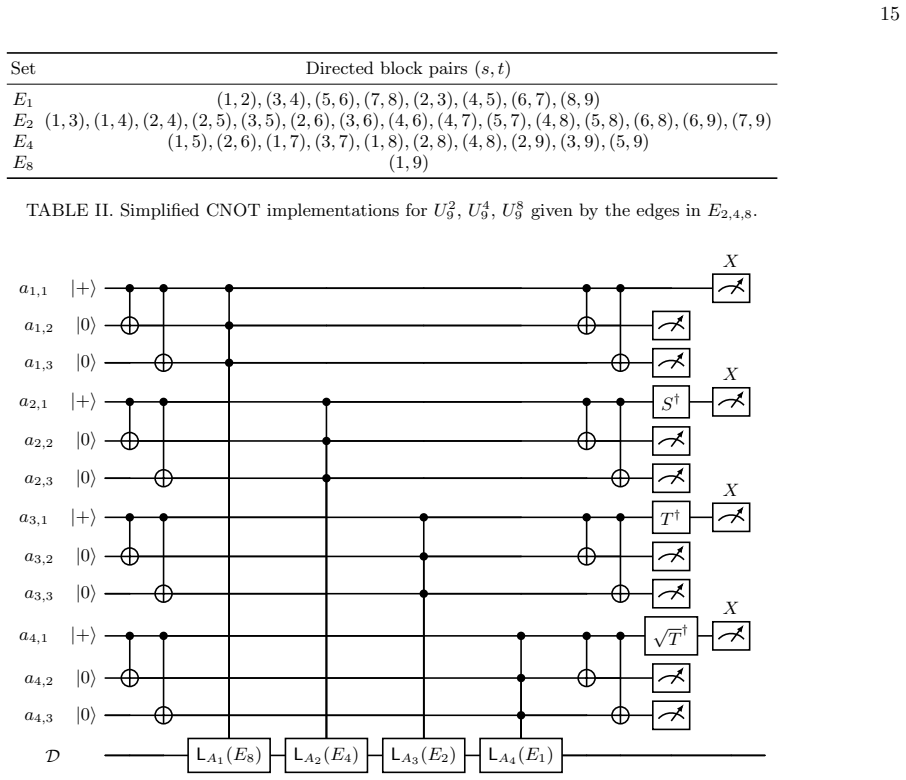
Logical-U 9 verification by phase estimation The central verification step is a logical-U 9 measure- ment implemented by a logical-level QPE circuit. Since the target eigenvaluee iπ/8 =e 2πi/16 corresponds to one of sixteen possible eigenphases, four ancilla bits suffice to resolve it. A verification round uses four fresh ancilla qubitsa 1, a2, a3, a4, ea...
-
[9]
We therefore follow the logical-U 9 check and ancilla cleanup with noisy distance-three stabilizer-measurement rounds on every Rot(3) block
Stabilizer measurement, code growth, and escape to Rot(7) A logical-U 9 verification round checks the catalyst eigenvalue, but does not by itself guarantee that the nine code blocks remain within the code space. We therefore follow the logical-U 9 check and ancilla cleanup with noisy distance-three stabilizer-measurement rounds on every Rot(3) block. Only...
-
[10]
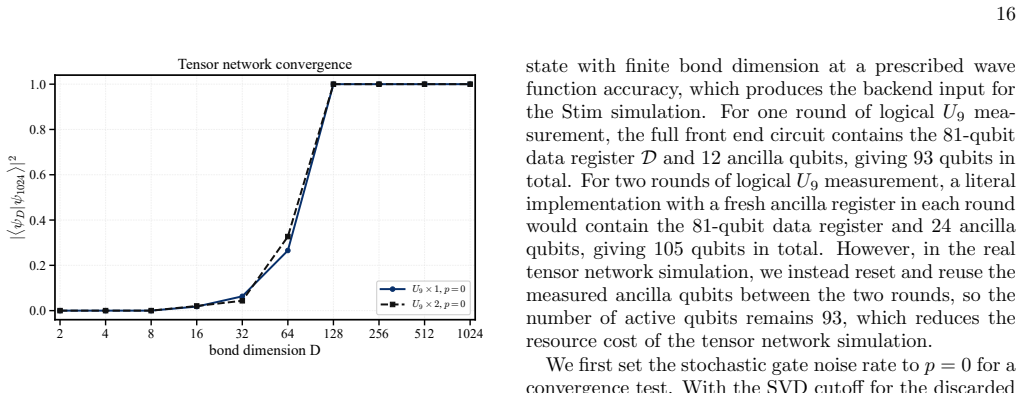
Front end: tensor-network state vector The first simulator carries the protocol from the prepa- ration of the physical catalyst|ψ 9⟩through encoding byU ⊗9 enc and the logical-U 9 verification round(s), up to and including the ancilla measurements: the four phase- estimation read-outsa j,1 and the GHZ clean-up qubits aj,2, aj,3 (j= 1, . . . ,4). The 81-qu...
-
[11]
Applying (U † enc)⊗9 maps each Rot(3) block back to one bare logical qubit and eight disentangled syndrome qubits
Handoff To transfer the accepted front-end state to the sta- bilizer simulator we read out the code syndromenoise- lessly. Applying (U † enc)⊗9 maps each Rot(3) block back to one bare logical qubit and eight disentangled syndrome qubits. We then measure the 9×8 = 72 syndrome qubits. We stress that this read-out should carry NO noise: it only extracts the ...
-
[12]
Their sole purpose is to determine the residual logical Pauli error left on the catalyst after decoding
Back end: stabilizer simulation of growth The remaining stages, including the noisy Rot(3) syn- drome round, the unitary growth Rot(3)→Reg(3) with its syndrome round, and the growth Reg(3)→Rot(5)→ Rot(7), are Clifford and are simulated with Stim [52]. Their sole purpose is to determine the residual logical Pauli error left on the catalyst after decoding. ...
-
[13]
Residual logical leakage For each accepted shot and each blockb, Stim pro- vides the logical- ¯Xb and logical- ¯Zb frame flipsactually produced by the sampled physical errors, while the de- coder provides itspredictionof the same two bits. The residual logical error is the bit-wise XOR of the two, (xb, zb) = ℓX,act b ⊕ℓ X,pred b , ℓ Z,act b ⊕ℓ Z,pred b ,(...
2000
-
[14]
P. W. Shor, Fault-tolerant quantum computation, inPro- ceedings of 37th Conference on Foundations of Computer Science(1996) pp. 56–65
1996
-
[15]
Aharonov and M
D. Aharonov and M. Ben-Or, Fault-tolerant quantum computation with constant error rate, SIAM Journal on Computing38, 1207 (2008)
2008
-
[16]
Knill, R
E. Knill, R. Laflamme, and W. H. Zurek, Resilient quan- tum computation, Science279, 342 (1998)
1998
-
[17]
Gottesman, The Heisenberg representation of quan- tum computers, (1998), arXiv:quant-ph/9807006
D. Gottesman, The Heisenberg representation of quan- tum computers, (1998), arXiv:quant-ph/9807006
Pith/arXiv arXiv 1998
-
[18]
Aaronson and D
S. Aaronson and D. Gottesman, Improved simulation of stabilizer circuits, Physical Review A70, 052328 (2004)
2004
-
[19]
A. G. Fowler, M. Mariantoni, J. M. Martinis, and A. N. Cleland, Surface codes: Towards practical large-scale quantum computation, Physical Review A86, 032324 (2012)
2012
-
[20]
Bravyi and A
S. Bravyi and A. Kitaev, Universal quantum computa- tion with ideal Clifford gates and noisy ancillas, Physical Review A71, 022316 (2005)
2005
-
[21]
C. M. Dawson and M. A. Nielsen, The Solovay–Kitaev algorithm, Quantum Information and Computation6, 81 (2006)
2006
-
[22]
V. Kliuchnikov, D. Maslov, and M. Mosca, Fast and ef- ficient exact synthesis of single-qubit unitaries generated by Clifford and T gates, Quantum Information and Com- putation13, 607 (2013), arXiv:1206.5236 [quant-ph]
Pith/arXiv arXiv 2013
-
[23]
N. J. Ross and P. Selinger, Optimal ancilla-free Clif- ford+T approximation ofz-rotations, Quantum Informa- tion and Computation16, 901 (2016)
2016
-
[24]
A. Paetznick and K. M. Svore, Repeat-until-success: Non-deterministic decomposition of single-qubit uni- taries, Quantum Information and Computation14, 1277 (2014), arXiv:1311.1074 [quant-ph]
Pith/arXiv arXiv 2014
-
[25]
A. Bocharov, M. Roetteler, and K. M. Svore, Efficient synthesis of universal repeat-until-success circuits, Phys- ical Review Letters114, 080502 (2015), arXiv:1404.5320 [quant-ph]
Pith/arXiv arXiv 2015
-
[26]
Jones, Low-overhead constructions for the fault- tolerant Toffoli gate, Physical Review A87, 022328 (2013)
C. Jones, Low-overhead constructions for the fault- tolerant Toffoli gate, Physical Review A87, 022328 (2013)
2013
-
[27]
Eastin, Distilling one-qubit magic states into Toffoli states, Physical Review A87, 032321 (2013)
B. Eastin, Distilling one-qubit magic states into Toffoli states, Physical Review A87, 032321 (2013)
2013
-
[28]
E. T. Campbell and M. Howard, Unifying gate synthe- sis and magic state distillation, Physical Review Letters 118, 060501 (2017)
2017
-
[29]
E. T. Campbell and J. O’Gorman, An efficient magic state approach to small angle rotations, Quantum Science and Technology1, 015007 (2016)
2016
-
[30]
Duclos-Cianci and D
G. Duclos-Cianci and D. Poulin, Reducing the quantum- computing overhead with complex gate distillation, Phys- ical Review A91, 042315 (2015)
2015
-
[31]
Bravyi and J
S. Bravyi and J. Haah, Magic-state distillation with low overhead, Physical Review A86, 052329 (2012)
2012
-
[32]
Haah and M
J. Haah and M. B. Hastings, Codes and protocols for distillingT, controlled-S, and Toffoli gates, Quantum2, 71 (2018)
2018
-
[33]
Litinski, Magic state distillation: Not as costly as you think, Quantum3, 205 (2019)
D. Litinski, Magic state distillation: Not as costly as you think, Quantum3, 205 (2019)
2019
-
[34]
Litinski, A game of surface codes: Large-scale quan- tum computing with lattice surgery, Quantum3, 128 (2019)
D. Litinski, A game of surface codes: Large-scale quan- tum computing with lattice surgery, Quantum3, 128 (2019)
2019
-
[35]
Gidney and A
C. Gidney and A. G. Fowler, Efficient magic state fac- tories with a catalyzed|CCZ⟩to 2|T⟩transformation, Quantum3, 135 (2019)
2019
-
[36]
Sales Rodriguez, J
P. Sales Rodriguez, J. M. Robinson, P. N. Jepsen,et al., Experimental demonstration of logical magic state distil- lation, Nature645, 620 (2025)
2025
-
[37]
Bomb´ ın, Gauge color codes: optimal transversal gates and gauge fixing in topological stabilizer codes, New Journal of Physics17, 083002 (2015)
H. Bomb´ ın, Gauge color codes: optimal transversal gates and gauge fixing in topological stabilizer codes, New Journal of Physics17, 083002 (2015)
2015
-
[38]
J. T. Anderson, G. Duclos-Cianci, and D. Poulin, Fault- tolerant conversion between the Steane and Reed-Muller quantum codes, Physical Review Letters113, 080501 (2014)
2014
-
[39]
Paetznick and B
A. Paetznick and B. W. Reichardt, Universal fault- tolerant quantum computation with only transversal gates and error correction, Physical Review Letters111, 090505 (2013)
2013
-
[40]
Kubica and M
A. Kubica and M. E. Beverland, Universal transversal gates with color codes: A simplified approach, Physical Review A91, 032330 (2015)
2015
-
[41]
Bomb´ ın, Dimensional jump in quantum error correc- tion, New Journal of Physics18, 043038 (2016)
H. Bomb´ ın, Dimensional jump in quantum error correc- tion, New Journal of Physics18, 043038 (2016)
2016
-
[42]
M. E. Beverland, A. Kubica, and K. M. Svore, Cost of universality: A comparative study of the overhead of state distillation and code switching with color codes, PRX Quantum2, 020341 (2021)
2021
-
[43]
F. Butt, S. Heußen, M. Rispler, and M. M¨ uller, Fault- tolerant code-switching protocols for near-term quantum processors, PRX Quantum5, 020345 (2024)
2024
-
[44]
Heußen, F
S. Heußen, F. Butt, M. Rispler, and M. M¨ uller, Effi- cient fault-tolerant code switching via one-way transver- sal CNOT gates, Quantum9, 1846 (2025)
2025
-
[45]
Magic state cultivation: growing T states as cheap as CNOT gates
C. Gidney, N. Shutty, and C. Jones, Magic state cul- tivation: growing T states as cheap as CNOT gates 10.48550/arXiv.2409.17595 (2024), arXiv:2409.17595
work page internal anchor Pith review Pith/arXiv arXiv doi:10.48550/arxiv.2409.17595 2024
-
[46]
Itogawa, Y
T. Itogawa, Y. Takada, Y. Hirano, and K. Fujii, Efficient magic state distillation by zero-level distillation, PRX 13 Quantum6, 020356 (2025)
2025
-
[47]
Hirano, T
Y. Hirano, T. Itogawa, and K. Fujii, Leveraging zero-level distillation to generate high-fidelity magic states, in2024 IEEE International Conference on Quantum Computing and Engineering (QCE), Vol. 1 (IEEE, Montr´ eal, 2024) pp. 843–853
2024
-
[48]
Y. Vaknin, S. Jacoby, A. Grimsmo, and A. Retzker, Efficient magic state cultivation on the surface code 10.48550/arXiv.2502.01743 (2025), arXiv:2502.01743
-
[49]
Z.-H. Chen, M.-C. Chen, C.-Y. Lu, and J.-W. Pan, Efficient magic state cultivation onRP 2 10.48550/arXiv.2503.18657 (2025), arXiv:2503.18657
-
[50]
J. Claes, Cultivating|t⟩states on the surface code with only two-qubit gates 10.48550/arXiv.2509.05232 (2025), arXiv:2509.05232
-
[51]
K. Sahay, P.-K. Tsai, K. Chang, Q. Su, T. B. Smith, S. Singh, and S. Puri, Fold-transversal sur- face code cultivation 10.48550/arXiv.2509.05212 (2025), arXiv:2509.05212
-
[52]
Y. Hirano, R. Toshio, T. Itogawa, and K. Fujii, Efficient magic state cultivation with lattice surgery 10.48550/arXiv.2510.24615 (2025), arXiv:2510.24615, arXiv:2510.24615 [quant-ph]
-
[53]
E. Rosenfeld, C. Gidney, G. Roberts,et al., Magic state cultivation on a superconducting quantum proces- sor 10.48550/arXiv.2512.13908 (2025), arXiv:2512.13908, arXiv:2512.13908 [quant-ph]
-
[54]
I. Chen, M. d. S. Fonseca, and A. Sornborger, Efficient magic state cultivation for √ t gates 10.48550/arXiv.2606.10430 (2026), arXiv:2606.10430, arXiv:2606.10430 [quant-ph]
work page internal anchor Pith review Pith/arXiv arXiv doi:10.48550/arxiv.2606.10430 2026
-
[55]
Gottesman and I
D. Gottesman and I. L. Chuang, Demonstrating the via- bility of universal quantum computation using teleporta- tion and single-qubit operations, Nature402, 390 (1999)
1999
-
[56]
A. Y. Kitaev, Quantum measurements and the Abelian stabilizer problem, (1995), arXiv:quant-ph/9511026
Pith/arXiv arXiv 1995
-
[57]
A. Y. Kitaev, A. H. Shen, and M. N. Vyalyi,Classical and Quantum Computation, Graduate Studies in Math- ematics, Vol. 47 (American Mathematical Society, 2002)
2002
-
[58]
Gidney, Halving the cost of quantum addition, Quan- tum2, 74 (2018)
C. Gidney, Halving the cost of quantum addition, Quan- tum2, 74 (2018)
2018
-
[59]
Gidney and M
C. Gidney and M. Eker˚ a, How to factor 2048 bit RSA in- tegers in 8 hours using 20 million noisy qubits, Quantum 5, 433 (2021)
2048
-
[60]
How to factor 2048 bit RSA integers with less than a million noisy qubits
C. Gidney, How to factor 2048 bit RSA integers with less than a million noisy qubits 10.48550/arXiv.2505.15917 (2025), arXiv:2505.15917
work page internal anchor Pith review Pith/arXiv arXiv doi:10.48550/arxiv.2505.15917 2048
-
[61]
Babbush, C
R. Babbush, C. Gidney, D. W. Berry, N. Wiebe, J. Mc- Clean, A. Paler, A. Fowler, and H. Neven, Encoding elec- tronic spectra in quantum circuits with linearTcomplex- ity, Physical Review X8, 041015 (2018)
2018
-
[62]
J. Lee, D. W. Berry, C. Gidney, W. J. Huggins, J. R. Mc- Clean, N. Wiebe, and R. Babbush, Even more efficient quantum computations of chemistry through tensor hy- percontraction, PRX Quantum2, 030305 (2021)
2021
-
[63]
I. H. Kim, Catalyticz-rotations in constantT-depth 10.48550/arXiv.2506.15147 (2025), arXiv:2506.15147, arXiv:2506.15147 [quant-ph]
-
[64]
Y. Xu and X. Wang, Controlled jump in the Clifford hierarchy 10.48550/arXiv.2602.22201 (2026), arXiv:2602.22201
-
[65]
C. Gidney, Stim: a fast stabilizer circuit simulator, Quan- tum5, 497 (2021), arXiv:2103.02202 [quant-ph]
arXiv 2021
-
[66]
O. Higgott, PyMatching: A python package for decoding quantum codes with minimum-weight perfect matching, ACM Transactions on Quantum Computing3, 1 (2022), arXiv:2105.13082 [quant-ph]
arXiv 2022
-
[67]
P. Selinger, Quantum circuits of T-depth one, Physical Review A87, 042302 (2013), arXiv:1210.0974 [quant-ph]
Pith/arXiv arXiv 2013
-
[68]
R. B. Griffiths and C.-S. Niu, Semiclassical fourier trans- form for quantum computation, Phys. Rev. Lett.76, 3228 (1996)
1996
-
[69]
Li, A magic state’s fidelity can be superior to the operations that created it, New Journal of Physics17, 023037 (2015)
Y. Li, A magic state’s fidelity can be superior to the operations that created it, New Journal of Physics17, 023037 (2015)
2015
-
[70]
Fishman, S
M. Fishman, S. R. White, and E. M. Stoudenmire, The ITensor Software Library for Tensor Network Calcula- tions, SciPost Phys. Codebases , 4 (2022)
2022
-
[71]
C. R. Rao, Information and the accuracy attainable in the estimation of statistical parameters, Bulletin of the Calcutta Mathematical Society37, 81 (1945)
1945
-
[72]
Blackwell, Conditional expectation and unbiased se- quential estimation, The Annals of Mathematical Statis- tics18, 105 (1947)
D. Blackwell, Conditional expectation and unbiased se- quential estimation, The Annals of Mathematical Statis- tics18, 105 (1947)
1947
-
[73]
C. P. Robert and G. Casella,Monte Carlo Statistical Methods, 2nd ed. (Springer, New York, 2004)
2004
-
[74]
T. G. Draper, S. A. Kutin, E. M. Rains, and K. M. Svore, A logarithmic-depth quantum carry-lookahead adder, Quantum Information & Computation6, 351 (2006), arXiv:quant-ph/0406142
Pith/arXiv arXiv 2006
-
[75]
Wang, LaserWong/Cultivation FinePhaseGate (2026)
X. Wang, LaserWong/Cultivation FinePhaseGate (2026). Appendix A: Unitary encoding circuit forrot(3) surface codes The cultivation protocol begins by preparing the nine- qubit state|ψ 9⟩and encoding itsj-th qubit into thej-th distance-three rot(3) surface code block. Here we spell out the detailed unitary encoding circuit. We note that the same circuit is ...
2026
discussion (0)
Sign in with ORCID, Apple, or X to comment. Anyone can read and Pith papers without signing in.