Updating the PATH framework with FRB host galaxy models
Pith reviewed 2026-06-27 12:35 UTC · model grok-4.3
The pith
Incorporating host magnitude priors into PATH increases confidence in all ASKAP FRB host identifications and shows hosts are fainter than star-formation-weighted models predict.
A machine-rendered reading of the paper's core claim, the machinery that carries it, and where it could break.
Core claim
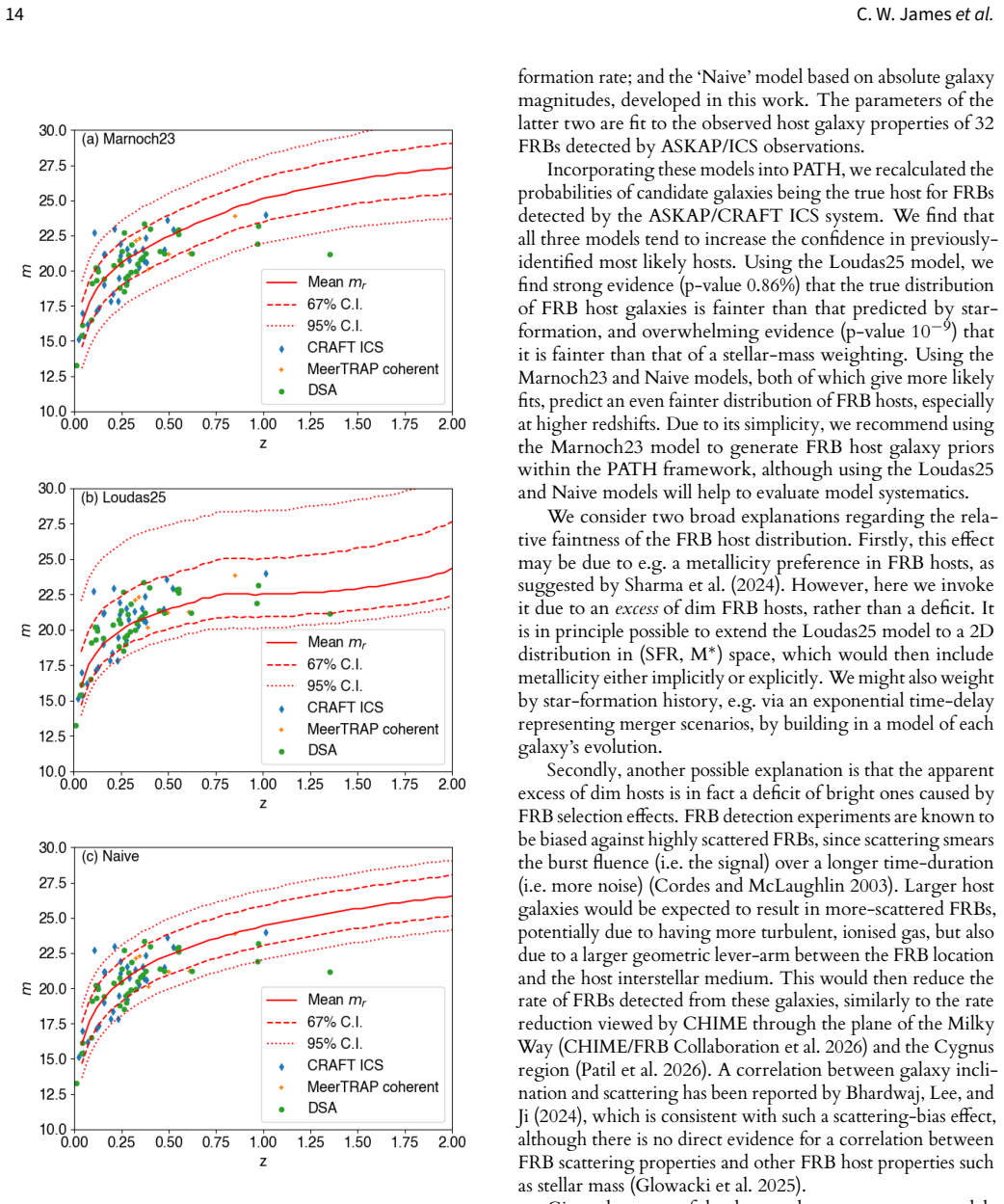
By developing three models for the apparent r-band magnitude distribution P(m_r|z) based on an FRB's expected host galaxy redshift and fitting their parameters to 32 ASKAP ICS FRB candidates, the updated PATH framework yields increased confidence in the most probable hosts for all such FRBs. All three models predict similar magnitude distributions at low redshift, confirming that the true FRB host distribution is fainter than expected for a star-formation-weighted distribution (p-value of 0.12%) while a mass-weighted distribution provides a worse fit (p-value of 10^{-9}).
What carries the argument
Three models for the apparent r-band magnitude distribution P(m_r|z) based on an FRB's expected host galaxy redshift, fitted to 32 ASKAP candidates and combined with P(z|DM).
If this is right
- All ASKAP ICS FRB host galaxies receive increased association probabilities under the new priors.
- The three models produce similar predicted host magnitude distributions at low redshift (z ~ 0.1).
- The observed FRB host distribution is fainter than a star-formation-weighted model at the 0.12% level.
- A mass-weighted host distribution fits the data even more poorly, at the 10^{-9} level.
- Additional FRBs at z > 0.5 would help distinguish between the three magnitude models.
Where Pith is reading between the lines
- The results suggest FRB progenitors may occur preferentially in lower-luminosity galaxies than star-formation weighting would imply.
- Incorporating additional host properties such as metallicity could further tighten the priors in future extensions.
- More reliable host associations would reduce systematic errors when using FRB dispersion measures to map the cosmic ionized gas distribution.
Load-bearing premise
The three models for the apparent r-band magnitude distribution accurately represent the underlying FRB host population when their parameters are fitted to the 32 ASKAP ICS FRB candidates.
What would settle it
A sample of FRBs with secure hosts at redshifts above 0.5, where the three models make different predictions for the magnitude distribution, would test whether the priors match the true population.
Figures

read the original abstract
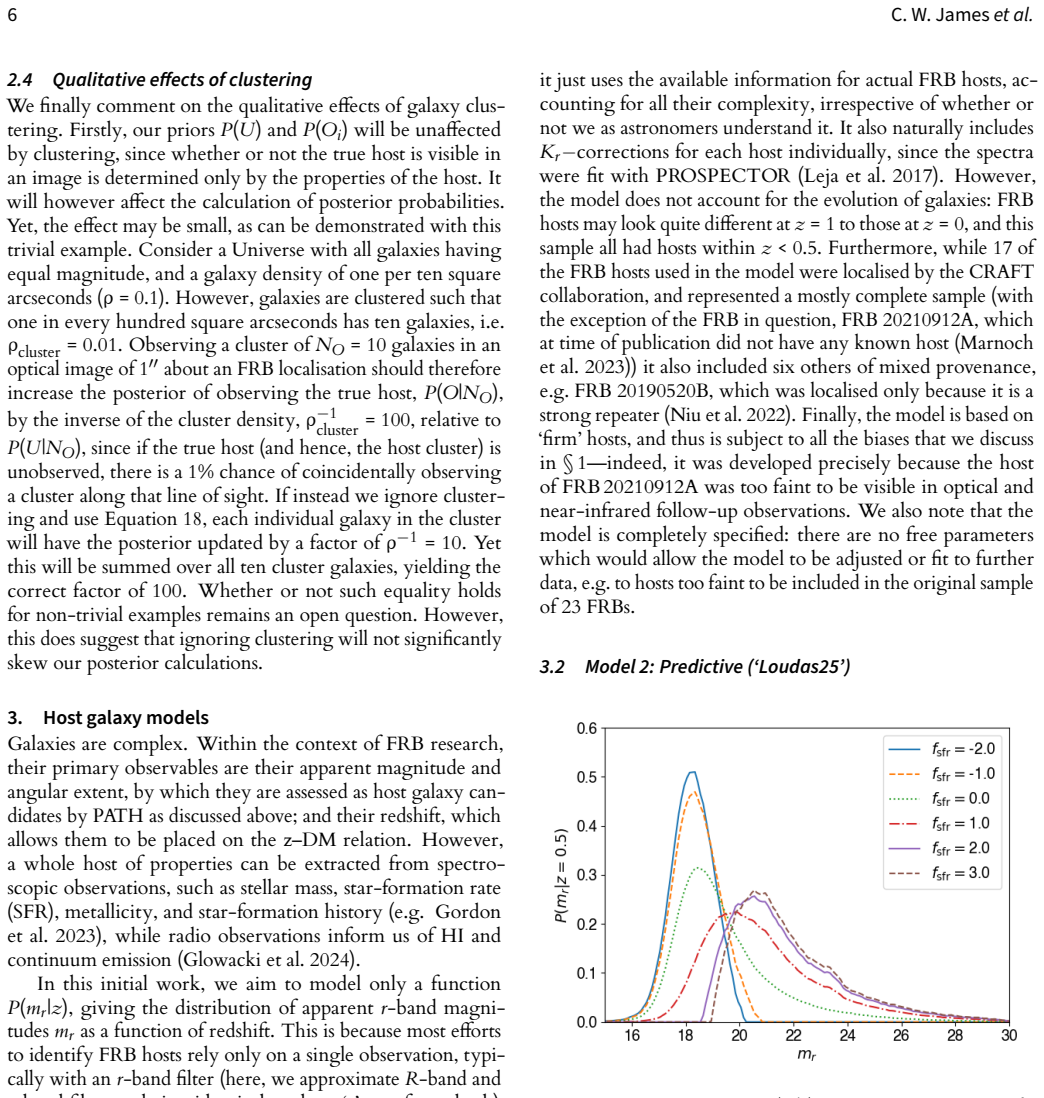
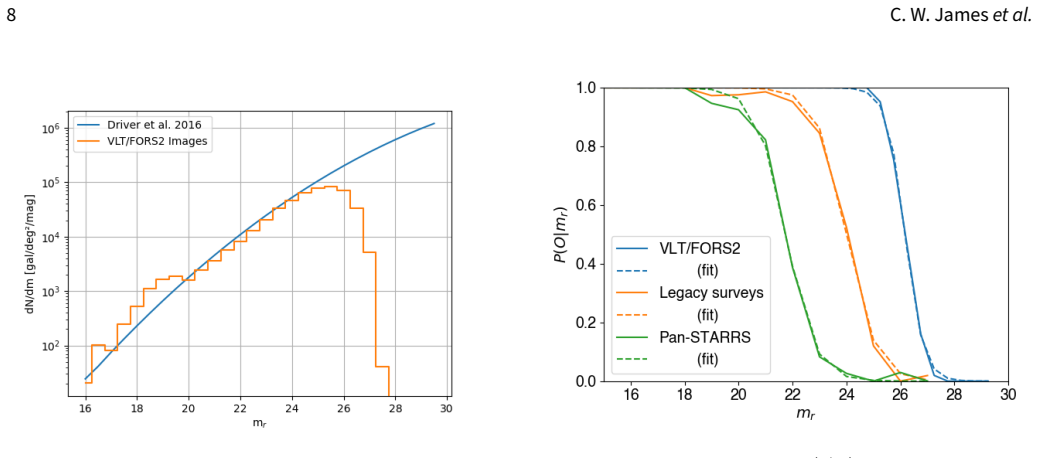
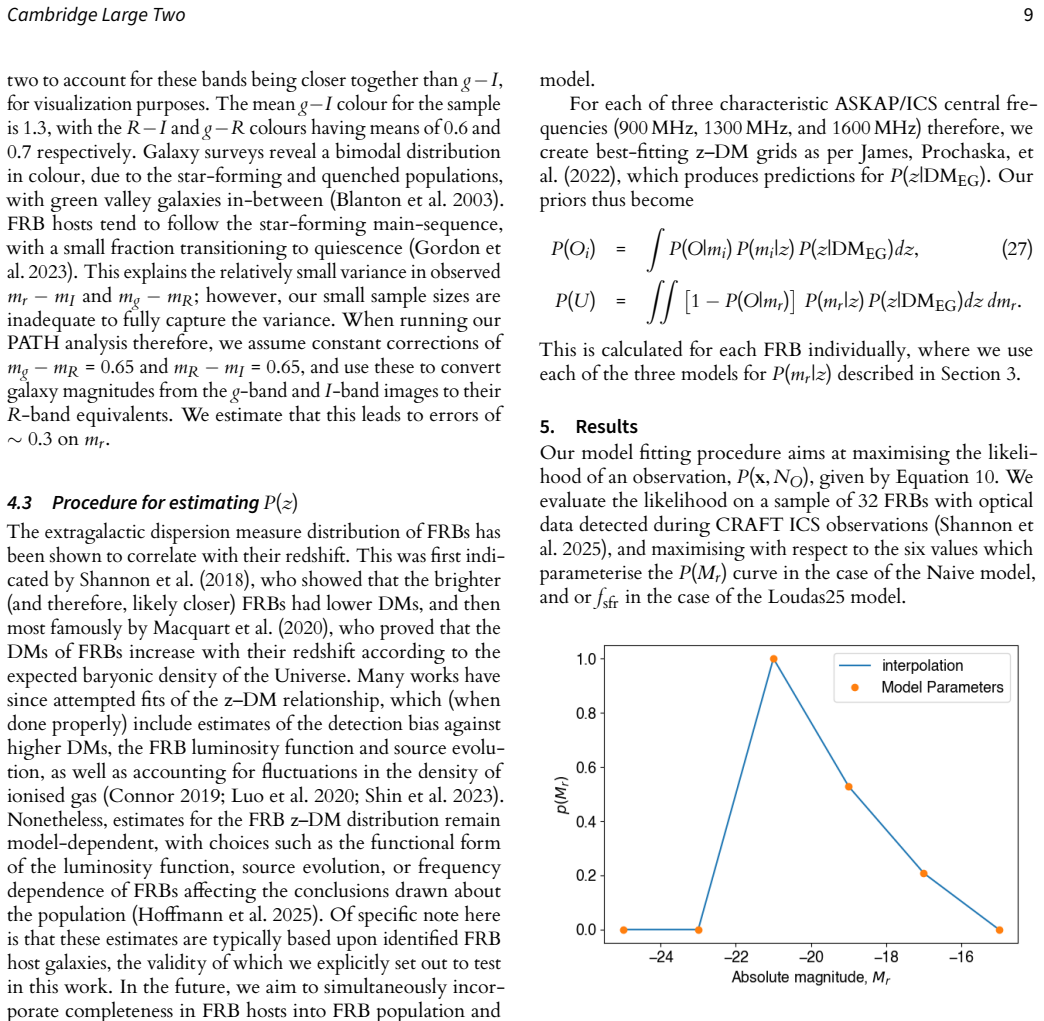
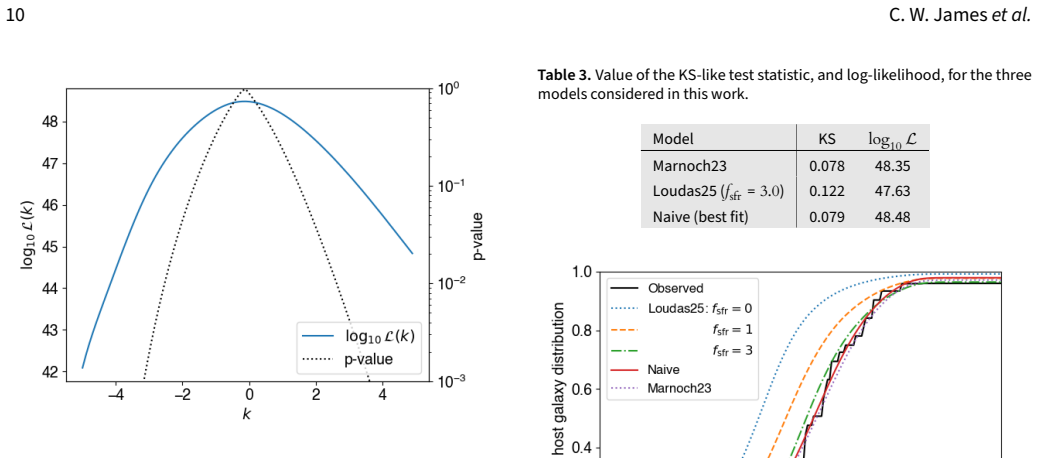
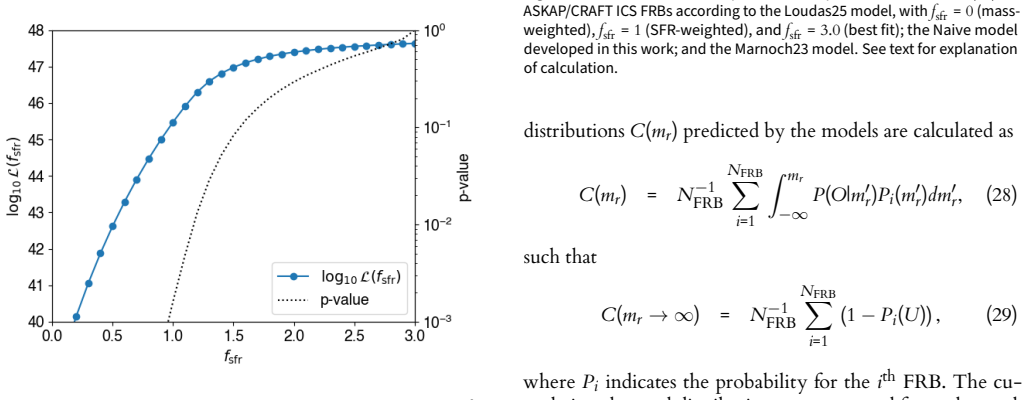
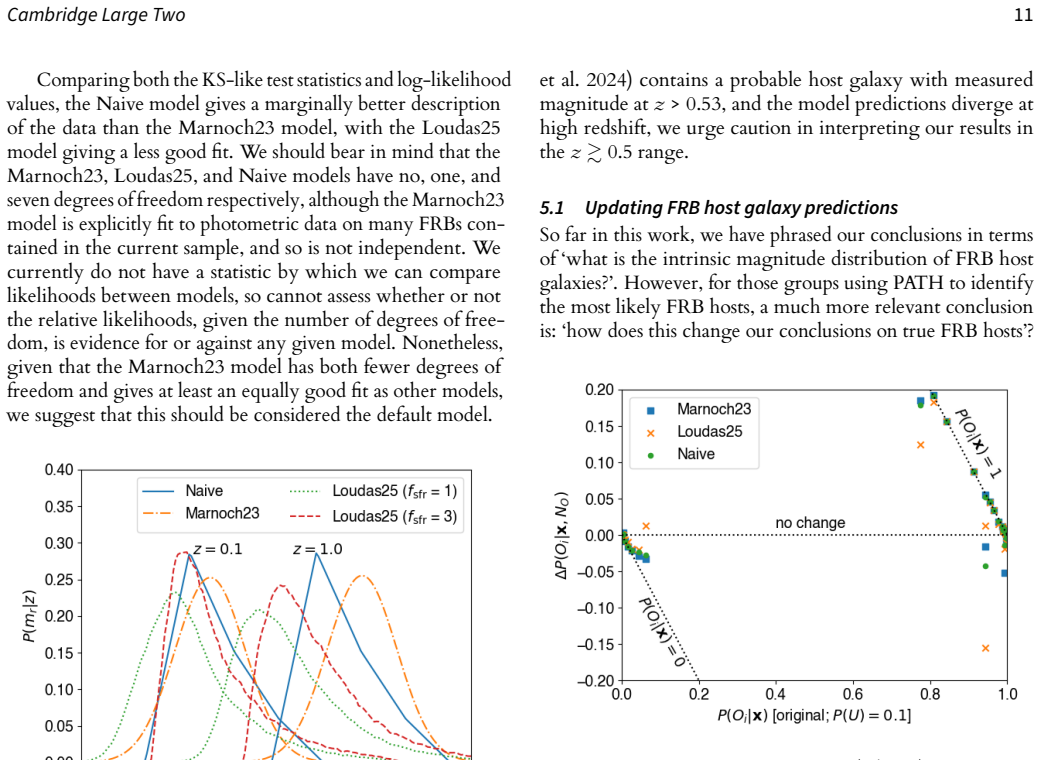
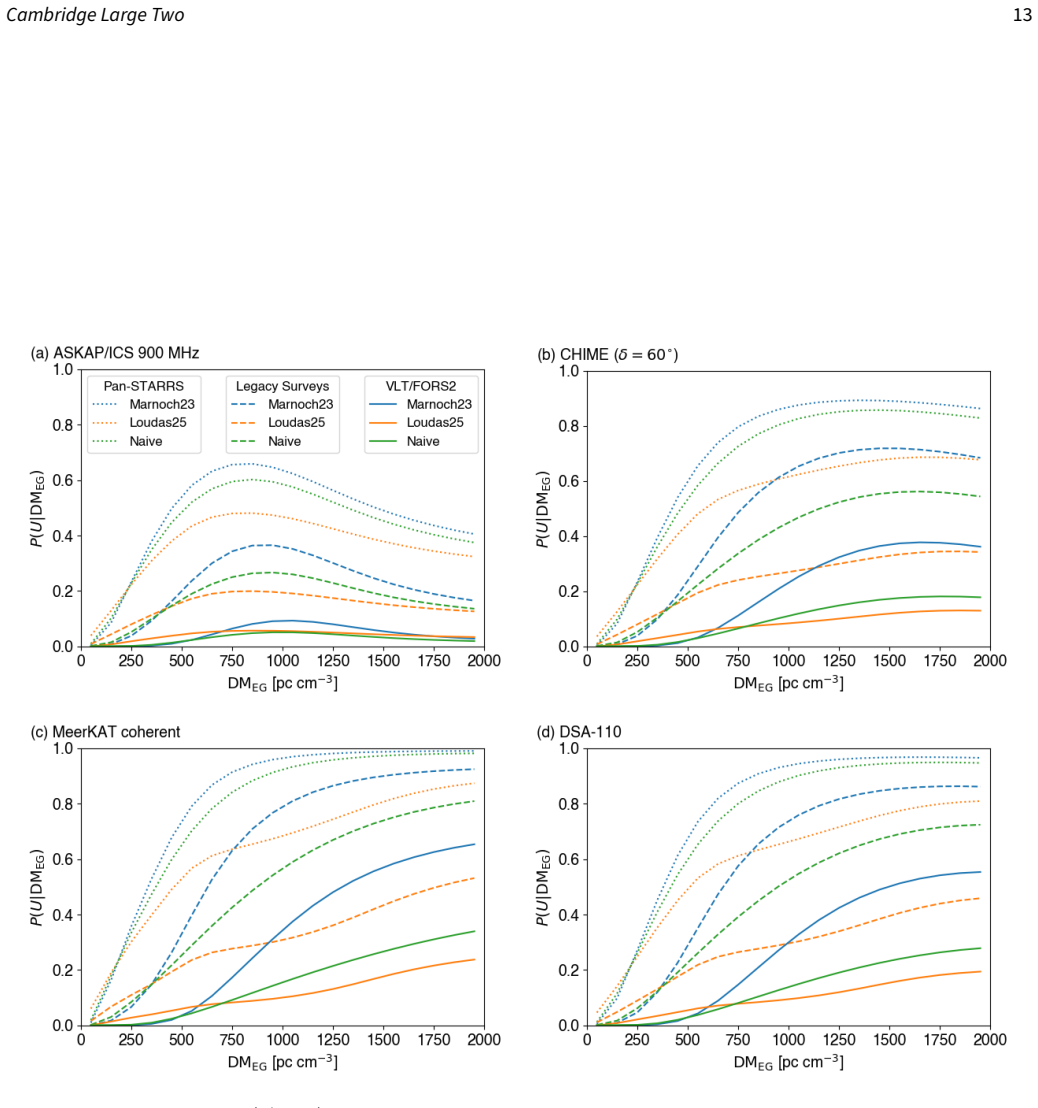
Over a hundred fast radio burst (FRB) host galaxies have now been identified, enabling both comparisons of host redshift with FRB dispersion measure to study the cosmological distribution of ionised gas, and analyses of host properties in order to identify FRB progenitors. The standard method for determining the most likely FRB host galaxy in an optical image is the Bayesian framework Probabilistic Association of Transients to their Hosts (PATH), which accounts for uncertainties in the radio localisation, and simplified prior distributions on the host being observable. In this work we extend PATH, incorporating physically-motivated priors that are based on expectations about FRB host galaxy magnitudes. We develop three different models for the apparent r-band magnitude distribution based on an FRB's expected host galaxy redshift, $P(m_r|z)$ and combine these with expectations for redshift based on an FRB's dispersion measure, $P(z|DM)$. We fit the parameters of these prior models using host galaxy candidates for 32 FRBs detected by the Australian SKA Pathfinder (ASKAP) in incoherent sum (ICS) mode by the Commensal Real-time ASKAP Fast Transients (CRAFT) survey. Employing PATH with the new priors on the host magnitudes, we find increased confidence in the most probable hosts of all ASKAP ICS FRB host galaxies. All three models predict similar distributions of FRB host magnitudes at low redshift $(z \sim 0.1)$, and we confirm previous results that the true FRB host galaxy distribution is fainter than expected for a star-formation-weighted distribution (p-value of 0.12%). However, a mass-weighted distribution provides an even worse fit (p-value of $10^{-9}$). Tests against more FRBs in the $z > 0.5$ range, where the models differ, and extensions of the models to account for e.g. host metallicity, may help to resolve these uncertainties in the FRB host distribution.
Editorial analysis
A structured set of objections, weighed in public.
Referee Report
Summary. The manuscript updates the Probabilistic Association of Transients to their Hosts (PATH) framework by introducing three new models for the apparent r-band magnitude distribution P(m_r|z) of FRB host galaxies. These models are fitted to the host galaxy candidates associated with 32 ASKAP incoherent sum (ICS) FRBs from the CRAFT survey. When the updated priors are applied back to these same FRBs, the paper reports increased confidence in the most probable host identifications for all of them. Additionally, the resulting host magnitude distribution is compared to star-formation-weighted and mass-weighted expectations, yielding p-values of 0.12% and 10^{-9}, respectively, suggesting FRB hosts are fainter than both but closer to the former.
Significance. If the priors prove robust on independent data, incorporating magnitude-based priors into PATH would improve the reliability of FRB host associations, directly aiding progenitor studies and cosmological analyses that rely on accurate redshifts and host properties. The explicit reporting of p-values for the magnitude distribution comparisons is a strength, providing quantitative grounding for claims about the FRB host population relative to star-formation and stellar-mass weighting.
major comments (2)
- [Abstract and model-fitting description] Abstract and the section describing the fitting of the three P(m_r|z) models: the model parameters are fitted directly to the host-galaxy candidates of the identical 32 ASKAP ICS FRBs that are later used both to demonstrate increased association confidence under the new priors and to construct the empirical magnitude histogram for the p-value tests against star-formation-weighted and mass-weighted distributions. Because the fitting sample and evaluation sample coincide, the reported gains in host probability and the statistical comparisons are not independent validations and are vulnerable to in-sample overfitting.
- [Abstract] Abstract: the claim that the new priors increase confidence for all ASKAP ICS hosts and enable a robust comparison to reference distributions rests on the assumption that the fitted P(m_r|z) models accurately represent the underlying population; no cross-validation, hold-out sample, or external catalog test is described to support this assumption.
minor comments (1)
- [Abstract] The abstract would benefit from a brief statement of the redshift range over which the three models are stated to be similar versus where they diverge, to clarify the domain of the reported conclusions.
Simulated Author's Rebuttal
We thank the referee for their constructive comments, which highlight an important limitation in our analysis. We agree that the use of the same sample for model fitting and subsequent evaluation means the reported improvements are not independent validations. We have revised the manuscript to explicitly acknowledge this and to moderate claims accordingly.
read point-by-point responses
-
Referee: [Abstract and model-fitting description] Abstract and the section describing the fitting of the three P(m_r|z) models: the model parameters are fitted directly to the host-galaxy candidates of the identical 32 ASKAP ICS FRBs that are later used both to demonstrate increased association confidence under the new priors and to construct the empirical magnitude histogram for the p-value tests against star-formation-weighted and mass-weighted distributions. Because the fitting sample and evaluation sample coincide, the reported gains in host probability and the statistical comparisons are not independent validations and are vulnerable to in-sample overfitting.
Authors: We agree that fitting the P(m_r|z) parameters to the 32 ASKAP ICS FRBs and then applying the resulting priors back to the same events means the reported gains in association confidence and the p-value comparisons are in-sample results rather than independent validations. This approach was adopted because the current sample of securely associated FRB hosts remains small. In the revised manuscript we have updated the abstract and the model-fitting section to state explicitly that the confidence increases are demonstrated on the fitting sample, and we have added a paragraph in the discussion noting the risk of overfitting and the desirability of future validation on independent data sets. revision: yes
-
Referee: [Abstract] Abstract: the claim that the new priors increase confidence for all ASKAP ICS hosts and enable a robust comparison to reference distributions rests on the assumption that the fitted P(m_r|z) models accurately represent the underlying population; no cross-validation, hold-out sample, or external catalog test is described to support this assumption.
Authors: We acknowledge that no cross-validation, hold-out testing, or external catalog comparison was performed. With only 32 events the sample is too small to reserve a meaningful hold-out set without compromising the model fits. The revised abstract and discussion now include an explicit caveat that the models have not been tested on independent data and that additional FRBs (especially at z > 0.5) will be required to assess whether the priors generalise. We retain the claim that the new priors increase confidence within the current sample, but we no longer describe the comparison to reference distributions as fully robust without further validation. revision: yes
Axiom & Free-Parameter Ledger
free parameters (1)
- parameters of the three P(m_r|z) models
axioms (2)
- domain assumption An FRB's dispersion measure supplies a usable prior P(z|DM) on host redshift
- domain assumption FRB host galaxies follow the modeled apparent-magnitude distribution at their redshift
Reference graph
Works this paper leans on
-
[1]
The Galactic Faraday rotation sky 2020. , keywords =. doi:10.1051/0004-6361/202140486 , archivePrefix =. 2102.01709 , primaryClass =
-
[2]
Polarization Sweeps in Rotation Powered Pulsars
Polarization Sweeps in Rotation-powered Pulsars. , keywords =. doi:10.1086/318224 , archivePrefix =. astro-ph/0008117 , primaryClass =
work page internal anchor Pith review Pith/arXiv arXiv doi:10.1086/318224
-
[3]
Frequency-dependent polarization of repeating fast radio bursts implications for their origin. Science , keywords =. doi:10.1126/science.abl7759 , archivePrefix =. 2202.09601 , primaryClass =
-
[4]
A depolarisation census of ASKAP fast radio bursts. arXiv e-prints , keywords =. doi:10.48550/arXiv.2503.19749 , archivePrefix =. 2503.19749 , primaryClass =
-
[5]
FAST Observations of an Extremely Active Episode of FRB 20201124A: I. Burst Morphology. Research in Astronomy and Astrophysics , keywords =. doi:10.1088/1674-4527/ac98f8 , archivePrefix =. 2210.03607 , primaryClass =
-
[6]
Australian Journal of Physics , keywords =
Pulsar microstructure: periodicities, polarization and probes of pulsar magnetospheres. Australian Journal of Physics , keywords =. doi:10.1071/PH790009 , adsurl =
-
[7]
Redshift Estimation and Constraints on Intergalactic and Interstellar Media from Dispersion and Scattering of Fast Radio Bursts. , keywords =. doi:10.3847/1538-4357/ac6873 , archivePrefix =. 2108.01172 , primaryClass =
-
[8]
Multifrequency Observations of Radio Pulse Broadening and Constraints on Interstellar Electron Density Microstructure. , keywords =. doi:10.1086/382680 , archivePrefix =. astro-ph/0401067 , primaryClass =
work page internal anchor Pith review Pith/arXiv arXiv doi:10.1086/382680
-
[9]
Polarization Properties of 128 Nonrepeating Fast Radio Bursts from the First CHIME/FRB Baseband Catalog. , keywords =. doi:10.3847/1538-4357/ad40aa , archivePrefix =. 2401.17378 , primaryClass =
-
[10]
Morphology of 137 Fast Radio Bursts Down to Microsecond Timescales from the First CHIME/FRB Baseband Catalog. , keywords =. doi:10.3847/1538-4357/ad9b11 , archivePrefix =. 2408.13215 , primaryClass =
-
[11]
Updating the First CHIME/FRB Catalog of Fast Radio Bursts with Baseband Data. , keywords =. doi:10.3847/1538-4357/ad464b , archivePrefix =. 2311.00111 , primaryClass =
-
[12]
GitHub repository , howpublished =
zdm , publisher =. GitHub repository , howpublished =
-
[13]
FRBs/FRB: Release to sync with Gordon et al. 2023. doi:10.5281/zenodo.8125230 , version =
-
[14]
The low density and magnetization of a massive galaxy halo exposed by a fast radio burst. Science , keywords =. doi:10.1126/science.aay0073 , archivePrefix =. 1909.11681 , primaryClass =
-
[15]
The fast radio burst dispersion measure distribution. , keywords =. doi:10.1093/mnras/staa3948 , archivePrefix =. 2012.15051 , primaryClass =
-
[16]
emcee: The MCMC Hammer. , keywords =. doi:10.1086/670067 , archivePrefix =. 1202.3665 , primaryClass =
work page internal anchor Pith review Pith/arXiv arXiv doi:10.1086/670067
-
[17]
Charles R. Harris and K. Jarrod Millman and St. Array programming with. 2020 , month = sep, journal =. doi:10.1038/s41586-020-2649-2 , publisher =
-
[18]
Computing in Science and Engineering , keywords =
Matplotlib: A 2D Graphics Environment. Computing in Science and Engineering , keywords =. 2007. doi:10.1109/MCSE.2007.55 , adsnote =
-
[19]
SciPy 1.0--Fundamental Algorithms for Scientific Computing in Python
SciPy 1.0: fundamental algorithms for scientific computing in Python. Nature Methods , keywords =. doi:10.1038/s41592-019-0686-2 , archivePrefix =. 1907.10121 , primaryClass =
work page internal anchor Pith review Pith/arXiv arXiv doi:10.1038/s41592-019-0686-2 1907
-
[20]
arXiv , doi =:1901.11051 , keywords =
, year =. arXiv , doi =:1901.11051 , keywords =
Pith/arXiv arXiv 1901
-
[21]
The Sensitivity of GPz Estimates of Photo-z Posterior PDFs to Realistically Complex Training Set Imperfections. , keywords =. doi:10.1088/1538-3873/ac59bf , archivePrefix =. 2202.12775 , primaryClass =
-
[22]
Contemporaneous optical-radio observations of a fast radio burst in a close galaxy pair. , keywords =. doi:10.1093/mnras/staf289 , archivePrefix =. 2502.10153 , primaryClass =
-
[23]
FRB microstructure revealed by the real-time detection of FRB170827
FRB microstructure revealed by the real-time detection of FRB170827. , keywords =. doi:10.1093/mnras/sty1122 , archivePrefix =. 1803.05697 , primaryClass =
work page internal anchor Pith review Pith/arXiv arXiv doi:10.1093/mnras/sty1122
-
[24]
Nature Biotechnology , author =
Nextflow enables reproducible computational workflows , volume =. Nature Biotechnology , author =. 2017 , pages =. doi:10.1038/nbt.3820 , language =
-
[25]
Host Galaxy Properties and Offset Distributions of Fast Radio Bursts: Implications for Their Progenitors. , keywords =. doi:10.3847/1538-4357/abb6fb , archivePrefix =. 2009.10747 , primaryClass =
-
[26]
Magnetospheric origin of a fast radio burst constrained using scintillation. , keywords =. doi:10.1038/s41586-024-08297-w , archivePrefix =. 2406.11053 , primaryClass =
-
[27]
FRB 121102 Bursts Show Complex Time-Frequency Structure
FRB 121102 Bursts Show Complex Time-Frequency Structure. , keywords =. doi:10.3847/2041-8213/ab13ae , archivePrefix =. 1811.10748 , primaryClass =
work page internal anchor Pith review Pith/arXiv arXiv doi:10.3847/2041-8213/ab13ae 2041
-
[28]
Limits on. , author =. 2020 , note =. doi:10.3847/2041-8213/abb462 , language =
-
[29]
Deep. , author =. 2023 , note =. doi:10.3847/1538-4357/accf1d , number =
-
[30]
Law, C. J. and Sharma, K. and Ravi, V. and Chen, G. and Catha, M. and Connor, L. and Faber, J. T. and Hallinan, G. and Harnach, C. and Hellbourg, G. and Hobbs, R. and Hodge, D. and Hodges, M. and Lamb, J. W. and Rasmussen, P. and Sherman, M. B. and Shi, J. and Simard, D. and Squillace, R. and Weinreb, S. and Woody, D. P. and Yadlapalli, N. , month = jul, ...
-
[31]
and Michilli, Daniele and Bandura, Kevin and Chatterjee, Shami and Peterson, Jeffrey B
Cassanelli, Tomas and Leung, Calvin and Sanghavi, Pranav and Mena-Parra, Juan and Cary, Savannah and Mckinven, Ryan and Bhardwaj, Mohit and Masui, Kiyoshi W. and Michilli, Daniele and Bandura, Kevin and Chatterjee, Shami and Peterson, Jeffrey B. and Kaczmarek, Jane and Patel, Chitrang and Rahman, Mubdi and Shin, Kaitlyn and Vanderlinde, Keith and Berger, ...
-
[32]
A repeating fast radio burst source localized to a nearby spiral galaxy , volume =. , author =. 2020 , note =. doi:10.1038/s41586-019-1866-z , language =
-
[33]
Magnetic field reversal in the turbulent environment around a repeating fast radio burst. Science , keywords =. doi:10.1126/science.abo6526 , archivePrefix =. 2202.11112 , primaryClass =
-
[34]
A fast radio burst source at a complex magnetized site in a barred galaxy , volume =. , author =. 2022 , note =. doi:10.1038/s41586-022-05071-8 , language =
-
[35]
Faraday conversion and magneto-ionic variations in Fast Radio Bursts
Faraday conversion and magneto-ionic variations in fast radio bursts. , keywords =. doi:10.1093/mnrasl/slz038 , archivePrefix =. 1812.07889 , primaryClass =
work page internal anchor Pith review Pith/arXiv arXiv doi:10.1093/mnrasl/slz038
-
[36]
A fast radio burst localized to a massive galaxy , volume =. , author =. 2019 , note =. doi:10.1038/s41586-019-1389-7 , language =
-
[37]
Missing. Science , author =. 2008 , note =. doi:10.1126/science.1151400 , number =
-
[38]
Reviews of Modern Physics , author =
The interstellar environment of our galaxy , volume =. Reviews of Modern Physics , author =. 2001 , note =. doi:10.1103/RevModPhys.73.1031 , number =
-
[40]
RM-Tools: Rotation measure (RM) synthesis and Stokes QU-fitting
-
[41]
Publications of the Astronomical Society of Australia , author =
The host galaxy of. Publications of the Astronomical Society of Australia , author =. 2023 , keywords =. doi:10.1017/pasa.2023.27 , language =
-
[42]
An accurate and efficient algorithm for detection of fast radio bursts with an unknown dispersion measure, for single-dish telescopes and interferometers , volume =. , author =. 2017 , keywords =. doi:10.3847/1538-4357/835/1/11 , language =
-
[44]
Journal of Astronomical Instrumentation , author =
A multi-beam radio transient detector with real-time de-dispersion over a wide dm range , volume =. Journal of Astronomical Instrumentation , author =. 2014 , note =. doi:10.1142/S2251171714500044 , number =
-
[45]
Analysis of common-mode effects in a dual-polarized planar connected-array antenna , volume =. Radio Science , author =. 2008 , note =. doi:10.1029/2007RS003798 , language =
-
[46]
Proceedings of the IEEE , author =
Australian. Proceedings of the IEEE , author =. 2009 , note =. doi:10.1109/JPROC.2009.2016516 , number =
-
[47]
Publications of the Astronomical Society of Australia , author =
Science with the. Publications of the Astronomical Society of Australia , author =. 2007 , note =. doi:10.1071/AS07033 , language =
-
[48]
A population analysis of pulse broadening in. , author =. 2020 , pages =. doi:10.1093/mnras/staa1916 , number =
-
[49]
Planck 2015 results. XIII. Cosmological parameters. , keywords =. doi:10.1051/0004-6361/201525830 , archivePrefix =. 1502.01589 , primaryClass =
work page internal anchor Pith review Pith/arXiv arXiv doi:10.1051/0004-6361/201525830 2015
-
[50]
Where. , author =. 2006 , note =. doi:10.1086/506505 , language =
-
[51]
The. , author =. 1998 , note =. doi:10.1086/306025 , language =
-
[52]
The Host Galaxy and Redshift of the Repeating Fast Radio Burst FRB 121102
The Host Galaxy and Redshift of the Repeating Fast Radio Burst FRB 121102. , keywords =. doi:10.3847/2041-8213/834/2/L7 , archivePrefix =. 1701.01100 , primaryClass =
work page internal anchor Pith review Pith/arXiv arXiv doi:10.3847/2041-8213/834/2/l7 2041
-
[53]
The direct localization of a fast radio burst and its host
A direct localization of a fast radio burst and its host. , keywords =. doi:10.1038/nature20797 , archivePrefix =. 1701.01098 , primaryClass =
work page internal anchor Pith review Pith/arXiv arXiv doi:10.1038/nature20797
-
[54]
A luminous fast radio burst that probes the Universe at redshift 1. Science , keywords =. doi:10.1126/science.adf2678 , archivePrefix =. 2210.04680 , primaryClass =
-
[56]
An extreme magneto-ionic environment associated with the fast radio burst source FRB 121102
An extreme magneto-ionic environment associated with the fast radio burst source FRB 121102. , keywords =. doi:10.1038/nature25149 , archivePrefix =. 1801.03965 , primaryClass =
work page internal anchor Pith review Pith/arXiv arXiv doi:10.1038/nature25149
-
[57]
Diverse polarization angle swings from a repeating fast radio burst source. , keywords =. doi:10.1038/s41586-020-2827-2 , archivePrefix =. 2011.00171 , primaryClass =
-
[58]
Highest. , author =. 2018 , note =. doi:10.3847/1538-4357/aad005 , language =
-
[59]
Subarcminute. , author =. 2023 , note =. doi:10.3847/1538-4357/accf89 , language =
-
[60]
Confronting the Magnetar Interpretation of Fast Radio Bursts through Their Host Galaxy Demographics. , keywords =. doi:10.3847/2041-8213/abd03e , archivePrefix =. 2009.11735 , primaryClass =
-
[61]
A repeating fast radio burst source in a globular cluster. , keywords =. doi:10.1038/s41586-021-04354-w , archivePrefix =. 2105.11445 , primaryClass =
-
[62]
The Broad-band Optical Properties of Galaxies with Redshifts 0.0 < z < 0.2
The Broadband Optical Properties of Galaxies with Redshifts 0.02<z<0.22. , keywords =. doi:10.1086/375528 , archivePrefix =. astro-ph/0209479 , primaryClass =
work page internal anchor Pith review Pith/arXiv arXiv doi:10.1086/375528
-
[63]
The Demographics, Stellar Populations, and Star Formation Histories of Fast Radio Burst Host Galaxies: Implications for the Progenitors. , keywords =. doi:10.3847/1538-4357/ace5aa , archivePrefix =. 2302.05465 , primaryClass =
-
[64]
NE2025: An Updated Electron Density Model for the Galactic Interstellar Medium
NE2025: An Updated Electron Density Model for the Galactic Interstellar Medium. , keywords =. doi:10.3847/1538-4357/ae5825 , archivePrefix =. 2602.11838 , primaryClass =
work page internal anchor Pith review Pith/arXiv arXiv doi:10.3847/1538-4357/ae5825
-
[65]
Baryons in the Darkest Sites of the Universe
Baryons in the Darkest Sites of the Universe. arXiv e-prints , keywords =. doi:10.48550/arXiv.2605.01994 , archivePrefix =. 2605.01994 , primaryClass =
work page internal anchor Pith review Pith/arXiv arXiv doi:10.48550/arxiv.2605.01994
-
[66]
The Host Galaxies of Fast Radio Bursts Track a Combination of Stellar Mass and Star Formation, Similar to Type Ia Supernovae. , keywords =. doi:10.3847/1538-4357/ae1f11 , archivePrefix =. 2504.08038 , primaryClass =
-
[67]
Dispersion Measures of Fast Radio Burst Host Galaxies Derived from IllustrisTNG Simulation. , keywords =. doi:10.3847/1538-4357/abaa4a , archivePrefix =. 2007.13935 , primaryClass =
-
[68]
Stellar Mass Dispersion Measure Correlations Constrain Baryonic Feedback in Fast Radio Burst Host Galaxies. , keywords =. doi:10.3847/2041-8213/ae044d , archivePrefix =. 2507.16816 , primaryClass =
-
[69]
The Crab Pulsar at Centimeter Wavelengths. II. Single Pulses. , keywords =. doi:10.3847/1538-4357/833/1/47 , archivePrefix =. 1608.08881 , primaryClass =
work page internal anchor Pith review Pith/arXiv arXiv doi:10.3847/1538-4357/833/1/47
-
[70]
Probabilistic Association of Transients to their Hosts (PATH). , keywords =. doi:10.3847/1538-4357/abe8d2 , archivePrefix =. 2102.10627 , primaryClass =
-
[71]
Theory of Probability
-
[72]
Modelling DSA, FAST and CRAFT surveys in a z-DM analysis and constraining a minimum FRB energy
Modelling DSA, FAST, and CRAFT surveys in a z-DM analysis and constraining a minimum FRB energy. , keywords =. doi:10.1017/pasa.2024.127 , archivePrefix =. 2408.04878 , primaryClass =
work page internal anchor Pith review Pith/arXiv arXiv doi:10.1017/pasa.2024.127 2024
-
[73]
I can see your halo: Constraining the MilkyWay halo DM with FRB population studies. , keywords =. doi:10.1017/pasa.2026.10143 , archivePrefix =. 2601.05496 , primaryClass =
-
[74]
The impact of the FREDDA dedispersion algorithm on H _ 0 estimations with fast radio bursts. , keywords =. doi:10.1093/mnras/stae131 , archivePrefix =. 2408.05937 , primaryClass =
-
[75]
Australian square kilometre array pathfinder: I. system description. , keywords =. doi:10.1017/pasa.2021.1 , archivePrefix =. 2102.01870 , primaryClass =
-
[76]
The Effect of Scattering on Pulsar Polarization Angle
The effect of scattering on pulsar polarization angle. , keywords =. doi:10.1051/0004-6361:20031190 , archivePrefix =. astro-ph/0308095 , primaryClass =
work page internal anchor Pith review Pith/arXiv arXiv doi:10.1051/0004-6361:20031190
-
[77]
Estimation of intrinsic fast radio burst width and scattering distributions from CRAFT data. arXiv e-prints , keywords =. doi:10.48550/arXiv.2510.05654 , archivePrefix =. 2510.05654 , primaryClass =
-
[78]
A fast radio burst from the first 3 billion years of the Universe. arXiv e-prints , keywords =. doi:10.48550/arXiv.2508.01648 , archivePrefix =. 2508.01648 , primaryClass =
-
[79]
The CRAFT coherent (CRACO) upgrade I: System description and results of the 110-ms radio transient pilot survey. , keywords =. doi:10.1017/pasa.2024.107 , archivePrefix =. 2409.10316 , primaryClass =
-
[80]
The First CHIME/FRB Fast Radio Burst Catalog. , keywords =. doi:10.3847/1538-4365/ac33ab , archivePrefix =. 2106.04352 , primaryClass =
-
[81]
An 8 per cent determination of the Hubble constant from localized fast radio bursts. , keywords =. doi:10.1093/mnrasl/slac022 , archivePrefix =. 2108.00581 , primaryClass =
-
[82]
A new measurement of the Hubble constant using fast radio bursts. , keywords =. doi:10.1093/mnras/stac077 , archivePrefix =. 2104.04538 , primaryClass =
-
[83]
A new electron-density model for estimation of pulsar and. , author =. 2017 , keywords =. doi:10.3847/1538-4357/835/1/29 , language =
discussion (0)
Sign in with ORCID, Apple, or X to comment. Anyone can read and Pith papers without signing in.