Interaction-driven dynamics in graphene flakes as a benchmark for quantum simulation
Pith reviewed 2026-06-27 11:47 UTC · model grok-4.3
The pith
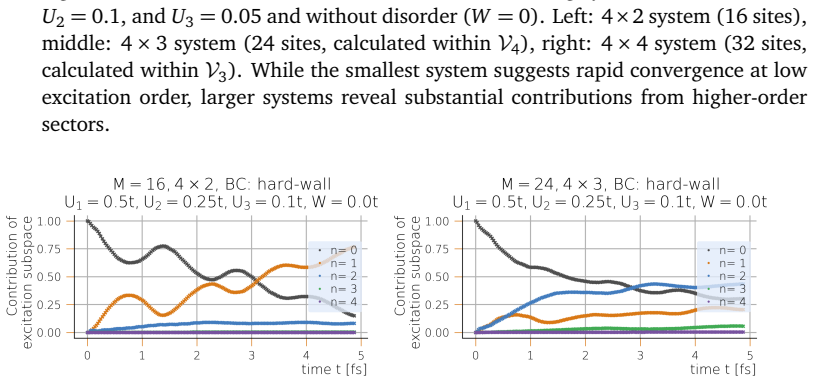
Periodic graphene flakes relax via low-order excitations after an optical quench, while confined geometries require higher-order contributions even at weak interactions.
A machine-rendered reading of the paper's core claim, the machinery that carries it, and where it could break.
Core claim
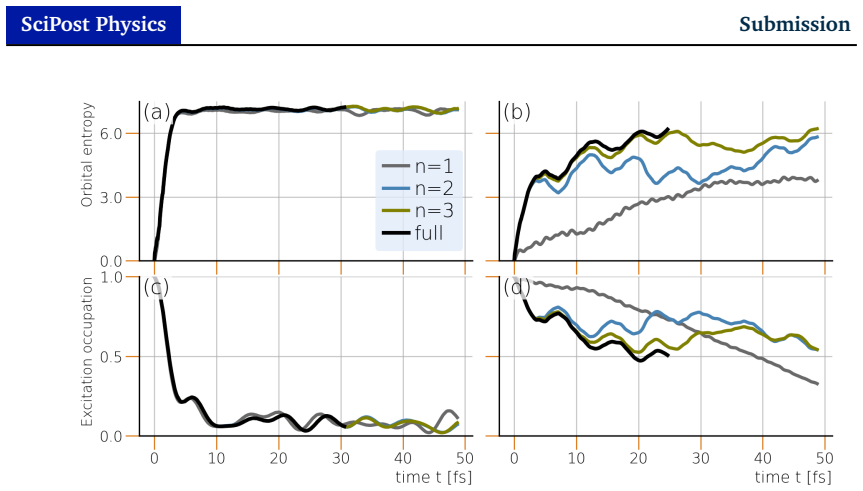
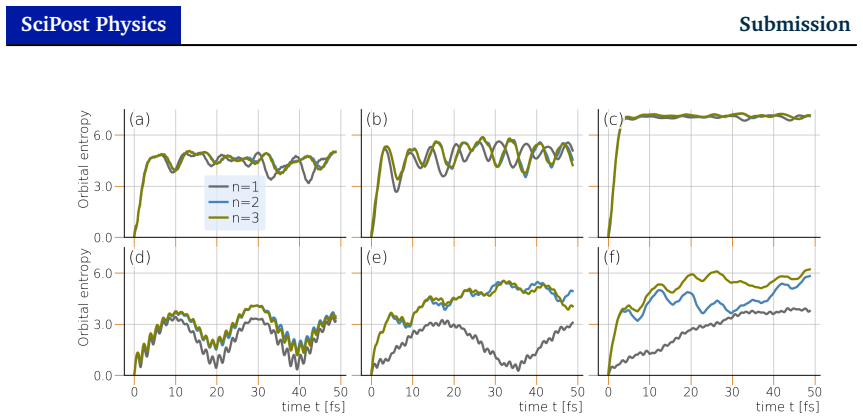
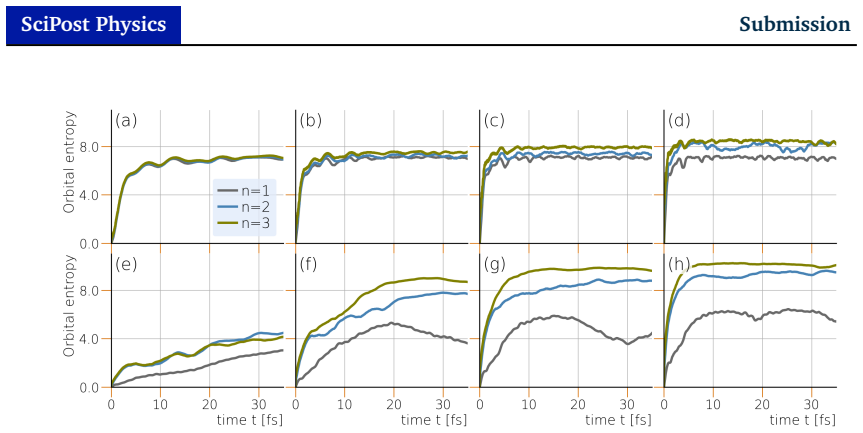
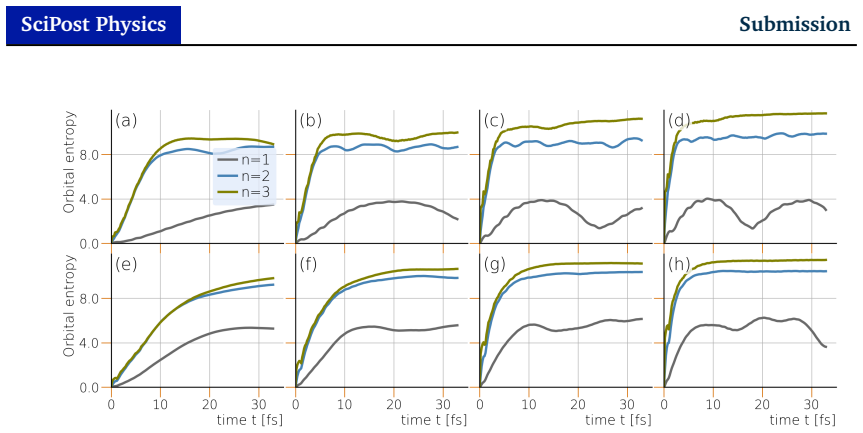
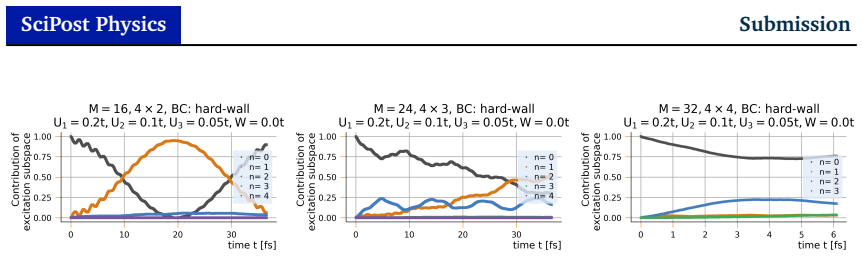
For the systems studied here, periodic graphene flakes are well described by low-order excitations, whereas confined geometries require substantial higher-order contributions even for relatively small interaction strengths. The single-particle orbital entropy provides a compact diagnostic for dynamic correlation growth, and the quench protocol combines simple initial-state preparation with strongly correlated dynamics.
What carries the argument
Comparison between exact real-time evolution and simulations restricted to particle-hole excitation subspaces, with single-particle orbital entropy as the diagnostic for correlation growth.
If this is right
- Relaxation after the quench in periodic flakes is captured by low-order many-body processes.
- Confined flake geometries exhibit dynamics that demand higher-order contributions despite small interaction strengths.
- Single-particle orbital entropy tracks the buildup of dynamic correlations during the evolution.
- The optical-pump-quench protocol in the interacting tight-binding model serves as a benchmark for quantum-computing simulations.
Where Pith is reading between the lines
- The geometry dependence suggests testing similar subspace comparisons in other lattice structures such as nanoribbons or moiré systems.
- Quantum simulators may require resources to capture higher-order correlations when modeling confined nanostructures even in the weak-coupling regime.
- Extending the flake-size scaling could show how the required excitation order grows with system size.
Load-bearing premise
The comparison between exact evolution and particle-hole subspace simulations isolates low-order many-body contributions without systematic bias from subspace truncation or the choice of interacting tight-binding Hamiltonian.
What would settle it
Exact real-time dynamics in periodic flakes deviating from low-order subspace results at the interaction strengths studied, or confined geometries matching low-order subspaces even at small interactions.
Figures
read the original abstract
We study interaction-driven ultrafast dynamics in finite graphene flakes following an optical pump quench in an interacting tight-binding model. By comparing exact real-time evolution with simulations restricted to particle-hole excitation subspaces, we assess when relaxation can be captured by low-order many-body processes and when this is not sufficient. The single-particle orbital entropy provides a compact diagnostic for dynamic correlation growth. For the systems studied here, periodic graphene flakes are well described by low-order excitations, whereas confined geometries require substantial higher-order contributions even for relatively small interaction strengths. The quench protocol combines simple initial-state preparation with strongly correlated dynamics, identifying a promising benchmark problem for future quantum-computing simulations.
Editorial analysis
A structured set of objections, weighed in public.
Referee Report
Summary. The manuscript examines interaction-driven ultrafast dynamics in finite graphene flakes after an optical pump quench within an interacting tight-binding model. Exact real-time evolution is compared to simulations restricted to particle-hole excitation subspaces to determine when relaxation is captured by low-order many-body processes. The single-particle orbital entropy serves as a diagnostic for correlation growth. The central finding is that periodic graphene flakes are well described by low-order excitations, whereas confined geometries require substantial higher-order contributions even at relatively small interaction strengths. The quench protocol is proposed as a benchmark for quantum-computing simulations.
Significance. If the reported geometry-dependent distinction holds under validated subspace truncations, the work supplies a concrete, falsifiable benchmark problem for quantum simulators that combines simple state preparation with strongly correlated dynamics. The entropy diagnostic is compact and potentially reusable. No machine-checked proofs or parameter-free derivations are present, but the dual-method comparison (exact vs. restricted) offers a clear test of the low-order approximation.
major comments (2)
- [Abstract] Abstract: the central claim that periodic flakes are 'well described by low-order excitations' while confined geometries 'require substantial higher-order contributions even for relatively small interaction strengths' is stated without any quantitative measures, error bars, subspace-size convergence data, or explicit validation of the truncation procedure. This renders the distinction between geometries impossible to assess from the given text and places the load-bearing empirical observation on an unshown comparison.
- [Abstract] The comparison between exact real-time evolution and particle-hole subspace simulations is presented as isolating the contribution of low-order processes, yet no details are supplied on how the subspace restriction was implemented, how its size was chosen, or whether alternative interaction forms were tested for bias. This directly affects the weakest assumption underlying the geometry-dependent conclusion.
Simulated Author's Rebuttal
We thank the referee for the constructive comments. We address each major point below and will revise the abstract to incorporate quantitative support and methodological details while preserving the manuscript's focus.
read point-by-point responses
-
Referee: [Abstract] Abstract: the central claim that periodic flakes are 'well described by low-order excitations' while confined geometries 'require substantial higher-order contributions even for relatively small interaction strengths' is stated without any quantitative measures, error bars, subspace-size convergence data, or explicit validation of the truncation procedure. This renders the distinction between geometries impossible to assess from the given text and places the load-bearing empirical observation on an unshown comparison.
Authors: We agree that the abstract would be strengthened by quantitative support. In revision we will add explicit metrics of agreement between exact and restricted dynamics (such as time-averaged deviations or maximum errors) together with notes on subspace-size convergence for the geometries considered. The main text and figures already contain these comparisons and validation data; the revision will make the abstract self-contained without altering the reported findings. revision: yes
-
Referee: [Abstract] The comparison between exact real-time evolution and particle-hole subspace simulations is presented as isolating the contribution of low-order processes, yet no details are supplied on how the subspace restriction was implemented, how its size was chosen, or whether alternative interaction forms were tested for bias. This directly affects the weakest assumption underlying the geometry-dependent conclusion.
Authors: The implementation of the particle-hole subspace restriction, the procedure for selecting subspace size via successive enlargement until observables converge, and the rationale for the interaction form are described in the Methods section. We will add a concise summary of the truncation protocol to the abstract. Alternative interaction forms were not tested because the study employs the standard on-site Hubbard interaction within the tight-binding model; the exact-versus-restricted comparison is performed inside this fixed Hamiltonian and therefore isolates the role of higher-order excitations without additional bias from changing the interaction. revision: partial
Circularity Check
No significant circularity detected
full rationale
The paper's central claim—that periodic graphene flakes are captured by low-order excitations while confined geometries require higher-order terms—arises from direct numerical comparison of exact real-time evolution against particle-hole subspace truncations in an interacting tight-binding model. This is an empirical diagnostic using the single-particle orbital entropy, with no reduction of any reported distinction to a fitted parameter, self-defined quantity, or self-citation chain. The quench protocol and subspace restriction are presented as independent methodological choices whose outcomes are then observed, without any load-bearing step that collapses by construction to its own inputs. The derivation chain is therefore self-contained against external benchmarks.
Axiom & Free-Parameter Ledger
Reference graph
Works this paper leans on
-
[1]
and Shivaraman, Shriram and Chandrashekhar, Mvs and Rana, Farhan and Spencer, Michael G
Dawlaty, Jahan M. and Shivaraman, Shriram and Chandrashekhar, Mvs and Rana, Farhan and Spencer, Michael G. , year =. Measurement of ultrafast carrier dynamics in epitaxial graphene , volume =. Applied Physics Letters , publisher =. doi:10.1063/1.2837539 , number =
-
[2]
Ultrafast nonequilibrium carrier dynamics in a single graphene layer , author =. Phys. Rev. B , volume =. 2011 , month =. doi:10.1103/PhysRevB.83.153410 , url =
-
[3]
Brida, D. and Tomadin, A. and Manzoni, C. and Kim, Y. J. and Lombardo, A. and Milana, S. and Nair, R. R. and Novoselov, K. S. and Ferrari, A. C. and Cerullo, G. and Polini, M. , year =. Ultrafast collinear scattering and carrier multiplication in graphene , volume =. Nature Communications , publisher =. doi:10.1038/ncomms2987 , number =
-
[4]
and Mitrano, Matteo and Cacho, Cephise and Turcu, I
Gierz, Isabella and Petersen, Jesse C. and Mitrano, Matteo and Cacho, Cephise and Turcu, I. C. Edmond and Springate, Emma and St\". Snapshots of non-equilibrium Dirac carrier distributions in graphene , volume =. Nature Materials , publisher =. 2013 , month = oct, pages =. doi:10.1038/nmat3757 , number =
-
[5]
Tielrooij, K. J. and Song, J. C. W. and Jensen, S. A. and Centeno, A. and Pesquera, A. and Zurutuza Elorza, A. and Bonn, M. and Levitov, L. S. and Koppens, F. H. L. , year =. Photoexcitation cascade and multiple hot-carrier generation in graphene , volume =. Nature Physics , publisher =. doi:10.1038/nphys2564 , number =
-
[6]
Tracking Primary Thermalization Events in Graphene with Photoemission at Extreme Time Scales , author =. Phys. Rev. Lett. , volume =. 2015 , month =. doi:10.1103/PhysRevLett.115.086803 , url =
-
[7]
Gierz, I. , year =. Probing carrier dynamics in photo-excited graphene with time-resolved ARPES , volume =. doi:10.1016/j.elspec.2016.11.001 , journal =
-
[8]
Tomadin, Andrea and Hornett, Sam M. and Wang, Hai I. and Alexeev, Evgeny M. and Candini, Andrea and Coletti, Camilla and Turchinovich, Dmitry and Kl\". The ultrafast dynamics and conductivity of photoexcited graphene at different Fermi energies , volume =. Science Advances , publisher =. doi:10.1126/sciadv.aar5313 , number =
-
[9]
George, Paul A. and Strait, Jared and Dawlaty, Jahan and Shivaraman, Shriram and Chandrashekhar, Mvs and Rana, Farhan and Spencer, Michael G. , year =. Ultrafast Optical-Pump Terahertz-Probe Spectroscopy of the Carrier Relaxation and Recombination Dynamics in Epitaxial Graphene , volume =. Nano Letters , publisher =. doi:10.1021/nl8019399 , number =
-
[10]
Strait, Jared H. and Wang, Haining and Shivaraman, Shriram and Shields, Virgil and Spencer, Michael and Rana, Farhan , year =. Very Slow Cooling Dynamics of Photoexcited Carriers in Graphene Observed by Optical-Pump Terahertz-Probe Spectroscopy , volume =. Nano Letters , publisher =. doi:10.1021/nl202800h , number =
-
[11]
Direct View of Hot Carrier Dynamics in Graphene , author =. Phys. Rev. Lett. , volume =. 2013 , month =. doi:10.1103/PhysRevLett.111.027403 , url =
-
[12]
Jensen, S. A. and Mics, Z. and Ivanov, I. and Varol, H. S. and Turchinovich, D. and Koppens, F. H. L. and Bonn, M. and Tielrooij, K. J. , year =. Competing Ultrafast Energy Relaxation Pathways in Photoexcited Graphene , volume =. Nano Letters , publisher =. doi:10.1021/nl502740g , number =
-
[13]
Slow Noncollinear Coulomb Scattering in the Vicinity of the Dirac Point in Graphene , author =. Phys. Rev. Lett. , volume =. 2016 , month =. doi:10.1103/PhysRevLett.117.087401 , url =
-
[14]
and Kadi, Faris and Divin, Charles J
Mihnev, Momchil T. and Kadi, Faris and Divin, Charles J. and Winzer, Torben and Lee, Seunghyun and Liu, Che-Hung and Zhong, Zhaohui and Berger, Claire and de Heer, Walt A. and Malic, Ermin and Knorr, Andreas and Norris, Theodore B. , year =. Microscopic origins of the terahertz carrier relaxation and cooling dynamics in graphene , volume =. Nature Communi...
-
[15]
Bonaccorso, F. and Sun, Z. and Hasan, T. and Ferrari, A. C. , year =. Graphene photonics and optoelectronics , volume =. Nature Photonics , publisher =. doi:10.1038/nphoton.2010.186 , number =
-
[16]
and Eisler, V
Peschel, I. and Eisler, V. , tittle =
-
[17]
Carrier Multiplication in Graphene , volume =
Winzer, Torben and Knorr, Andreas and Malic, Ermin , year =. Carrier Multiplication in Graphene , volume =. Nano Letters , publisher =. doi:10.1021/nl1024485 , number =
-
[18]
Microscopic theory of absorption and ultrafast many-particle kinetics in graphene , author =. Phys. Rev. B , volume =. 2011 , month =. doi:10.1103/PhysRevB.84.205406 , url =
-
[19]
Butscher, S. and Milde, F. and Hirtschulz, M. and Malić, E. and Knorr, A. , year =. Hot electron relaxation and phonon dynamics in graphene , volume =. Applied Physics Letters , publisher =. doi:10.1063/1.2809413 , number =
-
[20]
Relaxation of optically excited carriers in graphene , author =. Phys. Rev. B , volume =. 2011 , month =. doi:10.1103/PhysRevB.84.075449 , url =
-
[21]
Theory of the plasma-wave photoresponse of a gated graphene sheet , author =. Phys. Rev. B , volume =. 2013 , month =. doi:10.1103/PhysRevB.88.205426 , url =
-
[22]
Ultrafast carrier dynamics in Landau-quantized graphene , volume =
Wendler, Florian and Knorr, Andreas and Malic, Ermin , year =. Ultrafast carrier dynamics in Landau-quantized graphene , volume =. Nanophotonics , publisher =. doi:10.1515/nanoph-2015-0018 , number =
-
[23]
Microscopic Description of Intraband Absorption in Graphene: The Occurrence of Transient Negative Differential Transmission , author =. Phys. Rev. Lett. , volume =. 2014 , month =. doi:10.1103/PhysRevLett.113.035502 , url =
-
[24]
The impact of pump fluence on carrier relaxation dynamics in optically excited graphene , volume =
Winzer, T and Malic, E , year =. The impact of pump fluence on carrier relaxation dynamics in optically excited graphene , volume =. Journal of Physics: Condensed Matter , publisher =. doi:10.1088/0953-8984/25/5/054201 , number =
-
[25]
Microscopic mechanism for transient population inversion and optical gain in graphene , author =. Phys. Rev. B , volume =. 2013 , month =. doi:10.1103/PhysRevB.87.165413 , url =
-
[26]
Graphene and Carbon Nanotubes: Ultrafast Relaxation Dynamics and Optics , ISBN =
Malic, Ermin and Knorr, Andreas , year =. Graphene and Carbon Nanotubes: Ultrafast Relaxation Dynamics and Optics , ISBN =. doi:10.1002/9783527658749 , publisher =
-
[27]
Winnerl, Stephan and Mittendorff, Martin and K\". Ultrafast Processes in Graphene: From Fundamental Manybody Interactions to Device Applications , volume =. Annalen der Physik , publisher =. doi:10.1002/andp.201700022 , number =
-
[28]
Malic, E. and Winzer, T. and Wendler, F. and Brem, S. and Jago, R. and Knorr, A. and Mittendorff, M. and K\". Carrier Dynamics in Graphene: Ultrafast Many-Particle Phenomena , volume =. Annalen der Physik , publisher =. doi:10.1002/andp.201700038 , number =
-
[29]
Winzer, Torben and Mittendorff, Martin and Winnerl, Stephan and Mittenzwey, Henry and Jago, Roland and Helm, Manfred and Malic, Ermin and Knorr, Andreas , year =. Unconventional double-bended saturation of carrier occupation in optically excited graphene due to many-particle interactions , volume =. Nature Communications , publisher =. doi:10.1038/ncomms1...
-
[30]
Impact of doping on the carrier dynamics in graphene , volume =
Kadi, Faris and Winzer, Torben and Knorr, Andreas and Malic, Ermin , year =. Impact of doping on the carrier dynamics in graphene , volume =. Scientific Reports , publisher =. doi:10.1038/srep16841 , number =
-
[31]
Photoexcited carrier dynamics and impact-excitation cascade in graphene , author =. Phys. Rev. B , volume =. 2013 , month =. doi:10.1103/PhysRevB.87.155429 , url =
-
[32]
L. V. Keldysh , title =. Sov. Phys. JETP , volume =
-
[33]
Theory of ultrafast phenomena in photoexcited semiconductors , volume =
Rossi, Fausto and Kuhn, Tilmann , year =. Theory of ultrafast phenomena in photoexcited semiconductors , volume =. Reviews of Modern Physics , publisher =. doi:10.1103/revmodphys.74.895 , number =
-
[34]
Nonequilibrium dynamical mean-field theory and its applications , volume =
Aoki, Hideo and Tsuji, Naoto and Eckstein, Martin and Kollar, Marcus and Oka, Takashi and Werner, Philipp , year =. Nonequilibrium dynamical mean-field theory and its applications , volume =. Reviews of Modern Physics , publisher =. doi:10.1103/revmodphys.86.779 , number =
-
[35]
General Principles for the Nonequilibrium Relaxation of Populations in Quantum Materials , author =. Phys. Rev. X , volume =. 2018 , month =. doi:10.1103/PhysRevX.8.041009 , url =
-
[36]
Maskara, Nishad and Ostermann, Stefan and Shee, James and Kalinowski, Marcin and McClain Gomez, Abigail and Araiza Bravo, Rodrigo and Wang, Derek S. and Krylov, Anna I. and Yao, Norman Y. and Head-Gordon, Martin and Lukin, Mikhail D. and Yelin, Susanne F. , year =. Programmable simulations of molecules and materials with reconfigurable quantum processors ...
-
[37]
First-principles nonequilibrium Green's-function approach to transient photoabsorption: Application to atoms , author =. Phys. Rev. A , volume =. 2015 , month =. doi:10.1103/PhysRevA.92.033419 , url =
-
[38]
Perfetto, E. and Sangalli, D. and Marini, A. and Stefanucci, G. , year =. Ultrafast Charge Migration in XUV Photoexcited Phenylalanine: A First-Principles Study Based on Real-Time Nonequilibrium Green’s Functions , volume =. The Journal of Physical Chemistry Letters , publisher =. doi:10.1021/acs.jpclett.8b00025 , number =
-
[39]
Nonequilibrium Many-Body Theory of Quantum Systems: A Modern Introduction , ISBN =
Stefanucci, Gianluca and van Leeuwen, Robert , year =. Nonequilibrium Many-Body Theory of Quantum Systems: A Modern Introduction , ISBN =. doi:10.1017/cbo9781139023979 , publisher =
-
[40]
Quantum theory of nonequilibrium processes, I , volume =
Danielewicz, P , year =. Quantum theory of nonequilibrium processes, I , volume =. Annals of Physics , publisher =. doi:10.1016/0003-4916(84)90092-7 , number =
-
[41]
Density-Functional Theory for Time-Dependent Systems , author =. Phys. Rev. Lett. , volume =. 1984 , month =. doi:10.1103/PhysRevLett.52.997 , url =
-
[42]
Electron-phonon interactions from first principles,
Giustino, Feliciano , year =. Electron-phonon interactions from first principles , volume =. Reviews of Modern Physics , publisher =. doi:10.1103/revmodphys.89.015003 , number =
-
[43]
Interaction quench in the Hubbard model: Relaxation of the spectral function and the optical conductivity , author =. Phys. Rev. B , volume =. 2010 , month =. doi:10.1103/PhysRevB.81.115131 , url =
-
[44]
Dielectric function, screening, and plasmons in two-dimensional graphene , author =. Phys. Rev. B , volume =. 2007 , month =. doi:10.1103/PhysRevB.75.205418 , url =
-
[45]
Nonequilibrium electron transport using the density matrix renormalization group method , author =. Phys. Rev. B , volume =. 2004 , month =. doi:10.1103/PhysRevB.70.121302 , url =
-
[46]
Nonequilibrium optical response of a one-dimensional Mott insulator , author =. Phys. Rev. B , volume =. 2021 , month =
2021
-
[47]
Pump-probe spectroscopy of the one-dimensional extended Hubbard model at half filling , author =. Phys. Rev. B , volume =. 2023 , month =
2023
-
[48]
Nonequilibrium dynamics in pumped Mott insulators , author =. Phys. Rev. Res. , volume =. 2022 , month =
2022
-
[49]
Radiative Higgs mode in photoinduced
Ejima, Satoshi and Fauseweh, Benedikt , journal =. Radiative Higgs mode in photoinduced. 2025 , month =
2025
-
[50]
2023 , eprint=
Applicability and limitations of cluster perturbation theory for Hubbard models , author=. 2023 , eprint=
2023
-
[51]
Spectral Weight of the Hubbard Model through Cluster Perturbation Theory , author =. Phys. Rev. Lett. , volume =. 2000 , month =. doi:10.1103/PhysRevLett.84.522 , url =
-
[52]
The electronic properties of graphene , author =. Rev. Mod. Phys. , volume =. 2009 , month =. doi:10.1103/RevModPhys.81.109 , url =
-
[53]
Electronic transport in two-dimensional graphene , author =. Rev. Mod. Phys. , volume =. 2011 , month =. doi:10.1103/RevModPhys.83.407 , url =
-
[54]
Colloquium: Graphene spectroscopy , author =. Rev. Mod. Phys. , volume =. 2014 , month =. doi:10.1103/RevModPhys.86.959 , url =
-
[55]
Graphene: A Nearly Perfect Fluid , author =. Phys. Rev. Lett. , volume =. 2009 , month =. doi:10.1103/PhysRevLett.103.025301 , url =
-
[56]
Colloquium: Area laws for the entanglement entropy , author =. Rev. Mod. Phys. , volume =. 2010 , month =. doi:10.1103/RevModPhys.82.277 , url =
-
[57]
Quantum simulation , author =. Rev. Mod. Phys. , volume =. 2014 , month =. doi:10.1103/RevModPhys.86.153 , url =
work page internal anchor Pith review doi:10.1103/revmodphys.86.153 2014
-
[58]
Quantum Simulators: Architectures and Opportunities , author =. PRX Quantum , volume =. 2021 , month =. doi:10.1103/PRXQuantum.2.017003 , url =
-
[59]
Fauseweh, Benedikt , year =. Quantum many-body simulations on digital quantum computers: State-of-the-art and future challenges , volume =. Nature Communications , publisher =. doi:10.1038/s41467-024-46402-9 , number =
-
[60]
H. A. Bethe, Zur Theorie der Metalle. i. Eigenwerte und Eigenfunktionen der linearen Atomkette , Zeit. f \"u r Phys. 71 , 205 (1931), 10.1007\
1931
-
[61]
Ginsparg, It was twenty years ago today
P. Ginsparg, It was twenty years ago today... , http://arxiv.org/abs/1108.2700
discussion (0)
Sign in with ORCID, Apple, or X to comment. Anyone can read and Pith papers without signing in.