Dichotomous electronic system in a bilayer Ni¹⁺ nickelate
Pith reviewed 2026-06-27 11:40 UTC · model grok-4.3
The pith
Interstitial E* band in La3Ni2O5F self-dopes the nickelate and forms an incipient Dirac point with nickel d orbitals.
A machine-rendered reading of the paper's core claim, the machinery that carries it, and where it could break.
Core claim
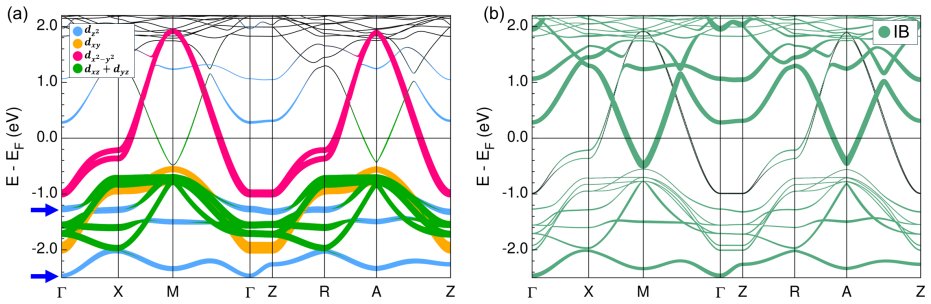
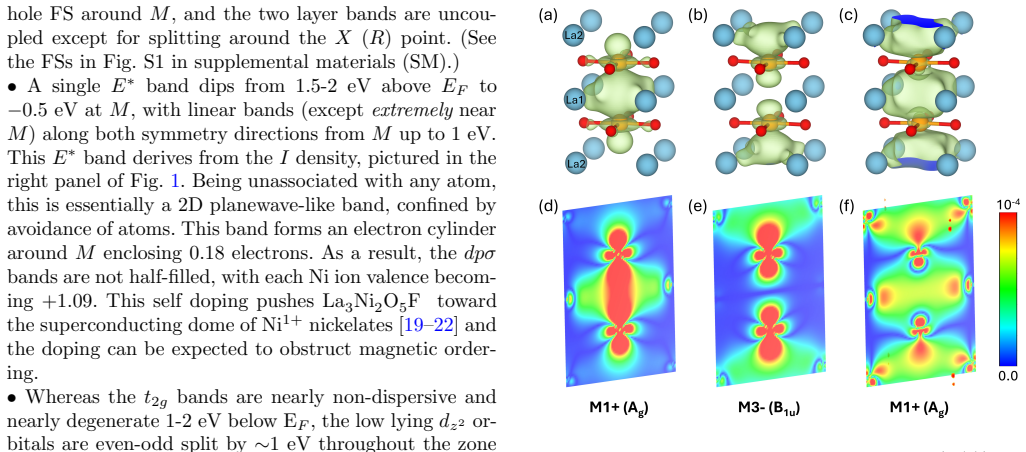
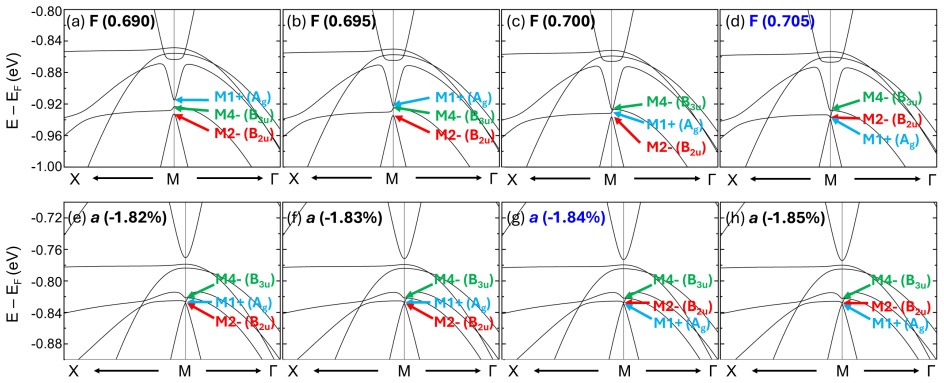
The central claim is that La3Ni2O5F hosts a distinct partially occupied E* band based on interstitial density whose strongly anisotropic shape extends over the three apical layers, leading to a cylindrical electron Fermi surface that gives self-doping, while this interstitial density partners with the Ni d_xz,d_yz pair to provide an incipient non-analytic Dirac point through an unusual interstitial density-d band coupling.
What carries the argument
The E* interstitial-density band, whose shape and coupling to the Ni d_xz,d_yz orbitals produce self-doping and the incipient Dirac point.
If this is right
- The E* electron band and the conventional Ni dpσ band will display a dichotomy of hole and electron quasiparticle behavior.
- This dichotomy will appear in normal state transport and far-IR properties.
- Unconventional superconducting state properties are likely to result even for nickelates.
Where Pith is reading between the lines
- Similar interstitial bands could appear in other layered nickelates or related compounds with empty apical oxygen sites.
- Tuning interstitial density through layer stacking or pressure might provide an independent control knob for the superconducting transition.
Load-bearing premise
The band-structure calculation accurately isolates the distinct interstitial-density band E* and its coupling to nickel orbitals under the assumption of an ideal two-dimensional structure with empty apical sites.
What would settle it
Angle-resolved photoemission spectroscopy that fails to detect the predicted cylindrical electron Fermi surface pocket from the E* band or the incipient Dirac point would falsify the self-doping and coupling mechanism.
Figures
read the original abstract
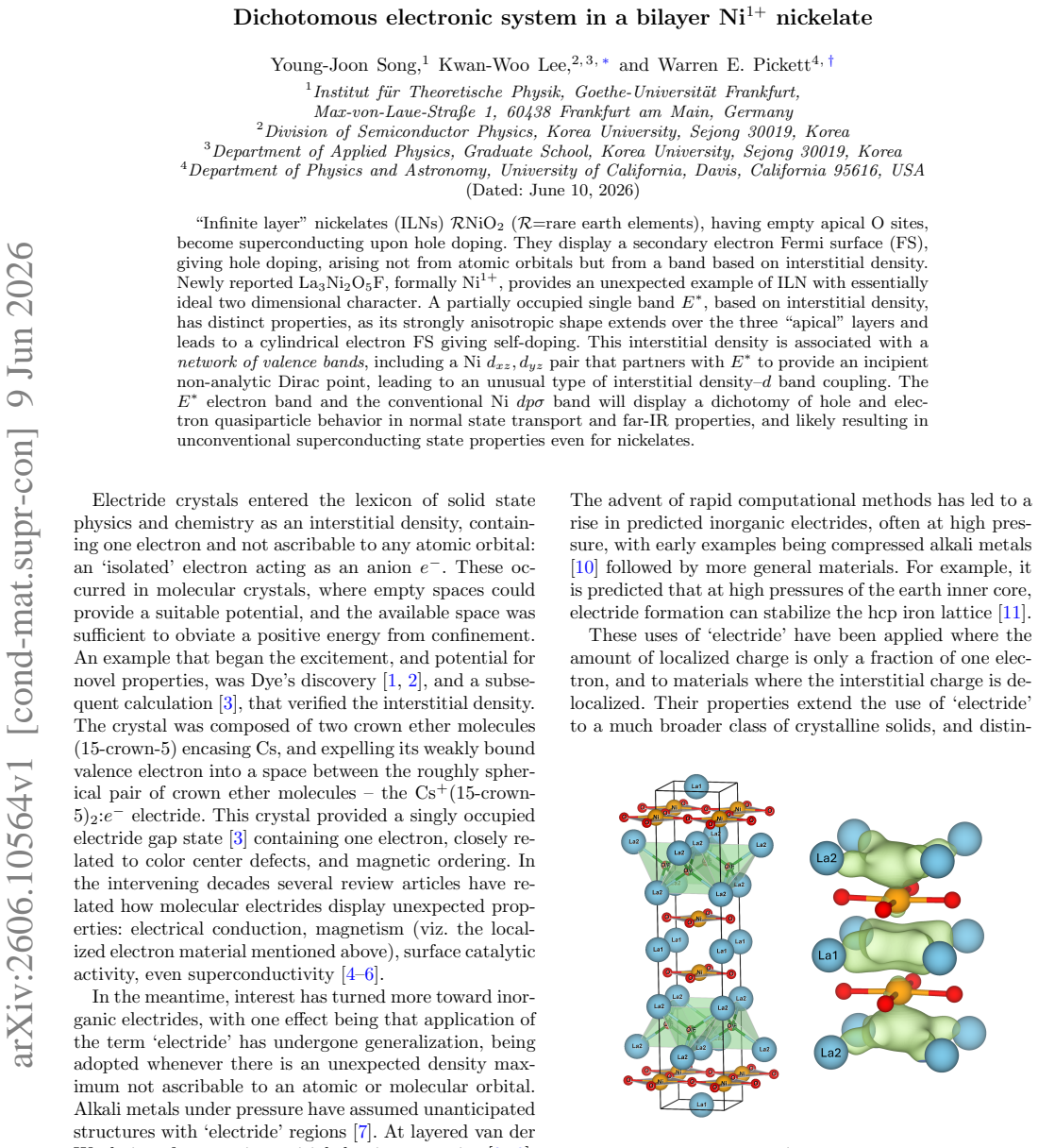
``Infinite layer'' nickelates (ILNs) ${\cal R}$NiO$_2$ (${\cal R}$=rare earth elements), having empty apical O sites, become superconducting upon hole doping. They display a secondary electron Fermi surface (FS), giving hole doping, arising not from atomic orbitals but from a band based on interstitial density. Newly reported La$_3$Ni$_2$O$_5$F, formally Ni$^{1+}$, provides an unexpected example of ILN with essentially ideal two dimensional character. A partially occupied single band $E^*$, based on interstitial density, has distinct properties, as its strongly anisotropic shape extends over the three ``apical'' layers and leads to a cylindrical electron FS giving self-doping. This interstitial density is associated with a {\it network of valence bands}, including a Ni $d_{xz},d_{yz}$ pair that partners with $E^*$ to provide an incipient non-analytic Dirac point, leading to an unusual type of interstitial density--$d$ band coupling. The $E^*$ electron band and the conventional Ni $dp\sigma$ band will display a dichotomy of hole and electron quasiparticle behavior in normal state transport and far-IR properties, and likely resulting in unconventional superconducting state properties even for nickelates.
Editorial analysis
A structured set of objections, weighed in public.
Referee Report
Summary. The manuscript claims that the bilayer nickelate La₃Ni₂O₅F (formally Ni^{1+}) realizes an ideal two-dimensional infinite-layer structure hosting a partially occupied interstitial-density band E* that produces self-doping via a cylindrical electron Fermi surface. This E* band couples anisotropically to a Ni d_{xz},d_{yz} pair, forming an incipient non-analytic Dirac point; the resulting electron-hole dichotomy between the E* and conventional Ni dpσ bands is predicted to govern normal-state transport, far-IR response, and unconventional superconducting properties.
Significance. If the reported band features are robust, the work would identify a new structural route to self-doping in nickelates and furnish a concrete microscopic origin for the electron-hole dichotomy invoked in transport and pairing scenarios. The emphasis on interstitial-density networks and their Dirac-point coupling to d orbitals adds a distinct mechanism to the ILN literature.
major comments (2)
- [Abstract] Abstract and computational results: the central claims of self-doping and the E*-Ni d_{xz}/d_{yz} Dirac point rest entirely on the positioning of the interstitial E* band relative to the Ni dpσ manifold, yet no DFT functional, Hubbard U value, k-mesh convergence, or error estimate is supplied; given the documented 0.2–0.3 eV sensitivity of nickelate bands to self-interaction, this omission renders the load-bearing features unassessable.
- [Computational results] Computational validation: no cross-checks (hybrid functional, GW, or comparison to established ILNs such as RNiO₂) are described that would confirm the interstitial density is correctly placed; a rigid shift of E* would eliminate both the cylindrical FS self-doping and the incipient Dirac point.
minor comments (2)
- [Introduction] Notation for the interstitial band is introduced as E* without an explicit definition or orbital decomposition in the main text; a figure or equation defining its interstitial character would improve clarity.
- [Abstract] The abstract refers to “newly reported La₃Ni₂O₅F” but provides no structural reference or citation for the experimental synthesis; adding this reference is needed for context.
Simulated Author's Rebuttal
We thank the referee for the detailed and constructive report. The two major comments correctly identify omissions in the computational description that limit assessability of the central claims. We address each point below and will revise the manuscript to incorporate the requested information.
read point-by-point responses
-
Referee: [Abstract] Abstract and computational results: the central claims of self-doping and the E*-Ni d_{xz}/d_{yz} Dirac point rest entirely on the positioning of the interstitial E* band relative to the Ni dpσ manifold, yet no DFT functional, Hubbard U value, k-mesh convergence, or error estimate is supplied; given the documented 0.2–0.3 eV sensitivity of nickelate bands to self-interaction, this omission renders the load-bearing features unassessable.
Authors: The referee is correct that the submitted manuscript omitted explicit statements of the DFT functional (PBE), Hubbard U (U=4 eV on Ni 3d), k-mesh (12×12×1 with 0.01 eV smearing), and convergence/error analysis. These parameters follow our prior ILN studies but were not restated. In revision we will add a dedicated Computational Methods section that reports all settings, documents k-mesh and U convergence tests (E* position varies <0.08 eV for U=3–5 eV), and supplies an estimated uncertainty band of ±0.1 eV on the E*–dpσ separation arising from self-interaction. This directly addresses the 0.2–0.3 eV sensitivity concern. revision: yes
-
Referee: [Computational results] Computational validation: no cross-checks (hybrid functional, GW, or comparison to established ILNs such as RNiO₂) are described that would confirm the interstitial density is correctly placed; a rigid shift of E* would eliminate both the cylindrical FS self-doping and the incipient Dirac point.
Authors: We agree that additional validation would strengthen the placement of E*. Hybrid and GW calculations on the 22-atom cell are computationally prohibitive at present, but we will add a direct comparison of the E* band position and interstitial charge density to our earlier PBE+U results on LaNiO₂ (where the same interstitial feature appears at comparable energy). We will also include a brief sensitivity discussion showing that a rigid 0.2 eV upward shift of E* would indeed remove the cylindrical FS and Dirac point, while our self-consistent calculations place E* stably below E_F. These additions will be included in the revised manuscript. revision: yes
Circularity Check
No circularity; claims from direct DFT on new La₃Ni₂O₅F structure
full rationale
The paper's central results—the identification of the partially occupied E* interstitial band, its cylindrical FS, anisotropy, and incipient Dirac point with Ni d_xz/d_yz—originate from standard band-structure modeling of the ideal La₃Ni₂O₅F lattice. No equation or claim reduces by construction to a fitted parameter, self-defined quantity, or load-bearing self-citation; the derivation chain is the computational output itself. This matches the expectation for a self-contained computational study of a newly reported compound and warrants score 0.
Axiom & Free-Parameter Ledger
axioms (1)
- domain assumption Standard density functional theory calculations accurately capture the interstitial-density states and their coupling to Ni d orbitals in this nickelate.
invented entities (1)
-
E* band based on interstitial density
no independent evidence
Reference graph
Works this paper leans on
-
[1]
followed by more general materials. For example, it is predicted that at high pressures of the earth inner core, electride formation can stabilize the hcp iron lattice [11]. These uses of ‘electride’ have been applied where the amount of localized charge is only a fraction of one elec- tron, and to materials where the interstitial charge is de- localized....
Pith/arXiv arXiv 2026
-
[2]
Iron, upgraded!
over both FSs, which will give canceling contribu- tions from the hole and electron surfaces, as expected. For a single circular FS [we treat thedpσFS also as circular with the same area (densityn d)], a reasonable model here, with constant velocityv F and curvature ∝1/kF on each surface, the Hall conductivity is analytic: σxyz,j = 2πe3 ℏ2 v2 F,j τj. The ...
2024
-
[3]
J. L. Dye, Anionic electrons in electrides, Nature365, 10 (1993)
1993
-
[4]
M. J. Wagner, R. H. Huang, J. L. Eglin, and J. L. Dye, An electride with a large six-electron ring, Nature368, 726 (1994)
1994
-
[5]
D. J. Singh, H. Krakauer, C. Haas, and W. E. Pickett, Theoretical determination that electrons act as anions in the electride Cs + (15-crown-5)2·e−, Nature365, 39 (1993)
1993
-
[6]
C. Liu, S. A. Nikolaev, W. Ren, and L. A. Burton, Elec- trides: a review, J. Mater. Chem. C8, 10551 (2020)
2020
-
[7]
Hosono and M
H. Hosono and M. Kitano, Advances in materials and ap- plications of inorganic electrides, Chem. Rev.121, 3121 (2021)
2021
-
[8]
F. Sun, Z. Guo, Y. Lu, J. Li, T.-N. Ye, H. Hosono, and J. Wu, Electrides: Emerging electronic materials for catalysis, Fundam. Res.6, 400 (2026)
2026
-
[9]
Cheng, K
W. Cheng, K. Li, T. Tada, H. Hosono, and J. Wang, Electride formation in ba–p system and the unexpected structure transition of electrides under pressure, J. Phys. Chem. C126, 16815 (2022)
2022
-
[10]
H. Y. Song, B. I. Yoo, J.-H. Choi, S.-H. Kang, J. Bang, W. Li, C. N. Nandadasa, D. Thapa, D. Yoon, M. J. Han, K. H. Lee, S. G. Kim, K. Lee, and S. W. Kim, Van der Waals electride: Toward intrinsic two-dimensional ferro- magnetism of spin-polarized anionic electrons, Mater. To- day Phys.20, 100473 (2021)
2021
-
[11]
Zhou, J.-Y
J. Zhou, J.-Y. You, Y.-M. Zhao, Y. P. Feng, and L. Shen, Van der Waals Electrides, Acc. Chem. Res.57, 2572 (2024)
2024
-
[12]
Miao and R
M.-S. Miao and R. Hoffmann, High Pressure Electrides: A Predictive Chemical and Physical Theory, Acc. Chem. Res.47, 1311 (2014)
2014
-
[13]
I. Park, Y. He, H.-k. Mao, J. H. Shim, and D. Y. Kim, Electride formation of hcp-iron at high pressure: Unrav- eling the origin of the superionic state of iron-rich com- pounds in rocky planets, Adv. Sci.11, 2308177 (2024)
2024
-
[14]
Wernert, R
R. Wernert, R. D. Smyth, and M. A. Hayward, Synthe- sis of the double infinite-layer ni(i) phase la 3ni2o5f via sequential topochemical reactions, Journal of the Amer- ican Chemical Society148, 6109 (2026)
2026
-
[15]
D. Li, K. Lee, B. Y. Wang, M. Osada, S. Crossley, H. R. Lee, Y. Cui, Y. Hikita, and H. Y. Hwang, Supercon- ductivity in an infinite-layer nickelate, Nature572, 624 (2019)
2019
-
[16]
Lee and W
K.-W. Lee and W. E. Pickett, Infinite-layer LaNiO2: Ni1+ is not Cu 2+, Phys. Rev. B70, 165109 (2004)
2004
-
[17]
Choi, K.-W
M.-Y. Choi, K.-W. Lee, and W. E. Pickett, Role of 4f states in infinite-layer NdNiO2, Phys. Rev. B101, 020503 (2020)
2020
-
[18]
M.-Y. Choi, W. E. Pickett, and K.-W. Lee, Fluctuation- frustrated flat band instabilities in NdNiO 2, Phys. Rev. Res.2, 033445 (2020)
2020
-
[19]
Y.-J. Song, W. E. Pickett, and K.-W. Lee, Anomalous Behavior of the Ni 1+ moment and interstitial band in bi-infinite-layered La3Ni2O5F, XXXX, XX (2026)
2026
-
[20]
Blaha, K
P. Blaha, K. Schwarz, F. Tran, R. Laskowski, G. K. H. Madsen, and L. D. Marks, WIEN2k: An APW+lo pro- gram for calculating the properties of solids, J. Chem. Phys. Soc.152, 074101 (2020)
2020
-
[21]
D. Li, B. Y. Wang, K. Lee, S. P. Harvey, M. Osada, B. H. Goodge, L. F. Kourkoutis, and H. Y. Hwang, Supercon- ducting Dome in Nd 1−xSrxNiO2 Infinite Layer Films, Phys. Rev. Lett.125, 027001 (2020)
2020
-
[22]
S. Zeng, C. S. Tang, X. Yin, C. Li, M. Li, Z. Huang, J. Hu, W. Liu, G. J. Omar, H. Jani, Z. S. Lim, K. Han, D. Wan, P. Yang, S. J. Pennycook, A. T. S. Wee, and A. Ariando, Phase Diagram and Superconducting Dome of Infinite-Layer Nd 1−xSrxNiO2 Thin Films, Phys. Rev. Lett.125, 147003 (2020)
2020
-
[23]
Osada, B
M. Osada, B. Y. Wang, K. Lee, D. Li, and H. Y. Hwang, Phase diagram of infinite layer praseodymium nickelate Pr1−xSrxNiO2 thin films, Phys. Rev. Mater.4, 121801 (2020)
2020
-
[24]
G. A. Pan, D. F. Segedin, H. LaBollita, Q. Song, E. M. Nica, B. H. Goodge, A. T. Pierce, S. Doyle, S. Novakov, D. C´ ordova Carrizales, A. T. N’Diaye, P. Shafer, H. Paik, J. T. Heron, J. A. Mason, A. Yacoby, L. F. Kourk- outis, O. Erten, C. M. Brooks, A. S. Botana, and J. A. Mundy, Superconductivity in a quintuple-layer square- planar nickelate, Nat. Mate...
2022
-
[25]
Nomura, M
Y. Nomura, M. Hirayama, T. Tadano, Y. Yoshimoto, K. Nakamura, and R. Arita, Formation of a two- dimensional single-component correlated electron system and band engineering in the nickelate superconductor NdNiO2, Phys. Rev. B100, 205138 (2019)
2019
-
[26]
Nomura and R
Y. Nomura and R. Arita, Superconductivity in infinite- layer nickelates, Rep. Prog. Phys.85, 052501 (2022)
2022
-
[27]
Adhikary, S
P. Adhikary, S. Bandyopadhyay, T. Das, I. Dasgupta, and T. Saha-Dasgupta, Orbital-selective superconductivity in a two-band model of infinite-layer nickelates, Phys. Rev. B102, 100501 (2020)
2020
-
[28]
Y. Gu, S. Zhu, X. Wang, J. Hu, and H. Chen, A substan- tial hybridization between correlated Ni-d orbital and itinerant electrons in infinite-layer nickelates, Commun. Phys.3, 84 (2020)
2020
-
[29]
Foyevtsova, I
K. Foyevtsova, I. Elfimov, and G. A. Sawatzky, Distinct electridelike nature of infinite-layer nickelates and the re- sulting theoretical challenges to calculate their electronic structure, Phys. Rev. B108, 205124 (2023)
2023
-
[30]
You, Interstitialsstates and chemical pressure as key drivers of enhanced electron-phonon coupling in infinite-layer nickelates, Phys
J.-Y. You, Interstitialsstates and chemical pressure as key drivers of enhanced electron-phonon coupling in infinite-layer nickelates, Phys. Rev. B113, 064510 (2026)
2026
-
[31]
J. C. Smith, S. Banerjee, V. Pardo, and W. E. Pickett, Dirac point degenerate with massive bands at a topologi- cal quantum critical point, Phys. Rev. Lett.106, 056401 (2011)
2011
-
[32]
Pardo, J
V. Pardo, J. C. Smith, and W. E. Pickett, Linear bands, zero-momentum weyl semimetal, and topological transi- tion in skutterudite-structure pnictides, Phys. Rev. B85, 214531 (2012)
2012
-
[33]
B. C. Sales, Filled skutterudites, in Handb. Phys. Chem. Rare Earths, Vol. 33, edited by K. Gschneidner, J.-C. B¨ unzli, and V. Pecharsky (Elsevier, 2003) pp. 1–34
2003
-
[34]
N. P. Ong, Geometric interpretation of the weak-field Hall conductivity in two-dimensional metals with arbi- trary Fermi surface, Phys. Rev. B43, 193 (1991). 6
1991
discussion (0)
Sign in with ORCID, Apple, or X to comment. Anyone can read and Pith papers without signing in.