Λ(1670) production in the psi(3686) to Λ bar Λ η reaction
Pith reviewed 2026-06-27 12:33 UTC · model grok-4.3
The pith
The Λ(1670) appears as a peak in ψ(3686) decays when meson-baryon pairs interact in a chiral unitary model.
A machine-rendered reading of the paper's core claim, the machinery that carries it, and where it could break.
Core claim
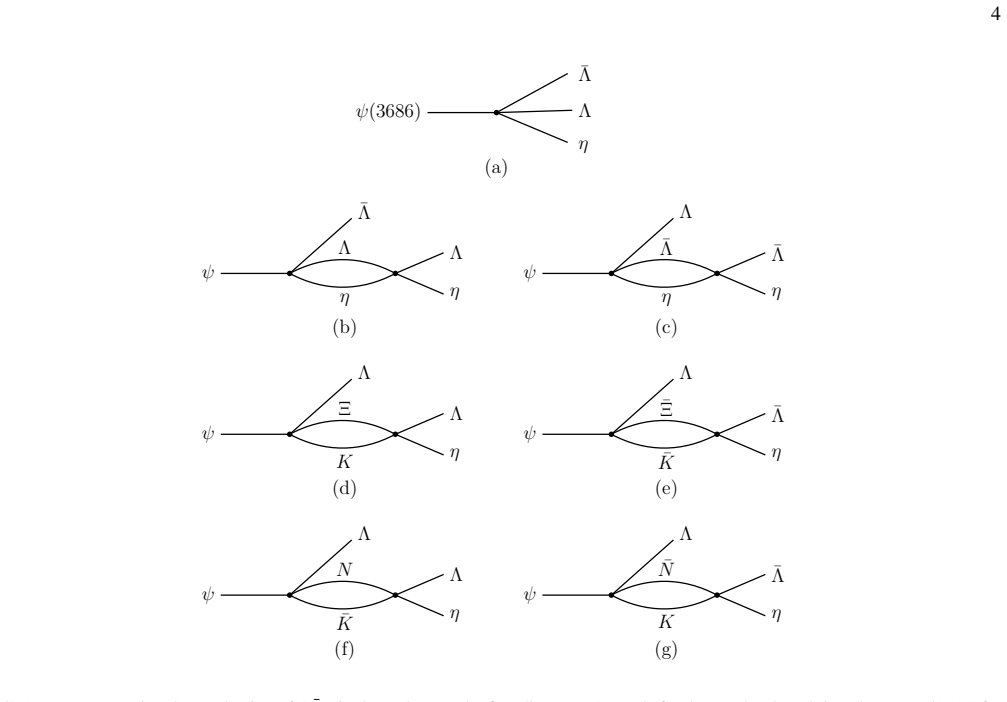
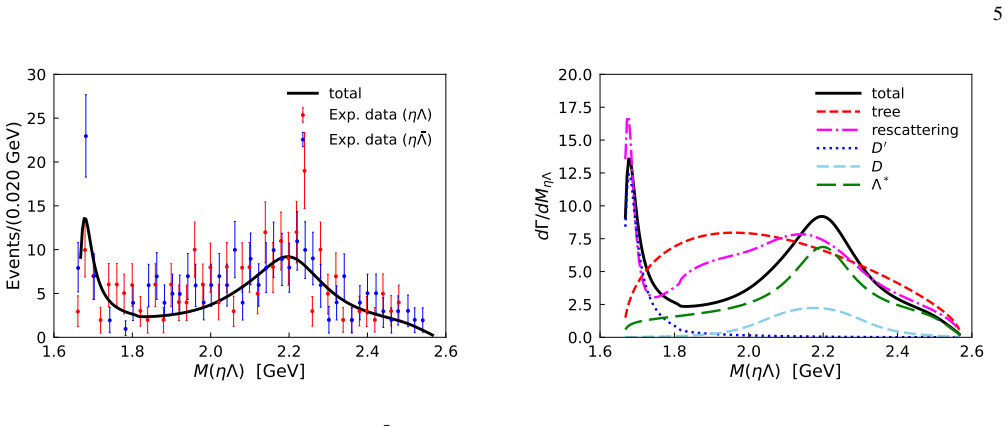
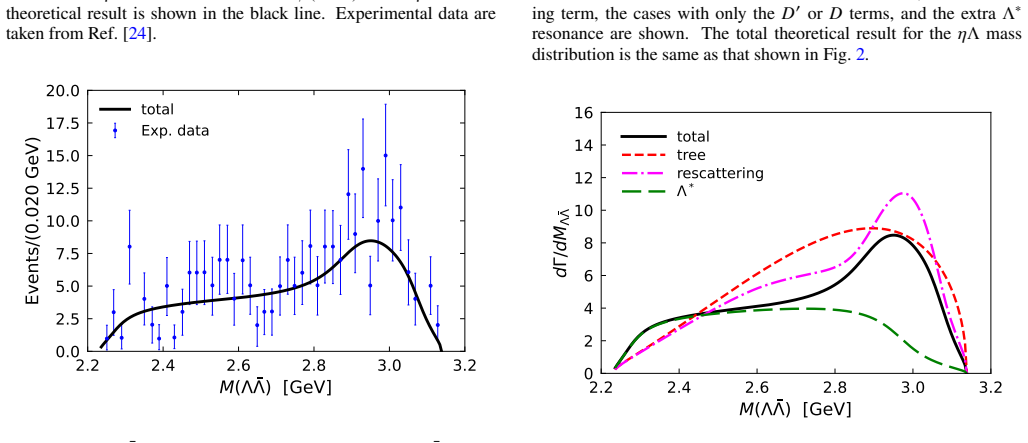
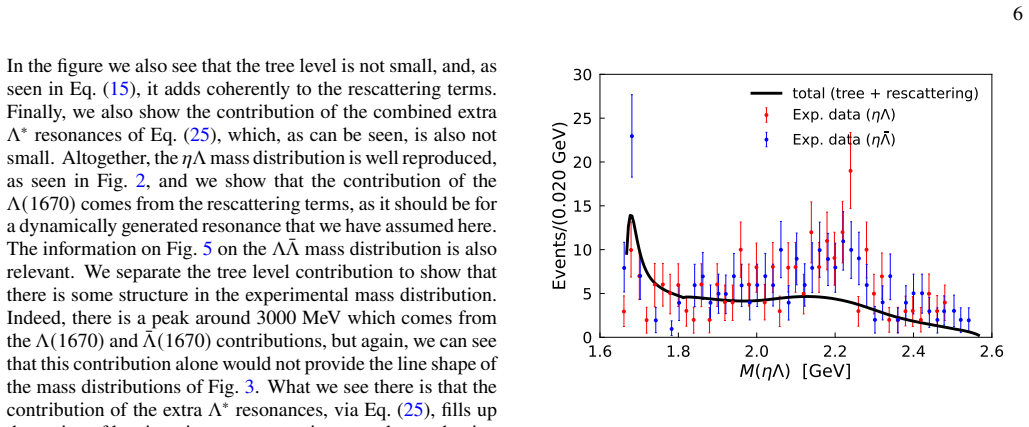
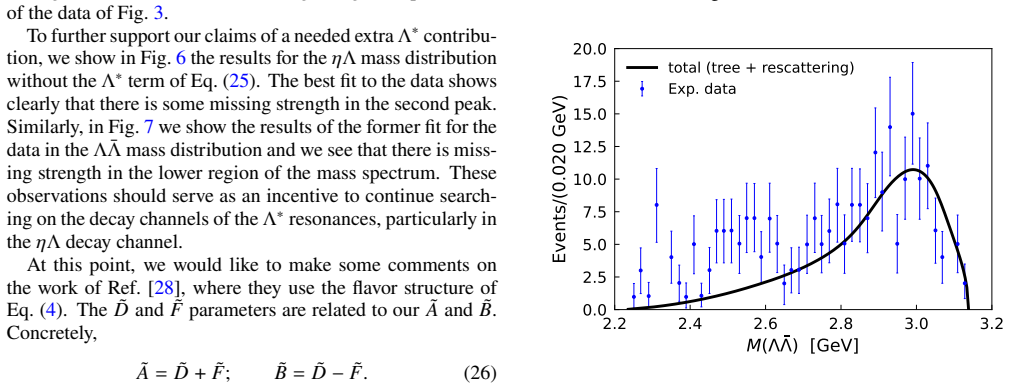
The ψ(3686), treated as an SU(3) singlet in the u,d,s sector, decays into a pseudoscalar, baryon and antibaryon through two independent flavor amplitudes. The Λ(1670) is generated dynamically by the unitarized meson-baryon interaction in the chiral framework. With one free parameter fixing the relative strength of the two amplitudes, the calculated ηΛ, ηΛ-bar and ΛΛ-bar mass spectra reproduce the data; an additional resonance contribution near 2200 MeV improves the description further.
What carries the argument
Two SU(3) flavor structures for the ψ(3686) decay amplitude together with the chiral unitary rescattering that dynamically generates the Λ(1670) pole from meson-baryon channels.
If this is right
- The same framework reproduces the three observed mass distributions with one parameter.
- The molecular picture of the Λ(1670) receives additional support from the decay data.
- An extra resonance contribution around 2200 MeV is needed for a better global fit.
- The approach links the production mechanism directly to the dynamical generation of the resonance.
Where Pith is reading between the lines
- The same two-structure construction could be tested in other charmonium decays involving the same final-state particles.
- If the molecular assignment holds, analogous peaks should appear in related reactions such as ψ(3770) decays.
- The 2200 MeV structure might correspond to a known higher-mass state whose coupling can be checked independently.
Load-bearing premise
The Λ(1670) is produced entirely by the final-state interaction of meson-baryon pairs inside the chiral unitary model.
What would settle it
A high-statistics measurement of the ηΛ invariant mass distribution that shows no resonance peak near 1670 MeV or a shape incompatible with the model for any value of the single relative-weight parameter.
Figures
read the original abstract
We perform a calculation of the invariant mass distributions in the $\psi(3686) \to \Lambda \bar \Lambda \eta$ reaction, where a neat peak for the excitation of the $\Lambda(1670)$ and $\bar \Lambda(1670)$ in the $\eta \Lambda$ and $\eta \bar \Lambda$ mass distributions, respectively, is observed. Our approach uses the fact that the $\psi(3686)$, a $c \bar c$ state, is a singlet of SU(3) in the $u,d,s$ quarks and constructs the two flavor structures allowed with a pseudoscalar meson, a baryon and an antibaryon. The resonance peaks come from the final state interaction of meson baryon pairs, which generate the $ \Lambda(1670)$ in our approach. With a reasonable relative weight of the two flavor structures, the only free parameter of the theory, we are able to get the three mass distributions in good agreement with experiment, giving extra support to the molecular structure of the $\Lambda(1670)$ resonance. The agreement with data improves with an extra resonance contribution with mass around 2200 MeV.
Editorial analysis
A structured set of objections, weighed in public.
Referee Report
Summary. The paper calculates the invariant mass distributions in the ψ(3686) → Λ Λ̄ η reaction. It employs SU(3) flavor structures for the c c̄ initial state decaying to a pseudoscalar, baryon, and antibaryon, combined with final-state interactions in the chiral unitary approach that dynamically generate the Λ(1670) resonance. With one free parameter (the relative weight of the two allowed flavor structures), the model reproduces the observed peaks and distributions; an additional resonance contribution near 2200 MeV is noted to further improve agreement.
Significance. If the central results hold, the work supplies concrete support for the molecular interpretation of the Λ(1670) by showing that its dynamical generation via meson-baryon FSI, together with minimal SU(3)-based production amplitudes, accounts for the data in a charmonium decay channel. The parameter-free character of the resonance generation itself is a methodological strength.
major comments (1)
- [Abstract] Abstract: The claim that 'with a reasonable relative weight of the two flavor structures, the only free parameter of the theory, we are able to get the three mass distributions in good agreement with experiment' is immediately qualified by the statement that 'the agreement with data improves with an extra resonance contribution with mass around 2200 MeV.' This indicates that the FSI-generated Λ(1670) component alone does not fully describe the distributions, so the quoted support for the molecular picture rests on an incomplete model whose additional term is introduced without derivation from the chiral unitary framework or the production mechanism.
Simulated Author's Rebuttal
We thank the referee for the careful reading and constructive comments on our manuscript. We address the major comment below.
read point-by-point responses
-
Referee: [Abstract] Abstract: The claim that 'with a reasonable relative weight of the two flavor structures, the only free parameter of the theory, we are able to get the three mass distributions in good agreement with experiment' is immediately qualified by the statement that 'the agreement with data improves with an extra resonance contribution with mass around 2200 MeV.' This indicates that the FSI-generated Λ(1670) component alone does not fully describe the distributions, so the quoted support for the molecular picture rests on an incomplete model whose additional term is introduced without derivation from the chiral unitary framework or the production mechanism.
Authors: We agree that the abstract phrasing could be refined for clarity. The central result is that the prominent peaks for Λ(1670) and Λ̄(1670) in the ηΛ and ηΛ̄ distributions are generated dynamically through meson-baryon final-state interactions within the chiral unitary approach, using the two allowed SU(3) flavor structures for the ψ(3686) decay and a single free parameter for their relative weight. This mechanism reproduces the main observed features and the overall shapes of the three mass distributions in reasonable agreement with data, thereby providing support for the molecular interpretation of the Λ(1670). The additional resonance term near 2200 MeV is a phenomenological addition to account for possible further structure in the higher-mass region and is not derived from the chiral unitary framework; it improves the fit but is not required for the primary conclusions on the Λ(1670). We will revise the abstract to emphasize that the FSI-based model already captures the key peaks and distributions, with the extra term noted only as an optional improvement. revision: yes
Circularity Check
Fitted relative weight of flavor structures provides the claimed support for molecular structure
specific steps
-
fitted input called prediction
[abstract]
"With a reasonable relative weight of the two flavor structures, the only free parameter of the theory, we are able to get the three mass distributions in good agreement with experiment, giving extra support to the molecular structure of the Λ(1670) resonance."
The relative weight is tuned ('reasonable') to match the observed ηΛ, ηΛ-bar and ΛΛ-bar distributions; the resulting agreement is then presented as independent support for the molecular picture generated by meson-baryon FSI. The support is therefore obtained by construction from the fit to the same data.
full rationale
The paper's central result is that agreement of the three mass distributions with experiment supports the molecular (dynamically generated) nature of Λ(1670). This agreement is obtained by choosing the single free parameter—the relative weight of the two SU(3) flavor structures—to reproduce the data. The dynamical generation itself is asserted via the authors' chiral unitary approach ('in our approach'). The numerical success therefore reduces to a fit rather than a parameter-free derivation, matching the 'fitted input called prediction' pattern. The additional statement that agreement improves with an extra resonance at ~2200 MeV further shows the base FSI model is incomplete without ad-hoc supplementation.
Axiom & Free-Parameter Ledger
free parameters (1)
- relative weight of the two SU(3) flavor structures
axioms (2)
- domain assumption ψ(3686) is an SU(3) singlet in the u,d,s quarks
- domain assumption Λ(1670) is generated dynamically by meson-baryon final-state interactions in the chiral unitary approach
Reference graph
Works this paper leans on
-
[1]
2, we present the results for𝑑Γ/𝑑𝑀 𝜂Λ, which are identical to those for𝑑Γ/𝑑𝑀 𝜂 ¯Λ
In Fig. 2, we present the results for𝑑Γ/𝑑𝑀 𝜂Λ, which are identical to those for𝑑Γ/𝑑𝑀 𝜂 ¯Λ. For this reason, we plot the experimental data for both distributions (in different colors), which are also equal within statistical errors. We have three parameters, ˜𝐴, ˜𝐵and ˜𝐶, but one is a global normalization. Hence, we have the ratio ˜𝐴/ ˜𝐵and ˜𝐶as free param...
2020
-
[2]
G. P. Gopal, R. T. Ross, A. J. Van Horn, A. C. McPherson, E. F. Clayton, T. C. Bacon, and I. Butterworth (Rutherford-London), Nucl. Phys. B119, 362 (1977)
1977
-
[3]
J. Y. Leeet al.(Belle), Phys. Rev. D103, 052005 (2021), arXiv:2008.11575 [hep-ex]
arXiv 2021
-
[4]
Ablikimet al.(BESIII), (2026), arXiv:2601.07617 [hep-ex]
M. Ablikimet al.(BESIII), (2026), arXiv:2601.07617 [hep-ex]
arXiv 2026
-
[5]
S. B. Yanget al.(Belle), Phys. Rev. D108, L031104 (2023), arXiv:2209.00050 [hep-ex]
arXiv 2023
-
[6]
R. Aaijet al.(LHCb), Phys. Rev. D108, 012023 (2023), arXiv:2208.03262 [hep-ex]
arXiv 2023
-
[7]
E. Oset, A. Ramos, and C. Bennhold, Phys. Lett. B527, 99 (2002), [Erratum: Phys.Lett.B 530, 260–260 (2002)], arXiv:nucl-th/0109006
Pith/arXiv arXiv 2002
-
[8]
C. Garcia-Recio, J. Nieves, E. Ruiz Arriola, and M. J. Vi- cente Vacas, Phys. Rev. D67, 076009 (2003), arXiv:hep- ph/0210311
arXiv 2003
-
[9]
E. E. Kolomeitsev and M. F. M. Lutz, Phys. Lett. B585, 243 (2004), arXiv:nucl-th/0305101
Pith/arXiv arXiv 2004
-
[10]
J. A. Oller, Eur. Phys. J. A28, 63 (2006), arXiv:hep-ph/0603134
Pith/arXiv arXiv 2006
- [11]
-
[12]
D. Jido, J. A. Oller, E. Oset, A. Ramos, and U. G. Meissner, Nucl. Phys. A725, 181 (2003), arXiv:nucl-th/0303062
Pith/arXiv arXiv 2003
-
[13]
Navaset al.(Particle Data Group), Phys
S. Navaset al.(Particle Data Group), Phys. Rev. D110, 030001 (2024)
2024
-
[14]
Starostinet al.(Crystal Ball), Phys
A. Starostinet al.(Crystal Ball), Phys. Rev. C64, 055205 (2001)
2001
-
[15]
X.-H. Zhong and Q. Zhao, Phys. Rev. C79, 045202 (2009), arXiv:0811.4212 [nucl-th]
Pith/arXiv arXiv 2009
-
[16]
K. Miyahara, T. Hyodo, and E. Oset, Phys. Rev. C92, 055204 (2015), arXiv:1508.04882 [nucl-th]
Pith/arXiv arXiv 2015
-
[17]
J.-J. Xie and L.-S. Geng, Eur. Phys. J. C76, 496 (2016), arXiv:1604.02756 [nucl-th]
Pith/arXiv arXiv 2016
-
[18]
G.-Y. Wang, N.-C. Wei, H.-M. Yang, E. Wang, L.-S. Geng, and J.-J. Xie, Phys. Rev. D106, 056001 (2022), arXiv:2206.01425 [hep-ph]
arXiv 2022
-
[19]
M.-Y. Duan, W.-T. Lyu, C.-W. Xiao, E. Wang, J.-J. Xie, D.- Y. Chen, and E. Oset, Phys. Rev. D111, 016004 (2025), arXiv:2410.16078 [hep-ph]
arXiv 2025
- [20]
-
[21]
W.-T. Lyu, S.-W. Liu, J.-J. Wu, D.-M. Li, and E. Wang, (2026), arXiv:2606.04690 [hep-ph]
Pith/arXiv arXiv 2026
-
[22]
M.-Y. Duan, M. Bayar, and E. Oset, Phys. Lett. B857, 139003 (2024), arXiv:2407.01410 [hep-ph]
arXiv 2024
-
[23]
S.-C. Zhang, M.-Y. Duan, W.-T. Lyu, G.-Y. Wang, J.-Y. Zhu, and E. Wang, Eur. Phys. J. C84, 1253 (2024), arXiv:2405.14235 [hep-ph]
arXiv 2024
-
[24]
L. R. Dai, W.-T. Lyu, and E. Oset, (2026), arXiv:2602.09136 [hep-ph]
arXiv 2026
-
[25]
M. Ablikimet al.(BESIII), Phys. Rev. D106, 072006 (2022), arXiv:2207.14350 [hep-ex]
arXiv 2022
-
[26]
Bramon, A
A. Bramon, A. Grau, and G. Pancheri, Phys. Lett. B283, 416 (1992)
1992
-
[27]
A. V. Manohar, inLes Houches Summer School in Theoretical Physics, Session 68: Probing the Standard Model of Particle Interactions(1998) pp. 1091–1169, arXiv:hep-ph/9802419
Pith/arXiv arXiv 1998
-
[28]
L. M. Abreu, L. Dai, and E. Oset, Phys. Lett. B843, 137999 (2023), arXiv:2303.00382 [hep-ph]
arXiv 2023
- [29]
-
[30]
Mandl and G
F. Mandl and G. Shaw,Quantum Field Theory, 2nd ed. (John Wiley and Sons, 2010)
2010
-
[31]
F. K. Guo, Private communication, (2026)
2026
discussion (0)
Sign in with ORCID, Apple, or X to comment. Anyone can read and Pith papers without signing in.