Unveiling the elusive Sigma(1380) resonance through coupled-channel dynamics in Λ_c^+toηπ^+Λ reaction
Pith reviewed 2026-06-28 05:41 UTC · model grok-4.3
The pith
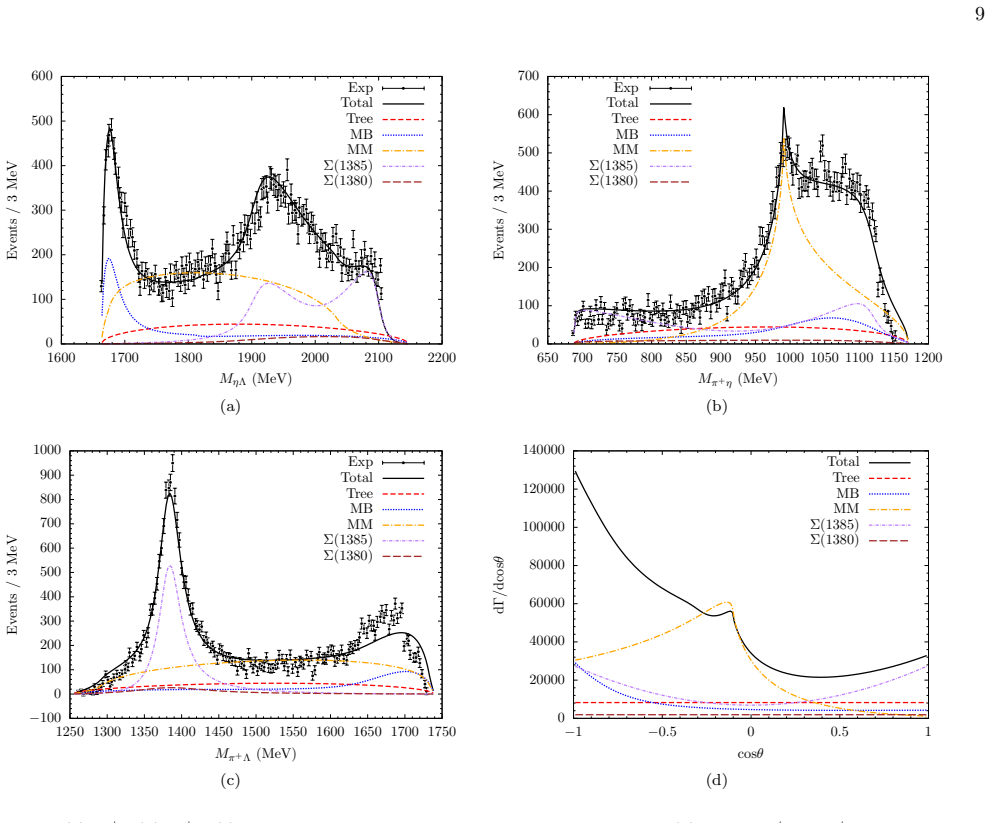
The Σ(1380) resonance with J^P=1/2^- improves the description of data in the Λ_c^+ → η π^+ Λ decay.
A machine-rendered reading of the paper's core claim, the machinery that carries it, and where it could break.
Core claim
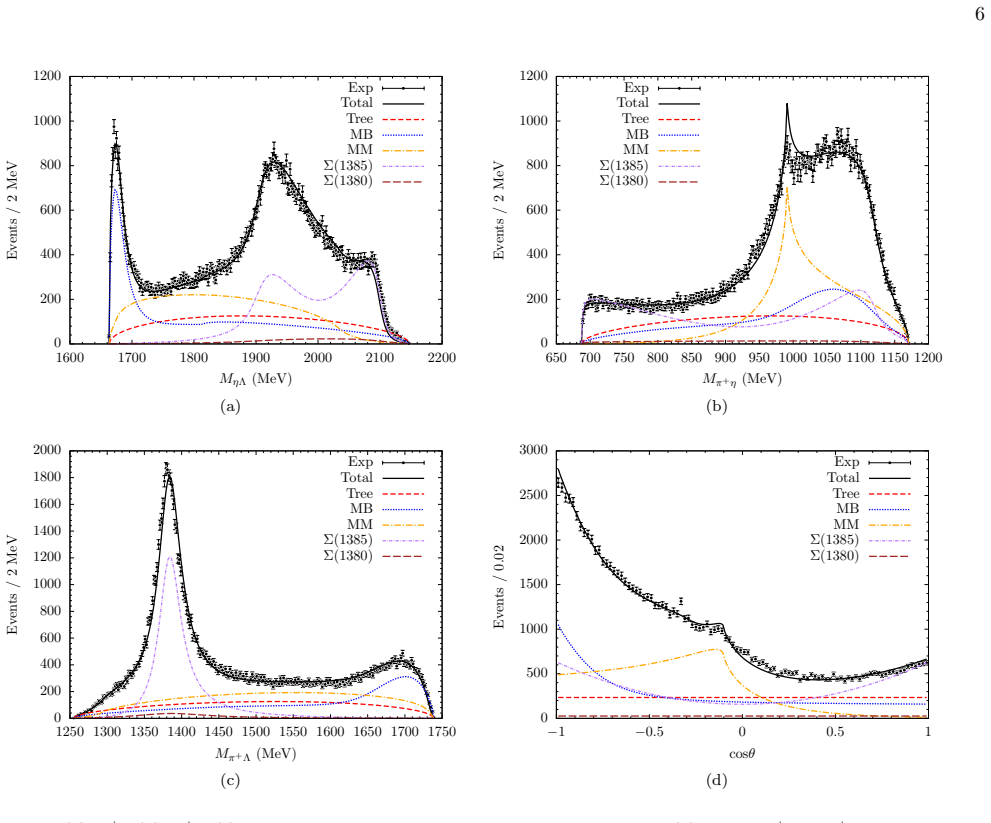
The Σ(1380) state with spin-parity 1/2^- contributes importantly to the Λ_c^+ → η π^+ Λ reaction; its explicit inclusion in the amplitude improves agreement with the measured invariant mass and angular distributions relative to calculations that omit it, while the line shapes of the dynamically generated Λ(1670) and a0(980) remain fixed from prior work.
What carries the argument
Explicit addition of the Σ(1380) resonance amplitude in the decay, together with coupled-channel-generated Λ(1670) and a0(980) states, to fit the ηΛ and π^+Λ invariant-mass spectra and angular distributions.
If this is right
- The Σ(1380) term alters the shape of the ηΛ invariant-mass spectrum in identifiable regions.
- Angular distributions supply independent sensitivity to the resonance's presence.
- High-precision measurements focused on those regions can confirm or rule out the state.
- If the line shapes hold, the same Σ(1380) contribution should appear in related hadronic reactions.
Where Pith is reading between the lines
- Confirmation would support the idea that some low-lying Σ states can be generated dynamically from meson-baryon interactions.
- The state could help account for missing entries in the Σ baryon spectrum below 1400 MeV.
- Analogous coupled-channel analyses of other Λ_c decays offer independent tests of the resonance parameters.
Load-bearing premise
The line shapes of the dynamically generated Λ(1670) and a0(980) states remain valid without modification when applied to the Λ_c^+ → η π^+ Λ channel.
What would settle it
High-precision data on the ηΛ invariant-mass distribution near 1380 MeV that show no improvement in fit quality, or that contradict the predicted angular dependence, when the Σ(1380) term is added.
Figures
read the original abstract
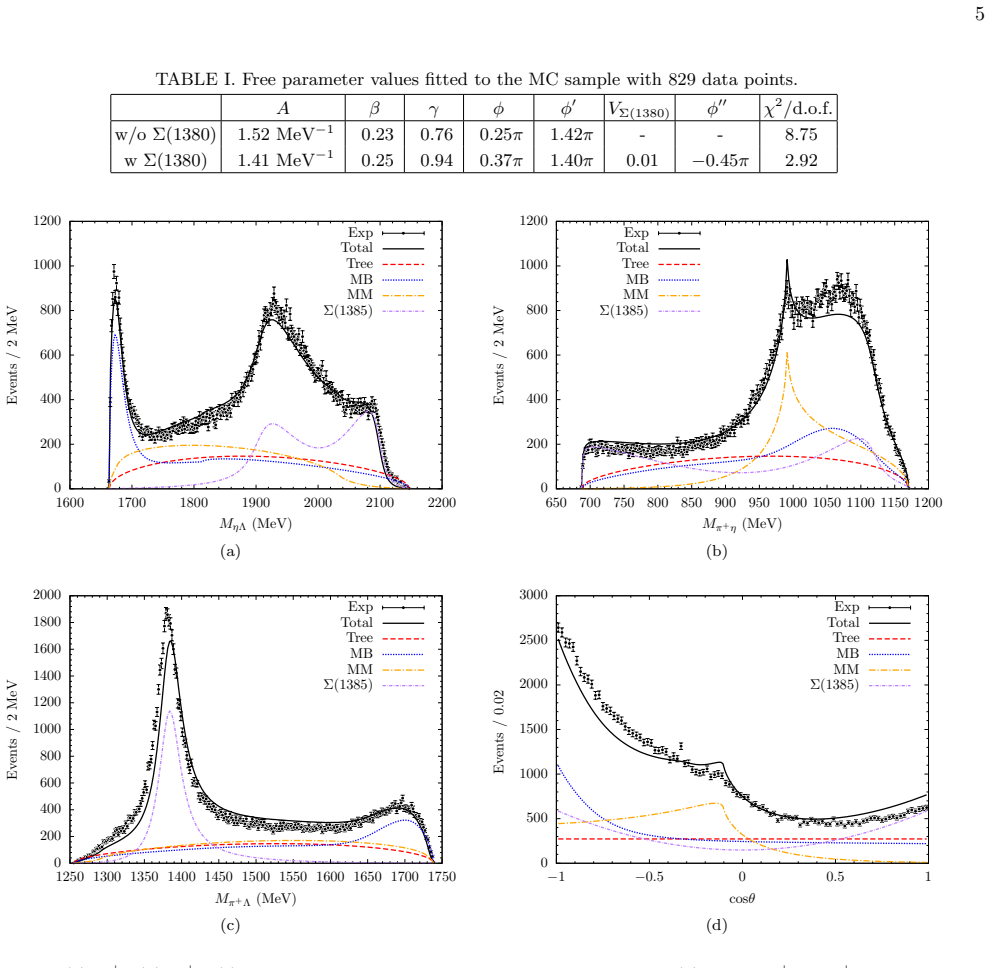
We investigate the $\Lambda_c^+ \to \eta \pi^+ \Lambda$ decay measured by the Belle and BESIII Collaborations, focusing on the possible role of the $\Sigma(1380)$ state with spin-parity $J^P=1/2^-$. In our theoretical framework, the $\Lambda(1670)$ and $a_0(980)$ are dynamically generated from meson-baryon and meson-meson final-state interactions, respectively, and the corresponding line shapes of these two states used here are applicable to all relevant hadronic reactions. Furthermore, the contributions from the intermediate $\Sigma(1385)$ resonance and the possible $\Sigma(1380)$ state are included explicitly. By comparing the invariant mass and angular distributions obtained with and without the $\Sigma(1380)$ state, we demonstrate that this state plays an important role in improving the description of the experimental data. We also identify the kinematic regions most sensitive to the possible $\Sigma(1380)$ contribution. Future high-precision measurements of this process will be instrumental for testing the existence of the $\Sigma$ state with $J^P=1/2^-$.
Editorial analysis
A structured set of objections, weighed in public.
Referee Report
Summary. The manuscript investigates the Λ_c⁺ → η π⁺ Λ decay measured by Belle and BESIII, employing coupled-channel dynamics to generate Λ(1670) and a₀(980) dynamically while including explicit contributions from Σ(1385) and a proposed Σ(1380) resonance with J^P = 1/2⁻. The central claim is that comparing invariant-mass and angular distributions with and without the Σ(1380) demonstrates its important role in improving agreement with data, while also identifying the most sensitive kinematic regions for future tests.
Significance. If the result holds after addressing the noted issues, the work would provide targeted evidence for the existence of the elusive Σ(1380) and illustrate how fixed line shapes from dynamical generation can be leveraged in weak decays of charmed baryons. The methodological choice to treat Λ(1670) and a₀(980) line shapes as transferable across reactions is a clear strength when properly validated, as it reduces free parameters relative to fully phenomenological fits.
major comments (2)
- [Abstract and model framework] Abstract and model framework: The statement that the line shapes of the dynamically generated Λ(1670) and a₀(980) 'are applicable to all relevant hadronic reactions' is used to hold these shapes fixed when applied to the Λ_c⁺ decay. No explicit test or sensitivity analysis is provided showing that the shapes survive the change in production mechanism and available energy; this assumption is load-bearing for the claim that any observed improvement is due to Σ(1380) rather than model mismatch.
- [Results (comparison of distributions with/without Σ(1380)] Results (comparison of distributions with/without Σ(1380)): The manuscript asserts that inclusion of Σ(1380) visibly improves the description of invariant-mass and angular distributions, yet reports no quantitative measures (Δχ², number of additional parameters, or statistical significance) for the improvement. Without these, it cannot be assessed whether the gain exceeds what is expected from the extra degrees of freedom (mass, width, and couplings of Σ(1380)) or from possible deficiencies in the baseline model.
minor comments (2)
- [Figures] Figure captions should explicitly state whether error bands include only statistical uncertainties or also systematic variations from the fixed line shapes.
- [Introduction] Add a short paragraph contrasting the present Σ(1380) parameters with earlier phenomenological extractions to clarify novelty.
Simulated Author's Rebuttal
We thank the referee for the careful reading and the constructive major comments. We address each point below and indicate the revisions we will make.
read point-by-point responses
-
Referee: [Abstract and model framework] Abstract and model framework: The statement that the line shapes of the dynamically generated Λ(1670) and a₀(980) 'are applicable to all relevant hadronic reactions' is used to hold these shapes fixed when applied to the Λ_c⁺ decay. No explicit test or sensitivity analysis is provided showing that the shapes survive the change in production mechanism and available energy; this assumption is load-bearing for the claim that any observed improvement is due to Σ(1380) rather than model mismatch.
Authors: We acknowledge that the present manuscript does not contain a dedicated sensitivity study that varies the production mechanism or available energy specifically for the Λ_c⁺ decay. The line shapes are taken from our prior coupled-channel calculations that were already confronted with data from several different reactions. To strengthen the paper we will add a short paragraph in the model section that recalls the range of reactions in which these shapes have been tested and that quantifies the residual uncertainty by varying the subtraction constants within their previously determined ranges. This will make the robustness of the assumption explicit without requiring a full re-calculation of the dynamical generation. revision: partial
-
Referee: [Results (comparison of distributions with/without Σ(1380)] Results (comparison of distributions with/without Σ(1380)): The manuscript asserts that inclusion of Σ(1380) visibly improves the description of invariant-mass and angular distributions, yet reports no quantitative measures (Δχ², number of additional parameters, or statistical significance) for the improvement. Without these, it cannot be assessed whether the gain exceeds what is expected from the extra degrees of freedom (mass, width, and couplings of Σ(1380)) or from possible deficiencies in the baseline model.
Authors: The referee is correct that only visual comparisons are shown. In the revised manuscript we will add a table reporting χ² per degree of freedom for the baseline model and for the model that includes the Σ(1380), together with the number of additional free parameters (mass, width, and two couplings) and the change in χ². We will also state the kinematic bins used for the comparison so that the improvement can be judged quantitatively. revision: yes
Circularity Check
No circularity; central comparison uses external line shapes and explicit addition of resonance
full rationale
The provided text shows a standard comparison of invariant-mass and angular distributions with versus without an explicit Σ(1380) term, while taking Λ(1670) and a0(980) line shapes from prior reactions as fixed inputs. No equation or statement reduces the improvement claim to a self-definition, a fitted parameter renamed as prediction, or a self-citation chain that bears the load. The derivation remains self-contained against the experimental data once the transferability assumption is granted; no load-bearing step collapses by construction.
Axiom & Free-Parameter Ledger
free parameters (1)
- Σ(1380) mass, width, and coupling constants
axioms (1)
- domain assumption Dynamically generated resonances from meson-baryon and meson-meson interactions retain their line shapes across different production reactions
invented entities (1)
-
Σ(1380) resonance with J^P=1/2^-
no independent evidence
Forward citations
Cited by 1 Pith paper
-
$\Lambda(1670)$ production in the $\psi(3686) \to \Lambda \bar \Lambda \eta$ reaction
Theoretical calculation of ψ(3686) → Λ Λ̄ η decay shows Λ(1670) peaks in ηΛ and ηΛ̄ distributions using two SU(3) flavor structures and final-state interactions, with one free parameter fitting data and supporting a m...
Reference graph
Works this paper leans on
-
[1]
Navaset al.[Particle Data Group], Phys
S. Navaset al.[Particle Data Group], Phys. Rev. D110, no.3, 030001 (2024)
2024
-
[2]
E. Oset, A. Ramos and C. Bennhold, Phys. Lett. B 527, 99-105 (2002) [erratum: Phys. Lett. B530, 260- 9 0 100 200 300 400 500 600 1600 1700 1800 1900 2000 2100 2200 Events / 3 MeV MηΛ (MeV) Exp Total Tree MB MM Σ(1385) Σ(1380) (a) 0 100 200 300 400 500 600 700 650 700 750 800 850 900 950 1000 1050 1100 1150 1200 Events / 3 MeV Mπ +η (MeV) Exp Total Tree MB...
2002
-
[3]
Oset and A
E. Oset and A. Ramos, Nucl. Phys. A635, 99-120 (1998)
1998
-
[4]
K. P. Khemchandani, A. Mart´ ınez Torres and J. A. Oller, Phys. Rev. C100, no.1, 015208 (2019)
2019
-
[5]
Kamiya, K
Y. Kamiya, K. Miyahara, S. Ohnishi, Y. Ikeda, T. Hyodo, E. Oset and W. Weise, Nucl. Phys. A954, 41-57 (2016)
2016
-
[6]
D. Jido, J. A. Oller, E. Oset, A. Ramos and U. G. Meiss- ner, Nucl. Phys. A725, 181-200 (2003)
2003
-
[7]
J. A. Oller, Eur. Phys. J. A28, 63-82 (2006)
2006
-
[8]
Garcia-Recio, J
C. Garcia-Recio, J. Nieves, E. Ruiz Arriola and M. J. Vi- cente Vacas, Phys. Rev. D67, 076009 (2003)
2003
-
[9]
M. F. M. Lutz and E. E. Kolomeitsev, Nucl. Phys. A 700, 193-308 (2002)
2002
-
[10]
Moriyaet al.[CLAS], Phys
K. Moriyaet al.[CLAS], Phys. Rev. C87, no.3, 035206 (2013)
2013
-
[11]
Roca and E
L. Roca and E. Oset, Phys. Rev. C88, no.5, 055206 (2013)
2013
-
[12]
L. R. Dai, R. Pavao, S. Sakai and E. Oset, Phys. Rev. D 97, no.11, 116004 (2018)
2018
-
[13]
J. J. Xie and E. Oset, Phys. Lett. B792, 450-453 (2019)
2019
-
[14]
E. Wang, J. J. Xie and E. Oset, Phys. Lett. B753, 526- 532 (2016)
2016
-
[15]
L. J. Liu, E. Wang, J. J. Xie, K. L. Song and J. Y. Zhu, Phys. Rev. D98, no.11, 114017 (2018)
2018
-
[16]
Y. H. Lyu, H. Zhang, N. C. Wei, B. C. Ke, E. Wang and J. J. Xie, Chin. Phys. C47, no.5, 053108 (2023)
2023
-
[17]
S. H. Kim, K. P. Khemchandani, A. Martinez Torres, S. i. Nam and A. Hosaka, Phys. Rev. D103, no.11, 114017 (2021)
2021
-
[18]
Y. Li, W. T. Lyu, G. Y. Wang, L. Li, W. C. Yan and E. Wang, Phys. Rev. D111, no.5, 054011 (2025)
2025
-
[19]
S. C. Zhang, W. T. Lyu, G. Y. Wang, B. Q. Ma and E. Wang, Chin. Phys. Lett.43, no.5, 050203 (2026)
2026
-
[20]
B. S. Zou, Nucl. Phys. B1024(2026), 117363
2026
-
[21]
Y. Yao, X. Liu, X. Chen, Y. Wu, J. Ping, Y. Tan and Q. Huang, Chin. Phys. C50(2026) no.2, 023109
2026
-
[22]
Z. L. Ma, Z. W. Liu and J. J. Liu, Phys. Rev. D113 (2026) no.1, 014037
2026
-
[23]
J. X. Lin, J. Song, M. Albaladejo, A. Feijoo and E. Oset, Phys. Rev. D112(2025) no.1, 014044
2025
-
[24]
H. P. Li, C. W. Xiao, W. H. Liang, J. J. Wu, E. Wang and E. Oset, Phys. Rev. D110(2024) no.11, 114018
2024
-
[25]
Maet al.[Belle], Phys
Y. Maet al.[Belle], Phys. Rev. Lett.130(2023) no.15, 151903 10
2023
-
[26]
Y. Y. Li, J. Song, E. Oset, W. H. Liang and R. Molina, Eur. Phys. J. C85(2025) no.9, 1086
2025
-
[27]
He, Phys
J. He, Phys. Rev. C112(2025) no.1, 015205
2025
-
[28]
E. Wang, L. S. Geng, J. J. Wu, J. J. Xie and B. S. Zou, Chin. Phys. Lett.41, no.10, 101401 (2024)
2024
-
[29]
Zhang, Y
A. Zhang, Y. R. Liu, P. Z. Huang, W. Z. Deng, X. L. Chen and S. L. Zhu, HEPNP29(2005), 250
2005
-
[30]
J. X. Lu, L. S. Geng, M. Doering and M. Mai, Phys. Rev. Lett.130(2023) no.7, 071902
2023
-
[31]
J. J. Wu, S. Dulat and B. S. Zou, Phys. Rev. C81, 045210 (2010)
2010
-
[32]
J. J. Wu, S. Dulat and B. S. Zou, Phys. Rev. D80, 017503 (2009)
2009
-
[33]
J. J. Xie, J. J. Wu and B. S. Zou, Phys. Rev. C90, no.5, 055204 (2014)
2014
-
[34]
Y. H. Chen and B. S. Zou, Phys. Rev. C88, no.2, 024304 (2013)
2013
-
[35]
K. Wang, Y. F. Wang, B. C. Liu and F. Huang, Phys. Rev. D110, no.9, 094017 (2024)
2024
-
[36]
Y. Li, S. W. Liu, E. Wang, D. M. Li, L. S. Geng and J. J. Xie, Phys. Rev. D110, no.7, 074010 (2024)
2024
-
[37]
P. Gao, J. J. Wu and B. S. Zou, Phys. Rev. C81, 055203 (2010)
2010
-
[38]
J. J. Xie and L. S. Geng, Phys. Rev. D95, no.7, 074024 (2017)
2017
-
[39]
G. Y. Wang, N. C. Wei, H. M. Yang, E. Wang, L. S. Geng and J. J. Xie, Phys. Rev. D106(2022) no.5, 056001
2022
-
[40]
J. Y. Leeet al.[Belle], Phys. Rev. D103, no.5, 052005 (2021)
2021
-
[41]
W. T. Lyu, S. C. Zhang, G. Y. Wang, J. J. Wu, E. Wang, L. S. Geng and J. J. Xie, Phys. Rev. D110, no.5, 054020 (2024)
2024
-
[42]
Ablikimet al.[BESIII], Phys
M. Ablikimet al.[BESIII], Phys. Rev. Lett.134, no.2, 021901 (2025)
2025
-
[43]
S. Wang, H. Liu, S. Fang and X. Wang, Chin. Phys. Lett. 43(2026) no.5, 050201
2026
-
[44]
M. Y. Duan, W. T. Lyu, C. W. Xiao, E. Wang, J. J. Xie, D. Y. Chen and E. Oset, Phys. Rev. D111, no.1, 016004 (2025)
2025
-
[45]
Jaeyong Lee, A PhD thesis submitted to the Graduate School of Seoul National University
-
[46]
X. R. Lyu, private communication
-
[47]
J. J. Xie and L. S. Geng, Eur. Phys. J. C76(2016) no.9, 496
2016
-
[48]
M. Y. Duan, M. Bayar and E. Oset, Phys. Lett. B857, 139003 (2024)
2024
-
[49]
Gasser and H
J. Gasser and H. Leutwyler, Annals Phys.158, 142 (1984)
1984
-
[50]
Scherer, Adv
S. Scherer, Adv. Nucl. Phys.27, 277 (2003)
2003
-
[51]
X. L. Ren, E. Oset, L. Alvarez-Ruso and M. J. Vicente Vacas, Phys. Rev. C91, no.4, 045201 (2015)
2015
-
[52]
M. Y. Li, W. T. Lyu, L. J. Liu and E. Wang, Phys. Rev. D111, no.3, 034046 (2025)
2025
-
[53]
Y. Li, E. Wang, L. S. Geng and J. J. Xie, Phys. Rev. D 113(2026) no.5, 054039
2026
-
[54]
M. Y. Li, G. Y. Wang, N. C. Wei, D. M. Li and E. Wang, Phys. Rev. D113(2026) no.9, 094013
2026
-
[55]
S. C. Zhang, M. Y. Duan, W. T. Lyu, G. Y. Wang, J. Y. Zhu and E. Wang, Eur. Phys. J. C84, no.12, 1253 (2024)
2024
-
[56]
Kamano, S
H. Kamano, S. X. Nakamura, T. S. H. Lee and T. Sato, Phys. Rev. C92, no.2, 025205 (2015) [erratum: Phys. Rev. C95, no.4, 049903 (2017)]
2015
-
[57]
J. X. Lin, J. T. Li, S. J. Jiang, W. H. Liang and E. Oset, Eur. Phys. J. C81, no.11, 1017 (2021)
2021
-
[58]
W. T. Lyu, L. L. Wei, D. M. Li and E. Wang, Phys. Rev. D112, no.5, 054015 (2025)
2025
-
[59]
T. E. O. Ericson and W. Weise, Clarendon Press, 1988, ISBN 978-0-19-852008-5
1988
-
[60]
E. Oset, H. Toki and W. Weise, Phys. Rept.83, 281-380 (1982)
1982
-
[61]
W. T. Lyu, L. R. Dai and E. Oset, [arXiv:2603.16640 [hep-ph]]
-
[62]
Rarita and J
W. Rarita and J. Schwinger, Phys. Rev.60, 61 (1941)
1941
discussion (0)
Sign in with ORCID, Apple, or X to comment. Anyone can read and Pith papers without signing in.