REVIEW 3 major objections 1 minor 40 references
A multiagent LLM system completes fragmented IoT rules by first reconstructing user intents and then regenerating safe rules from them.
Reviewed by Pith at T0; open to challenge. T0 means a machine referee read the full paper against a public rubric. the ladder, T0–T4 →
T0 review · grok-4.3
2026-06-27 12:39 UTC pith:PWBNPEDW
load-bearing objection The paper proposes a traceability tree and multiagent LLM for IoT rule completion from user fragments, but lacks the evaluation details needed to support its performance claims. the 3 major comments →
Exploring and Complementing End Users' Requirements in IoT enabled System
The pith
A machine-rendered reading of the paper's core claim, the machinery that carries it, and where it could break.
Core claim
By treating rule completion as intent reconstruction followed by rule regeneration with safety embedded, supported by a three-layer Bidirectional Requirements Traceability Tree and a multiagent LLM framework, the method produces rule completions that are both functionally complete and inherently safe while remaining traceable and explainable.
What carries the argument
The Bidirectional Requirements Traceability Tree, a three-layer model that links rules, intents, and quality concerns, together with the multiagent framework that combines LLM reasoning with structured traceability.
Load-bearing premise
The multiagent LLM framework reliably reconstructs accurate user intents from fragmented rules without introducing new errors, biases, or hallucinations.
What would settle it
Running the framework on a collection of fragmented rules where independent verification shows that the reconstructed intents do not match the users' actual goals, resulting in completions that add new safety violations.
If this is right
- Users can provide partial rules without needing to specify every safety condition explicitly.
- Logical conflicts in IoT rules become detectable and resolvable at the intent level rather than after the fact.
- System-generated rules carry built-in traceability that makes the reasoning behind each completion explainable.
- The approach shifts responsibility for rule safety from end users to the automated system.
- Evaluation metrics improve substantially, with 43% better completion and 21% fewer conflicts.
Where Pith is reading between the lines
- The method might extend to other user-generated specification tasks where inputs are naturally incomplete, such as defining workflows in business process tools.
- If the traceability tree can be maintained dynamically, it could support ongoing rule maintenance as devices are added or removed.
- Further tests could explore whether the same framework reduces user frustration with rule creation interfaces.
- Generalization beyond IoT to other trigger-action systems would require checking if the intent reconstruction step transfers to different domains.
Editorial analysis
A structured set of objections, weighed in public.
Referee Report
Summary. The paper claims that fragmented end-user IoT rules can be completed via intent reconstruction using a Bidirectional Requirements Traceability Tree and a multiagent LLM framework that regenerates rules while embedding safety constraints. This is said to produce functionally complete and safe rules that are traceable and explainable, with evaluation showing a 43% higher rule completion rate and over 21% fewer logical conflicts versus baselines.
Significance. If the evaluation protocol and LLM reliability claims hold, the work addresses a real gap in end-user IoT programming by shifting from functional correctness to holistic trustworthiness and system responsibility. The traceability tree and multiagent design offer a structured way to link rules, intents, and quality concerns. However, the absence of dataset details, ground truth, ablations, or hallucination metrics in the reported results limits assessment of whether the gains reflect genuine requirements completion.
major comments (3)
- [Abstract] Abstract: the headline quantitative claims (43% rule completion rate improvement, >21% logical conflict reduction) are presented without any information on dataset size, number of rules or users, statistical significance tests, baseline selection criteria, or evaluation protocol, preventing verification that the numbers support the central claim.
- [Evaluation] Evaluation section: no human-annotated ground truth is described for the reconstructed intents, so there is no direct evidence that the multiagent LLM step accurately recovers user intent rather than introducing hallucinations, biases, or fabricated constraints that would inflate the completion-rate numerator and undermine the conflict-reduction count.
- [Evaluation] Evaluation section: no ablation isolates the contribution of LLM stochasticity, prompt sensitivity, or the traceability tree itself, leaving open the possibility that reported deltas reflect model behavior rather than the proposed intent-driven method.
minor comments (1)
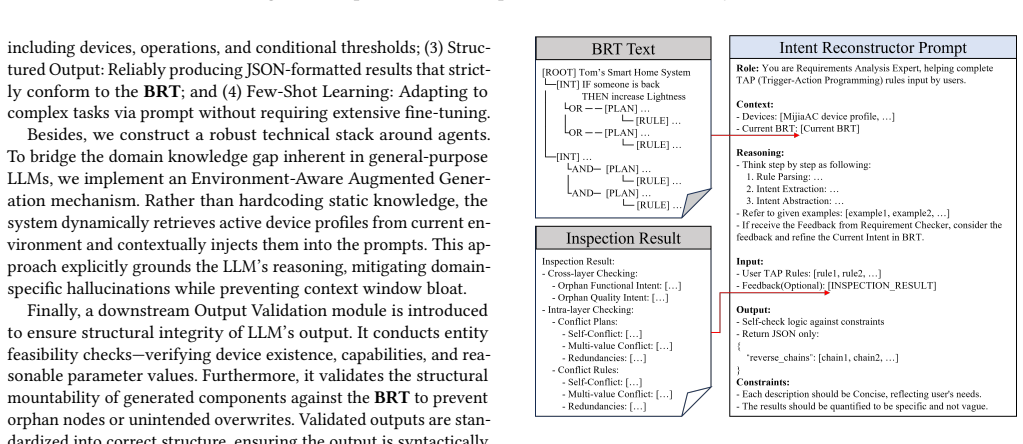
- [Introduction] The abstract and introduction use the term 'multiagent framework' without an early diagram or pseudocode showing agent roles, communication protocol, or how the Bidirectional Requirements Traceability Tree is traversed.
Simulated Author's Rebuttal
Thank you for the constructive feedback on our manuscript. We address each major comment point by point below, indicating where revisions will be incorporated to strengthen the presentation of the evaluation.
read point-by-point responses
-
Referee: [Abstract] Abstract: the headline quantitative claims (43% rule completion rate improvement, >21% logical conflict reduction) are presented without any information on dataset size, number of rules or users, statistical significance tests, baseline selection criteria, or evaluation protocol, preventing verification that the numbers support the central claim.
Authors: We agree that the abstract would benefit from additional context to support verification of the claims. The Evaluation section provides details on the dataset (IoT rules collected from end users), baseline selection (including rule-based and single-agent LLM approaches), and statistical analysis. To address this directly, we will revise the abstract to include a concise reference to the evaluation scale and protocol while maintaining its brevity. revision: yes
-
Referee: [Evaluation] Evaluation section: no human-annotated ground truth is described for the reconstructed intents, so there is no direct evidence that the multiagent LLM step accurately recovers user intent rather than introducing hallucinations, biases, or fabricated constraints that would inflate the completion-rate numerator and undermine the conflict-reduction count.
Authors: This observation is correct and highlights a limitation in the current validation approach. Our evaluation uses objective metrics for functional completeness and logical conflict detection, with the multiagent framework and traceability tree intended to constrain outputs and reduce hallucinations. However, no comprehensive human-annotated ground truth for reconstructed intents is described. We will revise the Evaluation section to explicitly discuss the validation steps, potential hallucination risks, and any mitigation strategies employed, along with a clearer statement of this limitation. revision: partial
-
Referee: [Evaluation] Evaluation section: no ablation isolates the contribution of LLM stochasticity, prompt sensitivity, or the traceability tree itself, leaving open the possibility that reported deltas reflect model behavior rather than the proposed intent-driven method.
Authors: We acknowledge that dedicated ablations would better isolate the contributions of the bidirectional traceability tree and multiagent design from LLM-specific behaviors. The reported results compare the full proposed method against baselines, but do not include component-wise ablations or sensitivity analyses for stochasticity and prompts. We will add an ablation study to the revised Evaluation section to address this gap and demonstrate the specific role of the traceability tree. revision: yes
Circularity Check
No derivation chain present; empirical evaluation only
full rationale
The paper proposes a multiagent LLM framework and Bidirectional Requirements Traceability Tree for IoT rule completion, then reports empirical results (43% higher completion rate, >21% fewer conflicts) from evaluation against baselines. No equations, mathematical derivations, fitted parameters, or first-principles claims appear in the provided text. The central claims rest on experimental outcomes rather than any self-referential definition, prediction-by-construction, or load-bearing self-citation. The derivation chain is therefore empty and self-contained against external benchmarks.
Axiom & Free-Parameter Ledger
read the original abstract
End users create IoT automation rules via trigger action programming, but their expressions are often fragmented, capturing device operations rather than high level intents. This gap leads to missing conditions, logical conflicts, and overlooked safety constraints, risking hazardous behaviors. To address this, we propose an intent driven requirements completion approach that reframes rule completion as a dual process: reconstructing intent from fragmented rules, then regenerating rules from that intent, with safety embedded throughout. We introduce a Bidirectional Requirements Traceability Tree, a three layer model linking rules, intents, and quality concerns, and design a multiagent framework that combines LLM reasoning with structured traceability. This enables completions that are both functionally complete and inherently safe, while remaining traceable and explainable. Evaluation shows our method significantly outperforms the baselines, improving the rule completion rate by 43% and reducing logical conflicts by over 21%. By grounding completion in intent understanding, we shift the paradigm from user to system responsibility, and from functional correctness to holistic trustworthiness.
Figures


Reference graph
Works this paper leans on
-
[1]
Israa Alqassem. 2014. Privacy and security requirements framework for the inter- net of things (IoT). InCompanion Proceedings of the 36th International Conference on Software Engineering. 739–741
2014
-
[2]
what if?
Natã M Barbosa, Joon S Park, Yaxing Yao, and Yang Wang. 2019. “what if?” predicting individual users’ smart home privacy preferences and their changes. Proceedings on Privacy Enhancing Technologies(2019)
2019
-
[3]
Han Bian, Xiaohong Chen, Zhi Jin, and Min Zhang. 2021. Approach to Generating TAP Rules in IoT Systems Based on Environment Modeling.International Journal of Software & Informatics11, 3 (2021)
2021
-
[4]
Michiel Brink and Johanna EMH van Bronswijk. 2013. Addressing Maslow’s deficiency needs in smart homes.Gerontechnology11, 3 (2013), 445–451
2013
-
[5]
Chao Chen, Abdelsalam Helal, Zhi Jin, Mingyue Zhang, and Choonhwa Lee
-
[6]
IoTranx: Transactions for Safer Smart Spaces.ACM Transactions on Cyber- Physical Systems (TCPS)6, 1 (2021), 1–26
2021
-
[7]
Liangyu Chen, Chen Wang, Cheng Chen, Caidie Huang, Xiaohong Chen, and Min Zhang. 2024. TapChecker: A lightweight SMT-based conflict analysis for trigger-action programming.IEEE Internet of Things Journal11, 12 (2024), 21411– 21426
2024
-
[8]
Xiaohong Chen, Shi Chen, Zhi Jin, Han Bian, Zihan Chen, and Haotian Li. 2025. Expressing the needs in smart home: What is the end users’ favorite way.ACM Transactions on Computer-Human Interaction32, 2 (2025), 1–38
2025
-
[9]
Gaetano Cimino, Vincenzo Deufemia, and Mattia Limone. 2025. IoT rule genera- tion with cross-view contrastive learning and perplexity-based ranking.IEEE Internet of Things Journal(2025)
2025
-
[10]
Fulvio Corno, Luigi De Russis, and Alberto Monge Roffarello. 2019. RecRules: recommending IF-THEN rules for end-user development.ACM Transactions on Intelligent Systems and Technology (TIST)10, 5 (2019), 1–27
2019
-
[11]
Fulvio Corno, Luigi De Russis, and Alberto Monge Roffarello. 2021. From users’ intentions to if-then rules in the internet of things.ACM Transactions on Infor- mation Systems (TOIS)39, 4 (2021), 1–33
2021
-
[12]
Maheswaree Kissoon Curumsing, Niroshinie Fernando, Mohamed Abdelrazek, Rajesh Vasa, Kon Mouzakis, and John Grundy. 2019. Emotion-oriented require- ments engineering: A case study in developing a smart home system for the elderly.Journal of systems and software147 (2019), 215–229
2019
-
[13]
Scott Davidoff, Min Kyung Lee, Charles Yiu, John Zimmerman, and Anind K Dey
-
[14]
InInternational conference on ubiquitous computing
Principles of smart home control. InInternational conference on ubiquitous computing. Springer, 19–34
-
[15]
Giuseppe Desolda, Carmelo Ardito, and Maristella Matera. 2017. Empowering end users to customize their smart environments: model, composition paradigms, and domain-specific tools.ACM Transactions on Computer-Human Interaction (TOCHI)24, 2 (2017), 1–52
2017
-
[16]
Noé Domínguez and In-Young Ko. 2018. Mashup recommendation for trigger action programming. InInternational Conference on Web Engineering. Springer, 177–184
2018
-
[17]
Mathias Funk, Lin Lin Chen, Shao Wen Yang, and Yen Kuang Chen. 2018. Ad- dressing the need to capture scenarios, intentions and preferences: Interactive intentional programming in the smart home.International Journal of Design12, 1 (2018), 53–66
2018
-
[18]
Yi Gao, Kaijie Xiao, Fu Li, Weifeng Xu, Jiaming Huang, and Wei Dong. 2024. ChatIoT: Zero-code generation of trigger-action based IoT programs.Proceedings of the ACM on Interactive, Mobile, Wearable and Ubiquitous Technologies8, 3 (2024), 1–29
2024
-
[19]
Giuseppe Ghiani, Marco Manca, Fabio Paternò, and Carmen Santoro. 2017. Per- sonalization of context-dependent applications through trigger-action rules.ACM Transactions on Computer-Human Interaction (TOCHI)24, 2 (2017), 1–33
2017
-
[20]
Google. 2026. Google Store for Google Made Devices & Accessories. https: //store.google.com/?hl=en-US
2026
-
[21]
Sirui Hong, Mingchen Zhuge, Jonathan Chen, Xiawu Zheng, Yuheng Cheng, Jinlin Wang, Ceyao Zhang, Zili Wang, Steven Ka Shing Yau, Zijuan Lin, et al
-
[22]
InThe twelfth international conference on learning representations
MetaGPT: Meta programming for a multi-agent collaborative framework. InThe twelfth international conference on learning representations
-
[23]
IFTTT. 2026. IFTTT - Automated business & home. https://ifttt.com
2026
-
[24]
Donghwan Jeong and Honguk Woo. 2025. On-Device Intent Reasoning for Smart Home Agents Via Ontology-Augmented sLLMs.IEEE Access13 (2025), 197645–197662
2025
-
[25]
Aixin Liu, Aoxue Mei, Bangcai Lin, Bing Xue, Bingxuan Wang, Bingzheng Xu, Bochao Wu, Bowei Zhang, Chaofan Lin, Chen Dong, et al . 2025. Deepseek- v3. 2: Pushing the frontier of open large language models.arXiv preprint arXiv:2512.02556(2025)
work page internal anchor Pith review Pith/arXiv arXiv 2025
-
[26]
Qinghua Liu, Tianwei Shi, and Ling Ren. 2022. Device action prediction based on k-means and apriori for smart home. In2022 IEEE Asia-Pacific Conference on Image Processing, Electronics and Computers (IPEC). IEEE, 1015–1021
2022
-
[27]
Manus. 2026. Manus. https://manus.im/
2026
-
[28]
Sarah Mennicken, Jo Vermeulen, and Elaine M Huang. 2014. From today’s aug- mented houses to tomorrow’s smart homes: new directions for home automation research. InProceedings of the 2014 ACM international joint conference on pervasive and ubiquitous computing. 105–115
2014
-
[29]
OpenManus. 2026. OpenManus. https://github.com/FoundationAgents/ OpenManus
2026
-
[30]
Ismini Psychoula, Deepika Singh, Liming Chen, Feng Chen, Andreas Holzinger, and Huansheng Ning. 2018. Users’ privacy concerns in IoT based appli- cations. In2018 IEEE SmartWorld, Ubiquitous Intelligence & Computing, Ad- vanced & Trusted Computing, Scalable Computing & Communications, Cloud & Big Data Computing, Internet of People and Smart City Innovation...
2018
-
[31]
Minjie Shen, Yanshu Li, Lulu Chen, and Qikai Yang. 2025. From mind to ma- chine: The rise of manus ai as a fully autonomous digital agent.arXiv preprint arXiv:2505.02024(2025)
work page internal anchor Pith review arXiv 2025
-
[32]
Antero Taivalsaari and Tommi Mikkonen. 2017. A roadmap to the programmable world: software challenges in the IoT era.IEEE software34, 1 (2017), 72–80
2017
-
[33]
Blase Ur, Elyse McManus, Melwyn Pak Yong Ho, and Michael L Littman. 2014. Practical trigger-action programming in the smart home. InProceedings of the SIGCHI conference on human factors in computing systems. 803–812
2014
-
[34]
Jason Wei, Xuezhi Wang, Dale Schuurmans, Maarten Bosma, Fei Xia, Ed Chi, Quoc V Le, Denny Zhou, et al. 2022. Chain-of-thought prompting elicits reasoning in large language models.Advances in neural information processing systems35 (2022), 24824–24837
2022
-
[35]
Charlie Wilson, Tom Hargreaves, and Richard Hauxwell-Baldwin. 2015. Smart homes and their users: a systematic analysis and key challenges.Personal and ubiquitous computing19, 2 (2015), 463–476. Conference acronym ’XX, June 03–05, 2018, Woodstock, NY Anonymous Author, et al
2015
-
[36]
Gang Wu, Liang Hu, Yuxiao Hu, Yongheng Xing, and Feng Wang. 2025. User intention prediction for trigger-action programming rule using multi-view rep- resentation learning.Expert Systems with Applications267 (2025), 126198
2025
-
[37]
Gang Wu, Liang Hu, Yuxiao Hu, Xingbo Xiong, and Feng Wang. 2025. Llm4tap: Llm-enhanced tap rule recommendation.IEEE Internet of Things Journal12, 10 (2025), 13157–13169
2025
-
[38]
Zapier. 2026. Zapier: Automated AI Workflows, Agents and Apps. https://zapier. com
2026
-
[39]
Lefan Zhang, Weijia He, Jesse Martinez, Noah Brackenbury, Shan Lu, and Blase Ur. 2019. AutoTap: Synthesizing and repairing trigger-action programs using LTL properties. In2019 IEEE/ACM 41st international conference on software engineering (ICSE). IEEE, 281–291
2019
-
[40]
Didar Zowghi and Vincenzo Gervasi. 2003. On the interplay between consis- tency, completeness, and correctness in requirements evolution.Information and Software technology45, 14 (2003), 993–1009
2003
discussion (0)
Sign in with ORCID, Apple, or X to comment. Anyone can read and Pith papers without signing in.