REVIEW 3 major objections 1 minor 21 references
Leveraging Metric Depth for Relative Depth Prediction
T0 review · 3 major / 1 minor · reviewed 2026-06-27 · grok-4.3
Pith's one-line read Metric depth estimates from large pretrained models enable effective relative depth prediction in football scenes with only thousands of training samples.
desk verdict This is a narrow competition report applying known pretrained metric depth models to football scenes, but it supplies no ablations or baselines to show the pretraining actually helps over direct fine-tuning. read the letter →
The pith
A machine-rendered reading of the paper's core claim, the machinery that carries it, and where it could break.
The reading
What carries the argument
Transfer of zero-shot metric depth predictions from large pretrained models to serve as guidance for the relative depth task.
What would settle it
Training an identical model architecture on the same football data but without any metric depth pretraining step and checking whether the resulting challenge score stays near 2.68 × 10^{-3} or becomes substantially worse.
Extended reading notes
Core claim
By taking advantage of the zero-shot metric depth capabilities of models pretrained on large-scale datasets, the method learns to predict relative depth effectively in football scenarios, reaching a score of 2.68 × 10^{-3} on the challenge set.
Load-bearing premise
That metric depth estimates produced by general pretrained models still supply useful information when applied inside the narrow visual domain of football scenes after adaptation on limited task data.
Editorial extensions
If this is right
- Relative depth prediction becomes feasible in other data-scarce scene types that share visual traits with football footage.
- Zero-shot outputs from large models can act as an intermediate representation that reduces the sample complexity of the target task.
- The approach demonstrates that metric depth can be repurposed even when the final requirement is only relative ordering.
- Competition performance at 2.68 × 10^{-3} shows the transfer is already accurate enough for the SoccerNet benchmark.
Reading between the lines
- The same pretraining-to-relative transfer could be tested on other sports videos or indoor scenes to measure how domain-specific the gain is.
- If the method scales, it would lower the annotation cost for building depth-aware sports analytics tools.
- A natural next test would replace the soccer fine-tuning data with even fewer examples to find the minimum data threshold where the pretrained metric signal still helps.
Editorial analysis
A structured set of objections, weighed in public.
Referee Report
Summary. The manuscript presents a solution to the 2025 SoccerNet Monocular Depth Estimation Competition Challenge. It claims that by leveraging zero-shot capabilities of models pretrained on large-scale datasets to learn metric depth, effective relative depth prediction can be achieved in football scenarios despite only thousands of training samples, with a reported score of 2.68 × 10^{-3} on the challenge set.
Significance. If substantiated with proper controls, the result would indicate that metric depth pretraining transfers usefully to relative depth prediction in narrow domains with limited data. This could be significant for applications where labeled data is scarce, highlighting the value of large-scale pretraining for specialized depth estimation tasks.
major comments (3)
- [Abstract] Abstract: The central claim that pretrained metric depth models enable effective relative depth prediction relies on transfer from large-scale pretraining, but the text supplies no implementation details, model architecture, fine-tuning procedure, or method for converting metric outputs to relative predictions, rendering the claim unevaluable.
- [Results] Results: No ablation studies or baseline comparisons are presented to show that metric depth pretraining outperforms direct relative-depth fine-tuning on the same limited football dataset, which is required to verify the transfer benefit asserted in the abstract.
- [Methods] Methods: The manuscript provides no description of how the zero-shot metric depth estimates are adapted, regularized, or used as input for the relative depth task, leaving the key methodological step unspecified.
minor comments (1)
- The reported score lacks context such as comparison to other competition entries or error analysis on football-specific challenges (e.g., player motion, field markings).
Simulated Author's Rebuttal
We thank the referee for the detailed comments on our competition solution manuscript. We address each point below and will revise the manuscript to provide the requested details and comparisons.
read point-by-point responses
-
Referee: [Abstract] Abstract: The central claim that pretrained metric depth models enable effective relative depth prediction relies on transfer from large-scale pretraining, but the text supplies no implementation details, model architecture, fine-tuning procedure, or method for converting metric outputs to relative predictions, rendering the claim unevaluable.
Authors: The manuscript is a concise competition report, which accounts for the brevity. We will revise the abstract and add a methods section specifying the exact zero-shot pretrained model (architecture and training data scale), confirming no fine-tuning was performed on the football dataset, and detailing the conversion step (normalization of metric depth values to a relative scale via min-max scaling to align with competition annotations). revision: yes
-
Referee: [Results] Results: No ablation studies or baseline comparisons are presented to show that metric depth pretraining outperforms direct relative-depth fine-tuning on the same limited football dataset, which is required to verify the transfer benefit asserted in the abstract.
Authors: We agree that the absence of ablations limits substantiation of the transfer claim. In the revision we will add a results subsection with a direct baseline: a model fine-tuned from scratch on relative depth labels using the same limited training set, to quantify the performance gain from the metric pretraining approach. revision: yes
-
Referee: [Methods] Methods: The manuscript provides no description of how the zero-shot metric depth estimates are adapted, regularized, or used as input for the relative depth task, leaving the key methodological step unspecified.
Authors: We will expand the methods to describe the process: the zero-shot metric depth model is applied directly to input images with no additional training or regularization; the resulting metric outputs are then converted to relative depth via a deterministic post-processing normalization that maps the values to the [0,1] relative range required by the task. revision: yes
Circularity Check
No derivation chain or equations present; empirical method is self-contained.
full rationale
The paper describes an empirical competition solution that fine-tunes or adapts large-scale pretrained metric-depth models for relative-depth output on limited football data. No equations, parameter-fitting steps, self-citations, or uniqueness claims appear in the provided text. The central claim rests on the external zero-shot capability of the pretrained models rather than any internal reduction to the paper's own fitted values or prior self-referential results. This is the normal case of a non-circular empirical report.
Assumptions & free parameters
Cite this review
Pith. "Pith review of Leveraging Metric Depth for Relative Depth Prediction." pith.science (2026). https://pith.science/paper/J6IQ3MNU
@misc{pith2026260610628,
  author       = {Pith},
  title        = {Pith review of: Leveraging Metric Depth for Relative Depth Prediction},
  year         = {2026},
  howpublished = {\url{https://pith.science/paper/J6IQ3MNU}},
  note         = {Machine review of arXiv:2606.10628}
}
abstract
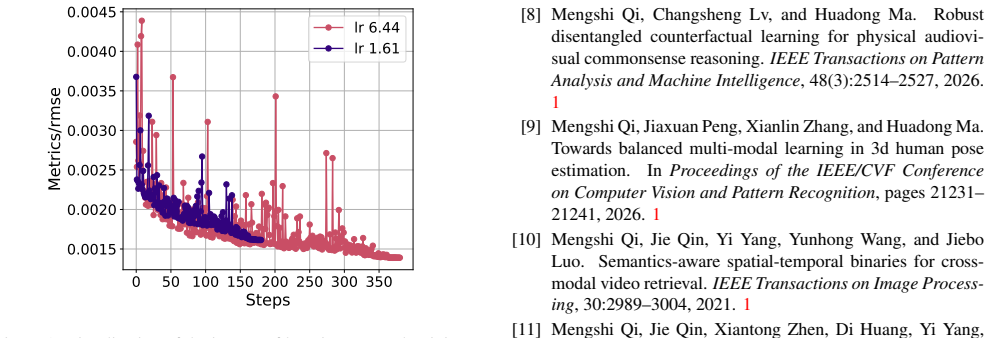
We present our solution to the 2025 SoccerNet Monocular Depth Estimation Competition Challenge. Predicting the relative depth in football scenarios is challenging, especially with only thousands of training samples available. To address this issue, our method leverages the powerful zero-shot capabilities of models pretrained on large-scale datasets to learn metric depth for effective relative depth prediction, achieving a score of $2.68 \times 10^{-3}$ on the challenge set.
Figures
Reference graph
Works this paper leans on
-
[1]
Localbins: Improving depth estimation by learning local dis- tributions
Shariq Farooq Bhat, Ibraheem Alhashim, and Peter Wonka. Localbins: Improving depth estimation by learning local dis- tributions. InEuropean Conference on Computer Vision, pages 480–496. Springer, 2022. 1
2022
-
[2]
ZoeDepth: Zero-shot Transfer by Combining Relative and Metric Depth
Shariq Farooq Bhat, Reiner Birkl, Diana Wofk, Peter Wonka, and Matthias M ¨uller. Zoedepth: Zero-shot trans- fer by combining relative and metric depth.arXiv preprint arXiv:2302.12288, 2023. 1
work page Pith review arXiv 2023
-
[3]
Repurpos- ing diffusion-based image generators for monocular depth estimation
Bingxin Ke, Anton Obukhov, Shengyu Huang, Nando Met- zger, Rodrigo Caye Daudt, and Konrad Schindler. Repurpos- ing diffusion-based image generators for monocular depth estimation. InProceedings of the IEEE/CVF Conference on Computer Vision and Pattern Recognition, pages 9492– 9502, 2024. 2
2024
-
[4]
Soccernet-depth: a scalable dataset for monocular depth estimation in sports videos
Arnaud Leduc, Anthony Cioppa, Silvio Giancola, Bernard Ghanem, and Marc Van Droogenbroeck. Soccernet-depth: a scalable dataset for monocular depth estimation in sports videos. InProceedings of the IEEE/CVF Conference on Computer Vision and Pattern Recognition, pages 3280– 3292, 2024. 1
2024
-
[5]
Improving batch normalization with test-time adaptation for robust object detection in self-driving
Dacheng Liao, Mengshi Qi, Liang Liu, and Huadong Ma. Improving batch normalization with test-time adaptation for robust object detection in self-driving. InProceedings of the AAAI Conference on Artificial Intelligence, volume 40, pages 6925–6933, 2026. 1
2026
-
[6]
T2sg: Traffic topology scene graph for topology reasoning in autonomous driving
Changsheng Lv, Mengshi Qi, Liang Liu, and Huadong Ma. T2sg: Traffic topology scene graph for topology reasoning in autonomous driving. InProceedings of the Computer Vision and Pattern Recognition Conference, pages 17197–17206,
-
[7]
Dinov2: Learning robust visual features without supervision
Maxime Oquab, Timoth ´ee Darcet, Th ´eo Moutakanni, Huy V o, Marc Szafraniec, Vasil Khalidov, Pierre Fernandez, Daniel Haziza, Francisco Massa, Alaaeldin El-Nouby, et al. Dinov2: Learning robust visual features without supervision. Transactions on Machine Learning Research Journal, 2024. 1
2024
-
[8]
Robust disentangled counterfactual learning for physical audiovi- sual commonsense reasoning.IEEE Transactions on Pattern Analysis and Machine Intelligence, 48(3):2514–2527, 2026
Mengshi Qi, Changsheng Lv, and Huadong Ma. Robust disentangled counterfactual learning for physical audiovi- sual commonsense reasoning.IEEE Transactions on Pattern Analysis and Machine Intelligence, 48(3):2514–2527, 2026. 1
2026
Show all 21 references
-
[9]
Towards balanced multi-modal learning in 3d human pose estimation
Mengshi Qi, Jiaxuan Peng, Xianlin Zhang, and Huadong Ma. Towards balanced multi-modal learning in 3d human pose estimation. InProceedings of the IEEE/CVF Conference on Computer Vision and Pattern Recognition, pages 21231– 21241, 2026. 1
2026
-
[10]
Semantics-aware spatial-temporal binaries for cross- modal video retrieval.IEEE Transactions on Image Process- ing, 30:2989–3004, 2021
Mengshi Qi, Jie Qin, Yi Yang, Yunhong Wang, and Jiebo Luo. Semantics-aware spatial-temporal binaries for cross- modal video retrieval.IEEE Transactions on Image Process- ing, 30:2989–3004, 2021. 1
2021
-
[11]
Few-shot ensemble learning for video classi- fication with slowfast memory networks
Mengshi Qi, Jie Qin, Xiantong Zhen, Di Huang, Yi Yang, and Jiebo Luo. Few-shot ensemble learning for video classi- fication with slowfast memory networks. InProceedings of the 28th ACM international conference on multimedia, pages 3007–3015, 2020. 1
2020
-
[12]
Sports video captioning via attentive motion representation and group relationship modeling.IEEE Transactions on Cir- cuits and Systems for Video Technology, 30(8):2617–2633,
Mengshi Qi, Yunhong Wang, Annan Li, and Jiebo Luo. Sports video captioning via attentive motion representation and group relationship modeling.IEEE Transactions on Cir- cuits and Systems for Video Technology, 30(8):2617–2633,
-
[13]
Explainable action form assessment by exploiting multimodal chain-of-thoughts reasoning.arXiv preprint arXiv:2512.15153, 2025
Mengshi Qi, Yeteng Wu, Xianlin Zhang, and Huadong Ma. Explainable action form assessment by exploiting multimodal chain-of-thoughts reasoning.arXiv preprint arXiv:2512.15153, 2025. 1
2025 arXiv
-
[14]
Ac- tion quality assessment via hierarchical pose-guided multi- stage contrastive regression.IEEE Transactions on Image Processing, 2025
Mengshi Qi, Hao Ye, Jiaxuan Peng, and Huadong Ma. Ac- tion quality assessment via hierarchical pose-guided multi- stage contrastive regression.IEEE Transactions on Image Processing, 2025. 1
2025
-
[15]
Dc-sam: In-context segment anything in images and videos via dual consistency
Mengshi Qi, Pengfei Zhu, Xiangtai Li, Xiaoyang Bi, Lu Qi, Huadong Ma, and Ming-Hsuan Yang. Dc-sam: In-context segment anything in images and videos via dual consistency. IEEE Transactions on Pattern Analysis and Machine Intelli- gence, 48(4):4642–4656, 2026. 1
2026
-
[16]
Rdfc-gan: Rgb-depth fusion cyclegan for in- door depth completion.IEEE Transactions on Pattern Anal- ysis and Machine Intelligence, 46(11):7088–7101, 2024
Haowen Wang, Zhengping Che, Yufan Yang, Mingyuan Wang, Zhiyuan Xu, Xiuquan Qiao, Mengshi Qi, Feifei Feng, and Jian Tang. Rdfc-gan: Rgb-depth fusion cyclegan for in- door depth completion.IEEE Transactions on Pattern Anal- ysis and Machine Intelligence, 46(11):7088–7101, 2024. 1
2024
-
[17]
Rgb-depth fusion gan for indoor depth completion
Haowen Wang, Mingyuan Wang, Zhengping Che, Zhiyuan Xu, Xiuquan Qiao, Mengshi Qi, Feifei Feng, and Jian Tang. Rgb-depth fusion gan for indoor depth completion. InPro- ceedings of the ieee/cvf conference on computer vision and pattern recognition, pages 6209–6218, 2022. 1
2022
-
[18]
Depth anything: Unleashing the power of large-scale unlabeled data
Lihe Yang, Bingyi Kang, Zilong Huang, Xiaogang Xu, Jiashi Feng, and Hengshuang Zhao. Depth anything: Unleashing the power of large-scale unlabeled data. InProceedings of the IEEE/CVF Conference on Computer Vision and Pattern Recognition, pages 10371–10381, 2024. 1
2024
-
[19]
Safedriverag: Towards safe autonomous driv- ing with knowledge graph-based retrieval-augmented gener- ation
Hao Ye, Mengshi Qi, Zhaohong Liu, Liang Liu, and Huadong Ma. Safedriverag: Towards safe autonomous driv- ing with knowledge graph-based retrieval-augmented gener- ation. InProceedings of the 33rd ACM International Con- ference on Multimedia, pages 11170–11178, 2025. 1 3
2025
-
[20]
Weakly-supervised temporal action localization by in- ferring salient snippet-feature
Wulian Yun, Mengshi Qi, Chuanming Wang, and Huadong Ma. Weakly-supervised temporal action localization by in- ferring salient snippet-feature. InProceedings of the AAAI conference on artificial intelligence, volume 38, pages 6908– 6916, 2024. 1
2024
-
[21]
Unsupervised self-driving attention prediction via un- certainty mining and knowledge embedding
Pengfei Zhu, Mengshi Qi, Xia Li, Weijian Li, and Huadong Ma. Unsupervised self-driving attention prediction via un- certainty mining and knowledge embedding. InProceedings of the IEEE/CVF international conference on computer vi- sion, pages 8558–8568, 2023. 1 4
2023
Reviewed June 27, 2026 · model on record in the stance chip above.
Discussion (0). Sign in to comment.