Equilibrating continuous-variable open quantum systems using stochastic classical trajectories in path-integral space
Pith reviewed 2026-06-27 13:07 UTC · model grok-4.3
The pith
Stochastic classical trajectories in path-integral space reach the exact quantum equilibrium state for open systems.
A machine-rendered reading of the paper's core claim, the machinery that carries it, and where it could break.
Core claim
Propagating stochastic classical trajectories generated by the recently derived Matsubara generalized Langevin equation in path-integral phase space leads to equilibration to the exact quantum equilibrium state. This state is an imaginary-time phase-space path integral in which positions are entangled with the bath and momenta correlate with positions through a phase term. The trajectories recover the purely imaginary momentum-position correlation despite the instability from evolving stochastic variables into the complex plane.
What carries the argument
The Matsubara generalized Langevin equation, which evolves stochastic variables into the complex plane to produce the imaginary correlations required by the equilibrium path integral.
If this is right
- The trajectories equilibrate to the exact state for a quartic oscillator coupled to a white-noise bath.
- The approach recovers the quantum equilibrium beyond the weak-coupling limit.
- The findings indicate a route to new approximate simulation methods for continuous-variable open quantum systems.
Where Pith is reading between the lines
- The same trajectory method might apply to other continuous-variable systems if the complex-plane evolution remains stable enough to sample.
- Hybrid schemes could combine these classical trajectories with quantum corrections for more general baths.
- Numerical stabilization techniques would be needed before the method scales to larger systems or longer times.
Load-bearing premise
The Matsubara generalized Langevin equation produces the imaginary correlations by evolving stochastic variables into the complex plane.
What would settle it
Run the trajectories for the quartic oscillator, extract the equilibrated momentum-position correlation, and test whether it equals the purely imaginary value predicted by the exact imaginary-time path integral.
Figures
read the original abstract
Beyond the weak-coupling limit, open quantum systems equilibrate to a highly entangled thermal state. For continuous-variable systems, this state can be written explicitly as an imaginary-time phase-space path integral, in which the positions are directly entangled with the bath, and the momenta are correlated with the positions through a phase term. Here, we ask to what extent this state can be reached by propagating stochastic classical trajectories in path-integral phase space. Surprisingly, we find that the trajectories equilibrate to the exact quantum equilibrium state, recovering the purely imaginary momentum-position correlation in the phase term. The trajectories are generated using a recently derived Matsubara generalized Langevin equation, which produces the imaginary correlations by evolving the stochastic variables into the complex plane. This makes the dynamics numerically unstable, but we are nonetheless able to demonstrate the equilibration of a quartic oscillator coupled to a white-noise bath. These unexpected findings could lead to new approximate methodologies for simulating continuous-variable open quantum systems.
Editorial analysis
A structured set of objections, weighed in public.
Referee Report
Summary. The paper claims that stochastic classical trajectories generated via the recently derived Matsubara generalized Langevin equation in path-integral phase space equilibrate to the exact quantum thermal state of a continuous-variable open quantum system (including the purely imaginary momentum-position correlation in the phase term), as demonstrated numerically for a quartic oscillator coupled to a white-noise bath, even though the complex-plane evolution produces numerical instability.
Significance. If the central numerical finding is robust, the result would be significant because it shows that a classical-like stochastic dynamics can sample an exact entangled quantum equilibrium distribution without fitting parameters, potentially enabling new trajectory-based methods for continuous-variable open systems beyond weak coupling.
major comments (2)
- [Numerical results / demonstration section] The central claim that the trajectories reach the 'exact' quantum equilibrium state rests on a single numerical demonstration (quartic oscillator, white-noise bath). Without additional systems, baths, or an analytical argument showing why the long-time statistics must converge to the exact imaginary correlations despite instability, the generality of the result remains under-supported.
- [Numerical results / stability discussion] The manuscript acknowledges numerical instability from complex-plane evolution of the stochastic variables. However, the evidence that long-time sampling nevertheless yields the exact quantum state (rather than an approximation limited by regularization, cutoff, or short-time effects) requires quantitative convergence diagnostics or error bounds as a function of propagation time; these appear to be absent or insufficient to rule out the skeptic's concern.
minor comments (1)
- [Abstract / Introduction] The abstract states the result is 'surprising' and 'unexpected'; the introduction or discussion should clarify how this finding relates to prior work on Matsubara dynamics or imaginary-time path integrals to help readers assess novelty.
Simulated Author's Rebuttal
We thank the referee for their constructive comments regarding the numerical demonstration and stability analysis. We respond to each major comment below.
read point-by-point responses
-
Referee: [Numerical results / demonstration section] The central claim that the trajectories reach the 'exact' quantum equilibrium state rests on a single numerical demonstration (quartic oscillator, white-noise bath). Without additional systems, baths, or an analytical argument showing why the long-time statistics must converge to the exact imaginary correlations despite instability, the generality of the result remains under-supported.
Authors: The Matsubara generalized Langevin equation is derived generally within the path-integral phase-space framework for continuous-variable systems and arbitrary baths. The single numerical example (quartic oscillator, white-noise bath) demonstrates that the exact imaginary momentum-position correlations can be recovered despite the complex-plane instability. We agree that the generality would be strengthened by additional examples or an analytical convergence argument. In revision we will expand the discussion section to explain why the path-integral structure implies the result should hold more broadly, while noting that the current work is a proof-of-principle and that further systems are left for future study. revision: partial
-
Referee: [Numerical results / stability discussion] The manuscript acknowledges numerical instability from complex-plane evolution of the stochastic variables. However, the evidence that long-time sampling nevertheless yields the exact quantum state (rather than an approximation limited by regularization, cutoff, or short-time effects) requires quantitative convergence diagnostics or error bounds as a function of propagation time; these appear to be absent or insufficient to rule out the skeptic's concern.
Authors: The referee is correct that explicit quantitative convergence diagnostics versus propagation time are not provided. The manuscript shows that the long-time sampled statistics match the exact quantum thermal state (including the imaginary correlation) for the quartic oscillator. In the revised version we will add plots of the time-dependent approach of the sampled position-momentum correlation to its exact imaginary value, together with statistical error estimates obtained from multiple independent trajectories. This will supply the requested quantitative support that the agreement is not an artifact of short-time or regularization effects. revision: yes
Circularity Check
No circularity: numerical demonstration stands on its own
full rationale
The paper's central claim is a numerical observation that stochastic trajectories generated by the Matsubara GLE reach the exact quantum thermal state, including the imaginary momentum-position correlation. This is presented as a surprising empirical result for the quartic oscillator case, not derived by fitting parameters or by redefining inputs. The GLE itself is referenced as recently derived, but the equilibration finding is not reduced to that prior equation by construction; it is tested via explicit propagation and sampling. No self-definitional steps, fitted-input predictions, uniqueness theorems, or ansatz smuggling appear in the derivation chain. The result is self-contained against external benchmarks (exact quantum equilibrium) and does not rely on load-bearing self-citations.
Axiom & Free-Parameter Ledger
axioms (1)
- domain assumption The Matsubara generalized Langevin equation generates trajectories that produce the imaginary momentum-position correlations needed for exact equilibration.
Reference graph
Works this paper leans on
-
[1]
overN L Lorentzians. Since each Lorentzian term is equivalent to a Debye–Drude spectral density with com- plex poles, the auxiliary variables resemble a straightfor- wardN L-dimensional generalisation of the variablez(t) in Eq. (25). For this reason, we will not need to gen- eralise the derivation of Sec. V beyond a Debye–Drude spectral density. III. IMAG...
-
[2]
Markovian auxiliary space and Fokker–Planck equation We introduce the auxiliary variables by expanding RC n(t) as RC n(t) =a nWn(t) +b nZn(t) +c nW¯n(t) +d nZ¯n(t) (52) where theW n(t) are independent white noise variates with the same kernels as Eq. (10), and theZ n(t) are solutions to the Ornstein–Uhlenbeck equation ˙Zn(t) =−|ω n|Zn(t) +|ω n|Wn(t).(53) ...
-
[3]
(50) will equilibrate any ini- tial distributionρ 0(P,Q) given sufficient time, we need to find the stationary solution of the FPE in Eq
Form of the FPE stationary solution To demonstrate that Eq. (50) will equilibrate any ini- tial distributionρ 0(P,Q) given sufficient time, we need to find the stationary solution of the FPE in Eq. (62) and show that it marginalises toρ eq(P,Q) of Eq. (42). Finding stationary solutions to FPEs is in general dif- ficult [18]. However, Eq. (62) turns out to...
-
[4]
(50) pro- duces the equilibrium distributionρ eq(P,Q) without ex- plicitly invoking the phase exp[−iθ M(P,Q)]
The imaginary momentum–position correlation The Matsubara Langevin equation of Eq. (50) pro- duces the equilibrium distributionρ eq(P,Q) without ex- plicitly invoking the phase exp[−iθ M(P,Q)]. In other words, an expectation value of some propertyA(P,Q) can be evaluated using Z dP Z dQρ eq(P,Q)A(P,Q) = lim Nt→∞ 1 Nt NtX i=1 A(P(ti),Q(t i)) (67) where the ...
-
[5]
At a tem- perature ofβ= 50, we find that the dynamics is sta- ble forM= 13, which is far lower than the value of M≃100 needed to convergeρ eq(P,Q) at this temper- ature
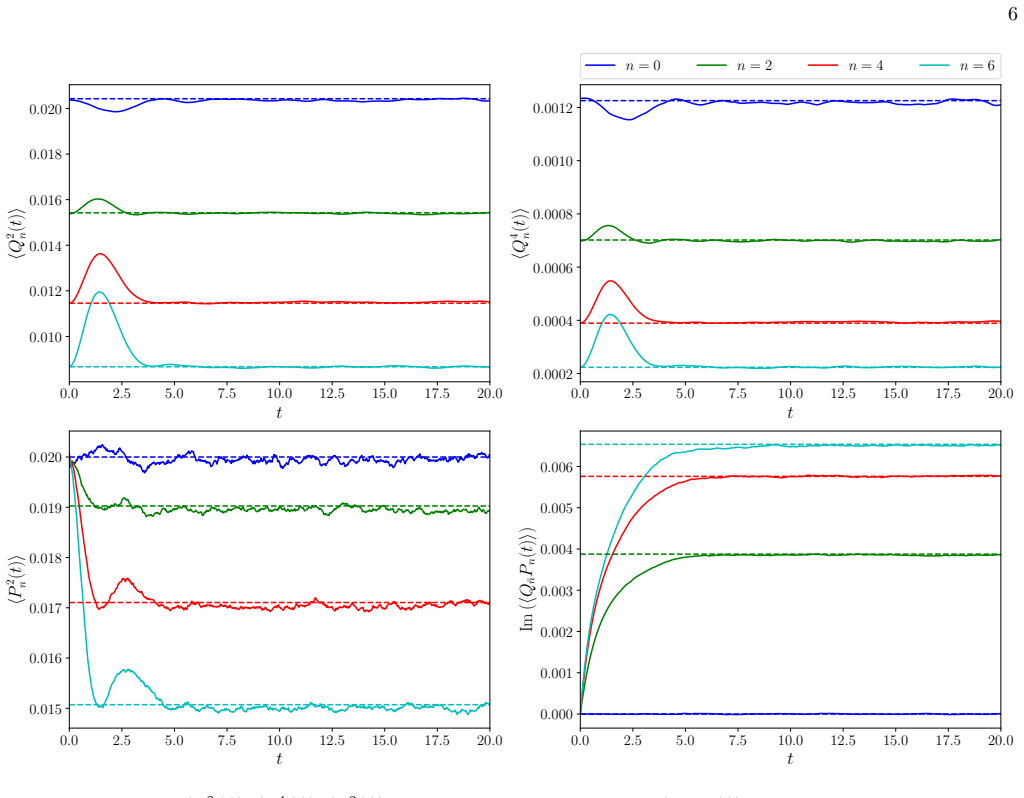
A simple numerical test We have investigated these numerical properties for the simple case of a quartic system potential V(q) = q4 4 (68) with a moderate damping strength ofγ= 1. At a tem- perature ofβ= 50, we find that the dynamics is sta- ble forM= 13, which is far lower than the value of M≃100 needed to convergeρ eq(P,Q) at this temper- ature. Nonethe...
-
[6]
A. O. Caldeira and A. J. Leggett, Physica A121, 587 (1983)
1983
-
[7]
Grabert, P
H. Grabert, P. Schramm, and G.-L. Ingold, Phys. Rep. 168, 115 (1988)
1988
-
[8]
Miret-Art´ es and E
S. Miret-Art´ es and E. Pollak, J. Phys.: Condens. Matter 17, S4133 (2005)
2005
-
[9]
E. E. Torres-Miyares, G. Rojas-Lorenzo, J. Rubayo- Soneira, and S. Miret-Art´ es, Phys. Chem. Chem. Phys. 24, 15871 (2022)
2022
-
[10]
Trenins and M
G. Trenins and M. Rossi, Phys. Rev. Lett.134, 226201 (2025)
2025
-
[11]
Tanimura and S
Y. Tanimura and S. Mukamel, J. Chem. Phys.99, 9496 (1993)
1993
-
[12]
Kato and Y
T. Kato and Y. Tanimura, J. Chem. Phys.120, 260 (2004)
2004
-
[13]
Weiss,Quantum Dissipative Systems(World Scien- tific, 2012)
U. Weiss,Quantum Dissipative Systems(World Scien- tific, 2012)
2012
-
[14]
S. C. Althorpe, Eur. Phys. J. B94, 155 (2021)
2021
-
[15]
Prada, E
A. Prada, E. S. P´ os, and S. C. Althorpe, J. Chem. Phys. 158, 114106 (2023)
2023
-
[16]
Parrinello and A
M. Parrinello and A. Rahman, J. Chem. Phys.80, 860 (1984)
1984
-
[17]
J. E. Lawrence, T. Fletcher, L. P. Lindoy, and D. E. Manolopoulos, J. Chem. Phys.151, 114119 (2019)
2019
-
[18]
T. J. H. Hele, M. J. Willatt, A. Muolo, and S. C. Al- thorpe, J. Chem. Phys.142, 134103 (2015)
2015
-
[19]
10 included the momentum– position correlation explicitly in the reduced density ma- trix at timet= 0 using analytic continuation
To compensate for this, Ref. 10 included the momentum– position correlation explicitly in the reduced density ma- trix at timet= 0 using analytic continuation
-
[20]
Tuckerman,Statistical Mechanics: Theory and Molec- ular Simulation(Oxford University Press, 2010)
M. Tuckerman,Statistical Mechanics: Theory and Molec- ular Simulation(Oxford University Press, 2010)
2010
-
[21]
Kubo, Rep
R. Kubo, Rep. Prog. Phys.29, 255 (1966)
1966
-
[22]
Zwanzig,Nonequilibrium statistical mechanics(Ox- ford university press, 2001)
R. Zwanzig,Nonequilibrium statistical mechanics(Ox- ford university press, 2001)
2001
-
[23]
Risken,The Fokker-Planck Equation: Methods of So- lution and Applications(Springer, 1989)
H. Risken,The Fokker-Planck Equation: Methods of So- lution and Applications(Springer, 1989)
1989
-
[24]
A. D. Baczewski and S. D. Bond, J. Chem. Phys.139, 044107 (2013)
2013
-
[25]
Meier and D
C. Meier and D. J. Tannor, J. Chem. Phys.111, 3365 (1999)
1999
-
[26]
Chandler and P
D. Chandler and P. G. Wolynes, J. Chem. Phys.74, 4078 (1981)
1981
-
[27]
D. M. Ceperley, Rev. Mod. Phys.67, 279 (1995)
1995
-
[28]
We assume throughout thatMis odd
-
[29]
R. D. Coalson, J. Chem. Phys.85, 926 (1986)
1986
-
[30]
W. H. D. Moore,Matsubara dynamics for open quantum systems, Ph.D. thesis, University of Cambridge (2026)
2026
-
[31]
EitherZ n(0) must be sampled from a Gaussian distribu- tion with zero mean andmγ|ω n|/βvariance or the noise must be allowed to build up its history for the noise ker- nels to be as shown
-
[32]
By which we mean thatV(q) is unspecified, anharmonic, and bound
-
[33]
For the noise in Eq. (71) to have the desired kernels, the auxiliary variables must also be sampled with initial conditions⟨Y j,n(0)Yj′,n′(0)⟩=mγ jωc,jδnn′ δjj ′ /β, ⟨Zj,n(0)Zj′,n′(0)⟩=mγ j|ωn|δnn′ δjj ′ /βand ⟨Yj,n(0)Zj′,n′(0)⟩= 2mγ jωc,j|ωn|δnn′ δjj ′ /β(ωc,j +|ω n|). Alternatively, the noise can simply be allowed to build up its history. 12
-
[34]
Equili- brating continuous-variable open quantum systems using stochastic classical trajectories in path-integral space
W. H. D. Moore, Research data supporting “Equili- brating continuous-variable open quantum systems using stochastic classical trajectories in path-integral space” (2026)
2026
discussion (0)
Sign in with ORCID, Apple, or X to comment. Anyone can read and Pith papers without signing in.