Balancing bias, baryons, and scale cuts in LSST 3x2pt analysis
Pith reviewed 2026-06-27 12:20 UTC · model grok-4.3
The pith
A minimal bias model with fixed higher-order terms remains unbiased for LambdaCDM parameters in LSST 3x2pt up to k_max=0.7 h/Mpc.
A machine-rendered reading of the paper's core claim, the machinery that carries it, and where it could break.
Core claim
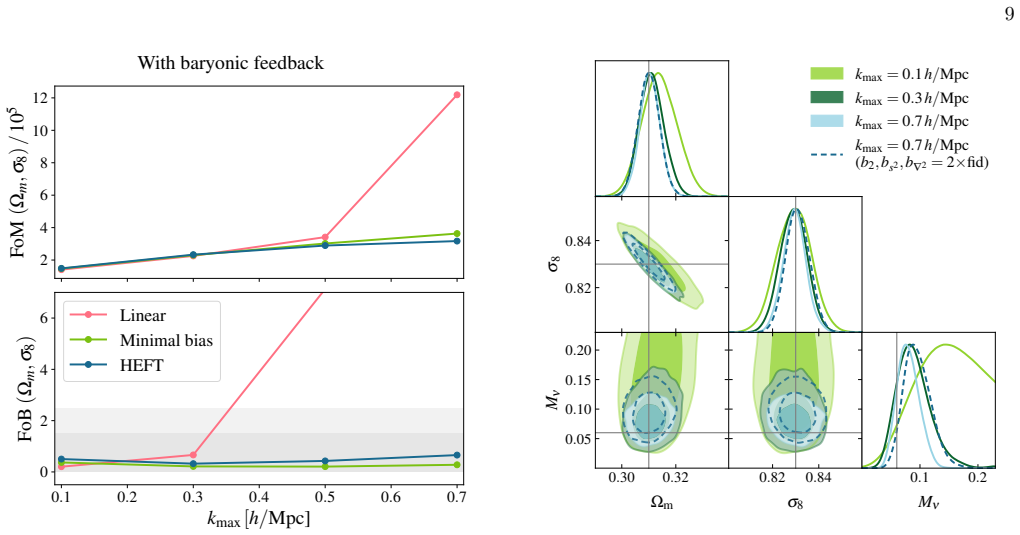
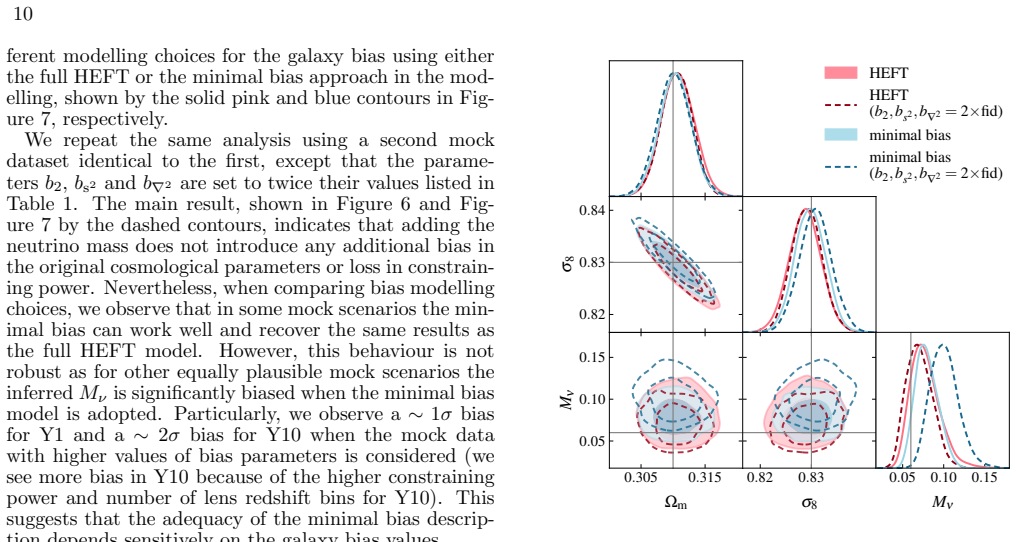
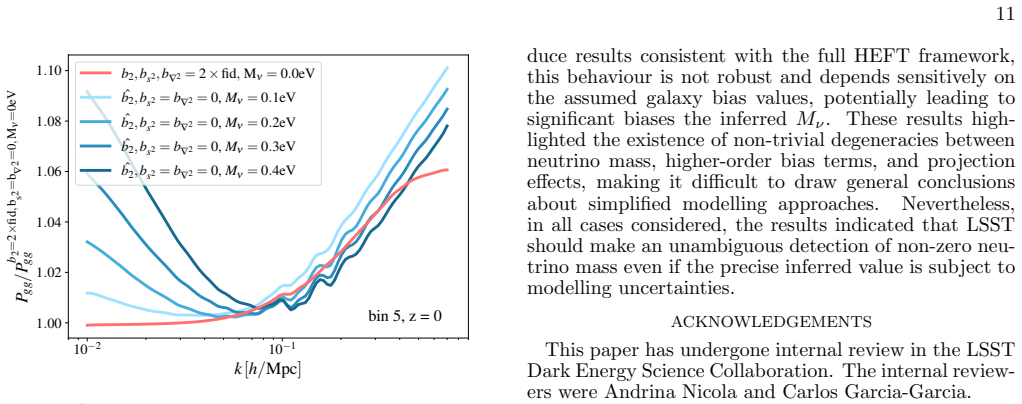
In a 3x2pt analysis for LSST using the BACCO emulator to model HEFT galaxy bias and baryonic feedback via baryonification, a minimal bias variant with fixed higher-order terms is unbiased in LambdaCDM even at k_max=0.7 h/Mpc. Higher-order bias can mimic baryonic suppression but baryons cannot reproduce the full range of higher-order bias behaviour. A detection of total neutrino mass M_nu is possible for both Y1 and Y10 for k>=0.3 h/Mpc at least when photo-z uncertainties and related nuisance parameters are precisely known, yet the inferred M_nu can be significantly biased by adopting the minimal bias model.
What carries the argument
Hybrid-effective field theory (HEFT) for nonlinear galaxy bias combined with the baryonification mechanism for feedback, both handled inside the BACCO emulator.
If this is right
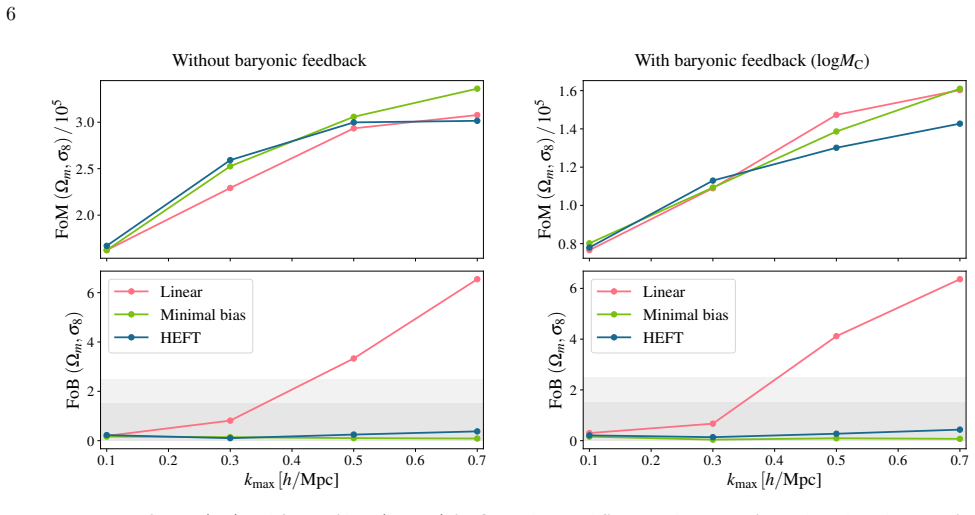
- Linear bias delivers percent-level unbiased constraints on Omega_m and sigma_8 only up to k_max=0.1 h/Mpc.
- The minimal bias variant with fixed higher-order terms stays unbiased in LambdaCDM at k_max=0.7 h/Mpc.
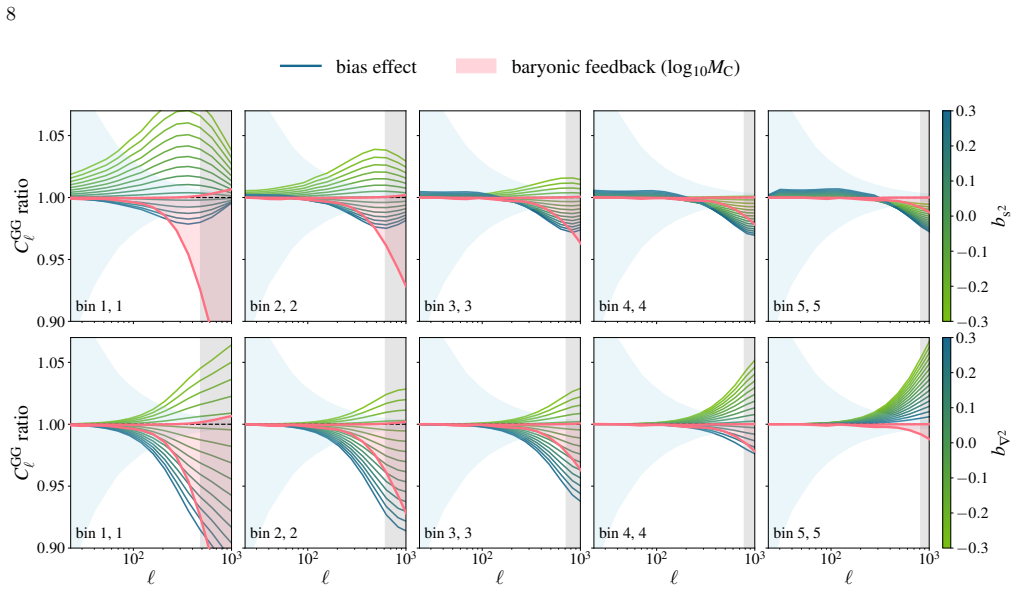
- Higher-order bias can mimic baryonic suppression on galaxy-matter and galaxy-galaxy power spectra, while baryons cannot span the full range of higher-order bias effects.
- Total neutrino mass M_nu can be detected for Y1 and Y10 data when k>=0.3 h/Mpc under the assumption of known photo-z uncertainties.
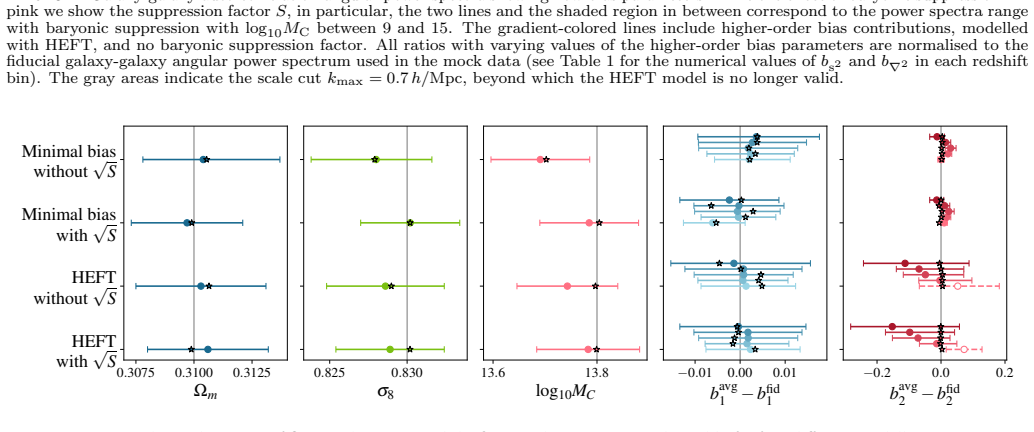
- The measured value of M_nu shifts substantially when the minimal bias model is adopted instead of the full HEFT model.
Where Pith is reading between the lines
- Analyses that fix higher-order bias terms may need extra validation against mocks that vary both bias and baryon parameters simultaneously.
- The sensitivity of M_nu to bias model choice suggests that future surveys should test multiple bias expansions before claiming a neutrino mass measurement.
- If photo-z nuisance parameters turn out to be less well constrained than assumed, the claimed detectability threshold at k=0.3 h/Mpc would move to larger scales.
- The open-source MGL pipeline introduced here could be applied to other Stage-IV surveys to check whether the same scale-cut and bias-model balance holds.
Load-bearing premise
Photo-z uncertainties and related nuisance parameters are precisely known.
What would settle it
A real LSST data analysis that recovers a statistically different total neutrino mass M_nu when the minimal bias model is replaced by the full HEFT model would show the robustness claim does not hold.
Figures
read the original abstract
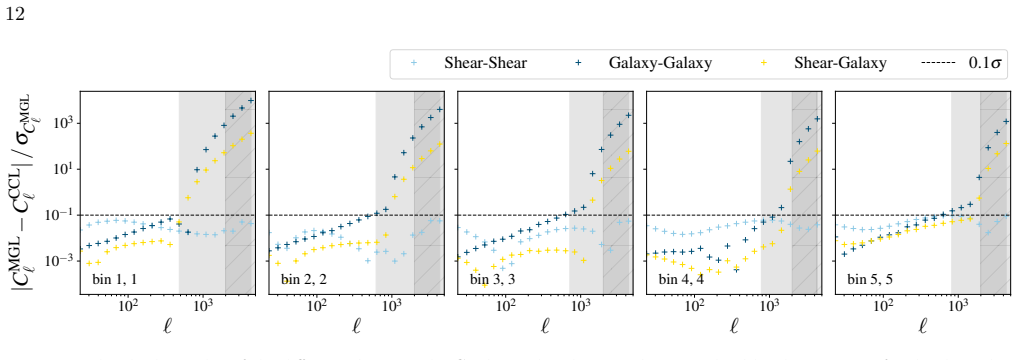
Stage IV surveys such as LSST will probe deeply into the nonlinear regime, where systematic effects from galaxy bias and baryonic feedback become dominant and poorly constrained nuisance parameters can lead to degeneracies. In this work we present a $3\times2$pt analysis for LSST Y1 and Y10 data using the BACCO emulator for modelling both the hybrid-effective field theory (HEFT) for nonlinear galaxy bias and the baryonic feedback using the baryonification mechanism. We aim to find a balance between model complexity and scale cuts, with particular attention to parameter degeneracies and baryonic feedback effects on the galaxy--matter and galaxy--galaxy power spectra. First, we find that a linear bias model delivers percent-level, unbiased constraints on $\Omega_{\rm m}$ and $\sigma_8$ only up to $k_{\rm max}=0.1\,h/$Mpc, but pushing to smaller scales requires a perturbative approach. Second, we compare HEFT with a minimal bias variant with fixed higher-order terms, and find that the latter is unbiased in $\Lambda$CDM even at $k_{\rm max}=0.7\,h/$Mpc. We show that higher-order bias can mimic baryonic suppression, but baryons cannot reproduce the full range of higher-order bias behaviour. Third, we find that a detection of the total neutrino mass $M_\nu$ is possible for both Y1 and Y10 for $k\geq0.3\,h/$Mpc, at least when photo-$z$ uncertainties and related nuisance parameters are precisely known. However, the specific measured value is not robust across equally plausible mock scenarios: the inferred $M_\nu$ can be significantly biased by adopting the minimal bias model. The entire analysis is conducted with a new independent, open source pipeline (MGL) that we present for the first time in this work.
Editorial analysis
A structured set of objections, weighed in public.
Referee Report
Summary. The manuscript presents a 3×2pt analysis for LSST Y1 and Y10 using the BACCO emulator to jointly model HEFT nonlinear galaxy bias and baryonic feedback via baryonification. It compares a linear bias model (unbiased only to k_max=0.1 h/Mpc), full HEFT, and a minimal-bias variant with fixed higher-order terms (claimed unbiased on Ω_m and σ_8 in ΛCDM to k_max=0.7 h/Mpc). It reports that higher-order bias can mimic baryonic suppression but not vice versa, and that M_ν detection is possible for k≥0.3 h/Mpc provided photo-z uncertainties are precisely known, although the inferred M_ν value is not robust and can be biased by the minimal-bias choice. The work introduces a new open-source pipeline (MGL).
Significance. If the central results hold, the paper offers concrete guidance on scale cuts and model complexity for Stage-IV 3×2pt analyses, particularly the interplay between bias, baryons, and neutrinos. The release of the independent MGL pipeline is a clear strength for reproducibility and community use.
major comments (2)
- [Abstract] Abstract (third result paragraph): The claim that a detection of M_ν is possible for both Y1 and Y10 at k≥0.3 h/Mpc is conditioned on photo-z uncertainties and related nuisance parameters being precisely known. This assumption is load-bearing; realistic marginalization over photo-z shifts (which enter the lensing and clustering kernels) can reintroduce degeneracies with M_ν, bias, and baryonic suppression. The minimal-bias model already produces significant M_ν biases across mocks, so the detection significance is not demonstrated to be robust once photo-z parameters are varied with LSST-like priors.
- [Abstract] Abstract (second result paragraph): The statement that the minimal-bias variant with fixed higher-order terms is unbiased in ΛCDM even at k_max=0.7 h/Mpc requires explicit quantification of any residual parameter biases (e.g., in a table of posterior means and shifts relative to the input cosmology). If the fixed higher-order coefficients are taken directly from the mock generation, the unbiased result may hold only by construction rather than as a general property of the model.
minor comments (1)
- The manuscript should include a dedicated section or appendix describing the MGL pipeline architecture, validation tests against existing codes, and public repository link to strengthen the reproducibility claim.
Simulated Author's Rebuttal
We thank the referee for their thorough review and constructive comments on our manuscript. We address each major comment below with point-by-point responses. Where appropriate, we will revise the manuscript to incorporate clarifications and additional quantification while preserving the integrity of the presented results.
read point-by-point responses
-
Referee: [Abstract] Abstract (third result paragraph): The claim that a detection of M_ν is possible for both Y1 and Y10 at k≥0.3 h/Mpc is conditioned on photo-z uncertainties and related nuisance parameters being precisely known. This assumption is load-bearing; realistic marginalization over photo-z shifts (which enter the lensing and clustering kernels) can reintroduce degeneracies with M_ν, bias, and baryonic suppression. The minimal-bias model already produces significant M_ν biases across mocks, so the detection significance is not demonstrated to be robust once photo-z parameters are varied with LSST-like priors.
Authors: We agree that the M_ν detection result is explicitly conditioned on photo-z uncertainties being precisely known, as already stated in the abstract. Our analysis isolates the impact of bias modeling and scale cuts under this controlled assumption to provide guidance on model complexity. We acknowledge that realistic marginalization over photo-z shifts with LSST-like priors could reintroduce degeneracies, and the paper already notes that the inferred M_ν value is not robust across bias model choices. We will revise the abstract and discussion to further emphasize this limitation and the sensitivity to nuisance parameter assumptions. revision: partial
-
Referee: [Abstract] Abstract (second result paragraph): The statement that the minimal-bias variant with fixed higher-order terms is unbiased in ΛCDM even at k_max=0.7 h/Mpc requires explicit quantification of any residual parameter biases (e.g., in a table of posterior means and shifts relative to the input cosmology). If the fixed higher-order coefficients are taken directly from the mock generation, the unbiased result may hold only by construction rather than as a general property of the model.
Authors: We will add a new table in the results section that reports the posterior means, 68% uncertainties, and shifts (in units of the posterior standard deviation) for Ω_m, σ_8, and other ΛCDM parameters under the minimal-bias model at k_max=0.7 h/Mpc, relative to the input mock cosmology. This will provide the explicit quantification requested. On the concern of construction: the higher-order coefficients are fixed to fiducial values from the BACCO emulator calibration, not tuned to the specific mocks used in this analysis. We will add clarifying text in the methods section to make this distinction explicit and demonstrate that the result is not by construction. revision: yes
Circularity Check
No significant circularity detected
full rationale
The paper's central claims rest on numerical results from the external BACCO emulator applied to mock catalogs and the new MGL pipeline; no derivation step reduces by construction to a fitted parameter renamed as a prediction, a self-defined quantity, or a load-bearing self-citation chain. The M_nu detection statement is explicitly conditioned on an external assumption (precise photo-z knowledge) rather than derived from quantities internal to the paper's equations. The analysis therefore remains self-contained against external benchmarks and receives the default non-circularity finding.
Axiom & Free-Parameter Ledger
free parameters (1)
- higher-order bias parameters
axioms (2)
- domain assumption The BACCO emulator provides accurate modeling of HEFT galaxy bias and baryonification effects across the relevant scales.
- domain assumption Photo-z uncertainties and related nuisance parameters can be precisely known or controlled.
Reference graph
Works this paper leans on
-
[1]
The Open Journal of Astrophysics , keywords =
The IA Guide: A Breakdown of Intrinsic Alignment Formalisms. The Open Journal of Astrophysics , keywords =. doi:10.21105/astro.2309.08605 , archivePrefix =. 2309.08605 , primaryClass =
-
[2]
Baryonic effects for weak lensing. Part I. Power spectrum and covariance matrix. , keywords =. doi:10.1088/1475-7516/2020/04/019 , archivePrefix =. 1910.11357 , primaryClass =
-
[3]
Baryonic effects for weak lensing. Part II. Combination with X-ray data and extended cosmologies. , keywords =. doi:10.1088/1475-7516/2020/04/020 , archivePrefix =. 1911.08494 , primaryClass =
-
[4]
Stage-IV Cosmic Shear with Modified Gravity and Model-independent Screening. arXiv e-prints , keywords =. doi:10.48550/arXiv.2404.11508 , archivePrefix =. 2404.11508 , primaryClass =
-
[5]
Modelling baryonic physics in future weak lensing surveys
Huang, Hung-Jin and Eifler, Tim and Mandelbaum, Rachel and Dodelson, Scott. Modelling baryonic physics in future weak lensing surveys. Mon. Not. Roy. Astron. Soc. 2019. doi:10.1093/mnras/stz1714. arXiv:1809.01146
-
[6]
Dark energy constraints from cosmic shear power spectra: impact of intrinsic alignments on photometric redshift requirements. New Journal of Physics , keywords =. doi:10.1088/1367-2630/9/12/444 , archivePrefix =. 0705.0166 , primaryClass =
work page internal anchor Pith review Pith/arXiv arXiv doi:10.1088/1367-2630/9/12/444
-
[7]
The halo model as a versatile tool to predict intrinsic alignments. , keywords =. doi:10.1093/mnras/staa3802 , archivePrefix =. 2003.02700 , primaryClass =
-
[8]
The MICE Grand Challenge Lightcone Simulation I: Dark matter clustering
The MICE grand challenge lightcone simulation - I. Dark matter clustering. , keywords =. doi:10.1093/mnras/stv138 , archivePrefix =. 1312.1707 , primaryClass =
work page internal anchor Pith review Pith/arXiv arXiv doi:10.1093/mnras/stv138
-
[9]
James, F. and Roos, M. Minuit: A System for Function Minimization and Analysis of the Parameter Errors and Correlations. Comput. Phys. Commun. 1975. doi:10.1016/0010-4655(75)90039-9
-
[10]
Dark Energy Survey Year 3 Results: Multi-Probe Modeling Strategy and Validation. arXiv e-prints , keywords =. doi:10.48550/arXiv.2105.13548 , archivePrefix =. 2105.13548 , primaryClass =
-
[11]
A 1\. arXiv e-prints , keywords =. doi:10.48550/arXiv.2412.08623 , archivePrefix =. 2412.08623 , primaryClass =
-
[12]
The BACCO simulation project: biased tracers in real space. , keywords =. doi:10.1093/mnras/stad2008 , archivePrefix =. 2101.12187 , primaryClass =
-
[13]
Priors on Lagrangian bias parameters from galaxy formation modelling. , keywords =. doi:10.1093/mnras/stac1673 , archivePrefix =. 2110.05408 , primaryClass =
-
[14]
The Open Journal of Astrophysics , keywords =
Cosmology with 6 parameters in the Stage-IV era: efficient marginalisation over nuisance parameters. The Open Journal of Astrophysics , keywords =. doi:10.21105/astro.2301.11895 , archivePrefix =. 2301.11895 , primaryClass =
-
[15]
Cosmology from weak lensing alone and implications for the Hubble tension
Hall, Alex. Cosmology from weak lensing alone and implications for the Hubble tension. Mon. Not. Roy. Astron. Soc. 2021. doi:10.1093/mnras/stab1563. arXiv:2104.12880
-
[16]
doi:10.1111/j.1365-2966.2009.15868.x , eprint =
Simulating the Universe with MICE: the abundance of massive clusters. , keywords =. doi:10.1111/j.1365-2966.2009.16194.x , archivePrefix =. 0907.0019 , primaryClass =
-
[17]
Euclid: modelling massive neutrinos in cosmology - a code comparison. , keywords =. doi:10.1088/1475-7516/2023/06/035 , archivePrefix =. 2211.12457 , primaryClass =
-
[18]
Bird, Simeon and Viel, Matteo and Haehnelt, Martin G. Massive Neutrinos and the Non-linear Matter Power Spectrum. Mon. Not. Roy. Astron. Soc. 2012. doi:10.1111/j.1365-2966.2011.20222.x. arXiv:1109.4416
-
[19]
Hannestad, Steen and Upadhye, Amol and Wong, Yvonne Y. Y. Spoon or slide? The non-linear matter power spectrum in the presence of massive neutrinos. JCAP. 2020. doi:10.1088/1475-7516/2020/11/062. arXiv:2006.04995
-
[20]
Neutrino masses and beyond-$\Lambda$CDM cosmology with LSST and future CMB experiments
Mishra-Sharma, Siddharth and Alonso, David and Dunkley, Joanna. Neutrino masses and beyond- CDM cosmology with LSST and future CMB experiments. Phys. Rev. D. 2018. doi:10.1103/PhysRevD.97.123544. arXiv:1803.07561
work page internal anchor Pith review Pith/arXiv arXiv doi:10.1103/physrevd.97.123544 2018
-
[21]
DESI and other dark energy experiments in the era of neutrino mass measurements
Font-Ribera, Andreu and McDonald, Patrick and Mostek, Nick and Reid, Beth A. and Seo, Hee-Jong and Slosar, An. DESI and other dark energy experiments in the era of neutrino mass measurements. JCAP. 2014. doi:10.1088/1475-7516/2014/05/023. arXiv:1308.4164
work page internal anchor Pith review Pith/arXiv arXiv doi:10.1088/1475-7516/2014/05/023 2014
-
[22]
The BACCO simulation project: a baryonification emulator with neural networks. , keywords =. doi:10.1093/mnras/stab1911 , archivePrefix =. 2011.15018 , primaryClass =
-
[23]
Simulations and symmetries. , keywords =. doi:10.1093/mnras/staa251 , archivePrefix =. 1910.07097 , primaryClass =
-
[24]
Large-scale galaxy bias. , keywords =. doi:10.1016/j.physrep.2017.12.002 , archivePrefix =. 1611.09787 , primaryClass =
work page internal anchor Pith review Pith/arXiv arXiv doi:10.1016/j.physrep.2017.12.002 2017
-
[25]
Extended Limber approximation. , keywords =. doi:10.1103/PhysRevD.78.123506 , archivePrefix =. 0809.5112 , primaryClass =
work page internal anchor Pith review Pith/arXiv arXiv doi:10.1103/physrevd.78.123506
-
[26]
, year = 1953, month = jan, volume =
The Analysis of Counts of the Extragalactic Nebulae in Terms of a Fluctuating Density Field. , year = 1953, month = jan, volume =. doi:10.1086/145672 , adsurl =
-
[27]
Nonlinear perturbation theory with halo bias and redshift-space distortions via the Lagrangian picture. , keywords =. doi:10.1103/PhysRevD.78.083519 , archivePrefix =. 0807.1733 , primaryClass =
work page internal anchor Pith review Pith/arXiv arXiv doi:10.1103/physrevd.78.083519
-
[28]
The cosmology dependence of galaxy clustering and lensing from a hybrid N-body-perturbation theory model. , keywords =. doi:10.1093/mnras/stab1358 , archivePrefix =. 2101.11014 , primaryClass =
-
[29]
Hefty enhancement of cosmological constraints from the DES Y1 data using a hybrid effective field theory approach to galaxy bias. , keywords =. doi:10.1088/1475-7516/2021/09/020 , archivePrefix =. 2103.09820 , primaryClass =
-
[30]
The Open Journal of Astrophysics , keywords =
Baryon-free S 8 tension with Stage IV cosmic shear surveys. The Open Journal of Astrophysics , keywords =. doi:10.33232/001c.129965 , archivePrefix =. 2410.18191 , primaryClass =
-
[31]
A new method to quantify the effects of baryons on the matter power spectrum
A new method to quantify the effects of baryons on the matter power spectrum. , keywords =. doi:10.1088/1475-7516/2015/12/049 , archivePrefix =. 1510.06034 , primaryClass =
work page internal anchor Pith review Pith/arXiv arXiv doi:10.1088/1475-7516/2015/12/049 2015
-
[32]
Figure of merit for dark energy constraints from current observational data. Phys. Rev. D. doi:10.1103/PhysRevD.77.123525 , archivePrefix =. 0803.4295 , primaryClass =
work page internal anchor Pith review Pith/arXiv arXiv doi:10.1103/physrevd.77.123525
-
[33]
Baryonification: An alternative to hydrodynamical simulations for cosmological studies. arXiv e-prints , keywords =. doi:10.48550/arXiv.2507.07892 , archivePrefix =. 2507.07892 , primaryClass =
-
[34]
Calibrating baryonic effects in cosmic shear with external data in the LSST era. arXiv e-prints , keywords =. doi:10.48550/arXiv.2506.11943 , archivePrefix =. 2506.11943 , primaryClass =
-
[35]
Clustering of dark matter tracers: generalizing bias for the coming era of precision LSS
Clustering of dark matter tracers: generalizing bias for the coming era of precision LSS. , keywords =. doi:10.1088/1475-7516/2009/08/020 , archivePrefix =. 0902.0991 , primaryClass =
work page internal anchor Pith review Pith/arXiv arXiv doi:10.1088/1475-7516/2009/08/020 2009
-
[36]
Biasing and Hierarchical Statistics in Large-scale Structure
Biasing and Hierarchical Statistics in Large-Scale Structure. , keywords =. doi:10.1086/173015 , archivePrefix =. astro-ph/9302009 , primaryClass =
work page internal anchor Pith review Pith/arXiv arXiv doi:10.1086/173015
-
[37]
Gravity and Large-Scale Non-local Bias
Gravity and large-scale nonlocal bias. , keywords =. doi:10.1103/PhysRevD.85.083509 , archivePrefix =. 1201.3614 , primaryClass =
work page internal anchor Pith review Pith/arXiv arXiv doi:10.1103/physrevd.85.083509
-
[38]
Evidence for Quadratic Tidal Tensor Bias from the Halo Bispectrum
Evidence for quadratic tidal tensor bias from the halo bispectrum. , keywords =. doi:10.1103/PhysRevD.86.083540 , archivePrefix =. 1201.4827 , primaryClass =
work page internal anchor Pith review Pith/arXiv arXiv doi:10.1103/physrevd.86.083540
-
[39]
Halo Stochasticity from Exclusion and non-linear Clustering
Halo stochasticity from exclusion and nonlinear clustering. , keywords =. doi:10.1103/PhysRevD.88.083507 , archivePrefix =. 1305.2917 , primaryClass =
work page internal anchor Pith review Pith/arXiv arXiv doi:10.1103/physrevd.88.083507
-
[40]
Testing one-loop galaxy bias: Power spectrum. , keywords =. doi:10.1103/PhysRevD.102.103530 , archivePrefix =. 2006.09729 , primaryClass =
-
[41]
Precision measurement of the local bias of dark matter halos
Precision measurement of the local bias of dark matter halos. , keywords =. doi:10.1088/1475-7516/2016/02/018 , archivePrefix =. 1511.01096 , primaryClass =
work page internal anchor Pith review Pith/arXiv arXiv doi:10.1088/1475-7516/2016/02/018 2016
-
[42]
Weak lensing and dark energy: the impact of dark energy on nonlinear dark matter clustering
Weak lensing and dark energy: The impact of dark energy on nonlinear dark matter clustering. , keywords =. doi:10.1103/PhysRevD.80.023003 , archivePrefix =. 0904.4697 , primaryClass =
work page internal anchor Pith review Pith/arXiv arXiv doi:10.1103/physrevd.80.023003
-
[43]
Biased Dark Energy Constraints from Neglecting Reduced Shear in Weak Lensing Surveys
Biased Dark Energy Constraints from Neglecting Reduced Shear in Weak-Lensing Surveys. , keywords =. doi:10.1088/0004-637X/696/1/775 , archivePrefix =. 0812.0769 , primaryClass =
work page internal anchor Pith review Pith/arXiv arXiv doi:10.1088/0004-637x/696/1/775
-
[44]
The Open Journal of Astrophysics , keywords =
The catalog-to-cosmology framework for weak lensing and galaxy clustering for LSST. The Open Journal of Astrophysics , keywords =. doi:10.21105/astro.2212.09345 , archivePrefix =. 2212.09345 , primaryClass =
-
[45]
Constraints on Neutrino Physics from DESI DR2 BAO and DR1 Full Shape
Constraints on Neutrino Physics from DESI DR2 BAO and DR1 Full Shape. arXiv e-prints , keywords =. doi:10.48550/arXiv.2503.14744 , archivePrefix =. 2503.14744 , primaryClass =
work page internal anchor Pith review Pith/arXiv arXiv doi:10.48550/arxiv.2503.14744
-
[46]
DESI 2024 VI: Cosmological Constraints from the Measurements of Baryon Acoustic Oscillations
DESI 2024 VI: cosmological constraints from the measurements of baryon acoustic oscillations. , keywords =. doi:10.1088/1475-7516/2025/02/021 , archivePrefix =. 2404.03002 , primaryClass =
work page internal anchor Pith review Pith/arXiv arXiv doi:10.1088/1475-7516/2025/02/021 2024
-
[47]
DESI DR2 Results II: Measurements of Baryon Acoustic Oscillations and Cosmological Constraints
DESI DR2 Results II: Measurements of Baryon Acoustic Oscillations and Cosmological Constraints. arXiv e-prints , keywords =. doi:10.48550/arXiv.2503.14738 , archivePrefix =. 2503.14738 , primaryClass =
work page internal anchor Pith review Pith/arXiv arXiv doi:10.48550/arxiv.2503.14738
-
[48]
Nonlinear perturbation theory integrated with nonlocal bias, redshift-space distortions, and primordial non-Gaussianity. , keywords =. doi:10.1103/PhysRevD.83.083518 , archivePrefix =. 1102.4619 , primaryClass =
work page internal anchor Pith review Pith/arXiv arXiv doi:10.1103/physrevd.83.083518
-
[49]
The LSST Dark Energy Science Collaboration (DESC) Science Requirements Document. arXiv e-prints , keywords =. doi:10.48550/arXiv.1809.01669 , archivePrefix =. 1809.01669 , primaryClass =
-
[50]
Cosmological Non-Linearities as an Effective Fluid
Cosmological non-linearities as an effective fluid. , keywords =. doi:10.1088/1475-7516/2012/07/051 , archivePrefix =. 1004.2488 , primaryClass =
work page internal anchor Pith review Pith/arXiv arXiv doi:10.1088/1475-7516/2012/07/051 2012
-
[51]
The Effective Field Theory of Cosmological Large Scale Structures
The effective field theory of cosmological large scale structures. Journal of High Energy Physics , keywords =. doi:10.1007/JHEP09(2012)082 , archivePrefix =. 1206.2926 , primaryClass =
work page internal anchor Pith review Pith/arXiv arXiv doi:10.1007/jhep09(2012)082 2012
-
[52]
Large-Scale Structure of the Universe and Cosmological Perturbation Theory
Large-scale structure of the Universe and cosmological perturbation theory. , keywords =. doi:10.1016/S0370-1573(02)00135-7 , archivePrefix =. astro-ph/0112551 , primaryClass =
work page internal anchor Pith review Pith/arXiv arXiv doi:10.1016/s0370-1573(02)00135-7
-
[53]
On the Renormalization of the Effective Field Theory of Large Scale Structures
On the renormalization of the effective field theory of large scale structures. , keywords =. doi:10.1088/1475-7516/2013/08/037 , archivePrefix =. 1301.7182 , primaryClass =
work page internal anchor Pith review Pith/arXiv arXiv doi:10.1088/1475-7516/2013/08/037 2013
-
[54]
Perturbation theory for modeling galaxy bias: Validation with simulations of the Dark Energy Survey. , keywords =. doi:10.1103/PhysRevD.102.123522 , archivePrefix =. 2008.05991 , primaryClass =
-
[55]
The Simons Observatory: Science goals and forecasts
The Simons Observatory: science goals and forecasts. , keywords =. doi:10.1088/1475-7516/2019/02/056 , archivePrefix =. 1808.07445 , primaryClass =
work page internal anchor Pith review Pith/arXiv arXiv doi:10.1088/1475-7516/2019/02/056 2019
-
[56]
Galaxy bias in the era of LSST: perturbative bias expansions. , keywords =. doi:10.1088/1475-7516/2024/02/015 , archivePrefix =. 2307.03226 , primaryClass =
-
[57]
Core Cosmology Library: Precision Cosmological Predictions for LSST. , keywords =. doi:10.3847/1538-4365/ab1658 , archivePrefix =. 1812.05995 , primaryClass =
-
[58]
and Amon, Alexandra and Efstathiou, George
Preston, Calvin and Rogers, Keir K. and Amon, Alexandra and Efstathiou, George. Prospects for disentangling dark matter with weak lensing. arXiv e-prints. 2025. arXiv:2505.02233
arXiv 2025
-
[59]
KiDS-1000 methodology: Modelling and inference for joint weak gravitational lensing and spectroscopic galaxy clustering analysis. , keywords =. doi:10.1051/0004-6361/202038831 , archivePrefix =. 2007.01844 , primaryClass =
-
[60]
Intrinsic alignment-lensing interference as a contaminant of cosmic shear
Intrinsic alignment-lensing interference as a contaminant of cosmic shear. , keywords =. doi:10.1103/PhysRevD.70.063526 , archivePrefix =. astro-ph/0406275 , primaryClass =
work page internal anchor Pith review Pith/arXiv arXiv doi:10.1103/physrevd.70.063526
-
[61]
Intrinsic and extrinsic galaxy alignment. , keywords =. doi:10.1046/j.1365-8711.2001.04105.x , archivePrefix =. astro-ph/0005470 , primaryClass =
-
[62]
The Open Journal of Astrophysics , keywords =
Accuracy requirements on intrinsic alignments for Stage-IV cosmic shear. The Open Journal of Astrophysics , keywords =. doi:10.33232/001c.117419 , archivePrefix =. 2311.16812 , primaryClass =
-
[63]
Dark Energy Survey Year 3 results: Cosmology from cosmic shear and robustness to modeling uncertainty. , keywords =. doi:10.1103/PhysRevD.105.023515 , archivePrefix =. 2105.13544 , primaryClass =
-
[64]
Intrinsic alignment from multiple shear estimates: a first application to data and forecasts for stage IV. , keywords =. doi:10.1093/mnras/stae054 , archivePrefix =. 2306.11428 , primaryClass =
-
[65]
KiDS-1000 Cosmology: Multi-probe weak gravitational lensing and spectroscopic galaxy clustering constraints. , keywords =. doi:10.1051/0004-6361/202039063 , archivePrefix =. 2007.15632 , primaryClass =
-
[66]
The fifth data release of the Kilo Degree Survey: Multi-epoch optical/NIR imaging covering wide and legacy-calibration fields. , keywords =. doi:10.1051/0004-6361/202346730 , archivePrefix =. 2503.19439 , primaryClass =
-
[67]
Dark Energy Survey Year 3 Results: Cosmological Constraints from Galaxy Clustering and Weak Lensing
Dark Energy Survey Year 3 results: Cosmological constraints from galaxy clustering and weak lensing. , keywords =. doi:10.1103/PhysRevD.105.023520 , archivePrefix =. 2105.13549 , primaryClass =
work page internal anchor Pith review Pith/arXiv arXiv doi:10.1103/physrevd.105.023520
-
[68]
Third data release of the Hyper Suprime-Cam Subaru Strategic Program. , keywords =. doi:10.1093/pasj/psab122 , archivePrefix =. 2108.13045 , primaryClass =
-
[69]
Euclid: I. Overview of the Euclid mission. , keywords =. doi:10.1051/0004-6361/202450810 , archivePrefix =. 2405.13491 , primaryClass =
-
[70]
The FLAMINGO project: cosmological hydrodynamical simulations for large-scale structure and galaxy cluster surveys. , keywords =. doi:10.1093/mnras/stad2419 , archivePrefix =. 2306.04024 , primaryClass =
-
[71]
doi:10.1111/j.1365-2966.2009.15868.x , eprint =
The physics driving the cosmic star formation history. , keywords =. doi:10.1111/j.1365-2966.2009.16029.x , archivePrefix =. 0909.5196 , primaryClass =
-
[72]
The BAHAMAS project: Calibrated hydrodynamical simulations for large-scale structure cosmology
The BAHAMAS project: calibrated hydrodynamical simulations for large-scale structure cosmology. , keywords =. doi:10.1093/mnras/stw2792 , archivePrefix =. 1603.02702 , primaryClass =
work page internal anchor Pith review Pith/arXiv arXiv doi:10.1093/mnras/stw2792
-
[73]
Quantifying baryon effects on the matter power spectrum and the weak lensing shear correlation
Quantifying baryon effects on the matter power spectrum and the weak lensing shear correlation. , keywords =. doi:10.1088/1475-7516/2019/03/020 , archivePrefix =. 1810.08629 , primaryClass =
work page internal anchor Pith review Pith/arXiv arXiv doi:10.1088/1475-7516/2019/03/020 2019
-
[74]
Modelling the large-scale mass density field of the universe as a function of cosmology and baryonic physics. , keywords =. doi:10.1093/mnras/staa1478 , archivePrefix =. 1911.08471 , primaryClass =
-
[75]
Planck 2018 results. VI. Cosmological parameters. , keywords =. doi:10.1051/0004-6361/201833910 , archivePrefix =. 1807.06209 , primaryClass =
work page internal anchor Pith review Pith/arXiv arXiv doi:10.1051/0004-6361/201833910 2018
-
[76]
FAST-PT: a novel algorithm to calculate convolution integrals in cosmological perturbation theory
FAST-PT: a novel algorithm to calculate convolution integrals in cosmological perturbation theory. , keywords =. doi:10.1088/1475-7516/2016/09/015 , archivePrefix =. 1603.04826 , primaryClass =
work page internal anchor Pith review Pith/arXiv arXiv doi:10.1088/1475-7516/2016/09/015 2016
-
[77]
Consistent modeling of velocity statistics and redshift-space distortions in one-loop perturbation theory. , keywords =. doi:10.1088/1475-7516/2020/07/062 , archivePrefix =. 2005.00523 , primaryClass =
-
[78]
Tomographic galaxy clustering with the Subaru Hyper Suprime-Cam first year public data release. , keywords =. doi:10.1088/1475-7516/2020/03/044 , archivePrefix =. 1912.08209 , primaryClass =
-
[79]
Sensitivity to neutrino parameters
Euclid preparation: LIV. Sensitivity to neutrino parameters. , keywords =. doi:10.1051/0004-6361/202450859 , archivePrefix =. 2405.06047 , primaryClass =
-
[80]
NAUTILUS: boosting Bayesian importance nested sampling with deep learning. , keywords =. doi:10.1093/mnras/stad2441 , archivePrefix =. 2306.16923 , primaryClass =
discussion (0)
Sign in with ORCID, Apple, or X to comment. Anyone can read and Pith papers without signing in.