A Processing Workflow for Cassini VIMS Jupiter Cubes
Pith reviewed 2026-06-27 11:52 UTC · model grok-4.3
The pith
A processing workflow turns raw Cassini VIMS Jupiter cubes into a uniform calibrated public catalog.
A machine-rendered reading of the paper's core claim, the machinery that carries it, and where it could break.
Core claim
The central claim is that a documented sequence of calibration steps, misalignment fixes, and dark-signal corrections applied to the raw VIMS cubes produces radiometrically consistent spectral products whose accuracy is confirmed by internal tests and matches to published reference spectra, resulting in a publicly released catalog suitable for further analysis.
What carries the argument
The processing workflow that converts raw VIMS cubes into calibrated multi-extension FITS files through revised visible and infrared calibrations, pointing corrections, and custom dark-signal strategies.
If this is right
- The catalog supplies a single, documented source of Jupiter spectra that any researcher can use without re-deriving the calibrations.
- Geometric backplanes included with each cube allow direct mapping of spectra onto planetary coordinates for atmospheric studies.
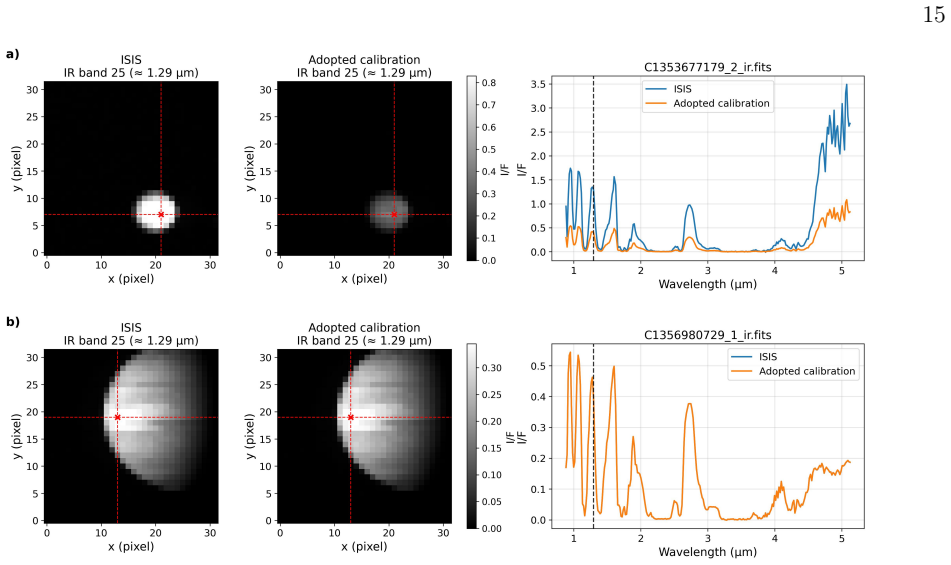
- The revised infrared calibration resolves specific problematic observations that standard pipelines left inconsistent.
- Public release at Zenodo makes the full set of processed cubes immediately available for community use.
Where Pith is reading between the lines
- The same workflow steps could be tested on VIMS data from other targets to check whether the fixes generalize.
- Users could now combine these cubes with later Jupiter observations from other missions to build longer time series without calibration offsets.
- The approach illustrates how targeted post-pipeline corrections can salvage value from archival instrument data that standard pipelines leave incomplete.
Load-bearing premise
That internal consistency tests and matches to independent literature spectra are enough to confirm the accuracy of the final calibrated products.
What would settle it
A systematic mismatch between the new calibrated VIMS spectra and high-resolution spectra of the same Jupiter regions taken by another instrument or from the ground at overlapping wavelengths.
Figures
read the original abstract
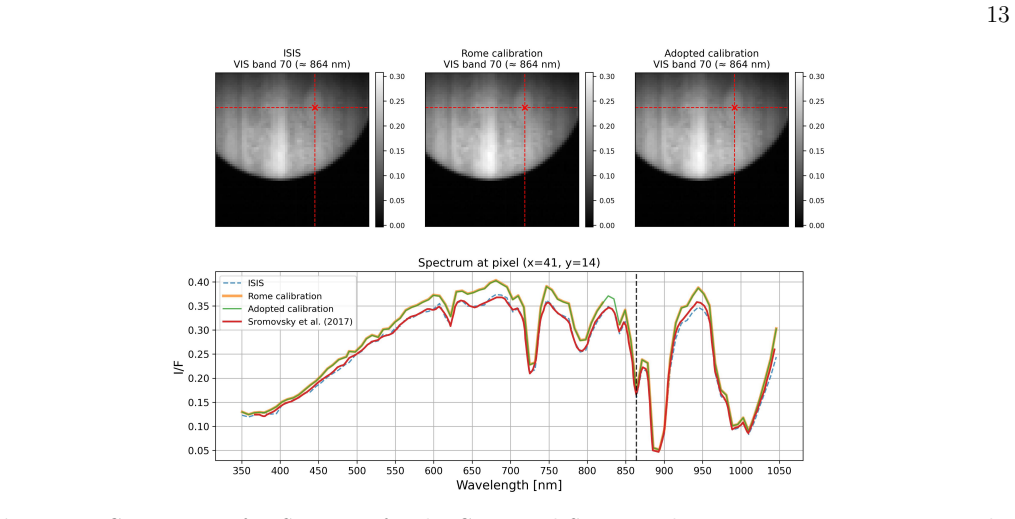
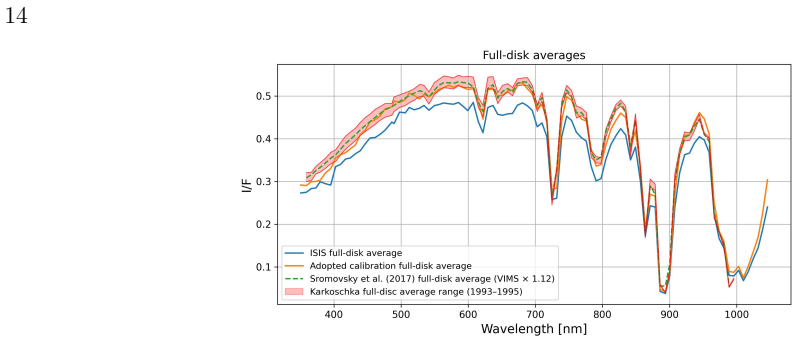
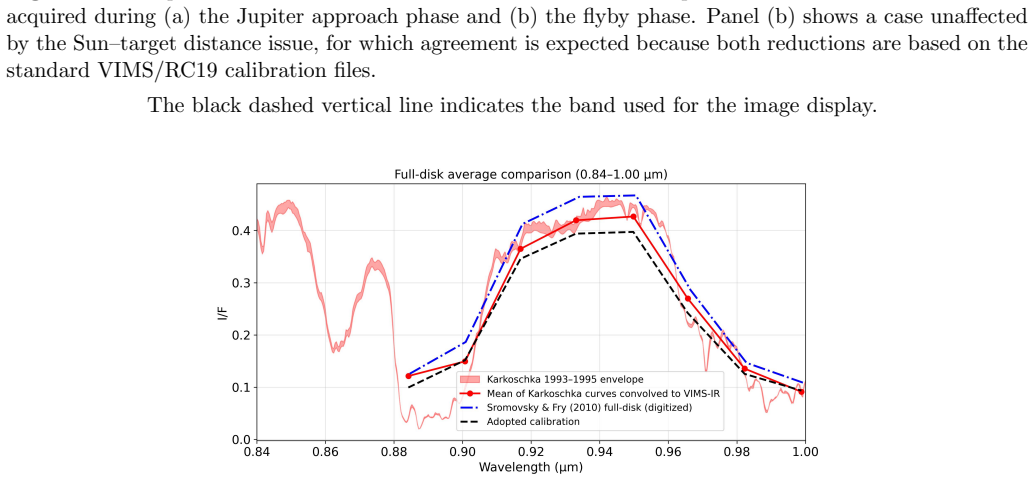
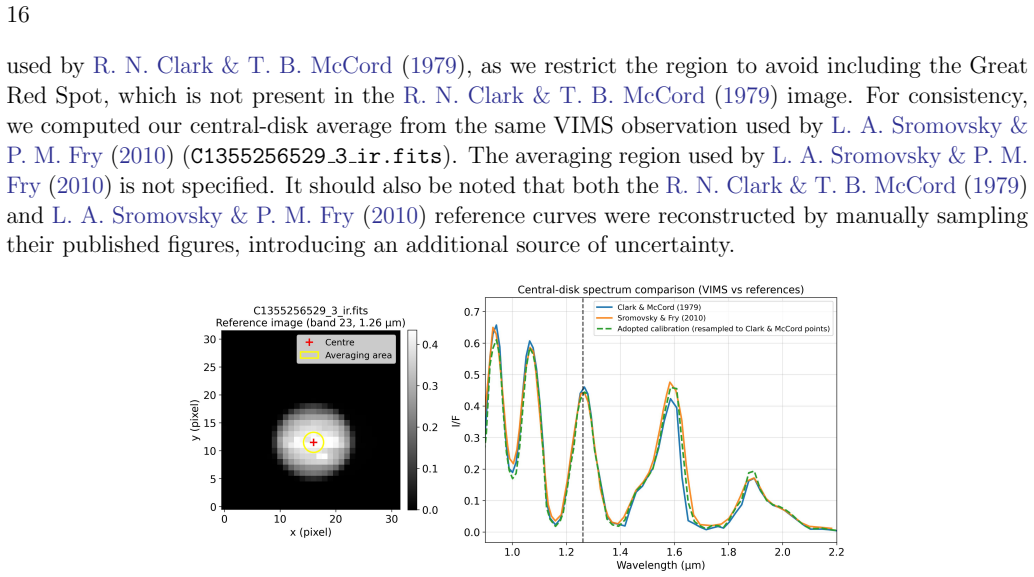
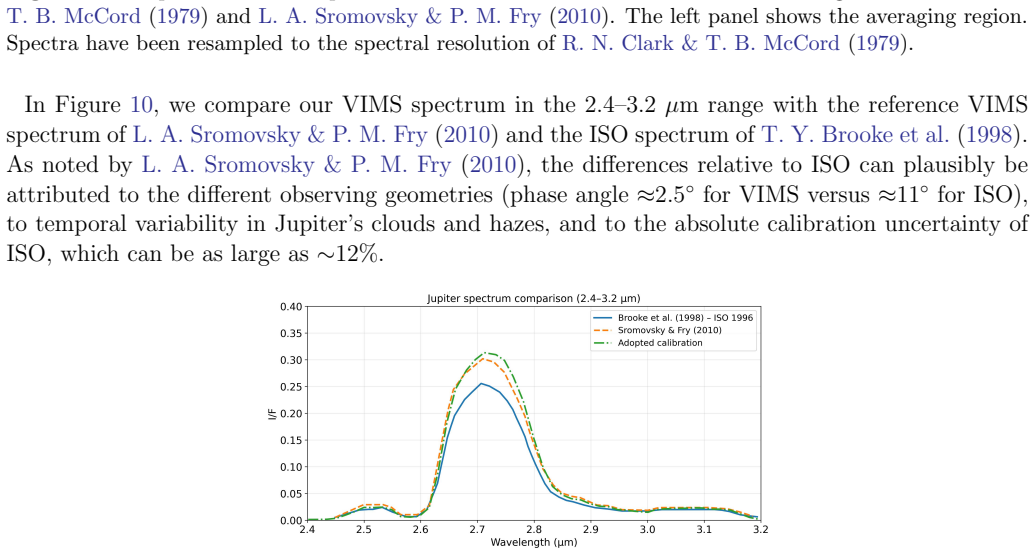
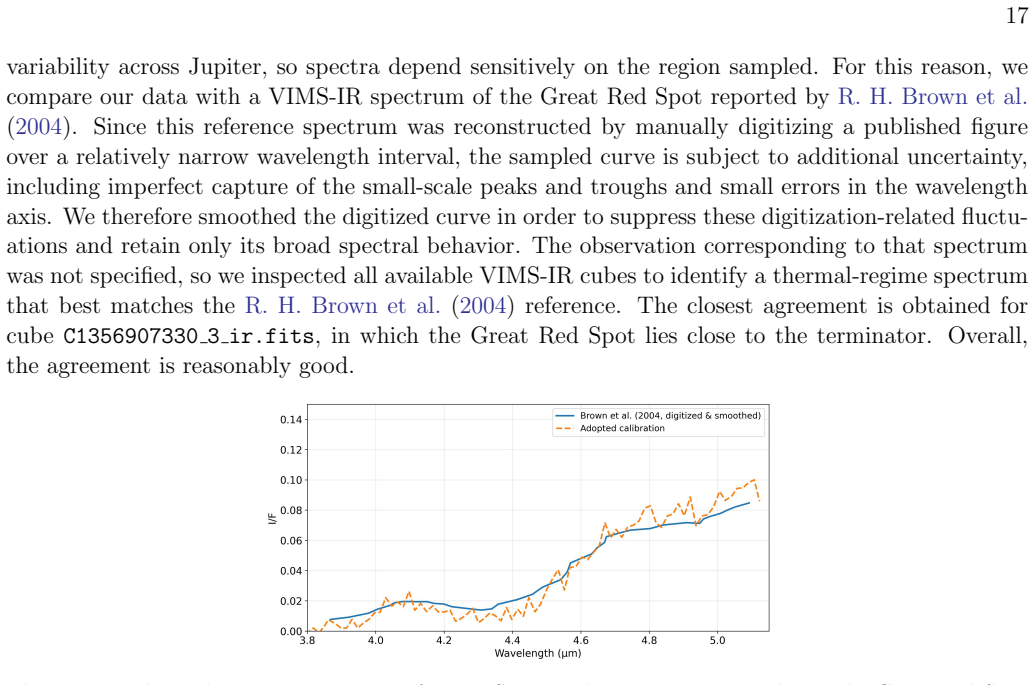
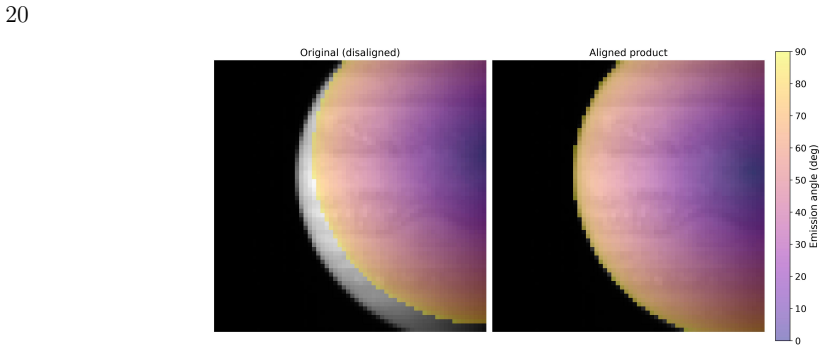
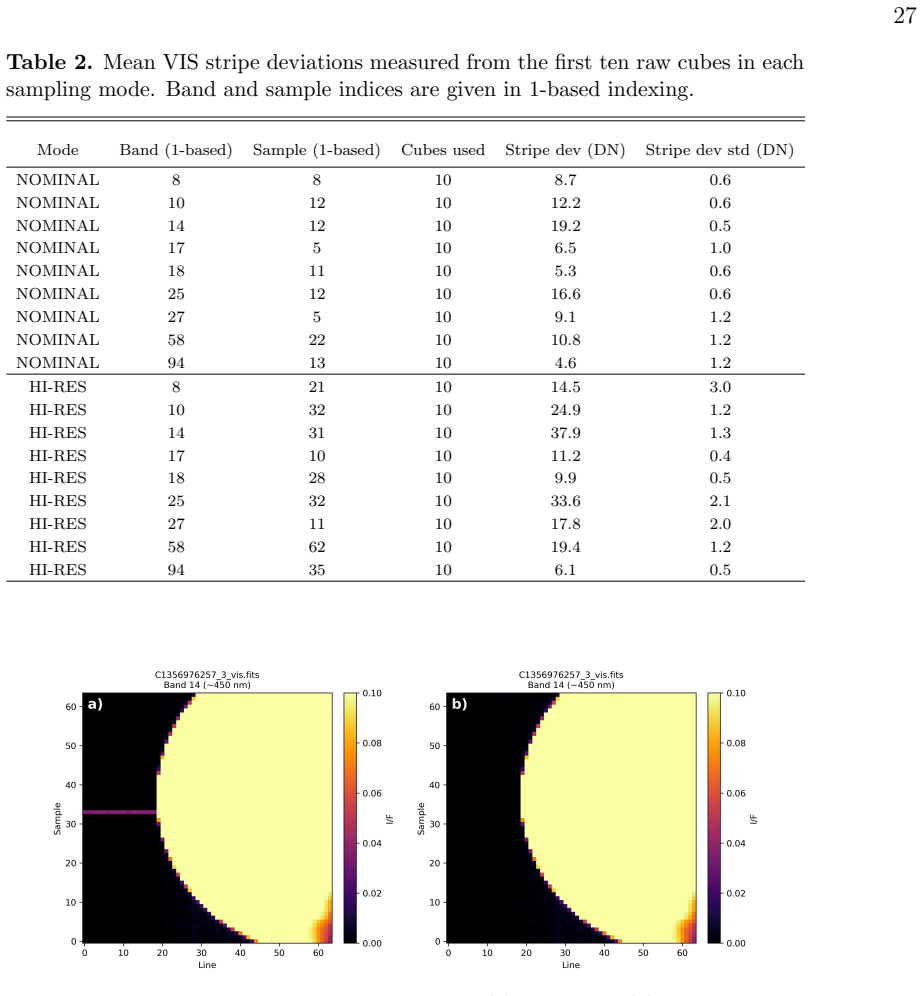
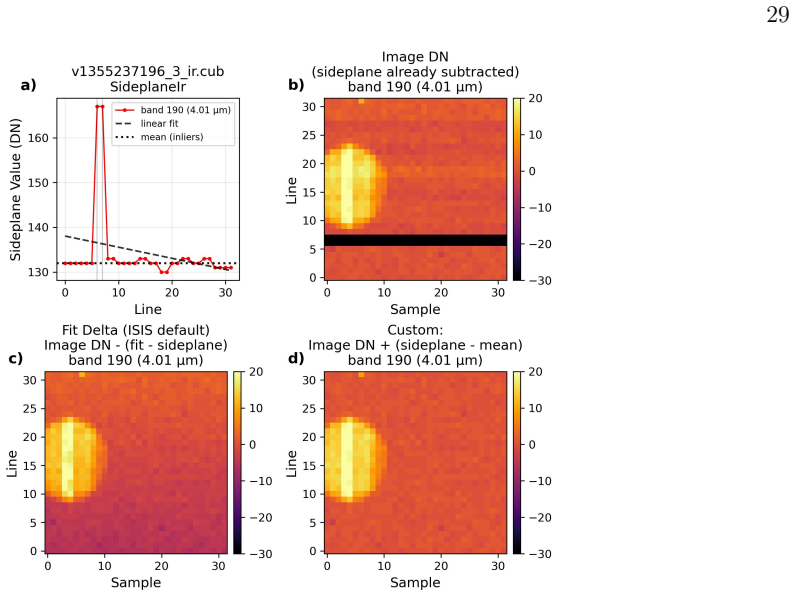
We present a calibrated catalog of Cassini Visible and Infrared Mapping Spectrometer (VIMS) observations of Jupiter, together with the processing workflow used to generate the final publicly available products. Starting from the raw VIMS cubes, the workflow produces radiometrically consistent multi-extension FITS files and includes a revised visible-channel calibration, a revised infrared-channel calibration that resolves a subset of problematic cases not satisfactorily treated by the standard ISIS pipeline, corrections for pointing-related misalignments between spectral cubes and geometric backplanes, and customized dark signal correction strategies. The final products include calibrated spectral cubes together with geometry backplanes and wavelength information for subsequent scientific analysis. We assess the consistency of the calibrated products through internal validation tests and comparisons with independent reference spectra from the literature. The resulting products provide a uniform and validated data set of Cassini VIMS Jupiter observations for community use. The full catalog is available as a public data set at Zenodo: doi:10.5281/zenodo.19223781.
Editorial analysis
A structured set of objections, weighed in public.
Referee Report
Summary. The paper presents a processing workflow for Cassini VIMS Jupiter cubes that starts from raw data and produces radiometrically consistent multi-extension FITS files. Key elements include a revised visible-channel calibration, a revised infrared-channel calibration addressing cases not handled well by the standard ISIS pipeline, corrections for pointing-related misalignments between spectral cubes and geometric backplanes, and customized dark-signal correction strategies. The final products comprise calibrated spectral cubes, geometry backplanes, and wavelength information; consistency is assessed via internal validation tests and comparisons with independent literature reference spectra. The full catalog is released publicly at Zenodo (doi:10.5281/zenodo.19223781).
Significance. If the workflow description is accurate and the reported validations hold, the work supplies a uniform, publicly available dataset that directly addresses documented limitations in the standard ISIS pipeline for VIMS Jupiter observations. This is a useful contribution for the planetary atmospheres community, enabling reproducible analyses without each user having to re-implement the same corrections.
minor comments (2)
- [Abstract] The abstract refers to 'a subset of problematic cases' resolved by the revised IR calibration; quantifying the fraction of cubes affected and describing the selection criteria would improve clarity for readers who wish to assess applicability to their own data.
- [Abstract] The statement that products 'provide a uniform and validated data set' would benefit from an explicit statement of the wavelength range and spatial resolution characteristics of the final catalog to allow immediate comparison with other Jupiter datasets.
Simulated Author's Rebuttal
We thank the referee for their positive assessment of the manuscript and for recommending acceptance. The report contains no major comments requiring response.
Circularity Check
No significant circularity; data-processing workflow paper
full rationale
The paper presents a calibration workflow and public data release for Cassini VIMS Jupiter cubes. Its central claim is the production of calibrated FITS products via described steps (revised calibrations, pointing corrections, dark corrections) plus internal consistency checks against literature spectra. No physical derivation, first-principles prediction, or fitted parameter is advanced whose output is forced by the inputs or by self-citation. Validations are external comparisons and internal tests, not reductions to the workflow itself. This is the expected non-circular outcome for a methods/data-release manuscript.
Axiom & Free-Parameter Ledger
axioms (1)
- domain assumption Standard assumptions in radiometric calibration of spectrometer data hold for the revised procedures.
Reference graph
Works this paper leans on
-
[1]
2018, Planetary and Space Science, 150, 9, doi: https://doi.org/10.1016/j.pss.2017.02.013
Acton, C., Bachman, N., Semenov, B., & Wright, E. 2018, Planetary and Space Science, 150, 9, doi: 10.1016/j.pss.2017.02.013
-
[2]
Acton, C. H. 1996, Planet. Space Sci., 44, 65, doi: 10.1016/0032-0633(95)00107-7
-
[3]
L., & Becker, K
Sucharski, T. L., & Becker, K. J. 2004, in Lunar and Planetary Science Conference, Vol. 35, 2039
2004
-
[4]
Anguiano-Arteaga, A., Irwin, P. G. J., P´ erez-Hoyos, S., Grassi, D., & D’Aversa, E. 2026, Cassini VIMS calibrated VIS and IR cubes for Jupiter, Zenodo, doi: 10.5281/zenodo.19223781 Astropy Collaboration, Price-Whelan, A. M., Lim, P. L., et al. 2022, ApJ, 935, 167, doi: 10.3847/1538-4357/ac7c74
-
[5]
Momary, T. W., & Fry, P. M. 2019, Icarus, 330, 217, doi: 10.1016/j.icarus.2019.04.008
-
[6]
Brooke, T. Y., Knacke, R. F., Encrenaz, T., et al. 1998, Icarus, 136, 1, doi: 10.1006/icar.1998.6013
-
[7]
Lavoie, S. 2005, Cassini Project Visual and Infrared Mapping Spectrometer (VIMS) Archive Volume and Detached Planetary Data System (PDS) Label Software Interface Specification (SIS), Version 1.1, JPL D-31782, IO-AR-009,, Technical report
2005
-
[8]
Brown, R. H., Baines, K. H., Bellucci, G., et al. 2004, Space Sci. Rev., 115, 111, doi: 10.1007/s11214-004-1453-x 30
-
[9]
Hedman, M. M. 2018, The VIMS Wavelength and Radiometric Calibration, Final Report,
2018
-
[10]
Clark, R. N., & McCord, T. B. 1979, Icarus, 40, 180, doi: 10.1016/0019-1035(79)90063-0
-
[11]
Coradini, A., Filacchione, G., Capaccioni, F., et al. 2004, Planet. Space Sci., 52, 661, doi: 10.1016/j.pss.2003.11.005
-
[12]
Coulter, D. J., Barnes, J. W., & Fortney, J. J. 2022, ApJS, 263, 15, doi: 10.3847/1538-4365/ac886a
-
[13]
Filacchione, G. 2006, PhD thesis, Universit` a degli Studi di Napoli “Federico II”, Naples, Italy, doi: 10.6092/UNINA/FEDOA/1462
-
[14]
S., Stopp, D
French, R. S., Stopp, D. J., Chang, Y.-J., et al. 2021, in LPI Contributions, Vol. 2549, Planetary Data Workshop, 7008
2021
-
[15]
Giles, R. S., Fletcher, L. N., & Irwin, P. G. J. 2015, Icarus, 257, 457, doi: 10.1016/j.icarus.2015.05.030
-
[16]
Irwin, P. G. J., Teanby, N. A., de Kok, R., et al. 2008, J. Quant. Spectrosc. Radiat. Transfer, 109, 1136, doi: 10.1016/j.jqsrt.2007.11.006
-
[17]
A., & Mandel, E
Joye, W. A., & Mandel, E. 2003, in ASP Conf. Ser., Vol. 295, Astronomical Data Analysis Software and Systems XII, 489
2003
-
[18]
1994, Icarus, 111, 174, doi: 10.1006/icar.1994.1139
Karkoschka, E. 1994, Icarus, 111, 174, doi: 10.1006/icar.1994.1139
-
[19]
1998, Icarus, 133, 134, doi: 10.1006/icar.1998.5913
Karkoschka, E. 1998, Icarus, 133, 134, doi: 10.1006/icar.1998.5913
-
[20]
Li, L., Baines, K. H., Smith, M. A., et al. 2012, J. Geophys. Res. Planets, 117, E11002, doi: 10.1029/2012JE004191
-
[21]
Matson, D. L., Spilker, L. J., & Lebreton, J.-P. 2002, Space Science Reviews, 104, 1, doi: 10.1023/A:1023609211620
-
[22]
McCord, T. B., Coradini, A., Hibbitts, C. A., et al. 2004, Icarus, 172, 104, doi: 10.1016/j.icarus.2004.07.001
-
[23]
2012, QFitsView: FITS File Viewer, https://www.mpe.mpg.de/∼ott/QFitsView/
Ott, T. 2012, QFitsView: FITS File Viewer, https://www.mpe.mpg.de/∼ott/QFitsView/
2012
-
[24]
Pence, W. D., Chiappetti, L., Page, C. G., Shaw, R. A., & Stobie, E. 2010, Astronomy & Astrophysics, 524, A42, doi: 10.1051/0004-6361/201015362
-
[25]
Carlson, R. W. 2017, Icarus, 291, 232, doi: 10.1016/j.icarus.2016.12.014
-
[26]
Sromovsky, L. A., & Fry, P. M. 2010, Icarus, 210, 230, doi: 10.1016/j.icarus.2010.06.039
-
[27]
S., Melin, H., Miller, S., et al
Stallard, T. S., Melin, H., Miller, S., et al. 2015, J. Geophys. Res. Space Physics, 120, 6948, doi: 10.1002/2015JA021097
-
[28]
Thompson, D. R., Seidel, F. C., Gao, B.-C., et al. 2015, Geophys. Res. Lett., 42, 4114, doi: 10.1002/2015GL063287
discussion (0)
Sign in with ORCID, Apple, or X to comment. Anyone can read and Pith papers without signing in.