Ultra-Soft Ferrimagnetism in a High-Entropy Spinel Oxide Driven by Site-Selective Cation Disorder
Pith reviewed 2026-06-27 12:49 UTC · model grok-4.3
The pith
Site-selective cation disorder in a high-entropy spinel oxide produces ultra-soft ferrimagnetism with 1.8 Oe coercivity at room temperature.
A machine-rendered reading of the paper's core claim, the machinery that carries it, and where it could break.
Core claim
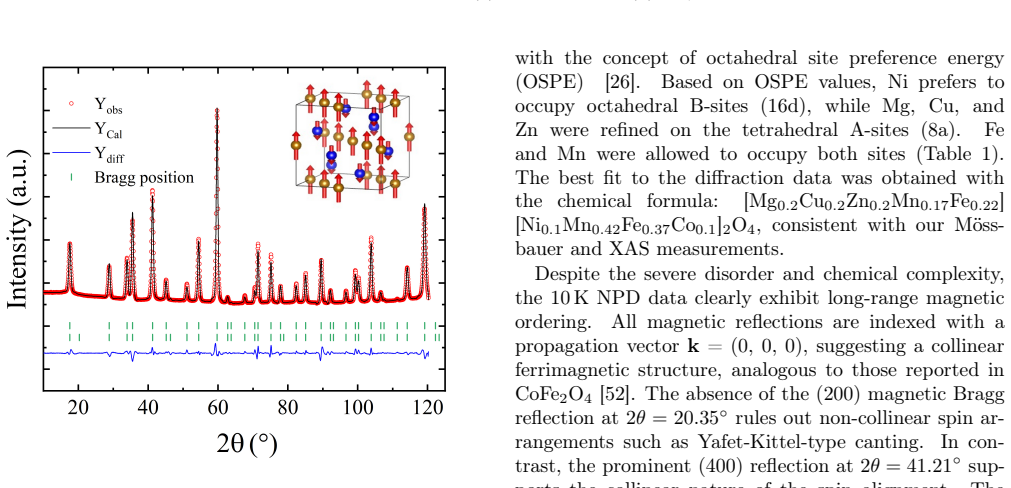
A high-entropy spinel oxide exhibits long-range collinear ferrimagnetic ordering (propagation vector k = 0,0,0) with a Curie temperature of 420 K, yet reaches a room-temperature coercivity of only 1.8 Oe and resistivity of 1560 ohm-cm; the low coercivity is attributed to site-selective cation disorder across tetrahedral and octahedral sites as determined by combined XAS, Mossbauer spectroscopy, and NPD.
What carries the argument
Site-selective cation disorder, the preferential occupation of specific tetrahedral versus octahedral sites by the multiple cations, which reduces magnetic anisotropy while preserving long-range collinear order.
If this is right
- The oxide meets the requirements for low-loss soft-magnetic materials in high-frequency devices because coercivity, ordering temperature, and resistivity are simultaneously favorable.
- Cation site selectivity offers a compositional handle for tuning magnetic softness in other complex spinels without lowering the transition temperature.
- High resistivity reduces eddy-current losses, making the material suitable for applications where conventional soft magnets would dissipate energy.
- The long-range ferrimagnetic order at 420 K ensures the soft response remains usable well above room temperature.
Where Pith is reading between the lines
- The same site-preference mechanism could be tested in other high-entropy spinels to determine whether ultra-soft behavior generalizes beyond this composition.
- Device-level measurements on sintered pellets or thin films would reveal whether the bulk coercivity and resistivity translate to reduced losses under alternating fields.
- If site disorder can be controlled by synthesis conditions, it may provide a route to design families of high-resistivity soft magnets without rare-earth or metallic elements.
Load-bearing premise
The measured low coercivity is caused by the particular cation distribution across sites rather than by other microstructural features such as grain boundaries or secondary phases.
What would settle it
Preparation and magnetic measurement of an otherwise identical high-entropy spinel whose cation site occupancies differ from those reported here but that still shows coercivity near 1.8 Oe at room temperature.
Figures
read the original abstract
High-entropy materials are complex, multifunctional materials that have reshaped the design of advanced functional materials. Their chemically diverse compositions enable access to a broader compositional space than conventional solid solutions, while simultaneously posing significant challenges for fundamental structure property understanding. In this study, we introduce a new highentropy spinel oxide with an exceptionally low coercivity of 1.8 Oe at room temperature, among the lowest reported for bulk spinel oxides, and a high electrical resistivity (1560 ohm-cm). Neutron powder diffraction (NPD) and magnetic measurements reveal long-range collinear ferrimagnetic ordering (k = 0,0,0) with a transition temperature at 420 K. This rare combination of ultra-soft magnetic behavior, robust ferrimagnetic ordering well above room temperature, and high resistivity highlights its strong potential as an advanced soft-magnetic oxide for low-loss, high-frequency applications. Furthermore, X-ray absorption spectroscopy (XAS), Mossbauer spectroscopy, and NPD analyses were combined to determine the cation distribution and site selectivity across the tetrahedral and octahedral sites of the complex structure.
Editorial analysis
A structured set of objections, weighed in public.
Referee Report
Summary. The manuscript reports synthesis of a new high-entropy spinel oxide and its characterization by NPD, magnetometry, XAS, and Mössbauer spectroscopy. It claims room-temperature coercivity of 1.8 Oe (among the lowest for bulk spinels), resistivity of 1560 ohm-cm, long-range collinear ferrimagnetic order (k=0) with Tc=420 K, and attributes the ultra-soft behavior to a specific site-selective cation distribution across tetrahedral and octahedral sites determined from the combined spectroscopies.
Significance. If the reported combination of ultra-low coercivity, high resistivity, and Tc well above room temperature is robustly supported by the data, the result would be of interest for soft-magnetic oxide applications. The experimental identification of cation occupancies in a complex high-entropy spinel is a useful addition to the literature on structure-property relations in these materials.
major comments (2)
- [Discussion / Conclusions] The central claim that site-selective cation disorder drives the ultra-soft ferrimagnetism (title and abstract) rests on correlation: the measured cation distribution (from XAS, Mössbauer, NPD) co-occurs with Hc=1.8 Oe, but no control composition, annealing experiment, or micromagnetic calculation isolates the contribution of this distribution to anisotropy or pinning relative to grain size, oxygen stoichiometry, or average composition. This inference is load-bearing for the title and application claims.
- [Magnetic properties] § on magnetic measurements: the reported Hc=1.8 Oe lacks stated error bars, number of samples measured, or explicit checks for demagnetization effects and sample purity; without these, it is difficult to assess whether the value is reproducible and truly among the lowest reported.
minor comments (2)
- [Abstract] Abstract: 'highentropy' should be hyphenated as 'high-entropy' for consistency with the title.
- [Experimental methods] Figure captions and text should explicitly state the wavelength or energy used for NPD and XAS to allow reproducibility.
Simulated Author's Rebuttal
We thank the referee for the detailed and constructive review. We address the two major comments below and will revise the manuscript accordingly where possible.
read point-by-point responses
-
Referee: [Discussion / Conclusions] The central claim that site-selective cation disorder drives the ultra-soft ferrimagnetism (title and abstract) rests on correlation: the measured cation distribution (from XAS, Mössbauer, NPD) co-occurs with Hc=1.8 Oe, but no control composition, annealing experiment, or micromagnetic calculation isolates the contribution of this distribution to anisotropy or pinning relative to grain size, oxygen stoichiometry, or average composition. This inference is load-bearing for the title and application claims.
Authors: We agree that the attribution of ultra-soft behavior specifically to the site-selective cation distribution is an inference drawn from the correlation between the multi-technique structural data (NPD, XAS, Mössbauer) and the measured magnetic properties. No control samples or micromagnetic simulations were performed to isolate this factor from grain size or stoichiometry effects. In revision we will temper the language in the title, abstract, and discussion to present the site distribution as strongly correlated with the observed low coercivity rather than as the definitively isolated driver, while retaining the structural characterization as a key contribution. revision: partial
-
Referee: [Magnetic properties] § on magnetic measurements: the reported Hc=1.8 Oe lacks stated error bars, number of samples measured, or explicit checks for demagnetization effects and sample purity; without these, it is difficult to assess whether the value is reproducible and truly among the lowest reported.
Authors: We will add the requested details in the revised magnetic-properties section: error bars derived from repeated measurements on multiple independently prepared pellets, the number of samples measured, explicit demagnetization corrections applied to the data, and additional characterization confirming phase purity (e.g., refined impurity limits from NPD). These additions will allow readers to evaluate reproducibility and the comparison to literature values. revision: yes
Circularity Check
No circularity: purely experimental characterization with no derivations
full rationale
The manuscript is an experimental report on synthesis and measurements (NPD, XAS, Mössbauer, magnetometry) of a high-entropy spinel. No equations, fitted parameters renamed as predictions, self-citations used as load-bearing uniqueness theorems, or ansatzes appear in the provided text. All claims rest on direct experimental observations rather than any derivation chain that reduces to its own inputs by construction. The correlational nature of the disorder-to-coercivity link is a separate issue of evidential strength, not circularity.
Axiom & Free-Parameter Ledger
axioms (1)
- domain assumption Spinel oxides can host long-range collinear ferrimagnetic order indexed by propagation vector k = 0,0,0.
Reference graph
Works this paper leans on
-
[1]
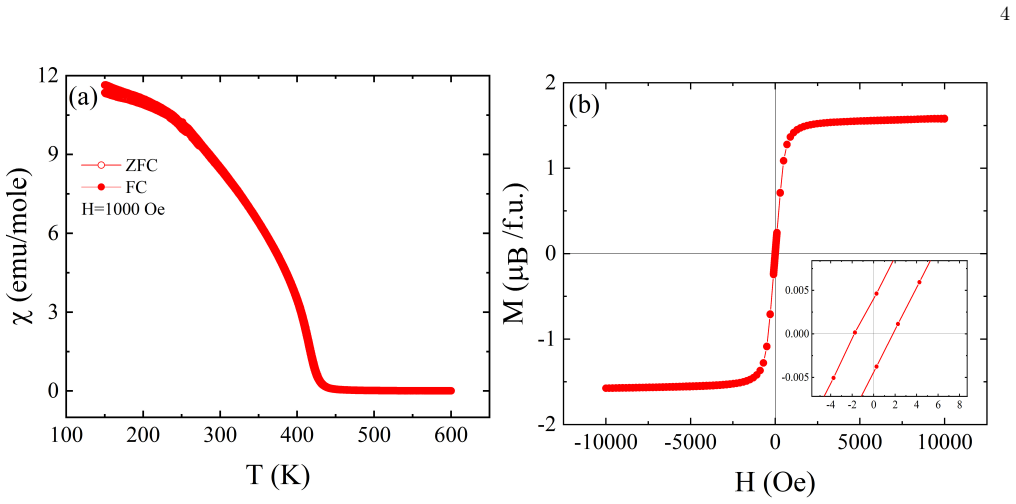
The magnetization exhibits a sharp increase below 420 K, indicative of a long-range ferrimagnetic ordering tran- sition. The sharpness of the magnetic transition suggests a robust collective magnetic state, which may be sta- bilized by the high configurational entropy, as reported in other high-entropy spinel systems [31]. The negligi- ble bifurcation bet...
2021
-
[2]
D. B. Miracle and O. N. Senkov, Acta Materialia, 2017, 122, 448–511
2017
-
[3]
S. S. Aamlid, M. Oudah, J. Rottler and A. M. Hallas, Journal of the American Chemical Society, 2023, 145, 5991–6006. 8
2023
-
[4]
Y. Ye, Q. Wang, J. Lu, C. Liu and Y. Yang, Materials Today, 2016, 19, 349–362
2016
-
[5]
Y. Jiao, J. Dai, Z. Fan, J. Cheng, G. Zheng, L. Grema, J. Zhong, H.-F. Li and D. Wang, Materials Today, 2024
2024
-
[6]
S. Sun, C. Dai, P. Zhao, S. Xi, Y. Ren, H. R. Tan, P. C. Lim, M. Lin, C. Diao, D. Zhang et al., Nature Commu- nications, 2024, 15, 260
2024
-
[7]
R. Das, D. Ghosh, S. Bhattacharya, S. Chowdhury, A. P. Singh, S. Ghosh, A. Gayen and M. M. Seikh, The Journal of Physical Chemistry C, 2024, 128, 14168–14184
2024
-
[8]
C. Rost, E. Sachet, T. Borman, Nature Communications, 2015, 6, 8485
2015
-
[9]
Y. Huo, Z. Wang, Y. Zhang and Y. Wang, International Journal of Minerals, Metallurgy and Materials, 2025, 32, 668–677
2025
-
[10]
Y. Wang, J. Mi and Z.-S. Wu, Chem Catalysis, 2022, 2, 1624– 1656
2022
-
[11]
Schweidler, M
S. Schweidler, M. Botros, F. Strauss, Q. Wang, Y. Ma, L. Velasco, G. Cadilha Marques, A. Sarkar, C. Kübel, H. Hahn et al., Nature Reviews Materials, 2024, 9, 266–281
2024
-
[12]
X. Liu, L. Ding, K. Li, J. Lv, J. Wen, H. Zhang, Y. Wang, Y. Yao and W. Lei, Acta Materialia, 2025, 120812
2025
-
[13]
W. Ji, J. Hou, Y. Miao and C. Ma, Ceramics Interna- tional, 2025, 51, 12951-12962
2025
-
[14]
Y. Mo, Z. Tian, K. Hu, W. Ren, X. Lu, X. Duan and S. Wang, ACS Catalysis, 2025, 15, 5928–5942
2025
-
[15]
Z. Zhao, Z. Ruan, R. Li, S. Yan, X. Sun, C. Liu, D. Zhang, B. Xu, Z. Ren, M. Wang et al., Journal of Mate- rials Science and Technology, 2025, 205, 315–326
2025
-
[16]
G. N. Kotsonis, S. S. Almishal, F. Marques dos San- tos Vieira, V. H. Crespi, I. Dabo, C. M. Rost and J.-P. Maria, Journal of the American Ceramic Society, 2023, 106, 5587–5611
2023
-
[17]
S. Li, B. Wu, S. Wang, M. Jiang, C. Pan, Y. Dong, W. Xu, H. Yu and K. C. Tam, Advanced Materials, 2025, 37, 2406054
2025
-
[18]
Zhang, F
Z. Zhang, F. Zhang, Y. Niu, M. Li, J. Liu and Z. J. Wang, ACS Applied Materials and Interfaces, 2025
2025
-
[19]
L. Duan, Y. Zhang, H. Tang, J. Liao, G. Zhou and X. Zhou, Advanced Materials, 2025, 37, 2411426
2025
-
[20]
J. L. Braun, C. M. Rost, M. Lim, A. Giri, D. H. Olson, G. N. Kotsonis, G. Stan, D. W. Brenner, J.-P. Maria and P. E. Hopkins, Advanced materials, 2018, 30, 1805004
2018
-
[21]
Zhang, W
W. Zhang, W. Zhang, H. Fei, J. Yan, Z. Li, S. Kang, S. Ren, Z. Wang and H. Shui, Fuel, 2025, 380, 133252
2025
-
[22]
Sarkar, P
A. Sarkar, P. K MAnnava, L. Velasco, C. Das, Scripta Materiala, 2022, 207, 114273
2022
-
[23]
Sarkar, D
A. Sarkar, D. Wang, M. V. Kante, L. Eiselt, V. Trouillet, G. Iankevich, Z. Zhao, S. S. Bhattacharya, H. Hahn and R. Kruk, Advanced Materials, 2023, 35, 2207436
2023
-
[24]
Zheng, F
Z. Zheng, F. Zhang, H. Shentu, X. Hu, Q. Wu, M. Pan, N. Yu, J. Fang, H. Ge and H. Yang, Journal of Alloys and Compounds, 2025, 1010, 177632
2025
-
[25]
Mandal, J
S. Mandal, J. Sharma, T. Chakraborty, S. K. Mahatha and S. Marik, Journal of Alloys and Compounds, 2025, 1010, 177993
2025
-
[26]
Musicó, Q
B. Musicó, Q. Wright, T. Z. Ward, A. Grutter, E. Aren- holz, D. Gilbert, D. Mandrus and V. Keppens, Physical Review Materials, 2019, 3, 104416
2019
-
[27]
Sarkar, B
A. Sarkar, B. Eggert, R. Witte, J. Lill, L. Velasco, Q. Wang, J. Sonar, K. Ollefs, S. S. Bhattacharya, R. A. Brand et al., Acta materialia, 2022, 226, 117581. Lett. 77, 3865 (1996)
2022
-
[28]
Huangfu, A
S. Huangfu, A. C. Austin, Z. Guguchia, Ø. S. Fjellvag, A. J. Knorpp, H. Luetkens, A. Schilling and M. Stuer, Inorganic Chemistry, 2023, 63, 247–255
2023
-
[29]
Zhang, Y
M. Zhang, Y. Gao, C. Xie, X. Duan, X. Lu, K. Luo, J. Ye, X. Wang, X. Gao, Q. Niu et al., Nature Communications, 2024, 15, 8306
2024
-
[30]
Z. Chen, B. Ma, C. Dang, J. Song and Y. Zhou, Nano Letters, 2025
2025
-
[31]
L. Min, J. P. Barber, Y. Wang, S. V. Gayathri Ayyagari, G. E. Niculescu, E. Krysko, G. R. Bejger, L. Miao, S. H. Lee, Q. Zhang et al., Journal of the American Chemical Society, 2024, 146, 24320–24329
2024
-
[32]
G. H. Johnstone, M. U. González-Rivas, K. M. Taddei, R. Sutarto, G. A. Sawatzky, R. J. Green, M. Oudah and A. M. Hallas, Journal of the American Chemical Society, 2022, 144, 20590– 20600
2022
-
[33]
Sharma, J
N. Sharma, J. Link, I. Heinmaa, R. Stern, T. Chakrabarty and S. Marik, Applied Physics Letters, 2025, 126
2025
-
[34]
Y. Yin, F. Shi, G.-Q. Liu, X. Tan, J. Jiang, A. Tiwari and B. Li, Applied Physics Letters, 2022, 120, 082404
2022
-
[35]
Sharma, S
N. Sharma, S. Mandal, S. Choudhury, S. K. Mahatha and S. Marik, Scripta Materialia, 2024, 244, 116017
2024
-
[36]
Angelo, L
G. Angelo, L. Klivansky, J. G. Philbrick, T. Kong, J. Zhang and X. Gui, Inorganic Chemistry, 2025
2025
-
[37]
F. Jin, Y. Zhu, L. Li, Z. Pan, D. Pan, M. Gu, Q. Li, L. Chen and H. Wang, Advanced Functional Materials, 2023, 33, 2214273
2023
-
[38]
C. M. Rost, Z. Rak, D. W. Brenner and J.-P. Maria, Journal of the American Ceramic Society, 2017, 100, 2732–2738
2017
-
[39]
M. P. Jimenez-Segura, T. Takayama, D. Bérardan, A. Hoser, M. Reehuis, H. Takagi and N. Dragoe, Applied Physics Letters, 2019, 114
2019
-
[40]
Rák and D
Z. Rák and D. Brenner, Journal of Applied Physics, 2020, 127, 122401
2020
-
[41]
X.Wang, B.L.Musicó, C.Kons, P.C.Metz, V.Keppens, D. A. Gilbert, Y. Zhang and K. Page, APL Materials, 2022, 10
2022
-
[42]
R. K. Mishra, E. Araújo and R. R. Shahi, Journal of Electroceramics, 2024, 1–11
2024
-
[43]
D’Ippolito, G
V. D’Ippolito, G. B. Andreozzi, D. Bersani and P. P. Lottici, Journal of Raman Spectroscopy, 2015, 46, 1255–1264
2015
-
[44]
Sharma, S
N. Sharma, S. Mandal and S. Marik, Ceramics Interna- tional, 2024
2024
-
[45]
Krysko, L
E. Krysko, L. Min, Y. Wang, N. Zhang, J. P. Barber, G. E. Niculescu, J. T. Wright, F. Li, K. Burrage, M. Matsuda et al., APL Materials, 2023, 11, 225001
2023
-
[46]
Hossain, M
M. Hossain, M. Hossain and S. Sikder, Journal of Mag- netism and Magnetic Materials, 2022, 564, 170095
2022
-
[47]
M. N. Rahman and M. A. Hossain, Materials Today Sus- tainability, 2026, 33, 101252
2026
-
[48]
Yasukawa, K
Y. Yasukawa, K. Nozawa, T. Tiittanen, M. Karppinen, J. Lindén, S. E. Shirsath and S. Yabukami, Scientific Re- ports, 2021, 11, 614
2021
-
[49]
M.Gilleo, Journal of Physics and Chemistry of Solids, 1960, 13, 33–39
1960
-
[50]
S.W.Hyun and C.S.Kim, physica status solidi (b), 2007, 244, 4586–4589
2007
-
[51]
Lumetzberger, M
J. Lumetzberger, M. Buchner, S. Pile, V. Ney, W. Gader- bauer, N. Daffé, M. V. Moro, D. Primetzhofer, K. Lenz and A. Ney, Physical Review B, 2020, 102, 054402. 9
2020
-
[52]
Stavitski and F
E. Stavitski and F. M. De Groot, Micron, 2010, 41, 687–694
2010
-
[53]
Teillet, F
J. Teillet, F. Bouree and R. Krishnan, Journal of mag- netism and magnetic materials, 1993, 123, 93–96
1993
discussion (0)
Sign in with ORCID, Apple, or X to comment. Anyone can read and Pith papers without signing in.