Amortized Simulation-Based Inference of Colliding-Wind Binaries from Short, Noisy Image Time Series
Pith reviewed 2026-06-27 11:57 UTC · model grok-4.3
The pith
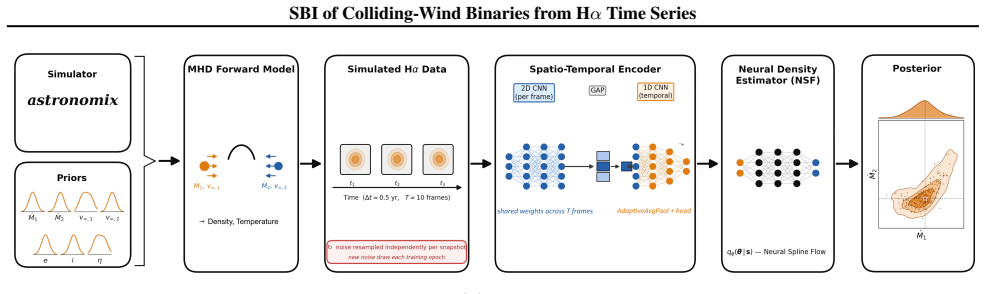
A factorized spatio-temporal neural architecture infers seven physical parameters of colliding-wind binaries from short noisy H-alpha image sequences.
A machine-rendered reading of the paper's core claim, the machinery that carries it, and where it could break.
Core claim
A factorized spatio-temporal architecture that separates spatial encoding from temporal aggregation, when paired with a neural spline flow, enables amortized posterior inference of seven physical parameters from synthetic 10-frame H-alpha photon-count time series of colliding-wind binaries, with the posteriors verified as well-calibrated via TARP and SBC diagnostics.
What carries the argument
The factorized spatio-temporal architecture that separates spatial encoding from temporal aggregation and induces time-translation equivariance in the learned representation.
Load-bearing premise
The hydrodynamic simulations used to generate the training data accurately represent the true emission and morphology of colliding-wind binaries under the observed conditions.
What would settle it
Running the trained model on new synthetic time series generated from hydrodynamic simulations that deliberately alter wind collision morphology or emission physics and checking whether the recovered posteriors remain accurate and calibrated.
Figures
read the original abstract
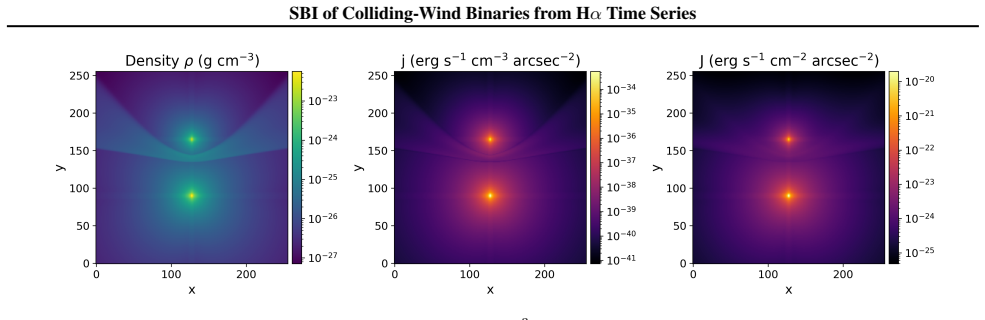
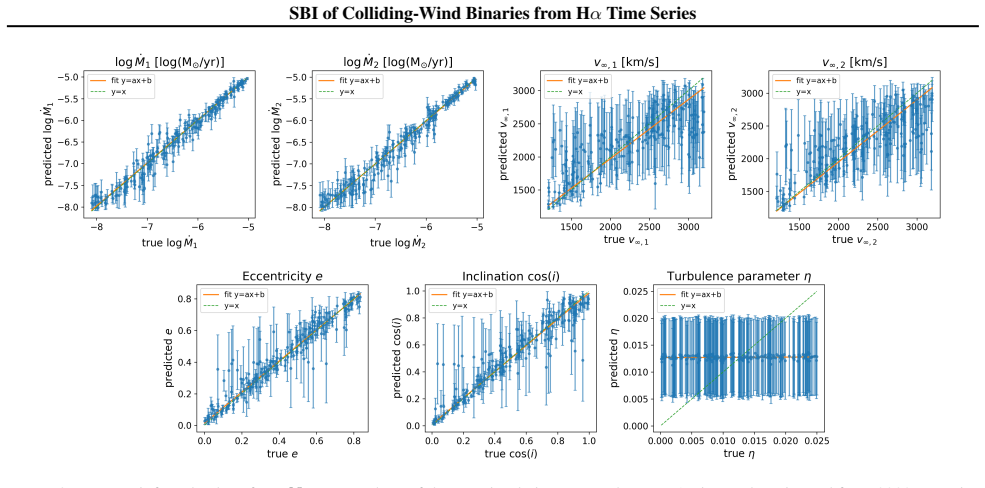
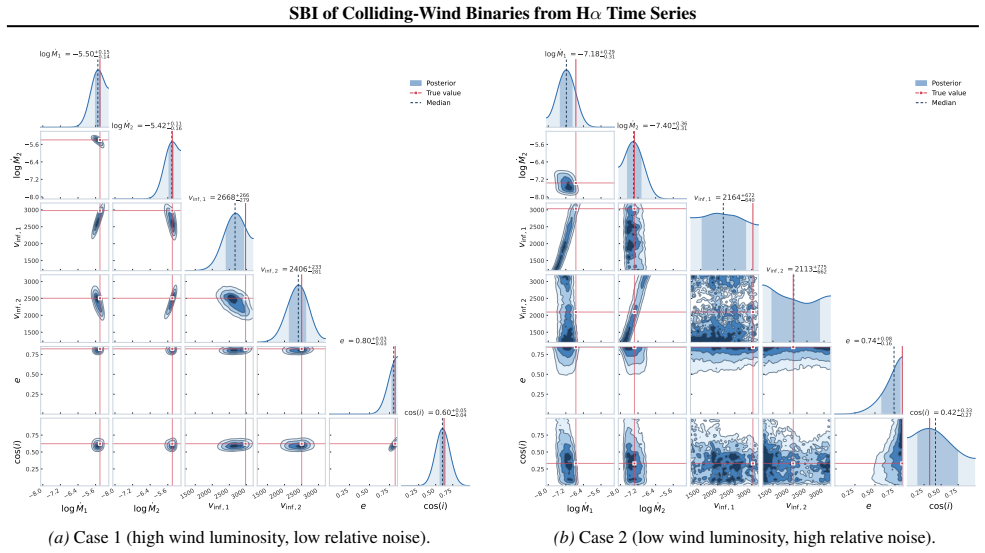
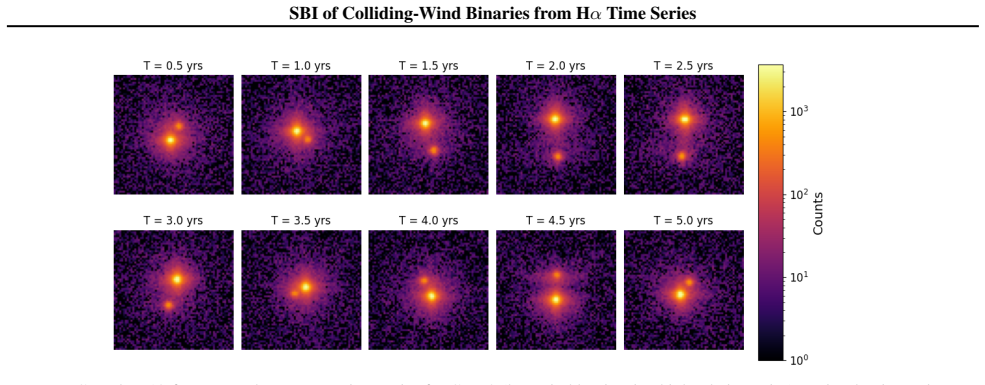
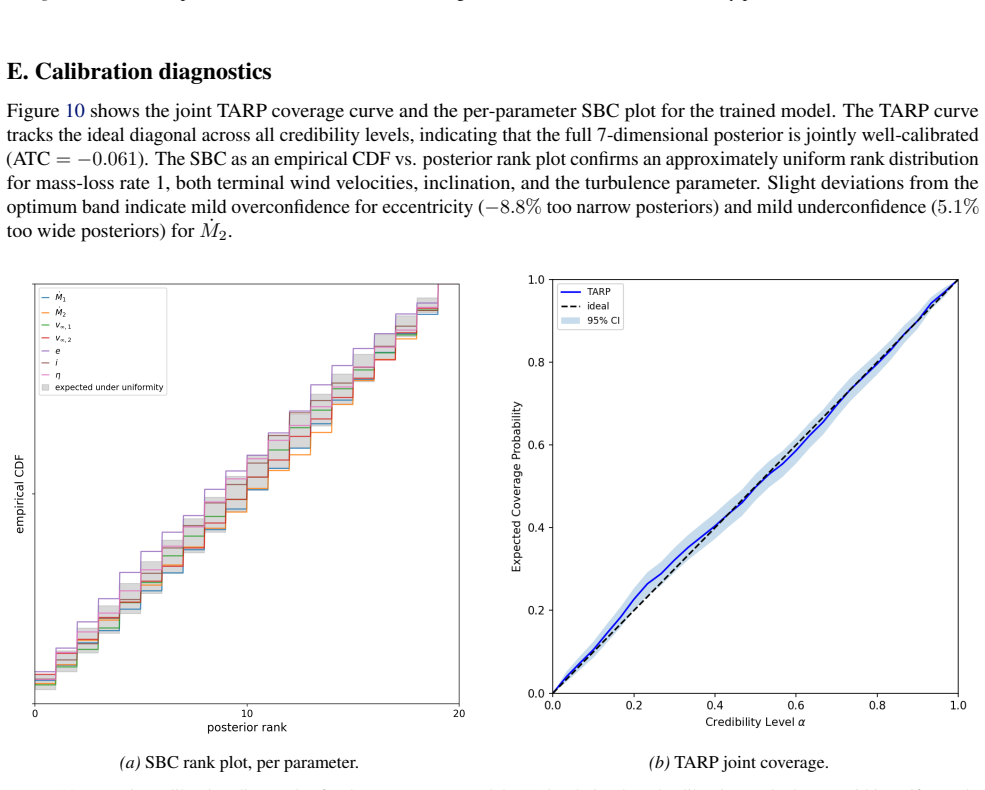
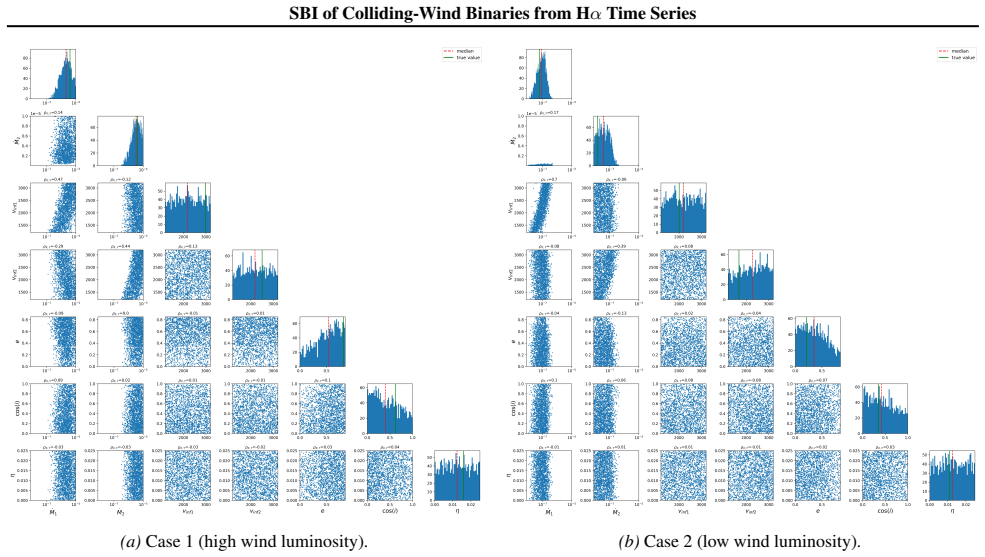
Colliding-wind binaries (CWBs), which are systems of two massive stars whose supersonic winds collide into bow shocks, encode rich information about stellar wind properties in their multi-frequency emission, e.g. images in the H$\alpha$, X-ray, and radio wavelengths. Inferring physical parameters (mass-loss rates, terminal wind velocities, orbital elements) from short time-series observations is a compelling but challenging inverse problem, because the forward hydrodynamic simulator is computationally expensive and the likelihood is intractable. We adopt a factorized spatio-temporal architecture for amortized posterior inference that separates spatial encoding from temporal aggregation. This design aligns with the structure of the underlying physical process of local morphology and global dynamical evolution, induces time-translation equivariance in the learned representation, and improves identifiability in low-signal regimes. Coupled with a neural spline flow conditioned on these spatio-temporal embeddings of 10-frame H$\alpha$ photon-count time series, we present a complete simulation-based inference pipeline for CWBs. Our method jointly infers seven physical parameters from synthetic observations under realistic detector noise, with posteriors verified as well-calibrated via TARP and SBC diagnostics. The approach naturally expands posterior width in information-poor regimes (low photon counts) and robustly recovers orbital parameters and mass-loss rates, demonstrating the feasibility of amortized likelihood-free inference for this challenging astrophysical inverse problem.
Editorial analysis
A structured set of objections, weighed in public.
Referee Report
Summary. The manuscript develops an amortized simulation-based inference pipeline for colliding-wind binaries that uses a factorized spatio-temporal neural architecture (spatial encoding followed by temporal aggregation) to produce embeddings for a neural spline flow. The method jointly infers seven physical parameters from synthetic 10-frame Hα photon-count time series generated by hydrodynamic simulations plus realistic detector noise. Posteriors are reported as well-calibrated on held-out synthetic data according to TARP and SBC diagnostics, with the architecture chosen to induce time-translation equivariance and to widen posteriors in low-signal regimes.
Significance. If the reported calibration on synthetic data holds, the work establishes a feasible amortized SBI approach for an inverse problem whose forward model is computationally expensive and whose likelihood is intractable. The explicit alignment of the network architecture with the separation of local morphology and global orbital evolution is a methodological strength, as is the demonstration that posterior width naturally expands under low photon counts. Because the central claim is confined to performance on data drawn from the same simulation distribution used for training, the result is a solid proof-of-concept for likelihood-free inference in this domain rather than a direct constraint on real observations.
minor comments (2)
- [Methods] The abstract and methods description refer to 'realistic detector noise' without an explicit equation or table specifying the noise model (e.g., Poisson statistics, read noise, or PSF convolution); adding this detail would improve reproducibility.
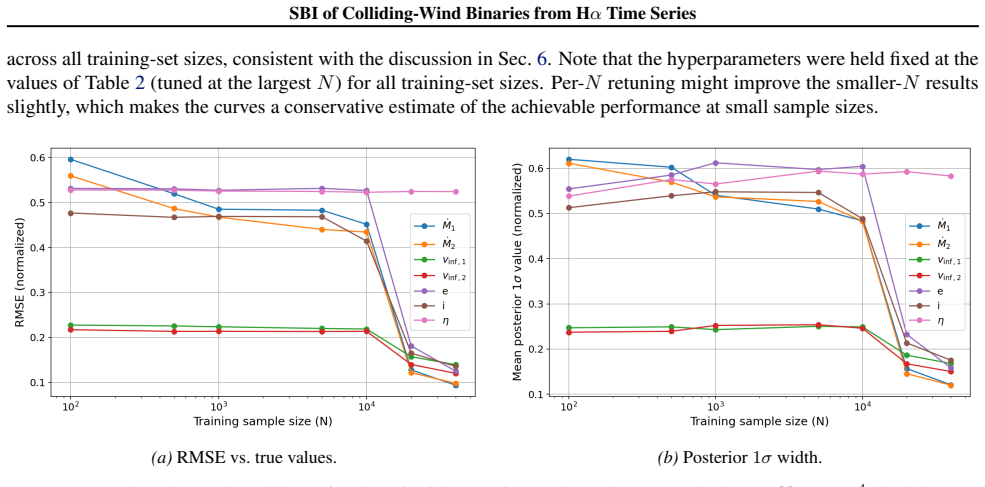
- [Results] The claim that the architecture 'improves identifiability in low-signal regimes' would benefit from a quantitative comparison (e.g., a table of posterior widths or coverage probabilities) against a non-factorized baseline in the results section.
Simulated Author's Rebuttal
We thank the referee for their accurate summary of the manuscript and for recommending minor revision. The assessment correctly identifies the work as a proof-of-concept demonstration of amortized SBI on synthetic data drawn from the training distribution.
Circularity Check
No significant circularity
full rationale
The paper describes an amortized SBI pipeline that trains a spatio-temporal encoder plus neural spline flow on synthetic Hα time series generated from external hydrodynamic simulations, then evaluates posterior calibration on held-out draws from the same simulator using TARP and SBC. The central claim is restricted to recovery of seven parameters under the model's own noise model; no derivation step equates a fitted quantity to a prediction by construction, no uniqueness theorem is imported from self-citation, and no ansatz is smuggled via prior work. The pipeline is therefore self-contained against its stated synthetic benchmark.
Axiom & Free-Parameter Ledger
axioms (1)
- domain assumption Hydrodynamic simulations of colliding winds accurately capture the relevant physics for generating training data
Reference graph
Works this paper leans on
-
[1]
A COMPASS to Model Comparison and Simulation-Based Inference in Galactic Chemical Evolution. arXiv e-prints , keywords =. doi:10.48550/arXiv.2507.05060 , archivePrefix =. 2507.05060 , primaryClass =
-
[2]
FlowSN: Neural Simulation-Based Inference under Realistic Selection Effects applied to Supernova Cosmology. arXiv e-prints , keywords =. doi:10.48550/arXiv.2603.11165 , archivePrefix =. 2603.11165 , primaryClass =
work page internal anchor Pith review Pith/arXiv arXiv doi:10.48550/arxiv.2603.11165
-
[3]
Proceedings of the National Academy of Sciences , volume =
The frontier of simulation-based inference. Proceedings of the National Academy of Science , keywords =. doi:10.1073/pnas.1912789117 , archivePrefix =. 1911.01429 , primaryClass =
-
[4]
Some models are useful, but how do we know which ones? Towards a unified Bayesian model taxonomy. arXiv e-prints , keywords =. doi:10.48550/arXiv.2209.02439 , archivePrefix =. 2209.02439 , primaryClass =
-
[5]
JANA: Jointly Amortized Neural Approximation of Complex Bayesian Models. arXiv e-prints , keywords =. doi:10.48550/arXiv.2302.09125 , archivePrefix =. 2302.09125 , primaryClass =
-
[6]
Emulating Radiative Transfer in Astrophysical Environments. arXiv e-prints , keywords =. doi:10.48550/arXiv.2511.08219 , archivePrefix =. 2511.08219 , primaryClass =
-
[7]
Machine Learning: Science and Technology , keywords =
Robust simulation-based inference in cosmology with Bayesian neural networks. Machine Learning: Science and Technology , keywords =. 2023a , month = mar, volume =. doi:10.1088/2632-2153/acbb53 , archivePrefix =. 2207.08435 , primaryClass =
-
[8]
Flow Matching for Scalable Simulation-Based Inference. Machine Learning for Astrophysics , year = 2023, month = jul, eid =. doi:10.48550/arXiv.2305.17161 , archivePrefix =. 2305.17161 , primaryClass =
-
[9]
CASBI -- Chemical Abundance Simulation-Based Inference for Galactic Archeology. arXiv e-prints , keywords =. doi:10.48550/arXiv.2411.17269 , archivePrefix =. 2411.17269 , primaryClass =
-
[10]
Inferring Galactic parameters from chemical abundances with simulation-based inference. , keywords =. doi:10.1051/0004-6361/202554306 , archivePrefix =. 2503.02456 , primaryClass =
-
[11]
The dynamical memory of tidal stellar streams: Joint inference of the Galactic potential and the progenitor of GD-1 with flow matching. , keywords =. doi:10.1051/0004-6361/202558358 , archivePrefix =. 2512.04600 , primaryClass =
-
[12]
Storcks, Leonard , title =. 2025 , copyright =. doi:10.5281/ZENODO.17782162 , url =
-
[13]
Exact, Algebraic Solutions of the Thin-Shell Two-Wind Interaction Problem. , keywords =. doi:10.1086/177820 , adsurl =
-
[14]
Monthly Notices of the Royal Astronomical Society , volume =
Pejcha, Ondřej and Calderón, Diego and Kurfürst, Petr , title =. Monthly Notices of the Royal Astronomical Society , volume =. 2022 , month =. doi:10.1093/mnras/stab3729 , url =
-
[15]
2023b , eprint=
Sampling-Based Accuracy Testing of Posterior Estimators for General Inference , author=. 2023b , eprint=
-
[16]
arXiv preprint arXiv:1804.06788 , year=
Validating Bayesian inference algorithms with simulation-based calibration , author=. arXiv preprint arXiv:1804.06788 , year=
-
[17]
Proceedings of the Twenty-Second International Conference on Artificial Intelligence and Statistics , pages =
Sequential Neural Likelihood: Fast Likelihood-free Inference with Autoregressive Flows , author =. Proceedings of the Twenty-Second International Conference on Artificial Intelligence and Statistics , pages =. 2019 , editor =
2019
-
[18]
Monthly Notices of the Royal Astronomical Society , volume =
Kochanek, C S , title =. Monthly Notices of the Royal Astronomical Society , volume =. 2019 , month =. doi:10.1093/mnras/sty3363 , url =
-
[19]
2023 , publisher =
Taming rotationally supported disks using state of the art numerical methods , author =. 2023 , publisher =
2023
-
[20]
2024 , eprint=
Differentiable Conservative Radially Symmetric Fluid Simulations and Stellar Winds -- jf1uids , author=. 2024 , eprint=
2024
-
[21]
Townsend, R. H. D. , year=. AN EXACT INTEGRATION SCHEME FOR RADIATIVE COOLING IN HYDRODYNAMICAL SIMULATIONS , volume=. The Astrophysical Journal Supplement Series , publisher=. doi:10.1088/0067-0049/181/2/391 , number=
-
[22]
2025 , eprint=
The Shamrock code: I- Smoothed Particle Hydrodynamics on GPUs , author=. 2025 , eprint=
2025
-
[23]
Aharonian, F. and Ashkar, H. and Backes, M. and Barbosa Martins, V. and Becherini, Y. and Berge, D. and Bi, B. and Böttcher, M. and de Bony de Lavergne, M. and Bradascio, F. and Brose, R. and Brun, F. and Bulik, T. and Burger-Scheidlin, C. and Cangemi, F. and Caroff, S. and Casanova, S. and Cerruti, M. and Chand, T. and Chandra, S. and Chen, A. and Chibue...
-
[24]
2025 , eprint=
Differentiable Cosmological Hydrodynamics for Field-Level Inference and High Dimensional Parameter Constraints , author=. 2025 , eprint=
2025
-
[25]
Thermal emission from bow shocks - I. 2D hydrodynamic models of the Bubble Nebula , DOI= "10.1051/0004-6361/201834832", url= "https://doi.org/10.1051/0004-6361/201834832", journal =
-
[26]
Thermal emission from bow shocks - II. 3D magnetohydrodynamic models of ζ Ophiuchi , DOI= "10.1051/0004-6361/202243531", url= "https://doi.org/10.1051/0004-6361/202243531", journal =
-
[27]
Thermal emission from bow shocks - III. Variable diffuse X-ray emission from stellar-wind bow shocks driven by dynamical instabilities , DOI= "10.1051/0004-6361/202553722", url= "https://doi.org/10.1051/0004-6361/202553722", journal =
-
[28]
Jan Boelts and Michael Deistler and Manuel Gloeckler and Álvaro Tejero-Cantero and Jan-Matthis Lueckmann and Guy Moss and Peter Steinbach and Thomas Moreau and Fabio Muratore and Julia Linhart and Conor Durkan and Julius Vetter and Benjamin Kurt Miller and Maternus Herold and Abolfazl Ziaeemehr and Matthijs Pals and Theo Gruner and Sebastian Bischoff and ...
-
[29]
RAS Techniques and Instruments , volume =
Spurio Mancini, A and Docherty, M M and Price, M A and McEwen, J D , title =. RAS Techniques and Instruments , volume =. 2023 , month =. doi:10.1093/rasti/rzad051 , url =
-
[30]
2018 , eprint=
Masked Autoregressive Flow for Density Estimation , author=. 2018 , eprint=
2018
-
[31]
2018 , eprint=
Fast -free Inference of Simulation Models with Bayesian Conditional Density Estimation , author=. 2018 , eprint=
2018
-
[32]
Proceedings of the 36th International Conference on Machine Learning , pages =
Automatic Posterior Transformation for Likelihood-Free Inference , author =. Proceedings of the 36th International Conference on Machine Learning , pages =. 2019 , editor =
2019
-
[33]
Proceedings of the 25th
Optuna: A Next-generation Hyperparameter Optimization Framework , author=. Proceedings of the 25th
-
[34]
and Pratap, A
Deb, K. and Pratap, A. and Agarwal, S. and Meyarivan, T. , journal=. A fast and elitist multiobjective genetic algorithm: NSGA-II , year=
-
[35]
2019 , eprint=
Neural Spline Flows , author=. 2019 , eprint=
2019
-
[36]
Astrophysics of gaseous nebulae and active galactic nuclei
-
[37]
Seo, Jeongbhin and Ryu, Dongsu , year=. HOW-MHD: A High-order WENO-based Magnetohydrodynamic Code with a High-order Constrained Transport Algorithm for Astrophysical Applications , volume=. The Astrophysical Journal , publisher=. doi:10.3847/1538-4357/acdf4b , number=
-
[38]
Grids of stellar models with rotation - I. Models from 0.8 to 120 M solar metallicity (Z = 0.014) , DOI= "10.1051/0004-6361/201117751", url= "https://doi.org/10.1051/0004-6361/201117751", journal =
-
[39]
The relative impact of photoionizing radiation and stellar winds on different environments , volume=
Haid, S and Walch, S and Seifried, D and Wünsch, R and Dinnbier, F and Naab, T , year=. The relative impact of photoionizing radiation and stellar winds on different environments , volume=. Monthly Notices of the Royal Astronomical Society , publisher=. doi:10.1093/mnras/sty1315 , number=
-
[40]
Beaumont, Mark A and Zhang, Wenyang and Balding, David J , title =. Genetics , volume =. 2002 , month =. doi:10.1093/genetics/162.4.2025 , url =
-
[41]
A Closer Look at Spatiotemporal Convolutions for Action Recognition , year=
Tran, Du and Wang, Heng and Torresani, Lorenzo and Ray, Jamie and LeCun, Yann and Paluri, Manohar , booktitle=. A Closer Look at Spatiotemporal Convolutions for Action Recognition , year=
-
[42]
Long-term recurrent convolutional networks for visual recognition and description , year=
Donahue, Jeff and Hendricks, Lisa Anne and Guadarrama, Sergio and Rohrbach, Marcus and Venugopalan, Subhashini and Darrell, Trevor and Saenko, Kate , booktitle=. Long-term recurrent convolutional networks for visual recognition and description , year=
-
[43]
Damineli, A. and Hillier, D. J. and Corcoran, M. F. and Stahl, O. and Levenhagen, R. S. and Leister, N. V. and Groh, J. H. and Teodoro, M. and Colombo, J. F. Albacete and Gonzalez, F. and Arias, J. and Levato, H. and Grosso, M. and Morrell, N. and Gamen, R. and Wallerstein, G. and Niemela, V. , year=. The periodicity of the Carinae events , volume=. Month...
discussion (0)
Sign in with ORCID, Apple, or X to comment. Anyone can read and Pith papers without signing in.