Bounding the Null Space: Interval-Based Uncertainty Quantification for Non-Identifiable Groundwater Models
Pith reviewed 2026-06-27 10:57 UTC · model grok-4.3
The pith
Optimization-based bound tightening gives guaranteed outer bounds on uncertain variables in non-identifiable groundwater models without sampling.
A machine-rendered reading of the paper's core claim, the machinery that carries it, and where it could break.
Core claim
Optimization-based bound tightening applied to a finite-volume discretization of Darcy's law, with McCormick relaxations augmented by flow sign prescription and irrotationality constraints, produces guaranteed outer bounds on all uncertain parameters, states, and boundary conditions for non-identifiable groundwater models.
What carries the argument
Optimization-based Bound Tightening (OBBT) that represents uncertainty as intervals and tightens them by solving optimization problems over the discretized physical constraints and data.
If this is right
- The method supplies conservative bounds on every uncertain variable without any sampling step.
- It applies unchanged to steady-state and transient problems on Cartesian and hexagonal grids.
- Flow sign prescription and irrotationality constraints each restore sign coupling and rotational consistency that plain McCormick relaxations lose.
- The resulting bounds are naturally linked to the null-space structure of the under-determined inverse problem.
Where Pith is reading between the lines
- The same interval formulation could be tested on other under-determined inverse problems such as atmospheric transport or reservoir history matching.
- The computed outer bounds could serve as a quantitative guide for choosing new observation locations that most reduce the null-space dimension.
- Scalability on larger three-dimensional grids would depend on the tightness of the chosen relaxations and the cost of the successive optimization solves.
Load-bearing premise
The flow sign prescription and irrotationality constraints, when added to the McCormick relaxations, must keep the resulting bounds both valid and sufficiently tight for the target models.
What would settle it
An admissible solution found by exhaustive sampling or another method that lies outside the interval bounds computed by the OBBT procedure, or a case in which the bounds remain too loose to be useful after the constraints are applied.
Figures





read the original abstract
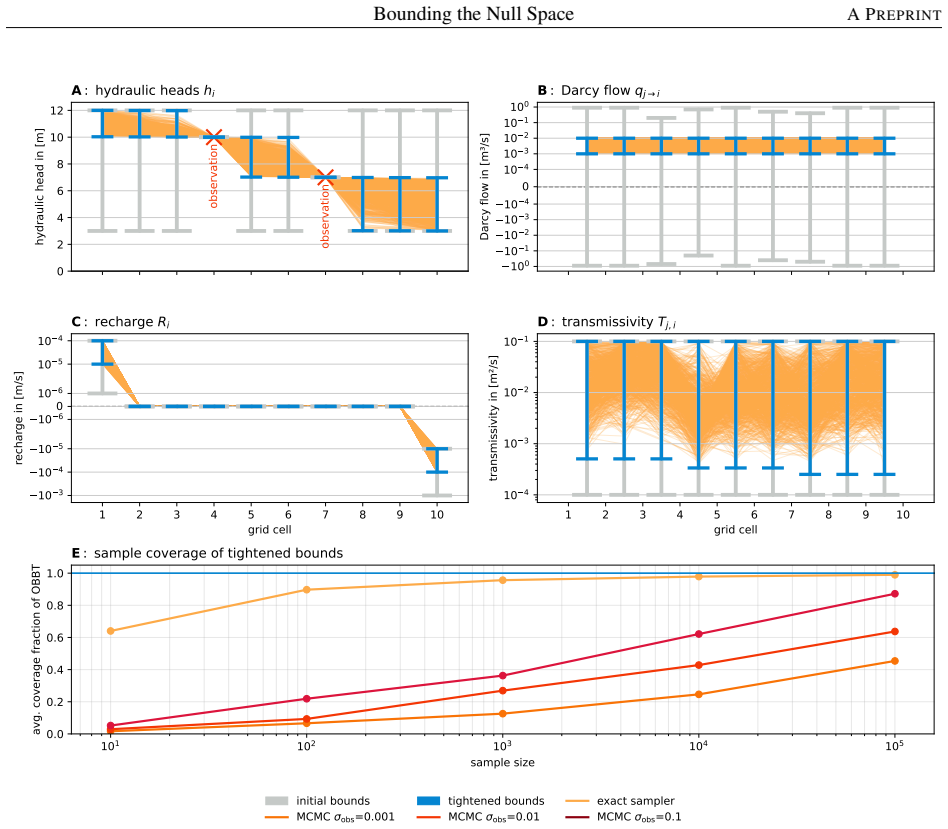
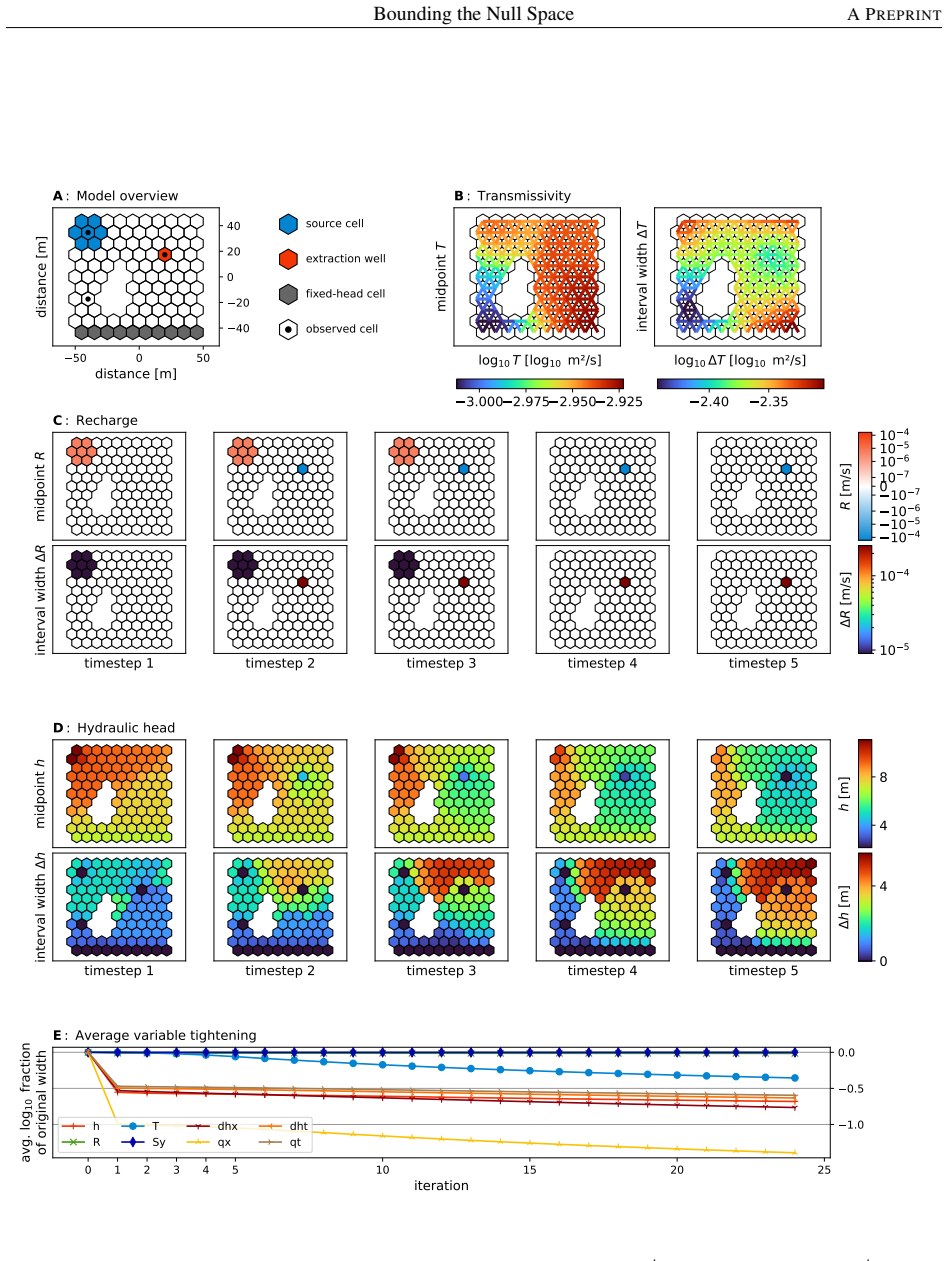
Groundwater models are routinely non-identifiable: sparse subsurface observations leave many combinations of parameters, states, and boundary conditions equally consistent with the available data. Existing uncertainty quantification (UQ) methods address this by exploring a finite set of model realizations, but incomplete exploration can systematically underestimate the true range of admissible solutions. We propose a fundamentally different approach based on Optimization-based Bound Tightening (OBBT), which represents uncertainty directly as intervals and tightens them by extremizing variables over a constraint system encoding physical laws and observations. This yields guaranteed outer bounds on all uncertain variables without sampling, side-stepping the exploration problem entirely. To apply OBBT to groundwater flow, we discretize Darcy's law using a finite-volume scheme and handle the resulting bilinear terms through McCormick relaxations. We show that these relaxations can break the sign coupling between fluxes and head gradients, permitting non-physical rotational flow and failing to provide sufficient information for effective bound tightening. We identify flow sign prescription and irrotationality constraints as effective remedies and characterize their respective strengths and limitations. We demonstrate the framework on three numerical examples - a 1D steady-state model, a 2D steady-state model across four experimental configurations, and a 2D transient model on a hexagonal grid - and discuss computational performance, scalability, and directions for future research. OBBT offers a conservative, deterministic, and physically grounded alternative to ensemble-based UQ, with natural connections to null space theory and data assimilation.
Editorial analysis
A structured set of objections, weighed in public.
Referee Report
Summary. The manuscript proposes an interval-based uncertainty quantification method for non-identifiable groundwater models via Optimization-based Bound Tightening (OBBT). It discretizes Darcy's law with a finite-volume scheme, relaxes the resulting bilinear terms using McCormick envelopes, and augments the formulation with flow sign prescription and irrotationality constraints to restore physical consistency. The framework is demonstrated on a 1D steady-state model, a 2D steady-state model across four configurations, and a 2D transient model on a hexagonal grid, with the central claim being guaranteed outer bounds on all uncertain variables without sampling.
Significance. If the added constraints produce a valid outer approximation whose optima remain both sound and sufficiently tight, the approach supplies a deterministic, conservative alternative to ensemble UQ that directly encodes the null space of admissible solutions. This would be a useful complement to sampling-based methods in data assimilation contexts, particularly where exhaustive exploration is impractical.
major comments (2)
- [Abstract (remedies paragraph)] Abstract (paragraph on remedies): The assertion that flow sign prescription and irrotationality constraints are effective remedies is load-bearing for the guarantee of outer bounds. The manuscript must show that these inequalities are valid for the original nonlinear problem (i.e., every feasible point of the unrelaxed finite-volume system remains feasible after augmentation) and does not merely tighten the relaxation gap at the cost of excluding admissible solutions.
- [Numerical examples] Numerical examples section: The demonstrations on the three models report no quantitative metrics of bound tightness (e.g., ratio of obtained interval widths to independently computed ground-truth ranges) or residual relaxation gap. Without such measures or comparison against a reference method, it is not possible to confirm that the remedies leave the bounds both valid and practically useful rather than excessively loose.
minor comments (1)
- [Abstract] The abstract mentions characterizing the 'strengths and limitations' of the two remedies; the main text should supply explicit statements of these (e.g., which remedy is more effective on transient vs. steady problems) with supporting numerical evidence.
Simulated Author's Rebuttal
We thank the referee for their thoughtful review and constructive feedback on our manuscript. We address each major comment below, indicating revisions where appropriate to strengthen the presentation of validity and tightness.
read point-by-point responses
-
Referee: Abstract (paragraph on remedies): The assertion that flow sign prescription and irrotationality constraints are effective remedies is load-bearing for the guarantee of outer bounds. The manuscript must show that these inequalities are valid for the original nonlinear problem (i.e., every feasible point of the unrelaxed finite-volume system remains feasible after augmentation) and does not merely tighten the relaxation gap at the cost of excluding admissible solutions.
Authors: We agree that an explicit demonstration of validity is required to support the outer-bound guarantee. The original manuscript characterizes the strengths and limitations of these constraints but does not contain a dedicated proof. In the revised version we will insert a new subsection (Section 3.4) that derives the flow-sign and irrotationality inequalities directly from the continuous Darcy and continuity equations, shows that every solution of the unrelaxed finite-volume system satisfies them, and therefore confirms that the augmented relaxation remains a valid outer approximation. This addition will be accompanied by a short remark on the conditions under which each constraint is active. revision: yes
-
Referee: Numerical examples section: The demonstrations on the three models report no quantitative metrics of bound tightness (e.g., ratio of obtained interval widths to independently computed ground-truth ranges) or residual relaxation gap. Without such measures or comparison against a reference method, it is not possible to confirm that the remedies leave the bounds both valid and practically useful rather than excessively loose.
Authors: We concur that quantitative assessment of tightness is necessary for readers to judge practical utility. For the 1-D and 2-D steady-state examples, where the admissible set can be enumerated or solved analytically, we will add tables reporting (i) the ratio of our interval widths to the true null-space ranges and (ii) the residual McCormick gap at the obtained optima. For the transient hexagonal-grid case we will report the same gap metric together with a comparison against a modest Monte-Carlo ensemble (10^4 realizations) to illustrate conservatism. These metrics and the associated discussion will be inserted into Section 4. revision: yes
Circularity Check
No significant circularity; derivation self-contained via standard relaxations
full rationale
The paper constructs its OBBT framework from the finite-volume discretization of Darcy's law, McCormick envelopes on bilinear terms, and added flow-sign and irrotationality inequalities drawn directly from the governing physics and observations. No step reduces a claimed prediction or bound to a fitted parameter, self-citation chain, or definitional tautology; the remedies are presented as explicit inequalities whose validity is argued from the original nonlinear model rather than assumed by construction. The central guarantee of outer bounds therefore rests on the soundness of these standard relaxation techniques and domain constraints, which remain independently verifiable outside the paper's fitted values or results.
Axiom & Free-Parameter Ledger
axioms (3)
- domain assumption Darcy's law governs steady and transient groundwater flow
- domain assumption Finite-volume discretization produces a faithful discrete representation of the continuous flow equations
- standard math McCormick envelopes supply valid convex relaxations of bilinear products
Reference graph
Works this paper leans on
-
[1]
Journal of hydrology , volume=
Equifinality, data assimilation, and uncertainty estimation in mechanistic modelling of complex environmental systems using the GLUE methodology , author=. Journal of hydrology , volume=. 2001 , publisher=
2001
-
[2]
Journal of hydrology , volume=
A manifesto for the equifinality thesis , author=. Journal of hydrology , volume=. 2006 , publisher=
2006
-
[3]
arXiv preprint arXiv:2402.17702 , year=
The SCIP optimization suite 9.0 , author=. arXiv preprint arXiv:2402.17702 , year=
-
[4]
Scientific investigations report , number=
Approaches to highly parameterized inversion: Pilot-point theory, guidelines, and research directions , author=. Scientific investigations report , number=. 2011 , publisher=
2011
-
[5]
Groundwater , volume=
Decision support modeling: Data assimilation, uncertainty quantification, and strategic abstraction , author=. Groundwater , volume=. 2020 , publisher=
2020
-
[6]
Journal of Global Optimization , volume=
Three enhancements for optimization-based bound tightening , author=. Journal of Global Optimization , volume=. 2017 , publisher=
2017
-
[7]
Mathematical Programming , volume=
A solution framework for linear PDE-constrained mixed-integer problems , author=. Mathematical Programming , volume=. 2021 , publisher=
2021
-
[8]
Water resources research , volume=
Real-time groundwater flow modeling with the ensemble Kalman filter: Joint estimation of states and parameters and the filter inbreeding problem , author=. Water resources research , volume=. 2008 , publisher=
2008
-
[9]
Mathematical Programming Computation , volume=
Parallelizing the dual revised simplex method , author=. Mathematical Programming Computation , volume=. 2018 , publisher=
2018
-
[10]
Advances in water resources , volume=
Ground-water models cannot be validated , author=. Advances in water resources , volume=. 1992 , publisher=
1992
-
[11]
Water Resources Research , volume=
Efficient posterior exploration of a high-dimensional groundwater model from two-stage Markov chain Monte Carlo simulation and polynomial chaos expansion , author=. Water Resources Research , volume=. 2013 , publisher=
2013
-
[12]
Mathematical Programming , pages=
McCormick envelopes in mixed-integer PDE-constrained optimization , author=. Mathematical Programming , pages=. 2025 , publisher=
2025
-
[13]
Advances in Water Resources , volume=
On uncertainty quantification in hydrogeology and hydrogeophysics , author=. Advances in Water Resources , volume=. 2017 , publisher=
2017
-
[14]
Mathematical programming , volume=
Computability of global solutions to factorable nonconvex programs: Part I—Convex underestimating problems , author=. Mathematical programming , volume=. 1976 , publisher=
1976
-
[15]
Water Resources Research , volume=
A reassessment of the groundwater inverse problem , author=. Water Resources Research , volume=. 1996 , publisher=
1996
-
[16]
Waterlines report series , number=
Australian groundwater modelling guidelines , author=. Waterlines report series , number=
-
[17]
Summary report of the national groundwater modelling uncertainty workshop , volume=
Groundwater Modelling Uncertainty—Implications for Decision Making , author=. Summary report of the national groundwater modelling uncertainty workshop , volume=
-
[18]
2009 , publisher=
Introduction to interval analysis , author=. 2009 , publisher=
2009
-
[19]
PyMC: A Modern, and Comprehensive Probabilistic Programming Framework in Python
Oriol Abril-Pla and Virgile Andreani and Colin Carroll and Larry Dong and Christopher J. Fonnesbeck and Maxim Kochurov and Ravin Kumar and Junpeng Lao and Christian C. Luhmann and Osvaldo A. Martin and Michael Osthege and Ricardo Vieira and Thomas Wiecki and Robert Zinkov , journal =. doi:10.7717/peerj-cs.1516 , year =
-
[20]
Water Resources Research , volume=
Non-Gaussian parameter inference for hydrogeological models using Stein variational gradient descent , author=. Water Resources Research , volume=. 2021 , publisher=
2021
-
[21]
Renard, Philippe , title =. Groundwater , volume =. doi:https://doi.org/10.1111/j.1745-6584.2007.00340.x , url =. https://ngwa.onlinelibrary.wiley.com/doi/pdf/10.1111/j.1745-6584.2007.00340.x , abstract =
-
[22]
Reviews of Geophysics , volume=
Beyond classical observations in hydrogeology: The advantages of including exchange flux, temperature, tracer concentration, residence time, and soil moisture observations in groundwater model calibration , author=. Reviews of Geophysics , volume=. 2019 , publisher=
2019
-
[23]
Journal of the ACM (JACM) , volume=
Smoothed analysis of algorithms: Why the simplex algorithm usually takes polynomial time , author=. Journal of the ACM (JACM) , volume=. 2004 , publisher=
2004
-
[24]
Statistics and Computing , volume=
Differential evolution Markov chain with snooker updater and fewer chains , author=. Statistics and Computing , volume=. 2008 , publisher=
2008
-
[25]
Water Resources Research , volume=
Calibration-constrained Monte Carlo analysis of highly parameterized models using subspace techniques , author=. Water Resources Research , volume=. 2009 , publisher=
2009
-
[26]
Nature methods , volume=
SciPy 1.0: fundamental algorithms for scientific computing in Python , author=. Nature methods , volume=. 2020 , publisher=
2020
-
[27]
Mathematical programming , volume=
On the implementation of an interior-point filter line-search algorithm for large-scale nonlinear programming , author=. Mathematical programming , volume=. 2006 , publisher=
2006
discussion (0)
Sign in with ORCID, Apple, or X to comment. Anyone can read and Pith papers without signing in.