Schmidt Decomposition-Based Methods for Efficient Quantum Image Encoding
Pith reviewed 2026-06-29 05:14 UTC · model grok-4.3
The pith
Schmidt decomposition enables low-rank approximations that cut quantum image encoding circuit depth by 97% while keeping reconstruction error low.
A machine-rendered reading of the paper's core claim, the machinery that carries it, and where it could break.
Core claim
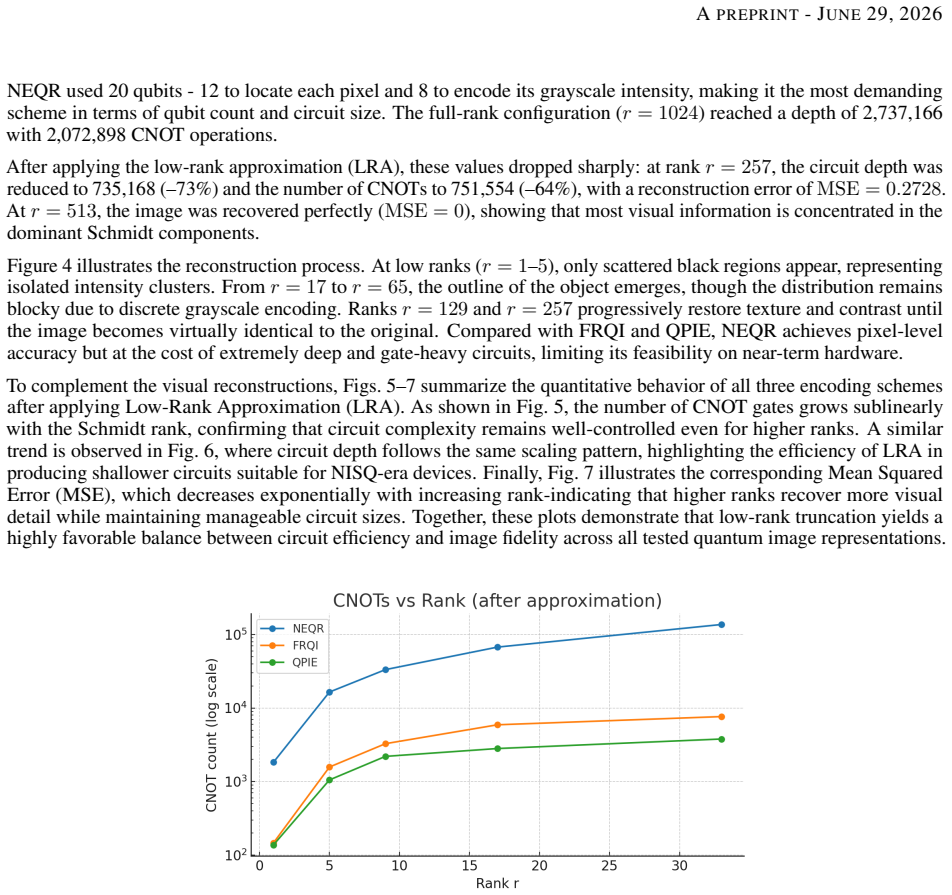
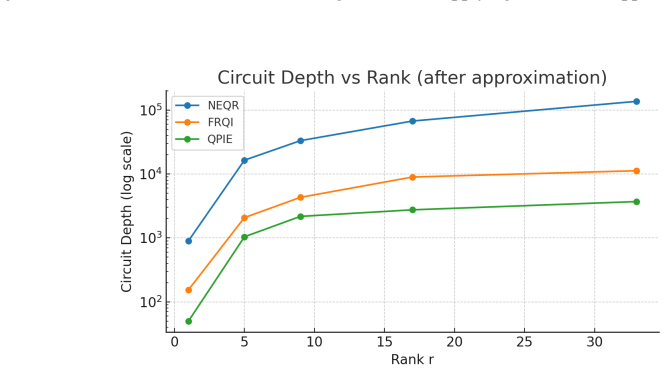
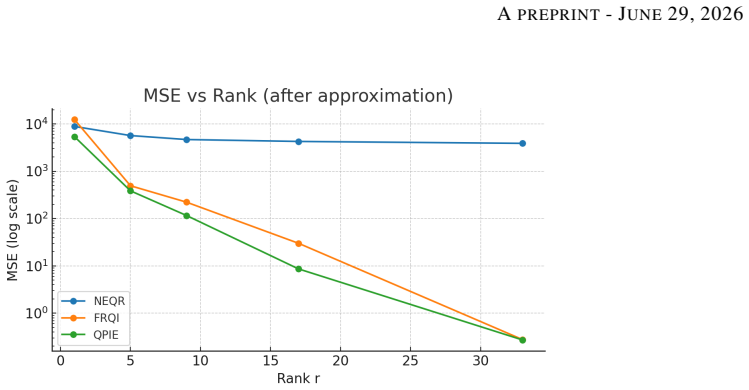
Low-rank state approximations via Schmidt decomposition reduce circuit depth and CNOT count for FRQI, QPIE, and NEQR encodings while preserving most image information, as measured by MSE values around 0.27 and maintained visual quality in reconstructed images.
What carries the argument
Schmidt decomposition for low-rank approximation of the quantum image state
If this is right
- FRQI encoding achieves the largest gain with a 97 percent circuit depth reduction at MSE of about 0.27.
- All three encodings exhibit trade-offs between accuracy and resource use after approximation.
- The method demonstrates that low-rank techniques can make quantum image processing more feasible on near-term hardware.
Where Pith is reading between the lines
- The same low-rank strategy might apply to other quantum data types such as audio or sensor readings.
- Adaptive choice of retained rank per image could further improve the accuracy-efficiency balance.
- Combining this approximation with hardware-specific error mitigation may extend usable image sizes.
Load-bearing premise
Retaining only the dominant Schmidt components preserves enough image information for the reported MSE and visual quality metrics to remain meaningful across tested images.
What would settle it
Testing the low-rank encodings on a new collection of images and finding that MSE rises above 1.0 or visible artifacts appear in reconstructions would show the preservation does not hold.
Figures
read the original abstract
In quantum image processing, a fundamental step is encoding classical image data into quantum states. This can be achieved using methods such as Flexible Representation of Quantum Images (FRQI), Quantum Probability Image Encoding (QPIE), and Novel Enhanced Quantum Representation (NEQR). However, on real quantum hardware, these encodings can quickly lead to circuits with many gates, large circuit depth, and high qubit usage, which is a problem for Noisy Intermediate-Scale Quantum (NISQ) devices. In this work, we investigate whether low-rank state approximation, formulated via Schmidt decomposition, can help reduce this complexity. The method keeps only the most significant parts of a quantum state's entanglement structure, making state preparation more efficient while preserving most of the image information. We compare the three encoding techniques in their original form and with low-rank approximation, evaluating metrics such as circuit depth, CNOT count, MSE, and visual quality of reconstructed images. The results reveal meaningful trade-offs between accuracy and resource efficiency, with the FRQI model achieving a 97 percent reduction in circuit depth while maintaining a near-perfect reconstruction (MSE of about 0.27). This demonstrates the potential of low-rank techniques for advancing practical quantum image processing on near-term hardware.
Editorial analysis
A structured set of objections, weighed in public.
Referee Report
Summary. The manuscript proposes applying Schmidt decomposition to obtain low-rank approximations of the quantum states produced by FRQI, QPIE, and NEQR image encodings, with the goal of reducing circuit depth and CNOT count on NISQ hardware while preserving image fidelity. It reports quantitative results including a 97% circuit-depth reduction for the approximated FRQI encoding at an MSE of approximately 0.27, together with comparisons of resource metrics and visual reconstruction quality across the three encodings.
Significance. If the low-rank approximations can be shown to preserve image information reliably and reproducibly across datasets, the approach would offer a concrete technique for mitigating the high resource cost of standard quantum image encodings, which is directly relevant to near-term hardware. The explicit comparison of three distinct encodings and the focus on circuit-level metrics are positive features of the study design.
major comments (3)
- [Abstract] Abstract: the headline quantitative claims (97% depth reduction for FRQI at MSE ≈ 0.27) are presented without any description of the bipartition chosen for the Schmidt decomposition, the retained rank, the singular-value spectrum of the tested states, or the images/dataset on which the metrics were computed. Because the central claim rests on the assertion that truncation preserves sufficient image information, these omissions render the reported MSE and depth figures unverifiable.
- [Results] Results (or equivalent section reporting the FRQI experiments): no information is given on how the truncated state is realized as a quantum circuit (i.e., the modified state-preparation unitary), whether the rank was chosen a priori or post-hoc, or whether error bars or multiple independent images were used. This directly affects the load-bearing assumption that the reported MSE reflects genuine information retention rather than an artifact of particular images or normalization.
- [Methods] Methods: the procedure for selecting the approximation rank and for constructing the low-rank state-preparation circuit is not specified, making it impossible to reproduce the claimed resource reductions or to assess whether the method generalizes beyond the images shown.
minor comments (2)
- [Abstract] The abstract and main text should explicitly state the number of qubits, the image resolution, and the classical post-processing used to obtain the reported MSE values.
- [Figures] Figure captions for reconstructed images should indicate which encoding and rank were used for each panel.
Simulated Author's Rebuttal
We thank the referee for the constructive and detailed comments. We agree that the current manuscript lacks sufficient detail on several key aspects of the Schmidt decomposition procedure, which limits verifiability and reproducibility. We will revise the manuscript to incorporate the requested information across the abstract, results, and methods sections.
read point-by-point responses
-
Referee: [Abstract] Abstract: the headline quantitative claims (97% depth reduction for FRQI at MSE ≈ 0.27) are presented without any description of the bipartition chosen for the Schmidt decomposition, the retained rank, the singular-value spectrum of the tested states, or the images/dataset on which the metrics were computed. Because the central claim rests on the assertion that truncation preserves sufficient image information, these omissions render the reported MSE and depth figures unverifiable.
Authors: We accept the criticism. In the revised abstract we will add a brief specification of the bipartition (between the intensity/color register and the position register), the retained rank (selected via singular-value threshold to reach the stated MSE), a short note on the observed singular-value decay, and the dataset (standard test images from the USC-SIPI database). These additions will make the headline claims verifiable without requiring the reader to consult later sections. revision: yes
-
Referee: [Results] Results (or equivalent section reporting the FRQI experiments): no information is given on how the truncated state is realized as a quantum circuit (i.e., the modified state-preparation unitary), whether the rank was chosen a priori or post-hoc, or whether error bars or multiple independent images were used. This directly affects the load-bearing assumption that the reported MSE reflects genuine information retention rather than an artifact of particular images or normalization.
Authors: We agree these experimental details are missing. The revised results section will describe how the low-rank state is prepared by truncating the Schmidt decomposition and implementing the corresponding reduced unitary. We will state that rank selection was performed post-hoc to balance MSE and circuit resources, and we will report metrics averaged over multiple independent images together with standard deviations to demonstrate that the quoted MSE is not an artifact of single-image normalization. revision: yes
-
Referee: [Methods] Methods: the procedure for selecting the approximation rank and for constructing the low-rank state-preparation circuit is not specified, making it impossible to reproduce the claimed resource reductions or to assess whether the method generalizes beyond the images shown.
Authors: We acknowledge the gap in the methods description. The revised methods section will provide an explicit algorithm: (1) the bipartition and tensor reshaping used for Schmidt decomposition, (2) the cumulative-energy threshold or MSE target used to choose the retained rank, and (3) the gate-by-gate construction of the truncated state-preparation unitary. This will enable exact reproduction and allow readers to evaluate generalization. revision: yes
Circularity Check
No circularity: standard Schmidt low-rank truncation applied to encoding outputs with independent metrics
full rationale
The paper applies Schmidt decomposition as a conventional linear-algebra tool to truncate the quantum states produced by FRQI/QPIE/NEQR encodings, then reports empirical outcomes (circuit depth, CNOT count, MSE, visual quality) on the resulting approximations. No derivation step equates a claimed result to its own inputs by definition, renames a fitted quantity as a prediction, or relies on a load-bearing self-citation chain. The reported 97% depth reduction at MSE ~0.27 is an observed consequence of rank truncation on the tested images, not a tautology; the bipartition, retained rank, and reconstruction procedure are external to the target metrics.
Axiom & Free-Parameter Ledger
free parameters (1)
- approximation rank
axioms (1)
- domain assumption Quantum image encoding states admit effective low-rank approximations via Schmidt decomposition without destroying essential image content
Reference graph
Works this paper leans on
-
[1]
Fei Yan and Abdullah M. Iliyasu. Quantum image processing. InSpringer Handbook of Digital Imaging, pages 1345–1394. Springer, 2017
2017
-
[2]
Doctor rerum naturalium (dr
Alexander Geng.Application of Hybrid Quantum Machine Learning for Image Processing in the NISQ Era. Doctor rerum naturalium (dr. rer. nat.), RPTU Kaiserslautern-Landau, 2024. Approved dissertation, defended on 08 February 2024
2024
-
[3]
Sinha, Garima Sinha, and Moin Hasan
Satinder Singh, Avnish Thakur, Deepak K. Sinha, Garima Sinha, and Moin Hasan. Quantum-enhanced eigenface algorithm for face verification.Journal of Information Systems Engineering and Management, 10(36s), 2025
2025
-
[4]
Venegas-Andraca
Fei Yan and Salvador E. Venegas-Andraca. Lessons from twenty years of quantum image processing.ACM Transactions on Quantum Computing, 6(1):Article 5, 2025
2025
-
[5]
Quantum machine learning.Nature, 549:195–202, 2018
Jacob Biamonte, Peter Wittek, Nicola Pancotti, Patrick Rebentrost, Nathan Wiebe, and Seth Lloyd. Quantum machine learning.Nature, 549:195–202, 2018
2018
-
[6]
Improved frqi on superconducting processors and its restrictions in the nisq era.Quantum Information Processing, 22:104, 2023
Alexander Geng, Ali Moghiseh, Claudia Redenbach, and Katja Schladitz. Improved frqi on superconducting processors and its restrictions in the nisq era.Quantum Information Processing, 22:104, 2023
2023
-
[7]
Quantum computing in the nisq era and beyond, 2018
John Preskill. Quantum computing in the nisq era and beyond, 2018
2018
-
[8]
Park, Carsten Blank, and Francesco Petruccione
Daniel K. Park, Carsten Blank, and Francesco Petruccione. Robust quantum classifier with minimal overhead. IEEE Transactions on Neural Networks and Learning Systems, 2021
2021
-
[9]
Le, Fangyan Dong, and Kaoru Hirota
Phuc Q. Le, Fangyan Dong, and Kaoru Hirota. A flexible representation of quantum images for polynomial preparation, image compression, and processing operations.Quantum Information Processing, 10(1):63–84, 2011
2011
-
[10]
Neqr: A novel enhanced quantum representation of digital images.Quantum Information Processing, 12(8):2833–2860, 2013
Yong Zhang, Kai Lu, Yinghui Gao, and Mo Wang. Neqr: A novel enhanced quantum representation of digital images.Quantum Information Processing, 12(8):2833–2860, 2013
2013
-
[11]
I. F. Araujo, C. Blank, I. C. S. Araújo, and A. J. da Silva. Low-rank quantum state preparation.IEEE Transactions on Computer-Aided Design of Integrated Circuits and Systems, 43(1):161–174, 2024
2024
-
[12]
Quantum entanglement.Reviews of Modern Physics, 81(2):865–942, 2009
Ryszard Horodecki, Pawel Horodecki, Michal Horodecki, and Karol Horodecki. Quantum entanglement.Reviews of Modern Physics, 81(2):865–942, 2009
2009
-
[13]
Nielsen and Isaac L
Michael A. Nielsen and Isaac L. Chuang.Quantum Computation and Quantum Information. Cambridge University Press, 10th anniversary edition edition, 2010
2010
-
[14]
Oxford University Press, 2007
Phillip Kaye, Raymond Laflamme, and Michele Mosca.An Introduction to Quantum Computing. Oxford University Press, 2007
2007
-
[15]
G. W. Stewart. On the early history of the singular value decomposition.SIAM Review, 35(4):551–566, 1993
1993
-
[16]
César Feniou, Olivier Adjoua, Baptiste Claudon, Julien Zylberman, Emmanuel Giner, and Jean-Philip Piquemal. Sparse quantum state preparation for strongly correlated systems.arXiv preprint arXiv:2311.03347, 2024
-
[17]
Dimension reduction and redundancy removal through successive schmidt decompositions.Applied Sciences, 13(5):3172, 2023
Ammar Daskin, Rishabh Gupta, and Sabre Kais. Dimension reduction and redundancy removal through successive schmidt decompositions.Applied Sciences, 13(5):3172, 2023
2023
-
[18]
Cross, Lev S
Andrew W. Cross, Lev S. Bishop, Sarah Sheldon, Paul D. Nation, and Jay M. Gambetta. Validating quantum computers using randomized model circuits.Physical Review A, 100(3):032328, 2019
2019
-
[19]
Maxwell T. West, Azar C. Nakhl, Jamie Heredge, Floyd M. Creevey, Lloyd C. L. Hollenberg, Martin Sevior, and Muhammad Usman. Drastic circuit depth reductions with preserved adversarial robustness by approximate encoding for quantum machine learning.arXiv preprint arXiv:2309.09424, 2023. 11 APREPRINT- JUNE29, 2026
-
[20]
The approximation of one matrix by another of lower rank.Psychometrika, 1(3):211–218, 1936
Carl Eckart and Gale Young. The approximation of one matrix by another of lower rank.Psychometrika, 1(3):211–218, 1936
1936
-
[21]
Shende, Stephen S
Vivek V . Shende, Stephen S. Bullock, and Igor L. Markov. Synthesis of quantum-logic circuits.IEEE Transactions on Computer-Aided Design of Integrated Circuits and Systems, 25(6):1000–1010, 2006
2006
-
[22]
Vartiainen, Ville Bergholm, and Martti M
Mikko Möttönen, Juha J. Vartiainen, Ville Bergholm, and Martti M. Salomaa. Transformation of quantum states using uniformly controlled rotations.Quantum Information & Computation, 5(6):467–473, 2005
2005
-
[23]
Chow, and Jay M
Abhinav Kandala, Antonio Mezzacapo, Kristan Temme, Maika Takita, Marcus Brink, Jerry M. Chow, and Jay M. Gambetta. Hardware-efficient variational quantum eigensolver for small molecules and quantum magnets.Nature, 549(7671):242–246, 2017. 12
2017
discussion (0)
Sign in with ORCID, Apple, or X to comment. Anyone can read and Pith papers without signing in.