MINDS survey of silicates in T Tauri disks: Correlation between dust and gas
Pith reviewed 2026-06-27 11:44 UTC · model grok-4.3
The pith
T Tauri disks show silicate dust features correlating with molecular gas emission lines
A machine-rendered reading of the paper's core claim, the machinery that carries it, and where it could break.
Core claim
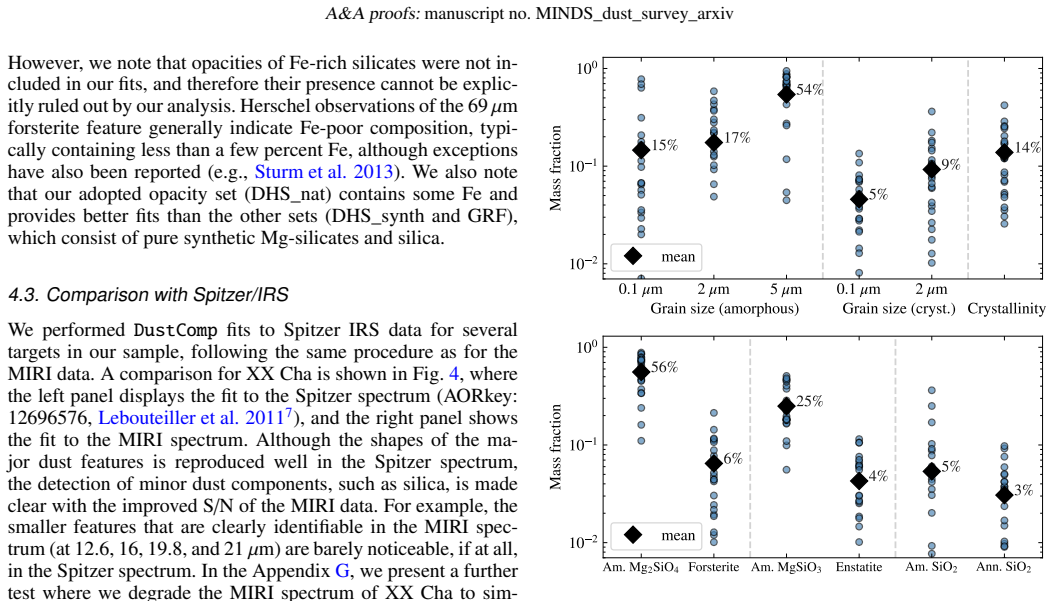
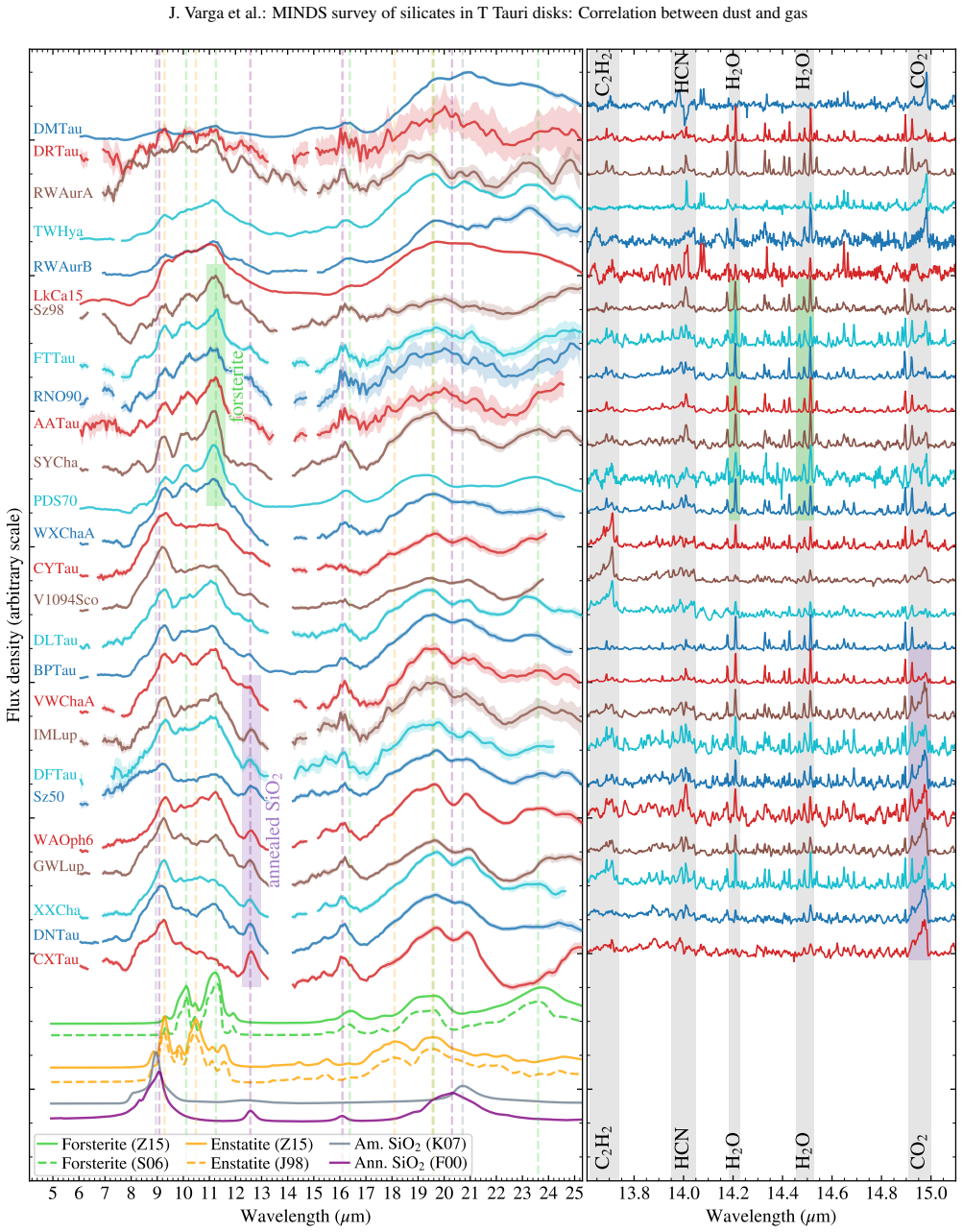
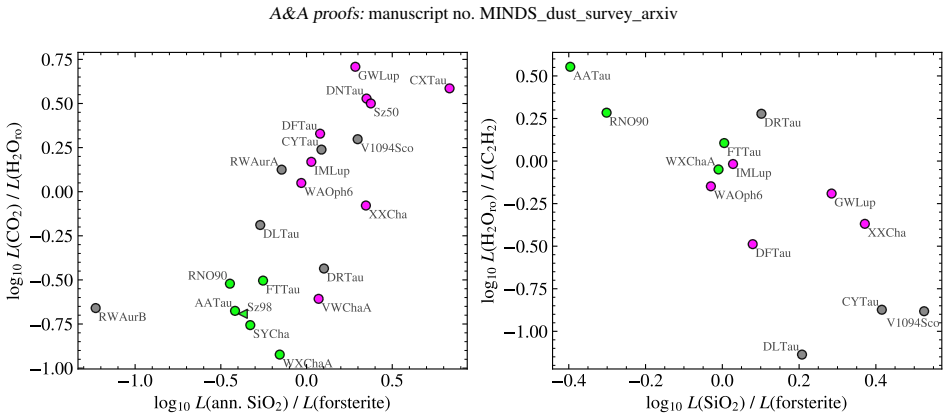
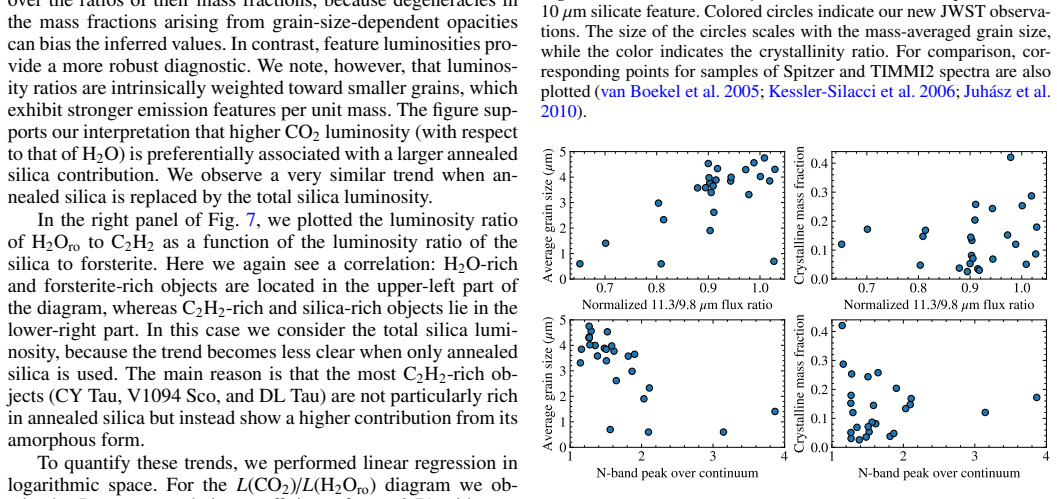
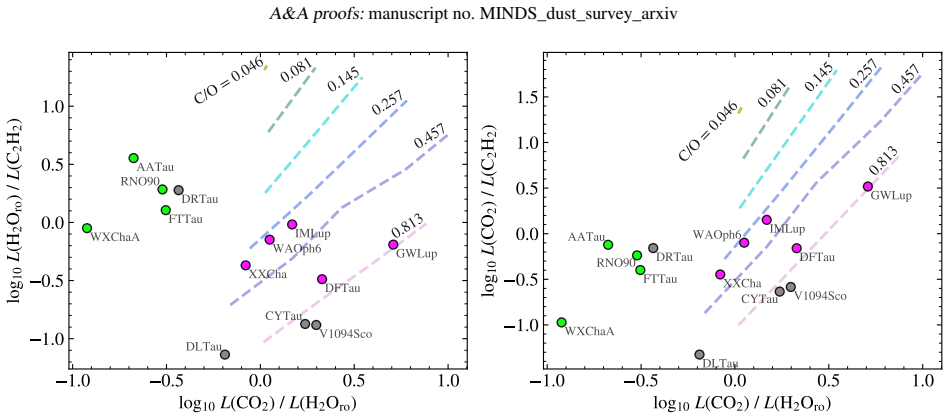
The MINDS survey data show that the average dust composition in these disks is approximately sixty percent forsterite-stoichiometry grains, thirty percent enstatite, and ten percent silica, with crystalline fractions averaging fourteen percent. Annealed silica, mainly cristobalite, appears in nine of the twenty-six disks. Disks displaying prominent annealed silica spectral features exhibit enhanced CO2 molecular emission, whereas forsterite-dominated disks show stronger H2O emission, and these may correspond to higher gas-phase C/O ratios. The findings indicate that the molecular gas composition regulates the availability of specific dust species in the inner disk.
What carries the argument
DustComp spectral decomposition tool that fits mass fractions of forsterite, enstatite, silica and their amorphous counterparts to the observed mid-infrared spectral features.
If this is right
- Grain size distributions skewed toward sizes larger than two micrometers indicate substantial grain growth has occurred in the sample.
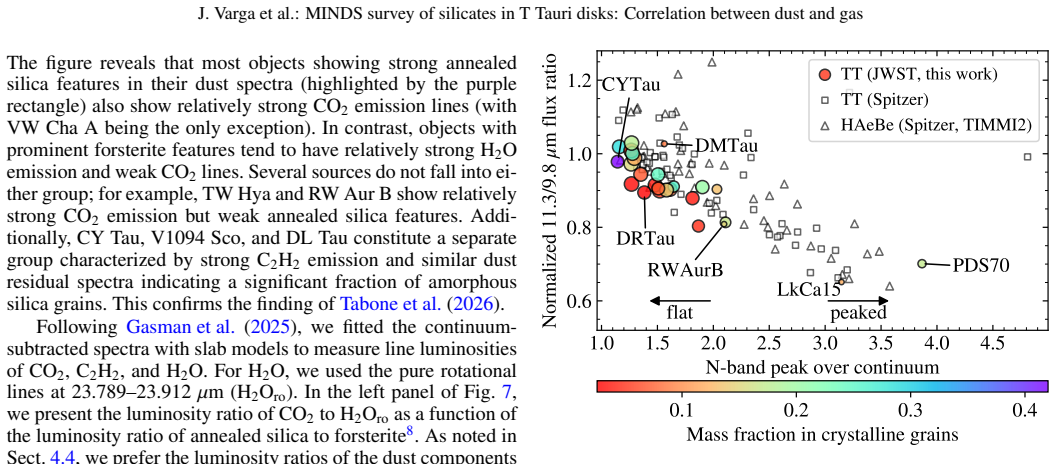
- Crystalline silicate mass fractions lie between five and twenty-four percent, with a sample mean of fourteen percent.
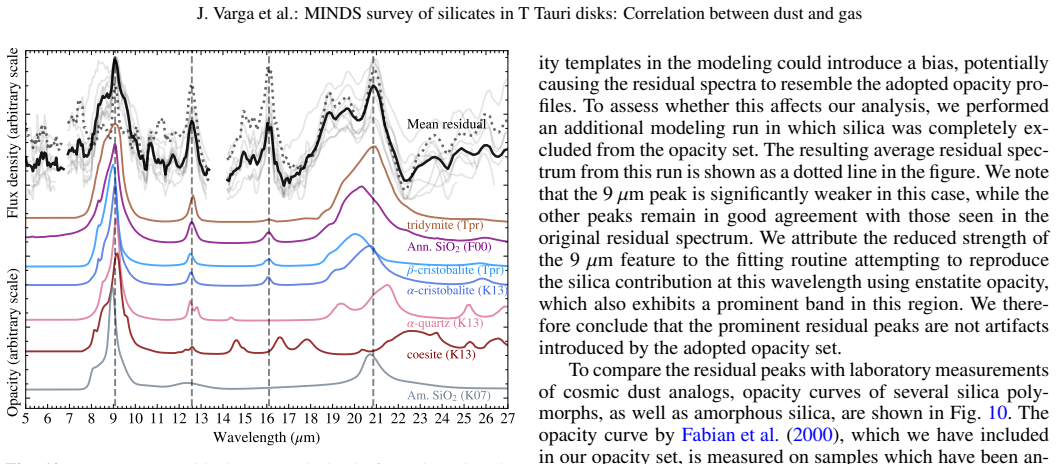
- Annealed silica is robustly detected in nine disks, primarily in the cristobalite form.
- Disks with annealed silica features may possess elevated gas-phase carbon-to-oxygen ratios.
Where Pith is reading between the lines
- If gas composition controls dust mineralogy, evolutionary changes in disk chemistry could shift the minerals supplied to planetesimals over time.
- The same correlation could be tested by targeting inner-disk regions in disks around stars of different masses or ages.
- The reported link would imply that the gas-phase carbon-to-oxygen ratio influences which silicates condense or anneal in the inner disk.
Load-bearing premise
The spectral decomposition can accurately identify the amounts of specific silicate minerals without major confusion from overlapping features or model choices.
What would settle it
Absence of any correlation between annealed silica feature strength and CO2 emission intensity when the same analysis is applied to an independent sample of T Tauri disks.
Figures
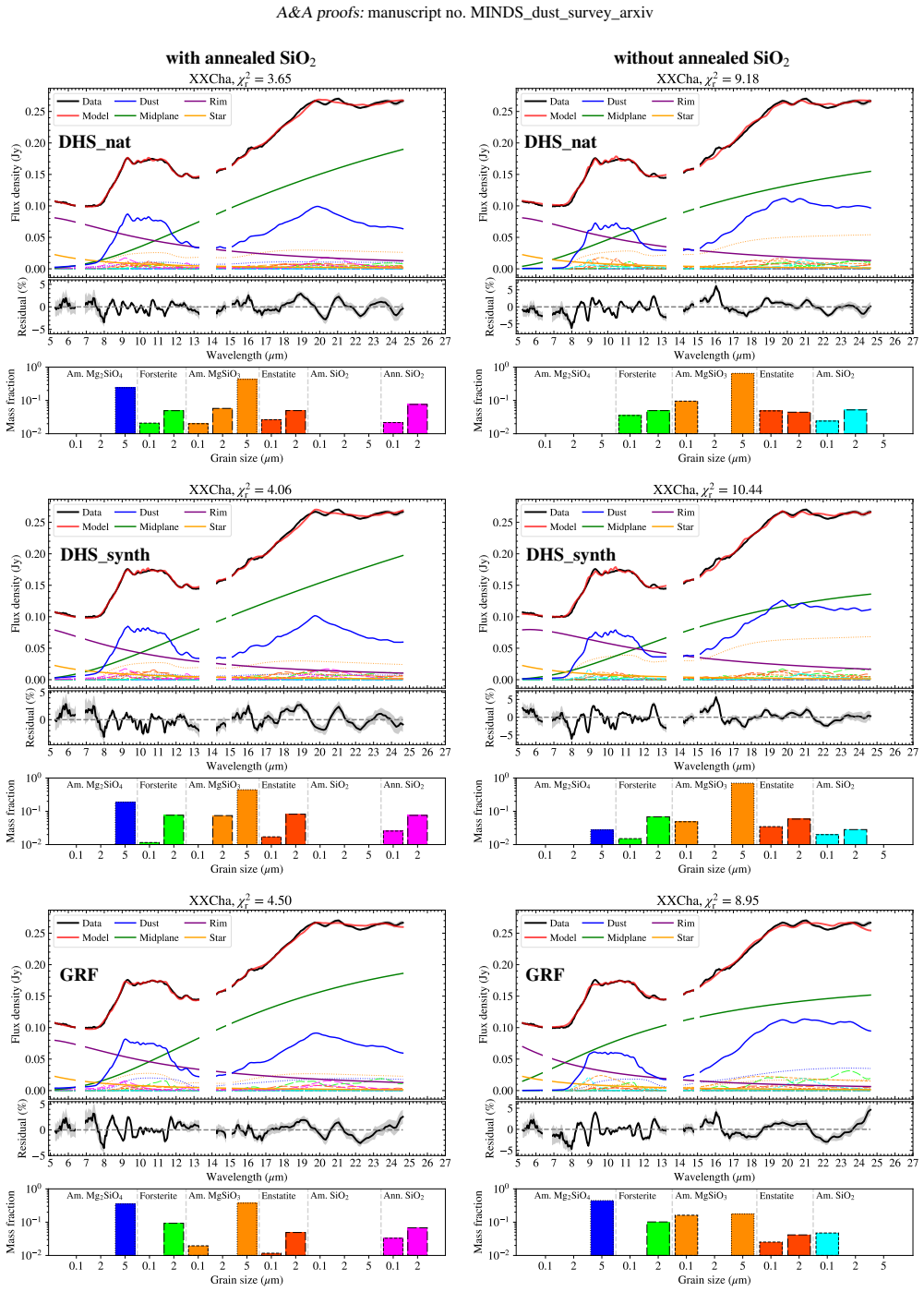
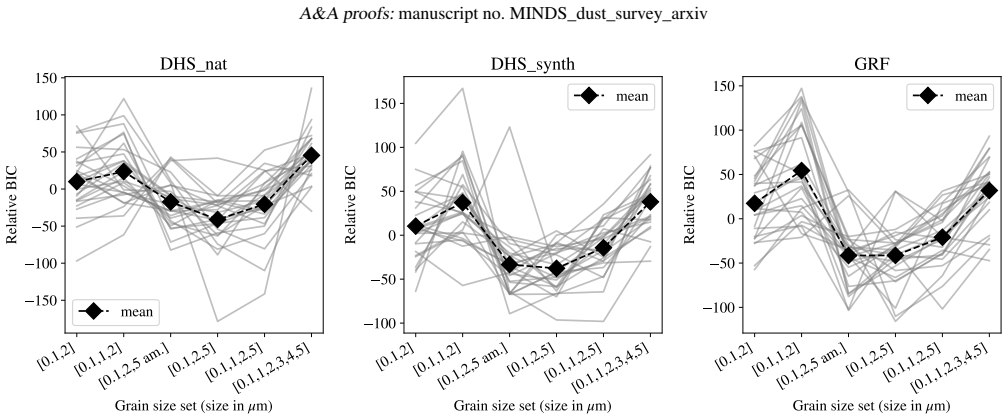
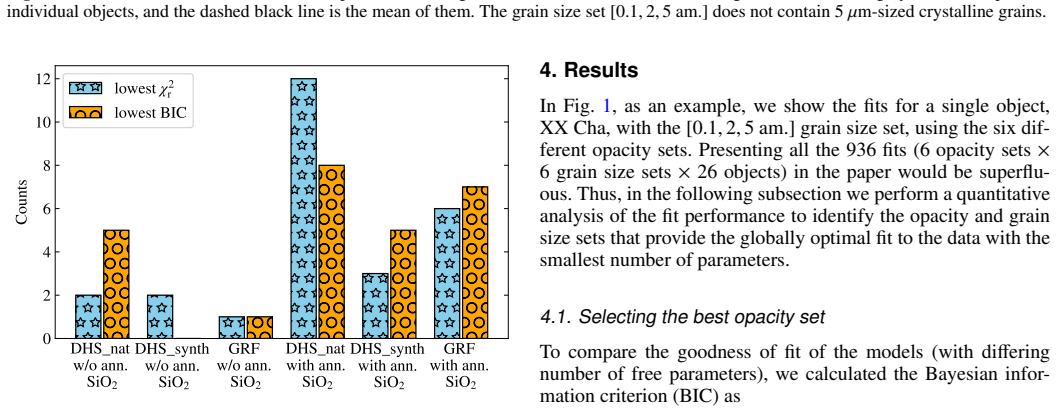
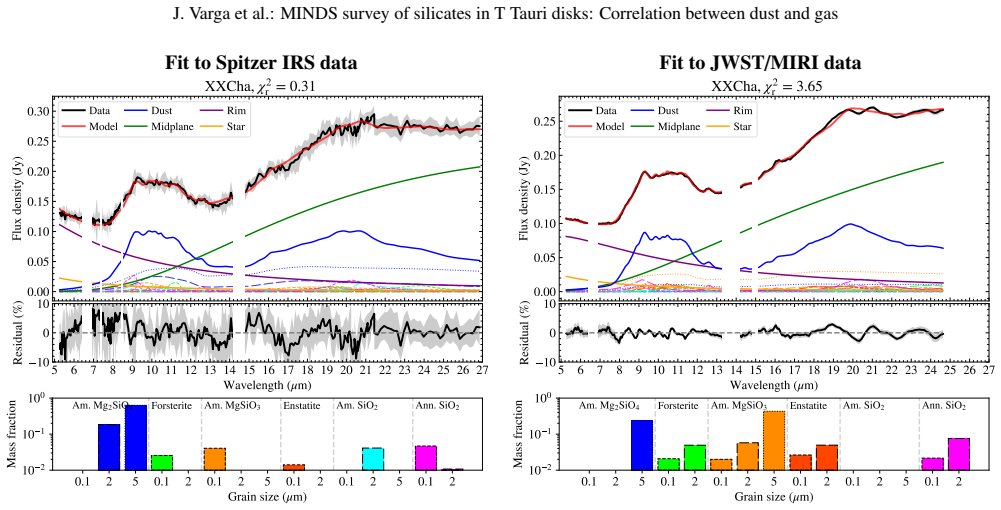
read the original abstract
Context. Silicates are key constituents of planet-forming disks and major building blocks of rocky planets. Mid-infrared spectral features of micron-sized silicate grains trace grain growth, mineralogy, and disk chemistry. Aims. We characterized the dust mineralogy in T Tauri disks using James Webb Space Telescope (JWST)/Mid-Infrared Instrument (MIRI) observations and investigated the connections between the dust and molecular gas compositions. Methods. We analyzed JWST/MIRI spectra of 26 disks from the MIRI mid-Infrared Disk Survey (MINDS). Using our DustComp spectral decomposition tool, we inferred the mass fractions of individual dust species. The fits included Mg$_2$SiO$_4$ (forsterite), MgSiO$_3$ (enstatite), and SiO$_2$ (silica), together with amorphous silicates of corresponding stoichiometry. Results. Mg-rich (and Fe-poor) silicates reproduce the data well, with residuals typically within $\pm3\%$. Grain size distributions are skewed toward sizes larger than $2\mu$m, indicating significant growth. The average dust composition is dominated by Mg$_2$SiO$_4$-stoichiometry grains ($\sim60\%$), followed by MgSiO$_3$ ($\sim30\%$) and SiO$_2$ ($\sim10\%$). Crystalline mass fractions are typically in the $5$-$24\%$ range, with a mean of $14\%$. Annealed silica is robustly detected in nine objects, with cristobalite as the main polymorph. We found a correlation between dust and molecular gas composition: disks with strong annealed silica features show stronger CO$_2$ emission, while forsterite-rich disks display stronger H$_2$O emission. Disks with annealed silica features may also have elevated gas-phase C/O ratios. Conclusions. The observed dust-gas correlation may provide the first indication that the molecular gas composition regulates the availability of dust species in the inner disk.
Editorial analysis
A structured set of objections, weighed in public.
Referee Report
Summary. The paper analyzes JWST/MIRI spectra of 26 T Tauri disks from the MINDS survey. Using the DustComp tool, it decomposes the 5-28 μm silicate features into mass fractions of forsterite (Mg2SiO4), enstatite (MgSiO3), silica (SiO2), and their amorphous counterparts, reporting Mg-rich compositions, grain sizes skewed above 2 μm, crystalline fractions of 5-24% (mean 14%), robust annealed silica (cristobalite) in nine disks, and correlations linking annealed silica to stronger CO2 emission and forsterite-rich disks to stronger H2O emission. The central claim is that these dust-gas correlations suggest molecular gas composition regulates dust species availability in the inner disk.
Significance. If the mass fractions are robust, the work supplies the first sizable JWST-based mineralogy survey of T Tauri disks and the first reported direct links between specific crystalline dust species and molecular gas tracers, with potential implications for inner-disk chemistry and planet formation. The sample size and use of high-S/N MIRI data are clear strengths.
major comments (3)
- [Methods (DustComp spectral decomposition)] Methods section on DustComp: the linear-combination fit to optical constants is stated to achieve residuals within ±3%, but no discussion is provided of how degeneracies among grain-size distributions, crystallinity fractions, and stoichiometry are regularized or tested (e.g., via multiple basis sets or Monte-Carlo realizations). Because the silica-CO2 and forsterite-H2O correlations rest directly on the uniqueness of the per-disk mass fractions, this is load-bearing.
- [Results (dust-gas correlations)] Results (correlation figures/tables): the reported dust-gas correlations are presented without quoted uncertainties on the derived mass fractions, without Spearman or Pearson coefficients with p-values, and without a direct comparison to the Spitzer-era mineralogy results that the sample overlaps. This prevents assessment of whether the claimed trends exceed the fit uncertainties.
- [Sample selection and observations] Sample and selection: the 26-disk MINDS subsample is used to claim a general regulatory link, yet no quantitative test for selection bias (e.g., luminosity or inclination cuts) or comparison of the crystallinity distribution to the parent MINDS or Spitzer samples is shown.
minor comments (2)
- [Abstract] Abstract: the statement that 'residuals typically within ±3%' would be clearer if the wavelength interval and the metric (e.g., rms or peak-to-peak) were specified.
- [Conclusions] The claim that annealed silica 'may also have elevated gas-phase C/O ratios' is qualitative; a short quantitative estimate or reference to existing C/O diagnostics would strengthen the conclusion.
Simulated Author's Rebuttal
We thank the referee for their detailed and constructive comments on our manuscript. We address each of the major comments below and have made revisions to strengthen the paper accordingly.
read point-by-point responses
-
Referee: Methods section on DustComp: the linear-combination fit to optical constants is stated to achieve residuals within ±3%, but no discussion is provided of how degeneracies among grain-size distributions, crystallinity fractions, and stoichiometry are regularized or tested (e.g., via multiple basis sets or Monte-Carlo realizations). Because the silica-CO2 and forsterite-H2O correlations rest directly on the uniqueness of the per-disk mass fractions, this is load-bearing.
Authors: We agree that additional discussion on potential degeneracies is warranted to support the robustness of our results. In the revised manuscript, we will expand the Methods section to include tests using multiple basis sets and Monte-Carlo realizations of the fits. These analyses show that the derived mass fractions for the key species (forsterite, enstatite, silica) are stable and the correlations remain significant within the uncertainties. revision: yes
-
Referee: Results (correlation figures/tables): the reported dust-gas correlations are presented without quoted uncertainties on the derived mass fractions, without Spearman or Pearson coefficients with p-values, and without a direct comparison to the Spitzer-era mineralogy results that the sample overlaps. This prevents assessment of whether the claimed trends exceed the fit uncertainties.
Authors: We acknowledge the need for statistical rigor in presenting the correlations. The revised version will include uncertainties on the mass fractions based on the spectral fit residuals, report Spearman correlation coefficients along with p-values, and add a comparison to the overlapping Spitzer mineralogy results to demonstrate that the observed trends are consistent with or extend previous findings. revision: yes
-
Referee: Sample and selection: the 26-disk MINDS subsample is used to claim a general regulatory link, yet no quantitative test for selection bias (e.g., luminosity or inclination cuts) or comparison of the crystallinity distribution to the parent MINDS or Spitzer samples is shown.
Authors: We will add to the revised manuscript a quantitative evaluation of selection effects by comparing the distributions of stellar luminosity and disk inclination in our subsample to the full MINDS sample. We will also compare the crystallinity fractions to those from the parent MINDS survey and prior Spitzer studies to assess any biases and the general applicability of our conclusions. revision: yes
Circularity Check
No significant circularity; results are direct observational measurements and empirical correlations.
full rationale
The paper reports JWST/MIRI spectral fits using DustComp to extract dust mass fractions (forsterite, enstatite, silica, amorphous counterparts) and then measures correlations with independent molecular gas line strengths (CO2, H2O). No equation or claim reduces the reported dust-gas correlations to the fitted parameters by construction, nor does any load-bearing step rely on a self-citation chain that itself assumes the target result. The derivation chain consists of standard spectral decomposition followed by statistical correlation analysis on the output quantities; these steps remain independent of the paper's own inputs and are externally falsifiable via the raw spectra.
Axiom & Free-Parameter Ledger
free parameters (2)
- mass fractions of forsterite, enstatite, silica, and amorphous counterparts
- grain size distribution parameters
axioms (2)
- domain assumption Mg-rich, Fe-poor silicates are the dominant carriers of the observed mid-infrared features
- domain assumption The MIRI spectra can be decomposed into linear combinations of laboratory-measured dust opacities without significant temperature or geometry effects
Reference graph
Works this paper leans on
-
[2]
The GRAVITY young stellar object survey. VII. The inner dusty disks of T Tauri stars. , keywords =. doi:10.1051/0004-6361/202141624 , archivePrefix =. 2109.11826 , primaryClass =
-
[3]
The GRAVITY Young Stellar Object survey. I. Probing the disks of Herbig Ae/Be stars in terrestrial orbits. , keywords =. doi:10.1051/0004-6361/201936403 , archivePrefix =. 1911.00611 , primaryClass =
-
[4]
Optical and Infrared Interferometry IV , year = 2014, editor =
GRAVITY data reduction software. Optical and Infrared Interferometry IV , year = 2014, editor =. doi:10.1117/12.2056850 , adsurl =
-
[5]
, archivePrefix = "arXiv", eprint =
The GRAVITY fringe tracker. , archivePrefix = "arXiv", eprint =. doi:10.1051/0004-6361/201834981 , adsurl =
-
[6]
Dust settling in magnetorotationally driven turbulent discs - I. Numerical methods and evidence for a vigorous streaming instability. , archivePrefix = "arXiv", eprint =. doi:10.1111/j.1365-2966.2009.14606.x , adsurl =
-
[7]
, archivePrefix = "arXiv", eprint =
Variations of the 10 m Silicate Features in the Actively Accreting T Tauri Stars: DG Tau and XZ Tau. , archivePrefix = "arXiv", eprint =. doi:10.1088/0004-637X/706/1/L168 , adsurl =
-
[8]
, year = 2007, month = oct, volume = 51, pages =
MIDI: Obtaining and analysing interferometric data in the mid-infrared. , year = 2007, month = oct, volume = 51, pages =. doi:10.1016/j.newar.2007.06.009 , adsurl =
-
[9]
, archivePrefix = "arXiv", eprint =
Investigating Planet Formation in Circumstellar Disks: CARMA Observations of Ry Tau and Dg Tau. , archivePrefix = "arXiv", eprint =. doi:10.1088/0004-637X/714/2/1746 , adsurl =
-
[10]
, archivePrefix = "arXiv", eprint =
Do We Really Know the Dust? Systematics and Uncertainties of the Mid-Infrared Spectral Analysis Methods. , archivePrefix = "arXiv", eprint =. doi:10.1088/0004-637X/695/2/1024 , adsurl =
-
[11]
The Messenger , keywords =
MIDI combines light from the VLTI: the start of 10 m interferometry at ESO. The Messenger , keywords =
-
[12]
Dust Evolution in Protoplanetary Disks Around Herbig Ae/Be Stars the Spitzer View. , keywords =. doi:10.1088/0004-637X/721/1/431 , archivePrefix =. 1008.0083 , primaryClass =
-
[13]
Mid-infrared sizes of circumstellar disks around Herbig Ae/Be stars measured with MIDI on the VLTI. , keywords =. doi:10.1051/0004-6361:20047178 , adsurl =
-
[14]
, archivePrefix = "arXiv", eprint =
Evidence for Dynamical Changes in a Transitional Protoplanetary Disk with Mid-Infrared Variability. , archivePrefix = "arXiv", eprint =. doi:10.1088/0004-637X/704/1/L15 , adsurl =
-
[15]
, archivePrefix = "arXiv", eprint =
High spatial resolution mid-infrared observations of the low-mass young star TW Hydrae. , archivePrefix = "arXiv", eprint =. doi:10.1051/0004-6361:20077357 , adsurl =
-
[16]
, year = 2004, month = nov, volume = 432, pages =
The building blocks of planets within the `terrestrial' region of protoplanetary disks. , year = 2004, month = nov, volume = 432, pages =. doi:10.1038/nature03088 , adsurl =
-
[17]
Evidence for a population of group II disks with gaps
The structure of disks around intermediate-mass young stars from mid-infrared interferometry. Evidence for a population of group II disks with gaps. , archivePrefix = "arXiv", eprint =. doi:10.1051/0004-6361/201525654 , adsurl =
-
[18]
Debris Disks and the Formation of Planets , year = 2004, series =
The Enigma of DG Tau: Silicate Emission Variability. Debris Disks and the Formation of Planets , year = 2004, series =
2004
-
[19]
American Astronomical Society Meeting Abstracts , year = 2000, series =
Yearly Variations in DG Tau's 10 micron Silicate Feature: Evidence for a Dust Processing in a Disk Atmosphere. American Astronomical Society Meeting Abstracts , year = 2000, series =
2000
-
[20]
Variability of Disk Emission in Pre-Main-Sequence and Related Stars. I. HD 31648 and HD 163296: Isolated Herbig Ae Stars Driving Herbig-Haro Flows. , archivePrefix = "arXiv", eprint =. doi:10.1086/529003 , adsurl =
-
[21]
Aperture Synthesis 13CO (J = 1-0) Observations of the Molecular Gas around DG Tauri: Evidence for a Dispersing Gas Disk. , keywords =. doi:10.1086/176728 , adsurl =
-
[22]
From Gas to Stars to Dust , year = 1995, series =
HIFOGS: Its design, operations and calibration. From Gas to Stars to Dust , year = 1995, series =
1995
-
[23]
Relation between the Luminosity of Young Stellar Objects and Their Circumstellar Environment. , eprint =. doi:10.1086/511327 , adsurl =
-
[24]
The Absence of Crystalline Silicates in the Diffuse Interstellar Medium. , eprint =. doi:10.1086/421339 , adsurl =
-
[25]
Observing faint targets with MIDI at the VLTI -- The MIDI AGN Large Programme experience
Observing faint targets with MIDI at the VLTI: the MIDI AGN large programme experience. Society of Photo-Optical Instrumentation Engineers (SPIE) Conference Series , year = 2012, series =. doi:10.1117/12.925521 , adsurl =. arXiv:1206.6620 , primaryClass = "astro-ph.IM", month = jul, eid =
work page internal anchor Pith review Pith/arXiv arXiv doi:10.1117/12.925521 2012
-
[26]
Periodic bubbles and a dusty disk wind?
Sub-arcsecond [Fe ii] spectro-imaging of the DG Tauri jet. Periodic bubbles and a dusty disk wind?. , archivePrefix = "arXiv", eprint =. doi:10.1051/0004-6361/201015886 , adsurl =
-
[27]
, archivePrefix = "arXiv", eprint =
Spatially Extended Brackett Gamma Emission in the Environments of Young Stars. , archivePrefix = "arXiv", eprint =. doi:10.1088/0004-637X/722/2/1360 , adsurl =
-
[28]
The Structure and Emission of the Accretion Shock in T Tauri Stars. II. The Ultraviolet-Continuum Emission. , eprint =. doi:10.1086/317253 , adsurl =
-
[29]
A Brgamma Probe of Disk Accretion in T Tauri Stars and Embedded Young Stellar Objects. , keywords =. doi:10.1086/300636 , adsurl =
-
[30]
The T Tauri Phase Down to Nearly Planetary Masses: Echelle Spectra of 82 Very Low Mass Stars and Brown Dwarfs. , eprint =. doi:10.1086/429794 , adsurl =
-
[31]
The Mass Accretion Rates of Intermediate-Mass T Tauri Stars. , keywords =. doi:10.1086/422733 , adsurl =
-
[32]
, archivePrefix = "arXiv", eprint =
Probing Stellar Accretion with Mid-infrared Hydrogen Lines. , archivePrefix = "arXiv", eprint =. doi:10.1088/0004-637X/801/1/31 , adsurl =
-
[33]
, archivePrefix = "arXiv", eprint =
Mid-infrared Spectral Variability Atlas of Young Stellar Objects. , archivePrefix = "arXiv", eprint =. doi:10.1088/0067-0049/201/2/11 , adsurl =
-
[34]
Interstellar dust and extinction. , keywords =. doi:10.1146/annurev.aa.28.090190.000345 , adsurl =
-
[35]
Star Formation in Space and Time: Taurus-Auriga. , eprint =. doi:10.1086/344293 , adsurl =
-
[36]
A CO survey of the dark nebulae in Perseus, Taurus, and Auriga. , keywords =. doi:10.1086/191176 , adsurl =
-
[37]
Observational Constraints on the Formation and Evolution of Binary Stars. , eprint =. doi:10.1086/321542 , adsurl =
-
[38]
On the Evolutionary Status of Class I Stars and Herbig-Haro Energy Sources in Taurus-Auriga. , eprint =. doi:10.1086/425115 , adsurl =
-
[39]
, archivePrefix = "arXiv", eprint =
Discovery of a bipolar X-ray jet from the T Tauri star DG Tauri. , archivePrefix = "arXiv", eprint =. doi:10.1051/0004-6361:20078141 , adsurl =
-
[40]
Imaging and Kinematic Studies of Young Stellar Object Jets in Taurus. , keywords =. doi:10.1086/300282 , adsurl =
-
[41]
, keywords =
Sub-arcsecond morphology and kinematics of the DG Tauri jet in the [O I] 6300 line. , keywords =
-
[42]
, archivePrefix = "arXiv", eprint =
Physical properties of the jet from DG Tauri on sub-arcsecond scales with HST/STIS. , archivePrefix = "arXiv", eprint =. doi:10.1051/0004-6361/201117510 , adsurl =
-
[43]
The Sloan Digital Sky Survey: Technical Summary. , eprint =. doi:10.1086/301513 , adsurl =
-
[44]
Spektroskopische und interferometrische Untersuchungen an T Tauri-Sternen im mittleren Infrarotbereich
-
[45]
High Spatial Resolution Infrared Studies of Proto-planetary Disks
-
[46]
ISO Documentation , year = 2007, adsurl =
SWS AOT-1 High Resolution Processing: Documentation. ISO Documentation , year = 2007, adsurl =
2007
-
[47]
Science , year = 1997, month = mar, volume = 275, pages =
The spectrum of Comet Hale-Bopp (C/1995 01) observed with the Infrared Space Observatory at 2.9 AU from the Sun. Science , year = 1997, month = mar, volume = 275, pages =. doi:10.1126/science.275.5308.1904 , adsurl =
-
[48]
, archivePrefix = "arXiv", eprint =
Episodic formation of cometary material in the outburst of a young Sun-like star. , archivePrefix = "arXiv", eprint =. doi:10.1038/nature08004 , adsurl =
-
[49]
, archivePrefix = "arXiv", eprint =
Dust Transport in Protostellar Disks Through Turbulence and Settling. , archivePrefix = "arXiv", eprint =. doi:10.1088/0004-637X/708/1/188 , adsurl =
-
[50]
Protostars and Planets V , eprint =
Disk Winds, Jets, and Outflows: Theoretical and Computational Foundations. Protostars and Planets V , eprint =
-
[51]
The role of laboratory experiments in the characterisation of silicon-based cosmic material. , keywords =. doi:10.1007/s00159-002-0017-x , adsurl =
-
[52]
, archivePrefix = "arXiv", eprint =
The Taurus Spitzer Survey: New Candidate Taurus Members Selected Using Sensitive Mid-Infrared Photometry. , archivePrefix = "arXiv", eprint =. doi:10.1088/0067-0049/186/2/259 , adsurl =
-
[53]
, archivePrefix = "arXiv", eprint =
Disk Evolution in the Three Nearby Star-forming Regions of Taurus, Chamaeleon, and Ophiuchus. , archivePrefix = "arXiv", eprint =. doi:10.1088/0004-637X/703/2/1964 , adsurl =
-
[54]
The C II], Fe II] and Si II] ultraviolet features
Constraints to the magnetospheric properties of T Tauri stars - I. The C II], Fe II] and Si II] ultraviolet features. , archivePrefix = "arXiv", eprint =. doi:10.1093/mnras/stu1045 , adsurl =
-
[55]
Protostars and Planets VI , archivePrefix = "arXiv", eprint =
Episodic Accretion in Young Stars. Protostars and Planets VI , archivePrefix = "arXiv", eprint =. doi:10.2458/azu_uapress_9780816531240-ch017 , adsurl =
-
[56]
New Frontiers in Stellar Interferometry , year = 2004, series =
Coherent fringe tracking and visibility estimation for MIDI. New Frontiers in Stellar Interferometry , year = 2004, series =
2004
-
[57]
, archivePrefix = "arXiv", eprint =
Protoplanetary Disks and Their Evolution. , archivePrefix = "arXiv", eprint =. doi:10.1146/annurev-astro-081710-102548 , adsurl =
-
[58]
, archivePrefix = "arXiv", eprint =
The Inner Regions of Protoplanetary Disks. , archivePrefix = "arXiv", eprint =. doi:10.1146/annurev-astro-081309-130932 , adsurl =
-
[59]
The VLTI/MIDI survey of massive young stellar objects . Sounding the inner regions around intermediate- and high-mass young stars using mid-infrared interferometry. , archivePrefix = "arXiv", eprint =. doi:10.1051/0004-6361/201321539 , adsurl =
-
[60]
, archivePrefix = "arXiv", eprint =
Mid-infrared spectroscopy of SVS13: silicates, quartz and SiC in a protoplanetary disc. , archivePrefix = "arXiv", eprint =. doi:10.1093/mnras/stv1171 , adsurl =
-
[61]
Discovery of an infrared companion to T Tauri. , keywords =. doi:10.1086/183778 , adsurl =
-
[62]
Detection of an infrared companion to Haro 6-10. , keywords =. doi:10.1086/185479 , adsurl =
-
[63]
, year = 1998, month = sep, volume = 395, pages =
Compact protoplanetary disks around the stars of a young binary system. , year = 1998, month = sep, volume = 395, pages =. doi:10.1038/26421 , adsurl =
-
[64]
, archivePrefix = "arXiv", eprint =
Circumbinary Ring, Circumstellar Disks, and Accretion in the Binary System UY Aurigae. , archivePrefix = "arXiv", eprint =. doi:10.1088/0004-637X/793/1/10 , adsurl =
-
[65]
The innermost astronomical unit of protoplanetary disks
The innermost astronomical units of protoplanetary disks. Optical and Infrared Interferometry and Imaging V , year = 2016, series =. doi:10.1117/12.2234439 , adsurl =. arXiv:1610.03780 , primaryClass = "astro-ph.SR", month = jul, eid =
work page internal anchor Pith review Pith/arXiv arXiv doi:10.1117/12.2234439 2016
-
[66]
Protostars and Planets VI , archivePrefix = "arXiv", eprint =
An Observational Perspective of Transitional Disks. Protostars and Planets VI , archivePrefix = "arXiv", eprint =. doi:10.2458/azu_uapress_9780816531240-ch022 , adsurl =
-
[67]
, archivePrefix = "arXiv", eprint =
Multiwavelength interferometric observations and modeling of circumstellar disks. , archivePrefix = "arXiv", eprint =. doi:10.1051/0004-6361/201220190 , adsurl =
-
[68]
VLTI observations of the young eruptive star V1647 Orionis during its 2003-2006 outburst
Dynamics during outburst. VLTI observations of the young eruptive star V1647 Orionis during its 2003-2006 outburst. , archivePrefix = "arXiv", eprint =. doi:10.1051/0004-6361/201218770 , adsurl =
-
[69]
, archivePrefix = "arXiv", eprint =
Revealing the inner circumstellar disk of the T Tauri star S Coronae Australis N using the VLTI. , archivePrefix = "arXiv", eprint =. doi:10.1051/0004-6361/201218892 , adsurl =
-
[70]
, archivePrefix = "arXiv", eprint =
The 2008 Outburst of EX Lup Silicate Crystals in Motion. , archivePrefix = "arXiv", eprint =. doi:10.1088/0004-637X/744/2/118 , adsurl =
-
[71]
, archivePrefix = "arXiv", eprint =
Multi-wavelength observations of the young binary system Haro 6-10: The case of misaligned discs. , archivePrefix = "arXiv", eprint =. doi:10.1051/0004-6361/201116805 , adsurl =
-
[72]
Radial Structure in the TW Hya Circumstellar Disk. , keywords =. doi:10.1088/0004-637X/728/2/96 , adsurl =
-
[73]
, archivePrefix = "arXiv", eprint =
Interferometric science results on young stellar objects. , archivePrefix = "arXiv", eprint =. doi:10.1016/j.newar.2010.07.007 , adsurl =
-
[74]
, archivePrefix = "arXiv", eprint =
Spatially resolved mid-infrared observations of the triple system T Tauri. , archivePrefix = "arXiv", eprint =. doi:10.1051/0004-6361/200811390 , adsurl =
-
[75]
Interferometry in the mid-infrared
High spatial resolution observations of the T Tau system II. Interferometry in the mid-infrared. Journal of Physics Conference Series , year = 2008, series =. doi:10.1088/1742-6596/131/1/012029 , adsurl =
-
[76]
10 $\mu$m interferometry of disks around young stars
10 m interferometry of disks around young stars. Journal of Physics Conference Series , year = 2008, series =. doi:10.1088/1742-6596/131/1/012023 , adsurl =. arXiv:0810.5534 , month = oct, eid =
work page internal anchor Pith review Pith/arXiv arXiv doi:10.1088/1742-6596/131/1/012023 2008
-
[77]
Journal of Physics Conference Series , year = 2008, series =
Observations of circumstellar disks with infrared interferometry. Journal of Physics Conference Series , year = 2008, series =. doi:10.1088/1742-6596/131/1/012019 , adsurl =
-
[78]
, archivePrefix = "arXiv", eprint =
The T Tauri star RY Tauri as a case study of the inner regions of circumstellar dust disks. , archivePrefix = "arXiv", eprint =. doi:10.1051/0004-6361:20077049 , adsurl =
-
[79]
FU Orionis: The MIDI VLTI Perspective. , eprint =. doi:10.1086/505857 , adsurl =
-
[80]
Disks around young stars with VLTI/MIDI
Disks around young stars with VLTI/MIDI. Society of Photo-Optical Instrumentation Engineers (SPIE) Conference Series , year = 2006, series =. doi:10.1117/12.673777 , adsurl =. astro-ph/0607387 , month = jun, eid =
work page internal anchor Pith review Pith/arXiv arXiv doi:10.1117/12.673777 2006
-
[81]
First AU-scale observations of V1647 Orionis with VLTI/MIDI. , eprint =. doi:10.1051/0004-6361:20064841 , adsurl =
discussion (0)
Sign in with ORCID, Apple, or X to comment. Anyone can read and Pith papers without signing in.