Flower-like WO3-modified Vulcan carbon GDEs for photoelectro-Fenton process: Efficient ciprofloxacin degradation and mechanistic insights
Pith reviewed 2026-06-27 12:18 UTC · model grok-4.3
The pith
A WO3-modified Vulcan carbon electrode produces hydrogen peroxide more efficiently and enables complete degradation of ciprofloxacin in a photoelectro-Fenton process.
A machine-rendered reading of the paper's core claim, the machinery that carries it, and where it could break.
Core claim
The 3 percent WO3 C gas diffusion electrode generates H2O2 at 423, 586, and 916 mg L^{-1} at current densities of 50, 75, and 100 mA cm^{-2} respectively, with around 70 percent current efficiency, outperforming bare Vulcan carbon. In electro-Fenton applications, it degrades ciprofloxacin by around 70 percent in 30 minutes, limited by slow Fe2+ regeneration, but photoelectro-Fenton with UV light achieves complete CIP removal in 90 minutes, and pairing with a BDD anode reaches 66 percent TOC mineralization. The degradation mechanism involves hydroxyl radical attack on the piperazine ring, possibly with defluorination and quinolone ring oxidation, confirmed by theoretical analysis to reduce en
What carries the argument
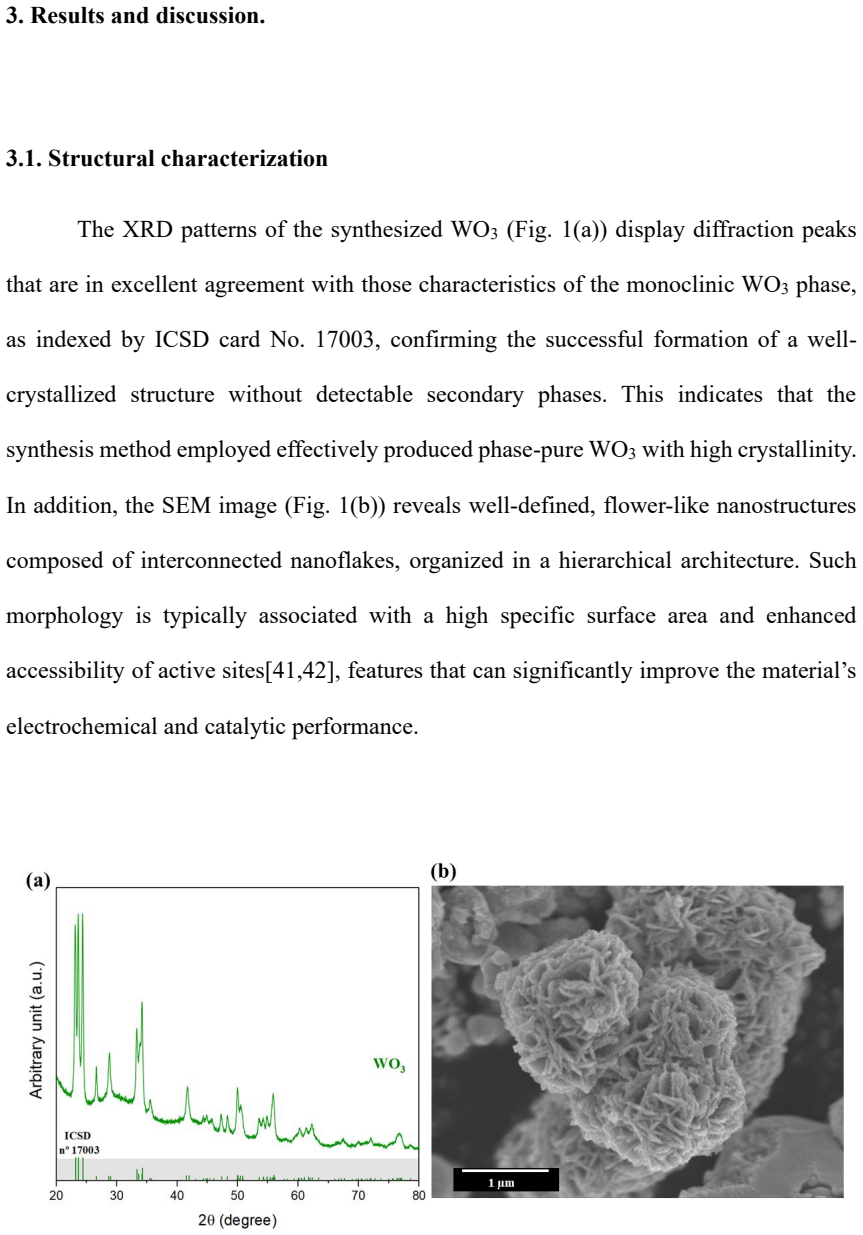
The flower-like WO3-modified Vulcan carbon gas diffusion electrode, which enhances H2O2 electrosynthesis through the claimed WO3-carbon synergistic effect.
If this is right
- Higher H2O2 generation supports faster initial antibiotic degradation in electro-Fenton setups.
- UV illumination in photoelectro-Fenton overcomes the Fe2+ regeneration bottleneck to achieve full pollutant removal.
- Use of a boron-doped diamond anode increases total organic carbon mineralization to 66 percent.
- The hydroxyl radical-based pathway leads to transformation products with lower toxicity.
- The electrode shows lower energy consumption compared to unmodified versions.
Where Pith is reading between the lines
- Similar modifications with other metal oxides might yield comparable gains in H2O2 production for wastewater treatment.
- Testing the electrode on other emerging contaminants could expand its applicability beyond ciprofloxacin.
- Integrating renewable energy sources for the process could further lower operational costs.
- Direct comparison experiments isolating the effect of WO3 morphology would strengthen the synergy claim.
Load-bearing premise
The performance gains come from a specific synergistic effect between WO3 and the carbon support rather than from incidental changes in electrode properties during preparation.
What would settle it
An experiment showing identical H2O2 production rates and degradation performance from a WO3-free electrode prepared with the same method would undermine the attribution to the WO3-carbon synergy.
Figures
read the original abstract
Electrochemical H2O2 synthesis was investigated using a 3 percent WO3 C gas diffusion electrode GDE. The catalyst outperformed bare Vulcan carbon, generating H2O2 concentrations of 423, 586, and 916 mg L at 50, 75, and 100 mA cm2, respectively, maintaining around 70 percent current efficiency. This performance and lower energy consumption are attributed to the WO3 carbon synergistic effect. In electro Fenton EF applications, the WO3 C GDE achieved rapid initial ciprofloxacin CIP degradation of around 70 percent in 30 min, though limited later by slow Fe2 regeneration. Incorporating UV light photoelectro Fenton overcame this constraint, yielding complete CIP removal within 90 min, while a boron doped diamond BDD anode enhanced total organic carbon TOC mineralization to 66 percent. The proposed degradation mechanism proceeds via hydroxyl radical attack on the piperazine ring with or without defluorination and quinolone ring oxidation, with theoretical analysis confirming reduced environmental toxicity of the transformation products. Overall, WO3 C GDEs represent a highly efficient strategy for H2O2 generation and wastewater remediation.
Editorial analysis
A structured set of objections, weighed in public.
Referee Report
Summary. The manuscript investigates a 3% WO3-modified Vulcan carbon gas diffusion electrode (GDE) for electrochemical H2O2 synthesis and its use in electro-Fenton and photoelectro-Fenton degradation of ciprofloxacin (CIP). The WO3/C GDE generates H2O2 at 423–916 mg L^{-1} (50–100 mA cm^{-2}) with ~70% current efficiency, outperforming bare Vulcan carbon; this and lower energy use are attributed to a WO3-carbon synergistic effect. In EF mode, ~70% CIP removal occurs in 30 min (limited by Fe^{2+} regeneration); UV-assisted PEF achieves complete removal in 90 min. With a BDD anode, TOC mineralization reaches 66%. A hydroxyl-radical mechanism (piperazine attack, possible defluorination, quinolone oxidation) is proposed, with theoretical toxicity assessment of products.
Significance. If the performance gains can be shown to arise from electronic/catalytic synergy rather than morphological or surface-area changes, the work would provide a useful electrode modification strategy for H2O2-based advanced oxidation processes. The reported degradation and mineralization metrics, together with the mechanistic proposal, address a practical wastewater-treatment challenge. The absence of controls isolating the claimed synergy currently limits the strength of the central materials claim.
major comments (2)
- [Abstract] Abstract: the claim that improved H2O2 generation, current efficiency, and lower energy consumption result from the 'WO3 carbon synergistic effect' is load-bearing for the paper's novelty, yet no controls are described that normalize performance by BET surface area, isolate morphology effects, or test inert particles producing comparable flower-like texture. Without such isolation the observed gains cannot be confidently assigned to chemical synergy rather than physical electrode restructuring.
- [Abstract] Abstract (and presumably Results section): quantitative performance claims (H2O2 concentrations, current efficiencies, CIP degradation percentages, TOC mineralization) are stated without any mention of replicate numbers, error bars, statistical tests, or data-exclusion criteria, rendering the magnitude and reproducibility of the reported improvements over bare carbon difficult to evaluate.
minor comments (2)
- [Abstract] The abstract supplies numerical outcomes but omits any information on experimental replicates or variability; this should be added to the abstract or a dedicated methods/results paragraph.
- Ensure all figures reporting concentrations, efficiencies, or degradation curves include error bars and that the methods section explicitly states the number of independent experiments and any statistical analysis performed.
Simulated Author's Rebuttal
We thank the referee for the constructive feedback on our manuscript. We address each major comment point-by-point below, indicating where revisions will be made to improve clarity and rigor.
read point-by-point responses
-
Referee: [Abstract] Abstract: the claim that improved H2O2 generation, current efficiency, and lower energy consumption result from the 'WO3 carbon synergistic effect' is load-bearing for the paper's novelty, yet no controls are described that normalize performance by BET surface area, isolate morphology effects, or test inert particles producing comparable flower-like texture. Without such isolation the observed gains cannot be confidently assigned to chemical synergy rather than physical electrode restructuring.
Authors: We agree that the manuscript does not present the specific controls mentioned (BET normalization, inert-particle morphology tests) to isolate chemical synergy from morphological or surface-area effects. Our attribution draws from the distinct flower-like WO3 morphology in SEM images and the performance differential versus bare Vulcan carbon, but we recognize this does not fully rule out physical restructuring contributions. We will revise the abstract to remove the unqualified 'synergistic effect' phrasing and add a short discussion paragraph citing the available BET and SEM data while noting the limitation. This constitutes a partial revision, as new dedicated control experiments are outside the scope of the current study. revision: partial
-
Referee: [Abstract] Abstract (and presumably Results section): quantitative performance claims (H2O2 concentrations, current efficiencies, CIP degradation percentages, TOC mineralization) are stated without any mention of replicate numbers, error bars, statistical tests, or data-exclusion criteria, rendering the magnitude and reproducibility of the reported improvements over bare carbon difficult to evaluate.
Authors: We concur that explicit reporting of replicates, variability, and exclusion criteria is necessary. The underlying experiments were conducted in triplicate with no data excluded, yet this detail was omitted. We will update the abstract, results text, and all relevant figure captions to state n=3, report mean values ± standard deviation, and add error bars to the figures. This revision will be incorporated in full. revision: yes
Circularity Check
No circularity; all claims rest on direct experimental measurements with no derivations or self-referential predictions
full rationale
The paper reports measured H2O2 concentrations (423–916 mg L^{-1}), current efficiencies (~70%), CIP degradation percentages (70% in 30 min, 100% in 90 min), and TOC mineralization (66%) as direct experimental outcomes from GDE testing under specified conditions. No equations, fitting procedures, or predictions are described that reduce to inputs by construction. Attribution to 'WO3 carbon synergistic effect' is interpretive but not derived from any self-citation chain or ansatz; it is presented as an inference from the observed performance difference versus bare Vulcan carbon. Theoretical toxicity analysis is mentioned but not shown to be load-bearing or circular. The work is self-contained against external benchmarks as standard electrochemistry experiments.
Axiom & Free-Parameter Ledger
Reference graph
Works this paper leans on
-
[1]
Bhatt S, Chatterjee S. Fluoroquinolone antibiotics: Occurrence, mode of action, resistance, environmental detection, and remediation – A comprehensive review. Environmental Pollution 2022;315. https://doi.org/10.1016/j.envpol.2022.120440
-
[2]
Global Antimicrobial Resistance and Use Surveillance System (GLASS) Report
World Health Organization (WHO). Global Antimicrobial Resistance and Use Surveillance System (GLASS) Report. Geneva: 2021
2021
-
[3]
ANTIMICROBIAL RESISTANCE: Global Report on Surveillance
World Health Organization. ANTIMICROBIAL RESISTANCE: Global Report on Surveillance. Geneva: 2014
2014
-
[4]
Bioprocessing for elimination antibiotics and hormones from swine wastewater
Cheng DL, Ngo HH, Guo WS, Liu YW, Zhou JL, Chang SW, et al. Bioprocessing for elimination antibiotics and hormones from swine wastewater. Science of the Total Environment 2018;621:1664–82. https://doi.org/10.1016/j.scitotenv.2017.10.059
-
[5]
Soares PA, Silva TFC V , Arcy AR, Souza SMAGU, Boaventura RAR, Vilar VJP. Assessment of AOPs as a polishing step in the decolourisation of bio-treated textile wastewater: Technical and economic considerations. J Photochem Photobiol A Chem 2016;317:26–38. https://doi.org/10.1016/j.jphotochem.2015.10.017
-
[6]
Evaluation of H2O2 electrogeneration and decolorization of Orange II azo dye using tungsten oxide nanoparticle-modified carbon
Paz EC, Aveiro LR, Pinheiro VS, Souza FM, Lima VB, Silva FL, et al. Evaluation of H2O2 electrogeneration and decolorization of Orange II azo dye using tungsten oxide nanoparticle-modified carbon. Appl Catal B 2018;232:436–
2018
-
[7]
https://doi.org/10.1016/J.APCATB.2018.03.082
-
[8]
Hydrogen Peroxide Electrogeneration by Gas Diffusion Electrode Modified With Tungsten Oxide Nanoparticles for Degradation of Orange II and Sunset Yellow FCF Azo Dyes
Paz EC, Pinheiro VS, Aveiro LR, Souza FL, Lanza MR V ., Santos MC. Hydrogen Peroxide Electrogeneration by Gas Diffusion Electrode Modified With Tungsten Oxide Nanoparticles for Degradation of Orange II and Sunset Yellow FCF Azo Dyes. J Braz Chem Soc 2019;30:1964–75
2019
-
[9]
Mohammadi M, Davarnejad R, Sillanpää M. A novel catalyst based on zero- valent iron nanoparticles for assisting electro-fenton process applied to a toxic 27 wastewater. Results in Engineering 2024;24. https://doi.org/10.1016/j.rineng.2024.102938
-
[10]
Da IC, Soares C, Oriol R, Ye Z, Martínez-Huitle CA, Cabot PL, et al. Photoelectro-Fenton treatment of pesticide triclopyr at neutral pH using Fe(III)- EDDS under UV A light or sunlight n.d. https://doi.org/10.1007/s11356-020- 11421-8/Published
-
[11]
Pinheiro VS, Paz EC, Aveiro LR, Parreira LS, Souza FM, Camargo PHC, et al. Mineralization of paracetamol using a gas diffusion electrode modified with ceria high aspect ratio nanostructures. Electrochim Acta 2019;295:39–49. https://doi.org/10.1016/j.electacta.2018.10.097
-
[12]
Antonin VS, Santos MC, Garcia-Segura S, Brillas E. Electrochemical incineration of the antibiotic ciprofloxacin in sulfate medium and synthetic urine matrix. Water Res 2015;83:31–41. https://doi.org/10.1016/j.watres.2015.05.066
-
[13]
Antonin VS, Aquino JM, Silva BF, Silva AJ, Rocha-Filho RC. Comparative study on the degradation of cephalexin by four electrochemical advanced oxidation processes: Evolution of oxidation intermediates and antimicrobial activity. Chemical Engineering Journal 2019;372:1104–12. https://doi.org/10.1016/j.cej.2019.04.185
-
[14]
Xia P, Ye Z, Zhao L, Xue Q, Lanzalaco S, He Q, et al. Tailoring single-atom FeN4 moieties as a robust heterogeneous catalyst for high-performance electro- Fenton treatment of organic pollutants. Appl Catal B 2023;322. https://doi.org/10.1016/j.apcatb.2022.122116
-
[15]
Barndõk H, Blanco L, Hermosilla D, Blanco Á. Heterogeneous photo-Fenton processes using zero valent iron microspheres for the treatment of wastewaters contaminated with 1,4-dioxane. Chemical Engineering Journal 2016;284:112–21. https://doi.org/10.1016/j.cej.2015.08.097
-
[16]
Trench AB, Fernandes CM, Moura JPC, Lucchetti LEB, Lima TS, Antonin VS, et al. Hydrogen peroxide electrogeneration from O2 electroreduction: A review focusing on carbon electrocatalysts and environmental applications. Chemosphere 2024;352. https://doi.org/10.1016/j.chemosphere.2024.141456
-
[17]
Gentil TC, Minichova M, Briega-Martos V , Pinheiro VS, Souza FM, Paulo C. Moura J, et al. Stability of supported Pd-based ethanol oxidation reaction electrocatalysts in alkaline media. J Catal 2024;440:115816. https://doi.org/10.1016/J.JCAT.2024.115816
-
[18]
Valim RB, Carneiro JF, Lourenço JC, Hammer P, dos Santos MC, Rodrigues LA, et al. Synthesis of Nb2O5/C for H2O2 electrogeneration and its application for the degradation of levofloxacin. J Appl Electrochem 2023. https://doi.org/10.1007/s10800-023-01975-z
-
[19]
Valim RB, Carneiro JF, Lourenço JC, Hammer P, dos Santos MC, Rodrigues LA, et al. Synthesis of Nb2O5/C for H2O2 electrogeneration and its application for 28 the degradation of levofloxacin. J Appl Electrochem 2023;1:1–15. https://doi.org/10.1007/S10800-023-01975-Z/FIGURES/7
-
[20]
Valim RB, Trevelin LC, Sperandio DC, Carneiro JF, Santos MC, Rodrigues LA, et al. Using carbon black modified with Nb2O5 and RuO2 for enhancing selectivity toward H2O2 electrogeneration. J Environ Chem Eng 2021;9. https://doi.org/10.1016/j.jece.2021.106787
-
[21]
Pinheiro VS, Paz EC, Aveiro LR, Parreira LS, Souza FM, Camargo PHC, et al. Ceria high aspect ratio nanostructures supported on carbon for hydrogen peroxide electrogeneration. Electrochim Acta 2018;259:865–72. https://doi.org/10.1016/J.ELECTACTA.2017.11.010
-
[22]
Antonin VS, Lucchetti LEB, Souza FM, Pinheiro VS, Moura JPC, Trench AB, et al. Sodium niobate microcubes decorated with ceria nanorods for hydrogen peroxide electrogeneration: An experimental and theoretical study. J Alloys Compd 2023;965:171363. https://doi.org/10.1016/j.jallcom.2023.171363
-
[23]
Machado Fernandes C, Moura JPC, Trench AB, Sotana R, Neto AMP, Santos WG, et al. Electron paramagnetic resonance study of radical species on NaNbO₃@CeO₂-modified carbon Vulcan XC72 gas diffusion electrode for electrochemical degradation of paracetamol via electro-Fenton. Colloids Surf A Physicochem Eng Asp 2026;728:138712. https://doi.org/10.1016/J.COLSUR...
-
[24]
MnO2/Vulcan-Based Gas Diffusion Electrode for Mineralization of Diazo Dye in Simulated Effluent
Aveiro LR, da Silva AGM, Candido EG, Paz EC, Pinheiro VS, Parreira LS, et al. MnO2/Vulcan-Based Gas Diffusion Electrode for Mineralization of Diazo Dye in Simulated Effluent. Electrocatalysis 2020;11:268–74. https://doi.org/10.1007/s12678-020-00583-1
-
[25]
Moura JPC, Antonin VS, Trench AB, Santos MC. Hydrogen peroxide electrosynthesis: A comparative study employing Vulcan carbon modification by different MnO2 nanostructures. Electrochim Acta 2023;463. https://doi.org/10.1016/j.electacta.2023.142852
-
[26]
Aveiro LR, da Silva AGM, Antonin VS, Candido EG, Parreira LS, Geonmonond RS, et al. Carbon-supported MnO2 nanoflowers: Introducing oxygen vacancies for optimized volcano-type electrocatalytic activities towards H2O2 generation. Electrochim Acta 2018;268:101–10. https://doi.org/10.1016/j.electacta.2018.02.077
-
[27]
Li L, Li J, Fang F, Zhang Y , Zhou T, Zhou C, et al. Efficient H2O2 production from urine treatment based on a self-biased WO3/TiO2-Si PVC photoanode and a WO3/CMK-3 cathode. Appl Catal B 2023;333. https://doi.org/10.1016/j.apcatb.2023.122776
-
[28]
Bai X, Li Y , Xie L, Liu X, Zhan S, Hu W. A novel Fe-free photo-electro-Fenton- like system for enhanced ciprofloxacin degradation: Bifunctional Z-scheme WO3/g-C3N4. Environ Sci Nano 2019;6:2850–62. https://doi.org/10.1039/c9en00528e. 29
-
[29]
Moura, L.E.B
João Paulo C. Moura, L.E.B. Luchetti, C.M. Fernandes, A.B. Trench, J.M. Almeida, M.C. Santos. Experimental and theoretical studies of WO3/Vulcan XC- 72 electrocatalyst enhanced H2O2 yield ORR performed in acid and alkaline medium . Manuscript Submitted for Publication 2024
2024
-
[30]
Moura J, Antonin VS, Machado Fernandes C, Liu L, Santos MC
Trench AB, Paulo C. Moura J, Antonin VS, Machado Fernandes C, Liu L, Santos MC. Improvement of H2O2 electrogeneration using a Vulcan XC72 carbon- based electrocatalyst modified with Ce-doped Nb2O5. Advanced Powder Technology 2024;35:104404. https://doi.org/10.1016/J.APT.2024.104404
-
[31]
Antonin VS, Assumpcao MHMT, Silva JCM, Parreira LS, Lanza MRV , Santos MC. Synthesis and characterization of nanostructured electrocatalystsbased on nickel and tin for hydrogen peroxide electrogeneration. Electrochim Acta 2013;109:245–51. https://doi.org/10.1016/j.electacta.2013.07.078
-
[32]
Uranyl extraction by N,N-dialkylamide ligands studied using static and dynamic DFT simulations
Sieffert N, Wipff G. Uranyl extraction by N,N-dialkylamide ligands studied using static and dynamic DFT simulations. Dalton Transactions 2015;44:2623–38. https://doi.org/10.1039/C4DT02443E
-
[33]
Density-functional exchange-energy approximation with correct asymptotic behavior
Becke AD. Density-functional exchange-energy approximation with correct asymptotic behavior. Phys Rev A (Coll Park) 1988;38:3098. https://doi.org/10.1103/PhysRevA.38.3098
-
[34]
Self‐Consistent Molecular‐Orbital Methods
Ditchfield R, Hehre WJ, Pople JA. Self‐Consistent Molecular‐Orbital Methods. IX. An Extended Gaussian‐Type Basis for Molecular‐Orbital Studies of Organic Molecules. J Chem Phys 1971;54:724–8. https://doi.org/10.1063/1.1674902
-
[35]
Lee C, Yang W, Parr RG. Development of the Colle-Salvetti correlation-energy formula into a functional of the electron density. Phys Rev B 1988;37:785. https://doi.org/10.1103/PhysRevB.37.785
-
[36]
Cossi M, Rega N, Scalmani G, Barone V . Energies, structures, and electronic properties of molecules in solution with the C-PCM solvation model. J Comput Chem 2003;24:669–81. https://doi.org/10.1002/JCC.10189
-
[37]
A Molecular Orbital Theory of Reactivity in Aromatic Hydrocarbons
Fukui K, Yonezawa T, Shingu H. A Molecular Orbital Theory of Reactivity in Aromatic Hydrocarbons. J Chem Phys 1952;20:722–5. https://doi.org/10.1063/1.1700523
-
[38]
Design of an ethidium bromide control circuit supported by deep theoretical insight
Vlahović F, Ognjanović M, Djurdjić S, Kukuruzar A, Antić B, Dojčinović B, et al. Design of an ethidium bromide control circuit supported by deep theoretical insight. Appl Catal B 2023;334:122819. https://doi.org/10.1016/J.APCATB.2023.122819
-
[39]
ECOSAR model performance with a large test set of industrial chemicals
Reuschenbach P, Silvani M, Dammann M, Warnecke D, Knacker T. ECOSAR model performance with a large test set of industrial chemicals. Chemosphere 2008;71:1986–95. https://doi.org/10.1016/J.CHEMOSPHERE.2007.12.006
-
[40]
ECOSAR Methodology Document 2012
Mayo-Bean K, Moran K, Meylan B, Ranslow P. ECOSAR Methodology Document 2012. 30
2012
-
[41]
Khan K, Baderna D, Cappelli C, Toma C, Lombardo A, Roy K, et al. Ecotoxicological QSAR modeling of organic compounds against fish: Application of fragment based descriptors in feature analysis. Aquatic Toxicology 2019;212:162–74. https://doi.org/10.1016/J.AQUATOX.2019.05.011
-
[42]
Li Y , He G, HuangFu H, Mi Y , Zhang H, Zheng D, et al. Morphology Evolution of NiFe Layered Double-Hydroxide Nanoflower Clusters from Nanosheets: Controllable Structure–Performance Relation for Green Energy Storage. Energy Technology 2024;12:2300749. https://doi.org/10.1002/ente.202300749
-
[43]
Han SJ, Ameen M, Hanifah MFR, Aqsha A, Bilad MR, Jaafar J, et al. Catalytic Evaluation of Nanoflower Structured Manganese Oxide Electrocatalyst for Oxygen Reduction in Alkaline Media. Catalysts 2020, V ol 10, Page 822 2020;10:822. https://doi.org/10.3390/catal10080822
-
[44]
Clematis D, Panizza M. Electro-Fenton, solar photoelectro-Fenton and UV A photoelectro-Fenton: Degradation of Erythrosine B dye solution. Chemosphere 2021;270:129480. https://doi.org/10.1016/J.CHEMOSPHERE.2020.129480
-
[45]
Cornejo OM, Sirés I, Nava JL. Characterization of a flow-through electrochemical reactor for the degradation of ciprofloxacin by photoelectro- Fenton without external oxygen supply. Chemical Engineering Journal 2023;455:140603. https://doi.org/10.1016/j.cej.2022.140603
-
[46]
Murrieta MF, Brillas E, Nava JL, Sirés I. Solar photoelectro-Fenton-like process with anodically-generated HClO in a flow reactor: Norfloxacin as a pollutant with a particular structure. Sep Purif Technol 2023;308:122893. https://doi.org/10.1016/j.seppur.2022.122893
-
[47]
Mineralization of pentachlorophenol by ferrioxalate-assisted solar photo-Fenton process at mild pH
Ye Z, Sirés I, Zhang H, Huang YH. Mineralization of pentachlorophenol by ferrioxalate-assisted solar photo-Fenton process at mild pH. Chemosphere 2019;217:475–82. https://doi.org/10.1016/j.chemosphere.2018.10.221
-
[48]
Antonio da Silva D, Cavalcante RP, Cunha RF, Machulek A, César de Oliveira S. Effective degradation of phenacetin in wastewater by (photo)electro-Fenton processes: Investigation of variables, acute toxicity, and intermediates. J Environ Chem Eng 2024;12:112704. https://doi.org/10.1016/j.chemosphere.2018.05.115
-
[49]
Jiang Y , Zhao H, Liang J, Yue L, Li T, Luo Y , et al. Anodic oxidation for the degradation of organic pollutants: Anode materials, operating conditions and mechanisms. A mini review. Electrochem Commun 2021;123:106912. https://doi.org/10.1016/J.ELECOM.2020.106912
-
[50]
Liu Z, Wan J, Ma Y , Wang Y . In situ synthesis of FeOCl@MoS2 on graphite felt as novel electro-Fenton cathode for efficient degradation of antibiotic ciprofloxacin at mild pH. Chemosphere 2021;273. https://doi.org/10.1016/j.chemosphere.2021.129747
-
[51]
Efficient removal of ciprofloxacin by heterogeneous electro-Fenton using natural air–cathode
Liu Z jun, Wan J quan, Yan Z cheng, Wang Y , Ma Y wen. Efficient removal of ciprofloxacin by heterogeneous electro-Fenton using natural air–cathode. 31 Chemical Engineering Journal 2022;433. https://doi.org/10.1016/j.cej.2021.133767
-
[52]
Ren S, Wang A, Zhang Y , Song Y , Wen Z, Zhang Z. Mechanism insights into H2O2 in situ generation and activation for ciprofloxacin degradation by electro- peroxidation using the ACF@RuO2/Ti cathode. Sep Purif Technol 2024;345. https://doi.org/10.1016/j.seppur.2024.127437
-
[53]
Wang S, Hu W, Li Y , Zhang D, Hu W, Li Y , et al. Efficient generation of singlet oxygen on Fe2O3/MoO3 Z-type heterojunction for removal of ciprofloxacin from water via photo-electro-Fenton-like system. Chemical Engineering Journal 2024;497. https://doi.org/10.1016/j.cej.2024.154400
-
[54]
Li X, Yang J, Shi X, Sun Z. N, P co-doped graphite felt cathode for efficient removal of ciprofloxacin in an ascorbic acid-coupled electro-Fenton process: Simultaneously enhancing H2O2 generation and Fe3+/Fe2+ cycling. Environ Res 2025;266. https://doi.org/10.1016/j.envres.2024.120577
-
[55]
Ahmad A, Kumar P, Kanwar B, Singh SP. Microbial fuel cell powered Fenton degradation of ciprofloxacin from wastewater employing MIL-88B(Fe)-MOF- laser-induced graphene cathode. Environ Res 2026:123807. https://doi.org/10.1016/j.envres.2026.123807
-
[56]
Fan S, Hou Y , Pan J, Zhu T, Zhang S, Liang T, et al. Cu-Doped V-Based MOF Derivative VO2@Cu-VMOF as a Cathodic Catalyst for Electro-Fenton Degradation of Antibiotics. Small 2025;21. https://doi.org/10.1002/smll.202406523
-
[57]
Ma B, Li J, Yang C, Wang D. Comparative study of electro-Fenton and photoelectro-Fenton processes using a novel photocatalytic fuel cell electro- Fenton system with g-C3N4@N-TiO2 and Ag/CNT@CF as electrodes. Water Environment Research 2024;96. https://doi.org/10.1002/wer.10946
-
[58]
Lai C, Zhang M, Li B, Huang D, Zeng G, Qin L, et al. Fabrication of CuS/BiVO4 (0 4 0) binary heterojunction photocatalysts with enhanced photocatalytic activity for Ciprofloxacin degradation and mechanism insight. Chemical Engineering Journal 2019;358:891–902. https://doi.org/10.1016/J.CEJ.2018.10.072
-
[59]
An T, Yang H, Li G, Song W, Cooper WJ, Nie X. Kinetics and mechanism of advanced oxidation processes (AOPs) in degradation of ciprofloxacin in water. Appl Catal B 2010;94:288–94. https://doi.org/10.1016/J.APCATB.2009.12.002
-
[60]
Gunawan G, Prasetya NBA, Wijaya RA. Degradation of Ciprofloxacin (CIP) Antibiotic Waste using The Advanced Oxidation Process (AOP) Method with Ferrate (VI) from Extreme Base Electrosynthesis. Trends in Sciences 2023;20. https://doi.org/10.48048/tis.2023.6639
-
[61]
Xu J, Wang Y , Wan J, Wang L. Facile synthesis of carbon-doped CoMn2O4/Mn3O4 composite catalyst to activate peroxymonosulfate for ciprofloxacin degradation. Sep Purif Technol 2022;287. https://doi.org/10.1016/j.seppur.2022.120576. 32
-
[62]
He R, Xue K, Wang J, Yan Y , Peng Y , Yang T, et al. Nitrogen-deficient g- C3Nx/POMs porous nanosheets with P–N heterojunctions capable of the efficient photocatalytic degradation of ciprofloxacin. Chemosphere 2020;259. https://doi.org/10.1016/j.chemosphere.2020.127465
-
[63]
Study of ciprofloxacin biodegradation by a Thermus sp
Pan L jia, Li J, Li C xing, Tang X da, Yu G wei, Wang Y . Study of ciprofloxacin biodegradation by a Thermus sp. isolated from pharmaceutical sludge. J Hazard Mater 2018;343:59–67. https://doi.org/10.1016/j.jhazmat.2017.09.009
-
[64]
Gao Y , Cong S, Yu H, Zou D. Investigation on microwave absorbing properties of 3D C@ZnCo2O4 as a highly active heterogenous catalyst and the degradation of ciprofloxacin by activated persulfate process. Sep Purif Technol 2021;262. https://doi.org/10.1016/j.seppur.2021.118330
-
[65]
Yakamercan E, Aygün A, Simsek H. Antibiotic ciprofloxacin removal from aqueous solutions by electrochemically activated persulfate process: Optimization, degradation pathways, and toxicology assessment. J Environ Sci (China) 2024;143:85–98. https://doi.org/10.1016/j.jes.2023.08.013
-
[66]
Du F, Lai Z, Tang H, Wang H, Zhao C. Construction and application of BiOCl/Cu-doped Bi2S3 composites for highly efficient photocatalytic degradation of ciprofloxacin. Chemosphere 2022;287. https://doi.org/10.1016/j.chemosphere.2021.132391
-
[67]
Bisht K, Kumar G, Dutta RK. Amine-Functionalized Crystalline Carbon Nanodots Decorated on Bi2WO6Nanoplates as Solar Photocatalysts for Efficient Degradation of Tetracycline and Ciprofloxacin. Ind Eng Chem Res 2022;61:16946–61. https://doi.org/10.1021/acs.iecr.2c02635
-
[68]
Li W, Li S, Tang Y , Yang X, Zhang W, Zhang X, et al. Highly efficient activation of peroxymonosulfate by cobalt sulfide hollow nanospheres for fast ciprofloxacin degradation. J Hazard Mater 2020;389. https://doi.org/10.1016/j.jhazmat.2019.121856
-
[69]
Supplementary material For Degradation of ciprofloxacin in UV/NH 2 Cl process: kinetics, mechanism, pathways and DBPs formation
Zhang R, Peng C, Wang Q, Zou X, Zhao Q, Wang J, et al. Supplementary material For Degradation of ciprofloxacin in UV/NH 2 Cl process: kinetics, mechanism, pathways and DBPs formation. 2023
2023
-
[70]
Raj SNM, Jothi VK, Rajaram A, Suresh P, Murugan K, Natarajan A. Rational design of α-MnO2/HT-GCN nanocomposite for effective photocatalytic degradation of ciprofloxacin and pernicious activity. Environmental Science and Pollution Research 2023;30:90689–707. https://doi.org/10.1007/s11356-023- 28636-0
-
[71]
O. Silva T, A. Goulart L, Sánchez-Montes I, O. S. Santos G, B. Santos R, Colombo R, et al. Using a novel gas diffusion electrode based on PL6 carbon modified with benzophenone for efficient H2O2 electrogeneration and degradation of ciprofloxacin. Chemical Engineering Journal 2023;455. https://doi.org/10.1016/j.cej.2022.140697
discussion (0)
Sign in with ORCID, Apple, or X to comment. Anyone can read and Pith papers without signing in.