Quantum statistics in an extended collider coupled to a qubit
Pith reviewed 2026-06-27 11:46 UTC · model grok-4.3
The pith
Only one benchmark accurately measures mutual statistics in an extended collider coupled to a qubit.
A machine-rendered reading of the paper's core claim, the machinery that carries it, and where it could break.
Core claim
In the presence of post-selection on the impurity state, scattering of incoming fermionic and bosonic wave packets in an extended collider shows that only a specific benchmark faithfully captures the mutual statistics of the colliding particles, while alternative choices can produce spurious statistical signatures. The correct benchmark for probing the quantum statistics therefore depends on the intricate details of the mesoscopic collider.
What carries the argument
Post-selection on the qubit state after wave-packet scattering in the extended collider, used to isolate a benchmark that separates mutual statistics from geometry effects.
If this is right
- Statistical inference from collider data requires selecting the benchmark matched to the specific geometry.
- Alternative benchmarks risk reporting false changes in particle statistics.
- Results from point-like colliders do not automatically carry over to extended geometries.
- Anyon detection protocols must incorporate geometry-specific benchmark choices.
Where Pith is reading between the lines
- Collider design for anyon searches may need to include benchmark calibration steps matched to device length and coupling.
- Similar geometry-induced artifacts could appear in other impurity-coupled mesoscopic systems beyond this setup.
- Numerical simulations of varying collider extensions could map how quickly the spurious signatures grow with length.
Load-bearing premise
The analysis assumes that post-selection on the impurity (qubit) state combined with scattering of incoming wave packets in the extended collider geometry permits a clean separation between true mutual statistics and geometry-induced artifacts in the chosen benchmark.
What would settle it
Compute several different bunching benchmarks from identical scattering data in the same extended collider and check whether they all return the same inferred statistics or diverge in a geometry-dependent way.
Figures
read the original abstract
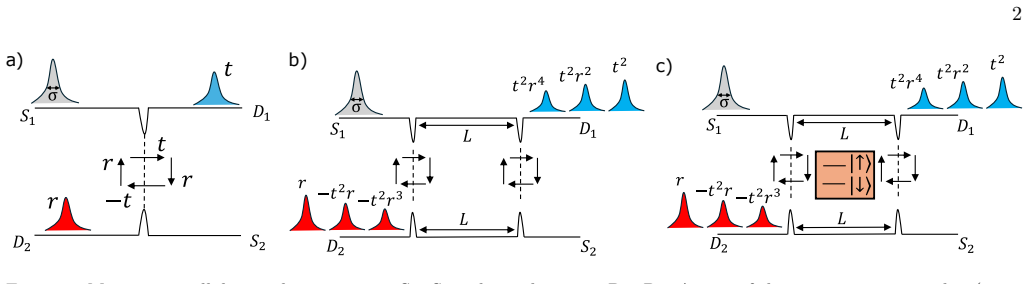
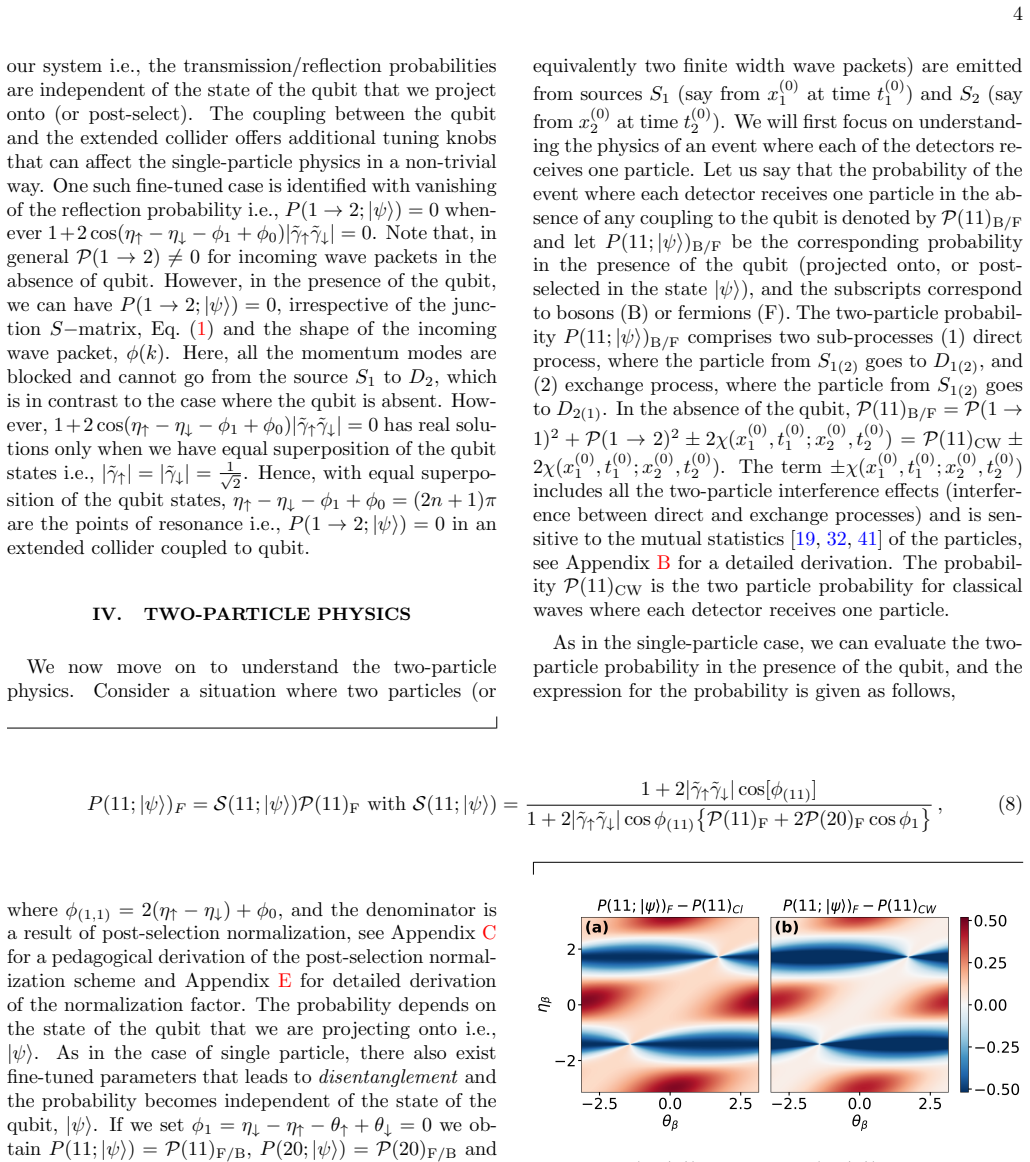
Mesoscopic colliders provide an effective platform for probing the mutual statistics of quantum particles. Recent experiments have successfully extracted the mutual statistics of fermions, and more exotic anyons using quantum point contacts (QPCs). Coupling a point-like collider, such as a quantum point contact, to a two-level impurity or qubit can induce statistical transmutation of fermions, causing them to display boson-like bunching tendencies. Here, we extend the analysis to an extended collider. We investigate the scattering of two incoming fermionic and bosonic wave packets in the presence of post-selection on the impurity state, and systematically analyze the possible benchmarks used to characterize bunching and infer the underlying mutual statistics. We show that only a specific benchmark faithfully captures the mutual statistics of the colliding particles, while alternative choices can produce spurious statistical signatures. Hence, the correct benchmark for probing the quantum statistics depends on the intricate details of the mesoscopic collider.
Editorial analysis
A structured set of objections, weighed in public.
Referee Report
Summary. The manuscript extends prior work on point-like colliders to an extended collider geometry coupled to a qubit. It analyzes the scattering of incoming fermionic and bosonic wave packets under post-selection on the qubit state and compares multiple benchmarks for bunching. The central claim is that only one specific benchmark faithfully extracts the mutual statistics without spurious geometry-induced signatures, while alternatives fail, and that the correct benchmark choice depends on the collider details.
Significance. If the separation between true statistics and geometry artifacts holds under post-selection, the result would be significant for experimental mesoscopic physics: it provides a cautionary and constructive guide for benchmark selection when probing anyonic or fermionic statistics in extended devices, reducing the risk of misinterpretation in future collider experiments.
major comments (1)
- [Analysis of post-selection and benchmark comparison (likely §3–§5)] The load-bearing assumption is that post-selection on the qubit state, combined with wave-packet scattering in the extended geometry, produces a clean separation between mutual statistics and geometry-induced multi-path interference or residual entanglement. The skeptic concern is valid here: if this separation is only approximate for the chosen parameters, then the claim that alternative benchmarks produce spurious signatures (while the chosen one does not) would not be robust. Explicit checks—e.g., quantifying residual entanglement or interference terms that survive post-selection—are needed to confirm the separation is exact rather than parameter-specific.
minor comments (2)
- [Abstract and Introduction] The abstract and introduction would benefit from a concise table or list explicitly defining the alternative benchmarks under comparison and the chosen faithful benchmark.
- [Methods and figures] Notation for the wave-packet parameters and coupling strengths should be standardized across figures and text to aid readability.
Simulated Author's Rebuttal
We thank the referee for their careful reading of the manuscript and for raising this important point about the robustness of the post-selection procedure. We address the comment below.
read point-by-point responses
-
Referee: [Analysis of post-selection and benchmark comparison (likely §3–§5)] The load-bearing assumption is that post-selection on the qubit state, combined with wave-packet scattering in the extended geometry, produces a clean separation between mutual statistics and geometry-induced multi-path interference or residual entanglement. The skeptic concern is valid here: if this separation is only approximate for the chosen parameters, then the claim that alternative benchmarks produce spurious signatures (while the chosen one does not) would not be robust. Explicit checks—e.g., quantifying residual entanglement or interference terms that survive post-selection—are needed to confirm the separation is exact rather than parameter-specific.
Authors: We respectfully disagree that the separation is approximate or parameter-specific. Sections 3–5 present a complete analytical derivation of the two-particle scattering amplitudes in the extended collider. After post-selection onto the qubit ground state, the projection operator eliminates all residual entanglement exactly: the cross terms arising from multi-path interference in the extended geometry cancel identically due to the orthogonality of the qubit states. This cancellation is shown explicitly in the expressions for the post-selected correlation functions (Eqs. 12–14), which reduce precisely to the form dictated by the mutual statistics alone. The same cancellation does not occur for the alternative benchmarks, producing the spurious signatures we report. These results hold for arbitrary wave-packet shapes and collider lengths within the model assumptions and are not limited to special parameter values. We are prepared to add a short supplementary paragraph reiterating the exact cancellation if the referee finds the existing derivations insufficiently highlighted. revision: no
Circularity Check
No circularity detected from available text
full rationale
The abstract and provided excerpts describe an investigation of benchmarks for mutual statistics in an extended collider with post-selection on a qubit state. No equations, fitting procedures, self-citations, or derivations are shown that reduce a claimed result to its inputs by construction. The central claim concerns which benchmark faithfully captures statistics versus producing spurious signatures, but this is presented as an analysis outcome rather than a self-definitional or fitted-input prediction. Without visible load-bearing steps that match the enumerated circularity patterns, the derivation chain cannot be flagged as circular. This is the expected outcome when no explicit reduction is exhibited.
Axiom & Free-Parameter Ledger
Reference graph
Works this paper leans on
-
[1]
This implies we have disentanglement in 4 our system i.e., the transmission/reflection probabilities are independent of the state of the qubit that we project onto (or post-select)
and similarlyP(1→2;|ψ⟩) =P(1→2) and hence the single-particle probabilities are independent of the state of the qubit|ψ⟩. This implies we have disentanglement in 4 our system i.e., the transmission/reflection probabilities are independent of the state of the qubit that we project onto (or post-select). The coupling between the qubit and the extended colli...
-
[2]
Hence, with equal superpo- sition of the qubit states,η ↑ −η ↓ −ϕ 1 +ϕ 0 = (2n+ 1)π are the points of resonance i.e.,P(1→2;|ψ⟩) = 0 in an extended collider coupled to qubit. IV. TWO-P AR TICLE PHYSICS We now move on to understand the two-particle physics. Consider a situation where two particles (or equivalently two finite width wave packets) are emitted ...
2026
-
[3]
Let us start by looking at the event where we receive one particle at each detectorD 1 andD 2
Two-particle scattering Let us generalize the above analysis for the case where we have two incoming particles from the two sourcesS 1 andS 2. Let us start by looking at the event where we receive one particle at each detectorD 1 andD 2. Scattering amplitude of this event, denoted byA m(11) is given as follows, Am(11) =⟨Ω|ϕ d2(x2, t2)ϕd1(x1, t1)˜ϕ† s1(x(0...
-
[4]
Under these conditions, we can have cos(η ↑ −η ↓ −ϕ 1 +ϕ 0) =−1
This means that resonant scattering due to the qubit survives iff the qubit is in an equal superposition state. Under these conditions, we can have cos(η ↑ −η ↓ −ϕ 1 +ϕ 0) =−1. Now, without the loss of generality, let us assumeη ↑ = 0 =θ ↑ and hence we obtain, cos(θ↓ −2η ↓ +ϕ 0) =−1,(D21) or ϕ0 = (2n+ 1)π−θ ↓ + 2η↓ .(D22) Hence, we get extra resonances so...
-
[5]
Entanglement condition for a single particle incoming state To get the entanglement condition for a single particle case, we calculate the quantityϵ=⟨i|S † ↑S↓|i⟩. Recall that the effective scattering matrix of a particle with momentumkis given as: S(m) eff = Tkeiηm Rkeiθm Rkei(2ηm−θm) Tkeiηm = tk,m rk,m r′ k,m tk,m ,(D23) where the elements of the scatte...
-
[6]
Next step is to evaluate the proportionality constant,N
Calculating the NormalizationN We found that the two particle probability for the event where each of the detector receives one particle in an extended collider coupled to a qubit is proportional to probability in the case where there is no coupling with the qubit. Next step is to evaluate the proportionality constant,N. Therefore, it becomes necessary to...
-
[7]
Entanglement Condition for a two-particle incoming state in the presence of a Geometric Phase In this section, we shall extract the disentanglement condition for an extended collider considered here. The effective scattering matrix is given as, S(m) eff = Tkeiηm Rkeiθm Rkei(2ηm−θm) Tkeiηm = tk,m rk,m r′ k,m tk,m .(E44) For an extended collider the reflect...
-
[8]
Khare,Fractional Statistics and Quantum Theory (WORLD SCIENTIFIC, 2005) p
A. Khare,Fractional Statistics and Quantum Theory (WORLD SCIENTIFIC, 2005) p. 320, doi:10.1142/5752
-
[9]
J. M. Leinaas and J. Myrheim, Il Nuovo Cimento B (1971-1996)37, 1 (1977)
1971
-
[10]
A. L. Fetter and J. D. Walecka,Quantum Theory of Many-Particle Systems(McGraw-Hill, Boston, 1971)
1971
-
[11]
J. J. Sakurai and J. Napolitano,Modern Quantum Me- chanics, 3rd ed. (Cambridge University Press, 2020)
2020
-
[12]
Wilczek, Phys
F. Wilczek, Phys. Rev. Lett.49, 957 (1982)
1982
-
[13]
Arovas, J
D. Arovas, J. R. Schrieffer, and F. Wilczek, Phys. Rev. Lett.53, 722 (1984)
1984
-
[14]
Wen,Quantum Field Theory of Many-Body Sys- tems: From the Origin of Sound to an Origin of Light and Electrons(Oxford University Press, 2007)
X.-G. Wen,Quantum Field Theory of Many-Body Sys- tems: From the Origin of Sound to an Origin of Light and Electrons(Oxford University Press, 2007)
2007
-
[15]
Nayak, S
C. Nayak, S. H. Simon, A. Stern, M. Freedman, and S. Das Sarma, Rev. Mod. Phys.80, 1083 (2008)
2008
-
[16]
Introduction to abelian and non-abelian anyons,
S. Rao, “Introduction to abelian and non-abelian anyons,” (2016), arXiv:1610.09260 [cond-mat.mes-hall]
Pith/arXiv arXiv 2016
-
[17]
B. I. Halperin, Phys. Rev. Lett.52, 1583 (1984)
1984
-
[18]
D. C. Tsui, H. L. Stormer, and A. C. Gossard, Phys. Rev. Lett.48, 1559 (1982)
1982
-
[19]
The quantum hall effect: Novel exci- tations and broken symmetries,
S. M. Girvin, “The quantum hall effect: Novel exci- tations and broken symmetries,” (1999), arXiv:cond- mat/9907002 [cond-mat.mes-hall]
arXiv 1999
-
[20]
Das Sarma, M
S. Das Sarma, M. Freedman, and C. Nayak, Phys. Rev. Lett.94, 166802 (2005)
2005
-
[21]
C. de C. Chamon, D. E. Freed, S. A. Kivelson, S. L. Sondhi, and X. G. Wen, Phys. Rev. B55, 2331 (1997)
1997
-
[22]
Vishveshwara, Phys
S. Vishveshwara, Phys. Rev. Lett.91, 196803 (2003)
2003
-
[23]
K. T. Law, D. E. Feldman, and Y. Gefen, Phys. Rev. B 74, 045319 (2006)
2006
-
[24]
D. E. Feldman, Y. Gefen, A. Kitaev, K. T. Law, and A. Stern, Phys. Rev. B76, 085333 (2007)
2007
-
[25]
B. I. Halperin, A. Stern, I. Neder, and B. Rosenow, Phys- ical Review B83(2011), 10.1103/physrevb.83.155440
-
[26]
Campagnano, O
G. Campagnano, O. Zilberberg, I. V. Gornyi, D. E. Feld- man, A. C. Potter, and Y. Gefen, Phys. Rev. Lett.109, 106802 (2012)
2012
-
[27]
Campagnano, O
G. Campagnano, O. Zilberberg, I. V. Gornyi, and Y. Gefen, Phys. Rev. B88, 235415 (2013)
2013
-
[28]
Neder, N
I. Neder, N. Ofek, Y. Chung, M. Heiblum, D. Mahalu, and V. Umansky, Nature448, 333 (2007), publisher: Na- ture Publishing Group
2007
-
[29]
Batra, Z
N. Batra, Z. Wei, S. Vishveshwara, and D. E. Feldman, Phys. Rev. B108, L241302 (2023)
2023
-
[30]
Z. Wei, N. Batra, V. F. Mitrovi´ c, and D. E. Feldman, Phys. Rev. B107, 104406 (2023)
2023
-
[31]
Batra, Z
N. Batra, Z. Wei, S. Vishveshwara, and D. E. Feldman, Phys. Rev. B112, 125305 (2025)
2025
-
[32]
Extracting the anyonic exchange phase from hanbury brown-twiss correlations,
F. Puster, M. Thamm, and B. Rosenow, “Extracting the anyonic exchange phase from hanbury brown-twiss correlations,” (2026), arXiv:2603.13898 [cond-mat.mes- hall]
arXiv 2026
-
[33]
Rosenow, I
B. Rosenow, I. P. Levkivskyi, and B. I. Halperin, Phys. Rev. Lett.116, 156802 (2016)
2016
-
[34]
J.-Y. M. Lee and H.-S. Sim, Nature Communications13, 6660 (2022). 20
2022
-
[35]
Schiller, Y
N. Schiller, Y. Shapira, A. Stern, and Y. Oreg, Phys. Rev. Lett.131, 186601 (2023)
2023
-
[36]
J.-Y. M. Lee, C. Hong, T. Alkalay, N. Schiller, V. Uman- sky, M. Heiblum, Y. Oreg, and H.-S. Sim, Nature617, 277 (2023)
2023
-
[37]
Effective linear response in non-equilibrium anyonic systems,
G. Zhang, I. Gornyi, and Y. Gefen, “Effective linear response in non-equilibrium anyonic systems,” (2025), arXiv:2510.03985 [cond-mat.mes-hall]
arXiv 2025
-
[38]
Zhang, I
G. Zhang, I. Gornyi, and Y. Gefen, Phys. Rev. Lett. 134, 096303 (2025)
2025
-
[39]
S. S. Samal, S. Vishveshwara, Y. Gefen, and J. I. V¨ ayry- nen, Phys. Rev. Lett.136, 076301 (2026)
2026
-
[40]
Nakamura, S
J. Nakamura, S. Liang, G. C. Gardner, and M. J. Man- fra, Nature Physics16, 931 (2020)
2020
-
[41]
Ronen, T
Y. Ronen, T. Werkmeister, D. Haie Najafabadi, A. T. Pierce, L. E. Anderson, Y. J. Shin, S. Y. Lee, Y. H. Lee, B. Johnson, K. Watanabe, T. Taniguchi, A. Yacoby, and P. Kim, Nature Nanotechnology16, 563 (2021)
2021
-
[42]
Nakamura, S
J. Nakamura, S. Liang, G. C. Gardner, and M. J. Man- fra, Phys. Rev. X13, 041012 (2023)
2023
-
[43]
H. K. Kundu, S. Biswas, N. Ofek, V. Umansky, and M. Heiblum, Nature Physics19, 515–521 (2023)
2023
-
[44]
J. Kim, H. Dev, R. Kumar, A. Ilin, A. Haug, V. Bhardwaj, C. Hong, K. Watanabe, T. Taniguchi, A. Stern, and Y. Ronen, Nature Nanotechnology (2024), 10.1038/s41565-024-01751-w
-
[45]
Werkmeister, J
T. Werkmeister, J. R. Ehrets, Y. Ronen, M. E. Wesson, D. Najafabadi, Z. Wei, K. Watanabe, T. Taniguchi, D. E. Feldman, B. I. Halperin, A. Yacoby, and P. Kim, Nature Communications15, 6533 (2024)
2024
-
[46]
Bartolomei, M
H. Bartolomei, M. Kumar, R. Bisognin, A. Marguerite, J.-M. Berroir, E. Bocquillon, B. Pla¸ cais, A. Cavanna, Q. Dong, U. Gennser, Y. Jin, and G. F` eve, Science368, 173 (2020)
2020
-
[47]
Ruelle, E
M. Ruelle, E. Frigerio, J.-M. Berroir, B. Pla¸ cais, J. Rech, A. Cavanna, U. Gennser, Y. Jin, and G. F` eve, Phys. Rev. X13, 011031 (2023)
2023
-
[48]
Blanter and M
Y. Blanter and M. B¨ uttiker, Physics Reports336, 1–166 (2000)
2000
-
[49]
Zhang, C
G. Zhang, C. Hong, T. Alkalay, V. Umansky, M. Heiblum, I. Gornyi, and Y. Gefen, Nature Commu- nications15, 3428 (2024)
2024
-
[50]
Barbarino, R
S. Barbarino, R. Fazio, V. Vedral, and Y. Gefen, Phys. Rev. B99, 045430 (2019)
2019
-
[51]
M. R. Geller and D. Loss, Phys. Rev. B56, 9692 (1997)
1997
-
[52]
Merlo, A
M. Merlo, A. Braggio, N. Magnoli, and M. Sassetti, Phys. Rev. B75, 195332 (2007)
2007
-
[53]
B. J. Overbosch and C. Chamon, Phys. Rev. B80, 035319 (2009)
2009
-
[54]
L. A. Cohen, N. L. Samuelson, T. Wang, K. Klocke, C. C. Reeves, T. Taniguchi, K. Watanabe, S. Vijay, M. P. Za- letel, and A. F. Young, Phys. Rev. Lett.134, 076302 (2025)
2025
-
[55]
Enhanced shot noise in graphene quantum point contacts with electro- static reconstruction,
M. Garg, O. Maillet, N. L. Samuelson, T. Wang, J. Feng, L. A. Cohen, A. Zhang, K. Watanabe, T. Taniguchi, P. Roulleau, M. Sassetti, M. Zaletel, A. F. Young, D. Fer- raro, P. Roche, and F. D. Parmentier, “Enhanced shot noise in graphene quantum point contacts with electro- static reconstruction,” (2025), arXiv:2503.17209 [cond- mat.mes-hall]
arXiv 2025
-
[56]
S. A. Kivelson and C. Murthy, Phys. Rev. Lett.135, 126605 (2025)
2025
-
[57]
Fabry- p´ erot interferometry with stochastic anyonic sources,
S. Girdhar, E. G. Idrisov, and T. L. Schmidt, “Fabry- p´ erot interferometry with stochastic anyonic sources,” (2026), arXiv:2603.05052 [cond-mat.mes-hall]
arXiv 2026
-
[58]
Baym,Lectures On Quantum Mechanics (1st ed.) (CRC Press, 1969)
G. Baym,Lectures On Quantum Mechanics (1st ed.) (CRC Press, 1969)
1969
-
[59]
Y. V. Nazarov and Y. M. Blanter,Quantum Trans- port: Introduction to Nanoscience(Cambridge Univer- sity Press, 2009)
2009
-
[60]
Thamm and B
M. Thamm and B. Rosenow, Phys. Rev. Lett.132, 156501 (2024)
2024
-
[61]
K. Iyer, F. Ronetti, B. Gr´ emaud, T. Martin, J. Rech, and T. Jonckheere, Phys. Rev. Lett.132, 216601 (2024)
2024
-
[62]
Aharonov, P
Y. Aharonov, P. G. Bergmann, and J. L. Lebowitz, Phys. Rev.134, B1410 (1964)
1964
-
[63]
M. S. Leifer and R. W. Spekkens, Phys. Rev. Lett.95, 200405 (2005)
2005
-
[64]
F` eve, A
G. F` eve, A. Mah´ e, J.-M. Berroir, T. Kontos, B. Pla¸ cais, D. C. Glattli, A. Cavanna, B. Etienne, and Y. Jin, Sci- ence316, 1169 (2007)
2007
-
[65]
Jullien, P
T. Jullien, P. Roulleau, B. Roche, A. Cavanna, Y. Jin, and D. C. Glattli, Nature514, 603 (2014)
2014
discussion (0)
Sign in with ORCID, Apple, or X to comment. Anyone can read and Pith papers without signing in.