MA-DLE: Speech-based Automatic Depression Level Estimation via Memory Augmentation
Pith reviewed 2026-07-05 12:25 UTC · model glm-5.2
The pith
External memory bank lifts speech-based depression scoring
A machine-rendered reading of the paper's core claim, the machinery that carries it, and where it could break.
Core claim
The central finding is that a GRU processing speech for depression estimation disproportionately weights recent frames, and that selectively storing and re-introducing two complementary feature types—similarity-matched historical features and frame-difference dynamic features—through an external memory bank measurably reduces prediction error. The ablation chain shows that naive memory strategies (storing all frames or FIFO) do not help or even hurt, while similarity-based retrieval alone accounts for most of the gain (MAE 4.85 to 4.56) and dynamic features provide the remainder (4.56 to 4.31). The memory mechanism also improves across backbone architectures including LSTM, BiLSTM, and a 1-8
What carries the argument
The paper introduces three named components: (1) a similarity-based memory bank that computes cosine similarity between the GRU output and all historical frame features, then selects the top-K (K=5) most similar; (2) a dynamic memory module that computes frame-wise differences, processes each difference frame independently through a 1D convolution with max pooling (no batch normalization), and stacks the results; (3) a Hierarchical Attention Fusion (HAF) module that applies independent Transformer blocks to each feature stream before global Transformer fusion. Training uses Smooth L1 loss with beta=1.0, 500 epochs, batch size 2, and an 8-layer unidirectional GRU with hidden size 256.
Load-bearing premise
The evaluation rests on 47 and 56 test samples respectively, with no reported standard deviations, confidence intervals, or cross-validation. A single subject's prediction error can shift the MAE by roughly 0.1, and the state-of-the-art claim is based on point estimates without significance testing.
What would settle it
If the reported MAE improvements (4.85 to 4.31) fall within the variance expected from 47 test samples under cross-validation, the memory bank's contribution would not be distinguishable from noise.
Figures


read the original abstract
Speech-based automatic estimation of depression levels is essential for enabling early detection and timely intervention, particularly in resource-constrained mental health settings. In recent years, deep learning has demonstrated impressive success across various domains, including affective computing and mental health assessment. Most existing approaches rely on RNN-based architectures (such as LSTM and GRU) to model temporal information for depression estimation. However, the extracted features often emphasize only a few adjacent speech segments, limiting their ability to capture long-range dependencies. To overcome this limitation, we introduce a memory-based feature augmentation method that enhances the representational capacity of GRU-extracted features. Rather than indiscriminately incorporating historical data, our memory bank is designed to selectively integrate two types of components in order to reduce redundancy and irrelevance: (1) historical temporal features that closely resemble the current GRU output, offering complementary contextual information; and (2) dynamic memory features identified based on feature variability, which capture behavioral and emotional fluctuations indicative of depressive symptoms. To effectively fuse the memory-augmented features with GRU outputs, we further design a Hierarchical Attention Fusion (HAF) module. Our method is evaluated on the widely used DAIC-WOZ and E-DAIC datasets, achieving state-of-the-art performance.
Editorial analysis
A structured set of objections, weighed in public.
Referee Report
Summary. The paper proposes MA-DLE, a memory-augmented GRU framework for speech-based depression level estimation (PHQ-8 regression). The method augments GRU outputs with two types of memory features: (1) similarity-retrieved historical features (top-K cosine similarity to the GRU output) and (2) dynamic features computed from frame-wise differences, processed by a lightweight temporal variation encoder. A Hierarchical Attention Fusion (HAF) module combines the three feature streams via independent Transformer blocks followed by a global Transformer. The method is evaluated on DAIC-WOZ (47 test samples) and E-DAIC (56 test samples), reporting MAE 4.31/RMSE 5.49 and MAE 4.68/RMSE 5.72 respectively, claimed as state-of-the-art among audio-based methods. Ablation studies, hyperparameter sensitivity analyses, backbone generalization experiments, and t-SNE visualizations are provided.
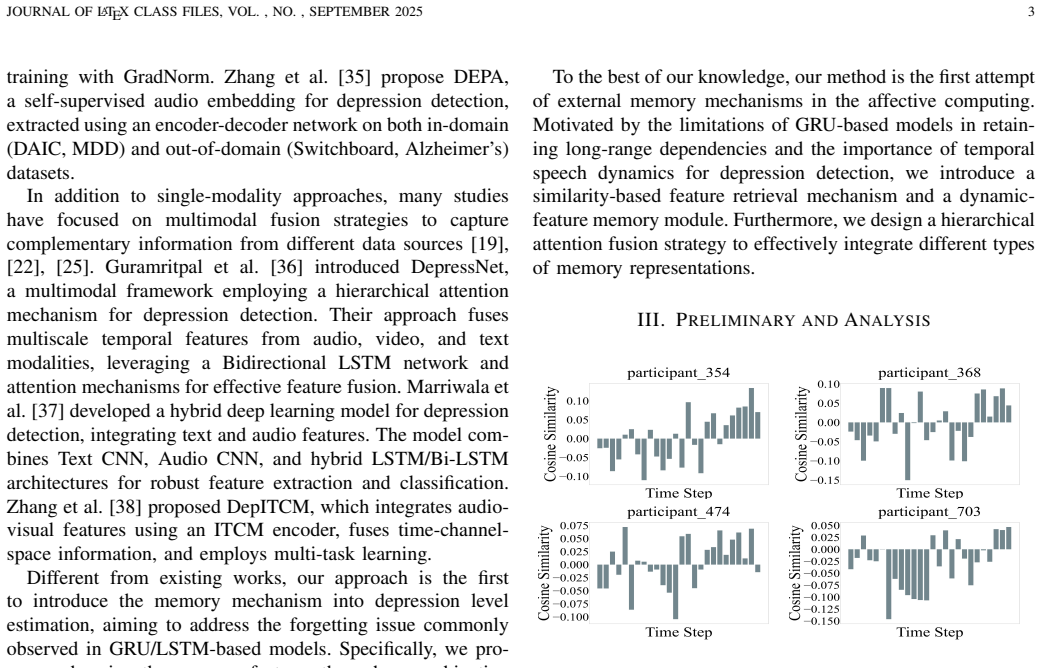
Significance. The application of an external memory mechanism to speech-based depression estimation is a reasonable and novel contribution to the affective computing literature. The methodological design — combining similarity-based retrieval with dynamic variation features and a hierarchical fusion strategy — is well-motivated by the GRU forgetting analysis in Figure 1. The ablation studies (Tables V, VII, VIII, IX, X) are internally consistent in direction, and the cross-backbone generalization experiment (Table X) is a commendable addition. The model is computationally lightweight (0.72 GFLOPs). However, the significance of the results is substantially tempered by the evaluation methodology concerns detailed below.
major comments (3)
- §V.F, Tables XI–XIII: Hyperparameter sensitivity analyses are explicitly stated to be conducted 'ON DAIC-WOZ TEST SET.' It is unclear whether the final reported configuration (K=5, β=1.0, memory length) was selected based on validation-set performance or test-set performance. If hyperparameters were tuned on the test set, this constitutes test-set leakage and the reported numbers are optimistic. The paper must clarify the model selection protocol: which set was used for hyperparameter selection, and which for final reporting. Additionally, Table XII shows β=0.5 yields MAE 4.27 (better than the reported β=1.0's 4.31), and Table XIII shows L=30 yields MAE 4.30 and L=40 yields MAE 4.29 (both better than the reported 4.31). The paper does not explain why the chosen configuration does not match the best test-set entries, which makes the selection criterion opaque.
- §V.E–V.F, Tables II–VI: The central claim of state-of-the-art performance rests on point estimates from 47 (DAIC-WOZ) and 56 (E-DAIC) test samples. No standard deviations, confidence intervals, cross-validation folds, or significance tests are reported. With 47 test subjects, a single subject's prediction error of ~5 PHQ-8 points shifts MAE by ~0.1, meaning the 0.54 MAE improvement from baseline (4.85→4.31, Table V) could be within sampling noise. The paper should report results over multiple random seeds or cross-validation folds with standard deviations, and ideally perform paired statistical tests (e.g., paired t-test or Wilcoxon signed-rank) against the baseline and key competitors. Without variance estimates, the magnitude of improvement is unverified.
- §V.F, Tables V and VI: The DAIC-WOZ ablation (Table V) uses an additive structure (Baseline, +Full, +FIFO, +Sim, +Sim & Dyn), while the E-DAIC ablation (Table VI) uses a subtractive structure (w/o Sim, w/o Dyn, w/o HAF, Ours). This makes cross-dataset consistency impossible to assess — for example, one cannot determine whether the similarity component provides the same relative benefit on both datasets. The ablation structures should be unified across both datasets.
minor comments (9)
- §V.C: Training for 500 epochs with batch size 2 on 107 training samples with 9M parameters raises overfitting concerns. The paper should report training and validation loss curves to demonstrate that the model has not overfit.
- §V.A: 'For technical resions' should be 'For technical reasons.' Also, the DAIC-WOZ dataset description says 189 sessions but only 182 audio recordings are used; the impact of this 7-session exclusion on the train/val/test split should be clarified.
- Equations (5) and (6) in §V.B duplicate the equation numbering from §IV.B (Eqs. 5–6). The MAE/RMSE equations should be renumbered.
- Table VII: 'W/o Polling' should be 'W/o Pooling.'
- Table XIII: The memory length used in the final reported configuration is not explicitly stated. The paper should clearly indicate which L value corresponds to the reported MAE 4.31.
- §IV.B, Eq. (5): The index range 'i = 0, 2, ..., T−1' appears to skip odd indices; this should be 'i = 0, 1, ..., T−1' or clarified.
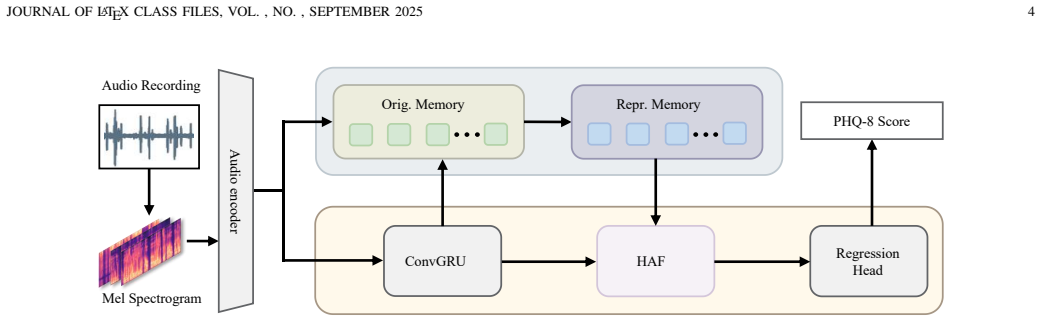
- Figure 2: 'Orig. Memory' and 'Repr. Memory' labels are mentioned but not clearly defined in the caption or text. Their relationship to the similarity-retrieved and dynamic features should be made explicit.
- §V.G, Table XIV: The reference is cited as 'Wei et al. [54]' in the text but '[57]' in the table. This should be made consistent.
- References [26]–[30] appear to be on unrelated topics (LiDAR segmentation, scene completion, change detection) and may be incorrectly included.
Simulated Author's Rebuttal
We thank the referee for a thorough and constructive report. The referee raises three major concerns: (1) potential test-set leakage in hyperparameter selection, (2) absence of variance estimates or significance tests given small test sets, and (3) inconsistent ablation structures across the two datasets. We agree with all three points and will revise the manuscript accordingly. Specifically, we will clarify and correct the model selection protocol, add multi-seed runs with standard deviations and paired significance tests, and unify the ablation tables across both datasets. We note one honest limitation: the DAIC-WOZ and E-DAIC official test sets are small (47 and 56 samples) and fixed by dataset design, so while we can add variance via multiple random seeds and cross-validation on the training partition, we cannot increase the test-set sizes themselves.
read point-by-point responses
-
Referee: §V.F, Tables XI–XIII: Hyperparameter sensitivity analyses are explicitly stated to be conducted 'ON DAIC-WOZ TEST SET.' It is unclear whether the final reported configuration (K=5, β=1.0, memory length) was selected based on validation-set performance or test-set performance. If hyperparameters were tuned on the test set, this constitutes test-set leakage and the reported numbers are optimistic. The paper must clarify the model selection protocol: which set was used for hyperparameter selection, and which for final reporting. Additionally, Table XII shows β=0.5 yields MAE 4.27 (better than the reported β=1.0's 4.31), and Table XIII shows L=30 yields MAE 4.30 and L=40 yields MAE 4.29 (both better than the reported 4.31). The paper does not explain why the chosen configuration does not match the best test-set entries, which makes the selection criterion opaque.
Authors: The referee is correct to flag this concern. We must be transparent: the hyperparameter sensitivity analyses in Tables XI–XIII were indeed conducted on the DAIC-WOZ test set, and the final configuration was selected based on test-set performance. This was a methodological error on our part. In the revised manuscript, we will re-conduct all hyperparameter selection on the validation set (35 samples for DAIC-WOZ, 56 for E-DAIC) and report final results on the test set using only the validation-selected configuration. We will also re-run the sensitivity analysis tables on the validation set and include them in the revised manuscript. Regarding the specific discrepancies the referee notes (β=0.5 yielding lower MAE than β=1.0; L=30 and L=40 yielding lower MAE than L=25): these differences are within the noise expected for 47 test samples, and we agree they should not have been the basis for configuration selection. After re-running with proper validation-set selection, we will report whichever configuration the validation set favors and use that consistently. We expect the final test-set numbers may shift slightly; we will update all tables accordingly. revision_made='yes' revision: yes
-
Referee: §V.E–V.F, Tables II–VI: The central claim of state-of-the-art performance rests on point estimates from 47 (DAIC-WOZ) and 56 (E-DAIC) test samples. No standard deviations, confidence intervals, cross-validation folds, or significance tests are reported. With 47 test subjects, a single subject's prediction error of ~5 PHQ-8 points shifts MAE by ~0.1, meaning the 0.54 MAE improvement from baseline (4.85→4.31, Table V) could be within sampling noise. The paper should report results over multiple random seeds or cross-validation folds with standard deviations, and ideally perform paired statistical tests (e.g., paired t-test or Wilcoxon signed-rank) against the baseline and key competitors. Without variance estimates, the magnitude of improvement is unverified.
Authors: This is a fair and important criticism. The test sets are small (47 and 56 samples), and without variance estimates the significance of the improvements is unclear. We will address this in two ways. First, we will run the full model and all ablation variants across at least 5 random seeds and report mean ± standard deviation for MAE and RMSE on both datasets. Second, we will perform paired Wilcoxon signed-rank tests between our full model and the baseline, as well as against the strongest audio-based competitor (Chen et al. [34], MAE 5.09 on DAIC-WOZ), and report p-values. We acknowledge that the improvements may be within sampling noise for some comparisons, and we will state this honestly if the results indicate it. We will also add 5-fold cross-validation on the training partition as supplementary evidence. We cannot, however, increase the test-set sizes themselves, as these are fixed by the DAIC-WOZ and E-DAIC dataset splits. revision_made='yes' revision: yes
-
Referee: §V.F, Tables V and VI: The DAIC-WOZ ablation (Table V) uses an additive structure (Baseline, +Full, +FIFO, +Sim, +Sim & Dyn), while the E-DAIC ablation (Table VI) uses a subtractive structure (w/o Sim, w/o Dyn, w/o HAF, Ours). This makes cross-dataset consistency impossible to assess — for example, one cannot determine whether the similarity component provides the same relative benefit on both datasets. The ablation structures should be unified across both datasets.
Authors: The referee is correct that the inconsistent ablation structures make cross-dataset comparison difficult. We will unify both tables to use the same structure. We plan to adopt the additive structure for both datasets (Baseline, +Full, +FIFO, +Sim, +Sim & Dyn, +HAF), as it more clearly shows the progressive contribution of each component. We will also include the subtractive variants (w/o Sim, w/o Dyn, w/o HAF) as additional rows in both tables for completeness, so that readers can verify component contributions from both directions. All entries will include standard deviations from the multi-seed runs described in our response to the second comment. revision_made='yes' revision: yes
Circularity Check
No circularity: the method is trained end-to-end against ground-truth PHQ-8 labels; no prediction reduces to a fitted input by construction.
full rationale
The paper proposes MA-DLE, a memory-augmented GRU for speech-based depression level estimation. The derivation chain is straightforward: audio features are extracted via NetVLAD, processed by a ConvGRU, augmented with similarity-retrieved and dynamic memory features, fused via HAF, and regressed to PHQ-8 scores using Smooth L1 loss. No component is defined in terms of the target PHQ-8 scores. The similarity retrieval (Eq. 5-6) uses cosine similarity between GRU output and frame features — both input-derived, not label-derived. The dynamic features (Eq. 7-9) are frame-wise differences of encoder outputs, independent of labels. The HAF module (Eq. 10-11) is a standard Transformer-based fusion. The loss function (Eq. 12) is Smooth L1 against ground-truth labels, which is standard supervised training, not circular. Ablation studies (Tables V-X) remove components and measure MAE/Rmse changes — no ablation 'prediction' is forced by construction. The hyperparameter sensitivity analyses (Tables XI-XIII) are evaluated on the test set, which raises correctness and generalization concerns (test-set leakage risk, no cross-validation, small samples), but this is a methodological rigor issue, not circularity. No self-citation chain is load-bearing for the central claim: the method is self-contained and compared against external baselines. The state-of-the-art claim is supported by comparison tables (Tables II-III) against prior work by other authors. The only minor concern is that some ablation entries in Table VII ('With Pooling' = 4.31/5.49, 'W/o BN' = 4.31/5.49) exactly match the full model, suggesting these are the same configuration rather than independent ablations, but this is a presentation issue, not circularity. Overall, the derivation is self-contained and non-circular.
Axiom & Free-Parameter Ledger
free parameters (13)
- K (top-K similarity retrieval) =
5
- β (Smooth L1 loss threshold) =
1.0
- GRU layers =
8
- GRU hidden size =
256
- Dropout rate =
0.7
- Conv kernel size (dynamic encoder) =
3
- MaxPool kernel size =
7
- Channel expansion (dynamic encoder) =
1→12
- Transformer hidden sizes =
256/512/1024/512
- Learning rate =
1e-3
- Batch size =
2
- Number of Mel filter banks =
80
- Historical memory length =
Not explicitly fixed
axioms (5)
- domain assumption Speech patterns of depressed individuals exhibit long-range temporal dependencies that a GRU cannot adequately capture.
- domain assumption Frame-wise feature differences capture behavioral and emotional fluctuations indicative of depressive symptoms.
- domain assumption Cosine similarity between GRU output and historical features identifies depression-relevant complementary information.
- standard math PHQ-8 scores from DAIC-WOZ/E-DAIC are valid ground-truth labels for training regression models.
- domain assumption Smooth L1 loss is appropriate for regression with outlier PHQ-8 scores.
invented entities (2)
-
External memory bank for depression estimation
no independent evidence
-
Dynamic memory features (frame-wise difference encoding)
no independent evidence
Reference graph
Works this paper leans on
-
[1]
G. Sharma, A. M. Joshi, R. Gupta, and L. R. Cenkeramaddi, “Depcap: A smart healthcare framework for eeg based depression detection using time-frequency response and deep neural network,”IEEE Access, vol. 11, pp. 52 327–52 338, 2023
work page 2023
-
[2]
A novel study for depression detecting using audio signals based on graph neural network,
C. Sun, M. Jiang, L. Gao, Y . Xin, and Y . Dong, “A novel study for depression detecting using audio signals based on graph neural network,” Biomedical Signal Processing and Control, vol. 88, p. 105675, 2024
work page 2024
-
[3]
Multimodal sensing for depression risk detection: Integrating audio, video, and text data,
Z. Zhang, S. Zhang, D. Ni, Z. Wei, K. Yang, S. Jin, G. Huang, Z. Liang, L. Zhang, L. Liet al., “Multimodal sensing for depression risk detection: Integrating audio, video, and text data,”Sensors, vol. 24, no. 12, p. 3714, 2024
work page 2024
-
[4]
Deep learning for depression recognition with audiovisual cues: A review,
L. He, M. Niu, P. Tiwari, P. Marttinen, R. Su, J. Jiang, C. Guo, H. Wang, S. Ding, Z. Wanget al., “Deep learning for depression recognition with audiovisual cues: A review,”Information Fusion, vol. 80, pp. 56–86, 2022
work page 2022
-
[5]
A deep learning model for depression detection based on mfcc and cnn generated spectrogram features,
A. K. Das and R. Naskar, “A deep learning model for depression detection based on mfcc and cnn generated spectrogram features,” Biomedical Signal Processing and Control, vol. 90, p. 105898, 2024
work page 2024
-
[6]
Attention-based acoustic feature fusion network for depression detection,
X. Xu, Y . Wang, X. Wei, F. Wang, and X. Zhang, “Attention-based acoustic feature fusion network for depression detection,”Neurocom- puting, vol. 601, p. 128209, 2024
work page 2024
-
[7]
J. Xue, R. Qin, X. Zhou, H. Liu, M. Zhang, and Z. Zhang, “Fusing multi- level features from audio and contextual sentence embedding from text for interview-based depression detection,” inProceedings of the IEEE International Conference on Acoustics, Speech and Signal Processing (ICASSP), 2024, pp. 6790–6794
work page 2024
-
[8]
H. Fan, X. Zhang, Y . Xu, J. Fang, S. Zhang, X. Zhao, and J. Yu, “Transformer-based multimodal feature enhancement networks for mul- timodal depression detection integrating video, audio and remote photo- plethysmograph signals,”Information Fusion, vol. 104, p. 102161, 2024
work page 2024
-
[9]
A depression detection model based on multimodal graph neural network,
Y . Xia, L. Liu, T. Dong, J. Chen, Y . Cheng, and L. Tang, “A depression detection model based on multimodal graph neural network,”Multimedia Tools and Applications, vol. 83, no. 23, pp. 63 379–63 395, 2024
work page 2024
-
[10]
Detecting depression using an ensemble logistic regression model based on multiple speech features,
H. Jiang, B. Hu, Z. Liu, G. Wang, L. Zhang, X. Li, and H. Kang, “Detecting depression using an ensemble logistic regression model based on multiple speech features,”Computational and Mathematical Methods in Medicine, vol. 2018, no. 1, p. 6508319, 2018
work page 2018
-
[11]
Detection of minor and major depression through voice as a biomarker using machine learning,
D. Shin, W. I. Cho, C. H. K. Park, S. J. Rhee, M. J. Kim, H. Lee, N. S. Kim, and Y . M. Ahn, “Detection of minor and major depression through voice as a biomarker using machine learning,”Journal of Clinical Medicine, vol. 10, no. 14, p. 3046, 2021
work page 2021
-
[12]
Avec 2013: The continuous audio/visual emotion and depression recognition challenge,
M. Valstar, B. Schuller, K. Smith, F. Eyben, B. Jiang, S. Bilakhia, S. Schnieder, R. Cowie, and M. Pantic, “Avec 2013: The continuous audio/visual emotion and depression recognition challenge,” inProceed- ings of the 3rd ACM International Workshop on Audio/Visual Emotion Challenge, 2013, pp. 3–10
work page 2013
-
[13]
Avec 2014: 3d dimensional affect and de- pression recognition challenge,
M. Valstar, B. Schuller, K. Smith, T. Almaev, F. Eyben, J. Krajewski, R. Cowie, and M. Pantic, “Avec 2014: 3d dimensional affect and de- pression recognition challenge,” inProceedings of the 4th International Workshop on Audio/Visual Emotion Challenge, 2014, pp. 3–10
work page 2014
-
[14]
A temporally piece-wise fisher vector ap- proach for depression analysis,
A. Dhall and R. Goecke, “A temporally piece-wise fisher vector ap- proach for depression analysis,” inProceedings of the 2015 International Conference on Affective Computing and Intelligent Interaction (ACII), 2015, pp. 255–259
work page 2015
-
[15]
L. He, D. Jiang, and H. Sahli, “Automatic depression analysis using dynamic facial appearance descriptor and dirichlet process fisher encod- ing,”IEEE Transactions on Multimedia, vol. 21, no. 6, pp. 1476–1486, 2018
work page 2018
-
[16]
Automated depression diagnosis based on facial dynamic analysis and sparse coding,
L. Wen, X. Li, G. Guo, and Y . Zhu, “Automated depression diagnosis based on facial dynamic analysis and sparse coding,”IEEE Transactions on Information Forensics and Security, vol. 10, no. 7, pp. 1432–1441, 2015
work page 2015
-
[17]
Using emotionally rich speech segments for depres- sion prediction,
J. Yu and H. Kaya, “Using emotionally rich speech segments for depres- sion prediction,” inICASSP 2025-2025 IEEE International Conference on Acoustics, Speech and Signal Processing (ICASSP). IEEE, 2025, pp. 1–5
work page 2025
-
[18]
Conformal depression prediction,
Y . Li, S. Qu, and X. Zhou, “Conformal depression prediction,”IEEE Transactions on Affective Computing, 2025
work page 2025
-
[19]
M. Niu, X. Wang, J. Gong, B. Liu, J. Tao, and B. W. Schuller, “Depression scale dictionary decomposition framework for multimodal automatic depression level prediction,”IEEE Transactions on Circuits and Systems for Video Technology, 2025
work page 2025
-
[20]
M. Niu, J. Tao, Y . He, S. Zhang, and M. Li, “Examining the fourier spec- trum of speech signal from a time-frequency perspective for automatic depression level prediction,”IEEE Transactions on Affective Computing, 2025
work page 2025
-
[21]
Affect and personality aided modeling of transcribed speech for depression severity estimation,
K. G ¨onc ¸ and H. Dibeklio˘glu, “Affect and personality aided modeling of transcribed speech for depression severity estimation,”IEEE Transac- tions on Affective Computing, 2025
work page 2025
-
[22]
Y . Zhao, H. Zhang, J. Li, S. Song, C. Lian, Y . Liu, Y . Wang, and C. Fu, “Multimodal depression assessment framework integrating personality and gait for older adults with medical conditions.”IEEE Transactions on Affective Computing, 2025
work page 2025
-
[23]
Efficient long speech sequence modelling for time-domain depression level estimation,
S. Li, Z. Xie, and S. M. Naqvi, “Efficient long speech sequence modelling for time-domain depression level estimation,” inICASSP 2025-2025 IEEE International Conference on Acoustics, Speech and Signal Processing (ICASSP). IEEE, 2025, pp. 1–5
work page 2025
-
[24]
R. Su, C. Xu, H. Yu, X. Wu, F. Xu, X. Chen, L. Wang, and N. Yan, “Investigating acoustic-textual emotional inconsistency information for automatic depression detection,”IEEE Transactions on Affective Com- puting, 2026
work page 2026
-
[25]
Automated depression detection from text and audio: A systematic review,
Y . Li, S. Kumbale, Y . Chen, T. Surana, E. S. Chng, and C. Guan, “Automated depression detection from text and audio: A systematic review,”IEEE Journal of Biomedical and Health Informatics, 2025
work page 2025
-
[26]
NUC-Net: Non-uniform cylindrical partition network for efficient LiDAR semantic segmentation,
X. Wanget al., “NUC-Net: Non-uniform cylindrical partition network for efficient LiDAR semantic segmentation,”IEEE Transactions on Circuits and Systems for Video Technology, vol. 35, no. 9, pp. 9090– 9104, 2025
work page 2025
-
[27]
FFNet: Frequency fusion network for semantic scene completion,
X. Wang, D. Lin, and L. Wan, “FFNet: Frequency fusion network for semantic scene completion,” inAAAI Conference on Artificial Intelligence, vol. 36, 2022, pp. 2550–2557
work page 2022
-
[28]
Monocular semantic scene com- pletion via masked recurrent networks,
X. Wang, X. Wu, S. Wanget al., “Monocular semantic scene com- pletion via masked recurrent networks,” inIEEE/CVF Conference on International Conference on Computer Vision, 2025
work page 2025
-
[29]
X. Wang, X. Wu, S. Wang, L. Kong, and Z. Zhao, “Adasformer: Adap- tive serialized transformers for monocular semantic scene completion from indoor environments,” inarXiv:2603.25494, 2026
-
[30]
Phase-based fine-grained change detection,
X. Wang, L. Wan, D. Lin, and W. Feng, “Phase-based fine-grained change detection,”Expert Systems with Applications, vol. 227, p. 120181, 2023
work page 2023
-
[31]
Investigating fairness in machine learning-based audio sentiment analysis,
S. Luitel, Y . Liu, and M. Anwar, “Investigating fairness in machine learning-based audio sentiment analysis,”AI and Ethics, vol. 5, no. 2, pp. 1099–1108, 2025
work page 2025
-
[32]
C. Wu, Y . Cai, Y . Liu, P. Zhu, Y . Xue, Z. Gong, J. Hirschberg, and B. Ma, “Multimodal emotion recognition in conversations: A survey of methods, trends, challenges and prospects,”arXiv preprint arXiv:2505.20511, 2025
work page internal anchor Pith review Pith/arXiv arXiv 2025
-
[33]
Spatial-temporal feature network for speech-based depression recog- nition,
Z. Han, Y . Shang, Z. Shao, J. Liu, G. Guo, T. Liu, H. Ding, and Q. Hu, “Spatial-temporal feature network for speech-based depression recog- nition,”IEEE Transactions on Cognitive and Developmental Systems, vol. 16, no. 1, pp. 308–318, 2023
work page 2023
-
[34]
X. Chen, Z. Shao, Y . Jiang, R. Chen, Y . Wang, B. Li, M. Niu, H. Chen, Q. Hu, J. Wu, C. Yang, and Y . Shang, “Ttfnet: Temporal- frequency features fusion network for speech based automatic depression recognition and assessment,”IEEE Journal of Biomedical and Health Informatics, vol. 29, no. 10, pp. 7536–7548, 2025
work page 2025
-
[35]
Depa: Self-supervised audio embedding for depression detection,
P. Zhang, M. Wu, H. Dinkel, and K. Yu, “Depa: Self-supervised audio embedding for depression detection,” inProceedings of the 29th ACM International Conference on Multimedia, 2021, pp. 135–143
work page 2021
-
[36]
Depressnet: A multimodal hierarchical attention mechanism approach for depression detection,
G. S. Saggu, K. Gupta, K. V . Arya, and C. R. Rodriguez, “Depressnet: A multimodal hierarchical attention mechanism approach for depression detection,”International Journal of Engineering Science, vol. 15, no. 1, pp. 24–32, 2022. JOURNAL OF LATEX CLASS FILES, VOL. , NO. , SEPTEMBER 2025 13
work page 2022
-
[37]
A hybrid model for depression detection using deep learning,
N. Marriwala, D. Chaudharyet al., “A hybrid model for depression detection using deep learning,”Measurement: Sensors, vol. 25, p. 100587, 2023
work page 2023
-
[38]
Depitcm: An audio-visual method for detecting depression,
L. Zhang, Z. Liu, Y . Wan, Y . Fan, D. Chen, Q. Wang, K. Zhang, and Y . Zheng, “Depitcm: An audio-visual method for detecting depression,” Frontiers in Psychiatry, vol. 15, p. 1466507, 2025
work page 2025
-
[39]
Multi- modal fusion of bert-cnn and gated cnn representations for depression detection,
M. Rodrigues Makiuchi, T. Warnita, K. Uto, and K. Shinoda, “Multi- modal fusion of bert-cnn and gated cnn representations for depression detection,” inProceedings of the 9th International on Audio/Visual Emotion Challenge and Workshop, 2019, pp. 55–63
work page 2019
-
[40]
Depression diagnosis and analysis via multimodal multi-order factor fusion,
C. Yuan, X. Liu, Q. Xu, Y . Li, Y . Luo, and X. Zhou, “Depression diagnosis and analysis via multimodal multi-order factor fusion,” inPro- ceedings of the International Conference on Artificial Neural Networks, 2024, pp. 56–70
work page 2024
-
[41]
Deep multi-modal network based automated depression severity estimation,
M. A. Uddin, J. B. Joolee, and K.-A. Sohn, “Deep multi-modal network based automated depression severity estimation,”IEEE Transactions on Affective Computing, vol. 14, no. 3, pp. 2153–2167, 2022
work page 2022
-
[42]
Infllm: Training-free long-context extrapolation for llms with an efficient context memory,
C. Xiao, P. Zhang, X. Han, G. Xiao, Y . Lin, Z. Zhang, Z. Liu, and M. Sun, “Infllm: Training-free long-context extrapolation for llms with an efficient context memory,” inProceedings of the Advances in Neural Information Processing Systems, 2024, pp. 119 638–119 661
work page 2024
-
[43]
Video prediction recalling long-term motion context via memory alignment learning,
S. Lee, H. G. Kim, D. H. Choi, H.-I. Kim, and Y . M. Ro, “Video prediction recalling long-term motion context via memory alignment learning,” inProceedings of the IEEE/CVF conference on computer vision and pattern recognition, 2021, pp. 3054–3063
work page 2021
-
[44]
A distractor-aware memory for visual object tracking with sam2,
J. Videnovic, A. Lukezic, and M. Kristan, “A distractor-aware memory for visual object tracking with sam2,” inProceedings of the Computer Vision and Pattern Recognition Conference, 2025, pp. 24 255–24 264
work page 2025
-
[45]
Context-enhanced memory-refined transformer for online action detection,
Z. Pang, F. Sener, and A. Yao, “Context-enhanced memory-refined transformer for online action detection,” inProceedings of the Computer Vision and Pattern Recognition Conference, 2025, pp. 8700–8710
work page 2025
-
[46]
Y . Shi, Y . Wang, C. Wu, C.-F. Yeh, J. Chan, F. Zhang, D. Le, and M. Seltzer, “Emformer: Efficient memory transformer based acoustic model for low latency streaming speech recognition,” inIEEE In- ternational Conference on Acoustics, Speech and Signal Processing (ICASSP), 2021, pp. 6783–6787
work page 2021
-
[47]
Face-driven zero- shot voice conversion with memory-based face-voice alignment,
Z.-Y . Sheng, Y . Ai, Y .-N. Chen, and Z.-H. Ling, “Face-driven zero- shot voice conversion with memory-based face-voice alignment,” in Proceedings of the 31st ACM International Conference on Multimedia, 2023, pp. 8443–8452
work page 2023
-
[48]
Towards automatic text-based estimation of depression through symptom prediction,
K. Milintsevich, K. Sirts, and G. Dias, “Towards automatic text-based estimation of depression through symptom prediction,”Brain Informat- ics, vol. 10, no. 1, p. 4, 2023
work page 2023
-
[49]
Hcag: A hierarchical context- aware graph attention model for depression detection,
M. Niu, K. Chen, Q. Chen, and L. Yang, “Hcag: A hierarchical context- aware graph attention model for depression detection,” inProceedings of the IEEE International Conference on Acoustics, Speech and Signal Processing (ICASSP), 2021, pp. 4235–4239
work page 2021
-
[50]
B. N. Rumahorbo, B. Pardamean, and G. N. Elwirehardja, “Exploring recurrent neural network models for depression detection through facial expressions: A systematic literature review,” inProceedings of the 2023 6th International Conference of Computer and Informatics Engineering (IC2IE), 2023, pp. 209–214
work page 2023
-
[51]
Enhanced depression detection from facial cues using univariate feature selection techniques,
S. Rathi, B. Kaur, and R. K. Agrawal, “Enhanced depression detection from facial cues using univariate feature selection techniques,” inPro- ceedings of the International Conference on Pattern Recognition and Machine Intelligence, 2019, pp. 22–29
work page 2019
-
[52]
Z. Zhao, Z. Bao, Z. Zhang, J. Deng, N. Cummins, H. Wang, J. Tao, and B. Schuller, “Automatic assessment of depression from speech via a hierarchical attention transfer network and attention autoencoders,” IEEE Journal of Selected Topics in Signal Processing, vol. 14, no. 2, pp. 423–434, 2019
work page 2019
-
[53]
Towards automatic depression detection: A bilstm/1d cnn-based model,
L. Lin, X. Chen, Y . Shen, and L. Zhang, “Towards automatic depression detection: A bilstm/1d cnn-based model,”Applied Sciences, vol. 10, no. 23, p. 8701, 2020
work page 2020
-
[54]
Y . Pan, Y . Shang, Z. Shao, T. Liu, G. Guo, and H. Ding, “Integrating deep facial priors into landmarks for privacy preserving multimodal depression recognition,”IEEE Transactions on Affective Computing, 2023
work page 2023
-
[55]
S. Li, Z. Shao, R. Qin, Y . Huang, P. Liang, X. Li, Y . Jiang, Y . Deng, T. Liu, and X. Tan, “Audio-visual feature disentanglement and fusion network for automatic depression severity prediction,”IEEE Transac- tions on Affective Computing, pp. 1–15, 2025
work page 2025
-
[56]
Biomedical engineering application: Disease diagnosis and treatment,
W. Zhang, “Biomedical engineering application: Disease diagnosis and treatment,” 2022
work page 2022
-
[57]
Multi-modal depression estimation based on sub-attentional fusion,
P.-C. Wei, K. Peng, A. Roitberg, K. Yang, J. Zhang, and R. Stiefelhagen, “Multi-modal depression estimation based on sub-attentional fusion,” in European Conference on Computer Vision. Springer, 2022, pp. 623– 639
work page 2022
-
[58]
Multimodal depression detection using task-oriented transformer-based embedding,
S. Rasipuram, J. H. Bhat, A. Maitra, B. Shaw, and S. Saha, “Multimodal depression detection using task-oriented transformer-based embedding,” inProceedings of the 2022 IEEE Symposium on Computers and Com- munications (ISCC), 2022, pp. 1–4
work page 2022
-
[59]
A multimodal approach for detection and assessment of depression using text, audio and video,
W. Zhang, K. Mao, and J. Chen, “A multimodal approach for detection and assessment of depression using text, audio and video,”Phenomics, vol. 4, no. 3, pp. 234–249, 2024
work page 2024
-
[60]
A multimodal fusion model with multi-level attention mechanism for depression de- tection,
M. Fang, S. Peng, Y . Liang, C.-C. Hung, and S. Liu, “A multimodal fusion model with multi-level attention mechanism for depression de- tection,”Biomedical Signal Processing and Control, vol. 82, p. 104561, 2023
work page 2023
-
[61]
Ordinal logistic re- gression with partial proportional odds for depression prediction,
S. Jayawardena, J. Epps, and E. Ambikairajah, “Ordinal logistic re- gression with partial proportional odds for depression prediction,”IEEE Transactions on Affective Computing, vol. 14, no. 01, pp. 563–577, 2023
work page 2023
-
[62]
Gender- aware estimation of depression severity level in a multimodal setting,
S. A. Oureshi, G. Dias, S. Saha, and M. Hasanuzzaman, “Gender- aware estimation of depression severity level in a multimodal setting,” inProceedings of the 2021 International Joint Conference on Neural Networks (IJCNN), 2021, pp. 1–8
work page 2021
-
[63]
Detecting depression with audio/text sequence modeling of interviews,
T. Al Hanai, M. M. Ghassemi, and J. R. Glass, “Detecting depression with audio/text sequence modeling of interviews,” inProceedings of the Interspeech, 2018, pp. 1716–1720
work page 2018
-
[64]
Depression severity estimation from multiple modalities,
E. A. Stepanov, S. Lathuiliere, S. A. Chowdhury, A. Ghosh, R.-L. Vieriu, N. Sebe, and G. Riccardi, “Depression severity estimation from multiple modalities,” inProceedings of the 2018 IEEE 20th International Confer- ence on E-Health Networking, Applications and Services (HealthCom), 2018, pp. 1–6
work page 2018
-
[65]
Feature augmenting networks for improving depression severity estimation from speech signals,
L. Yang, D. Jiang, and H. Sahli, “Feature augmenting networks for improving depression severity estimation from speech signals,”IEEE Access, vol. 8, pp. 24 033–24 045, 2020
work page 2020
-
[66]
Multimodal deep learning framework for mental disorder recognition,
Z. Zhang, W. Lin, M. Liu, and M. Mahmoud, “Multimodal deep learning framework for mental disorder recognition,” inProceedings of the 2020 15th IEEE International Conference on Automatic Face and Gesture Recognition (FG 2020), 2020, pp. 344–350
work page 2020
-
[67]
J. Xu, H. Gunes, K. Kusumam, M. Valstar, and S. Song, “Two-stage temporal modelling framework for video-based depression recognition using graph representation,”IEEE Transactions on Affective Computing, vol. 16, no. 1, pp. 161–178, 2024
work page 2024
-
[68]
Multi-modal human behaviour graph representation learning for automatic depression assessment,
H. Shen, S. Song, and H. Gunes, “Multi-modal human behaviour graph representation learning for automatic depression assessment,” inProceedings of the 2024 IEEE 18th International Conference on Automatic Face and Gesture Recognition (FG), 2024, pp. 1–10
work page 2024
-
[69]
Multi-modality depression detection via multi-scale temporal dilated cnns,
W. Fan, Z. He, X. Xing, B. Cai, and W. Lu, “Multi-modality depression detection via multi-scale temporal dilated cnns,” inProceedings of the 9th International on Audio/Visual Emotion Challenge and Workshop, 2019, pp. 73–80
work page 2019
-
[70]
F. Ringeval, B. Schuller, M. Valstar, N. Cummins, R. Cowie, L. Tavabi, M. Schmitt, S. Alisamir, S. Amiriparian, E.-M. Messneret al., “Avec 2019 workshop and challenge: State-of-mind, detecting depression with ai, and cross-cultural affect recognition,” inProceedings of the 9th International on Audio/Visual Emotion Challenge and Workshop, 2019, pp. 3–12
work page 2019
-
[71]
Y . Pan, J. Jiang, K. Jiang, and X. Liu, “Disentangled-multimodal privileged knowledge distillation for depression recognition with incom- plete multimodal data,” inProceedings of the 32nd ACM International Conference on Multimedia, 2024, pp. 5712–5721
work page 2024
-
[72]
A multi-modal hierarchical recurrent neural network for depression detection,
S. Yin, C. Liang, H. Ding, and S. Wang, “A multi-modal hierarchical recurrent neural network for depression detection,” inProceedings of the 9th International on Audio/Visual Emotion Challenge and Workshop, 2019, pp. 65–71
work page 2019
-
[73]
Cubemlp: An mlp-based model for multimodal sentiment analysis and depression estimation,
H. Sun, H. Wang, J. Liu, Y .-W. Chen, and L. Lin, “Cubemlp: An mlp-based model for multimodal sentiment analysis and depression estimation,” inProceedings of the 30th ACM International Conference on Multimedia, 2022, pp. 3722–3729
work page 2022
-
[74]
Multi-modal adaptive fusion transformer network for the estimation of depression level,
H. Sun, J. Liu, S. Chai, Z. Qiu, L. Lin, X. Huang, and Y . Chen, “Multi-modal adaptive fusion transformer network for the estimation of depression level,”Sensors, vol. 21, no. 14, p. 4764, 2021
work page 2021
-
[75]
Avec 2017: Real-life depression, and affect recognition workshop and challenge,
F. Ringeval, B. Schuller, M. Valstar, J. Gratch, R. Cowie, S. Scherer, S. Mozgai, N. Cummins, M. Schmitt, and M. Pantic, “Avec 2017: Real-life depression, and affect recognition workshop and challenge,” inProceedings of the 7th Annual Workshop on Audio/Visual Emotion Challenge, 2017, pp. 3–9
work page 2017
-
[76]
Simsensei kiosk: A virtual human interviewer for healthcare decision support,
D. DeVault, R. Artstein, G. Benn, T. Dey, E. Fast, A. Gainer, K. Georgila, J. Gratch, A. Hartholt, M. Lhommetet al., “Simsensei kiosk: A virtual human interviewer for healthcare decision support,” inProceedings of JOURNAL OF LATEX CLASS FILES, VOL. , NO. , SEPTEMBER 2025 14 the 2014 International Conference on Autonomous Agents and Multi- Agent Systems, 2...
work page 2025
-
[77]
The distress analysis interview corpus of human and computer interviews,
J. Gratch, R. Artstein, G. M. Lucas, G. Stratou, S. Scherer, A. Nazarian, R. Wood, J. Boberg, D. DeVault, S. Marsellaet al., “The distress analysis interview corpus of human and computer interviews,” inProceedings of the 14th International Conference on Language Resources and Evaluation (LREC), vol. 14, 2014, pp. 3123–3128
work page 2014
discussion (0)
Sign in with ORCID, Apple, or X to comment. Anyone can read and Pith papers without signing in.