Artificial Intelligence in Ship Finance: Applications, Opportunities, and a Case Study in AI-Augmented Loan Origination
Pith reviewed 2026-06-28 19:54 UTC · model grok-4.3
The pith
AI-assisted systems can support ship finance professionals in managing complex information and reporting requirements.
A machine-rendered reading of the paper's core claim, the machinery that carries it, and where it could break.
Core claim
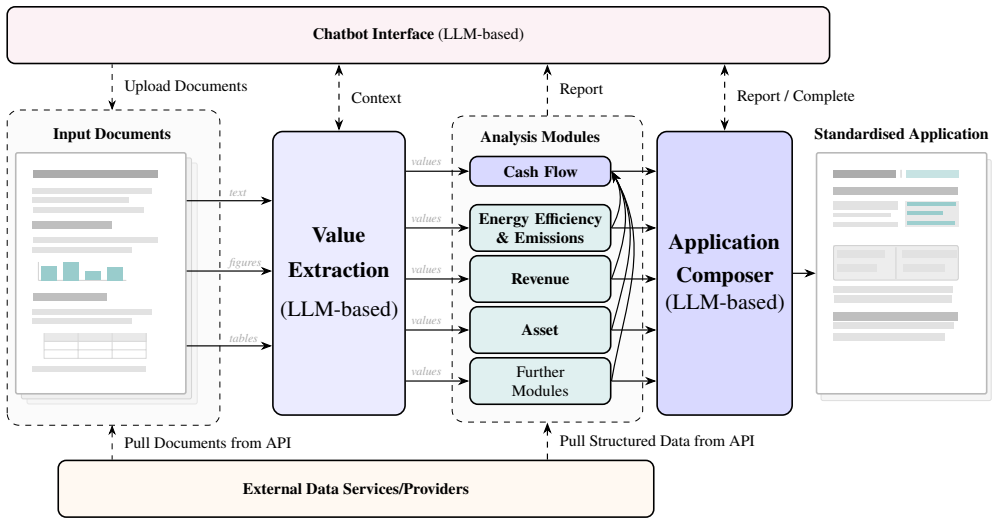
The paper claims that a modular agentic architecture using an LLM-based extraction module, financial analysis components, external maritime data services, and a controlled document-generation module with a chatbot interface can support the preparation of standardized financing applications in ship finance, while identifying key challenges for production use.
What carries the argument
ShipFinance.ai, a modular agentic architecture that integrates LLM-based extraction with financial analysis, external data services, and a chatbot for workflow automation in loan origination.
If this is right
- Automation of information extraction from financial, technical, contractual, and regulatory documents reduces manual effort in underwriting.
- Support for ESG reporting and environmental regulation compliance becomes more scalable in loan origination.
- Standardized financing applications can be prepared through controlled document generation and chatbot interaction.
- Production deployment requires addressing reliability challenges of LLM components in regulated finance environments.
Where Pith is reading between the lines
- The same modular approach could extend to other asset-based lending areas that rely on mixed structured and unstructured documents.
- Quantifying time savings would require running the system on archived loan files and comparing processing duration to current manual baselines.
- Linking the architecture directly to regulatory update feeds could enable proactive flagging of compliance changes during application review.
Load-bearing premise
That LLM-based extraction and analysis modules can reliably integrate and interpret heterogeneous unstructured sources in production without unacceptable error rates or hallucinations.
What would settle it
A side-by-side comparison of the system's outputs against human expert review on a set of real loan applications, measuring rates of extraction errors, hallucinations, and completeness.
Figures
read the original abstract
Ship finance is a data-intensive and document-heavy segment of asset-based lending, requiring the integration of financial, technical, contractual, and regulatory information from heterogeneous and largely unstructured sources. Increasing environmental regulation and ESG reporting requirements are adding further complexity to underwriting and loan-origination processes. Recent advances in artificial intelligence (AI), particularly large language models (LLMs), create new opportunities for processing and analysing such information. This paper reviews potential applications of AI in ship finance, with a particular focus on LLM-based systems for document comprehension, information extraction, and workflow automation. We present ShipFinance.ai, a modular agentic architecture to support loan application workflows in ship finance. The proposed system combines an LLM-based extraction module, financial analysis components, external maritime data services, and a controlled document-generation module with a chatbot interface to support the preparation of standardized financing applications. The paper discusses the key challenges for using such models in production. We argue that AI-assisted systems can support maritime finance professionals in managing increasingly complex information and reporting requirements.
Editorial analysis
A structured set of objections, weighed in public.
Referee Report
Summary. The manuscript reviews applications of AI, particularly LLMs, in ship finance for processing heterogeneous unstructured documents amid rising ESG and regulatory demands. It presents ShipFinance.ai, a modular agentic architecture integrating an LLM-based extraction module, financial analysis components, external maritime data services, and a controlled document-generation module with a chatbot interface to support standardized loan application workflows. The paper discusses production challenges and argues that AI-assisted systems can help maritime finance professionals manage complex information and reporting requirements.
Significance. If the proposed architecture proves reliable in practice, it could address a genuine pain point in a specialized, document-intensive lending sector. The work is primarily conceptual and opportunity-oriented rather than empirical; its significance therefore rests on whether future implementations can deliver production-grade extraction and analysis accuracy across financial, technical, contractual, and regulatory sources.
major comments (3)
- [Abstract, §3] Abstract and §3: The central claim that the ShipFinance.ai architecture can support loan origination depends on reliable LLM extraction and integration across heterogeneous sources, yet the section supplies only a high-level component description with no implementation details, test corpus, accuracy metrics, hallucination rates, or ablation results.
- [§4] §4: The discussion of challenges remains qualitative and does not quantify error risks (e.g., hallucination or integration failures) or demonstrate concrete mitigation strategies with evidence, leaving the production-readiness argument unsupported.
- [Title, Abstract] Title and abstract: The title announces a 'Case Study in AI-Augmented Loan Origination,' but neither the abstract nor the described content presents any specific case-study data, workflow outcomes, or performance evaluation.
minor comments (1)
- The manuscript would benefit from explicit section numbering and clearer delineation between the review of applications and the description of the proposed architecture.
Simulated Author's Rebuttal
We thank the referee for the constructive comments, which help clarify the scope and presentation of our conceptual work. We address each major comment below and indicate where revisions will be made to better align the manuscript with its intended contribution as a review and architectural proposal.
read point-by-point responses
-
Referee: [Abstract, §3] Abstract and §3: The central claim that the ShipFinance.ai architecture can support loan origination depends on reliable LLM extraction and integration across heterogeneous sources, yet the section supplies only a high-level component description with no implementation details, test corpus, accuracy metrics, hallucination rates, or ablation results.
Authors: We agree that §3 provides a high-level conceptual description rather than an implemented system with empirical metrics. The manuscript is positioned as a review of opportunities and a proposed modular architecture, not an empirical evaluation. We will revise §3 and the abstract to explicitly state that the architecture is conceptual, that no production implementation or test corpus was used, and that quantitative metrics on extraction accuracy, hallucination rates, or ablation studies are reserved for future work. This clarification will prevent overstatement of current capabilities. revision: yes
-
Referee: [§4] §4: The discussion of challenges remains qualitative and does not quantify error risks (e.g., hallucination or integration failures) or demonstrate concrete mitigation strategies with evidence, leaving the production-readiness argument unsupported.
Authors: The challenges section is qualitative because the architecture has not been deployed, so no system-specific error rates or production data are available. We will revise §4 to reference established LLM literature on hallucination risks and mitigation approaches (such as RAG, grounding, and human oversight) and describe how these are incorporated into the proposed design (e.g., controlled generation module). However, we cannot supply quantitative evidence from our own implementation at this stage, as none exists. revision: partial
-
Referee: [Title, Abstract] Title and abstract: The title announces a 'Case Study in AI-Augmented Loan Origination,' but neither the abstract nor the described content presents any specific case-study data, workflow outcomes, or performance evaluation.
Authors: This point is well taken. The term 'case study' was intended to refer to the illustrative description of the ShipFinance.ai architecture, but it risks implying empirical results. We will revise the title to 'Artificial Intelligence in Ship Finance: Applications, Opportunities, and an Architecture for AI-Augmented Loan Origination' and update the abstract to describe the work as a conceptual proposal rather than a data-driven case study. revision: yes
Circularity Check
No circularity: purely descriptive review with no derivations or self-referential logic
full rationale
The paper contains no equations, fitted parameters, derivations, or load-bearing self-citations. It is a high-level review of AI applications in ship finance plus a proposed modular architecture (ShipFinance.ai) described in prose. The central claim—that AI-assisted systems can support professionals—is presented as an argument from the described components rather than reduced to any input by construction. None of the six enumerated circularity patterns apply; the work is self-contained against external benchmarks as a conceptual proposal.
Axiom & Free-Parameter Ledger
Reference graph
Works this paper leans on
-
[1]
Journal of Shipping and Trade , year =
Schinas, Orestis and Stefanakos, Christos , title =. Journal of Shipping and Trade , year =
-
[2]
Stopford, Martin , title =
-
[3]
People-centred Transition in Maritime Decarbonization & Climate Justice , editor =
Orestis Schinas , title =. People-centred Transition in Maritime Decarbonization & Climate Justice , editor =
-
[4]
2025 , month = jul, url =
Petropoulos, Ted , title =. 2025 , month = jul, url =
2025
-
[5]
Ship Financing: Greek Banks Emerging as Major Players With a Market Share of 6.1\ year =
-
[6]
2025 , month = jun, day =
Dixon, Gary , title =. 2025 , month = jun, day =
2025
-
[7]
2020 , howpublished =
Nam, Hoyoon and Timpone, Mike , title =. 2020 , howpublished =
2020
-
[8]
2015 , doi =
HSBA Handbook on Ship Finance , publisher =. 2015 , doi =
2015
-
[9]
Ship Finance: Finding New Sources , year =
-
[10]
2024 , url =
Annual Disclosure Report 2024 , institution =. 2024 , url =
2024
-
[11]
Reducing Emissions from the Shipping Sector , year =
-
[12]
Regulation (EU) 2019/2088 on Sustainability-Related Disclosures in the Financial Services Sector , year =
2019
-
[13]
Regulation (EU) 2020/852 on the Establishment of a Framework to Facilitate Sustainable Investment , year =
2020
-
[14]
Directive (EU) 2023/959 Amending Directive 2003/87/EC as Regards Strengthening the EU ETS and Including Maritime Transport , year =
2023
-
[15]
Transportation Research Part D: Transport and Environment , volume =
Schinas, Orestis and Ross, Harm Hauke and Rossol, Tobias Daniel , title =. Transportation Research Part D: Transport and Environment , volume =. 2018 , doi =
2018
-
[16]
Transportation Research Part D: Transport and Environment , volume =
Schinas, Orestis and Metzger, Daniel , title =. Transportation Research Part D: Transport and Environment , volume =. 2019 , doi =
2019
-
[17]
Cleaner Logistics and Supply Chain , volume =
Schinas, Orestis and Bergmann, Niklas , title =. Cleaner Logistics and Supply Chain , volume =. 2021 , doi =
2021
-
[18]
Agentic AI: a comprehensive survey of architectures, applications, and future directions , url =
Abou Ali, Mohamad and Dornaika, Fadi and Charafeddine, Jinan , date =. Agentic AI: a comprehensive survey of architectures, applications, and future directions , url =. Artificial Intelligence Review , number =. 2025 , bdsk-url-1 =. doi:10.1007/s10462-025-11422-4 , id =
-
[19]
, year =
Tackling the terminology. , year =
-
[20]
2021 , publisher =
Artificial Intelligence: A Modern Approach , author =. 2021 , publisher =
2021
-
[21]
Martin , title =
Daniel Jurafsky and James H. Martin , title =. 2025 , note =
2025
-
[22]
GPT-4 Technical Report , author =. 2023 , journal =. doi:10.48550/arXiv.2303.08774 , url =
work page internal anchor Pith review Pith/arXiv arXiv doi:10.48550/arxiv.2303.08774 2023
-
[23]
2024 , eprint=
GPT-4 Technical Report , author=. 2024 , eprint=
2024
-
[24]
Advances in Neural Information Processing Systems , volume =
Attention Is All You Need , author =. Advances in Neural Information Processing Systems , volume =
-
[25]
On the Opportunities and Risks of Foundation Models
On the Opportunities and Risks of Foundation Models , author =. 2021 , journal =. doi:10.48550/arXiv.2108.07258 , url =
work page internal anchor Pith review Pith/arXiv arXiv doi:10.48550/arxiv.2108.07258 2021
-
[26]
Training language models to follow instructions with human feedback
Training Language Models to Follow Instructions with Human Feedback , author =. 2022 , journal =. doi:10.48550/arXiv.2203.02155 , url =
work page internal anchor Pith review Pith/arXiv arXiv doi:10.48550/arxiv.2203.02155 2022
-
[27]
Yue, Chongjian and Xu, Xinrun and Ma, Xiaojun and Du, Lun and Liu, Hengyu and Ding, Zhiming and Jiang, Yanbing and Han, Shi and Zhang, Dongmei , month = mar, year =. Enabling and. doi:10.48550/arXiv.2305.16344 , abstract =
-
[28]
Ma, Zhiqiang and Pomerville, Steven and Di, Mingyang and Nourbakhsh, Armineh , title =. Proceedings of the 43rd International ACM SIGIR Conference on Research and Development in Information Retrieval , pages =. 2020 , isbn =. doi:10.1145/3397271.3401406 , abstract =
-
[29]
Kurshan, Eren and Shen, Hongda and Chen, Jiahao , title =. 2021 , isbn =. doi:10.1145/3383455.3422564 , booktitle =
-
[30]
2023 , eprint=
ReAct: Synergizing Reasoning and Acting in Language Models , author=. 2023 , eprint=
2023
-
[31]
2023 , isbn =
Zeng, Zhen and Watson, William and Cho, Nicole and Rahimi, Saba and Reynolds, Shayleen and Balch, Tucker and Veloso, Manuela , title =. 2023 , isbn =
2023
-
[32]
2023 , eprint=
BloombergGPT: A Large Language Model for Finance , author=. 2023 , eprint=
2023
-
[33]
2025 , eprint=
FinGPT: Open-Source Financial Large Language Models , author=. 2025 , eprint=
2025
-
[34]
2025 , url =
AI integration in financial services: a systematic review of trends and regulatory challenges , author =. 2025 , url =
2025
-
[35]
2020 , url =
Transforming Paradigms: A Global AI in Financial Services Survey , author =. 2020 , url =
2020
-
[36]
2023 , url =
Large Language Models in Finance: A Survey , author =. 2023 , url =
2023
-
[37]
2022 , eprint=
Constitutional AI: Harmlessness from AI Feedback , author=. 2022 , eprint=
2022
-
[38]
2023 , eprint=
Self-Refine: Iterative Refinement with Self-Feedback , author=. 2023 , eprint=
2023
-
[39]
2015 , url =
An integrated credit rating and loan quality model: application to bank shipping finance , author =. 2015 , url =
2015
-
[40]
2025 , url =
A Novel Hybrid Model for Loan Default Prediction in Maritime Finance Based on Topological Data Analysis and Machine Learning , author =. 2025 , url =
2025
-
[41]
2025 , url =
Artificial intelligence technologies in banking: challenges and opportunities for anti-money laundering in the context of EU regulatory initiatives , author =. 2025 , url =
2025
-
[42]
2021 , url =
Fairness in Credit Scoring: Assessment, Implementation and Profit Implications , author =. 2021 , url =
2021
-
[43]
2024 , url =
Extracting Financial Data from Unstructured Sources: Leveraging Large Language Models , author =. 2024 , url =
2024
-
[44]
2024 , url =
Assessing Large Language Models Used for Extracting Table Information from Annual Financial Reports , author =. 2024 , url =
2024
-
[45]
2024 , url =
Leveraging Large Language Models for Few-Shot KPI Extraction from Financial Reports , author =. 2024 , url =
2024
-
[46]
2024 , url =
DocFinQA: A Long-Context Financial Reasoning Dataset , author =. 2024 , url =
2024
-
[47]
2024 , url =
Embedding Governance into LLM Workflow Architectures for Enterprise-Wide Automation , author =. 2024 , url =
2024
-
[48]
2022 , url =
Increasing customer service efficiency through artificial intelligence chatbot , author =. 2022 , url =
2022
-
[49]
2021 , url =
Toward a Chatbot for Financial Sustainability , author =. 2021 , url =
2021
-
[50]
2023 , url =
Deploying artificial intelligence for anti-money laundering and asset recovery: the dawn of a new era , author =. 2023 , url =
2023
-
[51]
2019 , url =
The Application of Artificial Intelligence in Financial Compliance Management , author =. 2019 , url =
2019
-
[52]
2023 , url =
Unveiling the Influence of Artificial Intelligence and Machine Learning on Financial Markets: A Comprehensive Analysis of AI Applications in Trading, Risk Management, and Financial Operations , author =. 2023 , url =
2023
-
[53]
2022 , url =
Algorithmic Trading and Financial Forecasting Using Advanced Artificial Intelligence Methodologies , author =. 2022 , url =
2022
-
[54]
2020 , url =
Improving the Accuracy and Transparency of Underwriting with AI to Transform the Life Insurance Industry , author =. 2020 , url =
2020
-
[55]
2024 , url =
A Comprehensive Review of Generative AI in Finance , author =. 2024 , url =
2024
-
[56]
2021 , url =
Artificial intelligence and fintech: An overview of opportunities and risks for banking, investments, and microfinance , author =. 2021 , url =
2021
-
[57]
2011 , url =
Enabling information extraction by inference of regular expressions from sample entities , author =. 2011 , url =
2011
-
[58]
2023 , url =
Data Extraction via Semantic Regular Expression Synthesis , author =. 2023 , url =
2023
-
[59]
2023 , url =
Benchmarking Large Language Models for News Summarization , author =. 2023 , url =
2023
-
[60]
2023 , url =
DocLLM: A layout-aware generative language model for multimodal document understanding , author =. 2023 , url =
2023
-
[61]
2024 , url =
LayoutLLM: Layout Instruction Tuning with Large Language Models for Document Understanding , author =. 2024 , url =
2024
-
[62]
2024 , url =
Evaluating LLMs' Mathematical Reasoning in Financial Document Question Answering , author =. 2024 , url =
2024
-
[63]
2023 , url =
Towards reducing hallucination in extracting information from financial reports using Large Language Models , author =. 2023 , url =
2023
-
[64]
2024 , howpublished =
Regulation (EU) 2024/1689 of the European Parliament and of the Council of 13 June 2024 laying down harmonised rules on artificial intelligence (Artificial Intelligence Act) , author =. 2024 , howpublished =
2024
-
[65]
2020 , institution =
Guidelines on Loan Origination and Monitoring (EBA/GL/2020/06) , author =. 2020 , institution =
2020
-
[66]
2025 , month = dec, day =
Guidance on ICT Risks in the Use of Artificial Intelligence at Financial Entities , author =. 2025 , month = dec, day =
2025
-
[67]
Proceedings of the 30th ACM International Conference on Multimedia , pages=
LayoutLMv3: Pre-training for Document AI with Unified Text and Image Masking , author=. Proceedings of the 30th ACM International Conference on Multimedia , pages=
-
[68]
Advances in Neural Information Processing Systems , volume=
Retrieval-Augmented Generation for Knowledge-Intensive NLP Tasks , author=. Advances in Neural Information Processing Systems , volume=
-
[69]
The Poseidon Principles: A Global Framework for Responsible Ship Finance , year=
-
[70]
LLM-as-a-Judge: The Ultimate Guide for AI Developers , year =
-
[71]
A Survey on Large Language Models: Applications, Challenges, Limitations, and Practical Usage , author=
discussion (0)
Sign in with ORCID, Apple, or X to comment. Anyone can read and Pith papers without signing in.