Position: Hippocampal Explicit Memory Is the Cornerstone for AGI
Pith reviewed 2026-06-27 21:43 UTC · model grok-4.3
The pith
Integrating explicit memory modeled on the hippocampus is required for LLMs to achieve AGI.
A machine-rendered reading of the paper's core claim, the machinery that carries it, and where it could break.
Core claim
Higher-order cognitive functions necessary for AGI, such as long-term strategic planning, metacognition, and symbolic reasoning, heavily rely on hippocampal explicit memory and cannot arise solely from implicit statistical learning; therefore integrating explicit memory is the cornerstone for advancing LLMs toward AGI.
What carries the argument
Hippocampal explicit memory, the system that stores and retrieves specific facts and episodes to support planning, self-reflection, and symbolic operations that implicit memory cannot perform.
Load-bearing premise
Higher cognitive functions required for AGI cannot emerge from implicit statistical learning alone.
What would settle it
An LLM that reaches robust long-term planning, metacognition, and symbolic reasoning at human-comparable levels through scaling of implicit learning without any added explicit memory store.
Figures
read the original abstract
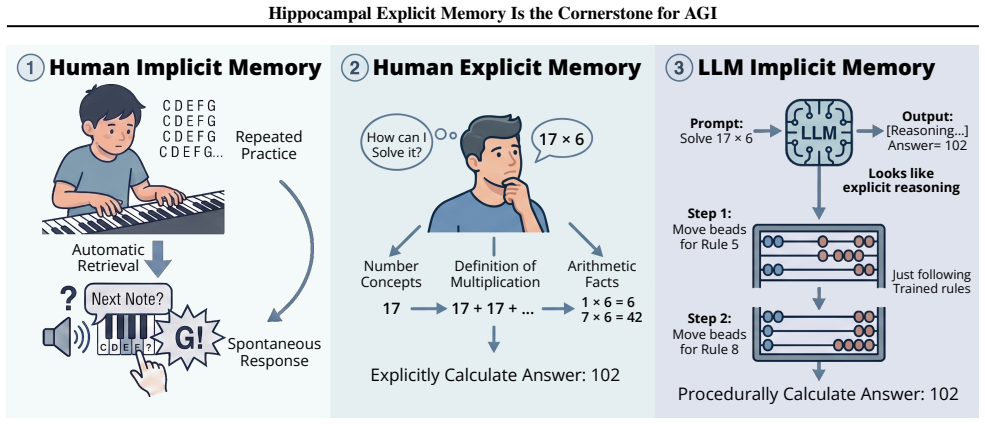
Large Language Models (LLMs) have demonstrated remarkable capabilities across various tasks, raising expectations for Artificial General Intelligence (AGI). This position paper argues that integrating explicit memory is the cornerstone for advancing LLMs toward AGI. The key reason is that the underlying learning mechanism of LLMs is highly analogous to human implicit memory. However, higher-order cognitive functions necessary for AGI, such as long-term strategic planning, metacognition, and symbolic reasoning, heavily rely on hippocampal explicit memory and cannot arise solely from implicit statistical learning. Drawing on findings from neuroscience, I advance this perspective and complement it with computational requirements for artificial explicit memory systems, hoping to foster further research and lay the groundwork for explicit memory integration.
Editorial analysis
A structured set of objections, weighed in public.
Referee Report
Summary. This position paper claims that LLMs operate via a learning mechanism analogous to human implicit memory, and that integrating explicit memory (modeled on hippocampal function) is the cornerstone for achieving AGI. It argues that higher-order functions required for AGI—long-term strategic planning, metacognition, and symbolic reasoning—cannot emerge from implicit statistical learning alone and draws on neuroscience to motivate computational requirements for artificial explicit memory systems.
Significance. If the central analogy and necessity claim hold, the paper would supply a concrete research direction for hybrid architectures that augment statistical learners with structured memory, potentially addressing current LLM limitations in planning and reasoning. As a perspective without new derivations, data, or falsifiable tests, its value is in framing an interdisciplinary hypothesis rather than establishing a result.
major comments (2)
- [Abstract] Abstract, paragraph 2: The assertion that higher-order functions 'cannot arise solely from implicit statistical learning' is load-bearing for the position yet is advanced without a computational argument, impossibility proof, or citation to results demonstrating that scaled implicit mechanisms are provably insufficient for the listed capabilities.
- [Abstract] Abstract and introduction: The mapping of LLM training to implicit memory is presented by definition, after which the necessity of explicit memory follows; no independent computational demonstration is supplied showing why the target AGI functions are unreachable by implicit mechanisms alone (cf. the circularity concern in the reader's note).
minor comments (1)
- The manuscript would benefit from an explicit section contrasting the proposed explicit-memory requirements against existing memory-augmented LLM architectures (e.g., retrieval-augmented generation) to clarify novelty.
Simulated Author's Rebuttal
We thank the referee for the detailed and thoughtful report. Below we address the major comments point by point, maintaining the scope of this work as a position paper that advances a neuroscience-motivated hypothesis rather than a formal technical result.
read point-by-point responses
-
Referee: [Abstract] Abstract, paragraph 2: The assertion that higher-order functions 'cannot arise solely from implicit statistical learning' is load-bearing for the position yet is advanced without a computational argument, impossibility proof, or citation to results demonstrating that scaled implicit mechanisms are provably insufficient for the listed capabilities.
Authors: As a position paper our central claim is presented as a hypothesis grounded in existing neuroscience rather than a new computational proof. The manuscript cites multiple studies on hippocampal amnesia patients who retain implicit statistical learning yet show profound deficits in long-term planning, metacognition, and flexible reasoning. These empirical results from cognitive neuroscience supply the evidential basis for the necessity claim. We agree that this does not constitute a formal impossibility result for arbitrarily scaled implicit systems; the paper instead uses the biological dissociation to motivate hybrid architectures. No change is required because the current framing accurately reflects the paper's intent and cited literature. revision: no
-
Referee: [Abstract] Abstract and introduction: The mapping of LLM training to implicit memory is presented by definition, after which the necessity of explicit memory follows; no independent computational demonstration is supplied showing why the target AGI functions are unreachable by implicit mechanisms alone (cf. the circularity concern in the reader's note).
Authors: The analogy rests on functional parallels documented in the cognitive-science literature: LLM training performs gradual, unconscious adjustment of parameters on the basis of statistical regularities, matching the operational definition of implicit memory. The introduction already references this distinction with supporting citations before applying it to LLMs. The necessity of explicit memory then follows from the position that the cited hippocampal functions cannot be substituted by implicit mechanisms alone. We do not supply an independent computational demonstration because the paper is not a technical derivation; it is an interdisciplinary hypothesis. We see no circularity once the neuroscience grounding is recognized. revision: no
Circularity Check
No significant circularity identified
full rationale
This position paper advances a perspective that LLMs are analogous to implicit memory and that explicit memory is required for AGI-level functions, drawing on neuroscience literature. No derivation chain, equations, fitted parameters, or self-citations are present in the provided text. The central assertion is offered as an interpretive claim rather than a result shown to reduce to its own inputs by construction. The paper is self-contained as a viewpoint and does not exhibit any of the enumerated circularity patterns.
Axiom & Free-Parameter Ledger
axioms (2)
- domain assumption The underlying learning mechanism of LLMs is highly analogous to human implicit memory
- domain assumption Higher-order cognitive functions necessary for AGI cannot arise solely from implicit statistical learning and require hippocampal explicit memory
Reference graph
Works this paper leans on
-
[1]
Declarative memory consolidation in humans: A prospective functional magnetic resonance imaging study , author =. 2006 , journal =. doi:10.1073/pnas.0507774103 , url =. https://www.pnas.org/doi/pdf/10.1073/pnas.0507774103 , abstract =
-
[2]
2023 , journal =
Beyond the Imitation Game: Quantifying and extrapolating the capabilities of language models , author =. 2023 , journal =
2023
-
[3]
The Llama 3 Herd of Models , author =. 2024 , url =. 2407.21783 , archiveprefix =
Pith/arXiv arXiv 2024
-
[4]
2007 , journal =
Remembering the past and imagining the future: Common and distinct neural substrates during event construction and elaboration , author =. 2007 , journal =
2007
-
[5]
Working Memory , author =. 1974 , publisher =. doi:https://doi.org/10.1016/S0079-7421(08)60452-1 , issn =
-
[6]
1986 , journal =
Parallel organization of functionally segregated circuits linking basal ganglia and cortex , author =. 1986 , journal =
1986
-
[7]
Qwen2.5 Technical Report , author =. 2025 , url =. 2412.15115 , archiveprefix =
Pith/arXiv arXiv 2025
-
[8]
Lamellar organization of hippocampal excitatory pathways , author =. 1971 , journal =. doi:10.1007/BF00234087 , isbn =
-
[9]
Psychological Review , volume =
Acquisition of Cognitive Skill , author =. Psychological Review , volume =. 1982 , month =. doi:10.1037/0033-295X.89.4.369 , isbn =
-
[10]
Contributions of episodic retrieval and mentalizing to autobiographical thought: evidence from functional neuroimaging, resting-state connectivity, and
Andrews-Hanna, Jessica R and Saxe, Rebecca and Yarkoni, Tal , year =. Contributions of episodic retrieval and mentalizing to autobiographical thought: evidence from functional neuroimaging, resting-state connectivity, and. Neuroimage , publisher =
-
[11]
2024 , month = dec, journal =
Titans: Learning to memorize at test time , author =. 2024 , month = dec, journal =
2024
-
[12]
AGI: The Cognitive Strengths and Weaknesses of Modern LLMs , author =
Generative AI vs. AGI: The Cognitive Strengths and Weaknesses of Modern LLMs , author =. 2023 , url =. 2309.10371 , archiveprefix =
arXiv 2023
-
[13]
2015 , month = aug, journal =
Specifying the core network supporting episodic simulation and episodic memory by activation likelihood estimation , author =. 2015 , month = aug, journal =
2015
-
[14]
2011 , month = nov, journal =
The neurobiology of semantic memory , author =. 2011 , month = nov, journal =
2011
-
[15]
2007 , month = feb, journal =
The role of the basal ganglia and cerebellum in language processing , author =. 2007 , month = feb, journal =
2007
-
[16]
2023 , month =
Sparks of Artificial General Intelligence: Early experiments with GPT-4 , author =. 2023 , month =
2023
-
[17]
2000 , journal =
The cognitive and neuroanatomical correlates of multitasking , author =. 2000 , journal =
2000
-
[18]
2022 , month = dec, booktitle =
Help me write a Poem - Instruction Tuning as a Vehicle for Collaborative Poetry Writing , author =. 2022 , month = dec, booktitle =. doi:10.18653/v1/2022.emnlp-main.460 , url =
-
[19]
2022 , month = may, journal =
Foundational number sense training gains are predicted by hippocampal-parietal circuits , author =. 2022 , month = may, journal =
2022
-
[20]
1998 , month = apr, journal =
Classical conditioning and brain systems: the role of awareness , author =. 1998 , month = apr, journal =
1998
-
[21]
Building machines that learn and think with people , author =. 2024 , journal =. doi:10.1038/s41562-024-01991-9 , isbn =
-
[22]
2020 , month = may, journal =
How does the brain learn environmental structure? Ten core principles for understanding the neurocognitive mechanisms of statistical learning , author =. 2020 , month = may, journal =
2020
-
[23]
Performance-optimized hierarchical models predict neural responses in higher visual cortex , author =. 2014 , journal =. doi:10.1073/pnas.1403112111 , url =. https://www.pnas.org/doi/pdf/10.1073/pnas.1403112111 , abstract =
-
[24]
2024 , month = jul, booktitle =
Larimar: Large Language Models with Episodic Memory Control , author =. 2024 , month = jul, booktitle =
2024
-
[25]
DeepSeek-R1: Incentivizing Reasoning Capability in LLMs via Reinforcement Learning , author =. 2025 , url =. 2501.12948 , archiveprefix =
Pith/arXiv arXiv 2025
-
[26]
2017 , month = oct, journal =
Episodic and semantic content of memory and imagination: A multilevel analysis , author =. 2017 , month = oct, journal =
2017
-
[27]
What Learning Systems do Intelligent Agents Need? Complementary Learning Systems Theory Updated , author =. 2016 , journal =. doi:https://doi.org/10.1016/j.tics.2016.05.004 , issn =
-
[28]
2005 , month = apr, journal =
Reorganization and plasticity in the adult brain during learning of motor skills , author =. 2005 , month = apr, journal =
2005
-
[29]
A cortical--hippocampal system for declarative memory , author =. 2000 , journal =. doi:10.1038/35036213 , isbn =
-
[30]
2024 , month = jul, journal =
Declarative memory supports children's math skills: A longitudinal study , author =. 2024 , month = jul, journal =
2024
-
[31]
2002 , month = may, journal =
Statistical learning of higher-order temporal structure from visual shape sequences , author =. 2002 , month = may, journal =
2002
-
[32]
2002 , month = nov, journal =
Statistical learning of new visual feature combinations by infants , author =. 2002 , month = nov, journal =
2002
-
[33]
2012 , month = may, journal =
The neural basis of metacognitive ability , author =. 2012 , month = may, journal =
2012
-
[34]
The organization of recent and remote memories , author =. 2005 , journal =. doi:10.1038/nrn1607 , isbn =
-
[35]
2013 , month = jan, journal =
Mathematical logic in the human brain: semantics , author =. 2013 , month = jan, journal =
2013
-
[36]
Gemma 2: Improving Open Language Models at a Practical Size , author =. 2024 , url =. 2408.00118 , archiveprefix =
Pith/arXiv arXiv 2024
-
[37]
Proceedings of the Thirty-Third International Joint Conference on Artificial Intelligence,
Large Language Models Are Not Strong Abstract Reasoners , author =. Proceedings of the Thirty-Third International Joint Conference on Artificial Intelligence,. 2024 , month =. doi:10.24963/ijcai.2024/693 , url =
-
[38]
2011 , month = jul, journal =
Modulation of striatal projection systems by dopamine , author =. 2011 , month = jul, journal =
2011
-
[39]
An Integrated Index: Engrams, Place Cells, and Hippocampal Memory , author =. Neuron , publisher =. 2020 , month =. doi:10.1016/j.neuron.2020.07.011 , isbn =
-
[40]
Dynamics of Retrieval Strategies for Remote Memories , author =. Cell , publisher =. 2011 , month =. doi:10.1016/j.cell.2011.09.033 , isbn =
-
[41]
1985 , journal =
Implicit and explicit memory for new associations in normal and amnesic subjects , author =. 1985 , journal =
1985
-
[42]
2008 , month = jul, journal =
Habits, rituals, and the evaluative brain , author =. 2008 , month = jul, journal =
2008
-
[43]
2020 , month = feb, journal =
Explicit memory and cognition in monkeys , author =. 2020 , month = feb, journal =
2020
-
[44]
Neuron , address =
Hassabis, Demis and Kumaran, Dharshan and Summerfield, Christopher and Botvinick, Matthew , year =. Neuron , address =
-
[45]
2007 , month = jul, journal =
Deconstructing episodic memory with construction , author =. 2007 , month = jul, journal =
2007
-
[46]
2010 , month = apr, journal =
Switching from automatic to controlled behavior: cortico-basal ganglia mechanisms , author =. 2010 , month = apr, journal =
2010
-
[47]
2019 , month = jun, journal =
Neurobiological basis of feeling of knowing in episodic memory , author =. 2019 , month = jun, journal =
2019
-
[48]
Emergent Abilities of Large Language Models , author =. 2022 , url =. 2206.07682 , archiveprefix =
Pith/arXiv arXiv 2022
-
[49]
2024 , booktitle =
Large Language Models Cannot Self-Correct Reasoning Yet , author =. 2024 , booktitle =
2024
-
[50]
Pattern Separation in the Dentate Gyrus and CA3 of the Hippocampus , author =. 2007 , journal =. doi:10.1126/science.1135801 , url =. https://www.science.org/doi/pdf/10.1126/science.1135801 , abstract =
-
[51]
2012 , month = mar, journal =
Implicit and explicit olfactory memory in people with and without Down syndrome , author =. 2012 , month = mar, journal =
2012
-
[52]
1993 , month = apr, journal =
Spatial selectivity of unit activity in the hippocampal granular layer , author =. 1993 , month = apr, journal =
1993
-
[53]
A Survey of Large Language Models for Healthcare: from Data, Technology, and Applications to Accountability and Ethics , author =. 2025 , url =. 2310.05694 , archiveprefix =
arXiv 2025
-
[54]
2002 , month = apr, journal =
Decisions and the evolution of memory: multiple systems, multiple functions , author =. 2002 , month = apr, journal =
2002
-
[55]
2010 , month = mar, journal =
The multiplicity of self: neuropsychological evidence and its implications for the self as a construct in psychological research , author =. 2010 , month = mar, journal =
2010
-
[56]
Striatal Plasticity and Basal Ganglia Circuit Function , author =. Neuron , publisher =. 2008 , month =. doi:10.1016/j.neuron.2008.11.005 , isbn =
-
[57]
Biological underpinnings for lifelong learning machines , author =. 2022 , month = mar, journal =. doi:10.1038/s42256-022-00452-0 , issn =
-
[58]
Memory systems of the brain: A brief history and current perspective , author =. 2004 , journal =. doi:https://doi.org/10.1016/j.nlm.2004.06.005 , issn =
-
[59]
Structure and function of declarative and nondeclarative memory systems , author =. 1996 , journal =. doi:10.1073/pnas.93.24.13515 , url =. https://www.pnas.org/doi/pdf/10.1073/pnas.93.24.13515 , abstract =
-
[60]
Online neural monitoring of statistical learning , author =. 2017 , journal =. doi:https://doi.org/10.1016/j.cortex.2017.02.004 , issn =
-
[61]
1992 , month = aug, journal =
Speech production, syntax comprehension, and cognitive deficits in Parkinson's disease , author =. 1992 , month = aug, journal =
1992
-
[62]
Training language models to follow instructions with human feedback , author =. 2022 , url =. 2203.02155 , archiveprefix =
Pith/arXiv arXiv 2022
-
[63]
Hosseini, Nancy Kanwisher, Joshua B
The neural architecture of language: Integrative modeling converges on predictive processing , author =. 2021 , journal =. doi:10.1073/pnas.2105646118 , url =. https://www.pnas.org/doi/pdf/10.1073/pnas.2105646118 , abstract =
-
[64]
Prioritized memory access explains planning and hippocampal replay , author =. 2018 , journal =. doi:10.1038/s41593-018-0232-z , isbn =
-
[65]
2010 , month = mar, journal =
The relationship between working memory capacity and executive functioning: evidence for a common executive attention construct , author =. 2010 , month = mar, journal =
2010
-
[66]
1995 , month = jul, journal =
Why there are complementary learning systems in the hippocampus and neocortex: insights from the successes and failures of connectionist models of learning and memory , author =. 1995 , month = jul, journal =
1995
-
[67]
2016 , booktitle =
Memory and cognitive control circuits in mathematical cognition and learning , author =. 2016 , booktitle =
2016
-
[68]
The use of procedural knowledge in simple addition and subtraction problems , author =. 2012 , journal =. doi:https://doi.org/10.1016/j.cognition.2012.02.008 , issn =
-
[69]
2023 , booktitle =
Language Models Don't Always Say What They Think: Unfaithful Explanations in Chain-of-Thought Prompting , author =. 2023 , booktitle =
2023
-
[70]
Computational roles for dopamine in behavioural control , author =. 2004 , journal =. doi:10.1038/nature03015 , isbn =
-
[71]
Position: Levels of
Morris, Meredith Ringel and Sohl-Dickstein, Jascha and Fiedel, Noah and Warkentin, Tris and Dafoe, Allan and Faust, Aleksandra and Farabet, Clement and Legg, Shane , year =. Position: Levels of. Proceedings of the 41st International Conference on Machine Learning , publisher =
-
[72]
NMDA receptors, place cells and hippocampal spatial memory , author =. 2004 , journal =. doi:10.1038/nrn1385 , isbn =
-
[73]
Requirement for hippocampal
Nakazawa, Kazu and Quirk, Michael C and Chitwood, Raymond A and Watanabe, Masahiko and Yeckel, Mark F and Sun, Linus D and Kato, Akira and Carr, Candice A and Johnston, Daniel and Wilson, Matthew A and Tonegawa, Susumu , year =. Requirement for hippocampal. Science , publisher =
-
[74]
Preserved Learning and Retention of Pattern-Analyzing Skill in Amnesia: Dissociation of Knowing How and Knowing That , author =. 1980 , journal =. doi:10.1126/science.7414331 , url =. https://www.science.org/doi/pdf/10.1126/science.7414331 , abstract =
-
[75]
GPT-4 Technical Report , author =. 2024 , url =. 2303.08774 , archiveprefix =
Pith/arXiv arXiv 2024
-
[76]
2002 , month = mar, journal =
Learning and memory functions of the Basal Ganglia , author =. 2002 , month = mar, journal =
2002
-
[77]
Proceedings of the 41st International Conference on Machine Learning , publisher =
Memoria: Resolving Fateful Forgetting Problem through Human-Inspired Memory Architecture , author =. Proceedings of the 41st International Conference on Machine Learning , publisher =. 2024 , month =
2024
-
[78]
Where do you know what you know? The representation of semantic knowledge in the human brain , author =. 2007 , journal =. doi:10.1038/nrn2277 , isbn =
-
[79]
Evidence for a competitive relationship between executive functions and statistical learning , author =. 2024 , journal =. doi:10.1038/s41539-024-00243-9 , isbn =
-
[80]
Holistic Evaluation of Language Models , author =. 2023 , url =. 2211.09110 , archiveprefix =
Pith/arXiv arXiv 2023
discussion (0)
Sign in with ORCID, Apple, or X to comment. Anyone can read and Pith papers without signing in.