Federated continual learning: A comprehensive survey on lifelong and privacy-preserving learning over distributed and non-stationary data
Pith reviewed 2026-06-27 14:18 UTC · model grok-4.3
The pith
Federated continual learning supports lifelong adaptation in privacy-preserving distributed systems facing non-stationary data.
A machine-rendered reading of the paper's core claim, the machinery that carries it, and where it could break.
Core claim
Federated Continual Learning emerges at the intersection of federated learning and continual learning to support lifelong, adaptive, and privacy-aware learning over distributed and non-stationary data; the survey formalizes the problem, analyzes the breakdown of classical federated methods under non-stationarity, proposes a multi-dimensional taxonomy, summarizes representative applications and metrics, and identifies open challenges such as scalable privacy-preserving memory and standardized long-term benchmarks.
What carries the argument
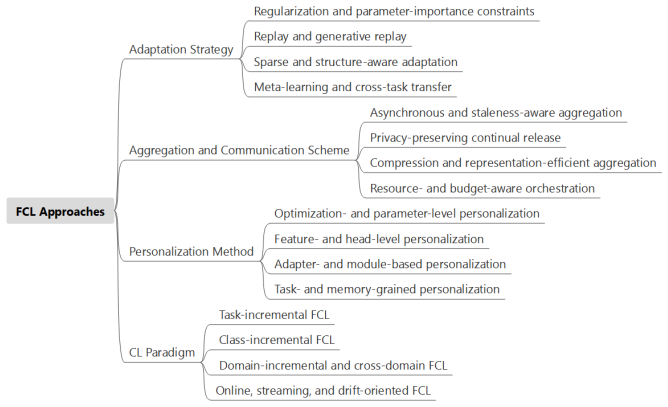
The multi-dimensional taxonomy of FCL approaches that organizes methods for integrating continual-learning principles into federated systems to counteract performance degradation and forgetting.
If this is right
- Classical federated learning will exhibit instability and catastrophic forgetting once data distributions drift across clients or over time.
- Continual learning techniques must be adapted to respect federated constraints on communication, privacy, and client heterogeneity.
- Evaluation protocols must track long-term performance and forgetting rather than single-round accuracy.
- Standardized benchmarks and privacy-preserving memory mechanisms become necessary for progress toward deployable systems.
Where Pith is reading between the lines
- FCL methods could be tested on controlled temporal-drift benchmarks that isolate the effects of client heterogeneity from distribution shift.
- Connections to edge-computing constraints in smart-city or cybersecurity settings may impose additional limits on memory size and update frequency.
- Hybrid designs that combine FCL with other adaptation strategies could address cases of extreme non-stationarity not yet covered by current taxonomies.
Load-bearing premise
Classical federated learning methods assume that data distributions remain stationary across clients and over time.
What would settle it
An experiment in which standard federated learning algorithms exhibit no measurable performance degradation or forgetting when trained on non-stationary data streams from heterogeneous clients would falsify the central premise.
Figures
read the original abstract
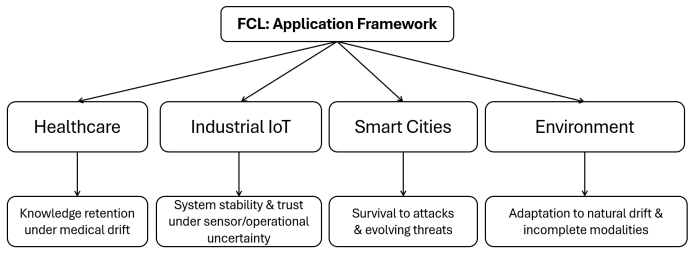
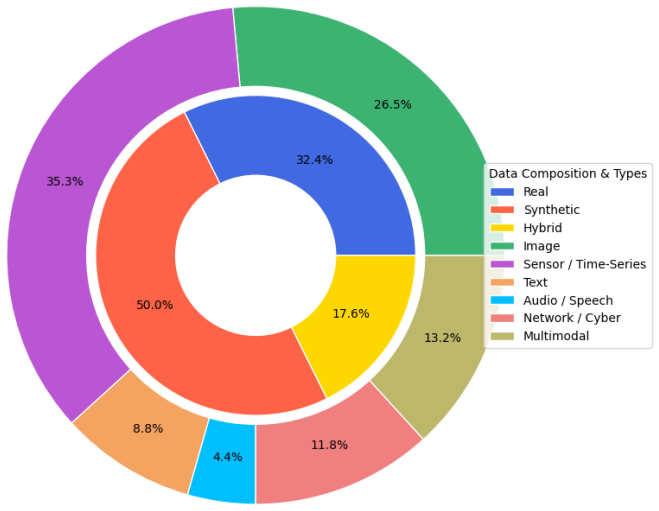
Federated Learning (FL) enables collaborative and privacy-preserving model training across distributed clients, but most existing FL systems implicitly assume data stationarity. In real-world settings-such as healthcare, industrial IoT (IIOT), cybersecurity, and smart cities-data streams are inherently non-stationary, leading classical FL methods to suffer from performance degradation, instability, and catastrophic forgetting. Continual Learning (CL) addresses learning under evolving data distributions but has been largely studied in centralized settings, overlooking key constraints of federated systems, including privacy, limited communication, and client heterogeneity. Federated Continual Learning (FCL) emerges at the intersection of FL and CL, aiming to support lifelong, adaptive, and privacy-aware learning over distributed and non-stationary data. This survey provides a comprehensive and systematic overview of FCL. We first present a formal definition of the FCL problem and clarify its distinctive characteristics. We then analyze the limitations of classical FL under non-stationary conditions, highlighting how CL principles support long-term adaptation. To organize the rapidly growing literature, we propose a multi-dimensional taxonomy of FCL approaches. Furthermore, we review representative application domains and data modalities, summarize commonly used evaluation metrics, and discuss experimental perspectives for assessing long-term performance and forgetting. Finally, we highlight key open challenges, including handling extreme heterogeneity under temporal drift, designing scalable and privacy-preserving memory mechanisms, and establishing standardized benchmarks. This survey aims to serve as a reference and a roadmap for advancing FCL toward robust and deployable real-world systems.
Editorial analysis
A structured set of objections, weighed in public.
Referee Report
Summary. The paper is a survey on Federated Continual Learning (FCL). It formally defines the FCL problem, analyzes how classical FL methods degrade under non-stationary data distributions due to catastrophic forgetting and instability, proposes a multi-dimensional taxonomy to classify existing FCL approaches, reviews representative application domains (healthcare, IIoT, cybersecurity) and data modalities, summarizes evaluation metrics and experimental practices for long-term performance, and identifies open challenges such as extreme heterogeneity under temporal drift and scalable privacy-preserving memory mechanisms.
Significance. If the taxonomy is comprehensive and the synthesis accurate, the survey would provide a valuable organizing framework and roadmap for research at the intersection of federated and continual learning. It explicitly credits the formal problem definition, the multi-dimensional taxonomy, and the structured review of metrics and benchmarks as contributions that can help standardize evaluation of lifelong adaptation in distributed, privacy-constrained settings.
minor comments (2)
- [Abstract] The abstract and introduction use both 'IIOT' and 'IIoT'; standardize the acronym for consistency across the manuscript.
- [Taxonomy] The taxonomy section would benefit from an explicit justification or decision tree explaining how the chosen dimensions (e.g., memory mechanisms, heterogeneity handling) were selected over alternatives in the literature.
Simulated Author's Rebuttal
We thank the referee for their constructive summary of our survey and for recommending minor revision. No specific major comments were raised in the report.
Circularity Check
No significant circularity; survey paper with no derivations
full rationale
This is a survey paper whose contribution consists of a formal definition of FCL, a multi-dimensional taxonomy, literature synthesis, and discussion of open challenges. No equations, predictions, fitted parameters, or theoretical derivations are present that could reduce to inputs by construction. The central claims rest on external prior work reviewed in the survey rather than any self-referential chain internal to the paper. This matches the default expectation for non-derivational survey work and receives the lowest circularity score.
Axiom & Free-Parameter Ledger
Reference graph
Works this paper leans on
-
[2]
J. L. Corcuera Bárcena, M. Daole, P. Ducange, F. Marcelloni, A. Renda, F. Ruffini, A. Schiavo, Fed-xai: Federated learning of explainable arti- ficial intelligence models, in: Proceedings of the 3rd Italian Workshop on Explainable Artificial Intelligence (XAI.it 2022), Vol. 3277 of CEUR Workshop Proceedings, 2022. URLhttp://ceur-ws.org/Vol-3277/
2022
-
[3]
R. Kalakoti, S. Nõmm, H. Bahsi, Federated learning of explainable ai(fedxai) for deep learning-based intrusion detection in iot networks, Computer Networks 270 (2025) 111479.doi:https://doi.org/10.1 016/j.comnet.2025.111479
arXiv 2025
- [4]
-
[5]
S. Li, T. Su, X.-Y. Zhang, Z. Wang, Continual learning with knowl- edge distillation: A survey, IEEE Transactions on Neural Networks and Learning Systems (2025).doi:10.1109/TNNLS.2024.3476068. 65
-
[6]
L. Chen, D. Zhao, Y. Gao, J. Zhou, T. C. Wei, Fedmtl: Adaptive multi-teacher knowledge distillation for federated continual learning, Knowledge-Based Systems (2025) 115160
2025
-
[7]
Z. Zhang, Y. Zhang, H. Li, S. Liu, W. Chen, Z. Zhang, L. Tang, Federated continual representation learning for evolutionary distributed intrusion detection in industrial internet of things, Engineering Ap- plications of Artificial Intelligence 135 (2024) 108826.doi:https: //doi.org/10.1016/j.engappai.2024.108826
-
[8]
L. Wang, X. Zhang, H. Su, J. Zhu, A comprehensive survey of con- tinual learning: Theory, method and application, IEEE Transactions on Pattern Analysis and Machine Intelligence 46 (8) (2024) 5362–5383. doi:10.1109/TPAMI.2024.3367329
-
[9]
M. F. Criado, F. E. Casado, R. Iglesias, C. V. Regueiro, S. Barro, Non- iid data and continual learning processes in federated learning: A long road ahead, Information Fusion 88 (2022) 263–280.doi:10.1016/j.in ffus.2022.07.024
-
[10]
X. Yang, H. Yu, X. Gao, H. Wang, J. Zhang, T. Li, Federated con- tinual learning via knowledge fusion: A survey, IEEE Transactions on Knowledge and Data Engineering 36 (8) (2024) 3832–3850.doi: 10.1109/TKDE.2024.3363240
-
[11]
Z. Wang, F. Wu, F. Yu, Y. Zhou, J. Hu, G. Min, Federated con- tinual learning for edge-ai: A comprehensive survey., arXiv preprint arXiv:2411.13740 (2024)
arXiv 2024
-
[12]
P. Hamedi, R. Razavi-Far, E. Hallaji, Federated continual learning: Concepts, challenges, andsolutions, Neurocomputing651(2025)130844. doi:https://doi.org/10.1016/j.neucom.2025.130844
-
[13]
A. Birashk, L. Khan, Federated continual learning for task-incremental and class-incremental problems: A survey, Expert Systems with Appli- cations 297 (2026) 129278.doi:https://doi.org/10.1016/j.eswa.2 025.129278
-
[14]
M. Savoia, D. Annunziata, D. Thakur, G. Fortino, F. Piccialli, Fed- erated continual learning meets digital twins: A survey on methods, 66 intersections and perspectives, Neurocomputing 681 (2026) 133366. doi:https://doi.org/10.1016/j.neucom.2026.133366
-
[15]
M. Ye, X. Fang, B. Du, P. C. Yuen, D. Tao, Heterogeneous federated learning: State-of-the-artandresearchchallenges, ACMComputingSur- veys (2023).doi:10.1145/3625558
-
[16]
A.Nandi, F.Xhafa, R.Kumar, Adocker-basedfederatedlearningframe- work design and deployment for multi-modal data stream classification, Computing 105 (2023) 2195–2229.doi:10.1007/s00607-023-01179-5
-
[17]
A. Nandi, F. Xhafa, A federated learning method for real-time emotion state classification from multi-modal streaming, Methods 204 (2022) 340–347.doi:https://doi.org/10.1016/j.ymeth.2022.03.005
-
[18]
J. Cai, X. Liu, Q. Ye, Y. Liu, Y. Wang, A federated learning framework based on differentially private continuous data release, IEEE Transac- tions on Dependable and Secure Computing 21 (5) (2024) 4879–4894. doi:10.1109/TDSC.2024.3364060
-
[19]
J. L. Corcuera Bárcena, P. Ducange, A. Ercolani, F. Marcelloni, A. Renda, An approach to federated learning of explainable fuzzy regres- sion models, in: 2022 IEEE International Conference on Fuzzy Systems (FUZZ-IEEE), IEEE, 2022.doi:10.1109/FUZZ-IEEE55066.2022.98 82881
-
[20]
A.Yazdinejad, Z.DehghaniMohammadabadi, A.Dehghantanha, G.Sri- vastava, An explainable and privacy-preserving federated learning model for threat detection in cyber-physical-social systems, IEEE Transactions on Computational Social Systems (2025).doi:10.1109/TCSS.2025.36 06798
-
[21]
Y. Wu, H. Yang, X. Wang, H. Yu, A. El Saddik, M. S. Hossain, An effective federated learning system for industrial iot data stream- ing, Alexandria Engineering Journal 105 (2024) 414–422.doi:https: //doi.org/10.1016/j.aej.2024.07.040
-
[22]
Y. Jin, L. Jiao, Z. Qian, S. Zhang, S. Lu, Budget-aware online control of edge federated learning on streaming data with stochastic inputs, IEEE Journal on Selected Areas in Communications 39 (12) (2021) 3704–3722. doi:10.1109/JSAC.2021.3118421. 67
-
[23]
Z. Zhang, Y. Zhang, D. Guo, C. Lin, J. Wang, X. Yang, Communication- efficientfederatedcontinuallearningfordistributedlearningsystemwith non-iid data, Science China Information Sciences 66 (12) (2023) 122102. doi:10.1007/s11432-020-3419-4
-
[24]
T. Zhou, B. Wang, Cross paradigm fusion of federated and contin- ual learning on multilayer perceptron mixer architecture for incremen- tal thoracic infection diagnosis, Scientific Reports 15 (24449) (2025). doi:10.1038/s41598-025-06077-8
-
[25]
Z. Zhang, B. Guo, W. Sun, Y. Liu, Z. Yu, Cross-fcl: Toward a cross- edge federated continual learning framework in mobile edge computing systems, IEEE Transactions on Mobile Computing 23 (1) (2024) 313– 326.doi:10.1109/TMC.2022.3223944
-
[26]
F.Shan, Y.Liu, L.Fan, Y.Mao, Z.Chen, S.Li, Asurveyofoptimization algorithms for differential privacy in federated learning, Journal of Sys- tems Architecture (2025) 103582doi:10.1016/j.sysarc.2025.103582
-
[27]
W. Liu, X. Zhang, J. Duan, C. Joe-Wong, Z. Zhou, X. Chen, Dy- namite: Dynamic interplay of mini-batch size and aggregation fre- quency for federated learning with static and streaming datasets, IEEE Transactions on Mobile Computing 23 (7) (2024) 7664–7679.doi: 10.1109/TMC.2023.3337016
-
[28]
M. De Lange, T. Tuytelaars, Continual prototype evolution: Learning online from non-stationary data streams, in: 2021 IEEE/CVF Interna- tional Conference on Computer Vision (ICCV), 2021, pp. 8230–8239. doi:10.1109/ICCV48922.2021.00814
-
[29]
H. Shi, Z. Xu, H. Wang, W. Qin, W. Wang, Y. Wang, Z. Wang, S. Ebrahimi, H. Wang, Continual learning of large language mod- els: A comprehensive survey, ACM Computing Surveys 58 (5) (2025). doi:10.1145/3735633
-
[30]
iCaRL: Incremental Classifier and Representation Learning
S.-A.Rebuffi, A.Kolesnikov, G.Sperl, C.H.Lampert, icarl: Incremental classifier and representation learning, in: Proceedings of the IEEE con- ference on Computer Vision and Pattern Recognition, 2017, pp. 2001– 2010.doi:10.48550/arXiv.1611.07725. 68
work page internal anchor Pith review Pith/arXiv arXiv doi:10.48550/arxiv.1611.07725 2017
-
[31]
Rolnick, A
D. Rolnick, A. Ahuja, J. Schwarz, T. Lillicrap, G. Wayne, Experience replay for continual learning, in: H. Wallach, H. Larochelle, A. Beygelz- imer, F. d'Alché-Buc, E. Fox, R. Garnett (Eds.), Advances in Neural Information Processing Systems, Vol. 32, Curran Associates, Inc., 2019. URLhttps://proceedings.neurips.cc/paper_files/paper/2019/ file/fa7cdfad1a5...
2019
-
[32]
Z.Li, D.Hoiem, Learningwithoutforgetting, IEEETrans.PatternAnal. Mach. Intell. 40 (12) (2018) 2935–2947.doi:10.1109/TPAMI.2017.277 3081
-
[33]
R. Krishnan, P. Rajpurkar, E. J. Topol, Self-supervised learning in medicine and healthcare, Nature Biomedical Engineering 6 (12) (2022) 1346–1352.doi:10.1038/s41551-022-00914-1
-
[34]
S. Iqbal, X. Zhong, M. A. Khan, Z. Wu, D. A. AlHammadi, W. Liu, I. A. Choudhry, Continual and wisdom learning for federated learning: A comprehensive framework for robustness and debiasing, Information Processing & Management 62 (5) (2025) 104157.doi:https://doi.or g/10.1016/j.ipm.2025.104157
-
[35]
Z. Yang, S. Zhang, C. Li, M. Wang, H. Wang, M. Zhang, Efficient knowledge management for heterogeneous federated continual learning on resource-constrained edge devices, Future Generation Computer Sys- tems 156 (2024) 16–29.doi:https://doi.org/10.1016/j.future.2 024.02.018
-
[36]
W. Zhang, X. Wang, P. Zhou, W. Wu, X. Zhang, Client selection for federated learning with non-iid data in mobile edge computing, IEEE Access 9 (2021) 24462–24474.doi:10.1109/ACCESS.2021.3056919
-
[37]
Z. Zhao, F. Lyu, L. Li, F. Hu, M. Gu, L. Sun, Towards long-term remem- bering in federated continual learning, Cognitive Computation 16 (7) (2024) 2803–2811.doi:10.1007/s12559-024-10314-z
-
[38]
H. Sun, W. Zhang, R. Zhang, L. Xu, H. Guan, H. Zhao, B. Zhang, S. Yang, X. Yu, Federated continual learning based on weakly supervised diffusion models for disease diagnosis, IEEE Internet of Things Journal 12 (22) (2025) 45958–45971.doi:10.1109/JIOT.2025.3535628. 69
-
[39]
M. J. Page, J. E. McKenzie, P. M. Bossuyt, I. Boutron, T. C. Hoff- mann, C. D. Mulrow, L. Shamseer, J. M. Tetzlaff, D. Moher, Updating guidance for reporting systematic reviews: development of the prisma 2020 statement, Journal of Clinical Epidemiology 134 (2021) 103–112. doi:https://doi.org/10.1016/j.jclinepi.2021.02.003. URLhttps://www.sciencedirect.com...
-
[40]
J. Le, X. Lei, N. Mu, H. Zhang, K. Zeng, X. Liao, Federated continuous learning with broad network architecture, IEEE Transactions on Cyber- netics 51 (8) (2021) 3874–3888.doi:10.1109/TCYB.2021.3090260
-
[41]
F. E. Casado, D. Lema, R. Iglesias, et al., Ensemble and continual fed- erated learning for classification tasks, Machine Learning 112 (9) (2023) 3413–3453.doi:10.1007/s10994-023-06330-z
-
[42]
C. B. Mawuli, L. Che, J. Kumar, S. U. Din, Z. Qin, Q. Yang, J. Shao, Fedstream: Prototype-based federated learning on distributed concept- drifting data streams, IEEE Transactions on Systems, Man, and Cyber- netics: Systems 53 (11) (2023) 7112–7124.doi:10.1109/TSMC.2023. 3293462
-
[43]
C. B. Mawuli, J. Kumar, E. Nanor, S. Fu, L. Pan, Q. Yang, W. Zhang, J. Shao, Semi-supervised federated learning on evolving data streams, Information Sciences 643 (2023) 119235.doi:https://doi.org/10.1 016/j.ins.2023.119235
arXiv 2023
-
[44]
L. Yu, L. Ge, G. Wang, J. Yin, Q. Chen, J. Zhou, L. He, Pi-fed: Continual federated learning with parameter-level importance aggre- gation, IEEE Internet of Things Journal 11 (22) (2024) 37187–37199. doi:10.1109/JIOT.2024.3440029
-
[45]
Z.Wang, Y.Zhang, X.Xu, Z.Fu, H.Yang, W.Du, Federatedprobability memory recall for federated continual learning, Information Sciences 629 (2023) 551–565.doi:https://doi.org/10.1016/j.ins.2023.02.015
-
[46]
H. Wang, J. Bian, J. Xu, On the local cache update rules in streaming federatedlearning, IEEEInternetofThingsJournal11(6)(2024)10808– 10816.doi:10.1109/JIOT.2023.3327316. 70
-
[47]
N. Wang, X. Li, Z. Guan, S. Yuan, Fedstream: A federated learning framework on heterogeneous streaming data for next-generation traffic analysis, IEEE Transactions on Network Science and Engineering 11 (3) (2024) 2485–2496.doi:10.1109/TNSE.2023.3292805
-
[48]
E. Baccarelli, M. Scarpiniti, A. Momenzadeh, S. Sarv Ahrabi, Afafed—asynchronous fair adaptive federated learning for iot stream ap- plications, Computer Communications 195 (2022) 376–402.doi:https: //doi.org/10.1016/j.comcom.2022.09.016
-
[49]
S. Zeng, Z. Li, H. Yu, Z. Zhang, L. Luo, B. Li, D. Niyato, Hfedms: Het- erogeneous federated learning with memorable data semantics in indus- trial metaverse, IEEE Transactions on Cloud Computing 11 (3) (2023) 3055–3069.doi:10.1109/TCC.2023.3254587
-
[50]
T. Xiong, C. Zhang, M. Rong, D. Gong, S. Yang, Adaptivestreamfl: A bayesian-enhancedmulti-scalefederatedlearningframeworkfordynamic data streams with uncertainty quantification, Expert Systems with Ap- plications 299 (2026) 129882.doi:https://doi.org/10.1016/j.eswa .2025.129882
-
[51]
B. Li, P. Song, C. Zhao, M. Xie, Facing spatiotemporal heterogeneity: A unified federated continual learning framework with self-challenge re- hearsal for industrial monitoring tasks, Knowledge-Based Systems 289 (2024) 111491.doi:https://doi.org/10.1016/j.knosys.2024.1114 91
-
[52]
K.O.Lamptey, B.J.Ayekai, S.UdDin, Federatedlearningonmultilabel evolving data streams, IEEE Internet of Things Journal 12 (20) (2025) 42103–42115.doi:10.1109/JIOT.2025.3592954
-
[53]
S. Iqbal, M. A. Khan, G. Mustafa, S. Ayouni, A. Aljohani, A. Hussain, Fedcapd: Federated class-incremental learning via capsule distillation and diffusion replay, Neurocomputing (2026).doi:10.1016/j.neucom .2026.133365
-
[54]
L. Chen, D. Zhao, Y. Gao, J. Zhou, C. W. Tan, Fedmtl: Adaptive multi-teacher knowledge distillation for federated continual learning, Knowledge-Based Systems (2026).doi:10.1016/j.knosys.2025. 115160. 71
-
[55]
Y. Liu, F. Liu, B. Guo, Z. Zhang, R. Xu, Z. Yu, Sparse-fcl: Sparse federated continual learning for evolving mobile edge computing en- vironments, IEEE Transactions on Services Computing 18 (4) (2025) 2403–2416.doi:10.1109/TSC.2025.3583174
-
[56]
J. Chen, J. He, J. Tang, W. Li, Z. Yin, Knowledge efficient federated continual learning for industrial edge systems, IEEE Transactions on Network Science and Engineering 12 (3) (2025) 2107–2120.doi:10.1 109/TNSE.2025.3544614
arXiv 2025
-
[57]
D. Li, N. Huang, Z. Wang, H. Yang, Personalized federated continual learning for task-incremental biometrics, IEEE Internet of Things Jour- nal 10 (23) (2023) 20776–20788.doi:10.1109/JIOT.2023.3284843
-
[58]
L. Sun, J. Wu, Y. Xu, Y. Zhang, A federated learning and blockchain frameworkforphysiologicalsignalclassificationbasedoncontinuallearn- ing, Information Sciences 630 (2023) 586–598.doi:https://doi.org/ 10.1016/j.ins.2023.02.003
-
[59]
A. J. Chaves, C. Martín, M. Díaz, Towards flexible data stream collab- oration: Federated learning in kafka-ml, Internet of Things 25 (2024) 101036.doi:https://doi.org/10.1016/j.iot.2023.101036
-
[60]
H. Li, Z. Wang, N. Zeng, P. Wu, Y. Li, Promoting objective knowledge transfer: A cascaded fuzzy system for solving dynamic multiobjective optimization problems, IEEE Transactions on Fuzzy Systems 32 (11) (2024) 6199–6213.doi:10.1109/TFUZZ.2024.3443207
-
[61]
J. Cai, Q. Ye, H. Hu, X. Liu, Y. Fu, Boosting accuracy of differentially private continuous data release for federated learning, IEEE Transac- tions on Information Forensics and Security 19 (2024) 10287–10301. doi:10.1109/TIFS.2024.3477325
-
[62]
J. Hu, H. Zhang, Fgs-fl: Enhancing federated learning with differential privacy via flat gradient stream, Expert Systems with Applications 288 (2025) 128273.doi:https://doi.org/10.1016/j.eswa.2025.128273
-
[63]
H. Li, Z. Fang, L. Hu, H. Liu, P. Wu, N. Zeng, A novel popula- tion robustness-based switching response framework for solving dy- namic multi-objective problems, Neurocomputing 583 (2024) 127601. doi:https://doi.org/10.1016/j.neucom.2024.127601. 72
-
[64]
K. Zhu, W. Chen, L. Jiao, J. Wang, Y. Peng, L. Zhang, Online training data acquisition for federated learning in cloud-edge networks, Com- puter Networks (2023).doi:10.1016/j.comnet.2023.109556
-
[65]
D. Su, Y. Zhou, L. Cui, Q. Z. Sheng, Communication cost-aware client selection in online federated learning: A lyapunov approach, Computer Networks (2024).doi:10.1016/j.comnet.2024.110517
-
[66]
J. Tang, Y. Gao, X. Li, J. Jia, Dpao-pfl: Dynamic parameter-aware optimization via continual learning for personalized federated learning, Electronics 14 (15) (2025).doi:10.3390/electronics14152945
-
[67]
Z. Chen, S. Xu, Learning domain-heterogeneous speaker recognition sys- tems with personalized continual federated learning, EURASIP Journal on Audio, Speech, and Music Processing 2023 (1) (2023) 33.doi:https: //doi.org/10.1186/s13636-023-00299-2
-
[68]
S. Zheng, J. Hu, G. Min, K. Li, Meta representation-based personalized federated continual learning in edge computing systems, IEEE Transac- tions on Computational Social Systems (2025) 1–12doi:10.1109/TCSS .2025.3582364
-
[69]
Z. Zhong, W. Bao, J. Wang, J. Chen, L. Lyu, W. Yang Bryan Lim, Sacfl: Self-adaptive federated continual learning for resource-constrained end devices, IEEE Transactions on Neural Networks and Learning Systems 36 (9) (2025) 17169–17183.doi:10.1109/TNNLS.2025.3565827
-
[70]
P. Wang, J. Wang, Z. Zhong, W. Bao, Y. Zhang, J. Chen, Enhancing long-term memory in federated class continual learning with lightweight adapters, Neurocomputing 656 (2025) 131459.doi:https://doi.org/ 10.1016/j.neucom.2025.131459
-
[71]
S. Iqbal, X. Zhong, M. A. Khan, Z. Wu, D. A. AlHammadi, W. Liu, I. A. Choudhry, Hierarchical continual learning for domain-knowledge reten- tion in healthcare federated learning, IEEE Transactions on Consumer Electronics 71 (2) (2025) 5025–5035.doi:10.1109/TCE.2025.3563909
-
[72]
Y. Luopan, R. Han, Q. Zhang, X. Zuo, C. H. Liu, G. Wang, L. Y. Chen, Loci: Federated continual learning of heterogeneous tasks at edge, IEEE Transactions on Parallel and Distributed Systems 36 (4) (2025) 775–790. doi:10.1109/TPDS.2025.3531123. 73
- [73]
-
[74]
R. Carillo, F. Cerasuolo, G. Bovenzi, D. Ciuonzo, A. Pescapè, Explain- able federated class incremental learning for encrypted network traffic classification, Computer Networks (2025).doi:10.1016/j.comnet.2 025.111448
-
[75]
Z. Jin, J. Zhou, B. Li, X. Wu, C. Duan, Fl-iids: A novel federated learning-based incremental intrusion detection system, Future Genera- tion Computer Systems (2024).doi:10.1016/j.future.2023.09.019
-
[76]
S. Iqbal, X. Zhong, M. A. Khan, Z. Wu, D. A. Alhammadi, W. Liu, Family-based continual learning for multi-domain pattern analysis in federated frameworks with gcn and vit, Neural Networks 192 (2025) 107920.doi:https://doi.org/10.1016/j.neunet.2025.107920
-
[77]
F. E. Casado, D. Lema, M. F. Criado, et al., Concept drift detection and adaptation for federated and continual learning, Multimedia Tools and Applications81(2022)3397–3419.doi:10.1007/s11042-021-11219-x
-
[78]
V. Sharma, V. K. R. Challa, P. Pranavi, R. P. Singh, Federated learning based gender classification in heterogeneous and distributed data having concept drift, Procedia Computer Science (2025).doi:10.1016/j.pr ocs.2024.12.033
-
[79]
A. Augello, A. D. Paola, G. L. Re, M2fd: Mobile malware federated detection under concept drift, Computers & Security (2025).doi:10.1 016/j.cose.2025.104361
arXiv 2025
-
[80]
M. A. T. A. Elgalhud, M. N. Fekri, S. Mir, K. Grolinger, Federated online learning for adaptive load forecasting across decentralized nodes, International Journal of Electrical Power and Energy Systems (2025). doi:10.1016/j.ijepes.2025.110779
-
[81]
E. Gelenbe, B. C. Gül, M. Nakıp, Disfida: Distributed self-supervised federated intrusion detection algorithm with online learning for health iot and iov, Internet of Things (2024).doi:10.1016/j.iot.2024.101 340. 74
discussion (0)
Sign in with ORCID, Apple, or X to comment. Anyone can read and Pith papers without signing in.