Lectures on Semiclassical Methods for Composite Operators
Pith reviewed 2026-06-27 12:06 UTC · model grok-4.3
The pith
The one-loop large-n scaling dimensions of composite operators at the Wilson-Fisher fixed point follow from the Lamé fluctuation spectrum around the classical elliptic solution.
A machine-rendered reading of the paper's core claim, the machinery that carries it, and where it could break.
Core claim
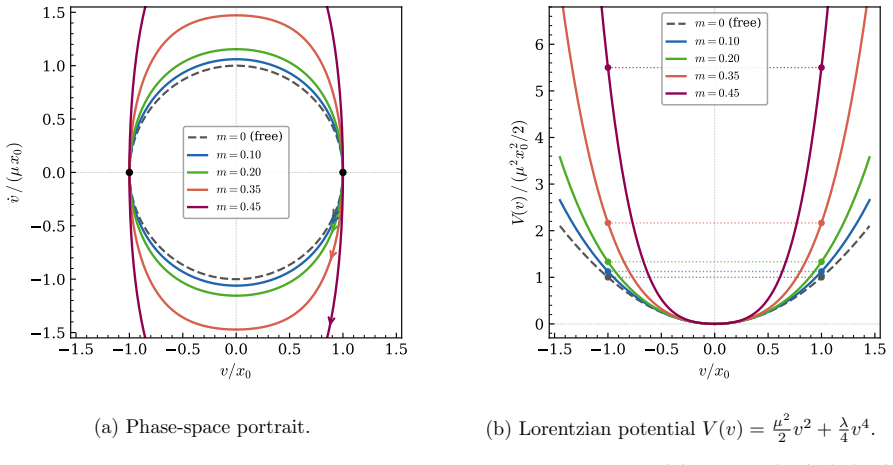
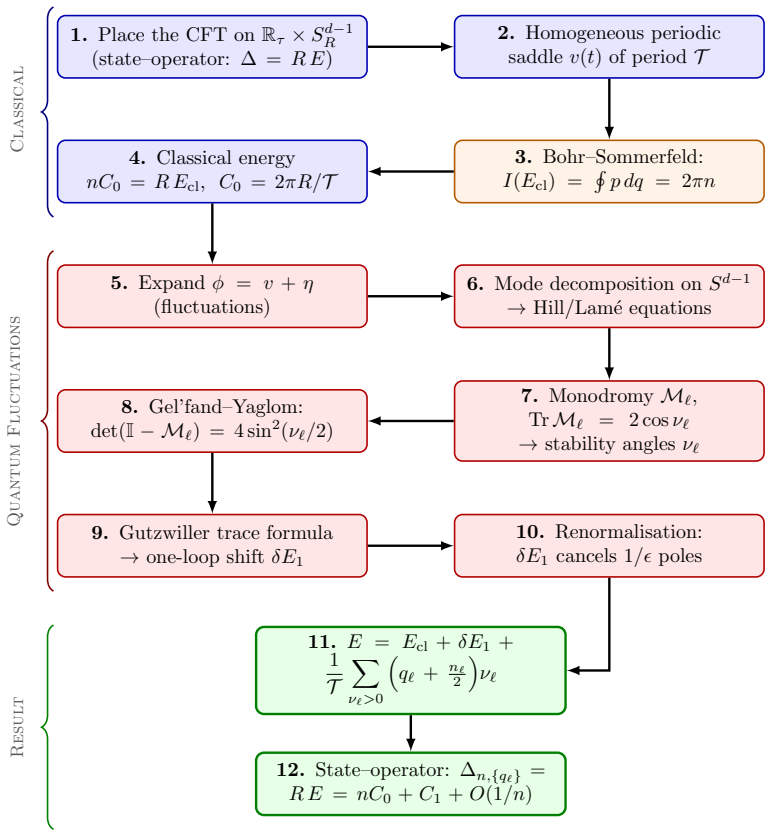
At the Wilson-Fisher fixed point of the O(N) phi^4 theory in d equals 4 minus epsilon, the leading large-n correction to the scaling dimension of phi^n is obtained from the one-loop fluctuation determinant around the classical elliptic solution on the cylinder; the fluctuation operator reduces to the Lamé equation whose eigenvalues, combined with the contribution of the two zero modes and the Gel'fand-Yaglom evaluation of the functional determinant, give the explicit shift in the energy.
What carries the argument
The classical elliptic saddle on the cylinder whose small fluctuations obey the Lamé equation, with the resulting spectrum and Gel'fand-Yaglom determinant supplying the one-loop shift to the scaling dimension.
If this is right
- The free-field result for the dimension of phi^n is reproduced exactly by three independent semiclassical routes.
- The same elliptic-saddle plus Lamé-spectrum construction yields the one-loop correction at the Wilson-Fisher fixed point.
- Composite operators serve as probes of collective sectors that can be extended to gauge theories and asymptotically safe models.
- Periodic-orbit techniques such as the Gutzwiller trace formula become available once the classical saddles are known.
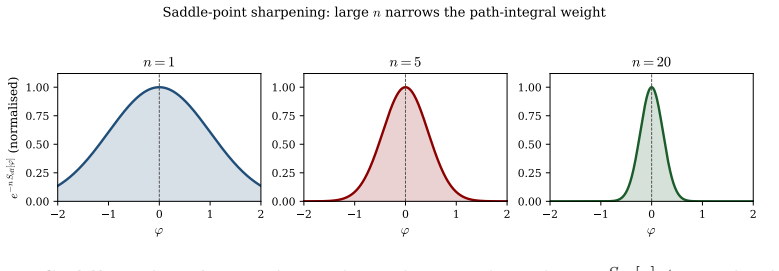
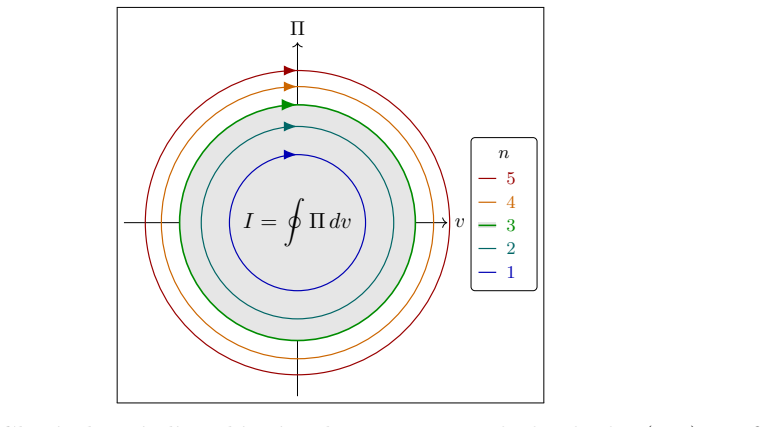
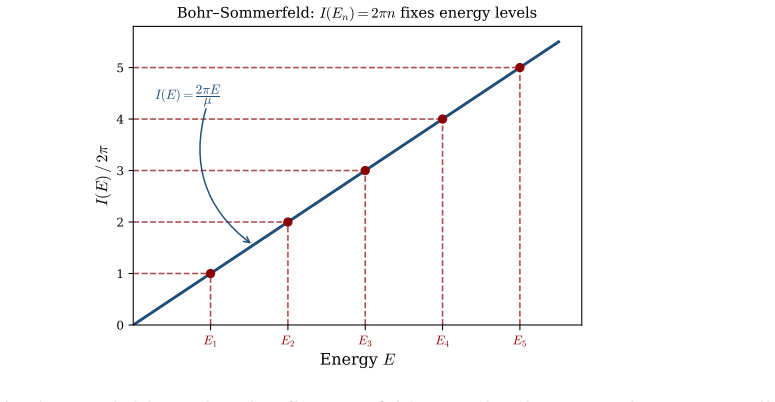
- The double-scaling limit organizes the expansion so that the classical action and the one-loop determinant are the leading terms.
Where Pith is reading between the lines
- The same saddle-plus-fluctuation logic could be tested in other fixed-point theories where a large-n or large-charge limit exists.
- Comparison of the semiclassical formula against known epsilon-expansion results at moderate n would indicate the size of higher-loop corrections.
- The method may supply non-perturbative input that can be fed into numerical bootstrap studies of operator spectra.
- Analogous constructions might apply to supersymmetric theories where some dimensions are protected and can serve as benchmarks.
Load-bearing premise
That the semiclassical approximation around the elliptic solution plus one loop of fluctuations remains valid and captures the leading large-n behavior even after the theory is deformed to the interacting fixed point.
What would settle it
A direct lattice or higher-order perturbative computation of the scaling dimension of phi^n for sufficiently large n that yields a numerical value differing from the one-loop semiclassical formula by more than the expected higher-order corrections.
Figures

read the original abstract
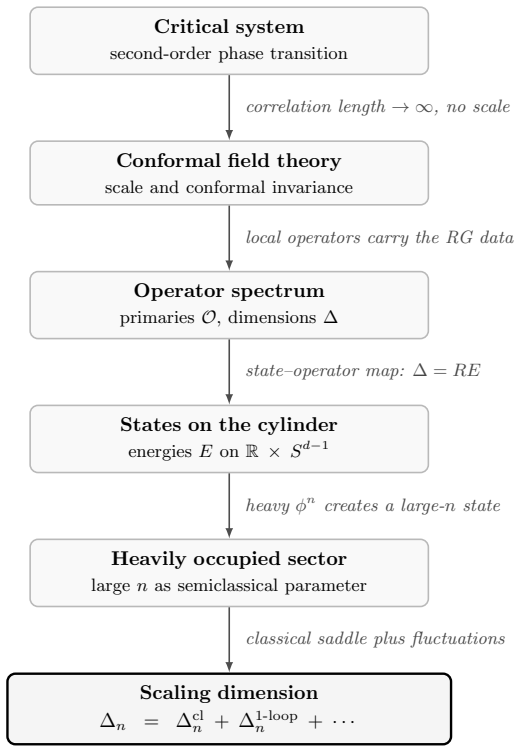
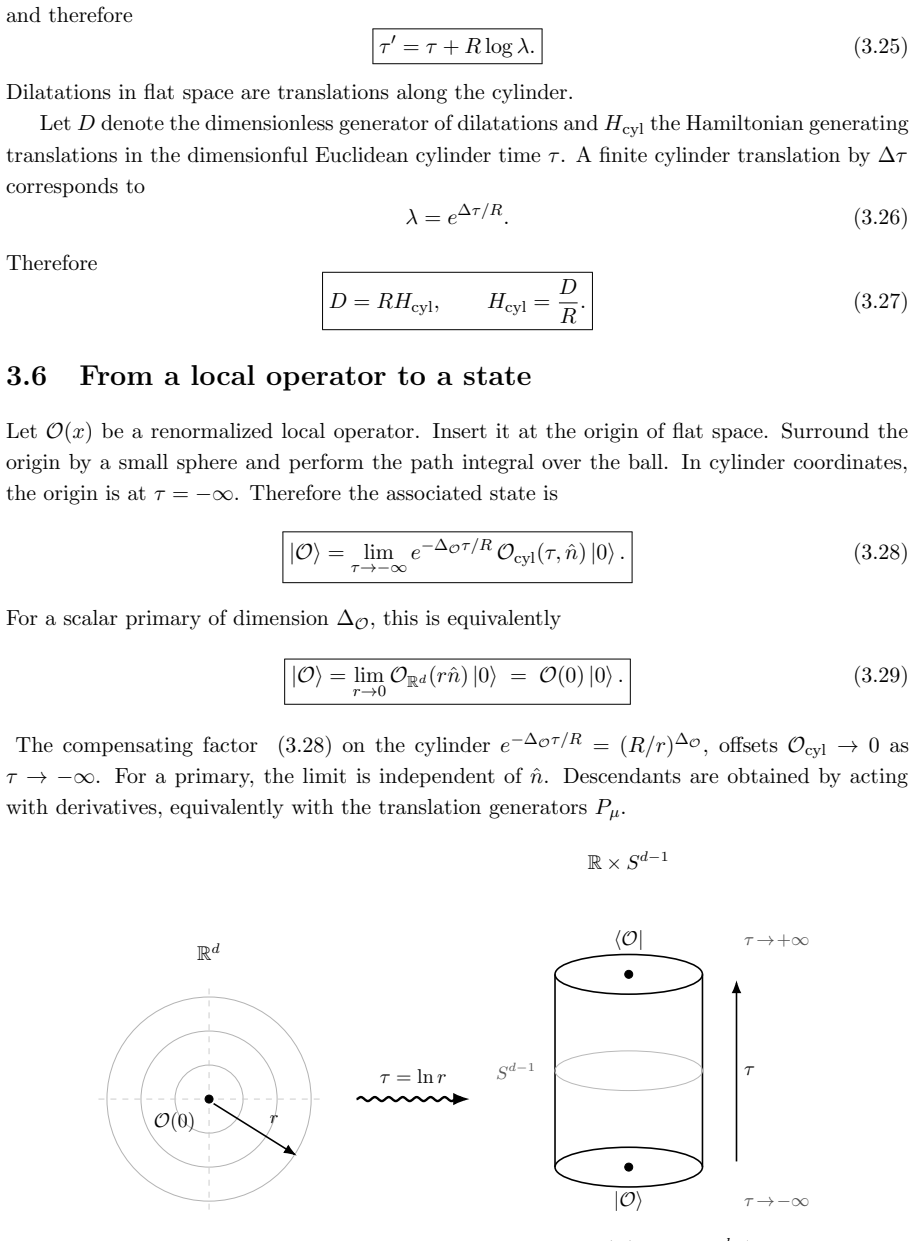
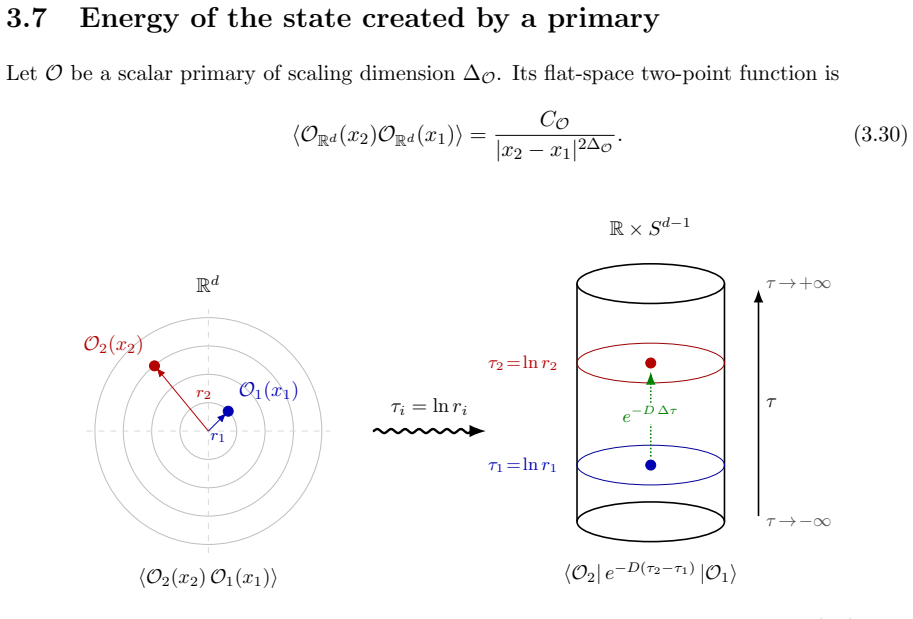
These lecture notes are intended as a coherent introduction to conformal field theory in general, and composite operators in particular, through a semiclassical framework for computing scaling dimensions, with emphasis on operators of the form $\phi^n$. In doing so, they aim to fill a gap in the literature and to help decode some of the relevant concepts. The physical idea is that at large $n$ an (heavy) operator creates a highly occupied state. Through the state-operator correspondence, this state lives on the cylinder $\mathbb{R}\times S^{d-1}$, and its scaling dimension is the corresponding energy of the theory on the cylinder. The notes are organized as a self-contained route from conformal symmetry to semiclassical dynamics. Part I reviews the conformal group, primary operators, radial quantization, the state-operator correspondence, and operator mixing. Part II builds the semiclassical framework, first in the free scalar theory, where the dimension of $\phi^n$ is recovered in three independent ways, and then through the double-scaling limit, the action variable, and Bohr-Sommerfeld quantization. Part III develops the general machinery of periodic saddles, Floquet theory, fluctuation determinants, the Gel'fand-Yaglom method, and the Gutzwiller trace formula. Part IV applies the framework to the $O(N)$ $\phi^4$ theory in $d=4-\epsilon$ at the Wilson-Fisher fixed point, deriving the classical elliptic solution, the Lam\'e fluctuation spectrum, the zero modes, and the one-loop contribution to the large-$n$ scaling dimensions. Beyond the explicit computation, the notes emphasize the role of composite operators as probes of collective sectors of quantum field theory, with extensions to gauge theories, conformal windows, and asymptotically safe field theories.
Editorial analysis
A structured set of objections, weighed in public.
Referee Report
Summary. These lecture notes develop a semiclassical framework for computing large-n scaling dimensions of composite operators φ^n in CFTs. Starting from conformal symmetry, primaries, radial quantization and the state-operator correspondence, the notes recover the free scalar theory dimension in three independent ways, introduce the double-scaling limit together with action variables and Bohr-Sommerfeld quantization, develop the general machinery of periodic saddles, Floquet theory, fluctuation determinants and the Gel'fand-Yaglom method, and apply the formalism to the O(N) φ^4 theory at the Wilson-Fisher fixed point in d=4-ε, obtaining the classical elliptic solution, the Lamé fluctuation spectrum, zero-mode handling and the one-loop correction to the scaling dimension.
Significance. If the central derivation holds, the notes supply a coherent, self-contained route from conformal symmetry to an explicit one-loop result for heavy operators at an interacting fixed point. The recovery of the free-theory result by three independent routes and the explicit construction via the Lamé spectrum plus Gel'fand-Yaglom determinants around the elliptic saddle constitute clear strengths. The framework treats composite operators as probes of collective sectors and sketches extensions to gauge theories and asymptotically safe models. The assumption that the semiclassical approximation remains valid in the double-scaling limit does not appear to introduce internal inconsistency once the free-theory checks are performed.
minor comments (3)
- [Part II] Part II: the three independent recoveries of the free-theory dimension are presented sequentially; a short comparative table or paragraph summarizing the agreement would improve readability.
- [Part III] § on the Gel'fand-Yaglom method: the treatment of the zero modes arising from translational invariance on the cylinder could be expanded by one paragraph to make the subtraction of collective coordinates fully explicit for readers new to the technique.
- [Part IV] The final expression for the one-loop correction at the Wilson-Fisher point is derived but not isolated in a single displayed equation; placing it in a boxed result would aid citation and verification.
Simulated Author's Rebuttal
We thank the referee for the positive and accurate summary of our lecture notes. The assessment correctly identifies the main strengths, including the three independent recoveries of the free-theory result and the explicit one-loop computation via the Lamé spectrum and Gel'fand-Yaglom method at the Wilson-Fisher fixed point. No specific major comments were raised in the report.
Circularity Check
No significant circularity; derivation self-contained
full rationale
The notes recover the free-theory dimension of φ^n in three independent ways before introducing the double-scaling limit or elliptic saddles. The one-loop correction at the Wilson-Fisher point is obtained from the Lamé spectrum, zero-mode handling, and Gel'fand-Yaglom determinants applied to the classical solution; these steps rely on standard Floquet theory and determinant methods rather than fitted inputs or self-citation chains. No load-bearing premise reduces to a prior result by the same authors, and the framework begins from conformal symmetry and state-operator correspondence without smuggling ansätze or renaming empirical patterns.
Axiom & Free-Parameter Ledger
axioms (2)
- domain assumption Conformal symmetry, radial quantization, and the state-operator correspondence apply to the theories under consideration.
- domain assumption The semiclassical approximation is reliable for highly occupied states created by φ^n at large n.
Reference graph
Works this paper leans on
-
[1]
Lenz,Beitrag zum verst¨ andnis der magnetischen erscheinungen in festen k¨ orpern, Physikalische Zeitschrift21(1920) 613
W. Lenz,Beitrag zum verst¨ andnis der magnetischen erscheinungen in festen k¨ orpern, Physikalische Zeitschrift21(1920) 613
1920
-
[2]
Ising,Beitrag zur theorie des ferromagnetismus,Zeitschrift f¨ ur Physik31(1925) 253
E. Ising,Beitrag zur theorie des ferromagnetismus,Zeitschrift f¨ ur Physik31(1925) 253
1925
-
[3]
Peierls,On ising’s model of ferromagnetism,Mathematical Proceedings of the Cambridge Philosophical Society32(1936) 477
R. Peierls,On ising’s model of ferromagnetism,Mathematical Proceedings of the Cambridge Philosophical Society32(1936) 477
1936
-
[4]
Kramers and G.H
H.A. Kramers and G.H. Wannier,Statistics of the two-dimensional ferromagnet. part i, Physical Review60(1941) 252
1941
-
[5]
Kramers and G.H
H.A. Kramers and G.H. Wannier,Statistics of the two-dimensional ferromagnet. part ii, Physical Review60(1941) 263
1941
-
[6]
Onsager,Crystal statistics
L. Onsager,Crystal statistics. i. a two-dimensional model with an order-disorder transition,Physical Review65(1944) 117
1944
-
[7]
P. Di Francesco, P. Mathieu and D. Senechal,Conformal Field Theory, Springer, New York (1997), 10.1007/978-1-4612-2256-9
-
[8]
Itzykson and J.-M
C. Itzykson and J.-M. Drouffe,Statistical Field Theory. Vol. 2: Strong Coupling, Monte Carlo Methods, Conformal Field Theory, and Random Systems, Cambridge University Press, Cambridge (1989)
1989
-
[9]
Ginsparg,Applied conformal field theory, inFields, Strings and Critical Phenomena, E
P. Ginsparg,Applied conformal field theory, inFields, Strings and Critical Phenomena, E. Brezin and J. Zinn-Justin, eds., vol. 49 ofLes Houches Summer School Proceedings, (Amsterdam), pp. 1–168, North-Holland (1990) [hep-th/9108028]
Pith/arXiv arXiv 1990
-
[10]
R. Blumenhagen and E. Plauschinn,Introduction to Conformal Field Theory: With Applications to String Theory, vol. 779 ofLecture Notes in Physics, Springer, Berlin, Heidelberg (2009), 10.1007/978-3-642-00450-6
-
[11]
Qualls,Lectures on Conformal Field Theory,1511.04074
J.D. Qualls,Lectures on Conformal Field Theory,1511.04074
-
[12]
M. Gillioz,Conformal field theory for particle physicists, SpringerBriefs in Physics, Springer (2023), 10.1007/978-3-031-27086-4, [2207.09474]
-
[13]
Chester,Weizmann lectures on the numerical conformal bootstrap,Phys
S.M. Chester,Weizmann lectures on the numerical conformal bootstrap,Phys. Rept. 1045(2023) 1 [1907.05147]. 159
arXiv 2023
-
[14]
D. Simmons-Duffin,The Conformal Bootstrap, inTheoretical Advanced Study Institute in Elementary Particle Physics: New Frontiers in Fields and Strings, pp. 1–74, 2017, DOI [1602.07982]
Pith/arXiv arXiv 2017
-
[15]
Sachdev,Quantum magnetism and criticality,Nature Phys.4(2008) 173 [0711.3015]
S. Sachdev,Quantum magnetism and criticality,Nature Phys.4(2008) 173 [0711.3015]
Pith/arXiv arXiv 2008
-
[16]
U. Schollwoeck,The density-matrix renormalization group in the age of matrix product states,Annals Phys.326(2011) 96 [1008.3477]
Pith/arXiv arXiv 2011
-
[17]
A. Pelissetto and E. Vicari,Critical phenomena and renormalization group theory,Phys. Rept.368(2002) 549 [cond-mat/0012164]
Pith/arXiv arXiv 2002
-
[18]
S. Hellerman, D. Orlando, S. Reffert and M. Watanabe,On the CFT Operator Spectrum at Large Global Charge,JHEP12(2015) 071 [1505.01537]
arXiv 2015
-
[19]
A. Monin, D. Pirtskhalava, R. Rattazzi and F.K. Seibold,Semiclassics, Goldstone Bosons and CFT data,JHEP06(2017) 011 [1611.02912]
Pith/arXiv arXiv 2017
-
[20]
L. ´Alvarez Gaum´ e, D. Orlando and S. Reffert,Selected Topics in the Large Quantum Number Expansion,Phys. Rept.933(2021) 1 [2008.03308]
arXiv 2021
-
[21]
Cardy,Conformal invariance and universality in finite-size scaling,J
J.L. Cardy,Conformal invariance and universality in finite-size scaling,J. Phys. A17 (1984) L385
1984
-
[22]
Simmons-Duffin,Projectors, Shadows, and Conformal Blocks,JHEP04(2014) 146 [1204.3894]
D. Simmons-Duffin,Projectors, Shadows, and Conformal Blocks,JHEP04(2014) 146 [1204.3894]
arXiv 2014
-
[23]
M. Bill` o, V. Gon¸ calves, E. Lauria and M. Meineri,Defects in conformal field theory, JHEP04(2016) 091 [1601.02883]
Pith/arXiv arXiv 2016
-
[24]
D. Karateev, P. Kravchuk and D. Simmons-Duffin,Weight Shifting Operators and Conformal Blocks,JHEP02(2018) 081 [1706.07813]
arXiv 2018
-
[25]
P. Kravchuk and D. Simmons-Duffin,Counting Conformal Correlators,JHEP02(2018) 096 [1612.08987]
Pith/arXiv arXiv 2018
-
[26]
S. Rychkov and Z.M. Tan,Theϵ-expansion from conformal field theory,J. Phys. A48 (2015) 29FT01 [1505.00963]
Pith/arXiv arXiv 2015
-
[27]
Hogervorst,RG flows onS d and Hamiltonian truncation,1811.00528
M. Hogervorst,RG flows onS d and Hamiltonian truncation,1811.00528
- [28]
-
[29]
Caron-Huot,Analyticity in Spin in Conformal Theories,JHEP09(2017) 078 [1703.00278]
S. Caron-Huot,Analyticity in Spin in Conformal Theories,JHEP09(2017) 078 [1703.00278]
Pith/arXiv arXiv 2017
-
[30]
S. Deser and A. Schwimmer,Geometric classification of conformal anomalies in arbitrary dimensions,Phys. Lett. B309(1993) 279 [hep-th/9302047]
Pith/arXiv arXiv 1993
-
[31]
M. Van Raamsdonk,Lectures on gravity and entanglement., inTheoretical Advanced Study Institute in Elementary Particle Physics: New Frontiers in Fields and Strings, pp. 297–351, 2017, DOI [1609.00026]. 160
Pith/arXiv arXiv 2017
-
[32]
Gaiotto,Boundary F-maximization,1403.8052
D. Gaiotto,Boundary F-maximization,1403.8052
-
[33]
Hogervorst,Dimensional Reduction for Conformal Blocks,JHEP09(2016) 017 [1604.08913]
M. Hogervorst,Dimensional Reduction for Conformal Blocks,JHEP09(2016) 017 [1604.08913]
Pith/arXiv arXiv 2016
- [34]
-
[35]
W. Zhu, C. Han, E. Huffman, J.S. Hofmann and Y.-C. He,Uncovering Conformal Symmetry in the 3D Ising Transition: State-Operator Correspondence from a Quantum Fuzzy Sphere Regularization,Phys. Rev. X13(2023) 021009 [2210.13482]
arXiv 2023
-
[36]
W. Guo, Z. Zhou, T.-C. Wei and Y.-C. He,TheO(N)Free-Scalar and Wilson-Fisher Conformal Field Theories on the Fuzzy Sphere,2512.02234
-
[37]
R.C. Brower, G.T. Fleming and H. Neuberger,Radial Quantization for Conformal Field Theories on the Lattice,PoSLATTICE2012(2012) 061 [1212.1757]
Pith/arXiv arXiv 2012
-
[38]
R.C. Brower, M. Cheng and G.T. Fleming,Improved Lattice Radial Quantization,PoS LATTICE2013(2014) 335 [1407.7597]
Pith/arXiv arXiv 2014
-
[39]
R.C. Brower, G.T. Fleming, A.D. Gasbarro, D. Howarth, T.G. Raben, C.-I. Tan et al., Radial lattice quantization of 3Dϕ4 field theory,Phys. Rev. D104(2021) 094502 [2006.15636]
arXiv 2021
-
[40]
V. Ayyar, R.C. Brower, G.T. Fleming, A.-M.E. Gl¨ uck, E.K. Owen, T.G. Raben et al., Operator product expansion for radial lattice quantization of 3Dϕ4 theory,Phys. Rev. D 109(2024) 114518 [2311.01100]
arXiv 2024
-
[41]
M. Hasenbusch,Finite size scaling study of lattice models in the three-dimensional Ising universality class,Phys. Rev. B82(2010) 174433 [1004.4486]
Pith/arXiv arXiv 2010
-
[42]
S. Giombi and V. Kirilin,Anomalous dimensions in CFT with weakly broken higher spin symmetry,JHEP11(2016) 068 [1601.01310]
Pith/arXiv arXiv 2016
-
[43]
K. Nii,Classical equation of motion and Anomalous dimensions at leading order,JHEP 07(2016) 107 [1605.08868]
Pith/arXiv arXiv 2016
-
[44]
S. Giombi, V. Gurucharan, V. Kirilin, S. Prakash and E. Skvortsov,On the Higher-Spin Spectrum in Large N Chern-Simons Vector Models,JHEP01(2017) 058 [1610.08472]
Pith/arXiv arXiv 2017
-
[45]
A. Codello, M. Safari, G.P. Vacca and O. Zanusso,Leading CFT constraints on multi-critical models in d>2,JHEP04(2017) 127 [1703.04830]
Pith/arXiv arXiv 2017
-
[46]
A. Kaviraj, K. Sen and A. Sinha,Analytic bootstrap at large spin,JHEP11(2015) 083 [1502.01437]
Pith/arXiv arXiv 2015
-
[47]
Goldberg,Breakdown of perturbation theory at tree level in theories with scalars, Phys
H. Goldberg,Breakdown of perturbation theory at tree level in theories with scalars, Phys. Lett. B246(1990) 445
1990
-
[48]
Wilson and M.E
K.G. Wilson and M.E. Fisher,Critical exponents in 3.99 dimensions,Phys. Rev. Lett. 28(1972) 240. 161
1972
-
[49]
Henriksson,The critical O(N) CFT: Methods and conformal data,Phys
J. Henriksson,The critical O(N) CFT: Methods and conformal data,Phys. Rept.1002 (2023) 1 [2201.09520]
arXiv 2023
-
[50]
S. Albayrak, D. Meltzer and D. Poland,More Analytic Bootstrap: Nonperturbative Effects and Fermions,JHEP08(2019) 040 [1904.00032]
arXiv 2019
-
[51]
J. Henriksson and M. Van Loon,Critical O(N) model to orderϵ 4 from analytic bootstrap, J. Phys. A52(2019) 025401 [1801.03512]
Pith/arXiv arXiv 2019
-
[52]
J. Henriksson, F. Herzog, S.R. Kousvos and J. Roosmale Nepveu,Multiloop spectra in general scalar EFTs and CFTs,Phys. Lett. B874(2026) 140235 [2507.12518]
arXiv 2026
-
[53]
J. Henriksson, S.R. Kousvos and J. Roosmale Nepveu,EFT meets CFT: multiloop renormalization of higher-dimensional operators in generalϕ 4 theories,JHEP05(2026) 005 [2511.16740]
arXiv 2026
-
[54]
Schnetz,ϕ4 theory at seven loops,Phys
O. Schnetz,ϕ4 theory at seven loops,Phys. Rev. D107(2023) 036002 [2212.03663]
arXiv 2023
-
[55]
M.V. Kompaniets and E. Panzer,Minimally subtracted six loop renormalization of O(n)-symmetricϕ 4 theory and critical exponents,Phys. Rev. D96(2017) 036016 [1705.06483]
Pith/arXiv arXiv 2017
-
[56]
C. Brust and K. Hinterbichler,Free□ k scalar conformal field theory,JHEP02(2017) 066 [1607.07439]
Pith/arXiv arXiv 2017
-
[57]
S. Giombi, I.R. Klebanov and G. Tarnopolsky,Bosonic tensor models at largeNand smallϵ,Phys. Rev. D96(2017) 106014 [1707.03866]
Pith/arXiv arXiv 2017
-
[58]
G. Cuomo, L. Rastelli and A. Sharon,Moduli spaces in CFT: large charge operators, JHEP09(2024) 185 [2406.19441]
Pith/arXiv arXiv 2024
-
[59]
V. Gorbenko, S. Rychkov and B. Zan,Walking, Weak first-order transitions, and Complex CFTs II. Two-dimensional Potts model atQ >4,SciPost Phys.5(2018) 050 [1808.04380]
Pith/arXiv arXiv 2018
-
[60]
Gurau,Notes on tensor models and tensor field theories,Ann
R.G. Gurau,Notes on tensor models and tensor field theories,Ann. Inst. H. Poincare D Comb. Phys. Interact.9(2022) 159 [1907.03531]
Pith/arXiv arXiv 2022
-
[61]
I.R. Klebanov and G. Tarnopolsky,Uncolored random tensors, melon diagrams, and the Sachdev-Ye-Kitaev models,Phys. Rev. D95(2017) 046004 [1611.08915]
Pith/arXiv arXiv 2017
-
[62]
D. Benedetti, R. Gurau, S. Harribey and D. Lettera,The F-theorem in the melonic limit,JHEP02(2022) 147 [2111.11792]
arXiv 2022
-
[63]
S. El-Showk, M.F. Paulos, D. Poland, S. Rychkov, D. Simmons-Duffin and A. Vichi, Solving the 3d Ising Model with the Conformal Bootstrap II. c-Minimization and Precise Critical Exponents,J. Stat. Phys.157(2014) 869 [1403.4545]
Pith/arXiv arXiv 2014
-
[64]
P. Liendo, L. Rastelli and B.C. van Rees,The Bootstrap Program for Boundary CFT d, JHEP07(2013) 113 [1210.4258]. 162
Pith/arXiv arXiv 2013
-
[65]
F. Kos, D. Poland, D. Simmons-Duffin and A. Vichi,Bootstrapping the O(N) Archipelago,JHEP11(2015) 106 [1504.07997]
Pith/arXiv arXiv 2015
-
[66]
S. El-Showk, M. Paulos, D. Poland, S. Rychkov, D. Simmons-Duffin and A. Vichi, Conformal Field Theories in Fractional Dimensions,Phys. Rev. Lett.112(2014) 141601 [1309.5089]
Pith/arXiv arXiv 2014
-
[67]
D. Simmons-Duffin,A Semidefinite Program Solver for the Conformal Bootstrap,JHEP 06(2015) 174 [1502.02033]
Pith/arXiv arXiv 2015
-
[68]
J. Rong and N. Su,Bootstrapping the minimalN= 1 superconformal field theory in three dimensions,JHEP06(2021) 154 [1807.04434]
Pith/arXiv arXiv 2021
-
[69]
S.M. Chester and S.S. Pufu,Towards bootstrapping QED 3,JHEP08(2016) 019 [1601.03476]
Pith/arXiv arXiv 2016
-
[70]
F. Kos, D. Poland and D. Simmons-Duffin,Bootstrapping theO(N)vector models, JHEP06(2014) 091 [1307.6856]
Pith/arXiv arXiv 2014
-
[71]
Gutzwiller,Periodic orbits and classical quantization conditions,J
M.C. Gutzwiller,Periodic orbits and classical quantization conditions,J. Math. Phys.12 (1971) 343
1971
-
[72]
L. Alvarez-Gaume, O. Loukas, D. Orlando and S. Reffert,Compensating strong coupling with large charge,JHEP04(2017) 059 [1610.04495]
Pith/arXiv arXiv 2017
-
[73]
Loukas,Abelian scalar theory at large global charge,Fortsch
O. Loukas,Abelian scalar theory at large global charge,Fortsch. Phys.65(2017) 1700028 [1612.08985]
Pith/arXiv arXiv 2017
-
[74]
O. Loukas, D. Orlando and S. Reffert,Matrix models at large charge,JHEP10(2017) 085 [1707.00710]
Pith/arXiv arXiv 2017
-
[75]
S. Hellerman and S. Maeda,On the LargeR-charge Expansion inN= 2Superconformal Field Theories,JHEP12(2017) 135 [1710.07336]
Pith/arXiv arXiv 2017
- [76]
-
[77]
Dunne,Functional determinants in quantum field theory,J
G.V. Dunne,Functional determinants in quantum field theory,J. Phys. A41(2008) 304006 [0711.1178]
Pith/arXiv arXiv 2008
-
[78]
Dashen, B
R.F. Dashen, B. Hasslacher and A. Neveu,Nonperturbative Methods and Extended Hadron Models in Field Theory 1. Semiclassical Functional Methods,Phys. Rev. D10 (1974) 4114
1974
-
[79]
D. Simmons-Duffin,The Lightcone Bootstrap and the Spectrum of the 3d Ising CFT, JHEP03(2017) 086 [1612.08471]
Pith/arXiv arXiv 2017
-
[80]
R. Rattazzi, V.S. Rychkov, E. Tonni and A. Vichi,Bounding scalar operator dimensions in 4D CFT,JHEP12(2008) 031 [0807.0004]
Pith/arXiv arXiv 2008
discussion (0)
Sign in with ORCID, Apple, or X to comment. Anyone can read and Pith papers without signing in.